Rabbi Yoseph Chaim of Baghdad, the 19th-century author of the acclaimed Ben Ish Chai, received an unusual query:
Someone has a mother named Mazal Tov. It is the custom of the city that whenever a woman gives birth to a daughter, each of her dear ones and relatives who comes in to see her says to the new mother, “Mazal Tov,” exactly these two words and nothing more. … The questioner asked about this woman named Mazal Tov who gave birth to a daughter: may her sons say “Mazal Tov” to her when they come in to see her, as is customary? Or, since that is their mother’s name, is it forbidden, because it would be as if they were calling her by her name?
The children want to wish their mother a congratulatory “mazal tov,” but it may seem disrespectful because their mother’s name is Mazal Tov! (Rabbi Yoseph Chaim permitted it because the children clearly intend to congratulate their mother.)
This responsum contains an important halakhic ruling, but it also offers a glimpse of a social reality: the phrase “mazal tov” is ubiquitous. It functions as a wish, a congratulation, and even a name.
Mazal tov is as Jewish as chicken soup, and it can be traced back to Parshat Vayetze, when Leah names a son Gad. But the history of the phrase is fraught with controversy.
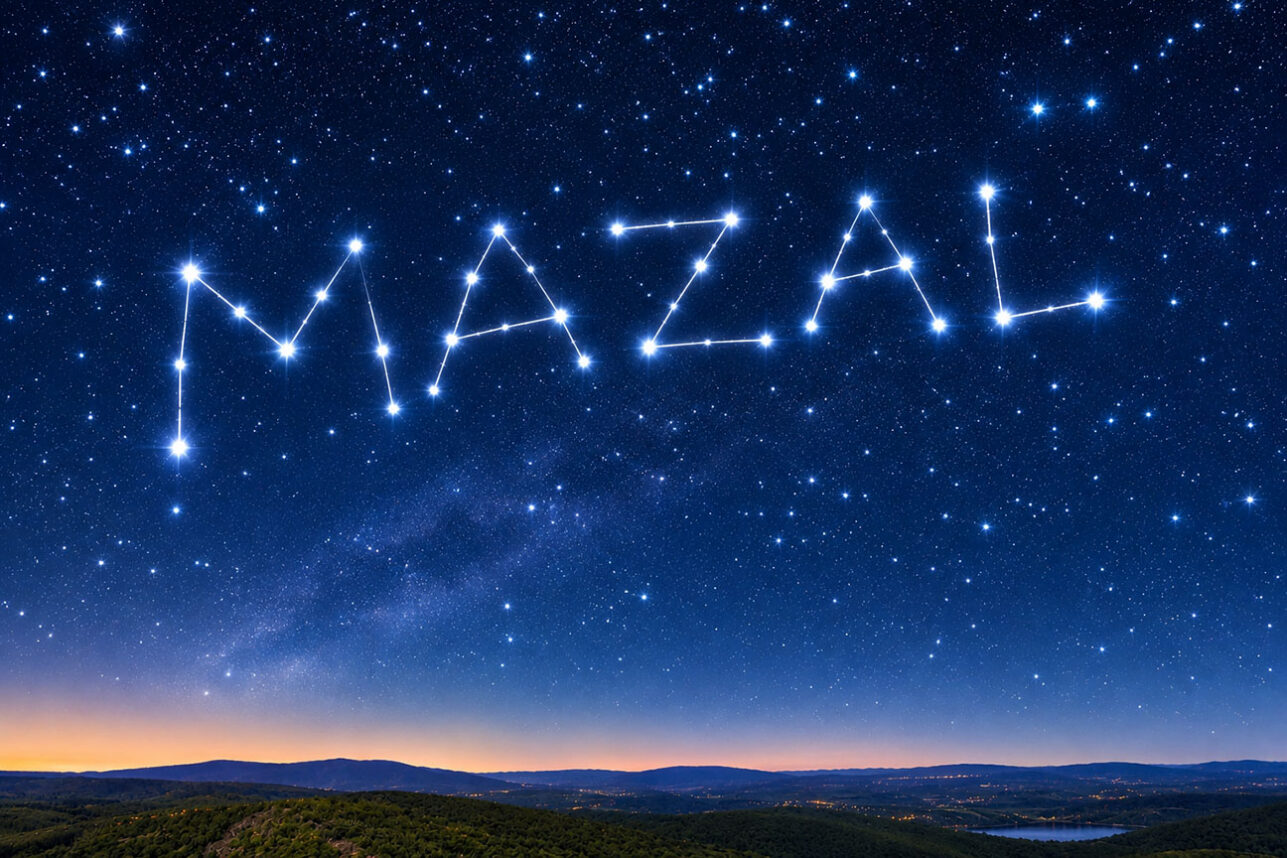
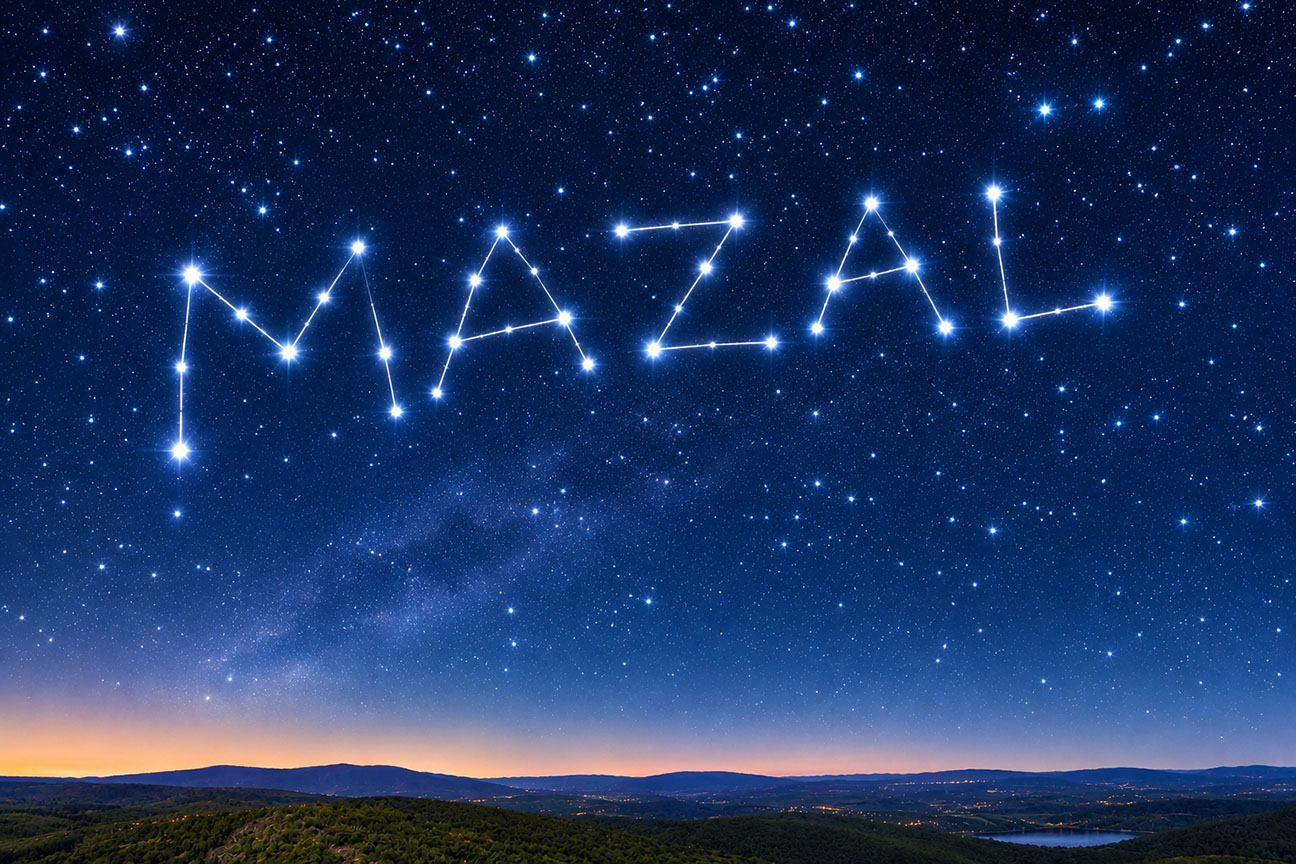
The word mazal means constellation. The Tanakh mentions it once, describing how King Josiah eradicated the idolatrous priests who “burned incense to Baal, to the sun and moon, to the constellations and to all the starry hosts.” Certainly not a promising first reference.
In the Talmud, mazal refers to astrological influence: how the constellations shape human life. The Talmud debates whether one’s horoscope determines one’s fate:
It was stated: Rabbi Hanina says: The constellation (mazal) under which one is born makes one wise, the constellation makes one wealthy, and Israel is subject to the constellations (mazal). Rabbi Yohanan said: Israel is not subject to the constellations (mazal).
The debate on astrology continues into the Middle Ages. Maimonides is an uncompromising critic of astrology. He attacks it as incompatible with free will. For Maimonides, free will is a fundamental Jewish belief; the commandments are meaningless if one is powerless to choose whether to perform them. But if astrology were true, the stars would already have decided one’s destiny, including whether one would be righteous or wicked.
Maimonides holds astrology responsible for the rise of paganism and blames it for the destruction of the Second Temple. But for Maimonides the rationalist, the greatest indictment of astrology was that it was foolish:
Thus, you ought to know that fools have composed thousands of books of nothingness and emptiness. Any number of men, great in years but not in wisdom, wasted all their days in studying these books and imagined that these follies are science. They came to think of themselves as wise men because they knew that science.
Maimonides dismisses as minority views the Talmudic opinions that accept astrology. He certainly wouldn’t have wished anyone mazal tov.
Influential as he is, Maimonides is far from the last word on the topic.
Astrology also had many defenders among the rabbis. Rabbi Moses Isserles sought a middle path. He is clearly uncomfortable with astrology but will not deny its efficacy, ruling that “If a person knows that something goes against his horoscope (mazal), he should not do it and should not rely on a miracle. However, one should not investigate this, because of ‘You shall be wholehearted with the Lord your God’ (Deuteronomy 18:13).”
The meaning of the word mazal shifted in the medieval era, coming to mean luck; “mazal tov” thus means “good luck.” Leah names one of Jacob’s sons Gad; she exclaims, “gad has arrived!” In what may be the earliest use of the phrase “mazal tov,” Rashi interprets the word gad as meaning “good luck (mazal tov) has arrived.”
Luck fits free will better than astrology does: luck doesn’t determine your actions, only your circumstances. Yet this too runs counter to another important Jewish belief: divine providence. In his argument against astrology, the Meiri explains that God ultimately determines our fate, and no matter what the stars might say, God will protect those who follow in His path.
The idea that one can be lucky challenges divine providence directly. If there is luck, God no longer determines our fate; what happens to both the righteous and the wicked may well be random.
Remarkably, there are multiple rabbinic statements that seem to accept the randomness of life. One of the most dramatic appears in Moed Katan 28a:
Rava said: Life, children and financial sustenance do not depend on merit; rather, they depend on the horoscope (mazal). For Rabbah and Rav Chisda were both righteous sages. One master would pray and rain would come, and the other master would pray and rain would come. Yet Rav Chisda lived ninety-two years, while Rabbah lived only forty. In Rav Chisda’s house there were sixty wedding feasts; in Rabbah’s house there were sixty bereavements. In Rav Chisda’s house there was fine flour bread for the dogs, and it went unwanted; in Rabbah’s house there was not even barley bread for the people.
Rabbah and Rav Chisda are equally righteous. Yet one lives a life of misery, the other a life of joy. Their example shows how random life can be. As the Zohar remarks, “Everything requires luck, even a Torah scroll in the ark.”
Commentators struggle with this text, which seems to negate divine providence. Tosafot and the Maharsha argue that although luck is a critical factor, one’s merits can change one’s mazal.
And that is what prayer is for: to ask for better luck.
This may be why wishing mazal tov has become a Jewish obsession. The phrase originally described what had already happened, as in Leah’s declaration that Gad’s birth was good fortune. Today we use it as a blessing. Mazal tov first became a common blessing at weddings in the 1200s, and it remains one today.
We may say it after the breaking of the glass because of a teaching by Rabbi Menachem Recanati. Breaking the glass under the chuppah, he explains, clears away whatever bad luck the couple was fated to have. The crowd then shouts mazal tov, praying that the couple will only have good luck for the rest of their lives.
Mazal tov is our way of wrestling with randomness. We refuse to leave fate alone. Instead, we pray for better luck than fate originally dealt us.
Praying for better luck is only half of the story. The Jewish obsession with mazal tov teaches us one more lesson about life: to always recognize good fortune, no matter the circumstances. We pray for the luck we lack, and we give thanks for the luck we have.
Leah exemplifies this. Her life was hard. She was an unwanted wife, pushed into her marriage by her scheming father. Her husband, Jacob, ignored her and focused his love on her sister Rachel. Leah’s heart was broken over and over again.
Leah had borne four sons in rapid succession; then she stopped conceiving. She decides to give her maidservant Zilpah to Jacob as a surrogate.
Zilpah bears two sons, whom Leah names Gad and Asher.
These two names are unique: both refer to luck. Gad, as we saw, means good fortune. Asher means fortunate or happy.
All the other names that Leah and Rachel give their children refer to God’s blessings or to the sisters’ struggles, whether with their husband or with each other. These two mention neither God nor the rivalry; they speak only of luck. Rabbi Moshe Alshich explains that at this moment Leah understood that these new children were not a reward for her merit. He writes:
Leah saw that she had borne four sons, and that now even her maidservant had begun to bear children, while Rachel remained barren. So she concluded that this could only be because, as the Sages say, “it does not depend on merit, but on mazal.” That is why she said, “Good fortune has come!”
Leah will have six sons of her own, but she recognizes that having two more via Zilpah is pure luck. And that luck needs to be appreciated as well.
Despite her heartbreak, Leah recognized that she was still lucky; she took pride in the children she had brought into the world. She understood that this was truly a matter of chance. Things in her life could have turned out very differently.
Leah felt lucky even though she knew she was quite unlucky too.
We often make two mistakes about luck. The first is that when we are fortunate, we imagine it is purely the result of our character and abilities. We forget that much of who we are begins with parents, teachers, and mentors, and that many of our greatest successes come from lucky breaks.
Some people are born on third base and think they hit a triple. They look down on others who have less. They don’t realize that but for a stroke of luck, they might have had far less success.
The second mistake is to overlook good luck when so much is going wrong. This is the mistake Leah refused to make.
Lou Gehrig was 36 when he made his farewell speech at Yankee Stadium in 1939. He had played in 2,130 consecutive games. Earlier that season, realizing his body was failing, he had benched himself. Soon after, he was diagnosed with ALS, the disease that would take his life two years later.
Gehrig’s speech is remembered above all for these words:
Fans, for the past two weeks you have been reading about the bad break I got. Yet today I consider myself the luckiest man on the face of the earth.
In these words, we hear an echo of Leah naming Gad: Gehrig faced great heartbreak, yet it did not make him forget his good fortune.
Leah had much to complain about; but instead, she saw herself as the luckiest woman in the world.
She understood that mazal tov is not just a wish, it is a way of live.
Rabbi Chaim Steinmetz is the Senior Rabbi of Congregation Kehilath Jeshurun in New York.