When Pavel Vogler left Krakow for Southern California in 1992, he brought almost 100 of his favorite paintings. The darkly shaded oil works in blue, black and purple show Vogler’s vision of his hometown and its medieval Jewish quarter, Kazimierz, filled with empty synagogues. Moonlight, twilight and the glow of streetlamps illuminate Vogler’s Polish works, where ghosts of a Jewish history haunt cobblestone streets.
Vogler’s first solo exhibit in the United States, now on view at A Shenere Velt Gallery, displays a range of the artist’s styles and settings. In “Past and Present from Poland to Pico: Memories and Paintings,” Vogler displays four series of work, created in Poland and his new home in West Covina. The paintings include “Shadows,” the last painting Vogler completed in Krakow, and “The Sign” (left) a brightly colored, swirling print of a man holding a Torah, the first of Vogler’s California works and a striking contrast to the dark Polish images.
The breadth of the artist’s talent is evident in the series titled “Family and Friends,” six portraits ranging from the agitated study in motion of “My Father” to the serene “La Paloma.” Unlike much of his work, many of the portrait subjects are not Jewish. “I just love working with people,” Vogler says.
Though the 38-year-old Vogler has exhibited his paintings widely in Europe, he is best known in America for his film work. Vogler’s films include “Three Stories,” based on the life of his father, Henryk, a well-known Polish author who was among the few Jews to return to Krakow after years in WWII concentration camps. Vogler is currently developing another film, “Moloch,” based on one of his father’s novels.
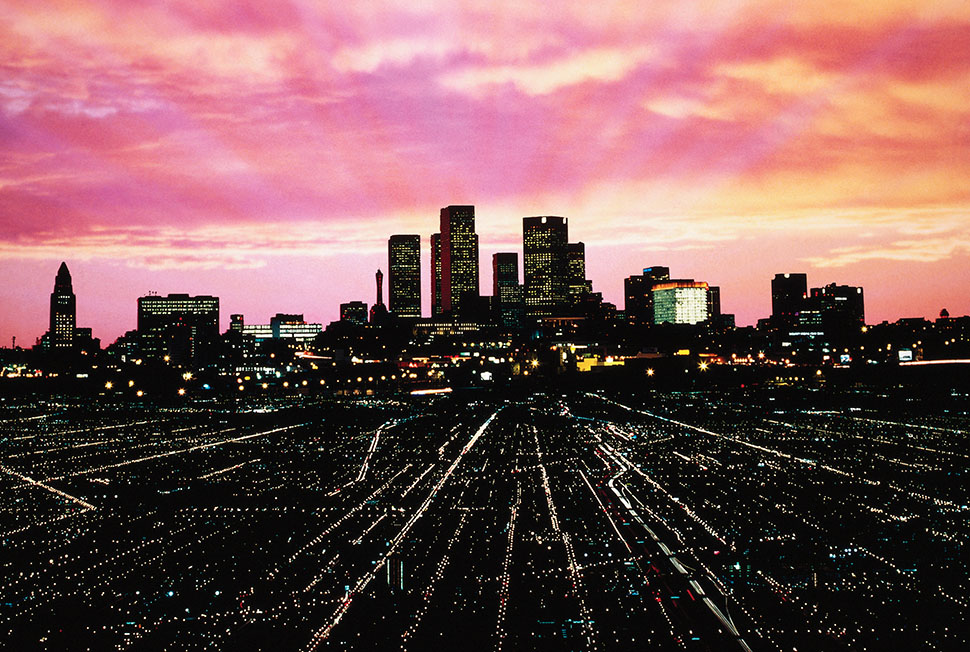
The artist hopes that this exhibit will lead to an opportunity for large-scale projects. “I’d love to do a series on Los Angeles,” he says, “a whole exhibition on how Jewish cultures are crisscrossing and thriving here.”
Through Aug. 31. A Shenere Velt Gallery, 1525 Robertson Blvd., Los Angeles. For more information, call (310) 552-2007 or visit www.fluxfire.com/pv.n