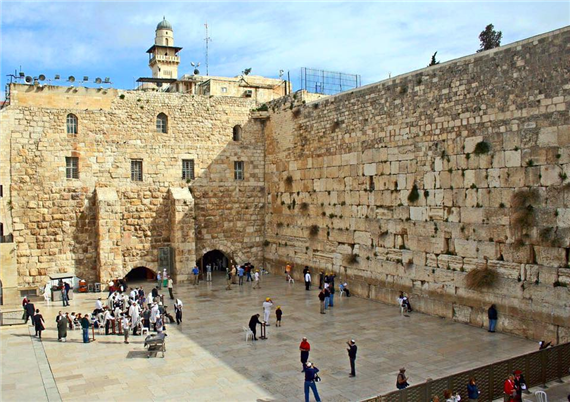
Give President Donald Trump credit for doing the right thing. Give him credit for once using his blunt-mannered approach to do something good. Give him credit for stating the obvious: Jerusalem is Israel’s capital.
Nothing can change this, nothing is supposed to change this. Recognizing Jerusalem as Israel’s capital does not infringe on anyone’s rights, it does not preclude a settlement over Jerusalem in the future, it does not mean that the Palestinians can’t have a claim for parts of Jerusalem. It is correcting a wrong — the wrong notion that Israel should be the only country in the world deprived of the right to establish a capital where it wants it to be.
I know, for some people, giving Trump credit for anything is painful. These people will come up with a pile of excuses as to why the recognition of Jerusalem is wrong, or why it was done at the wrong time, or why it was done in the wrong way, or by the wrong person.
For some people, giving Trump credit for anything is painful.
They would want a Barack Obama or a Hillary Clinton to be the one. They would want a peace deal to be the occasion. They would want Palestinians to accept it, to give their blessing before it is done. They would want it done only under very specific terms that currently seem remote, almost unreachable.
I can easily come up with a similar list and explain why and how such things should be done. But it’s a futile exercise: First, because Trump already made his decision — The New York Times reported that the president told Israeli and Arab leaders of it on Dec. 5, before a planned announcement the following day. Second, because for many of these people, no time would be the right time, and no person would be the right person.
Recognition is important, a moment to celebrate, but we ought to remember that Jerusalem will not change as a result of it. It is still a very poor city. It is unappealing to most Israelis — being too religious, too gloomy, too dirty.
And Jerusalem’s demographic reality is also something to consider. About a third of its residents are Arab. They could potentially elect an Arab mayor and have great impact on Jerusalem’s future. Only they choose to live in denial and pretend that Jerusalem is not Israel’s to keep.
Maybe Israel will not keep all of it forever. As is well documented, previous Israeli prime ministers agreed to compromise in Jerusalem. They agreed to let the Palestinians have their capital in parts of the city. They will have their Jerusalem; Israel will have its Jerusalem. Trump will have an opportunity to twice recognize a capital called Jerusalem.
But truthfully, it is not very likely that he will have such opportunity. The Arab world, predictably, responded to Trump’s decision in its habitual way: rejection, anger, threats, the usual mix of bombast and self-pity that characterizes many of its interactions with all things Israel.
That anger will subside and recognition will be a new reality. It is hard to envision a future American president taking recognition back, or moving an embassy back to Tel Aviv. Not even the Democratic legislators who currently criticize the President’s decision — wrong time, wrong way, wrong person — will take it back. Maybe in a few days, some of them will even come to their senses and agree that cutting this Gordian knot had to be done by a sword.
The Palestinians, if or when their anger subsides, will ask for compensation. They will expect compensation. They will tell their American counterparts that their peace plan must reflect the fact that Israel already got its reward from the administration, and that now it is time for Israel to pay a price for U.S. recognition. Who knows — maybe that’s the plan. Maybe all Trump is doing now is meant to buy credit and goodwill before serving the bitter pill of a controversial peace plan.
But until this happens, give the president the credit he deserves. Give him credit for being a man of his word on this issue. Give him credit for ignoring the threats of the Turks, the French and the Jordanians.
Give him credit for understanding that some bandages should be removed without much hesitation of negotiation or fear of temporary pain. And give him credit for being one of a few number of foreign leaders who throughout history recognized the connection of Jews to Jerusalem.
Shmuel Rosner is senior political editor. For more analysis of Israeli and international politics, visit Rosner’s Domain at jewishjournal.com/rosnersdomain.