fbpx

December 6, 2017

Make L’chaim, Not War

I was startled awake from my Shabbat afternoon nap by the sounds of sirens and shouting coming from the Jerusalem street outside the apartment my wife and I were renting for a few weeks during the summer of 2015. Was it a terror attack? An accident?

Any kind of commotion is a magnet for me. I have spent most of my life walking into potentially volatile situations to see how I can help, both in my countermissionary and Jewish outreach work, and in my work as a police chaplain and a reserve law-enforcement officer.

I rushed down six flights of stairs and up the hill to the nearby intersection. Immediately, I saw that this was no terror situation. On one side of Rechov Neviim, just across the street from the Bikur Cholim Hospital, about 150 bearded men dressed in all manner of black coats and hats swayed, chanting one word in a trancelike state.
“Shabbos! Shabbos! Shabbos!” they screamed.

Across the street, about 70 young secular Israelis, dressed in shorts and tank tops, brandished signs and chanted slogans protesting the infringement on their rights to use public transportation, shop or eat in restaurants on Saturdays.

It turned out, the protestors were regulars, fighting over how Shabbat would be observed in the public spaces of Israel — a battle that ratcheted up again recently when the Supreme Court ruled that Tel Aviv grocery stores could open on Shabbat.

In 1947, David Ben-Gurion came to an agreement with Orthodox rabbis that stipulated that public transportation would be closed on Shabbat, and municipalities could legislate which businesses could open. In Jerusalem, nearly all businesses are closed on Shabbat, and there are frequent and loud demonstrations over the status quo.

Since I founded Jews for Judaism 32 years ago, to counter deceptive proselytizing efforts targeting Jews, I have learned that what pulls people into cults is the warmth, love and community they offer. And what pulls people back to Judaism is the warmth, love and community we can offer. Coercion, manipulation and protests don’t move any minds or spirits.

So that Shabbat afternoon, I approached the Charedi side of the protest.

“Gut Shabbos,” I said to them, speaking in Hebrew and Yiddish. “Instead of chanting, ‘Shabbos,’ why don’t you say ‘Gut Shabbos,’ or ‘Shabbat Shalom?’ Show the chilonim [secular Israelis] what is beautiful about Shabbos.”

As if I didn’t exist, this extremist fringe of the Charedi community continued their mantra.

So I walked over to the secular side.

“Shabbat Shalom!” I screamed above the din. “Anyone who wants to see what Shabbat is really about please follow me to my apartment, a half a block away, for some good food and conversation. We’ll enjoy Shabbat, instead of standing here fighting about it.”

A few minutes later, I began to walk down the hill to my apartment. I turned around, and to my surprise about a dozen young secular Israelis were following me.

“Dvora,” I announced to my wife as we walked in, “we’re going to need a few more chairs, and all the food we have.”

I have spent most of my life walking into potentially volatile situations to see how I can help.

Dvora was unfazed, since we have hosted hundreds of people at our Shabbat table over the years, from Jewish Hari Krishnas to Jews of all ages eager to learn about their heritage. We pulled out pita, hummus, Moroccan fish, salads, drinks, chocolate rugelach — whatever we had. I also brought out a few bottles of good scotch.

The conversation flowed, as did the l’chaims. I shared some of my crazy stories about the people I’ve encountered and helped — religious and nonreligious, Jews and non-Jews. I wanted them to see that Judaism is about loving every Jew, and indeed, every human being.

A few hours later, long after the demonstration on the street had dispersed, we walked our guests out. They thanked us, saying they now had a new impression of Orthodox Jews and of Shabbat.

When I see the violent protests going on in Israel today, most recently related to Charedim being drafted into the military and protests over train construction on Shabbat, I know that anger and force won’t turn hearts and minds. And while these complicated issues won’t be solved over a spontaneous l’chaim, either, I know — given the mission of Judaism to make other lives safe, better and more meaningful — that it’s a step in the right direction.


Rabbi Bentzion Kravitz resides in Los Angeles and is the founder of Jews for Judaism.

Make L’chaim, Not War Read More »

Sex Scandals: What No One is Talking About

Nothing I’m about to say is in any way a defense of the men who commit acts of sexual harassment at work or elsewhere. They’re swine and deserve to be publicly shamed, fired from their jobs, abandoned by their wives, sent to the poorhouse by their victims. So, in fact, do the bosses and corporations that turned a blind eye to these men’s actions for decades, before suddenly catching ethicality and making a public show of firing them.

But there’s an elephant in this room people are afraid to acknowledge these days, and it’s this: There are victims, yes, and then there are willing victims.

There’s a difference between women (and men) who, for physical, emotional or economic reasons, have no choice but to submit to harassment, and those who willingly walk into their bosses’ depravity and use it to their own benefit.

The single mother of five making minimum wage who puts up with her boss’ perverse habits because she can’t afford to lose her job; the underage high school dropout who’s afraid of saying no to the town’s top cop; the abused child who becomes an abused wife and then is abused by a co-worker and just assumes this is the way of the world — these are victims. Anyone who’s been raped, or dragged into a room under false pretenses only to be cornered by an open bathrobe, or looked up from her desk to behold an old man’s naked body. They are victims.

But the aspiring actress who doesn’t think twice about spending an afternoon on the couch if it means she’ll get a part in a movie; the ambitious attorney who follows her degenerate boss from job to job because he’s a rising star and she would like to do “interesting work”; the massage therapist who’s hoping to get a book deal — I dare say they bear some of the responsibility for the present state of affairs.

Yes, I know the game is rigged in favor of the strong and the successful, most of whom happen to be male. I know that in a civilized society, no one should have to subject herself to a couch, a lap or a knee pad to get anything at all, that talent and effort should be the only criteria for professional advancement. I certainly know that everyone from Clarence Thomas to Matt Lauer to the next revolting abuser of real or perceived power benefit from long-entrenched conventions that no single individual is able to trounce. But, at the risk of being stoned to death by my fellow feminists, liberals and former employees of a bad boss, I do believe that some of the people who are now crying foul have been, at the very least, complicit in the indecency to which they and the others were subjected.

There’s an elephant in this room people are afraid to acknowledge these days, and it’s this: There are victims, yes, and then there are willing victims.

It’s true one shouldn’t have to choose between an easy book deal and the naked beast on the massage table, but, faced with that choice, one may want to consider risking the deal and resisting the beast. Some people do take that chance and walk out of the room. I know a few of them who silently walked away, fought back when they were able, complained to human resources knowing it would do no good and simply, on principle, brought lawsuits.

And maybe I know one or two of the knee pad persuasion, too. They may be good at recognizing a shortcut. They may realize that the only way in is through the open bathrobe and want the job badly enough to put up with it. Unless the job is putting food on their table, I wouldn’t call them victims.

It’s a difficult thing, lonely and terrifying, to be the one grating cog in an old, comfortable machine. The minute you threaten the status quo, your boss and his boss and the  entire institution will turn on you; your colleagues will turn on you; the world will turn on you. As far as I’m concerned, the men and women who have to submit to those demands because they’re backed into a corner and can’t run or hide deserve all the sympathy and recompense the world has to offer. But there’s a difference between these people and those who knowingly, willingly, trade on their sexuality.


Gina Nahai’s most recent novel is “The Luminous Heart of Jonah S.”

Sex Scandals: What No One is Talking About Read More »

Q&A with Zubin Mehta on Making Music After a Historic War

When the Israel Philharmonic Orchestra (IPO), conducted by Zubin Mehta, played at Walt Disney Concert Hall in October, it was part of a farewell tour for the 81-year-old maestro, who will retire in October 2019.

Born in India and music director of the Los Angeles Philharmonic Orchestra from 1962 to 1978, Mehta is much attached to L.A. and has a home here. Earlier this year, the Journal caught up with him in the Republic of Georgia, where he conducted an IPO performance. He reflected on his experience organizing a victory concert for the Six-Day War, visiting the Western Wall with Abba Eban, and more.

Jewish Journal: This summer was the 50th anniversary of the Six-Day War, at the conclusion of which you performed a concert in 1967. How did that come about?

Zubin Mehta: I went there on a spur of the moment with my colleague [pianist and conductor] Daniel Barenboim and Jacqueline du Pré [a cellist whom Barenboim married at the Western Wall on June 15, 1967]. We arrived there on the third day. We were there in the middle of the war. We didn’t know it was going to be six days.

JJ: How did the concert come about?

ZM: I was convinced Israel would triumph and decided on the spot to organize a victory concert. I went to Jerusalem to discuss the idea with the legendary mayor of Jerusalem.

JJ: Teddy Kollek?

ZM: Yes. Since that day, Teddy was my friend. … He suddenly inherited two cities. Teddy was loved by the Arabs until the end — until, unfortunately, he lost his last election to successors who then were not loved by the Arabs because they didn’t have the inner
feelings [that Teddy had] that these two people inherit the same ground and they have to live together. Teddy organized the first concert where Jews, Arabs and Christians sat together in Bethlehem, in front of the Church of the Nativity. Teddy passed. I miss him a lot.

“I was convinced Israel would triumph and decided on the spot to organize a victory concert.”

JJ: He was one of a kind.

ZM: I can tell you many stories about what happened to me during the Six-Day War but it’s not important. I was there at the Wailing Wall, which still had slums in front of it, with [Israeli statesman and scholar] Abba Eban, who went there for the first time. I went with him, and there was a journalist who asked him, “Well, what will you call this war?” Abba Eban said, “Maybe we’ll call it the War of Six Days.”

JJ: Right there?

ZM: Yes. We were going to perform the victory concert at the amphitheater of the Hebrew University. It was all set until they found out that it was completely mined. We moved to the Jerusalem Concert Hall.

JJ: What else do you recall from those six days in June?

ZM: I was the first civilian — not only foreigner — to cross the Mandelbaum Gate [a former checkpoint between the Israeli and Jordanian sectors of Jerusalem]. The soldier told me that when I passed through, it was just after Gen. [Chaim] Herzog, who later became president.

General Herzog was a commander of one army there and I visited him, had breakfast with him. Then, in Teddy Kollek’s office, this was before the war was over, the news came that Gen. [Uzi] Narkiss has just conquered the Western Wall. And [David] Ben-Gurion was sitting there in the office. He was not prime minister anymore, and he suddenly said, “This we will never give back!” I was there on this momentous occasion.

JJ: That’s amazing.

ZM: By the way, General Narkiss’ daughter today plays second oboe in the Israel Philharmonic [and] Abba Eban’s son for a long time played clarinet in the orchestra. … It brings the history full circle.


Tom Teicholz is an award-winning journalist, author and producer who lives in Santa Monica.

Q&A with Zubin Mehta on Making Music After a Historic War Read More »

Numerous Synagogues, Jewish Day Schools Closed Down Due to Skirball Fire

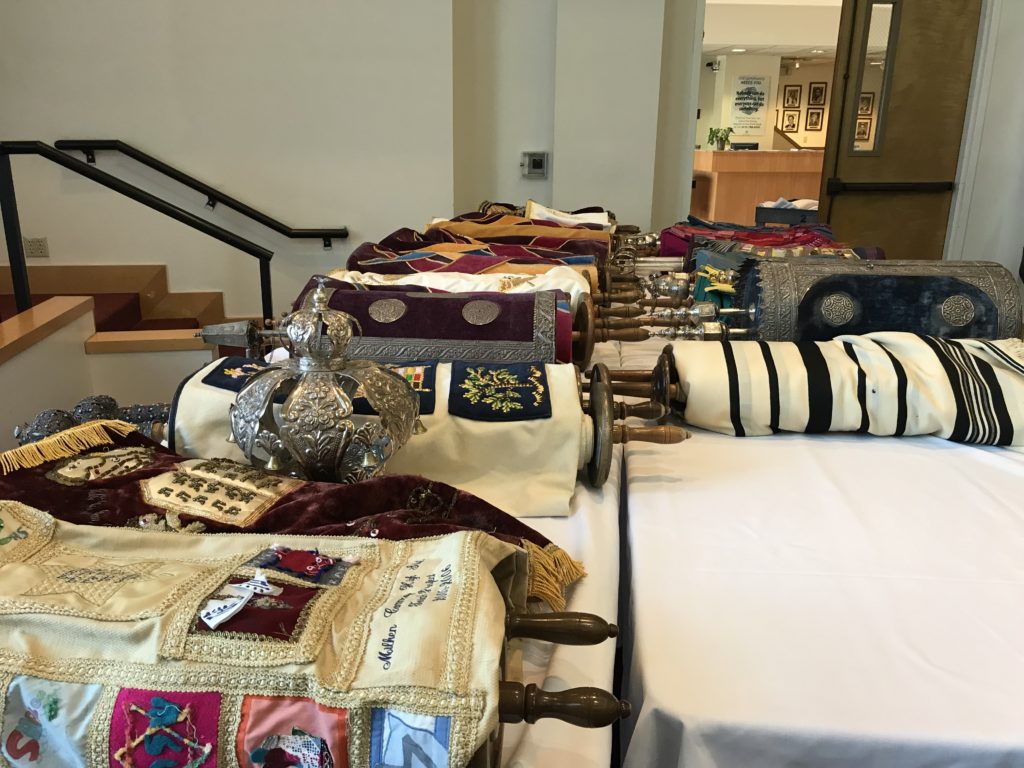
Several area synagogues and Jewish institutions closed Dec. 6 and removed their Torahs for safekeeping after a brushfire exploded on the east side of the Sepulveda Pass.

Leo Baeck Temple, Stephen Wise Temple, American Jewish University’s Familian Campus and the Skirball Cultural Center all were closed due to what is known as the Skirball Fire.

“The fires were literally right on top of us,” Leo Baeck Rabbi Ken Chasen said after recovering Torahs from his campus on Sepulveda Boulevard early Wednesday morning and bringing them to Valley Beth Shalom (VBS) in Encino for safekeeping.

The threat from the blaze — which led Los Angeles Mayor Eric Garcetti to declare a local state of emergency — led Stephen Wise Rabbi Yoshi Zweiback to transfer the temple’s Torah scrolls from its Bel Air campus to VBS. Temple groundskeepers hosed down the hill in front of the campus so that it would be less likely to catch ablaze if the winds pushed the fire there.

“We went basically building-to-building, turned off the gas, power and took all the Torah scrolls down to Valley Beth Shalom,” Zweiback said.

VBS also welcomed the Torah scrolls of Milken Community Schools, which was closed.

“There are 25 Sifrei Torah sitting in my chapel right now from three different places,” VBS Rabbi Noah Farkas said.

Numerous Torahs are being preserved from the Skirball fire in Valley Beth Shalom. Photo courtesy of Valley Beth Shalom.

The Skirball Fire is one of several fires that has blazed across the Southland since Monday. The other fires are known as the Thomas, Rye and Creek fires burning in Ventura County, Santa Clarita and Sylmar.

The Skirball fire’s proximity to Sepulveda also resulted in the closure of the Los Angeles Eruv, which uses fences, hillsides and lines through the Sepulveda pass. An eruv is a halachic perimeter that transforms a public area into a private domain for Shabbat, allowing observant Jews to carry items within its boundaries.

Both Sinai Temple in Westwood and Valley Beth Shalom closed their day schools. A large portion of Sinai Temple’s Alice and Nahum Lainer School (formerly Sinai Akiba Academy) faculty is based in the San Fernando Valley, near the fire.

Sinai Temple also has congregants who have been evacuated. “So as of now, we know about 15-to-20 families that have been evacuated,” Sinai Temple Rabbi Nicole Guzik said on Wednesday in a phone interview from downtown, where she was seeking refuge from the poor air-quality in Westwood.

Several emergency shelters have been set up in the wake of the fire, including at Balboa Park in Encino. Sinai Temple has offered itself up as a shelter for evacuees, and Temple Emanuel of Beverly Hills released a statement of support for those who need shelter or assistance.

Chasen said he received a telephone call on Wednesday morning ordering his neighborhood to evacuate. Speaking on the phone from his colleague Zweiback’s home, he said there was “some minor damage down in the [Leo Baeck] Temple property, but pretty minor. The main buildings were not breached even though the fire pushing up right against us.”

Numerous Synagogues, Jewish Day Schools Closed Down Due to Skirball Fire Read More »

Author Visits a Time of Russian Upheaval

Janet Fitch’s best-selling novels, “White Oleander” and “Paint It Black,” are set in contemporary America, but her newly published and much-anticipated novel, “The Revolution of Marina M.,” is about a remarkable young woman who finds herself in Imperial Russia on the eve of the Bolshevik Revolution. Fitch, who grew up on Los Angeles and studied history at Reed College in Oregon, talked to Journal book editor Jonathan Kirsch about her new work.

Jewish Journal: What inspired you to write a novel of and about Russia?

Janet Fitch: In fiction, things never take a straight line. After I’d finished “Paint It Black,” I wrote a short story about a woman who was a Russian émigré in Los Angeles in the 1920s. That character was Marina M. I thought: I’d love to write more about her, but I realized that I didn’t know her well enough — what her memories were, what her dreams were. And so, before I knew it, I was writing a novel set in the Russian Revolution.

JJ: I understand that you intended to become a historian. What inspired you to become a novelist?

JF: I was intensively studying history with the goal of academic writing, but I woke up suddenly on the night of my 21st birthday, sat bolt upright in bed, and decided that I wanted to be a novelist. History fascinates me, and so when I decided to become a novelist, it was only a matter of time that I would write a Russian novel. I am one of those people who is obsessed with Russia.

As a kid, anything that people didn’t talk about, that’s what I was interested in.

JJ: How did you conduct the research for “The Revolution of Marina M.”?

JF: Much of the research was conducted in books, and especially memoirs by women who lived through the events of that era. But I also went back to Russia in 2007 and took an apartment in St. Petersburg. I was there in the summer, and people said, “We are really not ourselves in the summer.” So I went back again in the winter. I just walked around and looked at things and touched things, walked the streets, went into the courtyards, and lived like my character, Marina.

JJ: Many American Jews are descended from men and women who escaped from czarist Russia. Is that true of your family, too?

JF: My family came out of Russia in 1905 after a pogrom that I didn’t know anything about until I started writing my novel. My father’s family came up from Galveston [Texas] to Omaha [Neb.], my mother’s family were New Yorkers, and none of them talked about it — it was a forbidden subject. Now that I know what they endured, I understand why. As a kid, anything that people didn’t talk about, that’s what I was interested in.

JJ: The very word “Russia” has taken on a new resonance during the Trump era. Does Russia mean something different to you today than it did before the Donald Trump presidency?

JF: I grew up during the Cold War, and I visited Russia for the first time during the Soviet era. You never saw the American president assume that Russian intelligence was more accurate than our own — it’s like “The Manchurian Candidate” or something. But I always differentiate between a leader and a people. The Russians are wonderful, and there are many things we can learn from them, especially now that we’re beginning to look more like them.

JJ: Do you feel that the Russians have any nostalgia for what happened in St. Petersburg during the Bolshevik Revolution, all of which figures so vividly in your book?

JF: Oh, no. The three legs of the old Romanov dynasty that ended in 1917 were autocracy, Orthodoxy and Great Russian nationality. It’s all being revived by [President Vladimir] Putin in Russia now, and it’s a horror to watch.

JJ: Did it take courage to undertake an 800-page novel in the era of the 280-character tweet?

JF: I didn’t know it was going to be so gigantic when I started to write it. There were times when I was utterly petrified. I felt as if I were building a Gothic cathedral all by myself.

Author Visits a Time of Russian Upheaval Read More »

Revolution Spurs Young Woman’s Evolution in ‘Marina M.’

Marina Dmitrievna Makarova, whom we meet in the opening pages of “The Revolution of Marina M.” by Janet Fitch (Little, Brown) is both a passionate young woman and a privileged member of the intelligentsia of imperial Russia. At 16, she already is a published poet, and yet she still is capable of a girlish thrill at the prospect of a kiss (and much more than that) from a handsome suitor. She also is vividly aware of the world-shattering conflicts that exist outside the confines of her parents’ comfortable home. “History was emerging from its shell,” Fitch writes, “like a chick from an egg.”

Strictly speaking, the novel is set in Petrograd at the height of World War I, the same city that was called St. Petersburg when it was founded by Peter the Great and Leningrad during the Soviet era. That attention to detail is characteristic of Fitch’s approach to storytelling, which is rooted in the hard facts of history but also penetrates the heart and soul of her characters. Like Marina herself, Fitch is a poet, and one of the glories of her new novel is the shimmering beauty of language.

“Don’t be in such a hurry to peel back the petals of the future,” muses Marina as she thinks back to New Year’s Eve in 1916. “It will be here soon enough, and it won’t be quite the bloom you expect. Just stay there, in that precious moment, at the hinge of time … but I was in love with the Future, in love with the idea of Fate. There’s nothing more romantic to the young — until its dogs sink their teeth into your calf and pull you to the ground.”

Marina’s privileged life soon is overtaken by the shockwaves of war and revolution. She may be susceptible to the charms of a gallant soldier, but she also sees with her own eyes what combat does to the human body: “Charm couldn’t dissuade bullets or bayonets, land mines or poison gas.” And when she hears the chants of the street demonstrators under the sword-blows of the mounted Cossacks — “Bread and justice!” — she is stirred to action. This prompts the officer who has become her lover to retort: “So it’s the workers you love now, not Kolya and his rapier?” with a sly reference to his own anatomy. “Do I address you as Comrade Marina?”

Fitch is faithful to the Tolstoyan traditions of the Russian novel.

Mina, one of Marina’s closest friends, is Jewish, and so is the photographer named Solomon Moiseivich, who has captured the images of “writers, actresses, singers, the most famous artists in Russia,” but St. Petersburg was mostly off limits to Jews under the czars. Marina sees the anti-Semitism for herself when she volunteers as a nurse in a military hospital and meets a Jewish soldier whose inability to secure an officer’s commission is explained by one of his comrades: “Who’d follow him anywhere except to the pawnshop?”

Marina is an eyewitness to all of the upheavals of the Russian Revolution, and an active participant in some of the more consequential ones: “Everyone was part of the revolution now … all moving forward together on the same great ship, which had finally left port.” Fitch displays a mastery of the nuances of revolutionary politics, but she also shows us what life is like for the men and women whose lives are depicted against the tableau of history.

Above all, Fitch is faithful to the Tolstoyan traditions of the Russian novel, writing about heroic events on an equally heroic scale. Remarkably, Fitch catches and holds our interest through 800 pages, rewarding us with rich and provocative stories, compelling characters and literary prose of the very highest order.


Jonathan Kirsch, author and publishing attorney, is the book editor of the Jewish Journal.

Revolution Spurs Young Woman’s Evolution in ‘Marina M.’ Read More »

Exhibition Brings Israel’s Intergalactic Sculptor Down to Earth

Enter the “Launch Sites LA: Ezra Orion Revisited” exhibition at American Jewish University (AJU) and you’ll see a virtual reality headset next to a computer screen. Put on the headset and headphones, and suddenly you are transported to a terrain of cracked earth and rust-colored mountains in the southern Israel desert landscape.

Ambient music fills your ears, and in the distance you see five large abstract sculptures, the work of the late Israeli artist Ezra Orion. Focus on any one of them for a couple seconds and you are whisked inside to stare in wonder at curving, concrete, cave-like formations. Short of hiking out to the Negev, this may be the best way to experience the massive sculptural works of Orion.

Orion’s sculptures are located in Israel as well as in far-flung sites such as the mountains of Nepal. He also created other kinds of works, including laser beams that were shot into space. Drawings of the project are on display at AJU. The exhibition also includes examples of Orion’s sketches, diagrams, a video interview with the artist, archival documents and photographic documentation of his work.

At AJU’s Brandeis-Bardin campus, artist Dan Levenson’s installation in response to Orion’s visual legacy also is on display.

A retrospective of Orion’s work was shown last year at the Israeli Center for Digital Art, Holon. The co-curator, Udi Edelman, worked with AJU’s chief curator, Rotem Rozental, to bring the current show to Los Angeles.

Orion was in many ways the prototypical sabra. Born in pre-state Palestine in 1934, he was a tall, charismatic kibbutznik and military commander who also led groups of volunteers to remote locations to realize his artistic visions. Like others of his generation, Orion felt a strong connection to the land of Israel in what he called his “geo-identity.”

“It’s a central theme in the way his life and career were shaped,” Rozental said, adding that Orion’s generation “was considered to be the strongest, the healthiest, the epitome of the new Jewish body, the Zionist conquerors.”

At AJU, his chutzpah is on full display in his 1992 concept drawing, “Intergalactic Sculpture,” in which Orion substituted matter with energy. As part of the project, he coordinated with stations in Austria, Germany, Egypt, Russia, Spain and Israel to shoot parallel laser beams at the speed of light through the Milky Way. Orion described the beams as a “super cathedral” that stretches into the universe infinitely.

“Though he was an atheist, he was a very spiritual person,” his son, Alon Orion, said in a telephone interview from his home in Jerusalem. “He said that in order to have a meaningful artistic experience, one should … be surrounded by [the art], more like the experience that you have when you enter a cathedral.”

Orion described the laser beams he shot through the Milky Way as a “super cathedral.”

The artist moved back to Israel in 1967, served in the Israel Defense Forces during the Six-Day War and settled in Sde Boker, a small Negev town where he had the open space to create large sculptures out of iron and concrete.

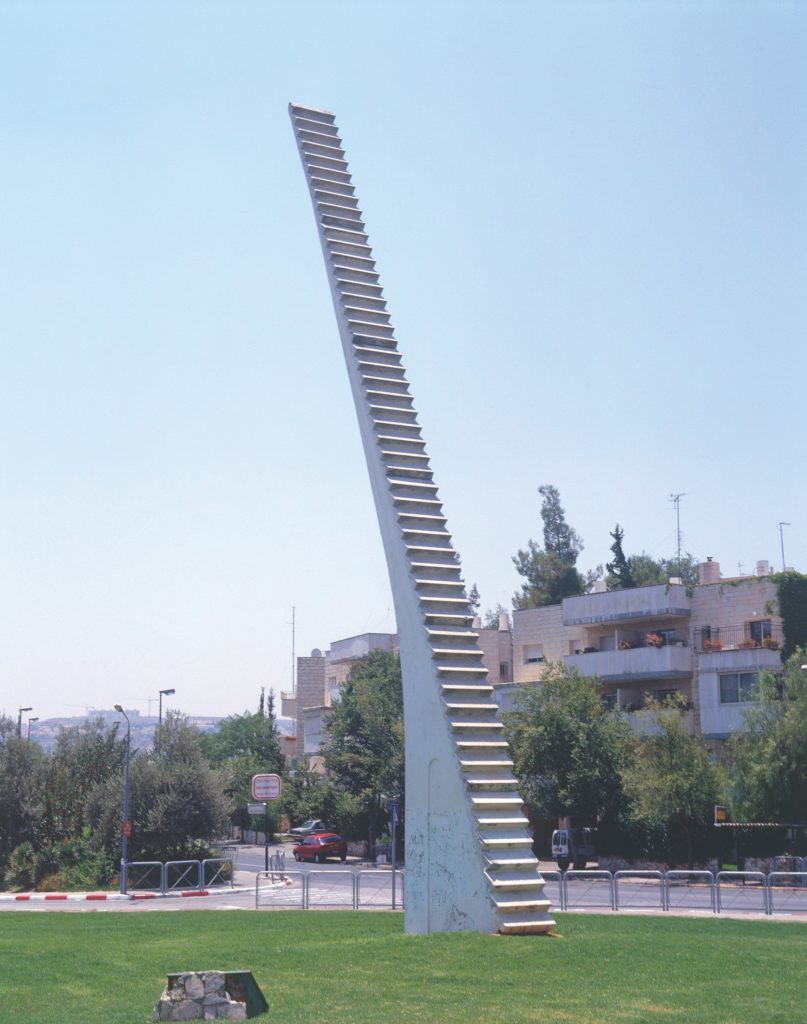
He became fascinated with the physical forces that control sub-atomic particles and distant universes, as well as the geologic forces of plate tectonics that form mountains. In Nepal, he created a staircase sculpture in the valley of the Himalayas to “form a launch pad for the creative observer’s consciousness … to peer into infinity,” he explains in a 1996 video included in the exhibition.

While Orion had a fairly successful career, with exhibitions in Israel and abroad, eschewing galleries limited his reach. Alon Orion said his father’s struggle with Alzheimer’s disease and dementia during the last dozen years of his life also prevented him from reaching a wider audience. The artist died in 2015.

“I feel very strongly about the validity of his message and his philosophy, and it would be a waste if nothing remains of it,” he said.

The “Launch Sites LA: Ezra Orion Revisited” exhibition is on display through Feb. 5 at the Platt and Borstein Galleries at AJU’s Familian Campus,15600 Mulholland Dr., Bel Air. A curatorial talk and tour will be held on Jan. 14 at 3 p.m. Cost is $10.

Exhibition Brings Israel’s Intergalactic Sculptor Down to Earth Read More »

Does God Want Higher Taxes?

Last week, Republicans did what they always do when they have power: They passed an across-the-board tax cut.

Not a single Democrat voted for the tax reform bill in the Senate or House. That’s a major shift since the 2001 tax cuts under George W. Bush, when 12 Democrats voted for that bill in the Senate, and 28 voted for it in the House.

Last week, Democrats rightly complained about the process, which was perfunctory and messy, complete with handwritten notes in the final Senate version. They wrongly complained about the structure of the tax reform bill, which they said raised taxes on the poor (false) to decrease taxes on the rich. And they hypocritically complained about increases to the deficit — when’s the last time Democrats complained about too much spending?

But it was peculiarly perplexing to watch religious Democrats complain about the tax bill by citing biblical text. Conservatives were high-handedly informed that God mandates higher taxes — that to care for the poor and the orphan, governments were instituted among men.

Rabbi Danya Ruttenberg led the charge, stating on Twitter, “If the Bible is so against systemic solutions to poverty, why is a jubilee year declared that releases people from debt to alleviate intergenerational poverty? What is leket, shikhah, pe’ah, and maaser if not taxes meant to create a safety net for those in need?”

Let’s begin with the bizarre contention that the Bible requires higher taxes. That’s simply untrue. The Bible talks about “taxes” (Hebrew: mas) in the traditional sense in only a few places: Solomon raised taxes, as did his son Rehoboam, with the result that the kingdom of Israel was split in half; Ahasuerus raised taxes at the end of the Book of Esther, a move that isn’t exactly seen as an unmitigated positive in the Talmud. The Torah’s emphasis on tzedakah is about private giving, not about government-enforced giving.

The Torah isn’t a guidebook for government welfare programs. It’s a guidebook for personal goodness.

Now, let’s talk other forms of biblical “taxes.” First, there’s maaser, tithing; Ruttenberg here probably is referring to maaser sheni, which in Deuteronomy 14 is directed toward the Levite, the stranger, the orphan and the widow (maaser is directed toward the priests alone). It applies only in the third and sixth years of the sabbatical cycle, and it’s 10 percent of the produce.

Then there’s shikhah, which occurs when you forget a sheaf in the field; you’re supposed to leave it for the widow and the orphan (Deuteronomy 24:19). That’s a rather de minimis contribution. Leket and pe’ah are referenced in Leviticus 19; leket refers to ears of corn forgotten on the ground, which are to be left there for the poor (again, this is de minimis); pe’ah refers to the corner of your field. The minimum amount for pe’ah is 1/60th of your field.

At best, then, we’re talking about a biblically mandated 11.7 percent of your produce every third and sixth year. Democrats want to maintain the highest tax rates at over 50 percent, if we include state and local taxes.

Finally, there’s shemitta and yovel. Shemitta mandates the waiver of all debts in the seventh year (Deuteronomy 15); yovel restores all land ownership to its original owner in the 50th year (Leviticus 25). Ruttenberg says that these mechanisms were designed to prevent accumulation of wealth. That’s untrue. Actually, they were designed to maintain tribal land ownership, since the Talmud says that yovel applies only when the tribes were living in their prescribed territories. And the rabbis designed an entire system, pruzbul, in order to avoid the impact of yovel and shmitta loans. It turns out that a system that routinely devaluates loans prevents their issuance, thereby harming the poor.

None of this is designed to undercut the notion that the Torah cares about the poor. It most certainly does. But our obligations are personal, not government-created; God wants us to act out of personal desire to help the poor. And not coincidentally, studies show that those who are most religious tend to give the most to charity, not those who point to the Bible in order to justify government cash-grabs.

The Torah isn’t a guidebook for government welfare programs. It’s a guidebook for personal goodness. To turn it into the former is to prevent the cultivation of the latter.


Ben Shapiro is a best-selling author, editor-in-chief at The Daily Wire and host of the conservative podcast “The Ben Shapiro Show.”

Does God Want Higher Taxes? Read More »

The Light We Create

I recently stopped in at one of my favorite shops in Manhattan, a small boutique on upper Madison Avenue. I try to avoid the place because I love the clothes too much. This time, though, I was happy to see Galit, an Israeli designer who works there when he’s not designing.

After we hugged and exchanged pleasantries, I asked him how he was doing. “Oh, you know, whatever.” What do you mean? I asked. What’s the matter? “Nothing. Nothing’s the matter. We get up, we go to work, we come home. Repeat.”

I know enough about depression to recognize it, especially at this time of year when it gets dark at an unseemly hour. But I also know enough about creative people to know that they need to create, that it is essential to their emotional health.

What have you been designing recently? I asked casually. “Nothing. I mean, why design? People like ugly trends,” he said, pulling out from the rack an ugly trend that can be spotted all over the city.

I urged him to continue designing anyway, but what I really wanted to say was this: The deeper meaning of creativity can be even more gratifying.

It is something I have fully understood only in recent years. Creating beauty — through words, paint, cloth — is a great honor, and often, as Michelangelo put it, a great burden. But creating light for those around us, through acts of goodness and kindness, is an even deeper beauty, and it creates an even deeper happiness.

For some, this comes quite easily. My mother, for instance, had what I can describe only as an eternal flame burning within her. Brimming with optimism and sweetness, she seemed to float through life, always being the bigger person no matter what situation she found herself in.

As a child, she was my entire world; as a rebellious teen, I found her perennial sunshine annoying. It was only in my 20s that I began to realize that her happiness came from giving, from creating light for others — it was a circle of positivity, of beauty.

She inherited this trait from her father, my much-adored grandfather, who brought light into people’s lives through humor. No matter where we went with him, cashiers, waitresses, shopboys always made a point of telling us how much they loved Aba. In his later years, we would park him on a bench so we could take a morning walk along the beach. Every time, we would come back to find the bench filled with people laughing.

It was only after I had my son, spending every precious (exhausting) minute with him as a baby and young child, that I fully understood the larger canvas of creativity.

It was only after I had my son, spending every precious (exhausting) minute with him as a baby and young child, that I fully understood the larger canvas of creativity. And it wasn’t just about him. Freed from the hectic pace of office life, I began to look for ways to help — other children, the elderly, people struggling with groceries. Perhaps the most gratifying moment of all was watching my son create light for others — watching his face fill with the deep joy that this special moment brings.

Of course, we don’t often have the luxury of slowing down time. And because of this, we need to make sure that we nourish our souls so that we can then nourish the souls of others. As I write this, “Ma’oz Tzur” plays softly in the background; it is for me one of the most spiritually cleansing songs of Judaism. Whether it’s music, art, majestic architecture, loving friends and family — we each need to recognize what we need to help us create circles of beauty, moments of light.

And so every year, as I teach my son the story of Hanukkah — the bravery of the Maccabees, the miracle of the oil — I increasingly emphasize a more personal meaning: Just as lighting Hanukkah candles creates a beautiful moment, we can do the same in our everyday lives — through just a smile, a kind word, a sweet gesture. Often it takes just a drop of beauty to light up someone’s world.

Chag sameach.


Karen Lehrman Bloch is a cultural critic and author of “The Lipstick Proviso: Women, Sex & Power in the Real World” (Doubleday). Her writings have appeared in The New York Times, The New Republic, The Wall Street Journal and Metropolis, among others.

The Light We Create Read More »

Feinstein to Celebrate the Jews Behind Christmas Music at Northridge Concert

Not only have Jewish composers and lyricists made an indelible mark on American music, they also have shown that they know their way around a Christmas tune.

When multiple-Grammy-nominated singer Michael Feinstein performs holiday season concerts, he always highlights the yuletide contributions of Jewish composers such as Irving Berlin (who wrote “White Christmas”), Felix Bernard (“Winter Wonderland”), Johnny Marks (“Rudolph the Red-Nosed Reindeer”) and Walter Kent (“I’ll Be Home for Christmas”).

Known as the ambassador of the Great American Songbook, Feinstein has served as the Pasadena Symphony’s principal pops conductor and has launched a pops series at the Kravis Center for the Performing Arts in Palm Beach, Fla. He is the author of “The Gershwins and Me,” and serves as artistic director of The Center for the Performing Arts in Carmel, Ind.

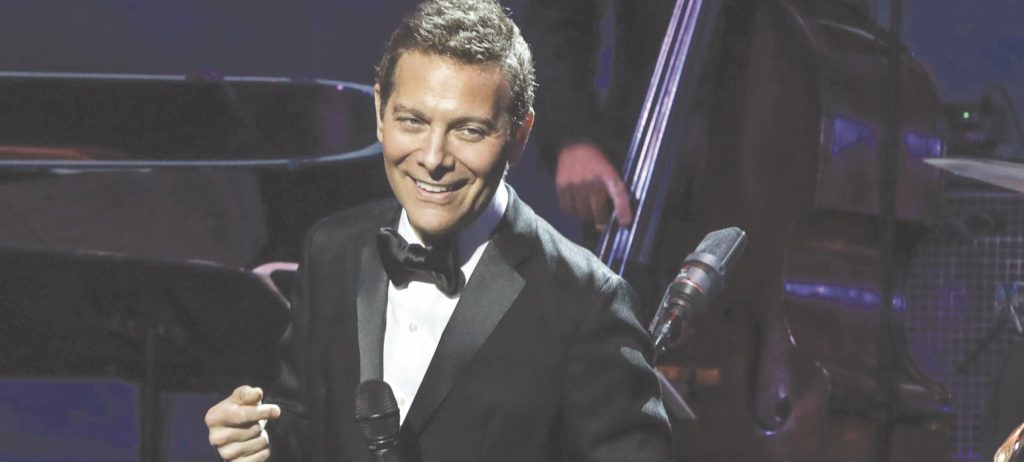
Feinstein, who will perform “A Michael Feinstein Holiday Celebration” at Cal State Northridge’s Valley Performing Arts Center on Dec. 8, recently spoke to the Jewish Journal by phone.

Jewish Journal: What are some of your favorite Christmas songs?

Michael Feinstein: “Have Yourself a Merry Little Christmas” is my favorite Christmas song, and that was written by Hugh Martin, who was a Seventh-day Adventist. So, he broke the Jewish rule. But that is my favorite because the construction of the music is glorious and the lyric is heartfelt and genuine.

A song [co-written] by Sammy Cahn called “The Secret of Christmas” is a favorite, although it’s lesser known. Of the more familiar ones, “White Christmas” is a song that is ubiquitous for good reason, because it is a brilliant song and, happily, I’ve never gotten tired of singing it. “The Christmas Song,” aka “Chestnuts Roasting,” is a favorite.

“I don’t think anyone wants to hear a Jew sing hymns — unless it’s Barbra Streisand.”

Those songs all have lyrics of some depth. The Christmas songs that wallow in mistletoe and sleigh bells and reindeer are of less interest because, emotionally, they’re light and frothy. But there’s only so far you can go emotionally in interpreting something like that. I do love the Jerry Herman song “We Need a Little Christmas.” Again, that’s a superior lyric. I have sung “Santa Claus Is Coming to Town,” but that, to me, is an example of a song that is really more for children than for larger audiences

JJ: What about some of the hymns and religious Christmas songs?

MF: They’re pretty, but I don’t think anyone wants to hear a Jew sing hymns — unless it’s Barbra Streisand. Her Christmas album was beautiful. But I think it’s best for me to stick to what I do best, which is really interpreting a substantial lyric.

JJ: At what point in your career did you decide to make holiday songs part of your professional repertoire?

MF: There was not a conscious decision. As a performer, I have to perform what pleases the audience. And people at the holiday times wanted to hear the songs. So I sang them from my earliest days in piano bars.

JJ: As a student of music, did you enjoy discovering the history of some of these holiday songs?

MF: I’ve always been fascinated with the history of everything I sing. Knowing the background, knowing something about the writers, knowing the year and the context of the songs have always been important to me. It has always informed the way I sing a song. Figuring out how to perform a song stylistically, what to do with it and how to retain its freshness for contemporary audiences all stem from that behind-the-scenes approach to the music.

JJ: You will be performing in New York on Christmas. Do you try to seek out wintery venues for holiday performances?

MF: Having grown up in Ohio, where it snowed relentlessly in the wintertime, I have no desire to experience more snow. I used to spend every Christmas with Rosemary Clooney, who was one of my favorite people and with whom I was very close. That’s the only time that Christmas had a greater significance for me, personally.

JJ: For the Valley Performing Arts Center show, will it be peculiar to be singing about snow and frost in what will likely be 80-degree Northridge weather?

MF: Well, that’s why Irving Berlin wrote the verse of “White Christmas” [that goes] “The sun is shining, the grass is green / The orange and palm trees sway / There’s never been such a day / In Beverly Hills, LA / But it’s December the 24th / And I’m longing to be up north.” That verse didn’t fit in the film “Holiday Inn.” There would have been no place for it, but for the exploration of the song itself, he wrote the song in California and he wrote that verse I’m sure while he was experiencing the sunshine of this place.

JJ: What should people expect from the Northridge performance?

MF: It’s going to be a fun show. The shows are interactive with the audience. They’re certainly, emotionally, quite varied, in that I do a lot of celebratory songs. But I also do a lot of things intimately at the piano, including some of my favorite ballads.

The shows are not only informative but humorous, because, to me, being able to do what I do is always a celebration. It is always something for which I am deeply grateful, and I never take for granted that people are present in those seats. So, I’m looking forward to it.

“A Michael Feinstein Holiday Celebration” will be performed at 8 p.m. Dec. 8 at the Valley Performing Arts Center on the Cal State Northridge campus. For more information, visit
valleyperformingartscenter.org.

Feinstein to Celebrate the Jews Behind Christmas Music at Northridge Concert Read More »