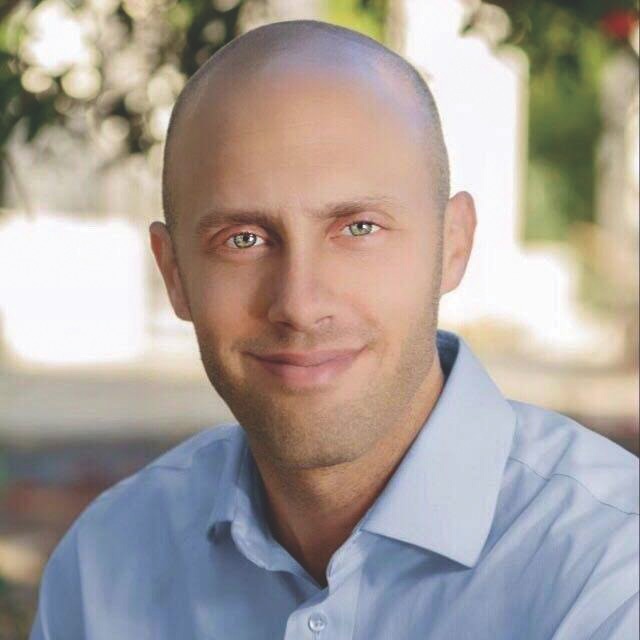
Brimming with intrigue and suspense, Michael Bassin’s outlandish stories make him seem like the lovechild of Dan Brown (“The Da Vinci Code”) and Frank Abagnale (“Catch Me If You Can”).
During a year as a student in the Middle East, he was accused of being a secret agent and threatened by a former Hezbollah fighter in Beirut, who told him: “You’re an Israeli. I can see it in your eyes. I’ve already killed two, and I said once I kill my third, I can die peacefully.”
But for all his capers, Bassin, 32, is really just a nice Jewish boy from Cincinnati with an aw-shucks attitude.
His newly released book, “I Am Not a Spy: An American Jew Goes Deep in the Arab World & Israeli Army,” recounts his exploits during a year in Egypt and the United Arab Emirates (UAE) — peppered with jaunts to Lebanon, Syria, Oman, Kashmir and Jordan — while he was a junior studying International Relations at George Washington University.
While his Jewish day school and Conservative youth group upbringing gave Bassin a solid pro-Israel foundation, it was the relationships he forged with Muslims at his public high school that made him itch to see the other side.
“I wanted to make peace in the Middle East,” Bassin said with the earnestness of a beauty pageant contestant. His role models were people like former American diplomat and Middle East peace negotiator Dennis Ross.
“I also wanted to be the dorky Jew in the room — but without the glasses. I don’t wear glasses,” he said.
So in the summer of 2006, Bassin spent a few months intensively studying Arabic at the American University in Cairo. From there, he went on to spend seven months at the American University of Sharjah, UAE.
After word got out about his Jewish identity in Sharjah, Bassin quickly became something of a cause célèbre. A particularly hostile group of students from the Palestinian diaspora led a crusade against him, he said, spreading the rumor that he was a Mossad agent.
“Yet the more they demonized me, the more popular I became,” Bassin said.
“I showed them the human side of Jews,” he continued. “Propaganda aside, it’s very hard to hate the person sitting in front of you.”
Ironically, Palestinian students from East Jerusalem ended up becoming Bassin’s closest allies on campus. They, too, were viewed with suspicion by other students — especially by those second-generation diaspora Palestinians who had never set foot in either Israel or the Palestinian territories — since they were far more moderate in their attitude toward Israel.
“The fact that they were so utterly shunned by other Palestinian students because they didn’t say Israel and Jews were bad in every way, the fact that they had some nuance to it, made them go in the opposite direction,” he said.
“I wanted to make peace in the Middle East.” — Michael Bassin
He told the Journal of his repeated efforts to strike up a conversation with a beautiful girl in a hijab who always found a way to abscond. “I realized I was having a public relations problem in that people were too afraid to talk to me,” he said.
In an effort to combat his ostracism, Bassin joined the biggest student group on campus, the Palestinian Cultural Club. Although at first he was treated like “the plague,” eventually people became used to his presence, he said. Even Samira, the beautiful girl in the hijab, apologized for being hostile.
“She told me, ‘If I’m going to hate you, I want to do so for my own reasons,’ ” he said. “We ended up becoming extremely good friends.”
Bassin credits his experiences in the Arab world for his decision to make aliyah. Although his time spent in the Middle East made him internalize the fact that human beings are malleable creatures that can learn and grow and affect geopolitical climates, he doesn’t believe this is something that will happen anytime soon.
For Bassin, the next step in his quest to support the Jewish state was to move there and join the military. He was recruited as a combat translator for the Kfir Infantry Brigade. These days, Bassin works as the chief revenue officer in an ad-tech startup in Tel Aviv.
When asked if he ever could see himself embarking on similar adventures again, Bassin smiles.
“I was a kid then,” he said. “I didn’t know my head from my tuchis. But you never know.”