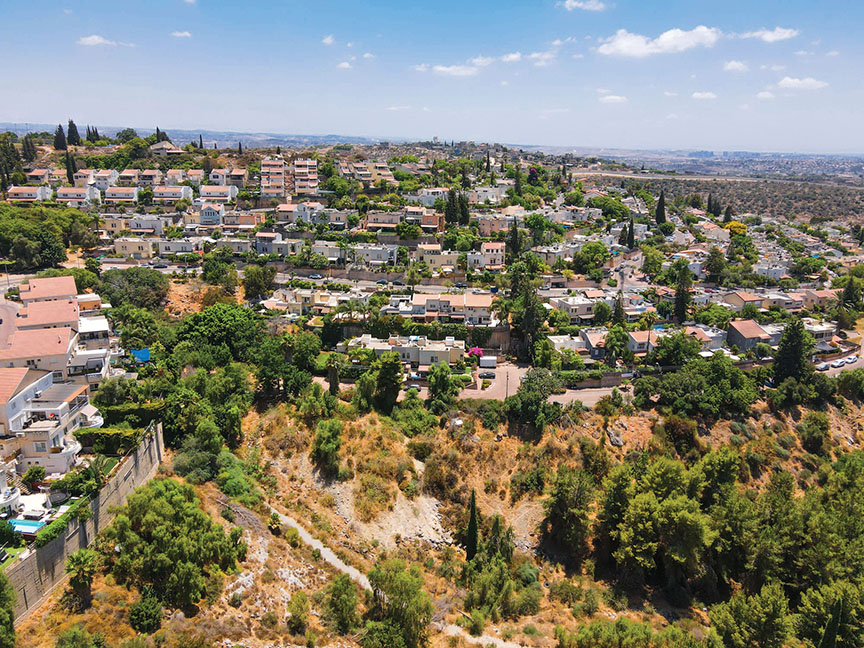
The question of the future of Judea and Samaria is a repressed one among the Israeli public. There are good reasons for this: it is a deeply complex challenge. It is a challenge for which various solutions have already been tried and failed. Most of all, it is a challenge that doesn’t seem to have any prospect of being addressed anytime soon in a way that leads to a final resolution.
A repressed question, but an ever-present one. Postponement is also a form of coping. Perhaps it is the right way to cope for this current era. Perhaps it is simply an unavoidable way of coping. But make no mistake: repression does not stop time from moving forward. In Judea and Samaria, demographic processes are unfolding, developments are taking place on the ground, and places are being built, destroyed, developed, and transformed. Settlements are established, farms pop up, shepherds roam the land, and reservists scramble around. Reality is dictated on the ground, every single day. It rolls along, currently, without a clear guiding hand.
Or perhaps there is one? If there is, it is likely the hand of Minister Bezalel Smotrich. He, at least, appears to have a plan and seems to be succeeding, with his limited means, in advancing it. What is his plan? To systematically undermine any future possibility of dividing the territory or conceding land. Regardless of whether one believes this is a good or bad plan for Israel, we must honestly admit: it is the only plan currently being advanced. There is no other.
What do Israelis want to happen in Judea and Samaria? What future do they envision when they think about this territory? Two years ago, when Donald Trump raised the possibility of relocating Gazans out of Gaza, many Israelis (mostly Jews) thought it was an excellent idea. If there are no Gazans in Gaza, the Strip will no longer be a real challenge. An empty territory is easy to manage; one can settle it, build hotels, or lay out golf courses – whatever Trump suggests. When we measured the level of public agreement with a plan to resettle Gazans in other countries, the approval rate was very high, but so was the skepticism. And rightly so – the plan came and went like many of Trump’s proposals. A fleeting illusion; here today, gone tomorrow. What should be done in Gaza? We still don’t know how to answer that.
In other words, Israel likely needs to think about the future of Judea and Samaria in the absence of an “Uzbek” or “Turkmen” solution. What does that mean? In the August JPPI survey, we explicitly asked respondents to choose a future for this territory that constitutes a “realistic strategic goal” for the “long term.” We offered ten options, and two preferences are more dominant than the rest: nearly a fifth of respondents favor a future where “part of the territory, with a Jewish majority, is annexed to Israel, and in the part with an Arab majority, a Palestinian state is established.” A similar proportion prefers a future where “the entire territory is annexed to Israel and the Arab population relocates to other countries.”
Here, in a nutshell, is the explanation for the public’s repression of the issue. One preferred solution is a path Israel has already tried to walk, which did not end well. Therefore, only 27% remain willing to accept the idea of a Palestinian state on part or all of the territory, even when talking about the distant future. The second preferred solution is the “Uzbekistan” solution: a solution involving the relocation of the Arab population “to other countries” – who knows how, when, where, or why.
What is the core difficulty that this repressed problem raises? It is convenient to ignore it, but it hasn’t disappeared. Therefore, following the questions about the future of Judea and Samaria and the settlements, the JPPI survey also presented a broader question. It sought to examine the potential tension between two foundational goals of the Israeli public (primarily the Jewish one): the desire to hold onto parts of the homeland like Judea and Samaria, both for cultural reasons (the land of our ancestors) and security reasons (our security buffer), versus the desire to ensure Israel maintains a Jewish majority, without which it is very hard to imagine Israel as a “Jewish and democratic” state.
Which brings us – in a perfectly circular conversation – back to our starting point. Right now, all anyone has to offer is a plan without a clear path to realization (partitioning the land for peace), or another plan without a clear path to realization (Palestinian departure). No wonder the conversation is repressed. To put it bluntly: all those involved are just waiting for a messiah – who will come and save us – or for a catastrophe – which will create an opportunity we don’t currently have.
Something I wrote in Hebrew
The Likud party elected its list of candidates this week. Here’s what I wrote about those who no longer intend to vote for the party:
There are two distinct tracks of departure from the ruling party Likud. What drives those crossing over to the opposition is the issue of the Haredi (ultra-Orthodox) military draft – 59% of them cite this as their motivation, compared to just 18% among those staying within the right-wing bloc. Meanwhile, what drives the defectors to other parties who remain within the coalition is the battle over the Supreme Court (the judicial overhaul) -47% among them, compared to 20% among those moving to the opposition. To put it slightly differently: for those leaving for the opposition, the Likud is too much Likud. In the eyes of those leaving for other coalition parties on the right, the Likud isn’t Likud enough.
A week’s numbers
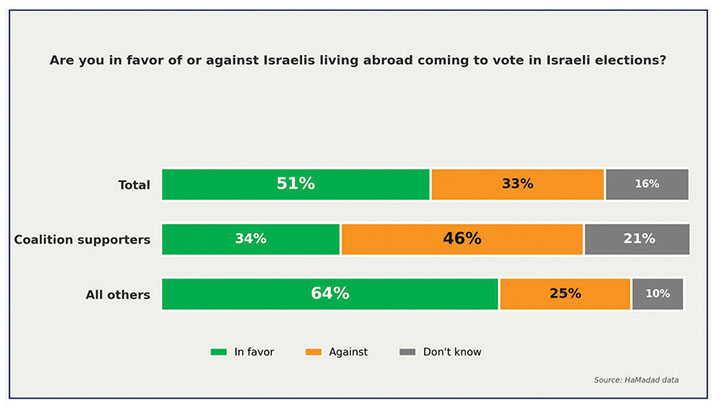
Where you sit is where you stand, and this time supporters of the coalition realize that most Israelis abroad who intend to vote are potential voters of the opposition.
A reader’s response
Abraham Kurtz writes: “If antisemitism keeps rising here, you in Israel should prepare for a huge wave of Aliya.” My response: We’d welcome everybody (but still need to remind the newcomers: Israel isn’t safe either).
Shmuel Rosner is senior political editor. For more analysis of Israeli and international politics, visit Rosner’s Domain at jewishjournal.com/rosnersdomain.