
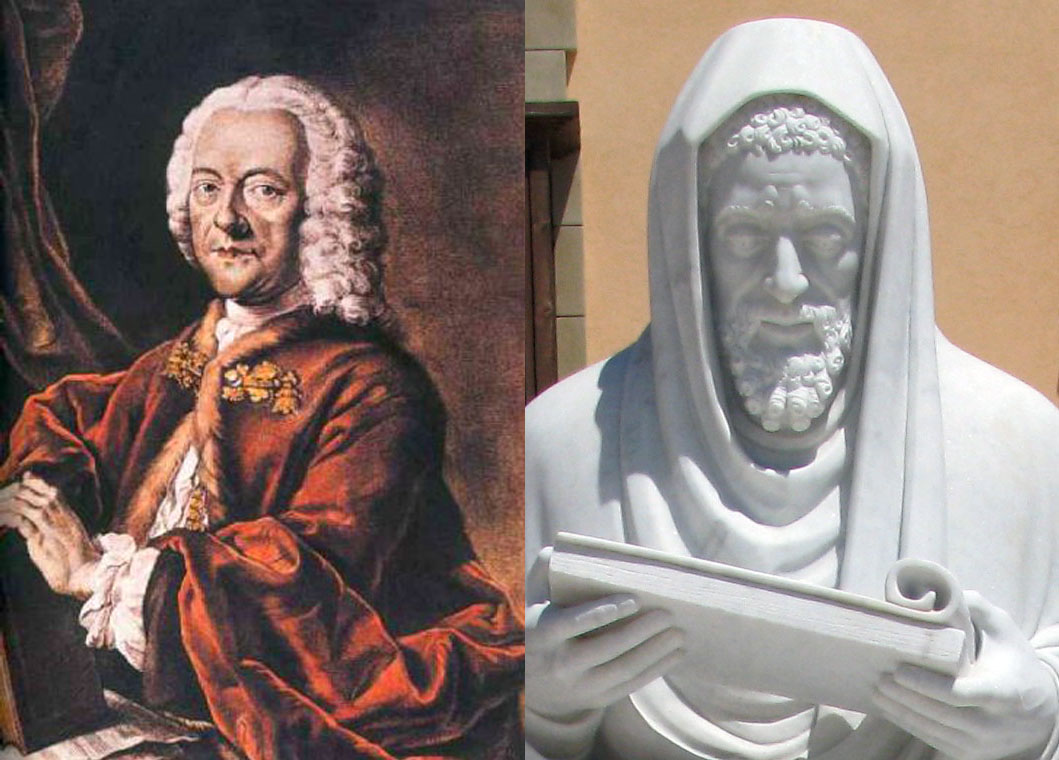
Because he wrote so much, they said that what he wrote could not be good.
I am referring to the great composer Georg Philipp Telemann.
That’s also what a lot of people say about my verses. Foul falsehood,
besides which I have never been like Georg Philipp a best-sellerman.
I’m not Baroque; the word that I prefer is Judeo-classic,
which draws me to the great Judeo-Spanish poet, Yehudah Halevi.
My detractors might prefer another term, like Jew-Jurassic:
the line by which these terms are separated isn’t red, but trayfy.
Just like Yehudah Halevi, I regard Jews’ exile from the land of Israel as an aporia,
in my LA diaspora dissenting with opponents of the return of Jews to Zion,
fighting against them with my poetic words, peace-loving warrior
less literate than the great rabbinic poet, whose name the Bible links to praise and to a lion.
“Aporia” denotes an irresolvable internal contradiction or logical disjunction in a text, argument, or theory.
In “Scattered Seeds: The Origins of Diaspora,” Jewish Review of Books, Winter 2025, Malka Z. Simkovich points out that the Bible’s first reference to the diaspora of the Jews is made by the Septuagint’s translation of Deut. 25:28. She writes:
Whenָ the Septuagint’s translators arrived at a verse in which Moses predicts that the Israelites would become a horror (za’ava) before the foreign nations if the terms of God’s covenant were violated, they searched for the right Greek word to describe the Israelites’ condition. Although they were not emissaries of the high priest of Jerusalem, the translators seem to have had personal ties to the Land of Israel, which influenced the word they chose. In fact, it was one that didn’t yet exist in that form: “diaspora,” from dia-, meaning over or through, and -sperein, meaning to scatter like seeds (the modern word “spore” is also derived from the verb).
In “The Khazars, the Jews, and Us: The Delusion of Origin and the Question of Zionism,” 5/15/25, David Lemler, a lecturer at the Department of Arabic and Hebrew Studies at the Sorbonne University, writes:
https://k-larevue.com/en/khazars/?utm_campaign=K.LaRevue%23216EN&utm_medium=email&utm_source=Mailjet
How did a classic work of Jewish thought written in Arabic in the 12th century, which claims the absolute superiority of Jews and Hebrew, come to be cited by both the Israeli far right and the most radical fringes of anti-Zionism? To dispel this mystery and the misreadings of this text, David Lemler immersed himself in Yehuda Halevi’s Kuzari. His interpretation reveals an unexpected utopia, that of the Jewish state of the Khazars, whose critical function could help us escape contemporary aporias.
Yehuda Halevi’s Kuzari has recently gained unexpected relevance. This 12th-century work is a distant source of the most radical discourse of the Israeli far right and one of the most popular arguments of radical anti-Zionism. Heraclitus already spoke of the harmony of opposites, but this unnatural alliance is nonetheless surprising. How can this be explained?
In the context of an apology for Judaism, the Kuzari articulates a thesis unprecedented in Jewish tradition: the intrinsic superiority of Jews over non-Jews, of the Hebrew language over all other languages, and of the land of Israel over all other lands. These theses subsequently found their way into many later texts, particularly Kabbalistic ones, and form the backdrop to religious Zionism. Today, they fuel the most extreme discourse within the Jewish and Israeli worlds.
Gershon Hepner is a poet who has written over 25,000 poems on subjects ranging from music to literature, politics to Torah. He grew up in England and moved to Los Angeles in 1976. Using his varied interests and experiences, he has authored dozens of papers in medical and academic journals, and authored “Legal Friction: Law, Narrative, and Identity Politics in Biblical Israel.” He can be reached at gershonhepner@gmail.com.