In the not-too-distant past, I sought help from a friend with the wording of a work email in which I would be letting down a colleague. My friend, who works in corporate law, scanned my draft and said it looked fine. But, he qualified, he doesn’t apologize in work emails. That sounded prudent — even revelatory. Feeling like I had been let in on a secret of success, I deleted the word “sorry” from the letter.
As I’ve learned since then, not saying sorry has unapologetically become best practice in professional settings. You can evade, clarify, thank, double down, ignore — but never apologize. There now exists a whole non-apologetic lexicon: A tweet rattling off alternatives that recently appeared in my timeline had been favorited over 365,000 times. It doesn’t stop there. To help people break this ugly habit, a Google Chrome extension called “Just Not Sorry” catches any contrite language that sneaks into your emails as you compose them. Who needs a friend in corporate law?
What’s the fuss over saying sorry, anyway? Is it a matter of presentation or does it strike at something deeper? A November 2012 article in the European Journal of Social Psychology stated that refusing to apologize could actually carry psychological benefits — improving self-worth and strengthening one’s sense of agency. On the other hand, the Just Not Sorry tool states apologizing “undermines your power and makes you appear unfit for leadership.” And all these years I thought I was taking the high road.
Granted, the anti-apology crusaders emerged to address the phenomenon of over-apologizing at work, where power structures are already often fraught with gender, race and sexual dynamics. For example, according to a November 2010 article by the National Library of Medicine, women tend to apologize more than men. Encouraging women to stand their ground can allow them — or anyone predisposed to self-doubt — to be themselves, share their opinions and advance more confidently in the workplace. In a society whose central principle is that competition brings out the best in us collectively even if it can bring out the worst in us individually, short-circuiting the human instinct to apologize is a rule of thumb being passed off as a self-help trick.
For the first 11 months of the year, whether the aversion to saying sorry stays at work or it bleeds into our personal lives, we can attempt to mute our instinct toward empathy. But Judaism creates a seasonal imperative to amplify it.
But it’s hard to build work habits that aren’t life habits. Is the “s”-word taboo really confined to the workplace any more than power dynamics are? You don’t have to look far to find people who avoid saying sorry even when doing so is thoroughly called for (or offer the “sorry-if-I-hurt-anyone” instead — a self-righteous, self-defeating anti-apology). The research hints at a dangerous feedback loop: As denying apology continually confirms our own correctness, we may begin to lose the ability to recognize our weaknesses and missteps. The next time I let down someone, will I even notice I’ve hurt them?
From the first shofar blows of Elul to the final blast of Yom Kippur, the Jewish period of repentance calls us to return — not only to God, and to one another, but to our human senses. In his treatise on repentance, Maimonides points out that the insight to know right from wrong and to choose with regard to that distinction is the defining feature of our species. Apologies, then, extend from an even greater gift: the ability to recognize that someone else might have chosen differently.
For the first 11 months of the year, whether the aversion to saying sorry stays at work or bleeds into our personal lives, we can attempt to mute our instinct toward empathy. But Judaism creates a seasonal imperative to amplify it. The month of Elul, whose precepts command us not only to repent but also to forgive, thus becomes a safe space for sincerity. This month plus the following 10 days are a time to allow ourselves to be vulnerable, to confront and admit fault — to err on the side of apology.
Seeking forgiveness from a Higher Power is to surrender the lower power — the notion of control that feels so pathetic this time of year — that we have been so desperate to protect. We emerge feeling invigorated not by feelings of self-determination but by the strength of our connections, with our faith and with each other.
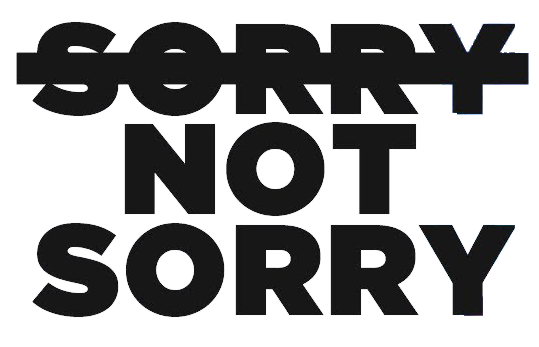
In the age of “Sorry/Not Sorry,” teshuvah is tonic. We humble ourselves before loved ones, revisiting our worst moments of the year (don’t try this at work) to see if they’ll still have us. Then we get to be magnanimous with others, modeling the forbearance we will soon pray for and enacting a vision of society that’s less concerned with negotiating power than building understanding.
Finally, seeking forgiveness from a Higher Power is to surrender the lower power — the notion of control that feels so pathetic this time of year — that we have been so desperate to protect. We emerge feeling invigorated not by feelings of self-determination but by the strength of our connections, with our faith and with each other.
But what happens when we break the fast and bump into someone in the line for bagels and apple juice? Does it make a difference whether we blurt out the “s”-word? The upshot of that European Journal of Social Psychology study is that the words “I’m sorry” still carry profound weight. If we’re trying to reclaim the apology from the realm of rote performance, we may choose to reserve it for graver offenses. But then let us be wary of acknowledging our humanity only 40 days a year.
Louis Keene is a writer living in Los Angeles. He’s on Twitter at @thislouis.