Anti-Semitic graffiti featuring a swastika, among other Nazi symbols, was found spray-painted in red on a Wisconsin synagogue on Sept. 22.
The words “I Jude KOS” as well as what appeared to be the Nazi “SS” logo were spray-painted in red on Beth Israel Sinai Congregation in Racine, Wisc. Jude was the word emblazoned on the yellow badges Jews were forced to wear in Nazi Germany. “KOS” could be a reference to the Knights of Satan gang, Congregation President Joyce Placzkowski told the Journal Times.
Rabbi Martyn Adelberg told the Wisconsin Jewish Chronicle that the graffiti was “totally shocking,” as he had never seen it anything like it in his nearly 20 years working at the temple. Placzkowshi told the Journal Times, “I was just angry at the beginning. Now it’s just sadness. How can any person have such hatred for people they don’t even know?”
She added that the synagogue is looking into increasing security measures in response to the graffiti.
Anti-Defamation League Midwest condemned the graffiti, saying they were “appalled” at the graffiti.
“These words and symbols invoke the painful history of the Holocaust and are intended to intimidate and spread fear,” the statement read, adding that it was part of “a disturbing nationwide trend in vandalism targeting Jewish houses of worship.”
Racine Mayor Cory Mason said in a statement it was “deeply disturbing that this horrendous act was committed the week before Jewish people will celebrate the High Holy Holidays of Rosh Hashanah and Yom Kippur, which are intended to be a time of reflection and celebration. This is a clear act of hate, and anti-Semitism of any kind has no place in our city.”
The vandalism comes as two other synagogues in Michigan and Massachusetts were vandalized with anti-Semitic graffiti on the same weekend.
The Facebook page for Fatah, Palestinian Authority President Mahmoud Abbas’ ruling party, was temporarily shut down on Sept. 25 amidst efforts to have it removed from the social media platform altogether.
The editor of the page, Munir Jaghoub, told the Times of Israel (TOI) that the move was “a precautionary measure” because they don’t want Facebook to permanently ban the page in response to Palestinian Media Watch’s (PMW) campaign against it. A spokesperson for Facebook told TOI that they didn’t take any action against the page.
PMW published a 40-page report earlier in the month arguing that the Fatah Facebook frequently promotes violence and terrorism and should therefore be taken down from Facebook. Among the examples listed in the report include praising the planner of the 1972 Munich terror attack that killed 11 Israelis as “a Red Prince” and hailing 17-year-old Palestinian suicide bomber Ayyat Al-Akhras – who killed two Israelis in a 2002 Jerusalem bombing – as a “Magnificent Martyrdom-seeker.”
Additionally, the Fatah page posted a photo of young girls holding assault rifles with the caption, “Fatah’s flowers” on Jan. 1.
PMW also published a report on Fatah’s Facebook page in February; PMW CEO Itamar Marcus told the Jerusalem Post that he met with a Facebook official sometime after the February report was published.
“I emphasized that every time Fatah posts a new terror message on Facebook encouraging violence or presenting murderers as role models, hundreds of thousands of Palestinians are given more motivation to kill Israelis,” Marcus said. “Facebook still chooses to do nothing to stop it. Their willingness to ignore the role they are playing in Fatah’s terror promotion is incomprehensible. Whereas in 2018, Facebook was an unwitting accomplice in Fatah’s terror promotion, Facebook is Fatah’s partner by choice in 2019.”
Marcus wrote on the PMW website on Sept. 25 that they had been working with Act.il, a joint project of the Israeli American Council (IAC), the Interdisciplinary Center (IDC) and the Maccabee Task Force that aims to take down anti-Semitic content online, to apply pressure to Facebook over the past two weeks. Marcus hailed the fact that the page has gone offline as a “great success.”
JERUSALEM (JTA) — Two Holocaust survivors who were separated as children reunited in Israel after 75 years.
Morris Sana, 87, and his cousin and friend Simon Mairowitz, 85, were convinced that the other had been killed by the Nazis, according to People magazine.
They reconnected after their descendants found each other on Facebook. The men had escaped Romania separately following the German invasion in 1940.
Sana lives in Israel, in Raanana, and Mairowitz ended up in the United Kingdom.
In a video posted online, the pair can be seen hugging each other and crying.
“Good to see you too after all these years,” Mairowitz said. “Seventy-five years you waited. I know it’s a long time. We’ve got each other now. And we can see each other.”
(JTA) — President Donald Trump pressed his Ukrainian counterpart to investigate former vice president Joe Biden and his son during a phone call between the two leaders, according to a transcript released Wednesday by the White House.
During the July 25 call, Trump asked the recently elected Volodymyr Zelensky, who is Jewish, to look into allegations that Hunter Biden engaged in illegal behavior while serving on the board of a Ukrainian firm that was being probed for corruption. Joe Biden is leading in the polls among the Democratic presidential candidates for 2020.
“There’s a lot of talk about Biden’s son, that Biden stopped the prosecution and a lot of people want to find out about that so whatever you can do with the Attorney General would be great,” Trump said, according to the transcript. “Biden went around bragging that he stopped the prosecution so if you can look into it … it sounds horrible to me.”
Giuliani and Trump have both claimed that Joe Biden was attempting to protect his son when he joined with other world leaders to demand the ouster of the then-Ukrainian top prosecutor, Viktor Shokin, who was widely seen as corrupt himself.
During the course of the call, Trump repeatedly reiterated that he would have Giuliani and U.S. Attorney General William Barr call him in the future.
Trump’s decision to ask a leader of a foreign power to investigate a potential rival has infuriated Democrats, who pointed out that Trump had decided to withhold about $250 million in defense assistance to Ukraine several days before the phone call.
Democratic leaders have alleged that withholding the money before making his request was an implicit quid pro quo. Ukraine is fighting Russian-backed insurgents in the east of the country.
The furor over the phone call has sparked House Speaker Nancy Pelosi to launch an impeachment investigation of Trump.
Zelensky, the former Soviet republic’s first Jewish president, appeared to agree with Trump, saying that his country’s prosecutor general would “look into the situation, specifically to the company that you mentioned in this issue.”
New York Times opinion editor and writer Bari Weiss discussed her new book, “How to Fight Anti-Semitism,” at the Skirball Cultural Center, on Sept. 22. The provocative writer appeared in conversation with “Mad Men” creator Matthew Weiner. Before a sold-out crowd, they spoke about Weiss’ book, which says that contemporary anti-Semitism comes from the far-right, the far-left and from radical Islam.
Following the discussion, which was organized by Writers Bloc, Weiss sat down for an interview with the Journal. The following is an edited transcript of the conversation.
Jewish Journal (JJ): Why do you advocate so strongly for Israel?
Bari Weiss (BW): It is my job as a journalist–and certainly a journalist with the platform I have–to tell the truth about things that are shrouded in conspiracy or that are lied about. Israel is one such topic. So I’m just doing my job. But I think you are asking a deeper question [which is] ‘Why do I care about Israel?’
JJ: Yes. Can you explain?
BW: I am of the strong view that Israel’s existence makes the lives of diaspora Jews far more secure. I think it is a delusion to think otherwise. I also think, just from a historical perspective, that the fact that we are alive during the Jewish return to political sovereignty is remarkable. I think about that a lot.
I consider my job as an outspoken Jewish Zionist to be a) defending Israel but also in the same way being an American patriot is about criticizing this president, part of being a Zionist is criticizing Israeli policy when it’s harming Israel and betraying Jewish values. So I pride myself on doing that, too, in my columns.
JJ: Yet you still are opposed to Trump, who supports Israel. How can that be?
BW: No policy is worth the price of what Trump is fundamentally doing to our culture and our politics, and what he is doing to our culture and politics is fundamentally making America less safe for everyone, including Jews. Policies can be unraveled by the next president. The thing that cannot be made whole again so easily once it’s broken is the breakdown of decency, of civility, of the belief that someone of a different skin color or who was born in a different country is just as American as someone who is white and whose family came here on the mayflower. He is calling those bedrock values into question and that is unbelievably dangerous.
JJ: What is it like working at the New York Times, which has a reputation for having a bias against Israel?
BW: What you see tonight and what you see in my columns is only part of what my job is. I’m also a commissioning editor, so I am in the mix when we try to figure out what deserves to run in our pages. We’re trying to do something that increasingly is unique in the news business, which is we have an op-ed page with editors with some diversity of views. That is something we pride ourselves on, especially in a news environment where it’s very easy to find the pages where everyone agrees.
JJ: How do you handle criticism on Twitter?
BW: I mute people. I try to limit my time I am very lucky to be surrounded in my actual life, in the real world, by people who know me and love me and understand that there’s an avatar not just of me but, increasingly, of everyone. I’m maybe a prime example of that but that is just one of the terrifying things about social media in general, which is there are real people in the world and there’s a two-dimensional version of them.
JJ: You call yourself center-left but your view sounds more to the right. Can you explain how you reconcile that?
BW: If you go down the list of policies i support, that is where I come down. But to be honest, I don’t spend that much time labeling myself anymore, because it’s useless. The markers are changing so rapidly. You have Tucker Carlson making Elizabeth Warren’s arguments on Fox at night, economically speaking, so—things are just changing so rapidly that you can call me whatever you want. I really don’t care.
Malaysian Prime Minister Mahathir Mohamad defended his prior remarks on the Holocaust and Jews while speaking at a Sept. 25 event at Columbia University, arguing that it was an example of free speech.
During the question-and-answer session, a Students Supporting Israel (SSI) Columbia board member pointed out that Mohamad has questioned if six million Jews died during the Holocaust, and gloated about being called an anti-Semite. She then asked him to clarify his stance on the Holocaust.
“I am exercising my right to free speech,” Mohamad said. “Why is it that I can’t say something against the Jews when a lot of people say nasty things about me and about Malaysia and I didn’t protest?”
Mohamad added that he accepts that the Holocaust occurred, but claimed that there are varying statistics on the number of Jews that died. He also said he was once “sympathetic” toward the Jews during World War II and mentioned that he was alive during that period while the SSI member wasn’t.
“My grandmother was in the Holocaust,” the SSI member interjected. “So she was around.” Mahathir then replied, “Thank you. I think I’ve said enough.”
Mohamad posted his free speech defense to Twitter, prompting Claire Voltaire to respond, “You’re an anti-Semite and allowed to be one. In the same way we’re allowed to point and show disgust.”
Bunny boo, you’re an antisemite and allowed to be one. In the same way we’re allowed to point and show disgust. https://t.co/pE19oFzPmP
Before Mohamad started speaking, Columbia University Senior Adviser to Foreign Affairs Vishaka Desai introduced him as “a figure of significance.” However, she pointed out Mohamad has a history of “anti-Semitic statements” and that Malaysia banned Israeli athletes from participating at the 2019 Para Swimming World Championships.
“Such attitudes are absolutely contrary to what we stand for,” Desai said. She then highlighted University President Lee Bollinger’s statement that while “the anti-Semitic statements of Prime Minister Mahathir to be abhorrently contrary to what we stand for,” it’s important “to understand and confront the world as it is, which is a central and utterly serious mission for any academic institution.”
SSI Columbia thanked Desai in a Facebook post for calling out Mohamad.
“We are very grateful that she stressed that although hosting him, Columbia does not support such anti-Semitic statements,” they wrote.
Democrats and Israel I don’t know whether I’m more disappointed in the Sept. 13 cover story on Mark Mellman of Democratic Majority for Israel (“A New Pro-Israel Democratic Group Looks to Reduce the Political Partisan Divide”) or the Sept. 20 letter from Ada Horwich of the Jewish Democratic Council of America. The cover story lamented Democratic unhappiness with Israel, yet I failed to hear solutions except to get Democratic leaders to trumpet the same “Israel = good” message we hear from the right. On the other hand, Horwich alarmingly denies that there is a serious problem and mainly decries virulent anti-Semitism on the right.
But I note helpful statements in both writings: The story notes the balancing act of “defending the virtues of the U.S.-Israel relationship while also acknowledging the precarious nature of the [Israeli-Palestinian] conflict.” And the letter fairly argues that differences with Israel’s policies don’t equate to “abandoning Israel.”
My worry is that Democrats and Republicans increasingly blur the lines between political dissent and rejection of statehood. To combat this (in part), I suggest we more genuinely welcome political discussion, including progressives’ anger at the Israeli government, while inviting opinions on how to better and strengthen the (sometimes deeply) flawed yet most liberal-democratic institution in the Middle East. Michael Feldman, Los Angeles
The recently minted (2017) Jewish Democratic Council of America (JDCA) is agroup that poses as an independent voice for Jews but is obviously owned by the Democratic Party. This is manifest when one of its board members, Ada Horwich, castigates the Republican Party’s support for Israel and especially President Donald Trump, who, according to her Sept. 20 letter to the editor, “regularly engages in anti-Semitic rhetoric that other Republicans refuse to condemn or acknowledge.” That position is based primarily on an off-hand remark Trump made after a Unite the Right Rally in Charlottesville, Va. Horwich ignores the fact that the remark was later amended and amplified to remove any possibility that the president was supporting neo-Nazis who allegedly were present.
Aside from the fact that the president’s son-in-law, Jared Kushner, daughter Ivanka and their children are Jewish, he has had the U.S. recognize Jerusalem as Israel’s capital, moved the U.S. Embassy to Jerusalem and has acknowledged Israel’s sovereignty over the Golan Heights. There is no issue with Trump and Republicans supporting Israel. The issue is the anti-Semitic Democrats in the House of Representatives and the refusal of the Democratic Party to denounce them. Richard N. Friedman, via email
Lessons From Our Elders Wendy Paris’ story on the death of her father-in-law (Daniel Callahan) struck a very responsive chord within my psyche and my heart.I totally concur with her decision to take on some part of Callahan’s character (“Taking on What Others Leave Behind, “Sept. 20).
Through the death of my parents, I resolved to embrace the gift of empathy that my mother possessed in such abundance as well as the reasoning and forbearance traits that my father bestowed on me by his words and actions.
My mother taught me that even while I was the sun in her universe, I was, in reality, a planet in the wider galaxy and it thus behooved me to try to acknowledge and understand (even if I did not agree) with anyone who crossed my path.
Conversely, my father inculcated in me the lessons of deploying the dyadic tools of rationalism and patience in my daily endeavors while concomitantly using emotions as the fuel to rocket my thought-out decisions into fruition.
Between the passed on gifts of my parents, I have tried to live a moral and productive life that honors their legacy and burnishes their collective memories. Marc Rogers, North Hollywood
Local Teen Lucky to Be Alive Wow. Yasher koach to the Journal for publishing the story about Simah Herman, who nearly died from complications of vaping (“Local Teen ‘Lucky to Be Alive’ After Vaping Incident,” Sept. 13). The word needs to get out to our “precious jewels” that e-cigarettes are dangerous. Parents need to be more proactive in talking to their children about vaping and to inform them that just because something tastes good doesn’t mean it is healthy.
The increasing use of e-cigarettes among youth threatens five decades of public health gains in successfully deglamorizing, restricting and decreasing the usage of tobacco products. Thank you, Simah, for being brave enough to share your story. Hopefully it will result in better e-cigarette regulation and legislative action ASAP. Ronald Nagel, M.D., Beverly Hills
Philippines Opened Doors for Jewish Refugees In 1939, refugees fled fascist regimes in Europe to find no other countries would take them in. In a notable humanitarian act, Manuel L. Quezon, who served as president of the Commonwealth of the Philippines from 1935-44, in cooperation with U.S. High Commissioner Paul V. McNutt, facilitated a rescue plan. Herbert Frieder and sons, owners of a cigar and cigarette manufacturing company and family friend of Quezon, raised money to transport the refugees to Manila, provided housing and built schools for their children.
Quezon and McNutt previously proposed 30,000 refugees to settle in Mindanao and 30,000 to 40,000 on Polillo Island. Quezon offered a 10-year loan to the Manila Jewish Refugee Committee on a tract of land adjacent to his family’s estate.
During World War II, at the invitation of the U.S. government, Quezon established the commonwealth government-in-exile with headquarters in Washington, D.C. There, he served as a member of the Pacific War Council, signed the Declaration of the United Nations against the Axis powers. He died Aug. 1, 1944 in Saranac Lake, N.Y.
On Nov. 29, 1947, the Philippines became the only Asian nation to cast a crucial vote in the U.N. General Assembly for the partition of Palestine and the creation of the State of Israel. Willie Florendo Ordonez, Altadena
I Am A Jew
I am also
A Charedi Jew
A Chabad Jew
A Satmar Jew
A Modern Orthodox Jew
A Conservative Jew
A Reform Jew
A Reconstructionist Jew
A Baal Teshuva Jew
An Engaged-Affiliated Jew
Unaffiliated, indifferent Jew
A Zionist Jew
A Non-Zionist Jew
And many other things these past 3,500 years.
I do not like the second and third prayers of Kol Nidre.
I think the Amidah is unnecessarily repeated.
I am all those things like every other Jew.
I am a Jew. Walter Uhrman, Encino
CORRECTION In an interview with Steven Rajninger (“The Architect of Sacred Spaces,” Sept. 20), the reporter wrote that Temple Beth Am asked Rajninger’s firm to answer how an auditorium is different from a sanctuary. It was one of the firm’s previous clients, Congregation B’nai Israel in Sacramento, that presented the question to the firm.
Now it’s your turn. Letters should be no more than 200 words and must include a valid name and city. The Journal reserves the right to edit all letters. letters@jewishjournal.com.
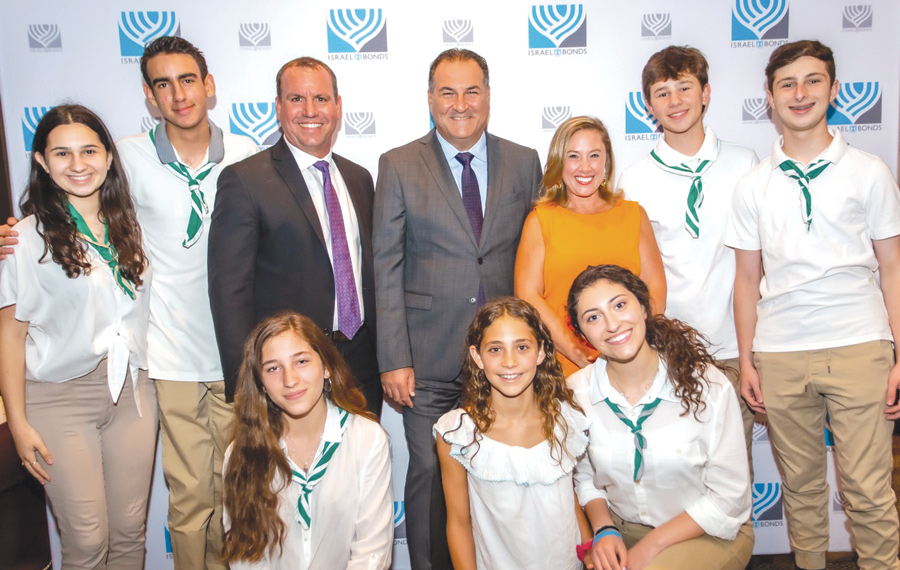
Development Corporation for Israel/Israel Bonds Los Angeles held a private Prime Minister’s Club reception on Sept. 9, welcoming the newly appointed Consul General of Israel in Los Angeles Hillel Newman at the home of Laura and Leigh Stein in Beverly Hills. Attendees included prominent community members who have invested $25,000 or more in Israel bonds.
Erez Goldman, executive director for Israel Bonds’ Western region, addressed the assembly, stating, “It is great to see such a large gathering of some of the strongest Israel Bonds investors, who directly support the Zionist enterprise and help to secure a safe and prosperous Jewish homeland.”
The event also featured remarks by Rabbi Marvin Hier, founder and dean of the Simon Wiesenthal Center, and Israel Maimon, president and CEO of Israel Bonds. Maimon, in referencing Israel’s second round of national elections held Sept. 17, said, “Democracy is, and will remain, a defining trait of the Jewish state. In a region of dictatorships, oppression and totalitarian rule, Israel, the Middle East’s only democracy, stands apart.”
The reception was organized by the Steins and Sam Goldfeder and Joe McNamara, all of whom are Los Angeles-based Israel Bonds investors.
The gathering was the latest in a number of high-profile Israel Bonds events. Others have included an investors’ forum featuring guest speaker Lauren Weinstein and the annual Golda Meir Luncheon, which generated more than $9 million of Israel Bonds investments and pledges to invest.
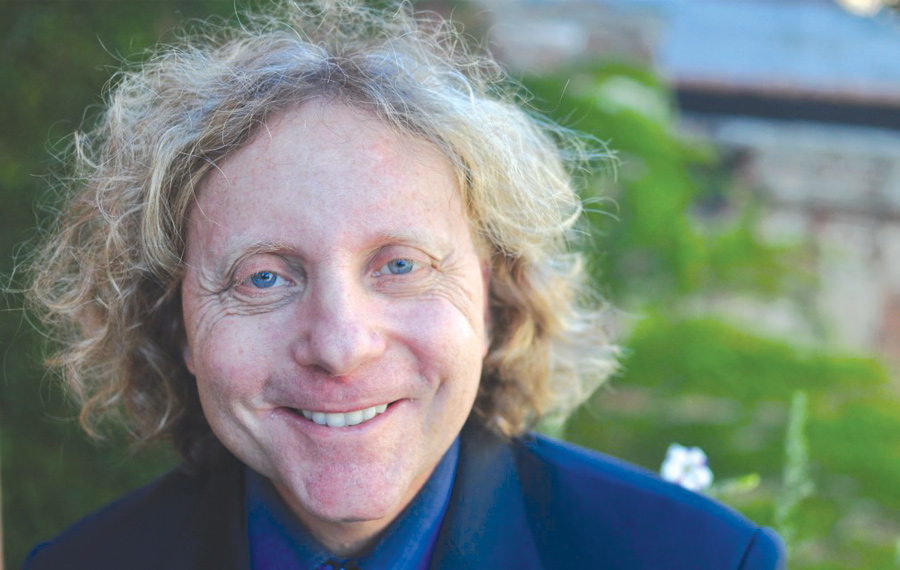
Thane Rosenbaum; Photo courtesy of timesofisrael.com
Noted author and law professor Thane Rosenbaum has been appointed a distinguished university professor at Touro College.
Alan Kadish, president of Touro College, said, “I am pleased that Thane Rosenbaum has joined the Touro College and University System. Rosenbaum is a thoughtful and perceptive scholar and public intellectual whose analysis and thought leadership is widely sought by educators, students and media outlets across the country and globally. In addition to his public leadership, we are excited about the impact he will have on our students through his teaching.”
Rosenbaum, founder and director of Forum on Life, Culture & Society, a nonprofit that is now affiliated with Touro College, said he is looking forward to being “a part of Touro’s ongoing growth and evolution as a dynamic place for students and faculty. The fact that it is under Jewish auspices appealed to me, as well, given that so much of my work as a novelist, essayist and commentator involves Jewish themes.”
Touro College is a nonprofit education institution devoted to enriching students’ Jewish heritage. The Touro College network includes 34 campuses and locations in New York, California, Nevada, Berlin, Jerusalem and Moscow.
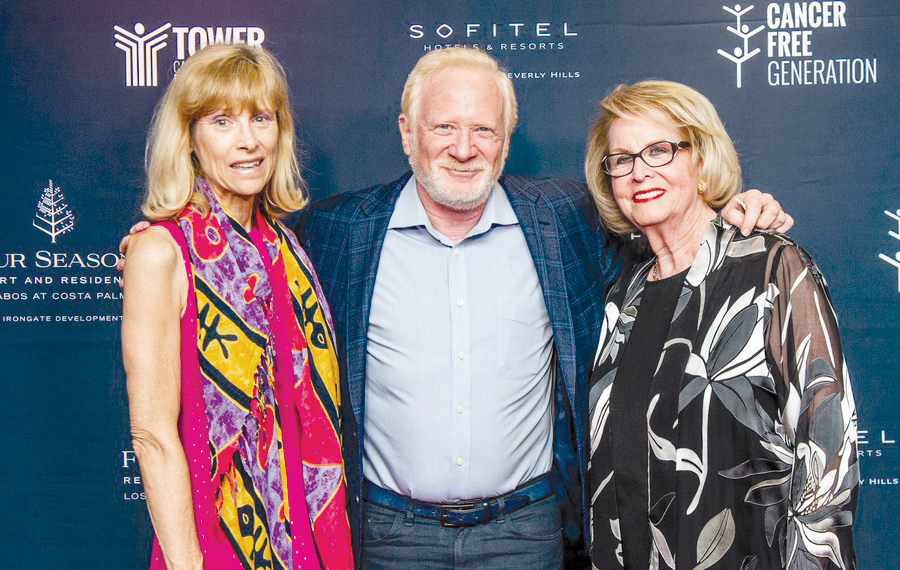
From left: Megan Most, actor Don Most (“Happy Days”) and Tower Cancer Research Foundation (TCRF) Board Chair Donna Rosen attended TCRF’s recent celebrity poker tournament, which raised funds for cancer research. The event honored longtime Jewish Federation supporter Casey Federman. Photo by Betesh Photography
Dozens of stars from TV, film, music and sports turned out to support young cancer researchers and change the future of cancer at Tower Cancer Research Foundation’s (TCRF) sixth annual Ante Up for a Cancer Free Generation Celebrity Poker Tournament and Game Night on Sept. 7 at the Sofitel Los Angeles at Beverly Hills.
This year’s tournament honored Casey Federman, founding president of Cancer Free Generation (CFG), the young leadership division of TCRF.Federman is a longtime Jewish Federation of Greater Los Angeles supporter.
CFG seeks to identify visionary and innovative doctors, medical professionals and researchers and enable them to discover and implement new ideas and techniques to conquer cancer. Additionally, CFG’s efforts support young people and their families who have been impacted by cancer so that they can approach life with renewed strength and optimism.
More than 400 people attended the poker tournament, including more than 40 celebrities from TV, film, music, sports and poker. The event raised more than $250,000 and was TCRF’s most successful poker tournament to date, according to a TCRF press release.
The funds raised will support young cancer research investigators with career development grants as well as patient support programs.
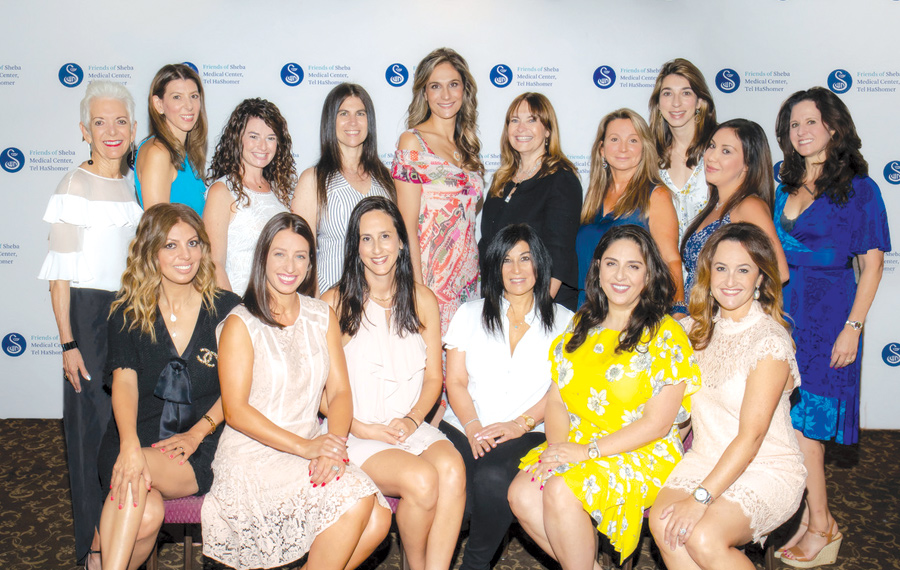
Friends of Sheba Medical Center luncheon committee members. Photo courtesy of Friends of Sheba Medical Center
Friends of Sheba Medical Center (FSMC) held its second annual
Women’s Community Luncheon on Aug. 29 at Woodland Hills Country Club.
The luncheon brought together the West San Fernando Valley community to support Israel and challenge outdated views and the life-limiting stigmas attached to mental illness. The event was held in memory of David Shakiban.
More than 250 guests attended the sold-out event, led by mistress of ceremonies Jill Simonian, an author and media personality on parenting segments known on-air and online as “The FAB Mom.”
The luncheon featured a keynote presentation by professor Mark Weiser, head of the division of psychiatry at Sheba Medical Center. Weiser declared that funds
raised at the luncheon will directly support the launch of Sheba’s at-home nursing program and implementation of telemedicine for the treatment of patients with
mental illness.
Dr. Susan Bookheimer, a clinical neuropsychologist and professor-in-residence in the UCLA Department of Psychiatry and Behavioral Sciences and Department of Psychology, was honored at the luncheon. Bookheimer specializes in functional brain imaging with PET and functional MRI. Her work centers on the organization of language and memory in the brain, in healthy adults and children, and in neurologic conditions and developmental disorders.
“I am thrilled that so many women in our community attended this meaningful luncheon to show their support for the mental health services at Sheba Medical Center,” luncheon Chair Lisa Golshani said. “Professor Weiser’s insightful presentation on mental health really resonated with many in the audience.”
Recently named one of the “Top 10 Best Hospitals in the World” by Newsweek magazine, Sheba Medical Center, Tel HaShomer calls itself the largest and most comprehensive medical center in the entire Middle East.
Want to be in Movers & Shakers? Send us your highlights, events,
honors and simchas. Email ryant@jewishjournal.com.
In the not-too-distant past, I sought help from a friend with the wording of a work email in which I would be letting down a colleague. My friend, who works in corporate law, scanned my draft and said it looked fine. But, he qualified, he doesn’t apologize in work emails. That sounded prudent — even revelatory. Feeling like I had been let in on a secret of success, I deleted the word “sorry” from the letter.
As I’ve learned since then, not saying sorry has unapologetically become best practice in professional settings. You can evade, clarify, thank, double down, ignore — but never apologize. There now exists a whole non-apologetic lexicon: A tweet rattling off alternatives that recently appeared in my timeline had been favorited over 365,000 times. It doesn’t stop there. To help people break this ugly habit, a Google Chrome extension called “Just Not Sorry” catches any contrite language that sneaks into your emails as you compose them. Who needs a friend in corporate law?
What’s the fuss over saying sorry, anyway? Is it a matter of presentation or does it strike at something deeper? A November 2012 article in the European Journal of Social Psychology stated that refusing to apologize could actually carry psychological benefits — improving self-worth and strengthening one’s sense of agency. On the other hand, the Just Not Sorry tool states apologizing “undermines your power and makes you appear unfit for leadership.” And all these years I thought I was taking the high road.
Granted, the anti-apology crusaders emerged to address the phenomenon of over-apologizing at work, where power structures are already often fraught with gender, race and sexual dynamics. For example, according to a November 2010 article by the National Library of Medicine, women tend to apologize more than men. Encouraging women to stand their ground can allow them — or anyone predisposed to self-doubt — to be themselves, share their opinions and advance more confidently in the workplace. In a society whose central principle is that competition brings out the best in us collectively even if it can bring out the worst in us individually, short-circuiting the human instinct to apologize is a rule of thumb being passed off as a self-help trick.
For the first 11 months of the year, whether the aversion to saying sorry stays at work or it bleeds into our personal lives, we can attempt to mute our instinct toward empathy. But Judaism creates a seasonal imperative to amplify it.
But it’s hard to build work habits that aren’t life habits. Is the “s”-word taboo really confined to the workplace any more than power dynamics are? You don’t have to look far to find people who avoid saying sorry even when doing so is thoroughly called for (or offer the “sorry-if-I-hurt-anyone” instead — a self-righteous, self-defeating anti-apology). The research hints at a dangerous feedback loop: As denying apology continually confirms our own correctness, we may begin to lose the ability to recognize our weaknesses and missteps. The next time I let down someone, will I even notice I’ve hurt them?
From the first shofar blows of Elul to the final blast of Yom Kippur, the Jewish period of repentance calls us to return — not only to God, and to one another, but to our human senses. In his treatise on repentance, Maimonides points out that the insight to know right from wrong and to choose with regard to that distinction is the defining feature of our species. Apologies, then, extend from an even greater gift: the ability to recognize that someone else might have chosen differently.
For the first 11 months of the year, whether the aversion to saying sorry stays at work or bleeds into our personal lives, we can attempt to mute our instinct toward empathy. But Judaism creates a seasonal imperative to amplify it. The month of Elul, whose precepts command us not only to repent but also to forgive, thus becomes a safe space for sincerity. This month plus the following 10 days are a time to allow ourselves to be vulnerable, to confront and admit fault — to err on the side of apology.
Seeking forgiveness from a Higher Power is to surrender the lower power — the notion of control that feels so pathetic this time of year — that we have been so desperate to protect. We emerge feeling invigorated not by feelings of self-determination but by the strength of our connections, with our faith and with each other.
In the age of “Sorry/Not Sorry,” teshuvah is tonic. We humble ourselves before loved ones, revisiting our worst moments of the year (don’t try this at work) to see if they’ll still have us. Then we get to be magnanimous with others, modeling the forbearance we will soon pray for and enacting a vision of society that’s less concerned with negotiating power than building understanding.
Finally, seeking forgiveness from a Higher Power is to surrender the lower power — the notion of control that feels so pathetic this time of year — that we have been so desperate to protect. We emerge feeling invigorated not by feelings of self-determination but by the strength of our connections, with our faith and with each other.
But what happens when we break the fast and bump into someone in the line for bagels and apple juice? Does it make a difference whether we blurt out the “s”-word? The upshot of that European Journal of Social Psychology study is that the words “I’m sorry” still carry profound weight. If we’re trying to reclaim the apology from the realm of rote performance, we may choose to reserve it for graver offenses. But then let us be wary of acknowledging our humanity only 40 days a year.
Louis Keene is a writer living in Los Angeles. He’s on Twitter at @thislouis.
When I’m walking my dogs in the neighborhood and I come upon a pine cone on the sidewalk, I can’t help picking it up. Pine cones are considered gold in crafting currency. There are so many projects you can make with them. And here’s a fun example just in time for fall — turn them into little apples that can hold place cards. What a whimsical idea for your table on Rosh Hashanah, or save them for Sukkot in a few weeks.
What you’ll need: Pine cones
Red acrylic paint
Paint brush
Green felt
Glue
Cardstock
1. Gather your pine cones. If you don’t have any in your yard or neighborhood, you can buy them at the crafts store. The pine cones I used were on the small side, about two inches around. The smaller they are, the easier they are to paint.
2. Apply red acrylic paint on the pine cones with a paintbrush. Try to get in between the scales so that the whole pine cone is covered, except for the small scale at the very top. I like to keep that one unpainted so it looks like an apple stem.
3. Cut a leaf shape out of green felt, and glue it to one of the scales at the top of the pine cone. You can also use green construction paper if you have some of that handy.
4. Cut small strips of cardstock and write names of guests on them. The size of the strips will depend on the size of your pine cones. My place cards were about 1 /2 inch by 2 inches. Then slide the place cards between the pine cone scales.
Jonathan Fong is the author of “Flowers That Wow” and “Parties That Wow,” and host of “Style With a Smile” on YouTube. You can see more of his do-it-yourself projects online.