fbpx

September 25, 2019

14-Year-Old Israeli Sailing Champion Now Lives in Los Angeles

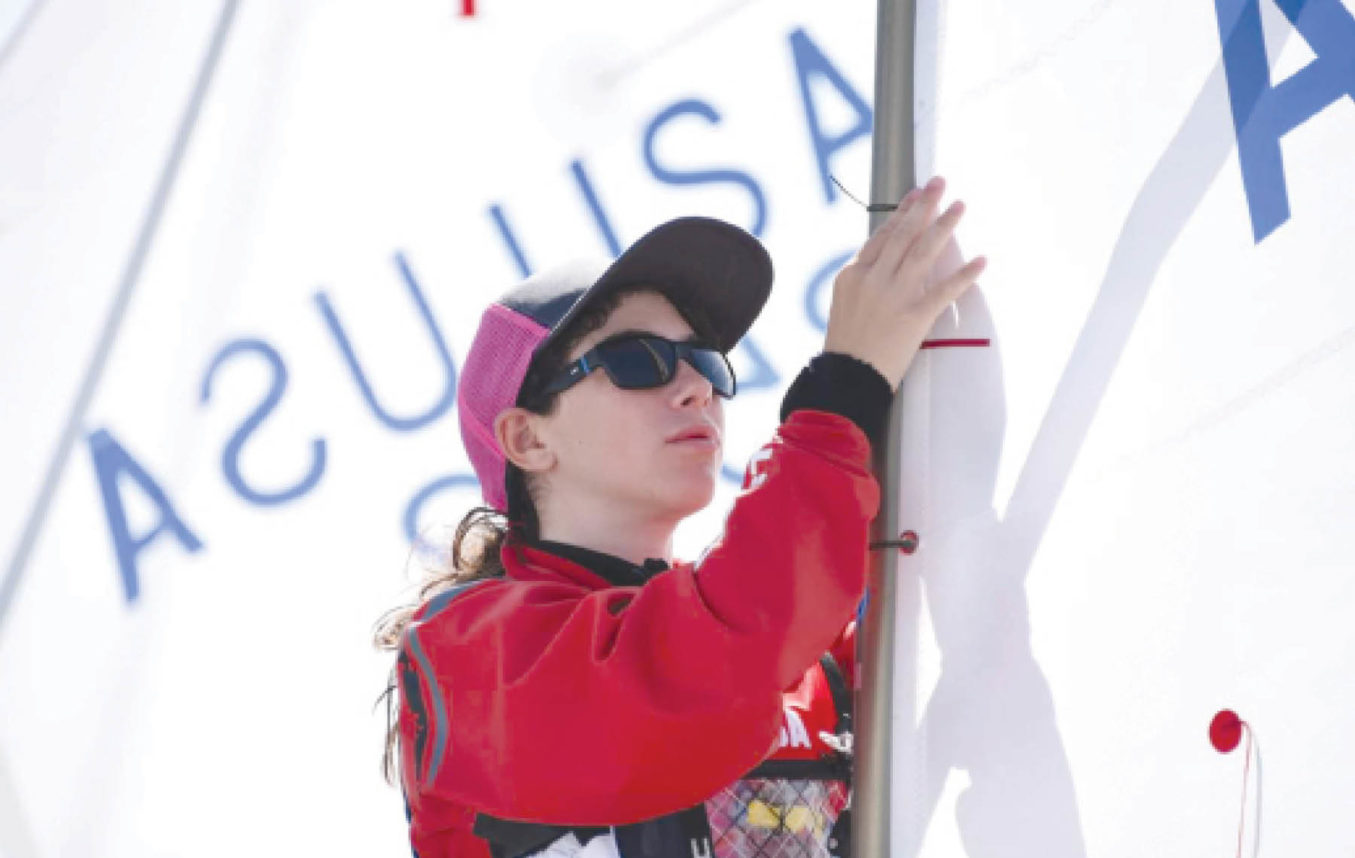
It seems like smooth sailing ahead for Mika Sternberg. Not only has the 14-year-old Israeli sailing champion racked up competition victories in her homeland, she is now competing all over the United States, having moved from Tel Aviv to Los Angeles with her family. She recently participated in an international regatta in Belgium as part of the official U.S. sailing team, in which she finished in the top 10, beating more than 100 competitors from 22 countries.

Mika’s interest in sailing began when she was around 9 years old, and she joined her father, Amit, on weekly sailing excursions at the Tel Aviv marina. “Every time we arrived at the marina, Mika would see all the small boats and she would ask me how she can start sailing on those boats,” Amit told the Journal. “So one of my friends made a connection to the Tel Aviv sailing club and that’s where it all started. Mika climbed into a boat and never got out of it. It took her just one summer to learn the ropes.”

For Mika’s parents, her talent came as somewhat of a surprise because she doesn’t come from a family of professional sailors. “My wife and I have no clue how she got this kind of talent,” Amit said. “I remember the very first competition that Mika took part in, which took place during winter in Haifa. She was in a small boat and it was raining horribly and she was sailing in between large ships and huge tankers in the harbor and we just looked at one another in absolute shock and amazement.”

Mika was 12 when she moved with her family to Los Angeles in 2017. Even though her parents moved for business reasons — both are involved in startups — their No. 1 priority was cementing their daughter’s future in sailing. 

“My biggest influence is Gil Cohen, an Israeli Olympic sports sailor. To excel like her, I need to constantly push my limits.”  — Mika Sternberg

“During this time, Mika was already accomplishing so many things in Israel, such as winning the Israel sailing championship in her age group. So in order to keep that momentum it was very important for us to find the right club and to be based somewhere near the marina, so we chose to live in Pacific Palisades,” Amit said. “I got in touch with the program manager of the California Yacht Cub and, based on Mika’s accomplishments, she got into the club’s program. Mika’s last training in Tel Aviv was on a Saturday and the following week, she already was sailing in California. We tried to make Mika’s transition as smooth as possible.” 

Mika attends Palisades Charter High School, where she is part of the school’s sailing team. She also practices every weekend at the California Yacht Club. Since her achievements in Belgium, she has won second place in the “Best Girl” category of the West Coast Championship. Later this year, she’ll compete in the national championship in New Orleans.

For Mika, the transition from Israel to L.A. has been somewhat challenging. “I still feel Israeli in my heart and soul, and keep in close touch with my Israeli friends,” she said. 

“Israel is so much smaller than the U.S. The farthest competition Mika took part in was in Eilat, which is just three hours away from Tel Aviv,” Amit said. “Now we have to fly everywhere. Also, in Israel, the sailing community is a small group and it feels like a very big family, so people would help each other and take each other’s boats to competitions. In America, everything is larger on every scale. It is much more methodological here — you have grades and instructors taking pictures and videos of the yachtsmen while they train, which they can analyze later on.”

For the most part, Mika feels tranquil on the water. “It depends if it is a big competition,” she said. “Sometimes I can be a little bit nervous but mostly I am calm and relaxed.” 

Mika’s ultimate goal is to become one of the best athletes in her sport, and hopefully have the chance to compete one day in the Olympics as part of either the Israeli or American national team. “My biggest influence is Gil Cohen, an Israeli Olympic sports sailor. She competed in sailing in the Women’s 470 in the 2012 Summer Olympics, and in the same event in the 2016 Summer Olympics. To excel like her, I need to constantly push my limits,” Mika said.

“We are very proud of her and totally support her,” Amit said. “All these years she has been pushing herself. We never forced her. She was like a magnet to the sport. One cannot do this without passion. It is tough on the water; it’s tough in the competitions.”

14-Year-Old Israeli Sailing Champion Now Lives in Los Angeles Read More »

Shofar-Blowing Class Provides Lung Workout in Time for the High Holy Days

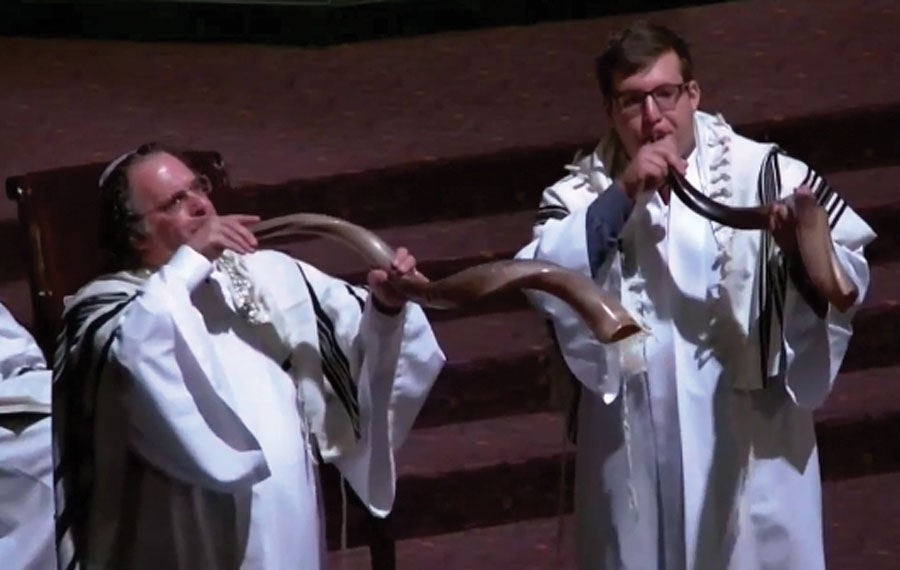
While every Jew is commanded to hear the shofar on Rosh Hashanah, thankfully we’re not all required to learn how to blow one. But for those wanting to give their lungs the ultimate workout, Hollywood Temple Beth El held a shofar workshop on Sept. 15, led by Rabbi Norbert Weinberg. A few hardy souls showed up to learn how to wail like Joshua bringing down the walls of Jericho or, in this reporter’s case, blow oneself red in the face while bringing forth a sound resembling a dying moose.

Weinberg told the Journal that this was the second time he’s held the workshop. As part of the synagogue’s Rosh Hashanah services, he likes to invite any member of the congregation to come up to the bimah and become familiar with the instrument. 

Unlike the trumpet or other horns, you don’t have to worry about hitting the right note. The ram’s horn’s unpredictable sound is a feature, not a bug. Maimonides called the sound of the shofar “penetrating” and its harsh, atonal sound is meant to unsettle. 

“The Rambam says this unsettling forces us to think about our actions for the year,” Weinberg said. It’s also why shofars are never equipped with a mouthpiece. “If you use a mouthpiece, it’s predictable,” Weinberg explained. “This is a wild animal and playing it is like taming a wild animal, so you need an untamed beast. You’re going to take it as it comes: natural. That’s a very important part.”

Shofars available at the workshop. Photos by Steven Mirkin

Weinberg demonstrated the three types of sounds heard on Rosh Hashanah, starting with the malchuyot, one long blast, representing the enthronement of God — the coronation. “That would be the original intention,” Weinberg said, “because you blow the shofar at the coronation of a king; God is King of the Universe.” Then there is the zichronot, three short blasts that represent remembrance. “This is very practical,” Weinberg said. “God remembered us in the past, maybe we’ll get a lucky break and escape the pogrom this year, too.” Finally, the shofarot, “the sound that comes at the end of history, when all existence is redeemed.” Taken together, he said, “you have the present, past and the future, and all of that is in the shofar.”

“This is a wild animal and playing it is like taming a wild animal.” — Rabbi Norbert Weinberg

When it came time to finally pick up their horns and blow, one player stood out. Yoni Workman arrived with his own very impressive shofar, and he sounded so adept, it was possible to believe he was a ringer. 

However, he told the Journal he bought the shofar only a few days earlier at a Judaica store on Fairfax Avenue, and he was able to produce that familiar keening wail from the get-go. He started to play as he walked down Fairfax to his car. “People were coming up to me saying how cool it sounded,” he said. 

Weinberg allayed the other would-be shofar blowers’ fears by stating, “The Baal Shem Tov wanted to find a person to blow the shofar for him at Rosh Hashanah. So he interviewed three candidates. He asked the first [candidate] what was on his mind when he played. He said, ‘I’m thinking of the Torah, the kabbalah, etc.’ The second one said he was thinking of all the great ones who came before him. The third candidate said, ‘I’ve got a wife, I’ve got 10 kids, there’s no money to feed them. If I get this position, maybe you’ll give me a few dollars to blow the shofar.’ The Baal Shem Tov said, ‘You are the one I choose, because you mean it.’”

Shofar-Blowing Class Provides Lung Workout in Time for the High Holy Days Read More »

Rick Recht Brings High Energy to the High Holy Days

Jewish rock music is a relatively new concept among American Jews but has found its way into traditional services as a way to connect people to their faith.

 Rick Recht, song leader and legendary Jewish rock star, grew up idolizing Elvis and dreaming of becoming a rock star but had no idea he would go on to impact thousands of Jewish people in synagogues around the world. 

“I didn’t grow up with Debbie Friedman or Craig Taubman. I grew up in a small Conservadoxish shul and it was great but it didn’t have a lot of music,” Recht, 49, told the Journal. “I joined [the Reform Jewish youth movement] NFTY in high school and from there I was exposed to contemporary Jewish music for the first time, but mainly exposed to holding hands with girls while listening to ‘Shalom Rav’ and ‘Heivenu.’ So it wasn’t something I thought of seriously until my mid-20s.”

Now with more than 10 Jewish rock albums, a musical partnership with PJ Library, and an internet radio station Jewish Rock Radio to his credit, Jewish music is an extension of himself. 

Recht strives to enhance the traditional Jewish experience. Together with his wife, Elisa, a Jewish educator who introduced Recht to Jewish song leading, they work with rabbis, cantors and other Jewish leaders at Songleader Boot Camp teaching how to integrate informal Jewish experiences like summer camp and youth group into a sanctuary setting.

“We found that Jews now more than ever … want to engage, they want to interact,” Recht said. This can include introducing new melodies, call-and-response songs, English transliterations and creating an energy that moves congregants.

He added it’s common to see this energy throughout synagogues across the country. “A lot of the time nowadays the concern is not having contemporary music,” he said, “it’s losing the traditional music altogether. So one of the biggest concerns is making sure while we incorporate all this new interactive music, we also still honor traditional music.” 

Many of Recht’s songs including, “The Hope,” “Hallelujah,” “Mi Kamocha,” and “Kobi’s Lullaby,” have been integrated in Shabbat and Havdalah services for several years. 

Recht said the repetition of his songs and songs of other Jewish music rockers have allowed people of all ages to sing along and join in during services. Even his sons, Kobi and Tal, whom he once wrote lullabies for, are engaged during his musical experiences and have also inherited the musical gene.

With the High Holy Days approaching, Recht is gearing up to lead services in St. Louis but the music he plans to incorporate isn’t the top priority. His energy and the way he engages with his congregants are what he is looking forward to the most. Elisa’s home cooking after services is a close second.

“I don’t zero in on any particular prayer. The holidays are an opportunity, a window, for many people who only come to synagogue maybe that time each year,” Recht said. “It is a really wonderful opportunity to the leaders of the service to share a glimpse of the highlights of the rest of the year. When I’m leading services, I’m thinking about ‘What’s the best of the best?’ and ‘How can I bring that into this High Holy experience so that we can take it into the stratosphere for people?’ ”

And, he added, it’s also about the delivery. “More often, it’s not about the song selection it’s about the presentation.” He also hopes people in their suits and dresses feel compelled to dance and sway with each other so their High Holy Day experience is meaningful. 

“This is our big shot,” he proclaimed, adding his wish is that the energy from the High Holy Days continues throughout the year, which is why his work is never about any single song but rather “about the potential [a] song might have to making a community more connected. People walking out of the experience will feel incrementally different than they did when they walked in. They will feel more connected to each other [and] have a stronger pride and connection with their identity as Jews.”

Having the ability to enrich Jewish lives in so many ways and also help others become Jewish song leaders is something Recht said he is fortunate be a part of. 

“We are educators where music is our vehicle,” he said. “Jewish artists have the opportunity to impact lives in a way that sometimes transcends anything academic or intellectual. It just goes straight from the heads to the hearts. It’s a responsibility.” 

More on Rick Recht can be found online. His music also is available on Spotify and Apple Music. 

Rick Recht Brings High Energy to the High Holy Days Read More »

Hazon Calls for ‘Environmental Teshuvah’ in the New Year 5780

“Essentially, we are working to enable the Jewish community to make a difference on the climate crisis and using that process to strengthen Jewish life.”

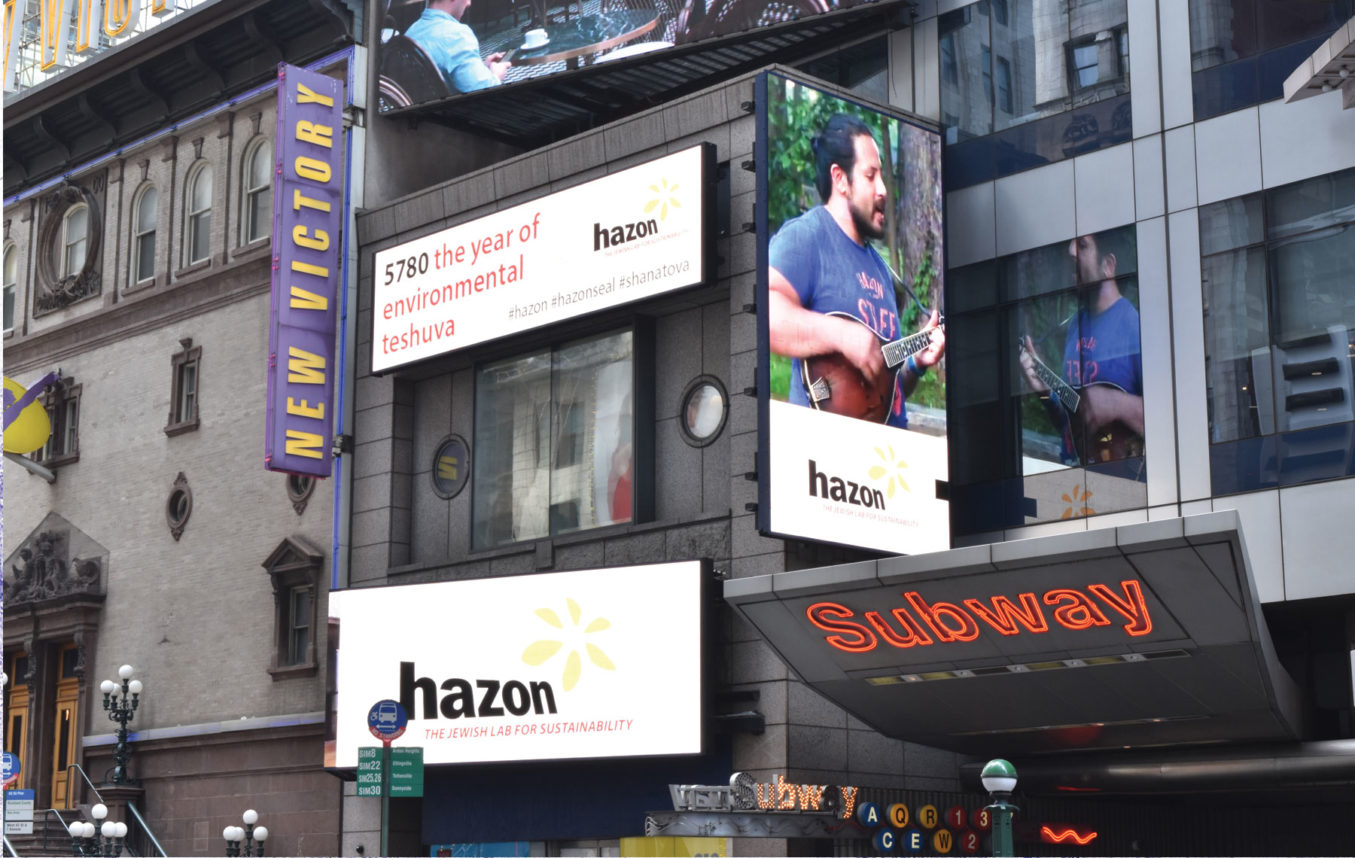
So says Hazon founder and CEO Nigel Savage, whose environmental nonprofit is marking the Jewish year 5780 as the year of “environmental teshuvah.”

“We really are raising our game and starting to rally the Jewish community and people want to make a difference, so it seemed very clear to us to say this has to be the year of environmental teshuvah,” Savage said. “It is not only the right thing to do, it is actually really necessary and if we do it seriously, it will not only strengthen the Jewish community and help build relationships with other faith communities in this country, it will also strengthen civic society. It is also a new way to frame a relationship with Israel. It is not just that this is a climate crisis; there are many big consequences in engaging in a positive way with the need to do environmental teshuvah.”

Hazon also is offering five steps everyone can take as they sit at holiday tables and consume what can be considered as excessive amounts of food.

“We are a community and a people of lists,” Savage said. “We really are trying to help to make it easier for people and one of the key things that we are stressing is everything to do with food. For thousands of years, people have a tradition of keeping kosher and the word kosher literally means steps. If we ask [is this kosher?], we’re really saying [is this safe for us to eat?]”

The first step is to eat a plant-rich diet by committing to eating fewer industrial meat and dairy products. “Most people know that it’s better [for the environment] to drive a Prius or a Tesla than an SUV,” Savage said. “I think that people are aware that industrial meat and dairy constitute half of all human-caused climate change. So we have to start to make that change. It doesn’t mean you have to be vegetarian or vegan, but if we do eat meat or dairy, we should try having it be from regenerative agriculture and from animals that have lived in a mixed-use environment.”

The second step is to waste less food by buying only what you need and by eating, rather than throwing out, any leftovers. According to Savage, “Over 40% of all the food produced in this country is wasted. An enormous amount of carbon is going in its manufacture, in transportation. To cut that down radically would be the equivalent of turning off a slew of coal-fired power plants. And most people don’t realize that.”

Step three consists of getting to know and buy from local farmers. One of the ways Hazon has promoted this is through the introduction of CSAs — Community Supported Agriculture programs. “Today, there are more than 70 CSAs in Jewish communities around the country, supporting local farms,” Savage said. “A growing number of people in the Jewish community are starting to connect to farms in a thoughtful, serious way.” 

“When we eat our apple and honey this year, it should be an organic apple and local or organic honey, and our blessing should be, ‘Please, God, let me help to make a healthier world this year.’ ” — Nigel Savage

The next step is reducing and better managing plastic waste. This means avoiding single-use plastic disposables, including plastic cups, bottles, utensils, bags and takeout containers. Try to buy in bulk and support companies that strive to reduce the amount of packaging they use and incorporate recycled content into their packaging.

Finally, one should choose good apples and honey.

“We begin Rosh Hashanah hoping for a sweet year with two things that both come from the natural world,” Savage said. “When you think of all the gunk that is sprayed on apples, you think of the colony collapse disorder in relationship to bees, so when we eat our apple and honey this year, it should be an organic apple and local or organic honey, and our blessing should be, ‘Please, God, let me help to make a healthier world this year,’ and that’s what environmental teshuvah really means.”

Hazon also is collaborating with author Jonathan Safran Foer, whose latest book, “We Are the Weather,” explores how food choices impact the climate. Hazon has sent copies of the book to more than 100 rabbis and invited them to give sermons on environmental teshuvah.

“This really is a climate crisis,” Savage said. “It’s become clearer and clearer, and Jewish tradition compels us to respond.”

Hazon Calls for ‘Environmental Teshuvah’ in the New Year 5780 Read More »

Susan Karlin Carries on the Family Shofar Blowing Tradition

There are three shofars on display in Susan Karlin’s West Hollywood apartment, but to her, they’re not just Judaica. “When I look at them, it makes me smile and think of my parents and my lineage, and making people happy at synagogue,” she said. 

A fourth-generation shofar blower, she provides the teruah, tekiah and shevarim blasts every year at the Laugh Factory comedy club’s High Holy Days services.

“It’s a very majestic, powerful and spiritual sound. It can be chilling or very emotional,” Karlin said. “There’s something awe-inspiring about everyone gathering together and listening to that sound together. There’s an element of power and spirituality associated with it. It’s a profound ritual. That’s what draws me to it.”

Growing up in New Jersey, Karlin loved watching her father blow the shofar at their synagogue. “One Rosh Hashanah, we came home from services and I asked him to show me how,” she said. She learned on the smallest of her shofar trio, which her grandfather brought from Poland to the United States in the 1920s. 

“I had to keep practicing and practicing. It took a while to actually get a sound out of it. Then my dad taught me how to manipulate my tongue to get the notes. He taught me to blow it on the side of my mouth, not straight on. You purse your lips and you want to wet them and create a little airway so they vibrate a little bit,” she said. ‘You have to hit it in exactly the right spot.

“It also takes a lot of core work,” Karlin noted. “If you don’t take the breaths properly, you get really dizzy. I’ve learned over the years to slow down. My dad did it rapid-fire and I’d copy his pace but I found I couldn’t do it. It gives me a new respect for trumpet players.”

On a trip to Israel in the late 1970s, Karlin was with her father when he bought two shofars in Hebron, one 29 inches long and the other 12 inches. Each of the trio has a different sound. Her grandfather’s 10-inch shofar is “a bit shrill, and harder to blow because of its narrower opening. The large one has a deeper tone. The middle one is easiest for me,” she said. “It’s the one I play the most.”

“It’s very profound to be carrying on a family tradition like 

this. I like that I pushed this family tradition into the 21st century and broke some barriers. It started as a badge of honor, carrying it on. Now I derive more meaning from it. It makes me feel more connected to the ritual of gathering together as a community and taking stock of our lives.” 

— Susan Karlin

Karlin didn’t learn to blow the shofar with any intention of doing it publicly, but after she attended services at the Laugh Factory, she approached Rabbi Bob Jacobs and volunteered. She auditioned and was hired on the spot. She was aware that at that time, in the 1990s, there were no female shofar blowers. “Now it’s much more common. I’ve seen female rabbis, kids, fathers and daughters do it,” she said. She hopes to bequeath her shofars and teach the skill to her teenage niece.

“It’s very profound to be carrying on a family tradition like this,” she said. “I like that I pushed this family tradition into the 21st century and broke some barriers. It started as a badge of honor, carrying it on. Now I derive more meaning from it. It makes me feel more connected to the ritual of gathering together as a community and taking stock of our lives.”

A University of Pennsylvania graduate, Karlin is a journalist who writes “about the nexus of science, technology and the arts,” and whose work has taken her to every continent. She recently became recertified in SCUBA diving for an assignment and will go to Lake Como in Italy for a comic-art show this spring. She’s developing ideas for books, graphic novels and oral storytelling. “My goal is to continue to learn and try new things and to have as many adventures as I can,” she said. “I’ve always been more interested in experiences than things.” She attends the Burning Man festival every year and has turned her pet snails into Facebook stars.

Of Polish and Russian heritage, Karlin was raised in a Conservative, kosher home. Her father was Orthodox and her mother was Reform and, she said, the two “met in the middle.” She “still has PTSD from learning my haftarah at my bat mitzvah,” she joked. Pork and shellfish are still off the menu, and she defines her humor as “very Jewish. I see everything through that prism,” she said. Diagnosed with hypoglycemia several years ago, she no longer fasts on Yom Kippur. “I eat, but less than I normally would.”

Since returning from Burning Man in early September, Karlin has been practicing her shofar-blowing every day. She also is teaching herself to play the banjo, an instrument she received as a gift at the festival. “My neighbors are going to hate me,” she said. 

For Karlin, the High Holy Days are more than an occasion to pray and ask forgiveness, “even though that’s part of it. It’s more about taking stock of who I am, who I’ve become, how I’ve changed in the last year as a person, how I want to better myself, and whether I’m happy with the direction I’m going in on a spiritual level. It’s also taking stock of how I’ve wronged other people, wanting to ask their forgiveness and forgiving myself for how I’ve handled things in the past,” she said. 

“At the Laugh Factory, I feel a greater connection to the community and spirituality and my growth as a human being.”

Rosh Hashanah services will be held at 11 a.m. Sept. 30, continuing with Kol Nidre at 5 p.m. Oct. 8, and Yom Kippur at 11 a.m. Oct. 9 at the Laugh Factory, 8001 Sunset Blvd., Los Angeles. (323) 656-1336. Admission is free.

Susan Karlin Carries on the Family Shofar Blowing Tradition Read More »

Zioness Seeks to Create New Progressive Jewish Narrative

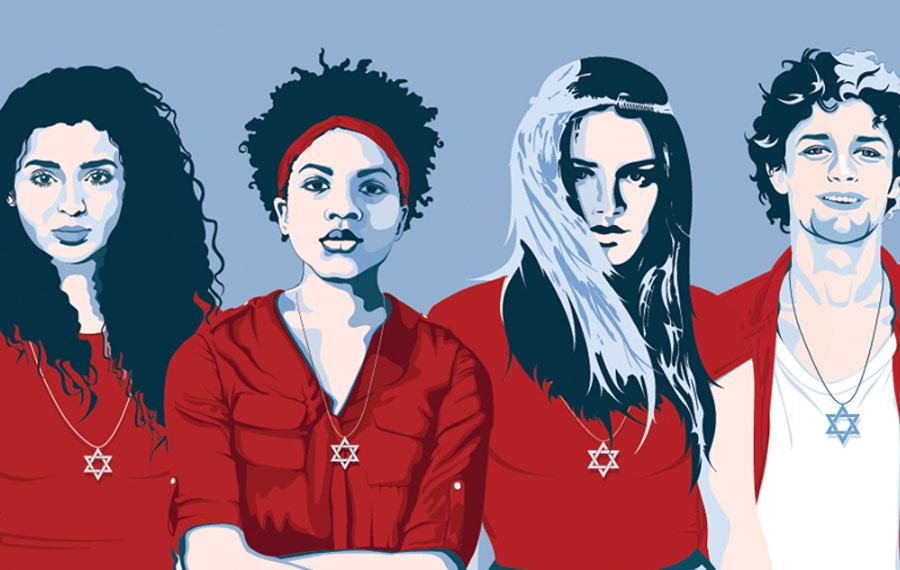
Barely two years after its founding, the progressive Jewish feminist movement Zioness has expanded its reach and has big plans in the works. 

At a briefing in Los Angeles on Sept. 20, Zioness founder and Executive Director Amanda Berman said hiring Carly Pildis as its director of grassroots organizing is just one of the many changes the organization is undertaking. 

Founded in 2017, the organization came to prominence that same year after the Chicago Dyke March initially refused to allow people to carry Jewish pride flags during the march (the March eventually reversed its decision in the wake of backlash). Zioness members participated in that march.

Today, Zioness has branched out to more than 30 cities including Los Angeles, New York and Washington, D.C., but is also working to provide resources to smaller cities. 

While Zioness promotes women’s equality, Black Lives Matter and LGBTQ  rights among others, the organization also tackles anti-Semitism in progressive spaces and has criticized former Women’s March, Inc. leaders Tamika Mallory and Linda Sarsour for their explicit forms of anti-Semitism, which include supporting the Boycott, Divestment and Sanctions (BDS) movement against Israel. 

Berman said when BDS and forms of anti-Semitism appear in places that have nothing to do with the social justice organization in question (including the aforementioned 2017 Dyke March and the 2019 Los Angeles Women’s March), many progressive Jews feel uncomfortable and turn away from fighting for causes they believe in. 

“Zioness is really about pushing anti-Semitism out of progressive spaces through a narrative shift. It’s hurtful when progressives who are running for office or hold office are perpetuating a narrative that is totally inconsistent with how American Jews feel.”
— Zioness Executive Director Amanda Berman 

“There’s been a real attempt to take over and really exploit a lot of progressive spaces and movements to talk exclusively about the Israeli-Palestinian conflict,” Berman said, “and it’s really hard for those movements because the conversation ends up being about anti-Semitism and Palestine and the conflict in the Middle East and foreign aid, and nothing to do with the domestic progressive agenda.” 

She added that if progressive Jews become “politically homeless,” they just won’t show up. The fear, Berman said, “is that if we don’t have a home on the left, we are done; we don’t have a voice and we are in big, big trouble.” 

Citing the recent decision by Mallory, Sarsour and Bob Bland to resign from the Women’s March, Inc. board, Berman said Zioness openly supported that decision. However, she said it became clear that it was too good to be true when Zahra Billoo was added to the board. Billoo has a history of tweets equating Israel to the Nazis and ISIS. 

“The things that [Billoo] tweets are truly some of the most vile things I’ve ever seen in an attack on the Jewish community,” Berman said. “It’s not even a question that if somebody spoke that way about any other community, nobody would give them one second to be a part of a progressive movement.”

Zioness immediately put out a statement condemning Billoo’s appointment. Within 12 hours, Women’s March, Inc. had removed Billoo from the board.

“We’re thrilled,” Berman said. “This is the first time the Women’s March has actually heard the Jewish community and seen the pain that we are trying to express and communicate. … I really hope that this will be a model for other progressive movements to see that it is possible to actually address anti-Semitism, even if it is masked as anti-Zionism.” 

Berman also noted that while it’s not possible to control what people say, anyone who wants to attend and support social justice causes should never be turned away because they are Jewish or identify as a Zionist. However, she added that the focus shouldn’t have to be on the Jewish community. “It’s about the advancement of the women’s movement and the women’s agenda, and if we are talking about anti-Semitism we aren’t talking about that.”

Zioness’ ultimate goal, Berman said, is to distribute its information to as many people as possible so they have the tools necessary to form marches and petitions in various communities. 

“It’s really important that we provide resources and direction to the lay leaders who have reached out and have said, ‘We need a Zioness chapter,’ ‘Zioness speaks for me,’ ‘Zioness is my natural ideological home but I know my community better than you do.’ ”

Berman cited the Twin Cities Zioness chapter in Minnesota as an example of this, which, she said, “has done amazing things,” including protesting outside a local bar where the owner used “Nazi-like” anti-Semitic rhetoric. Because the local chapter could target it quickly through the use of the Zioness’ materials, it was able to act on it. 

Of the 2020 Democratic presidential candidates, Berman said although Sens. Bernie Sanders and Elizabeth Warren are popular among progressives, she was disappointed that Sanders and Warren appointed Sarsour and Max Berger (a former IfNotNow activist), respectively, to their campaigns. “It just doesn’t make sense,” Berman said. 

“Zioness is really about pushing anti-Semitism out of progressive spaces through a narrative shift,” she continued. “It’s hurtful when progressives who are running for office or hold office are perpetuating a narrative that is totally inconsistent with how American Jews feel. It makes our work really difficult. It makes Jewish life in America really difficult.”

Zioness Seeks to Create New Progressive Jewish Narrative Read More »

ROSIES Foundation Helps Those With Disabilities ‘Give to Grow’

The nonprofit ROSIES Foundation that helps people with disabilities access meaningful work is offering an eight-week apprenticeship program, HirEd, in late October. The program will focus on building professional and personal skills to obtain market-wage jobs through peer-to-peer collaboration and mentorships. Following ROSIES’ motto, “Give to Grow,” apprentices will be provided with the tools to overcome obstacles, drive initiatives and train others.

ROSIES Founder and Chief Encouragement Officer Lee Chernotsky told the Journal, “A huge obstacle for many people with disabilities is that sometimes we need to be explicitly taught key practical skills, such as appropriate communication, teamwork and self-awareness. ROSIES’ holistic approach creates opportunities to develop talent and design programs with people and the employers hiring them to realize the value and power of diverse abilities.”

With almost 20 years’ experience working with people with disabilities, Chernotsky added he “discovered how empowering it is to be able to remove an obstacle, not for — but with — someone who might be more impacted by their challenges, regardless of the cause.”

ROSIES hopes “to give people with diverse abilities opportunities to learn why accessibility and awareness need to be core competencies at work, in schools and more importantly, in everyday life,” he said.

ROSIES has arranged trainings and employment opportunities for people with diverse abilities through Authentic Interactions (AI) technology. ROSIES provides people with the necessary skills to be able to pursue additional jobs “across several industries, some even launching their own entrepreneurial ventures,” Chernotsky said.

Board member Courtney Mizel told the Journal, “ROSIES’ interest in helping individuals discover themselves … and [giving] them opportunities that they may not otherwise be afforded is really along the lines of tikkun olam. How do we make the world a better place? We give more people meaning in their life, we help people in the community understand people who are different than they are, and we help people work alongside one another.”

Through ROSIES’ social enterprise arm, POP!, the organization provides crew members (previous apprentices) with meaningful employment opportunities. For example, ROSIES worked to transform a school bus into an ice cream truck, becoming the first ADA accessible food truck in the United States. Partnering with renowned brands, such as The Bigg Chill and Little West juice maker, ROSIES sells various products out of its truck at large-scale or privately catered events around Los Angeles County. 

A former ROSIES crew member from Los Angeles, Teren’e Chambers, told the Journal, “Lee was very impressed [by my] customer service, selling people hot dogs and/or ice cream. Because of ROSIES, that’s how I got [my current job in retail] because I’ve done customer service and handling money.”

“What I learned from my bubbe Rose, a Holocaust survivor, about perseverance, empathy and belief in everyone’s potential is at the core of what ROSIES is about.”

— Lee Chernotksy

As a 24-year-old with Asperger’s syndrome going into her senior year at UCSB, Chambers said, “It’s hard for me to hunt for a job out in the working world, and ROSIES foundation is one that actually [helped me to find] a sustainable job … and I was very surprised about that. “Since [I found] a job at ROSIES, it’s [made me] feel like I’m very productive and … very busy, making sure that I get paid enough, making sure there is no discrimination … that we’re all equal, that I belong.”

The organization has impacted the community by contributing to an “increased number of people with disabilities in paid employment at ROSIES and/or in our growing network of employment opportunities [and an] increased amount of wages earned by people with disabilities, giving them the ability to both spend and save money for the future,” Chernotsky said.

“Everyone needs a place where they feel a sense of confidence in their abilities,” he added. “Daily challenges I experience because of ADHD make me feel anxious, uncomfortable and overwhelmed in settings or situations where attention to detail is a priority. What I learned from my bubbe Rose, a Holocaust survivor, about perseverance, empathy and belief in everyone’s potential is at the core of what ROSIES is about. My grandmother taught me that if you give more than you take, there is a tomorrow.”


Melissa Simon is a senior studying journalism at University of Wisconsin-Madison and was a Jewish Journal summer intern.

ROSIES Foundation Helps Those With Disabilities ‘Give to Grow’ Read More »

Two L.A. Rabbis Participate in International ‘Common Destiny’ Forum in Israel

Acknowledging a growing rift among Jews and the increasing challenges presented by a shifting of Jewish identities, a group of 30 Jewish scholars, rabbis and activists from a wide spectrum of Jewish affiliations from Israel and the Diaspora came together on Sept. 10-11 in Jerusalem to launch an initiative designed to strengthen the bonds among Jews worldwide. 

“It seems like such a critical moment for the Jewish community. The rifts are so profound between religious and secular, between left and right, Israel and the Diaspora,” Los Angeles’ IKAR Senior Rabbi Sharon Brous told the Journal. “The idea to understand and articulate what our shared values are and how we can lead with those values in such tumultuous times really resonates with me.”

Brous, together with Rabbi Pini Dunner of Young Israel of Beverly Hills, were among the American delegation to the Our Common Destiny initiative, a joint project of the Genesis Philanthropy Group and the government of Israel under the patronage of Israeli President Reuven Rivlin. 

The group was comprised of one-third Israelis, one-third American Jews and one-third Jews from Europe, Latin America and Asia. There were also an equal number of men and women.

In their final declaration, which they presented to Rivlin on Sept. 10, the group called on Jews to “rise above internal disputes.

“We must transcend the ways in which we have understood our relationships to each other. We must move forward from a sense of shared fate, a ‘Covenant of Fate,’ one that focuses on a past in which we had less self-determination, to a covenant of a shared future, a ‘Covenant of Destiny,’ and join together to create a future that we can determine for ourselves,” they said in the declaration.

Rivlin welcomed the initiative, noting that as Jewish communities have successfully integrated into their home countries, they now face new challenges to their Jewish identity and the Jewish people. 

“The future of the Jewish people depends on three things: preserving our core values — traditions and identity — mutual respect for our differences,  and mutual responsibility to each other,” he told the group. “We must embrace our unity and our diversity. We must see our diversity not as a source of weakness, but a source of strength. When I say that the future of the Jewish people depends on preserving our identity, mutual respect and mutual recognition, I mean also the future of the State of Israel.”

Rivlin added that those who hate Jews don’t differentiate between one stream of Judaism and another. “Secular, Charedi, Reform, Conservative, Masorti — for them we are all Jews,” he said.

“The future of the Jewish people depends on three things: preserving our core values — traditions and identity — mutual respect for our differences, and mutual responsibility to each other.” 

— Israeli President Reuven Rivlin

The final declaration will be shared with Jewish communities around the world, and they will be asked to review and discuss it, and add their comments and views so that when the document returns to Israel by next year, it will encompass a wide selection of opinions. Rivlin said he was hopeful that the document would be an impetus for “conversations between communities, streams and generations” and that it could “serve as a roadmap for the future of the Jewish people.”

Ilia Salita, president and CEO of the Genesis Philanthropy group, told the Journal the input on the document from Jews of all perspectives was one of their main goals and they hope the possibility to contribute to the document will excite people who have not been involved in their Jewish communities and “allow them their voice.”

The Genesis Philanthropy Group, a global group of foundations, initially was established to strengthen the Jewish identity of Russian-speaking Jews worldwide. Today, it also works to strengthen the bonds and understanding between Israeli Jews and Jews in the Diaspora. 

From left: Gennady Gazin, chairman of Genesis Philanthropy Group, Ilia Salita, president and CEO of GPG, Israeli President Reuven Rivlin, and Sanford R. Cardin, chair of Our Common Destiny Advisory Board. Photos by Avishag Shaar-Yashuv

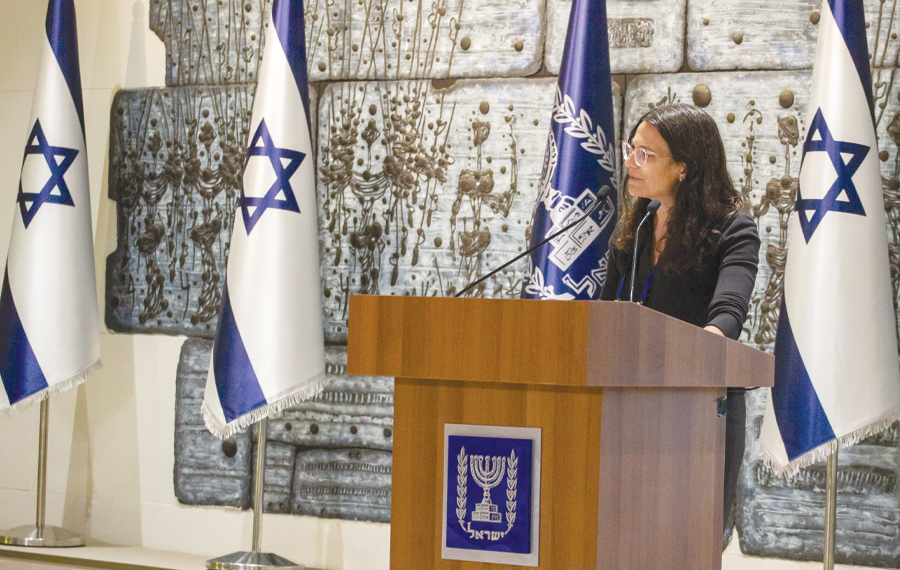
One of three speakers invited to address the gathering at the president’s house, Brous noted that the Jewish community is well aware of the external threats it faces. 

“As an American Jew, I can tell you that the past three years have felt like no other time in my life, as the rise in white nationalism has led to synagogue shootings, anti-Semitic vandalism, death threats and competing allegations of dual loyalty and disloyalty from the highest offices,” she said. “But we have, until now, failed to adequately address our internal struggles — which matter just as profoundly. The challenges facing the Jewish people are not superficial; they are foundational, and we must reckon with them honestly and openly.”

Dunner told the Journal that there are no easy answers to the existential question “How do we function as Jews with fundamental differences?”

“How do we find a common destiny? As much as we talk about the ‘Jewish people’ we are generally speaking of our own communities,” he said. “We live in our own bubble and very rarely do we venture out.”

He cited the boycott, divestment and sanctions movement as being one of the more divisive issues among Jews. 

“All this is part of a total disconnect between the Israeli narrative and the Jewish narrative,” he said. “The gulf is so wide, unless we work to bridge that gap … the destiny of Jews as one people will be a disaster … [and will] destroy the idea of a common destiny.” 

Israeli Rabbi Yaacov Meidan, head of the religious-Zionist Har Etzion yeshiva, expressed his support for the initiative in his address to the group and said he viewed opening the final document to Jews around the world “with great importance,” not only so they can contribute to the text itself but so they can help formulate a future vision for the Jewish people.

“The ‘streams’ of the Jewish people have became greater than the colors of the rainbow,” he said. “Under no condition is the document we present today to erase or blur the differences which exist between us today. The differences exist and they will continue to exist. … The strength of this document is that in spite of all the differences as great as they may be, our similarities are greater and more important than the differences.” 

Argentine Rabbi Silvina Chemen said that for her as a Jew from a country with a tiny Jewish population — out of a population of 45 million people, only 180,000 are Jewish — it was important that the point of view of the non-American Diaspora also be represented in the document, as they live in a different reality.

“It is very hard to understand but it also has to be a part [of the document],” she said. “When I was asked to participate, I realized they understand the complexity of what it is to speak about the Jewish people. I was called because I also have a voice.”


Judith Sudilovsky, a Cleveland, Ohio native with Latin American roots, is a veteran freelance journalist covering Israel and the Palestinian Territories.

Two L.A. Rabbis Participate in International ‘Common Destiny’ Forum in Israel Read More »

The Family That Plays Shofar Together…

More than a few times, Mitch and Max Dorf have been out and about together when they are approached by a stranger who says something along the lines of: “Aren’t you the guys who play shofar at Wilshire Boulevard Temple?”

The answer is a resounding yes. The father-son duo has been playing together at the mid-city Reform synagogue since 2008, with a couple of years off because of the younger Dorf’s school commitments. They are as close as you can get to shofar rock stars. And they will be back on the bimah together this year.

It all started in 2002, when Mitch and his wife, Lynda, received a shofar for their 15th wedding anniversary from Lynda’s parents. The shofar was selected by their Milwaukee-based cantor during a visit to Chicago. 

Mitch, 56, a post-production sound mixer for television and film who played tuba in high school and college, tinkered with the shofar a bit. But mostly it served as a cherished decorative item. Then in 2006, Wilshire Boulevard Temple’s (WBT) Rabbi Dennis Eisner held a shofar blowing class in advance of the High Holy Days. Dorf brought his. Shortly thereafter, he was asked if he would play at services. With multiple services sometimes taking place concurrently, it simply wasn’t possible for temple clergy to play the shofar at every single one. Dorf was honored to be considered and began practicing.

The first service where he was asked to play was a family service at the Wiltern Theatre near the synagogue. “It was almost packed,” Dorf recalled. Then he had a realization: “I’m going on the same stage where I saw the Rolling Stones and Jerry Garcia.”

When Cantor Don Gurney called out the first tekiah, Dorf began. However, he unintentionally played in a higher register than he had been practicing, resulting in a distinctive sound. 

“We go through the whole thing and the place erupts and starts cheering,” Dorf said. Dorf did several other services that year. When Max, then 7, expressed an  interest in playing the shofar, too, they borrowed a small ram’s horn from Gurney and Max joined his dad on the bimah at the end of the Neilah service on Yom Kippur for a single tekiah gedolah. The following year was much the same.

In April 2008, the Dorf family, including daughter Sadie, traveled to Israel. Among the items on Mitch’s to-do list was purchasing a shofar for 9-year-old Max at the shuk in Jerusalem.

“It was like a supermarket for shofars,” said Max, now 20, and a junior at UC Berkeley. He remembers buckets and buckets of them. “My dad would pick one up and play it for a second. He probably went through 150 or 200.” Eventually, Mitch found one that caught his fancy and that he thought would be suitable for Max. But it was pricey. So he engaged in the obligatory bargaining. Max was unaccustomed to the practice. “I thought we were going to get into a fight,” he said. Instead, he got a shofar. A photo from that day captures a very happy, shaggy-haired boy in a Milwaukee Brewers baseball cap proudly carrying his shofar.

The commandment isn’t to blow the shofar, [it’s] to hear the shofar. We’re just the vehicle. It’s an extreme honor and privilege, and being able to do this with my son is unlike any other experience this father has with this son.” —  Mitch Dorf

That September, Mitch and Max brought their instruments to the Selichot service. Mitch expected a bunch of other players to be there, a sort of shofar choir. It turned out it was just the two of them. He also thought the service called for only 10 blasts. There were 30. Mitch remembers turning to Max: “Just blow and stay on your note in rhythm,” he counseled. “I’ll do the rest.

“After the first tekiah call from Cantor Gurney, we heard this amazing major chord [from mine and my son’s shofars] that sounded like a train rocketing through the sanctuary,” Mitch continued. “I looked at Cantor Gurney and saw in his eyes exactly what I heard. He then continued the calls and by the end we were all in tears. None of us had ever heard anything like it before. After, I don’t recall saying a thing but we embraced and maybe he said, ‘You two are hired.’ ”

It turned out that the shofar purchased in Chicago and the one purchased six years later and 6,000 miles away in Jerusalem, were a perfect, complementary pair.

A few days after their debut, the Dorfs played together at the family service, where they have become something of a fixture. In the years since, Mitch and Max have played dozens of more services. In 2012, they played at the Dorothy Chandler Pavilion, where services were held while the sanctuary at WBT was undergoing renovations. The following year, they played at the community-wide celebration for the temple’s reopening and made the evening news. Max also took up the trombone along the way, although he has since transitioned to tuba, along with several other instruments. (He plays tuba for the Berkeley marching band.) 

For father and son, it’s been incredibly gratifying on multiple levels.

“The thing about blowing the shofar,” Mitch said, “[is] the commandment isn’t to blow the shofar, the commandment is to hear the shofar. We’re just the vehicle. It’s an extreme honor and privilege, and being able to do this with my son is unlike any other experience this father has with this son. The connection we have on the bimah — we don’t have to talk. We are listening to each other. As our sounds blend in this unique, wonderful chord, it kind of intertwines both of us together.”

“The experience and the evolution that this has gone through is something that I definitely would never have thought would happen,” Max added. “It’s cool that literally it was finding a needle in a haystack — this one shofar in a bucket stuck in the back corner of a shop in a shuk — and progressed into what it is today, and the effect it has brought into a lot of people’s lives.”

The Family That Plays Shofar Together… Read More »

Homeless Man Pleads Guilty to Burning Down Minnesota Synagogue

(JTA) — A homeless man pleaded guilty to burning down a historic Minnesota synagogue earlier this month.

Prosecutors have indicated that they intend to ask for probation for Matthew James Amiot, 36, The Associated Press reported. He could have faced a maximum of three years in prison.

Amiot pleaded guilty to negligent fire charges on Tuesday in the fire at the Adas Israel Synagogue in Duluth. He had previously admitted to starting the fire outside the synagogue on the morning of Sept. 9.

Police have said that they saw no evidence that the arson was a bias or hate crime. Amiot told police that he tried to spit on the blaze to put it out but walked away when he was unsuccessful.

The nearly 120-year-old synagogue was deemed a total loss, with damage to property estimated to be at least $117,000 for the structure and at least $250,000 for religious items.

At the time of the blaze, Amiot was sheltering in an alcove between the synagogue building and its sukkah.

Amiot used a lighter to set fire to what the criminal complaint said was “a variety of combustible materials.” Two minutes later he is seen on surveillance video walking away from the building.

Homeless Man Pleads Guilty to Burning Down Minnesota Synagogue Read More »