fbpx

September 25, 2019

Insights from the Rabbi Who Wrote the Book on ‘Open Orthodoxy’

“Orthodoxy” with a capital “O” is a misunderstood and misused word in Judaism. Modern Orthodoxy is used to identify the mainstream of strictly observant Judaism, of course, but “ultra-Orthodox” is an adjective that is applied to the Charedi, Chasidic and Yeshivish movements in Judaism, each of which is distinct from the others. 

So, where does “Open Orthodoxy” fit into the Jewish world?

The single best source for an answer to that question is the man who coined the phrase, Rabbi Avraham Weiss. As the founder of the two yeshivot that ordain rabbis in the community of Open Orthodoxy, he is respectfully and affectionately known as “Rav Avi” by his students, staff and colleagues. The rich, resonant and sometimes provocative story is told by Rav Avi himself in “Journey to Open Orthodoxy” (KTAV Publishing and Urim Publications), a blend of memoir and manifesto that must be regarded as a Jewish classic immediately upon publication.

“Though Rabbi Avi Weiss avers consistently, and has demonstrated, that a vibrant religious movement cannot be synonymous with any single individual, Open Orthodoxy has unquestionably been closely identified with his thoughts and actions since the late 1990s,” explains Jeffrey S. Gurock, the Libby M. Klaperman Professor of Jewish History at Yeshiva University, in his foreword to “Journey to Open Orthodoxy.”

The foundational document of Open Orthodoxy is a 1997 article by Rabbi Weiss, “From Modern Orthodoxy to Open Orthodoxy,” which is reproduced at the outset of his new book. At that time, he was serving as the spiritual leader of the Hebrew Institute of Riverdale, a New York synagogue known by its members as “the Bayit,” but the article was a call to action to the Jewish world at large.

“As a Modern Orthodox Rabbi, I profess an unequivocal commitment to the truth, validity and eternal applicability of the Halakhic system,” Weiss declared. But he also insisted on making a crucial distinction between Modern Orthodoxy and what he called the Orthodox Right. “For the Orthodox Right, disciplines that are not pure Torah are hol (profane). … We Modern Orthodox disagree. Chemistry, language, medicine, and all disciplines are potentially aspects of the Torah. In a word, there is nothing in the world devoid of God’s imprint.”

For a rabbi seeking a readership among highly observant Jews, each one of these topics is a minefield. As if to anticipate his adversaries and critics, Weiss insists that “Open Orthodoxy is not simply about promoting particular views on cutting-edge issues; it also seeks out ways to achieve greater spiritual heights.” 

That article was only the first step on the journey that Weiss describes in heartfelt detail in his new book. “Movements are generally not announced; they evolve,” he writes. The meaning and proper use of various aspects of the Jewish world — Israel, the Holocaust, the role of women, the attitude toward homosexuality, rabbinic authority over marriage and divorce, the relationships among the various movements within Judaism, and much more — are explored and explained with the greatest delicacy and compassion but also with vision and courage.

Although Rabbi Weiss writes with respect and restraint, he is clearly aware that many of his ideas and aspirations will be off-putting to readers in the Orthodox communities. For that reason, he is careful to acknowledge the primacy of halachah, and he insists that he embraces the same reverence for mesorah (tradition) that is the benchmark of Orthodoxy. “Halakha, with its strictures and demands, may seem to weigh us down, but if halakha is suffused with holiness, we will be able to soar, to reach higher and higher in our mission to impact our people and redeem the world,” he writes. As if to inoculate Rabbi Weiss against the criticisms that he expects to hear, Gurock writes in his foreword: “[H]is openness is not newness.”

Yet it is also true that “Journey to Open Orthodoxy” embraces an approach to Judaism that may be more familiar and more appealing to non-Orthodox readers. A chapter on “Creating Spaces for Those With Disabilities” includes a quotation from a beloved Leonard Cohen song: “Forget your perfect offering/ There is a crack in everything/ That’s how the light gets in.” While Weiss declines to conduct gay weddings, he points out that “to demand that gay people not have a life partner is, for many, akin to a death sentence,” and concludes that “we must do all we can to find a way for halakha to help guide gay couples to live in loving partnerships.” He calls on Orthodox Jews to reach out to Reform, Conservative and nonaffiliated Jews but warns that “coercion — social, psychological, emotional, spiritual, or otherwise — alienates rather than attracts” and calls for “a moratorium on the spirit of negativism that so often engulfs our communities.”

For a rabbi seeking a readership among highly observant Jews, each one of these topics is a minefield. As if to anticipate his adversaries and critics, Weiss insists that “Open Orthodoxy is not simply about promoting particular views on cutting-edge issues; it also seeks out ways to achieve greater spiritual heights.” He is careful to link even his most innovative proposals to the Torah, Talmud and halachah. But he argues that “like the Torah from which it emerges, halakha is an eitz hayyim, a tree of life, and a living organism,” which has always responded to “the needs of the day” and should do so now.

Weiss embraces both creativity and compassion in confronting even the hardest problems that come with inclusion. He acknowledges the importance of separating men and women in synagogue with a mechitzah, but he also insists that the women’s section should not be placed or constructed such that “women should see or hear less.” His test of “a fully welcoming” mechitzah is “when no one is in the sanctuary, one should be unable to know on which side the men or women sit.” And he defends the practice of ordaining women with the title “Rabba” rather than “Maharat,” which is more widely used in Orthodoxy, on the grounds that it does not change the function of a woman in a role of spiritual leadership but affords her “more dignity and respect.”

“In Conservative and Reform Judaism, a woman’s role is identical to a man’s role,” he explains. “In Orthodoxy, the roles of men and women in spiritual leadership overlap in 90% of areas, but there are distinctions.” A woman can conduct a wedding ceremony, including the reading of the ketubah, for example, but she cannot sign the ketubah. She can conduct religious services “as halakha permits,” but she is not included when counting the minyan. Still, Open Orthodoxy has gone where Modern Orthodoxy had not gone before, and Weiss declares himself and his movement to being “deeply committed to halakha and open and welcoming to all.”

Rabbi Weiss insists that American Jews are ready for the full flowering of Open Orthodoxy. “People are looking for something new that speaks more directly to their inner convictions and passions,” he writes. “They are looking for an Orthodoxy that is inclusive, non-judgmental and open.” He invokes an urgent lyric from the Song of Songs, “one of the more beautiful pleas in the Tanakh,” to justify his principle of inclusivity: “The voice of my beloved is knocking — open the door.” In a real sense, the key to that door is the book he has now bestowed on us and our posterity.

‘Journey to Open Orthodoxy’  by Avraham “Avi” Weiss
Excerpted from “Journey to Open Orthodoxy” by Avraham “Avi” Weiss (KTAV Publishing and Urim Publications). Used with permission. 

Not many people can say they have lived to see their professional dreams realized. My dream began when I became the Rabbi of the Hebrew Institute of Riverdale (HIR) — an amazing congregation affectionately known as “The Bayit.” The dream continued when, during these years, I had the great fortune of participating with our community in various activist causes on behalf of the Jewish people.

In the last two decades, the dream carried on with the establishment of two rabbinical schools: Yeshivat Chovevei Torah (YCT) for men and Yeshivat Maharat (YM) for women, and the formation of a new Modern Orthodox rabbinical organization: the International Rabbinic Fellowship (IRF). At a time when Modern Orthodoxy has been moving precipitously toward the right, these institutions — and others such as the Jewish Orthodox Feminist Alliance (JOFA), the International Beit Din (IBD), the Institute for Jewish Ideas and Ideals, and People for Orthodox Renaissance and Torah (PORAT) here in America, alongside Beit Hillel, Beit Morasha and Ne’emanei Torah Va’avodah in Israel — stepped into the breach. While many were convinced we could not succeed, we’ve exceeded expectations.

Around the time I was contemplating stepping back from the senior rabbinic position at the Bayit and transferring the mantle of leadership of YCT and YM to the next generation of spiritual leaders, my granddaughter Ariella Levie suggested that I collect into a single cohesive volume the essays I had written over the years reflecting my vision of Judaism — a vision that I have come to call “Open Orthodoxy.”

The title of the book, Journey to Open Orthodoxy, can be understood in two ways. First, as worldviews evolve over time, the word “journey” attempts to capture the various stages of my religious quest. That quest, I pray, will continue — never static, always forward. At the same time, “journey” is also meant as an imperative. It invites the reader to evaluate the book’s content and consider his or her own journey, leading, it may be hoped, to a consideration of the principles of Open Orthodoxy.

While it is fully committed to the divinity of the Torah and the meticulous observance of halakha, it seeks to promote a Judaism that is open, non-judgmental and inclusive.

Inclusivity: At its core, inclusivity sets Open Orthodoxy apart. This means interfacing with the non-affiliated, other streams of Judaism and other faith communities; it also means lovingly embracing the most vulnerable — LGBT+ Jews, the elderly, and the physically and mentally challenged. For me, as I explicate in the opening article of this section, the nation of Israel is family. As family, boundaries soften, they fray and even disappear. As a loving family unconditionally embraces all its members, so, too, should Am Yisrael.

Spirituality: Open Orthodoxy seeks out ways to achieve greater spiritual heights, the subject of our next section. For me, spirituality offers the wings which allow halakhic observance to soar. This understanding has framed my approach to prayer, learning, ritual, interpersonal relationships and lifecycle events. Through song, dance, explanation, introspection, and silence, one can give greater spiritual meaning to rites of passage, whether a brit (circumcision), simchat bat (girl baby naming), bar mitzvah, bat mitzvah, wedding, funeral or burial.

Gender: Here, Open Orthodoxy parts with the non-Orthodox community, as halakha is not fully egalitarian. There is, rather, an overlapping of 90% of halakhic roles, with 10% of those roles having clear distinctions that cut in both directions, i.e., what women can do and men cannot, and what men can do and women cannot. In the same breath, I part with the Orthodox right, believing that women not only ought to study Torah on the same quantitative and qualitative level as men, but that they can be ordained and serve as spiritual leaders with appropriate titles (Maharat, Rabba …).

Faith: Life is complex. Challenges, both personal and communal, inevitably surface, sometimes precipitating deep struggles concerning God’s benevolence and God’s ethics. While feeling God’s presence in the good times and bad times is at the core of my very being, I, too, have had moments of feeling abandoned. Open Orthodoxy encourages expression of these doubts without fear of being ostracized or cast aside. The gateway to increased spiritual striving is via open, honest and respectful dialogue.

Leadership: Open Orthodoxy recognizes the need for strong leadership. What’s needed are women and men — rabbinic and lay — with a deep love for Am Yisrael, who have the courage, within halakhic parameters, to institute change. Included in this section, as well, are other fundamental principles of leadership. Indeed, built into strong leadership is humility and the self-awareness of limitation. The best leaders express their views with softness and patience — setting out to be persuasive rather than coercive.

Conversion: An example of leadership that unfortunately falls short is the Israeli Chief Rabbinate. Its consolidation of rabbinic authority and use of coercive powers have alienated much of Israel’s citizenry. Unfortunately, the rabbinate has placed barriers and stumbling blocks before tens of thousands of Israelis who wish to convert. To wit: Of the 300,000 Soviet emigres to Israel who are not halakhically Jewish, only 20,000 have been converted over the past 30 years. In America, too, the Rabbinical Council of America (RCA) capitulated to demands from Israel’s Chief Rabbinate and has now centralized its conversion process, making it unnecessarily onerous. I believe we should  ease the pathway to become Jewish. This can be done by providing guidelines within which local Orthodox rabbis —who best know the situation of prospective converts in their communities — have the autonomy to form a beit din (Jewish court), apply the vast corpus of halakha that is more welcoming to converts, and perform conversions. This, in general terms, is the position that the International Rabbinic Fellowship has adopted.

Mission: Judaism ought not to be only functional, i.e., promoting halakhic observance, but mission driven, seeing observance as part of a larger mission to powerfully impact Am Yisrael and the world. Open Orthodoxy does not view halakha as a noun, but a verb, guiding us to fulfill the Torah mandate of “keep[ing] the way of the Lord, to do righteousness and justice” (Genesis 18:19).

My understanding of Open Orthodoxy goes well beyond such controversial issues as women and halakha, interdenominational and interfaith relations and LGBT+ inclusion. For me, Open Orthodoxy is holistic, all encompassing, embracing the whole of Jewish spiritual, religious, halakhic and national life. 

Excerpted from “Journey to Open Orthodoxy” by Avraham “Avi” Weiss (KTAV Publishing and Urim Publications). Used with permission. Buy the book on Amazon here. 


Jonathan Kirsch, author and publishing attorney, is the book editor of the Jewish Journal.

Insights from the Rabbi Who Wrote the Book on ‘Open Orthodoxy’ Read More »
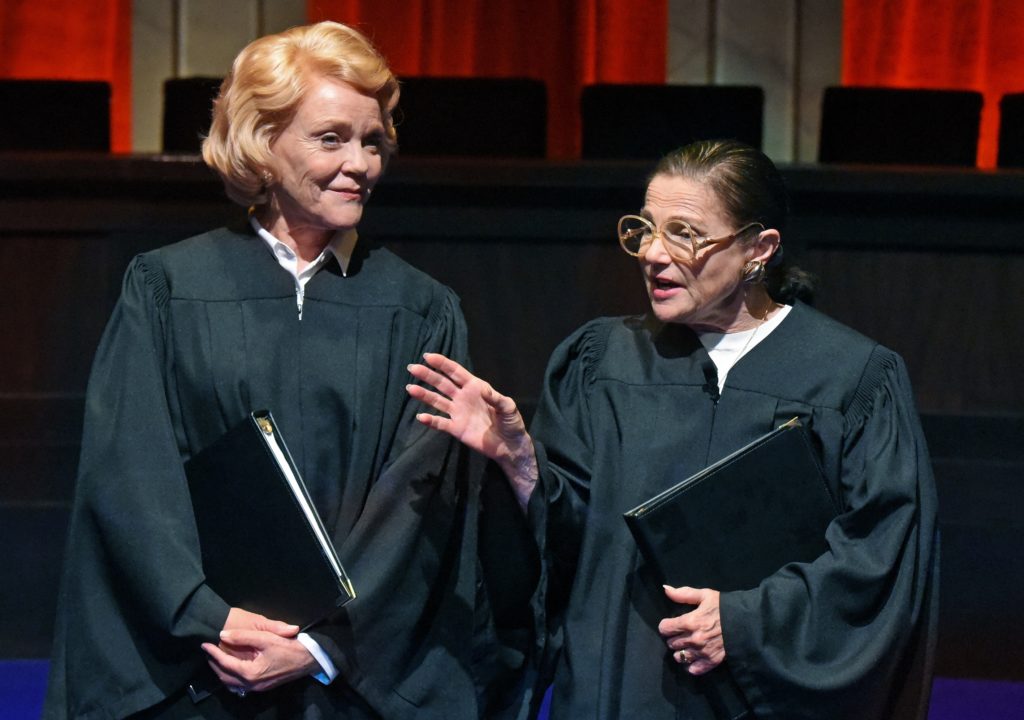
‘Sisters in Law’ Goes Inside the Hearts and Minds of Justices O’Connor and Ginsburg

As the first women on the United States Supreme Court, what would conservative Sandra Day O’Connor and liberal Ruth Bader Ginsburg have discussed behind closed doors? This is the question explored in the new play “Sisters in Law,” written by Jonathan Shapiro and based on the book of the same name by Linda Hirshman. The show is currently running at the Wallis Annenberg Center for the Performing Arts in Beverly Hills.

Deftly directed by Patricia McGregor, actresses Stephanie Faracy and Tovah Feldshuh play O’Connor and Ginsburg respectively, delving into the hearts and brilliant minds of these passionate, erudite women over the course of almost two decades. The two fight over how to affect change when it comes to equality for women (and indeed for all), with a central focus of the production being the 1993 workplace harassment Harris vs. Forklift Systems case. Yet there are also incredible moments of humor and pathos as the justices bond over their shared struggles — whether it’s figuring out how to move ahead in a man’s world, or dealing with illness. 

A lawyer turned television writer, this is Shapiro’s first play. Speaking with the Journal by phone, Shapiro said he really honed in on how O’Connor embodies a West coast sentiment and Ginsburg an East coast one. “In many ways,” he said, “these women are the products of where they were born and raised.”

And in adapting the book to the stage, Shapiro noted the challenge was “how can we make it a great evening of dramatic theater with humor and with feeling and be true to who these women are?”

It’s also why in choosing which cases to include, Shapiro thought long and hard. “Being a writer and being a lawyer are really similar,” he said, “because most of the job involves making a lot of little decisions that will ultimately result in a verdict. The challenge was, ‘Do you do Bush vs. Gore? Do you do the death penalty case? It seemed to me the Harris vs. Forklift was the best one because it was the first time [O’Connor and Ginsburg] really dealt with one another on the court on a gender issue.”

And in one of those twists of fate, Shapiro noted that the #Metoo movement “became front and center in the national debate a month after I finished the first draft [of the play].” 

Born and raised in a Jewish household in Woodland Hills, Shapiro took a course on the Old Testament and its interpreters in college and as a Rhodes scholar at Oxford studied biblical law.  

“I think that Ruth in particular has a Talmudic understanding of the law and a rabbinical approach to its uses to heal a broken world,” he said. “She even makes reference to tikkun olam in the play.”

“[O’Connor] is the relaxed, expansive heartfelt cowgirl. [Ginsburg] is the more somber, brilliant intellectual.” 

— Tovah Feldshuh

It’s a sentiment echoed by Feldshuh. Speaking with the Journal in the Wallis’ lobby immediately following the first preview performance, Feldshuh said, “[Ginsburg], more than any characters I’ve played has influenced me; studying her. She is a completely inclusive human being. She carries a copy of the United States constitution in her purse — like it is her Talmud — and there’s no question that the Jewish tradition of erudition, scholarship and love of learning influenced her ability to be a great Supreme Court justice.” 

Feldshuh also spoke about the enormity of taking on a living legend. “In all my years in the theatre this is the first time I’ve played a living legend at the height of her fame. So how do we honor a woman who is soft-spoken, shy, modest and just decent and moral?”

It’s something Feldshuh was deeply concerned about, especially “because I’m about as shy as a tank coming towards you. And [Ginsburg’s] modesty — how do you deal with that on the stage? You have to be vocally available but your body has to stay quiet.”

Feldshuh has come up with some intricate physical and vocal interpretations to do justice to the justice’s character traits. “Talent,” Feldshuh said, “is the ability is to hit a target that nobody else can hit. Genius is the ability to hit a target that nobody else can see. Ruth Bader Ginsburg is a genius. She saw gender equality and she ferreted out gender equality in every corner of society she could find.” 

Feldshuh is also thrilled that Ginsburg has invited the actress to meet with her
next month in her chambers. “Unfortunately it’s after the run but that’s OK,” Feldshuh
said, “Because I know this [play] will have a future life.”

And while she loves playing RBG, Feldshuh believes Faracy has the more humorous, “fun part. [O’Connor] is the relaxed, expansive heartfelt cowgirl. I am the more somber, brilliant intellectual whom they confuse as not being warm. But she’s very warm.  It’s just that her testosterone comes through her brain. When I play Ruth older I always think that she’s so brilliant that her brain is heavy so it moves forward off her spine.” 

For her part, Faracy said in a separate phone interview that she believes O’Connor is indeed funny. “Part of her charm in my estimation was her great sense of humor. And a sense of humor is really a lightness of heart.”

Faracy, too found playing such an iconic person daunting, “but the more I read about her and understood her and stood in her feet a little, I could only think of her family — like I was a sibling and someone was saying, ‘Take care of my mother.’ I try to portray her in a way that would honor her,” she said, adding, “It’s my greatest concern and I have her pictures in my little dressing room and I nod to her and say ‘May I honor you?’”

Like Feldshuh, Faracy studied recordings of the woman she was portraying and read many books on her, including O’Connor’s 2002 memoir “Lazy B: Growing Up on a Cattle Ranch in the American Southwest.” 

“Lazy B,” Faracy said, “is a window into Sandra’s heart. She was authentic, because she didn’t know how to be anything else. That’s my sense of her. She had deep values.”

In comparing her alongside Ginsburg, Faracy said O’Connor “really valued women in a whole different way than Ruth did. She understood how long it took to get some things done and it’s almost like Ruth now has become more understanding of compromise, and Sandra understood that early on.”

And given the juggernaut that RBG has become in the last couple of years, Faracy felt this play was the perfect opportunity to give O’Connor her due. “When I first took on this part and started to read about [her], I thought, ‘Wait a minute, we have not given Sandra her praise. She was the first person looking out for women: That she navigated the world of men was her honor and her fight for women. I want to take care of her and put her vision into the world more clearly because I think women now can understand what she was doing more clearly. She was the brave one.”

Shapiro loves both characters equally. “O’Connor was a great contrast to Ruth because she was a Christian,” he said. “She was not terribly devout but she was a real seeker when it came to all faiths and she was an extremely spiritual person.”

One of the things Shapiro said he wanted to convey was that “Jew or Christian, these two women brought a much deeper belief in each of their responsibilities to be just and to make the world better. And the challenge of all people of faith is how do you do it in a way that honors our responsibilities to one another as human beings without making things worse?”


“Sisters in Law” runs through Oct. 13 at The Wallis Annenberg Center for Performing Arts. For ticket information, click here. 

‘Sisters in Law’ Goes Inside the Hearts and Minds of Justices O’Connor and Ginsburg Read More »

‘Point of Extinction’ Pushes New Boundaries

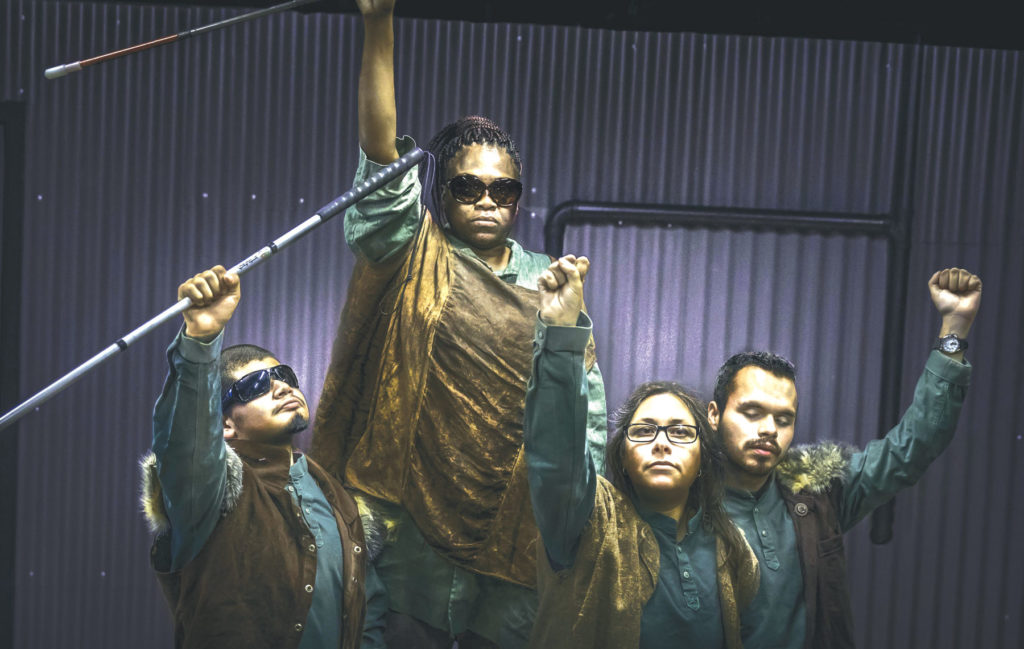
Many people feel panicky when speaking before a crowd. The cast members of Theatre by the Blind, the nation’s only all-blind acting troupe, manage this feat without being able to see.

On Oct. 6, the 13 actors in the group’s current show, “Point of Extinction,” face a new challenge: performing in Culver City’s 1,500-seat Robert Frost Auditorium on a raised stage with microphones.

Theatre by the Blind — run by the performing arts-based nonprofit CRE Outreach and co-founded by Greg Shane in 2007 — empowers blind and disabled Angelenos through the writing and performing of full-length plays. Shane previously told the Journal that Jewish values of family and overcoming hardship were part of his inspiration to create CRE Outreach.

“Point of Extinction” began its run at CRE Outreach’s intimate home theater, The Blue Door, on Venice Boulevard in Culver City. The one-day only performance at Robert Frost is thanks to a $12,000 grant from Culver City’s Performing Arts Grant Program, with support from Sony Pictures Entertainment. The grant helped pay the actors for rehearsal time, and using one of a handful of sizable venues.

“We were looking for a way to expand our message,” CRE Outreach Executive Director Bryan Caldwell told the Journal. “The larger venue gives us a chance to challenge the community to stretch its notion of empowerment for people with disabilities.”

A sci-fi political thriller written by Cosette Ruesga and David Shecter, “Point of Extinction” takes place 100 years in the future. A super-volcano has killed one-third of the Earth’s population, and left many survivors disabled and/or blind. America has warped into a nation called New America, run by a dictator-like president. 

“We do say ‘watch’ a movie or TV show. For sighted people, everything is visual. I always tell people that if you close your eyes and listen, you hear things you miss if you’re watching the action.” — Sheila Walker

When the play opens, the president wants to “cure” the disabled by forcing them to take a serum that can restore sight. Or it might kill them. The serum hasn’t been perfected, and as the play continues, it becomes clear that ridding the nation of anyone disabled — and therefore a “strain” on the nation’s resources in the president’s view — has become her real goal.

The play, which feels very much like a commentary on this political moment, casts disabled people as “the other.” This political focus came from the cast, said co-writer Shecter, who usually writes TV comedy, which has included an episode of “2 Broke Girls.” 

“When I came in, they had already decided they wanted the story to be a dystopian future and a clash between this new government and the disabled community,” Schechter said. “They kind of feel like rights are being taken away from this group and that if you’re not a completely healthy ox of a person and upper class, you’re at risk. We thought the play had a strong message: We don’t need to be cured. Who is the government to say that we need to be like you?”

Sheila Walker plays Geneva, the despotic president. She said the play’s dark mood comes from her community’s concerns about this divisive time. “We didn’t focus on race, but the play is mimicking what’s happening right here, right now. If it’s not race, it’s disability. If it’s not disability, it’s something else. It affects us as disabled people.”

This is Walker’s ninth show with Theatre by the Blind, and her first time playing a bad guy. “I told Greg, ‘I want to be challenged to go outside my comfort zone.’ So he gave me this role.” Walker said she “watched (listened to) political debates and movies with super-villains for style cues. 

“We do say ‘watch’ a movie or TV show,” Walker said. “For sighted people, everything is visual. I always tell people that if you close your eyes and listen, you hear things you miss if you’re watching the action.”

As with all Theatre by the Blind shows, this one is something of a musical, with six original songs written by musical director Laurie Grant and performed by Rex & Friends, an award-winning group of disabled musicians. 

“I hope the songs stand on their own, are melodic and fun and alive, but also help bring the points of the play home,” Grant said. The play ends with the upbeat song “Daybreak,” which, she said, aims to turn around the dystopian vision. “They have a bright future.”

Moving the play to Robert Frost will require new blocking and new entrances and exits, which can be challenging to learn, even if you are sighted. Shane, who also serves as the artistic director, long ago devised a blocking method of placing textured gardening mats in strategic locations. The actors guide themselves around the stage by feeling for the mats with their feet. At Robert Frost, Shane will add carpeting around the edges and the front of the stage, which stands about eight feet high. “I have to orchestrate a way for them to know where they are in space and where the stage’s edges are. I have to make it feel safe,” he said. “We have only four hours in the space before the show. The actors won’t be able to walk on the stage until then, or try using the mic.”

Does this make him nervous? “Nooo,” Shane said, his voice cracking. “I think it will be fine. They’re really ambitious and want to push their limits and challenge themselves.”

“Point of Extinction” will begin at 3 p.m. Oct. 6 at the Robert Frost Theatre. For tickets and information, visit CREOutreach.org/Frost.


Wendy Paris is a writer living in Los Angeles. She is the author of “Splitopia: Dispatches From Today’s Good Divorce and How to Part Well.”

‘Point of Extinction’ Pushes New Boundaries Read More »

As We Take an Accounting of Our Souls and Ourselves, a Lesson in Inclusion

Perhaps the most universal theme in the High Holy Days is what our tradition calls a cheshbon ha-nefesh — the accounting of the soul — that Jews do leading up them.

Many may not use Jewish law as their barometer, but most prepare for a new year with an examination of our past year and our actions. Judaism teaches us that the forgiveness of Yom Kippur depends upon an honest, searching and then sparing self-assessment in the month before Rosh Hashanah: the good, the bad, the strengths, weaknesses and opportunities. Whether we think our conduct is judged solely by ourselves, by our society or by God, we all recognize the goal is to be the best versions of ourselves, which we can’t really work on without self-knowledge.

Best practice in disability inclusion is to start with an honest inventory of where you are. The parallels to a good inventory and a good cheshbon ha-nefesh are striking, as, I believe, are the parallels between teshuvah, a word that is more about return and repair then repentance, and a good inclusion plan.

After the unflinching self-assessment to see where we are, we must reach out to those with whom our behavior fell short, and seek to make amends with them. Only then can we seek divine or societal forgiveness.

Similarly, among all of the inclusion tools that we offer at RespectAbility, a nonprofit organization that aims to fight stigmas and advance opportunities for people with disabilities, we emphasize “ask the person” to assess what someone wants or needs to feel fully welcomed and respected. You could do a searching self-assessment, and follow every best practice that RespectAbility and others put out, and that would still fall short if you didn’t reach out to those in your community who have been excluded from participation in your programs, to understand and address their individual experience.

“Best practice in disability inclusion is to start with an honest inventory of where you are.”

Judaism also teaches us that sin is focused on intent, or even the inherent evil of an action, but how the person subject to our action experiences it. In addition to explicit evils, some of the “sins” listed in the liturgy talk about wronging people in our speech, our eating or drinking or our business dealings. These are not inherently bad but have the potential, knowingly or unknowingly, to wrong someone.

This, too, is an important lesson in our searching inclusion inventory. There are clear sins like of physical access, lack of interpreters or outright shunning of those whose disabilities are unfamiliar, such as mental illness or intellectual disability. But there is also routine exclusion, locating an activity in a place that cannot be reached by transportation by a person with a mobility impairment, or sitting at a social gathering while ignoring a deaf attendee with whom we don’t know how to communicate.

This exclusion, buried in our daily pursuits that we didn’t even realize we were committing, is as much a part of our inventory to remedy as the horrible examples above. For all of these things we seek absolution but it means that first we must truly repent and do better.

Truly doing better, interdependence or inclusion.

The last parallel is in doing better. True repentance is not about apologies or absolution but rather making a plan to rectify the places where you sin, and commitment to learn from your past sins, to do better in the year to come.

That type of self-improvement isn’t easy. It requires a plan, attention, strategies and steps. The idea is to do a little better each day so that next year’s inventory shows improvement.

The same could be said of inclusion. It’s not enough to do an inventory, do some quick fixes or even someone like me — someone who loves Judaism and uses a wheelchair — as a scholar in residence. Making next year better than this requires a plan to address the systemic shortcomings to inclusion in your organization, and implementing it faithfully.

I wish you a good and a sweet new year, a meaningful and reflective period of teshuvah, followed by renewal and a great year. May we work not only to be the best people that we can be, but to bring our inclusion practices to new heights.


Matan Koch is the director of RespectAbility’s Project Moses, a training and placement program for talented Jews with disabilities to serve the Jewish community of greater Los Angeles. He can be reached at MatanK@RespectAbility.org

As We Take an Accounting of Our Souls and Ourselves, a Lesson in Inclusion Read More »

Comedians Cook and Chefs Do Stand Up in ‘Comedy Kitchen’

Like an ingenious mash-up of “Top Chef” and “Bring the Funny,” Jewish Life TV’s (JLTV) “Comedy Kitchen” serves up a recipe of cooking and comedy, with a role reversal twist: In each of the four episodes, comedians make the food and chefs get the laughs.

It’s the brainchild of comedian Craig Shoemaker, who found the inspiration for the show in real life after he taught his friend, chef and restaurateur Tony Luke Jr., how to be a stand-up comic. “He killed it. It was the best comedy debut I’ve ever seen,” Shoemaker said. “He’s now touring with me as my opening act.”

Shoemaker brought the idea to JLTV, which snapped it up for four episodes (so far). “Food and funny are two things associated with Jews,” he said. “We’re combining both in one show.”

Shoemaker assembled friends from the comedy world including Bill Bellamy, Bobby Slayton, Heather McDonald, John Henson and chefs Luke, Todd Stein, Gina Neely, Keith Breedlove and Joseph Ciolli at Davis Wine Estates vineyard in Napa Valley for the competition. “We have a winner each week and each show has different judges, who judge both the cooking and the comedy,” he told the Journal. “They have a scale they go by — quality, originality, taking risks, meeting the challenge.”

A self-described foodie, Shoemaker participated in the cooking challenge, which required incorporating wine into the recipe, in keeping with the vineyard setting. (He made a wine reduction for his steak.) The recipes weren’t easy, but the chefs had the more difficult task, he said. “Speaking in front of people is hard enough, and making them laugh is really scary. But every single chef nailed it.” The winners receive a check for the charity of their choice and a watch for themselves.

Although Shoemaker is half-Jewish on his father’s side, he identifies more closely with the Tribe. “The Jewish part of me made me a foodie and a comedian,” he said, mentioning Jewish stand-up influences Rodney Dangerfield and Woody Allen. He grew up on bagels and brisket and was the class clown in school. “I got my first laughs in fourth grade. I told stories and the teacher was red-faced trying not to laugh,” he recalled. 

Doing stand-up put him through college, where he was pre-law, and he’d do routines in the cafeteria of the law firm where he clerked. When a colleague asked him to open the show for his band, “I got one laugh and I was hooked. I haven’t turned back,” he said. “It’s led to every television thing, every business I do. Everything is related to these roots in comedy.”

“Food and funny are two things associated with Jews. We’re combining both in one show” 

— Craig Shoemaker

But his childhood wasn’t exactly hilarious. His father left when Shoemaker was a baby, and his mother, who married twice more — each time to Jewish men —moved often. “We got evicted and would live with an uncle or aunt. There was a lot of disarray and chaos and lack of love, but comedy was always the great comfort,” he said. 

Shoemaker, whose paternal forebears were from Switzerland and changed their surname from Schumacher, grew up celebrating Christian and Jewish holidays. “It was a confusing childhood, but it was a good training ground for being a comic and being creative,” he said. He didn’t have a bar mitzvah. “I got all the neuroses and angst but none of the bar mitzvah money,” he joked.

Shoemaker has several SoCal shows booked in October, but he aims to produce and create more and tour less in the future because of the constraints imposed by the need not to offend. “I can’t stand the ridiculous political correctness that’s going on,” he said. “Comics, who are the truth tellers, are vilified for doing so. There’s no trial, no due process. Politicians say things that are far worse and much more divisive than comedians who are just trying to entertain you and show you a side that you’re not seeing. Our goal is to unite people through laughter. But people are pouncing on comedians while giving everyone else free rein to say anything racist or bigoted.”

This unfortunate climate change has impacted his act. He has stopped making ethnic — including Jewish — jokes. “You can feel the audience tense up every time you mention race or culture, it’s this fear mode,” Shoemaker said. “I’m bothered by that, and it has made me shift to behind the scenes.”

He has a production company and is working on several projects, a stand-up special and feature and documentary films among them. He also has small roles in the upcoming indie films “Motorvation” and “Ticket to Nashville.” He hopes “Comedy Kitchen” will be picked up for more episodes, either by JLTV or another cable or streaming entity, and already is thinking about recipe themes and cuisines from different countries and cultures.

But it’s family that brings Shoemaker the greatest pleasure. “I give them everything that I longed for in my childhood,” said the married father of four. “Everything I didn’t have, I give to them — openly, freely and easily.”


“Comedy Kitchen” premieres Sept. 30 on JLTV. Visit jltv.tv for additional dates. Craig Shoemaker performs Oct. 3-5 at the Brea Improv; Oct. 12 at the Ice House in Pasadena; and Oct. 24-26 at Levity Live in Oxnard.

Comedians Cook and Chefs Do Stand Up in ‘Comedy Kitchen’ Read More »

Author Bari Weiss on Fighting Anti-Semitism

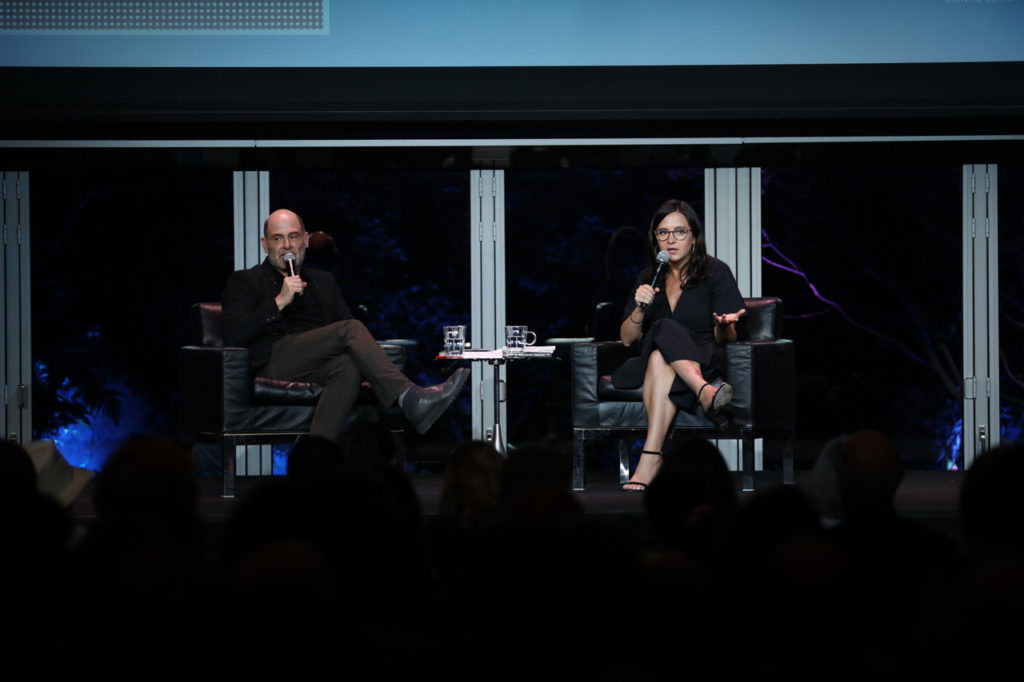
Author Bari Weiss has a pro-Jewish message for those concerned about anti-Semitism: “This is a time to dig deep into the particulars of who we are,” the New York Times opinion writer and editor said during a Sept. 22 conversation with television producer Matthew Weiner (“Mad Men”) at the Skirball Cultural Center, co-sponsored by Writers Bloc.

Weiss, a Pittsburgh native who now lives in New York, told the audience of 450 that she began writing her first book, “How to Fight Anti-Semitism,” which was released Sept. 10, after last year’s shooting at the Tree of Life synagogue in her hometown. 

Contemporary anti-Semitism, she said, comes from “the three-headed dragon” of the far right, the far left and radical Islam. So while she has condemned the white supremacist anti-Semitism that led to the Pittsburgh and Chabad of Poway shootings, Weiss also criticized the Jewish community’s willingness to denounce anti-Semitism on the right while ignoring it on the left.

“It is much easier in our community, in which 75% of Jewish Americans still vote Democrat, to condemn people like [Rep.] Steve King (R-Iowa) than to condemn people like [Rep.] Ilhan Omar,” (D-Minn.), Weiss said. “It is just socially much more difficult and much more complicated for us.”

Weiss went on to say if anti-Semitism from the left often manifests as anti-Zionism, inclusion in liberal, progressive circles is contingent on one’s willingness to “disavow Jewish power, and the most potent symbol of Jewish power is, of course, the State of Israel. So, in a sense, you have to convert to anti-Zionism.”

During the commotion, Skirball Founding President Uri Herscher took a microphone on the side of the stage and said, “I think the conversation is great … but [Weiss’ book] title is ‘How to Fight Anti-Semitism,’ and I think a lot of people came to hear you speak about the book.”

On the issue of intersectionality, Weiss said, “It’s this very smart theory that in practice is terrible,” adding that it creates a caste system that puts Ashkenazi Jews near the bottom, “just above the white, cisgendered, able-bodied tall man.”

“I’ve experienced a lot of anti-Semitism in my life,” Weiner said, describing an incident in which he ran into former classmates from his Los Angeles private high school and was left speechless when the classmate said, “Matt wasn’t a loser in high school. Matt had the misfortune of being born Jewish.”

Weiner said his more pressing challenge today is speaking about Israel to his own children, who see it as a colonialist power. 

At that moment, someone from the audience yelled, “Let [Weiss] talk!” Then a cellphone rang and during the commotion, Skirball Founding President Uri Herscher took a microphone on the side of the stage and said, “I think the conversation is great … but [Weiss’ book] title is ‘How to Fight Anti-Semitism,’ and I think a lot of people came to hear you speak about the book.”

READ MORE: BARI WEISS TALKS ISRAEL LOVE, HANDLING HATERS AND MORE

“Speak for yourself,” someone else called out from the audience.

“I am speaking for myself,” Herscher said.

“I think we are having an extremely Jewish experience,” Weiner quipped. “I would like to ask for pledges now.”

After the event, Weiner told the Journal he was surprised by Herscher’s interruption but nonetheless said, “I am a person very open to all ideas.” 

After order was restored, Weiss, who describes herself as center-left politically and holds pro-Israel views that include criticisms of the Jewish state, went on to speak about her own family’s wrestling with the politics of the day, with her sisters and her mother not allowing their “Trump-curious” father to vote for Donald Trump for president in 2016. 

“We prevented him from voting for Trump, and he wrote [on his ballot] Steph Curry [the NBA star]. I don’t know what’s going to happen in the next election, especially if it’s Bernie [Sanders] or Elizabeth Warren [as the Democratic candidate],” Weiss said. “I think a lot of Jews could be writing in Steph Curry.”

Weiss said while she supports Trump’s relocation of the U.S. Embassy in Israel from Tel Aviv to Jerusalem, his scuttling of the Iran nuclear deal and his recognition of Israeli control over the Golan Heights, Trump’s disregard for civil discourse has had a poisonous effect on the country. But she also empathizes with those that don’t see themselves reflected in the current Democratic Party. 

“Trump’s terrible and then people look at what they fear can be happening to the Democratic Party and they feel, ‘This place I thought was my natural political home is no longer hospitable to me,’ ” she said. “‘How can it be hospitable to me when anti-Semitism is now politically survivable?’”

The conversation spotlighted the boycott, divestment and sanctions (BDS) movement, which has largely failed to gain traction among elected officials. Despite a recent adoption of an anti-BDS bill in Congress, Weiss said the movement has succeeded because it has misled people about its real aim: the elimination of the State of Israel. 

Turning to the news of the Israeli elections, Weiss predicted that a potential leadership transition would reveal that anti-Zionism is not, as anti-Zionists claim, about disagreeing with Prime Minister Benjamin Netanyahu, but rather about seeking the destruction of Israel. 

“It’s going to lead to the end of the romance between Trump and the Israeli prime minister,” she said. “It’s going to lead to the end of disgusting race-baiting against the Arab population, which constitutes 22% of the population. Hopefully, it will lead to a loosening of the stranglehold that the rabbinate holds on religious life, but it’s also going to be clarifying. I think … we are going to see the people who claim their problem was Bibi Netanyahu, it wasn’t actually their problem at all. Their problem is with the existence of the State of Israel.”

Asked by an audience member about Jewish students on college campuses who are attracted to progressive groups that delegitimize or demonize Israel, Weiss said, “We need to be offering them something better.” 

Speaking with the Journal after the event, Weiss said, “The most gratifying are the young people I am hearing from, whom I am hearing from every day now, and it’s just amazing. [My book] is reaching the kind of people I want it to reach.”  

Author Bari Weiss on Fighting Anti-Semitism Read More »

Synagogues Discuss Security Ahead of High Holy Days

As the Los Angeles Jewish community prepares to celebrate its first High Holy Days since the deadly shootings at Pittsburgh’s Tree of Life synagogue and Chabad of Poway, synagogues are working to ensure the safety of their congregants.

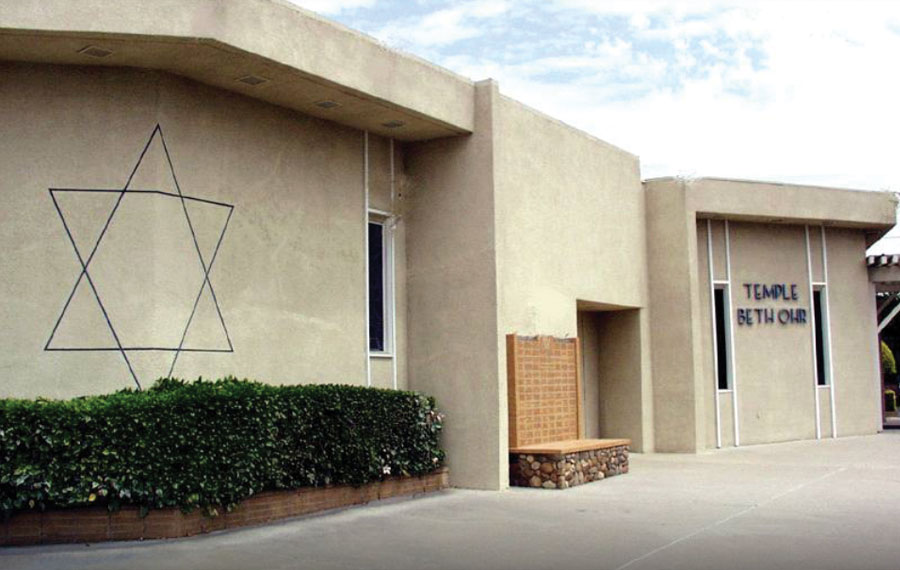
Deterrence plays a major part in the effort, Doug Kotkin, chair of the security and safety committee at Temple Beth Ohr in La Mirada, told the Journal.

The synagogue is expecting approximately 200 people for the High Holy Days, and Kotkin said the entrance to the shul would now have ID scanners. 

“In the past, if you didn’t have a ticket you went on through,” Kotkin said. “Now everything is done outside. Those without tickets will be ID scanned.”

The synagogue is located in an area that doesn’t have active hate groups, Kotkin said, but it nonetheless has hired two retired police officers for High Holy Days services. And although they won’t be patting down people or checking purses, the officers will “be keeping an eye out for anything suspicious,” Kotkin said.

Additionally, the synagogue had a Sheriff’s Department official do a walk-through of the site and went through safety procedures with Temple Beth Ohr staff. 

“Our primary objective is to make sure people feel safe and are safe. One of those challenges is balancing being welcoming with being secure.” — Melissa Balaban, IKAR

At IKAR, which holds services at Shalhevet High School and draws up to 4,000 people during the High Holy Days, Executive Director Melissa Balaban said in addition to security staff, congregants play an invaluable role in creating a safe synagogue environment. 

“I think it’s a mistake for folks to think security is being taken care of for them,” she said. “No amount of security can take the place of people taking care of one another and being on alert for things that might be problematic.”

The key, Balaban added, is balance. “Our primary objective is to make sure people feel safe and are safe. One of those challenges is balancing being welcoming with being secure.”

And security is definitely the watchword, particularly when the Anti-Defamation League’s (ADL) audit of anti-Semitic incidents in 2018 revealed California as the state with the highest number of anti-Semitic incidents.

During a recent pre-High Holy Days security briefing, ADL Regional Director Ariella Lowenstein said security isn’t just for synagogues with large budgets. There are also low-cost, practical ways to create more secure environments. Some of those, she said, include liaising with local law enforcement so that in the event of an incident, the synagogue knows who to contact; establishing procedures for controlling access to facilities; and designating a member of staff to serve as a security manager.

At Temple Beth Ohr, Kotkin said it isn’t possible to have multiple checkpoints before people enter the synagogue because there are no gates outside the shul and the parking lot isn’t secure. However, he said they do employ other methods including assigning different members of the security team to focus on different elements of security.

At IKAR, the safety team includes lay leaders and staff who have worked with security consultants on figuring out “pieces we need to put in place,” Balaban said, adding that IKAR is committed to “making sure we are available and open to people who are unaffiliated and may not have planned three months in advance for High Holy Days and have a safe place to sit.” 

And like Kotkin, Balaban said IKAR is in close touch with law enforcement.

“It’s such a changing landscape. What security looked like at IKAR 15 years ago is drastically different from what it looks like in this day and age,” she said. “With the relatively frequent public shootings in places of worship, we need to be aware of that and plan accordingly.”

For additional tips on synagogue security, visit the ADL website.

Synagogues Discuss Security Ahead of High Holy Days Read More »

Shalhevet Student Creates 3D-Printed iPad Accessory

“I definitely wanted to somewhat represent I was Jewish if I was going to be on TV and be in the public eye.” 

So said 16-year-old Samson Taxon after he appeared last month on KTLA’s morning news to discuss the iPad accessory he made using a 3D printer.

Wearing a yarmulke imprinted with the name of his school, Shalhevet High, the junior spoke with KTLA tech reporter Rich DeMuro about his invention called GRP, which keeps the wireless Apple pencil fastened to the iPad Pro.

The pencil was designed to magnetically attach to the tablet, but users have found that it doesn’t always stay put. So Samson designed a stick-on grip made of bioplastic and adhesive. As he prepared to put the $10 accessory on Kickstarter, a crowdfunding platform, his mother reached out to KTLA asking if the station wanted to do a segment on her son. She got an email back asking to have him on.

“We scheduled a time and went to the studio,” Samson told the Journal. “It was a really great experience.”

On the first day of the Kickstarter campaign, 512 backers pledged more than $5,200 for the gadget. 

“I’ve always been interested in making things, understanding how things work, tearing things apart,” Samson said. “My grandfather was an electrical engineer. I learned about 3D printing when I was 10 years old.”

“I definitely wanted to somewhat represent I was Jewish if I was going to be on TV and be in the public eye.”
— Samson Taxon 

Even back then, he said, “I thought [3D printing] was cool. You did not have to fabricate plastic parts with hand tools; you could design the prototype on a computer and have it made within a couple of hours. It’s a cool emerging industry and technology.”

GRP isn’t Samson’s first invention. In seventh grade, he created an iPhone game, “Piggy Plane,” which is available in the Apple app store. 

And last year, he created the app StudySam, featuring an animated character named Sam who helps students study. He entered the app into the Congressional App Challenge and won first place in his congressional district. An in-person meeting with Rep. Ted Lieu followed.

“He’s a tinkerer,” Nick said. “He loves to do anything mechanical, to take things apart, and he is kind of self-taught in respect to 3D printing and coding.”

Samson wants to put some of the money he’s earned from GRP back into the community to encourage others to develop their tech and coding skills. As captain of the robotics team at Shalhevet, he plans to mentor inner-city school students to help them develop their robotics programs.

Along with prepping for robotics season at school, Samson also wants to create a larger 3D printer and continue improving his technology skills. His most recent innovation was a mostly 3D-printed gaming console for his younger brother, designing the circuitry around an open-sourced microcomputer.

“I definitely want to pursue making things new and innovative,” Samson said. “I don’t know if it will manifest itself in 3D printing, but having those skills helps me create new things. I definitely want a future of creating something new.”

Shalhevet Student Creates 3D-Printed iPad Accessory Read More »

For Kids: A Few Good Books for a Good Year

New books for fall include a number of picture books about the holidays, but also other Jewish-themed books for kids that should get some attention even though they revolve around topics other than Jewish holidays. Of special note is R.J. Palacio’s graphic novel debut, “White Bird,” which likely will appear on many “best” lists by the end of the year.

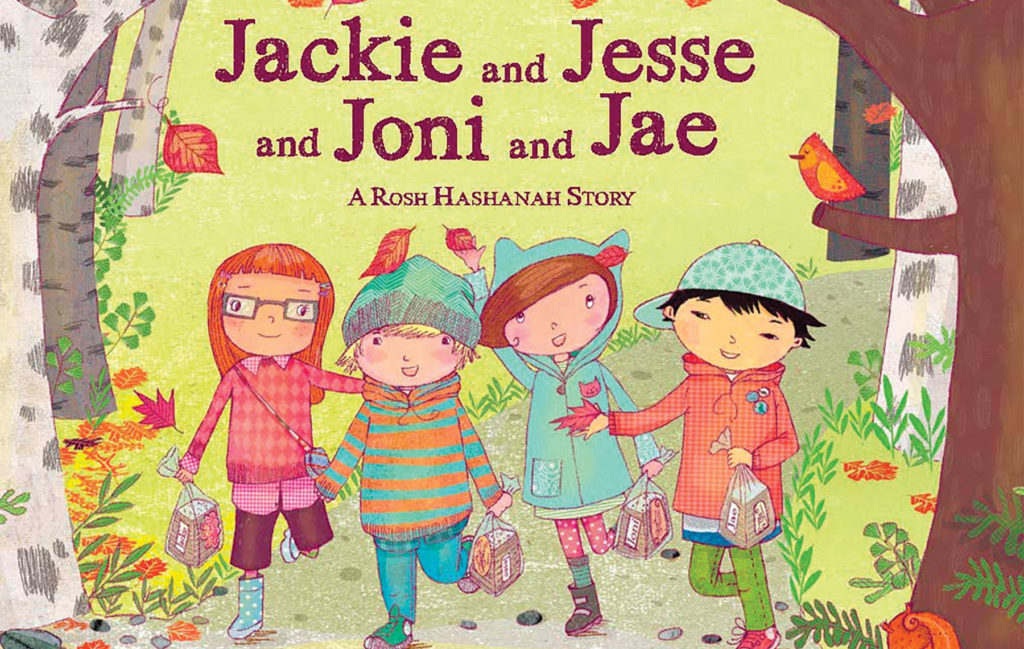
“Jackie and Jesse and Joni and Jae: A Rosh Hashanah Story”
By Chris Barash. Illustrated by Christine Battuz. Apples & Honey Press, 2019.
Ages 4-6.

This cute rhyming story is useful as a simple explanation for very young children of the tashlich ritual. Four children, along with their rabbi and others in the community, take a holiday walk to the nearby river on a fine autumn day. The four friends consider the times in the year they may have acted “unfriendly” to one another and offer apologies. They toss bread into the river, considering it as “mistakes that we’ll throw” and watch the symbolic crumbs float away. Each “mistake” represents a missed goal of attaining positive character traits important to relay to children, such as friendship, honesty and compassion. Autumn colors and childlike illustrations featuring small animal cameos will appeal to a preschool audience.
Available on Amazon.


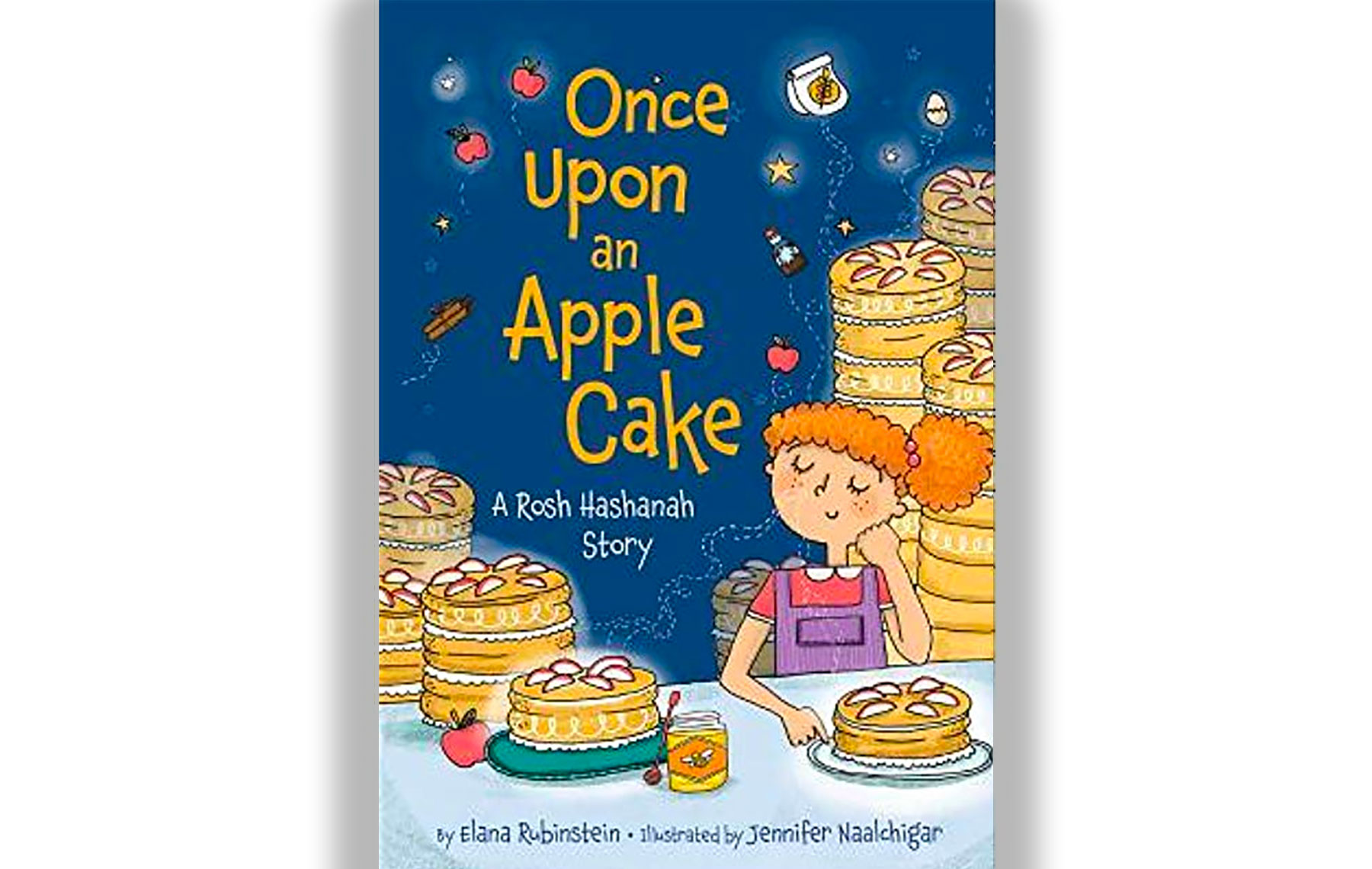
“Once Upon an Apple Cake: A Rosh Hashanah Story”
By Elana Rubinstein, illustrations by Jennifer Naalchigar. Apples & Honey Press, 2019.
Ages 7-10.

Ten-year-old Saralee Siegel has an amazing sense of smell. She says she can smell things “like nobody’s business.” She can discern any recipe’s ingredients with a sniff or two, as well as know what shampoo someone used last night. She is part of a hilarious, quirky family who owns a popular restaurant. Saralee’s kin include Aunt Bean, a germaphobe who cleans the glass dessert case with a toothbrush; a 5-year-old cousin who thinks he’s a doctor; her bubbe, who can’t remember names so she calls everyone “Pookie-Wookie”; and youthful Aunt Lotte, who often is on the phone and just can’t be bothered.

Siegel House restaurant is known for its awesome Rosh Hashanah apple cakes, baked by Saralee’s zayde, using a special secret ingredient even her super-nose can’t detect. But three days before the holiday, he falls down the basement stairs and gets a bump on the head that causes temporary amnesia. It is left to Saralee to fulfill all the town’s apple cake orders, but that super-nose of hers just can’t sniff out the secret ingredient. When some sinister newcomers try to sneak into her zayde’s files to bake apple cakes for their rival bakery called Perfection on a Platter, it is left to Saralee to use her wits (along with her sniffer) to save Rosh Hashanah. 

Along the way, she learns much about friendship, patience, persistence and love. This funny and well-plotted story with delightful characters and amusing line-drawn illustrations is a perfect holiday tale for early chapter book readers.
Available on Amazon.


“And There Was Evening and There Was Morning”
By Harriet Cohen Helfand and Ellen Kahan Zager. Illustrated by Ellen Kahan Zager. Kar-Ben, 2018.

Each new year recalls the story of the seven days of creation, and there are numerous books for children on this topic. However, this uniquely illustrated take on Genesis features such clever design elements that it is a pleasure to contemplate the pages and imagine the creative process of the talented illustrator. Taking cues from the Torah text by focusing on how each day feels different (“a peaceful day” or “a fruitful day”), the days of creation are described in rhyming couplets, with illustrations of Hebrew letters beautifully integrated within the design, often creating words of their own. For example, when God creates animals, the letters for “avaz” (goose) and “dionun” (squid) showcase Hebrew letter “vav” as the goose’s neck, along with other long, graceful “vavs” and “nuns” as portions of the squid’s flowing tentacles. 

Zager does this for about 50 Hebrew words, and it is an extraordinary feat. The artist’s note at the end of the book states: “The pictures in this book are also created with words. Because Hebrew is the language of the Torah, these images are in Hebrew. Each image is created with the Hebrew letters for that word.” Flipping back and forth from the pages to the glossary in the back (which contains the Hebrew and transliteration alongside a small image of the featured plant or animal) will delight both children and adults who know their Hebrew letters and love a bit of a puzzle. The chance to learn some new vocabulary is a plus, in addition to spurring ideas of creating an animal of your own by playing with colorful letters on paper.
Available on Amazon.


“Gittel’s Journey: An Ellis Island Story”
By Leslea Newman. Illustrated by Amy June Bates. Abrams, 2018.

As some vocal Americans currently may grapple with Emma Lazarus’ words on the base of the Statue of Liberty, this beautifully written and illustrated children’s book helps young readers to understand the perils of immigration to an unfamiliar new country. The story follows 9-year-old Gittel, who attempts to immigrate to America with her mother in the early part of the 20th century but has to go it alone after her mother is denied boarding because of an eye infection.

The author states the narrative is based on two true stories from her childhood: one from a family friend and one from her grandmother. In the author notes, Newman shares a photo of the brass candlesticks she inherited from her grandmother that also appear within the story as the one family heirloom Gittel brings with her on her solitary journey. Gittel’s mother also gives her a piece of paper with the name and address of her New York cousin and tells Gittel to keep it safe. Gittel does as she is asked, but the constant handling of the paper over the two-week voyage rends it illegible by the time she arrives at Ellis Island. A clever Yiddish-language interpreter gets her photo in the newspaper; her relative sees it and comes to greet Gittel the following day. This part of the tale also is an element of a true story the author heard while growing up. 

Newman ends her notes by stating, “To this day, thousands of people, including many children traveling alone, immigrate to America each year in search of a better life and a safe place to call home.”
Available on Amazon.


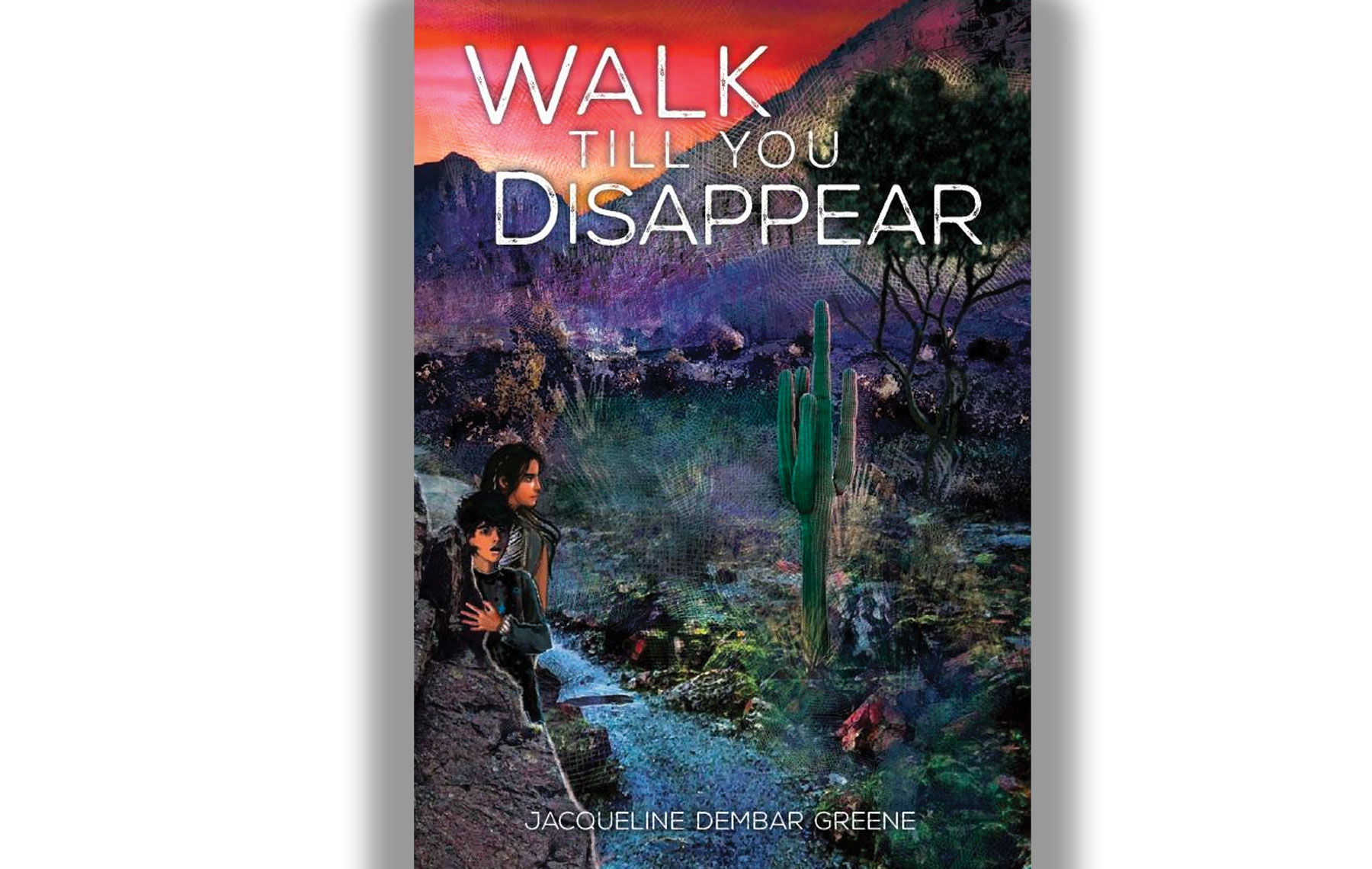
“Walk Till You Disappear”
By Jacqueline Dembar Greene. Kar-Ben, 2019.
Ages 9-14.

Middle-grade readers who love a good adventure will be turning pages eagerly in this new novel blending historical fiction with a survival story. Jewish kids who liked Elizabeth Speare’s popular “The Sign of the Beaver” will discover a bit of their own heritage while delving into the very modern issues of diversity and acceptance of differences. Miguel Abrano and his family are ranchers in Arizona territory near Tucson in 1872. He is a devoted Catholic, considering a career in the priesthood, and impatiently awaiting his 13th birthday so he can be allowed more adult privileges. After an “Israelite” peddler visits his home (at a Friday night dinner when his mother bakes her usual challah and lights candles at a festive meal), he discovers to his dismay that he is a descended from Converso Jews who fled the Inquisition.This revelation sets in motion a panicked flight from his home into the unforgiving desert on a borrowed horse. He promptly loses his way and is captured by a band of Apaches, who do not treat him well. When hope is almost lost, he is rescued by a friendly member of the Tohono O’odham tribe who is running away from an American mission school. A lot of danger, adventure and eye-opening scenes are included. Scorpion bites, rattlesnake and horsemeat consumption, American Indian survival tips and a literal “cliff-hanger” keep the narrative moving at a fast pace.There are more than a few (age-appropriate) descriptions of cruelty, both from American troops toward the Tohono O’odham boy and from the tribal men toward their white captive. The author has created a realistic youth in transition. His wilderness experience sets him on a path to question his stringent beliefs that the “truth” can only been seen through the eyes of the church. As he learns that kindness toward others with varying beliefs is more important than forced adherence to both intolerant church and unfair government policies, he reconciles his past heritage with the type of man he wants to become.
Available on Amazon.


“White Bird.”
Written and illustrated by R.J. Palacio.
Knopf, 2019.
Ages 8-12.

The first graphic novel by the author of “Wonder” is a dramatic story of a young French girl hidden from the Nazis by brave gentile neighbors. It serves as a bit of backstory to the character of Julian, the antagonist who had bullied Auggie, the main character from “Wonder” with a genetic condition that affects his appearance. Portions of this particular story previously were in a chapter of “Auggie and Me: Three Wonder Stories,” but this graphic-novel format expands it and makes for a particularly affecting novel that should touch the hearts of readers of all ages.

Julian has reformed and transferred to a new school. He has an essay to write for a class, so he calls his French grandmother on Facetime to interview her about her childhood during World War II. He opens with a quick comment about his regret for his past behavior and she replies, “We are not defined by our mistakes, but by what we do after we’ve learned from them.” Thus commences Grandmere’s story, beginning in France as the Nazis restrict Jewish movement and start rounding up children from their schools. Grandmere, whose name is Sara Blum, recounts her teenage escape with the help of a classmate named Julien, whose family takes her in, brings her food daily, and does much to keep up her spirits when her parents are deported. She lives in the hayloft of their barn for the duration of the war and eventually feels more than just friendship toward her kind classmate.

Those familiar with Palacio’s work will appreciate the twist that distinguishes this tale from other middle-grade Holocaust fiction: Julien is disabled from polio and has suffered intense bullying since he contracted the disease and began using crutches to walk. Although Sara sat next to him in school for three years, she had never acknowledged him or objected to her friends’ verbal disdain for him. While in hiding and under his family’s dedicated care, she reflects on her previous behavior and realizes, “Evil will only be stopped when good people decide to put an end to it.”

The story itself is exciting, with a couple of surprising turns and some fantasy elements connecting her life to that of a free white bird. These elements provide some of the most affecting scenes. It is written at a perfect level for readers in grades 4 and up who are into graphic novels and ready to learn about the Holocaust in an accessible way. Although not based on any one survivor’s story, this novel would be an excellent companion to any of the other books young people first read on the subject, including “Number the Stars” or particularly Anne Frank’s diary, to which it draws a number of parallels.

The final scenes when Sara finishes telling her story to her grandson (and we now realize why he is named Julian) move easily from 20th-century injustice to contemporary 21st-century events, as the author encourages her readers to stand up to prejudice when they see it. A well-researched glossary and excellent list for further reading are included. This is a grand achievement by the author in both story and graphic-art illustration.
Available on Amazon.


Lisa Silverman is the director of the Burton Sperber Jewish Community Library located at American Jewish University.

For Kids: A Few Good Books for a Good Year Read More »

Rabbi Jason Rosner Brings Green Initiatives to Highland Park Shul

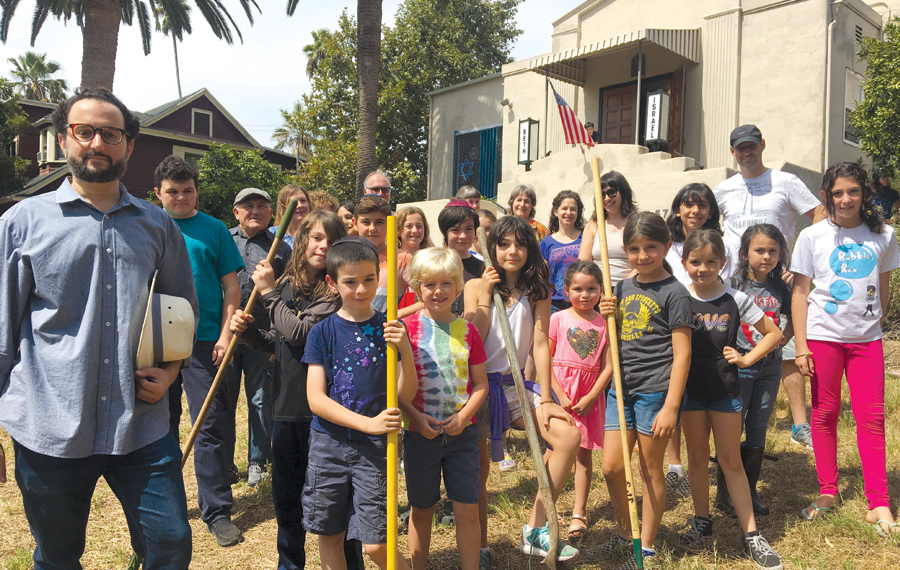
Highland Park is filled with historic buildings, hilly roads, vintage clothing stores, art galleries and vegan eateries. Also tucked away in this Eastside enclave — which is attracting a diverse group of Angelenos — is a 90-year-old, forward-thinking synagogue.

Temple Beth Israel (TBI) is a self-described haimish synagogue that is also egalitarian and inclusive. It began as a Conservative synagogue in 1929, but today is unaffiliated. 

Rabbi Jason Rosner, who was hired this past May, was ordained at the Reform Hebrew Union College. Although he leads the congregation, at TBI, everyone is encouraged to take part and introduce new initiatives. 

“We really run on the principle that our community belongs to our members,” Rosner said. “We address the questions that are on the minds of our membership like climate change and sustainable transportation.”

To that end, TBI offers the CoPious Box, a box that contains organic produce from local farmers and is available at the synagogue, or for delivery, on a weekly basis for TBI members and the wider community. 

“We understand the cost of living is high, so it’s one way to keep the cost of living lower and address the need for affordable, healthy food to fight diabetes and the like,” Rosner said. 

TBI has a garden with an etrog tree, and recently installed solar panels that were dedicated by two synagogue members. On Sukkot, TBI will host a single-use plastic reduction class in the sukkah, and hopes to set up a compost bin on-site. 

Having all these environmental programs in place commemorates Judaism’s emphasis on ecology, Rosner explained, noting that in Deuteronomy 20:19, it says not to cut down fruit trees when besieging a city. He added that the Mishnah and Talmud are full of agricultural laws, and in the Mishneh Torah, Kings and Wars, 6:9-10, Maimonides instructs
us not to needlessly destroy nature or waste food. 

 “We are utilizing Jewish tradition, literature and art to address questions of ecology, halachah around business, asking questions like what is ethical investment and housing affordability, and its corollary, homelessness.” 

— Rabbi Jason Rosner

“I believe the Jewish tradition perceives us to be living in a terrarium,” Rosner said. “We’re in a closed environment and we need to respect it. We have a strong tradition of ecology, but [also] there is this idea we are supposed to be fruitful and multiply and fill up the earth. We’re supposed to fill it up the way we do a terrarium, within the limits of what it can contain and respecting natural cycles. We’ll pollute it if we fill it up too much, so we have to find a balance.”

Along with the environmental initiatives, TBI offers weekly Shabbat morning services, first Friday Kabbalat Shabbat dinners, family Friday Shabbats, Torah classes for kids, and adult classes including memoir writing. Instead of tasking the clergy to create programming and activities, the shul’s members put forth ideas and make them happen.

“It is tremendously gratifying working with so many people who are volunteers and willing to put their time and energy into running this institution,” Rosner said. “I couldn’t ask for better partners.”

Because of TBI’s commitment to volunteerism and inclusion, members like Naama Haviv, the director of development and community relations for MAZON: A Jewish Response to Hunger, have found a home at TBI. Haviv, who grew up in a secular Israeli family, had never celebrated the High Holy Days until last year, when she went to TBI for Yom Kippur with her husband and daughter.

“Everybody at all levels of Judaism can experience a sense of community there,” she said. “They let me in on the process, and I am an otherwise secular Israeli. It’s very indicative of the experience at TBI.” 

Even though Haviv has been working in the Los Angeles Jewish community for 10 years, it wasn’t until she went to TBI that she felt like she was truly part of it. “It’s this place where you can find your footing in a way that is difficult in L.A.,” she said. “It’s the kind of place where you can come up with an idea if you want to make it happen. If you need something, someone will point you in the right direction. There are dozens of other people trying to make projects happen, and it weaves together into this amazing community.” 

TBI President and Social Action Committee Chair Raphael Leib echoed that sentiment, noting that whereas Jews may not be able to find a spiritual home in other parts of L.A., they can at TBI.  

“We’d like to put northeast L.A. on the map within the wider Jewish community,” he said. “A lot of folks don’t think of northeast L.A. as a center of Jewish life. We want to change that. With all due respect to congregations on the Westside, there’s a huge sector of the Jewish community that is not represented and live near us. We want to make our voices heard and our presence felt.”

The welcoming attitude of the synagogue and its focus on members first has led to a jump in membership. According to Rosner, they’re in a growth phase, and they will likely have 200 to 300 members within the next several years. He sees more Jewish families coming to the neighborhood, and the synagogue is looking at opening a preschool.

In the future, Rosner said, they may even get historic landmark status, since TBI is considered a historical overlay building. “The synagogue has a sense of continuity, which is really nice in a city of newness,” he said. “It’s exactly what you might expect in Highland Park: historic architecture, non-hierarchical structure and very inclusive.”

For now, Rosner and the congregants are focused on community first, and putting on programming and initiatives they truly believe in. 

“I’m happy to be in an environment that I feel is really dedicated to Jewish life and tradition, but through the lens of what it means to us in northeast L.A.,” Rosner said. “Tradition that is living and breathing and constantly being reinterpreted and applied. It’s not from the top down. We are utilizing Jewish tradition, literature and art to address questions of ecology, halachah around business, asking questions like what is ethical investment and housing affordability, and its corollary, homelessness.”

Rabbi Jason Rosner Brings Green Initiatives to Highland Park Shul Read More »