Close to 60% of Jewish Israelis place themselves, in one way or another, in the “right wing” camp. We see this in almost every measurement we take. Whether we divide the public into two camps (right and left); three camps (right, center, left); five camps (adding “moderate right” and “moderate left”); seven groups; or even nine. We haven’t tried more than nine, but we shouldn’t expect a different result in such a scenario.
Every new scale yields a slightly different result, but the reality is stark: Between 50-to-60% of Jewish Israelis prefer the brand “right” as part of their political identity. They prefer “right-center” over “center.” They prefer “moderate right” over anything that isn’t right. And then there are those who choose “deep right.” For them, the standard “right” is a bit too moderate. They know exactly where they stand — at the rightmost edge of the spectrum. In a recent survey, 12% of Jews selected this “deep right” category.
Because the right is so dominant — comprising the clear majority of the Jewish population — and because it is so diverse, stretching from the deep right to the center-right, there is value in examining the differences within the camp. In fact, these internal differences are more important than the differences between the right and the smaller camps of the center and left.
The left is tiny, hovering around 5%. The center-left adds another 15%. Together, they are dwarfed by the sheer size of the right. Therefore, if one half of the right thinks differently from the other half, that disagreement is numerically more significant than the traditional friction between right and left.
It must be said: the right is diverse not just in self-definition, but in substance. When “Moshe” calls himself right and “Hannah” calls herself center-right, they aren’t just choosing different labels; they are expressing different ideologies and sentiments. These differences are currently the most significant variable in the Israeli public arena because they will likely determine where voters migrate in the next election, and perhaps where the next government will steer the country.
So, what are the glaring differences inside the right?
To make life easier, we will do two things. First, we will skip the complicated division into four or five right-wing sub-groups and look at the right as two main blocs: the “right” and the “center-right.” Second, we will look at just three core issues. We chose these three because we have polled them repeatedly, allowing us to ensure the analysis is robust.
We will examine the gap between the right and the center-right regarding the Israeli-Palestinian conflict, judicial reform, and the draft of Yeshiva students (Haredim). These are three issues at the center of the agenda.
1. On the Palestinian conflict we presented three options: First, strengthening control, expanding settlements and considering annexation in Judea and Samaria. Second, maximum separation from Palestinians while maintaining security control. Third, striving for a peace agreement.
Let’s look at the first option – deepening control. In the “right” group, 70% choose this option. A clear majority. In the “center-right” group, only 35% choose this option. The majority of the center-right prefers separation. The Gap: 35%.
2. The Haredi Draft question had just two options. One: support of the coalition’s exemption law. Two: mandating the draft of young Haredim and deepening economic sanctions on draft dodgers.
In the right, 55% support the exemption law. In the center-right, only 25% support the exemption law. Again, a distinct gap in preferences: 30%.
3. The question on judicial reform also had three options: Oppose any reform; support reform only with broad consensus; or support reform even without consensus.
In the right, there is a small majority (52%) in favor of reform even without consensus. (with a high percentage of “don’t knows”). In the center-right, only 18% support unilateral reform. They may want changes to the legal system, but they reject the aggresive approach. The gap: 34%.
These gaps are already visible in the shadow campaign for the next election. The battle is for the soul — and the vote — of the center-right.
PM Netanyahu and the Likud are emphasizing judicial reform. There are center-right voters who care about this issue, but perhaps less than Netanyahu thinks. Challengers like Naftali Bennett and Gadi Eisenkot are talking about the Haredi draft. This is an excellent wedge issue because even within the right there isn’t much enthusiasm about the exemption law, and the center-right actively opposes it. The only problem? For many voters, the draft is important, but not the most crucial factor for their vote.
And what about the conflict? The right will promise settlements and perhaps annexation. Avigdor Lieberman, Eisenkot, and Bennett will maneuver carefully, emphasizing “security.”
One thing is certain: The elections of 2026 will not be “right vs. center-left.” They will be “right vs. right.” Because there is one right, and there is another right. And as the numbers show, it is quite easy to spot the difference.
Something I wrote in Hebrew
Another week, another Trump-Netanyahu meeting, another pre-meeting competition of guessing games:
As Netanyahu sits down for his umpteenth meeting with President Trump (there have been so many that counting seems pointless) the challenge isn’t explaining why a U.S. nuclear deal with Iran endangers Israel and global stability. The hard part is convincing Trump that a more aggressive path serves his own interests, both politically and personally.
A week’s numbers
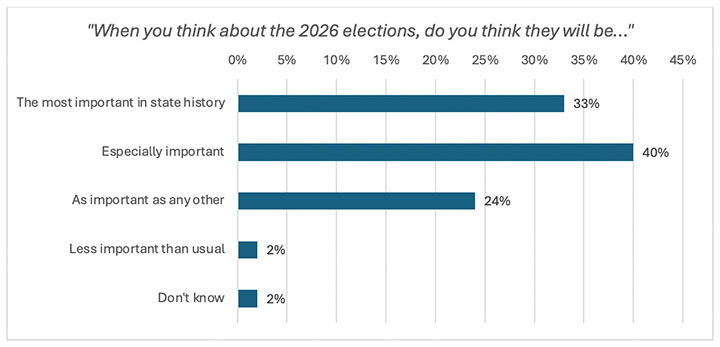
The center-left think it’s the most important ever, the right tends to say “as important as any other.”
A reader’s response
Toby writes (following last week’s article): “Israel isn’t western, it’s a theocracy of Jews.” My response: No, it’s not. A country doesn’t have to be as strict as the US in separating church and state to be considered “western” (a poorly defined term anyway).
Shmuel Rosner is senior political editor. For more analysis of Israeli and international politics, visit Rosner’s Domain at jewishjournal.com/rosnersdomain.