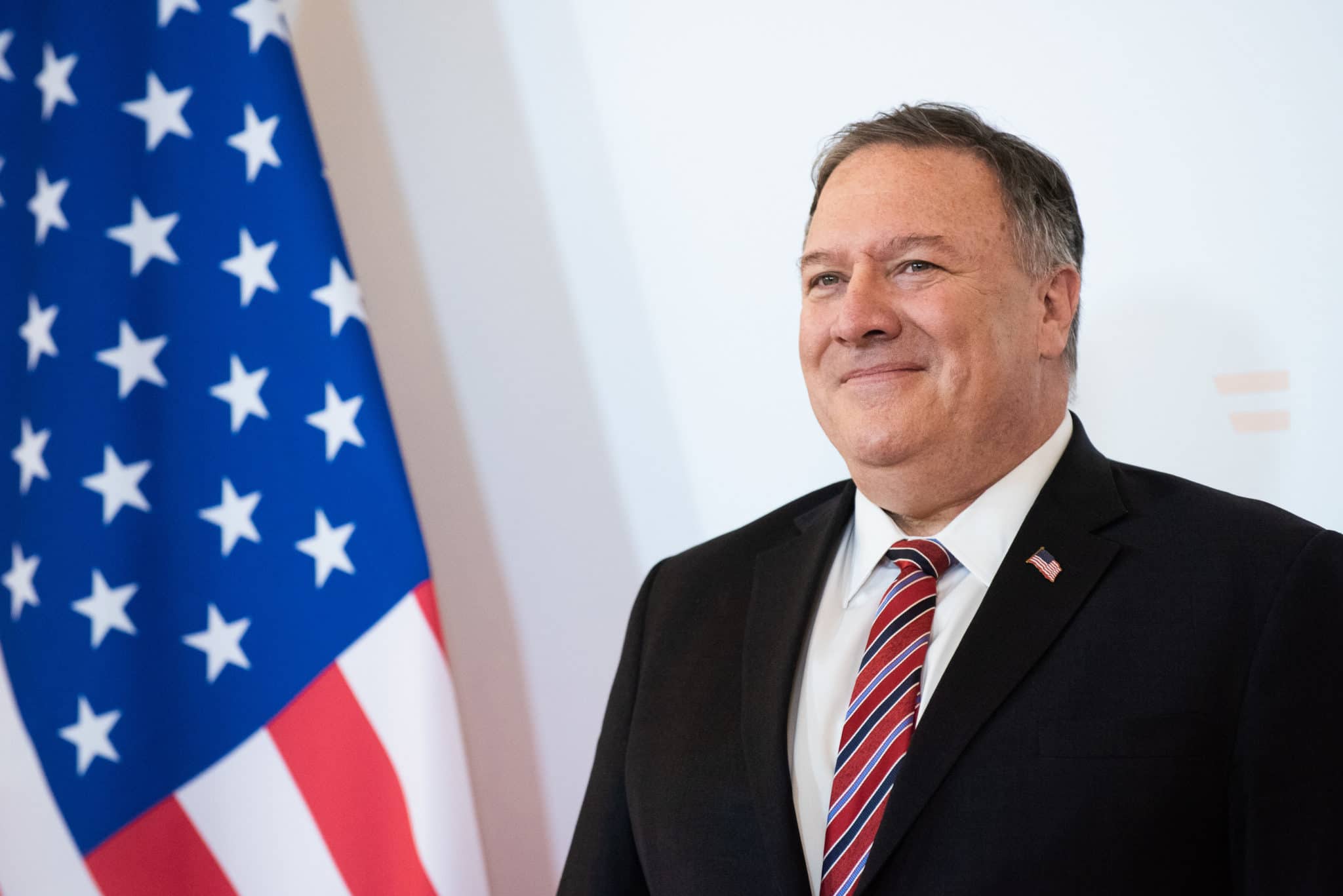
Secretary of State Mike Pompeo announced on Aug. 20 that the United States has begun the process to re-impose sanctions on Iran lifted under the 2015 Iran nuclear deal.
Pompeo tweeted, “Today I hand-delivered a letter to @UN Security Council President Dian Triansyah Djani to formally notify the Council of something we all know too well — Iran’s failure to meet its commitments under the terrible nuclear deal.”
The process to re-impose sanctions on Iran begins. Today I hand-delivered a letter to @UN Security Council President Dian Triansyah Djani to formally notify the Council of something we all know too well—Iran's failure to meet its commitments under the terrible nuclear deal. pic.twitter.com/MltLupj7lg
— Secretary Pompeo (@SecPompeo) August 20, 2020
The letter, which was signed by U.S. Ambassador to the United Nations Kelly Craft, argued that Iran’s violations of the deal include enriching uranium and gathering heavy water far beyond the limits established under the deal.
“Despite extensive and exhaustive diplomacy efforts on the part of those [U.N. Security Council] Member States, Iran’s significant non-performance persists,” Craft wrote. “The United States is left with no choice but to notify the Council that Iran is in significant non-performance of its JCPOA [Joint Comprehensive Plan of Action] commitments.”
#BreakingNews accompanied with @SecPompeo, @USUN Ambassador @USAmbUN presented a notification to #UNSC President @indonesiaunny, stating that the #US makes as 1 of the #JCPOA participants identified in paragraph 10 of resolution 2231 1/2 pic.twitter.com/ntcuKnmdop
— Ali Barada (@BaradaAli) August 20, 2020
Britain, Germany and France rebuffed the U.S. in a subsequent statement.
“France, Germany and the United Kingdom note that the US ceased to be a participant to the JCPOA following their withdrawal from the deal on May 8, 2018,” the statement read. “We cannot therefore support this action which is incompatible with our current efforts to support the JCPOA.”
Germany is not a member of the U.N. Security Council but is a signatory to the JCPOA.
Russia and China — two signatories on the original pact — also argued that the U.S. doesn’t have legal standing to re-impose U.N. sanctions on Iran because the Trump administration exited from the deal.
Iranian Foreign Minister Javad Zarif tweeted that the Trump administration’s attempt to re-impose U.N. sanctions on Iran is “illegitimate and felonious” because the U.S. exited from the deal. The tweet featured a “fact sheet” arguing that the Trump administration has been operating in bad faith and that the administration’s current sanctions are in violation of the deal.
Factsheet on the illegitimate and felonious U.S. attempt to re-impose U.N. sanctions on Iran pic.twitter.com/wPbFytmA98
— Javad Zarif (@JZarif) August 20, 2020
The White House has argued that the deal allows for countries that initially signed on to the deal to re-impose U.N. sanctions even if it has exited from the deal.
Israeli Prime Minister Benjamin Netanyahu praised the U.S. for its efforts to re-impose sanctions.
“Responsible countries should support the United States in seeking a real solution, one that will prevent Iran from building nuclear weapons,” Netanyahu said. “Israel stands proudly and firmly with the United States, as do governments across the Middle East who opposed the JCPOA quietly and now support the restoration of sanctions publicly. Ultimately, the tyrants of Tehran must understand this: If Iran wants to be treated like a normal country, it must start acting like a normal country. That has not yet happened.”
Prime Minister Benjamin Netanyahu's statement on the American decision to trigger snapback sanctions against Iran:
"I commend the United States for its decision to trigger snapback sanctions against Iran. This is the right decision." pic.twitter.com/gIEyt2tmKj— Prime Minister of Israel (@IsraeliPM) August 20, 2020
The Trump administration’s actions come after the U.N. Security Council rejected the administration’s efforts on Aug. 14 to extend the U.N.’s arms embargo on Iran, which expires in October. If the U.N. determines that the U.S. has legal standing to re-impose U.N. sanctions on Iran, then the sanctions would go back into effect in 30 days.