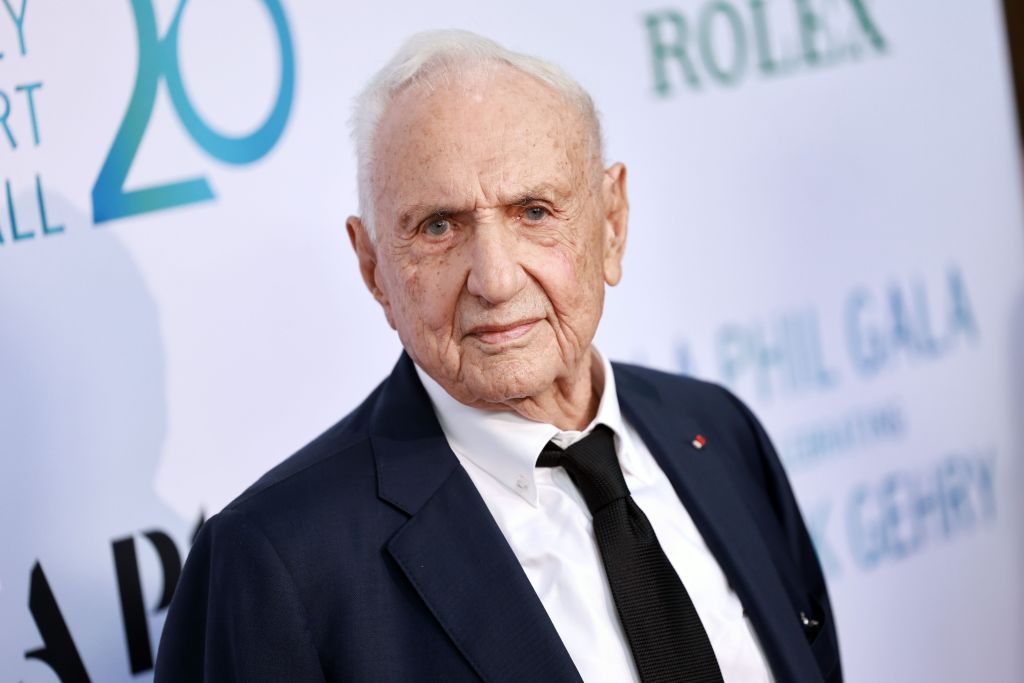
Frank Gehry, the Los Angeles-based architect whose buildings became iconic landmarks, died on Dec. 5 at his home in Santa Monica. He was 96.
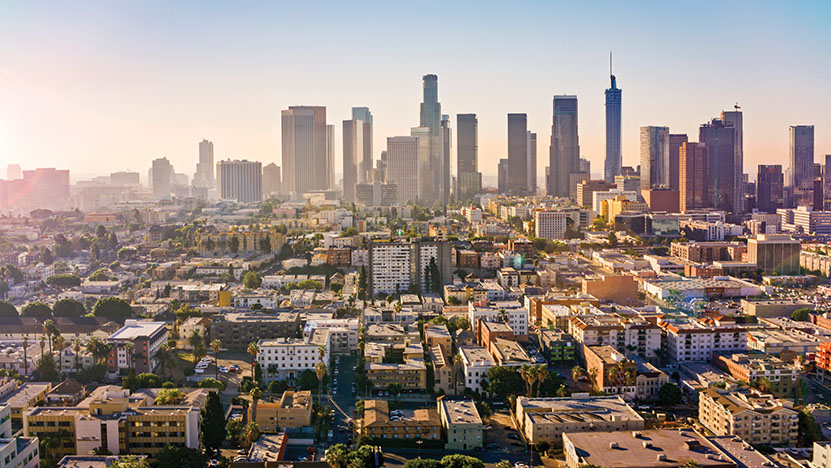
Over a career spanning more than 60 years, Gehry designed concert halls, museums, academic buildings and public spaces that shifted how people talked about architecture, Los Angeles and sometimes city planning itself.
He was born Ephraim Owen Goldberg on Feb. 28, 1929, in Toronto. His mother encouraged him to draw and listen to classical music. His maternal grandmother kept live carp in the bathtub before turning them into gefilte fish, and those early shapes stayed with him. He later traced his fascination with fish forms back to afternoons spent on the floor with her and with wood scraps from his grandfather’s hardware store. His father struggled with business and had a volatile temper.
Gehry lost 33 members of his extended family in Auschwitz. He seldom spoke about it but told the Journal in 2019, “You hope that kind of stuff isn’t repeated; that people find pride in their own history.”
The family moved to Los Angeles after his father suffered a heart attack. Gehry drove trucks, worked odd jobs, and took night classes before finding his way into architecture school. He studied at Los Angeles City College, then earned his degree from USC in 1954. After a stint in the Army, he went to Harvard to study city planning but walked away from the program. He worked for an architect in Paris, where he studied Romanesque churches and paid attention to Picasso and Le Corbusier.
“Frank was honored by everybody: clients, the public, the press as the most important architect worldwide because he was the most important architect. You can point to at least twenty plus buildings that can only be described as amazing, a legacy that one must see with their own eyes.” – Michael Eisner
He returned to Los Angeles in the early 1960s, opened his own firm, and built small houses, academic buildings and museums across Southern California. He took the materials around him — chain-link, plywood, exposed studs — and treated them as legitimate building blocks. When he wrapped his modest Santa Monica house in those materials in 1978, critics saw it as a breakthrough. Neighbors hated it, though sent his career to new heights.
He created a giant fish sculpture for the 1992 Summer Olympics in Barcelona and designed buildings across Europe, Asia and Latin America. But the two projects that would become his most prominent were The Guggenheim Museum Bilbao, which opened in 1997, and The Walt Disney Concert Hall in downtown Los Angeles, which opened in 2003.
Michael Eisner, who was CEO of Disney during the planning and construction of the hall, wrote on X, “Frank, very early, worked with us at the Walt Disney Company creating excellence in Anaheim and Paris.” He continued, “Frank was honored by everybody: clients, the public, the press as the most important architect worldwide because he was the most important architect. You can point to at least twenty plus buildings that can only be described as amazing, a legacy that one must see with their own eyes. From a hockey rink for the Mighty Ducks of Anaheim to Walt Disney Concert Hall, from a museum in Bilbao Spain to a soaring tower in NYC, and from a meeting/convening building that Frank designed for our family in Colorado to millions of square feet of ‘can you believe that’ around the world, we have lost someone who was super super super special.”
Both Bilbao and Disney Hall showed how far Gehry was willing to push metals, curves and surface. Both also leaned on software first used in aerospace engineering, adapted by Gehry Technologies for architecture.
Although he stepped away from religious practice at thirteen, after finding his bar mitzvah crowd “disingenuous,” he still carried pieces of Jewish life with him. He said he loved hearing Kol Nidre when performed well and that he viewed religion more as a search for belonging. “I look at religion as trying to find your place in the world,” he said.
His relationship with Israel was complicated. He agreed in 2004 to design the Museum of Tolerance in Jerusalem but withdrew from the project in 2010. “I’ve had so many funny relationships with Israel about buildings,” he said. “I don’t know if I’d accept a project in Israel other than this one.” The exception was the World’s Jewish Museum in Tel Aviv. For him, the museum’s purpose was to “be an important message for the world that a lot of people accomplished many things in the fields of science and art and education and all the important topics we live by and we are inspired by.”
He developed friendships with Israeli leaders, including Shimon Peres. Gehry recalled one moment that stayed with him: presenting a model at the president’s residence and thinking, “Zayde, I’m in the president of Israel’s house and I’m presenting a model for a museum in Jerusalem and I’m standing between Shimon Peres and Ehud Olmert.”
Following his passing, The Solomon R. Guggenheim Foundation wrote on X, that Gehry’s “visionary architecture reshaped our institution and changed cities around the world.” The statement continued, “His buildings paid profound homage to Frank Lloyd Wright’s foundational vision for the Guggenheim—architectural distinction in service of art, artists, and visitor experience.”
Even at the height of his global fame, he pushed back at the idea that architecture had lost its artistic core.
“The issue for architecture is that historically, it was considered an art, and since the war, since modernism, it got mixed up with other issues like commercial developers,” he said. “It slowly became just stupid … I think what’s needed is architects who are artists.”
Gehry taught at USC, Harvard, UCLA and Yale. He received the Pritzker Prize in 1989 and the Presidential Medal of Freedom in 2016.
His work reshaped cities and set new expectations for what public buildings could be. A generation of architects grew up studying his models, drawings and the risks he took.
He is survived by his wife, Berta, and his children Samuel, Alejandro, Leslie and Brina.