Many in the latest generation of women rabbis don’t think of themselves as feminists. For them, being a rabbi is a birthright; they grew up with women rabbis. They have little sense of what it took to get to this point. For those of us in the first generation, that is a bit frustrating.
Moses had the same problem, as can be seen in this week’s Torah portion. The second generation of Israelites is camped on the plains of Jericho, overlooking the Promised Land. Moses tells them about the great exodus, the miracle at the sea, the epiphany at Mount Sinai.
Moses wants to provide a little historical perspective. They weren’t at Sinai. They don’t remember much of the journey. Moses knows that for them to succeed in the Promised Land, they need to remember what it was like in the past.
I am particularly attuned to this sort of disconnect, having just returned from an extraordinary trip organized by the American Jewish Archives (AJA) and the Jewish Women’s Archives (JWA) to honor the memory of Rabbi Regina Jonas, the first woman to be ordained a rabbi. She was born in Berlin in 1902 and independently ordained in Germany in 1935. Called Frau Rabbinerin Jonas (Miss Rabbi Jonas), she struggled to be accepted. She worked as a community rabbi, teacher and pastor, and, as the situation in her country began to worsen, she was called upon by Jewish communities to fill in for their rabbis who had emigrated. In 1942, she was deported to Terezin, where she worked with Viktor Frankl to bring comfort to fellow prisoners. In October 1944, she was murdered in Auschwitz.
Although some survivors of the Holocaust, including important rabbis and leaders, knew her, they didn’t talk about her. It wasn’t until the Berlin Wall fell and her papers were discovered in an East Berlin archive that her story began to emerge.
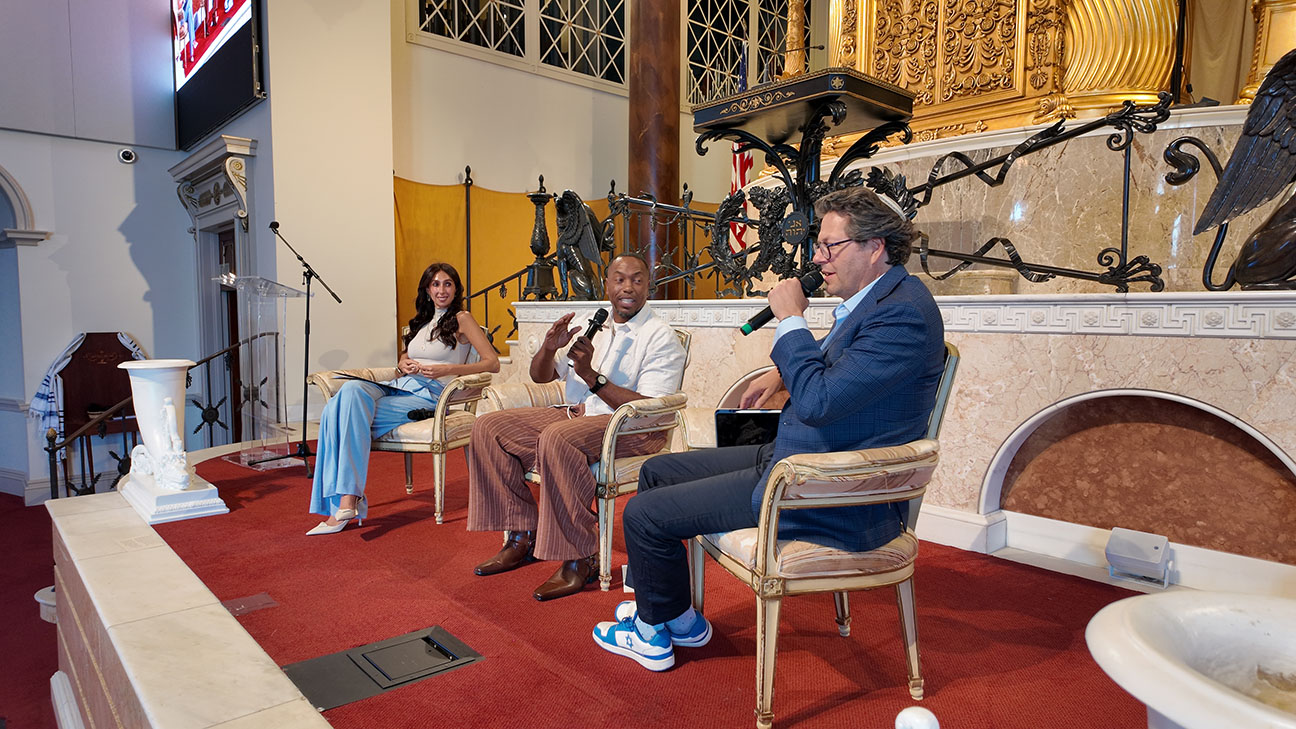
A highlight of our very emotional trip was a panel in the social hall of the Centrum Judaicum in Berlin’s New Synagogue, the first major synagogue to house a liberal congregation there and to have mixed choir and organ. This was the spiritual home of the famous composer Louis Lewandowski and where Albert Einstein played his violin. The small congregation is led by Rabbi Gesa Ederberg, who was ordained in 2003 at the Schechter Institute in Jerusalem.
On the panel were the first women ordained as rabbis by their respective movements. Rabbi Sandy Sasso, ordained in 1974 in the Reconstructionist movement, quoted a Mary Oliver poem: “Pay attention. Be astonished. Tell the story.” She was joined by Rabbi Sally Priesand, ordained in 1972 by Hebrew Union College-Institute of Religion (HUC-JIR); Rabbi Amy Eilberg, ordained in 1985 by Jewish Theological Seminary; Rabbi Jacqueline Tabick, ordained in 1975 by Leo Baeck College; Rabbi Alina Treiger, Germany’s first modern woman rabbi, ordained at Abraham Geiger College in Berlin in 2010, on the 75th anniversary of Jonas’ ordination; and Rabbi Sara Hurwitz — who connected remotely from Jerusalem because Ben- Gurion Airport was closed briefly as a result of escalating conflict with Gaza — was ordained in 2009, the first woman ordained by an Orthodox institution. Each told her story. Also present were other European women rabbis serving in Germany and Poland, as well as the first woman rabbi in Israel, Rabbi Kinneret Shiryon. I was part of the delegation of women and men from the United States — rabbis, Jewish scholars, lay leaders.
The next day we traveled to Terezin, where we dedicated a plaque to the memory of Rabbi Jonas as part of the U.S. Commission for the Preservation of America’s Heritage Abroad and HUC-JIR.
Why didn’t those survivors who knew her tell her story? Were they ambivalent about her because she was a woman? Were they just so focused on surviving the trauma of the Shoah that her story didn’t matter? We’ll never know. Her story came to light only after the fall of the Berlin Wall, when her papers were discovered in an East German archive. We saw those papers. There are just a few, really, with a handful of pictures and a copy of her thesis, titled “Can a Woman Be a Rabbi According to Halachic Sources?” The papers include an ordination document written on behalf of the Liberal Rabbinic Association by its leader, Rabbi Max Dienemann. Terezin has a few of her papers as well, including a handwritten list of topics she lectured on in Terezin, such as women in the Bible, women in the Talmud, and Jewish holidays and beliefs.
Each of us women rabbis has given talks with those same titles … under such different circumstances.
Not just the pioneers, but also each successive generation of women rabbis stand today on her shoulders. She was totally alone, independently ordained, unsupported by most of the Jews around her. But we have one another, and the support of our movements and so many women and men. Women have come from the margins into the center and have transformed the Jewish world. We must urge our successors to preserve the story of our journey.
Meanwhile, the AJA and the JWA are trying to determine the date of Jonas’ death so we can say Kaddish for her. It is most likely the day she arrived at Auschwitz, or the day after. At Temple Emanuel of Beverly Hills, we will read her name every year on her yahrzeit.
Pay attention. Be astonished. Tell the story.
It was true for Moses. It is still true for us.
A version of this piece appeared first in the Times of Israel.