

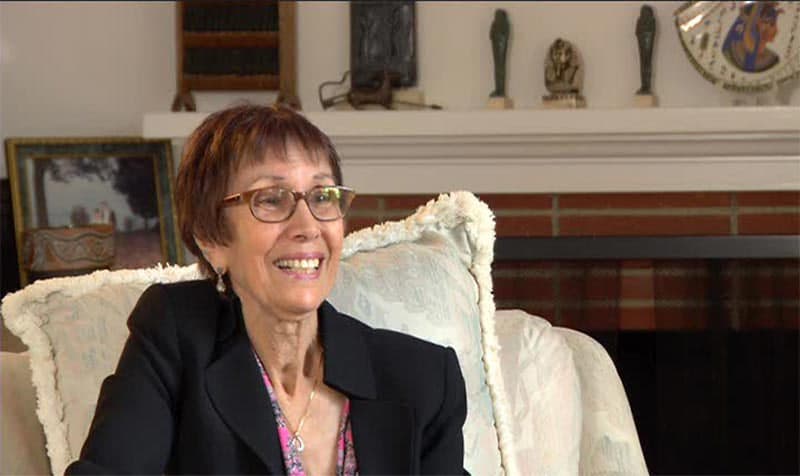
Ruth Pearl, mother of slain Wall Street Journal correspondent Daniel Pearl and co-founder and CFO of The Daniel Pearl Foundation, died this week at the age of 85.
Ruth, an electrical engineer and computer software analyst who was born in Baghdad, and her husband, Judea Pearl, were thrust into the international spotlight when their son was abducted and murdered by Al Qaeda terrorists in 2002 in Karachi, Pakistan. His widow, Mariane, gave birth to their son, Adam, three months after Daniel was killed.
Ruth and Judea founded and ran the Daniel Pearl Foundation to promote cross-cultural understanding through journalism and music. She co-edited the 2005 book I Am Jewish: Personal Reflections Inspired by the Last Words of Daniel Pearl.
The Daniel Pearl Foundation sponsors an annual international Music Day and a fellowship that brings journalists from Muslim countries to the United States. For more than a decade, a Daniel Pearl Fellow, spent a week at the Jewish Journal of Los Angeles every year. A Los Angeles Unified School District magnet school in Lake Balboa focusing on journalism and communications is named in Daniel’s memory.
Ruth ran the foundation, working to perpetuate her son’s commitment to reaching across divides through music and words.
“It’s very hard even today. It doesn’t change. Time doesn’t do anything. I miss him. We all miss him. And it doesn’t end, because he’s always in the news,” Ruth said in testimony recorded with USC Shoah Foundation in 2014.
“It breaks my heart to know that Judea has lost his beloved Ruth, and the world has lost another Pearl,” said Stephen Smith, USC Shoah Foundation Finci-Viterbi Executive Director. “I’m profoundly grateful to have known Ruth, and to know that her story and that of her son Daniel live on in her testimony.”
Ruth’s testimony is one of 20 interviews in the Visual History Archive collected in recent years about the Jewish experience in North Africa and the Middle East in the World War II era. Jews who fell under German occupation in these regions were subject to Nazi persecution, and some 850,000 were expelled from Muslim and Arab countries after the establishment of the State of Israel in 1948.
In her 2014 testimony, Ruth said that the night Daniel was kidnapped, she dreamt that he was scared and in trouble, and she told him she would bring him tea and take care of him. She woke up in a panic and sent her son an email.
“I said, ‘Danny, this is a dream that I had. Please humor me and answer this email immediately.’ He never did,” she said.
Ruth had been having vivid nightmares since an antisemitic pogrom tore through Baghdad in 1941, when she was five years old. Throughout her adult years, she had a recurring dream that a man with a big knife was chasing her up the stairs in her school.
Born Eveline Rejwan in Baghdad on November 10, 1935, Ruth lived in a mixed Muslim and Jewish neighborhood with her parents and four siblings.
Her peaceful childhood was shattered when a failed coup left a power vacuum in British-controlled Baghdad and on June 1 and 2, 1941, thousands of Iraqi civilians, soldiers and paramilitary youth gangs, prompted by Nazi-inspired propaganda and anti-Zionist fervor, rampaged through the streets with machetes and guns. The violence became known as the Farhud, a Kurdish word denoting a breakdown in law and order.
In her testimony, Ruth recalled looking out the window and seeing Jewish homes and shops being looted and bullets flying past her mother, who was holding Ruth’s baby sister. Her father ushered the family down to the cellar, but allowed Ruth to go back upstairs to retrieve his cigarettes, warning her to not look out the window.
“Of course, I looked. And I saw a man [who was a looter] with a sack next to him, injured, leaning at the door,” she said.
One-hundred-seventy-nine Baghdadi Jews—some historians say the numbers are much higher—were killed during the Farhud, and hundreds of others were raped, injured, or had their homes and livelihoods destroyed.
After the Farhud, the Rejwan family moved to the suburbs. Still, Ruth said, “We were at a state of panic—the kids—at all times. Because we were afraid that there will be another violence.”
She and her best friend would stand look-out for each other when they walked home at night. Her father was attacked while riding his bicycle, losing vision in one eye. Her brothers were arrested for no reason and released only after their father bribed the police.
She remembers the bodies of Jews—accused of being Zionists, Communists, or on trumped up charges—hanging in the public square.
Ruth and her siblings were members of the Tenuah underground Zionist youth group, and her two older brothers were smuggled from Iraq to Palestine around 1948.
In February 1951, Ruth, then 15, her parents and her two younger sisters were part of a mass exodus of Jews allowed to leave Iraq if they forfeited their citizenship and all their assets. They were transported to Israel on cargo planes through Cyprus.
Ruth was in a refugee camp in Holon when she met a friend from Baghdad who revealed shocking news: Ruth’s oldest brother had been killed fighting in the Israeli army in 1949.
“I felt like somebody hit me on the head … And I was walking. And I didn’t know how to go back to the tent, because then, you know, how am I going to tell my mother? How am I going to tell the family?” she said in her testimony.
She walked aimlessly for hours, and then found her father, who confirmed what she had heard. He had not wanted to tell his daughters or his wife before they embarked on their risky journey to Israel.
The family subsequently bought an apartment in Tel Aviv and Ruth attended high school in the evening while working during the day. She enlisted in the Navy in 1955 and then earned a degree in electrical engineering at The Technion Israel Institute of Technology in Haifa, where she was on of four women in a class of 120.
At Technion, she met Judea Pearl, whose family had come to Israel from Warsaw in 1924. They married in 1960 and moved to New Jersey to pursue graduate degrees. They had three children in eight years as Judea earned a PhD in electrical engineering and Ruth earned a masters. The family then moved to Los Angeles, where Judea took up a teaching post at UCLA in 1970 and Ruth worked as a computer software analyst.
Daniel, the middle child between sisters Tamara and Michelle, was born on October 10, 1963, and became a precocious child who loved music and sports.
Since his murder, every year on Daniel’s birthday dozens of communities around the world host bridge-building concerts as part of the Daniel Pearl Foundation Music Day project, in addition to the many programs focused on journalism and education.
“Dehumanizing people is the first step to inviting violence, like Nazism and fascism,” Ruth said in her testimony. “It’s very easy to dehumanize. I’m sure the killers of Danny didn’t have any sense of identifying with the humanity that connects us. For them, Danny was an object. And that can happen only if you really don’t have your own self-respect and your own respect for human beings. So we have to figure ways to educate the next generation differently.”
Ruth Pearl is survived by her husband, Judea, her daughters Michelle and Tamara, her daughter-in-law Mariane, her sister Carmella, and grandchildren Leora, Tori, Ari, Evan, and Adam.
Julie Gruenbaum Fax is a writer in Los Angeles working on community outreach at USC Shoah Foundation.

































