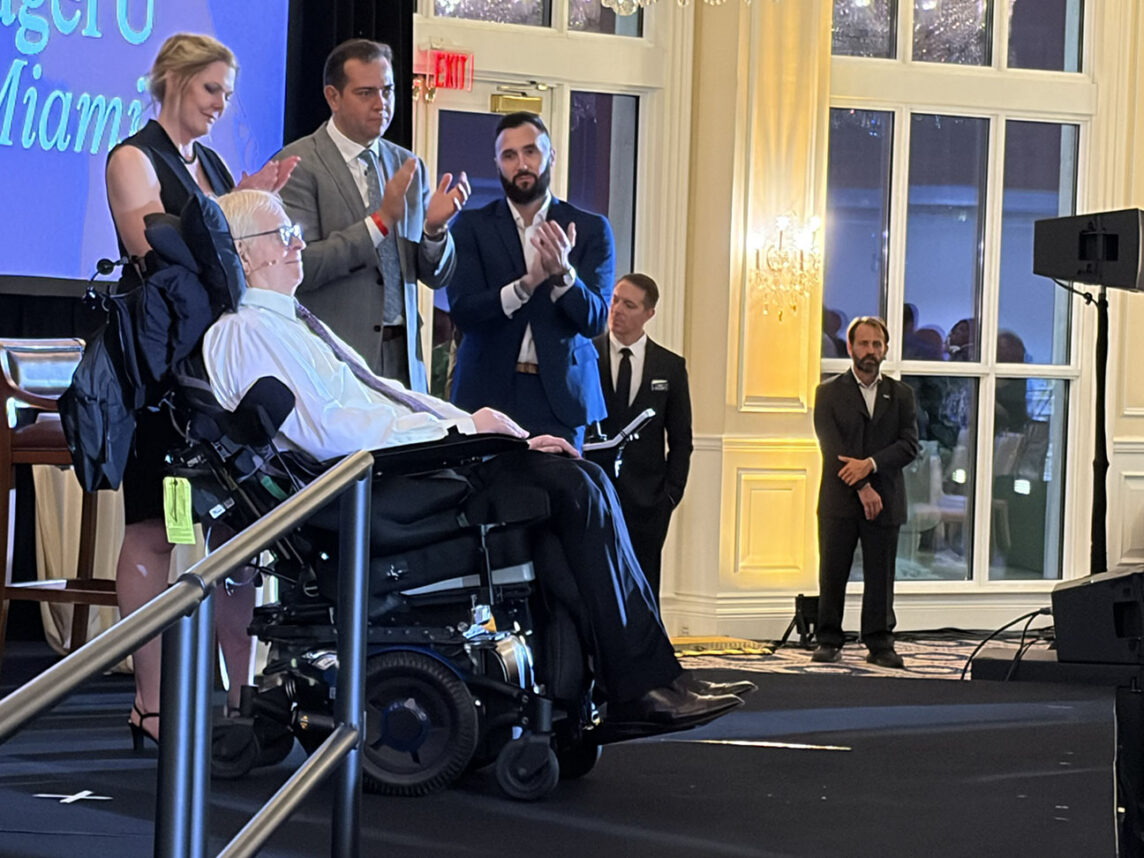
Civil rights activist, USC professor of social work and best-selling author Ralph Fertig was a stalwart example of the Jewish commitment to social justice.
As a boy, he was profoundly affected by his family welcoming European-Jewish immigrants fleeing the Holocaust into their home on the North Side of Chicago. “Each night, I laid awake while they lingered at the table, recounting atrocities and narrow escapes. It was in that sanctuary that I learned about evil and swore an eternal oath to do battle against racism in all its ugly forms. For a long time, it was a very lonely commitment,” Fertig wrote in his 2018 autobiography, “A Passion for Justice: One Man’s Dedication to Civil Rights.”
Fertig died March 28 at his home in Los Angeles. He was 89.
Fertig was born on Feb. 24, 1930, in Chicago to Lottie Berg Fertig and Joseph Fertig. A graduate of Columbia University and the University of Chicago with degrees in social work, Fertig became a leader in the civil rights movement. In the 1960s, he became a Freedom Rider, traveling to Alabama, where he was dragged from a bus, beaten several times and was nearly hanged by Southern vigilantes. After his narrow escape, Fertig went on to organize, with the Rev. Martin Luther King Jr., the 1963 March on Washington and to help pass the Civil Rights Act of 1964. In recounting the passage of the Civil Rights Act, Fertig wrote, “I hugged Barratt O’Hara, 87, the congressman we had elected from the University of Chicago area, kissed him, and we danced. We had changed the world!”
Working as a community organizer and social worker, Fertig ran settlement homes for immigrant and low-income communities in Chicago and Washington, D.C. He was a fierce advocate for underserved communities, strengthening rights for tenants, welfare recipients, and working to reduce gang violence through innovative approaches. When he left Washington, D.C., for Los Angeles in 1973, The Washington Post called him the “Conscience of Washington.”
After earning a law degree from UCLA in 1979, Fertig served many years as a civil rights lawyer and federal administrative law judge.
Fertig was also a writer. His historical novel, “Love and Liberation: When the Jews Tore Down the Ghetto Walls” (Writers Club Press, 2001), recounts the subjugation of Jews in revolutionary France, and became a Los Angeles Times best-seller.
As a professor at the USC School of Social Work, Fertig inspired the next generation of social workers, employing project-based teaching techniques.
As president of the Humanitarian Law Project and as a consultant to the United Nations, he challenged restrictions to free speech in the U.S.A. Patriot Act before the Supreme Court.
Fertig was a congregant of Leo Baeck Temple, where he served on the committee to aid the homeless.
Fertig is survived by his children Jill, David (Louisa), Katie (Carl), son-in-law Ananda and grandchildren Laura, Thomas, Ravi, Melissa and Thea, and life partner Suzy Marks. He was predeceased by his wives Marjorie, Madeleine, Ann and children Karen and Jack.
A memorial service will be held at 1p.m. April 7 at Leo Baeck Temple (1300 N. Sepulveda Blvd., Los Angeles). Shivah will be held at 7 that evening at Leo Baeck Temple.