(JTA) — A song on Vampire Weekend’s upcoming album will feature a reference to the Balfour Declaration, the British World War I-era statement which helped lead to the founding of Israel.
“Jerusalem, New York, Berlin” will be the last track on the rock band’s anticipated fourth album “Father of the Bride,” due out May 3. The news was revealed by Jonathan Dean in a Sunday Times interview with the band’s singer Ezra Koenig published Sunday.
Koenig went on to talk about his own Jewish identity.
“[A]nyone with a brain can see people, both Jewish and non-Jewish, cynically using the charge of anti-semitism in both England and the States. And that doesn’t mean there isn’t anti-semitism — it just means Jewish identity is increasingly fraught. I don’t mean violence is around every corner, just that, when everybody is talking about what it means to be a Jewish person, necessarily the concept becomes a mindf***,” Koenig said.
As for the song, Dean added: “Koenig feels strongly that fans should hear the new music before he offers context.”
On their last album, “Modern Vampires of the City,” Koenig penned a song about an Orthodox Jewish girl who fell in love with an Arab falafel shop employee.
The band recently put out a music video for their new song “Sunflower,” which follows Koenig through Jewish delis in New York and includes an encounter with Jerry Seinfeld.
Koenig also said in the interview that he is backing Bernie Sanders’ presidential bid, as he did in 2016.
Some other Jewish fun facts from the article: Koenig and Danielle Haim, of the Israeli-American band Haim, sing a duet on one track; and one song samples a section from the film score of “The Thin Red Line,” composed by Jewish Academy Award winner Hans Zimmer.
JERUSALEM (JTA) — A Palestinian man was shot and killed by the father of a teenage girl he allegedly tried to stab in a car near a West Bank checkpoint where traffic was at a standstill.
The man was brandishing a knife when he pulled open the passenger door of the vehicle on Route 60 near the Hawara checkpoint, south of Nablus, on Wednesday morning. The father was driving his daughter to high school. They are residents of the West Bank settlement of Elon Moreh, according to reports.
The would-be stabber was taken by ambulance to an Israeli hospital, where he was declared dead. He was identified by the Palestinian media as Muhammad Abed al-Fattah, 23, a resident of the northern West Bank district of Salfit.
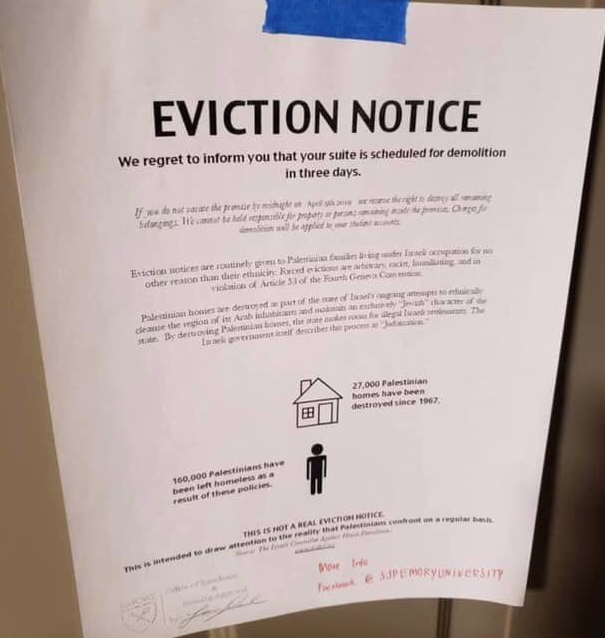
Several mock eviction notices were found outside the doors of student dorm rooms at Emory University on the morning of April 2.
The notices state, “We regret to inform you that your suite is scheduled for demolition in three days.” It proceeds to state that “eviction notices are routinely given to Palestinian families living under Israeli occupation for no other reason than their ethnicity” and then it’s “part of the state of Israel’s outgoing attempts to ethnically cleanse the region.”
Jewish students with Mezuzahs on their doors @EmoryUniversity woke up this morning to these “eviction notices”.
Emory student Anthony Wong wrote in an op-ed for The Emory Wheel, a student-run newspaper, that Emory Students for Justice in Palestine (ESJP) were behind the notices as part of Israeli Apartheid Week. Wong praised ESJP “for starting the discussion” about Palestinian home demolitions.
However, Rabbi Russ Shukles, who heads the Hillel of Georgia, told WSB-TV Atlanta that he thought the notices were “racist, anti-Semitic and absolutely offensive.”
“From anger to fear to security issues, how could Emory allow this to take place?” Shukles said.
Emory Hillel director Dave Cohn told the Algemeiner that there wasn’t any evidence indicating that Jewish students were specifically targeted by the notices. However, Cohn told the Hillel community in an email that they are “defending the safety of our students from this intrusion on their privacy and security.”
The university told Algemeiner that the flyers were taken down because they violated the university’s posting guidelines. The university also told WSB that permission was not given for the flyers to be posted on the doors of student dorm rooms and they are determining the next course of action.
Simon Wiesenthal Center Associate Dean Rabbi Abraham Cooper told the Journal in a statement via email, “Such insidious intimidation against Jewish students occur with such impunity when university officials fail to take decisive action against perpetrators. Jews deserve same protection given to other minorities when hateful threats are launched against them.”
Max Samarov, StandWithUs’s executive director of Research and Strategy, similarly told the Journal in a statement via email, “No student deserves to find something like this on their door.”
“SJP is not only spreading misleading and dehumanizing claims about Israelis, they are also violating school policies and creating emotional distress for their peers,” Samarov said. “We fully support the efforts of Emory students and faculty to hold SJP accountable.”
ESJP did not respond to the Journal’s request for comment.
The mock eviction notices on college campuses have been used in the past; according to the Anti-Defamation League (ADL), there were eight different campuses during the 2013-14 academic year where the notices were found.
“On several campuses, students have reported that the mock eviction tactic left them feeling intimidated,” the ADL noted. “University administrations were typically responsive to these issues, while protecting First Amendment freedoms.”
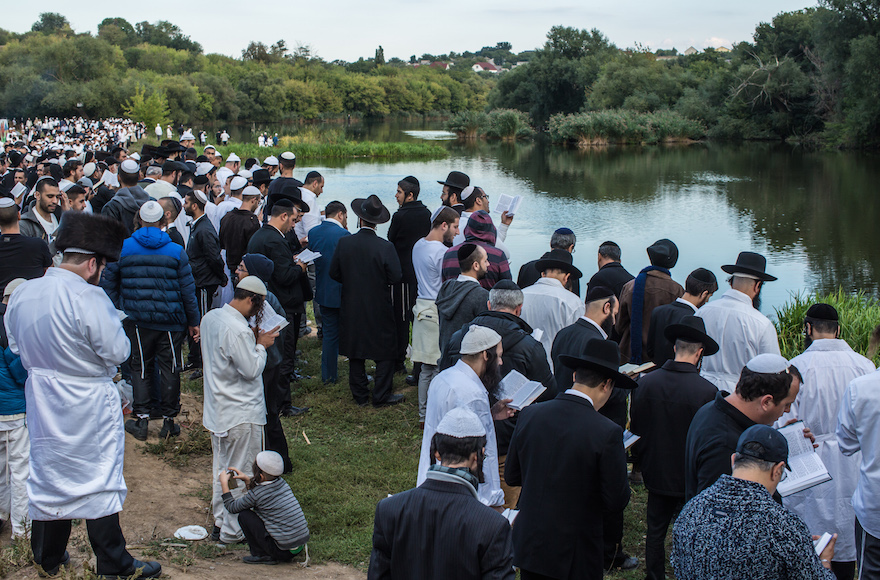
JERUSALEM (JTA) — Israel’s measles outbreak took off in September after thousands of mostly Hasidic Orthodox pilgrims brought the virus back from Uman, Ukraine.
Tens of thousands of Jews gather in the central Ukrainian city each year on Rosh Hashanah, the Jewish New Year, near what many believe is the burial site of Rabbi Nachman, an 18th-century luminary.
Ukraine’s measles outbreak began in 2017 and has had almost 70,000 cases, The New York Times reported Wednesday. In late September, following Rosh Hashanah and the annual Uman pilgrimage, measles cases exploded in Israel, to 949 in October, according to the newspaper, citing Dr. Patrick O’Connor, leader of the rapid disease control team at the World Health Organization’s European office, which oversees Israel. The cause is believed to be the numerous pilgrims who returned from Ukraine with the virus.
Meanwhile, a measles outbreak in New York began in October with a child in the Bensonhurst section of Brooklyn who had visited Israel. Also in October, an outbreak began among Orthodox Jews in London.
Israel’s measles outbreak began in March 2018, according to O’Conner, in a small Orthodox community in Safed, in the northern part of the country.
Orthodox Jews in Israel for the most part do not have a problem with vaccines, which are provided free there. However, large Orthodox families often are not careful about making sure all their children have their vaccinations.
Vaccination rates among the Orthodox in Israel are in the 80 percent range, and the virus spreads quicker as Orthodox children attend more life-cycle events such as weddings and circumcisions, giving them more opportunity to be exposed.
The far-right leader was asked on Tuesday during his visit to Israel if he agreed with the claim by his foreign minister, Ernesto Araujo, that Nazis were leftists.
Bolsonaro was visiting Israel just days before Prime Minister Benjamin Netanyahu is up for re-election. Prior to the trip, the Brazilian leader walked back his promise to move his country’s embassy to Jerusalem from Tel Aviv, saying that his government may instead open a “business office” in Jerusalem.
Netanyahu has appeared eager to embrace the new leader of Latin America’s largest economy, despite criticism by Bolsonaro’s opponents at home that the president is hostile to black, indigenous and LGBTQ people, as well as the environment and human rights.
Jews of Color The cover photo on the March 29 edition is iconic — incredible, actually — depicting the perilous journeys of groups like Yemenite Jews and others from Arab lands and their perilous journey to Palestine (“The Forgotten Jews of Color”).
Unfortunately, Israeli public relations have been deficient in presenting the multicolored face of Israel to the world. The loud voices of the left have made Israel’s case into a case analogous to European colonization of the Middle East, which in the case of Israel is not only a bald-faced lie, but in direct opposition to the historical record.
It is Israel in the past 2,000 years that has been colonized by other powers: Romans, Arabs, Turks and British.
A higher profile of Sephardic Jews and Jews of Ethiopian background in the Israeli Diplomatic Corps would effectively refute the lies of Israel’s enemies. Richard Friedman, via email
In 1969, on a beach in Tel Aviv, an Israeli woman of color asked me, “Do you think Moses was white?”
Today, I think most of the Jews described in Exodus were “of color.” Lester Helmus, via email
Missing the Mark About Ilhan Omar Dan Schnur’s column concerning Ilhan Omar and lobbying money is at best disingenuous and at worst makes her point valid (“Omar’s Hatred Has No Place in Congress,” March 29). The fact that Israel spends $34 million lobbying in the United States while South Korea and Japan spend more is irrelevant to prove Omar is misguided. South Korea and Japan are lobbying for their countries and their businesses. They are not lobbying for or against Israel or for a Middle East policy. While Qatar spends more per capita (still around 33 percent of what Israel spends), it is not lobbying for Palestinian interests. What is relevant is how much is spent lobbying in favor of the Palestinian state, a figure that is noticeably missing from the column and leads to the conclusion that there is a vast disparity that favors Israel.
These types of attacks are simply dishonest and miss the point that Israel and American Jews do spend substantial sums to influence American policy toward Israel and to elect sympathetic candidates.
Why else would you spend the money? Unfortunately, that is what our politicians expect.
Instead of making these types of arguments, we should be impressing to Omar that American policy toward Israel is premised upon shared common values and that Israel provides a more democratic and tolerant society than its Arab neighbors.
These factors far outweigh any monetary considerations. Larry E. Wasserman, Studio City
Pitzer Protest As one of the first men to be admitted and graduate from Pitzer College, I have a unique perspective about the evolution of the College over many decades. I firmly agree with the position of Pitzer President Melvin Oliver objecting to the action of some faculty and students who sought to ban the opportunity for students to study at the University of Haifa (“Pitzer President Vetoes College Council Vote on Israel Program,” March 22). I assert that students should retain the right and the academic freedom to choose study abroad programs to gather firsthand understanding of any issues of concern.
The controversy at Pitzer continues in 2019. In 2018, the Pitzer student council and a few faculty members advocated to have Pitzer withdraw from allowing students to attend Haifa University in Israel for study abroad. Causing national attention to these narrow boycott, divestment and sanctions (BDS) views potentially can harm the reputation of any college. Advocating for BDS, interruption of events, interfering with a discussion of issues to present other perspectives, along with demonizing Israel doesn’t address the core issues. Entering a dialogue that is productive and establishes a more comprehensive perspective to resolve the conflict between the Palestinian people and Israel is a more constructive approach.
This BDS movement is not isolated. It is found at campus protests nationwide, and among community members such as one retirement community in Claremont. While not diminishing the importance of resolving the Palestinian issue, it is also reasonable to focus on countries where the violation of human rights is particularly pronounced beyond any of the Israeli concerns.
Many students and faculty who don’t support BDS are frustrated by the continuing campus controversy that interferes with more constructive discourse. I admire the upcoming conference on April 5 at USC. This type of program should be scheduled at the Claremont Colleges this fall, to provide a forum for students, faculty and members of the community to come together to examine many facets of resolving Palestinian and Israel concerns. Bernard Karmatz, via email
The Importance of Community Monica Osborne’s column “The Power of Community” (March 8) resonated with me. As a disabled person, I have limited one-on-one time with others, so I thrive on community with the human race. Community is important to me and a big force in my life. Whether it’s my work community, the community I live in or my religious community, making strides to connect with people throughout my day is a priority. I believe that community is a living, breathing thing and I am grateful for the opportunity to connect every day. This connection gives me a feeling of belonging. Susan Cohn, Redding, Calif.
Judge Not Mark Schiff’s beautifully observed account of the judgment factor nearly destroying a now cherished relationship has stayed with me (“Here Comes the Judge,” March 29). Coupled with the anguish Judy Gruen expresses so poignantly in her column concerning the same factor, I am left contemplating my own propensity to disconnect from those whose conduct or politics have put me off (“Politics Claims Another Friendship,” March 29).
Philosophically accepting the mandate to love every Jew, and by extension every person, as I do myself comes easily. But how committed have I been to genuinely overcoming my resentment toward those who seem overly willing to buy into the caricature of conservatives as individuals in any way less compassionate than their counterparts on the left? What about my own embrace of the cartoon image of the “lefty” as someone more concerned with establishing his moral superiority than with whether the policies he champions will truly most benefit those in need?
My thanks to these writers and the Journal for challenging me to confront my own judgment-related shortcomings. Mark Ellman, via email
Mueller Report Now that the Mueller report is in, there are questions that still remain, not about collusion but about how the most prominent blue-chip journalists botched the Russia story from beginning to end. As Sean Davis so poignantly stated in the March 26 edition of The Wall Street Journal, this was a catastrophic media failure.
At one time, particularly around the time that President Donald Trump was elected, the Journal appeared to be part of the mainstream media that Trump labeled, correctly in hindsight, fake news. For example, [Steve] Greenberg had a cartoon showing Trump in bed with Putin. It is gratifying that over the past two years, we, in the Los Angeles Jewish community who rely on the Journal as a publication that serves the Jewish community, have been given more credible journalism.
The record should be corrected by Greenberg in a graphic manner, just as he falsely portrayed Trump colluding with Putin in a graphic manner. Marshall Lerner, Beverly Hills
Now it’s your turn. Submit your letter to the editor.Letters should be no more than 200 words and must include a valid name and city. The Journal reserves the right to edit all letters. letters@jewishjournal.com.
“Dinner for 30 Strangers” Join the Chai Center for “Dinner for 30 Strangers,” a four-course Shabbat meal in an elegant setting, with an opportunity to meet and connect religiously with Jewish singles ages 21–39. Rabbi Mendel Schwartz and his rebbetzin, Esther, host the evening in their Hancock Park home. Between courses, they entertain and teach while introducing Chassidic melodies, followed by rounds of “Stump the Rabbi and the Rebbetzin.” 7–10:30 p.m. Free. $100 sponsorship. RSVP required. Address provided upon RSVP. If sold out, email adrianne@chaicenter.org to be placed on a waiting list.
“Let My People Come” Enjoy food and storytelling and explore the Passover themes of redemption and freedom at the Skirball Cultural Center in partnership with Miry’s List. Rabbi Sarah Bassin begins the “Let My People Come” evening, defining the Jewish value of welcoming the stranger, in particular, today’s refugees. Guests are served a Syrian dinner prepared by a recently arrived refugee family while KCRW host Evan Kleiman moderates a discussion with chefs about their escapes from danger. 6:30 p.m. $45 members, $55 general admission, $90 host. Skirball Cultural Center, 2701 N. Sepulveda Blvd. (310) 440-4500.
“Shabbat in the Park” Families with children ages 6 and younger are invited to attend Sinai Temple’s “Shabbat in the Park,” offering a breezy and fun introduction to Shabbat. Music, play areas and the open spaces of Holmby Park highlight the Friday evening gathering. Families are encouraged to bring their own dairy picnic dinner. 5:45–7:15 p.m. Free. Holmby Park, 601 Club View Drive, Los Angeles. (310) 474-1518.
Adam Milstein Israeli-American philanthropist and community leader Adam Milstein addresses the Republican Jewish Alliance’s San Fernando Valley chapter about the hate threatening American Jews today. Milstein, a native of Haifa, Israel, and chair of the Israeli-American Council, argues that anti-Zionism is anti-American. Buffet lunch served. Noon–1:30 p.m. $30 members, $40 general, $45 at the door. Credit card or check only. Braemar Country Club, 4001 Reseda Blvd., Tarzana.
“Friday Night Unplugged” Rabbi Mendel Simons and an acapella group offer a Friday night experience for Jewish professionals ages 21–39 at Beverly Hills Synagogue. The evening opens with a scotch-and-sushi cocktail hour and includes a mindful, musical and meditative Kabbalat Shabbat. Evening attire. 6–9 p.m. 6:30 p.m., bar opens. $15. Beverly Hills Synagogue, 9261 Alden Drive, Beverly Hills. (310) 692-4190.
“Love Shabbat” Celebrate the most important person in your life in a quiet setting during “Love Shabbat Unplugged,” featuring the soft string melodies by the JAC Trio and readings of memorable love poetry. Participants also may wish to receive a special anniversary blessing. 8–9:30 p.m. Free. Temple Emanuel, Corwin Family Sanctuary, 8844 Burton Way, Beverly Hills. (310) 288-3737.
Laurie Levenson
Jewish Legal Opinions Loyola Law School professor Laurie Levenson appears as the Shabbat scholar-in-residence for three days at Temple Ramat Zion in Northridge. A 30-year member of the Loyola faculty, Levenson specializes in ethical advocacy and is often quoted by news media for her legal insights. Levenson’s topics are “Seeing the American Media Through Jewish Eyes,” “Seeing the American Legal System Through Jewish Eyes” and “Jewish Identity and the Separation of Church and State.” Friday, 6 p.m. Shabbat services and 7:15 p.m. dinner, with Levenson’s presentation to follow. 9 a.m. Shabbat morning service, with Levenson speaking at lunch. 9 a.m. Sunday breakfast with Levenson to follow. $15 Shabbat dinner, free Shabbat lunch but reservations recommended, $8 Sunday breakfast. Temple Ramat Zion, 17655 Devonshire St., Northridge. (818) 360-1881.
SUN APRIL 7
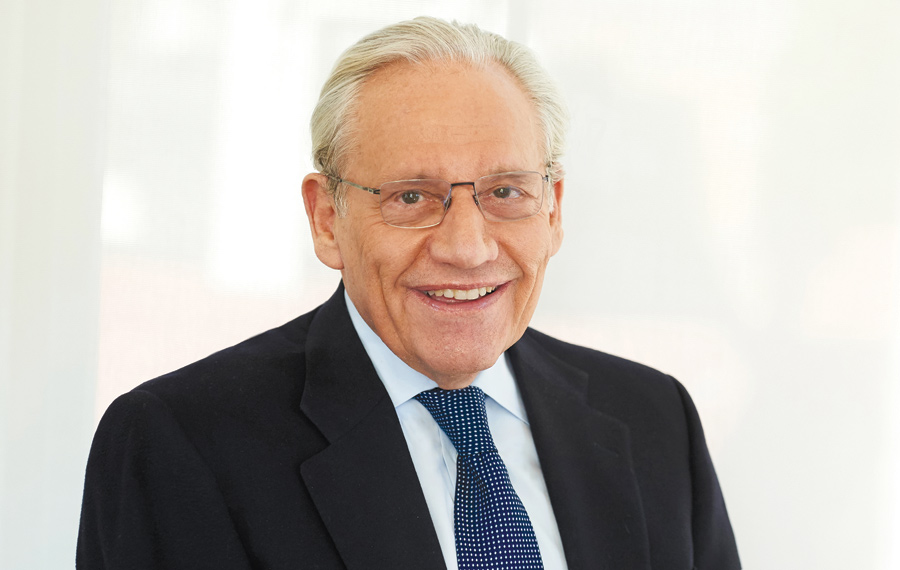
Bob Woodward
Bob Woodward at AJU Nearly a half-century after his investigations into the Watergate scandal made him a celebrity journalist, Bob Woodward, associate editor at The Washington Post, sits for a conversation with Jeffrey Herbst, president of American Jewish University. They talk about the inner workings of government and the media, and the role of leadership. Woodward has won or shared two Pulitzer Prizes, starting with his coverage of Watergate, and 13 of the 19 books he has written or co-authored have been #1 best-sellers. 9:30 a.m. Tickets $55 and $75. A VIP breakfast with Woodward at 8:30 a.m. is $150. American Jewish University, Gindi Auditorium, 15600 Mulholland Drive, Bel Air. (310) 440-1572.
Mark Schiff A funny thing happens to comedian Mark Schiff on his way to Temple Ner Simcha, which he talks about when he headlines “The Simcha Series: A Celebration of Jewish Arts.” 7–8:30 p.m. Free. Temple Ner Simcha, 880 Hampshire Road, Westlake Village. (818) 851-0030.
Camp Alonim Open House Two months before the end of the school year, Camp Alonim and Gan Alonim hold an open house followed by a campuswide “Sunday in the Park” event, featuring horseback riding, archery and arts and crafts. Kosher food for sale. Noon–4 p.m. Camp Alonim tours, 12:15 p.m., 12:45 p.m., 1:15 p.m. and 1:45 p.m. Gan Alonim tours, 12:15 p.m., 1 p.m. and 1:45 p.m. Brandeis-Bardin Campus of American Jewish University, 1101 Peppertree Lane, Simi Valley. (877) 225-6646.
“Walk to End Genocide” Jewish World Watch’s seventh annual “Conejo Valley Walk to End Genocide,” a 5K walk and rally, assembles at Temple Etz Chaim. Catering to children as well as adults, the event offers a Red Hands Campaign, arts and crafts, and a free hate-speech workshop, while drawing attention to specific violent areas around the world. 12:30–2:30 p.m. $30, ages 23-and-older; $18, ages 5–22; free for children ages 4 and younger. Temple Etz Chaim, 1080 E. Janss Road, Thousand Oaks. Jewish World Watch: (818) 501-1836.
TUE APRIL 9
Adam Milstein
Milstein and Berenbaum Israeli-American leader Adam Milstein argues “Anti-Semitism Is Not Only a Jewish Problem — It’s An American One, Too: Discussing Unique Strategies to Fight Back,” with Michael Berenbaum, director of American Jewish University’s Sigi Ziering Institute. 7:30 p.m. $10. American Jewish University Familian Campus, Gindi Auditorium, 15600 Mulholland Drive, Bel Air. (310)440-1572.
WED APRIL 10
“Politics on the Pulpit” Three prominent rabbis debate their distinct views during “Politics on the Pulpit.” Rabbi Elliot Dorff, rector of American Jewish University and a professor of philosophy at AJU’s Ziegler School of Rabbinic Studies, moderates a panel featuring IKAR Rabbi Sharon Brous, Rabbi Elazar Muskin of Young Israel of Century City and Rabbi John Rosove of Temple Israel of Hollywood. They examine the role of the rabbi in discussing headline-making issues that may have profound moral implications. 7:30 p.m. $10. American Jewish University, Gindi Auditorium, 15600 Mulholland Drive, Bel Air. (310) 440-1572.
Chief Rabbi of Uganda Chief Rabbi Gershom Sizomu, leader of the Abayudaya (People of Judah) community, an estimated 1,500 Jews in Uganda, talks about how interfaith initiatives have improved the lives of Jews and non-Jews alike, brought a measure of peace, and tamped down anti-Semitism. Sizomu received ordination from American Jewish University’s Ziegler School of Rabbinic Studies in 2008. After his lecture, he delivers a musical performance. 7 p.m. Free. Temple Beth Am, 1039 S. La Cienega Blvd. (310) 652-7353. RSVP at lmandelbaum@tbalaorg.
THU APRIL 11
‘Orphans’ at Yula “Orphans,” a play about two adult brothers who are orphaned during childhood and pursue lives of crime, opens at YULA Boys High School for three performances. Written by Lyle Kessler, “Orphans” debuted in 1983 and was praised by the Los Angeles Times for conveying the message that “we all need each other.” April 11: 7:30 p.m. April 14: 2 p.m. and 7:30 p.m. Tickets $10–$180.YULA Boys High School, 9760 Pico Blvd. (310) 203-3180. .
“Threats to the Future of Judaism”
David Suissa, publisher and editor-in-chief of the Jewish Journal, discusses “What Is the Biggest Threat to the Future of Judaism?” at an event organized by The Executives of the Los Angeles Jewish Home. 7 p.m., wine and dessert reception. 7:30 p.m. program. Members $25 pre-registered, $30 at the door. General admission, $30 pre-registered, $35 at the door. El Caballero Country Club, 18300 Tarzana Drive, Tarzana. (818) 774-3332.
Have an event coming up? Send your information two weeks prior to the event to ryant@jewishjournal.com for consideration. For groups staging an event that requires an RSVP, please submit details about the event the week before the RSVP deadline.
Nearly 400 people gathered in the Gindi Auditorium at American Jewish University (AJU) on March 24 for the screening and discussion of the documentary film “Who Will Write Our History.”
The 2018 documentary from director Roberta Grossman tells the story of how, in November 1940, days after the Nazis sealed 450,000 Jews in the Warsaw Ghetto, a secret group led by historian Emanuel Ringelblum and known by the code name Oyneg Shabes vowed to defeat Nazi lies and propaganda with pen and paper. They risked everything so that their archive would survive, even if they did not.
In her introduction for the program, Laura-Beth Sholkoff, interim director at the Whizin Center for Continuing Education at American Jewish University, said that as the daughter of a child survivor of the Holocaust and the mother of a past March of the Living participant, it was especially moving for her to participate in the evening.
The post-screening discussion included Grossman, who also wrote and produced the film; its executive producer Nancy Spielberg; and Michael Berenbaum, an AJU professor of Jewish studies and director of AJU’s Sigi Ziering Institute.
AJU partnered with Builders of Jewish Education and the Jewish Historical Society of Southern California to host the event.
From left: Author Amelia Saltsman (“The Seasonal Jewish Kitchen”), author Beth Ricanati (“Braided: A Journey of a Thousand Challahs”) and chef and restaurateur Susan Feniger before their panel, “Jewish Women Foodies: Tradition & Innovation,” on March 10. Photo courtesy of Jewish Women’s Theatre
The “Jewish Women Foodies: Tradition & Innovation” program on March 10, organized by The Jewish Women’s Theatre (JWT) group, drew a strong turnout that filled the room at The Braid in Santa Monica. The mid-morning event treated attendees to a light brunch, after which there was plenty of food for thought.
Beth Ricanati, author of “Braided: A Journey of a Thousand Challahs,” kicked off the program with a challah-making demonstration. As she combined ingredients, Ricanati shared her story as well as what she learned when she started baking challah every week. Challah-baking, she said, taught her the power of ritual, community and food as medicine.
After Ricanati’s demonstration, she was joined on stage by cookbook authors Amelia Saltsman (“The Seasonal Jewish Kitchen”) and chef and restaurateur Susan Feniger of Border Grill to share their connections with and love of food. Among the topics, Saltsman talked about shopping for and cooking with locally grown produce, and Feniger shared her journey from chef to restaurateur. JWT advisory council member Maureen Rubin moderated the panel.
“We are thrilled that so many of our members of our JWT community are attending our ‘Sunday Morning at the Braid’ events,” Rubin said in an interview. “Our panelists for Jewish Women Foodies cooked up some real treats for our audience and [their] backstories [were] entertaining and inspirational.” — Debra Eckerling, Contributing Writer
At a benefit for Temple Israel of Hollywood, writer and composer Ryan Langer performed his “mourning songs,” 15-second original tunes he posted daily for a year on Instagram after the murder of his father. Photo by Ella Hovsepian
About 100 people gathered in the backyard of a private home in Hancock Park on March 27 for an evening of storytelling on the topic of loss. The event, a benefit for Temple Israel of Hollywood (TIOH), featured stories and music on the subject by writers and actors.
The event was co-hosted by Jessica Queller, author of the loss memoir “Pretty Is What Changes” and executive producer of the TV series “Supergirl,” and Gabrielle Birkner, co-author of “Modern Loss.”
Actors Kate Burton (“Grey’s Anatomy,” “Scandal”), Willie Garson (“Hawaii Five-O,” “White Collar,” “Sex and the City”), actor-singer-writer Daniel Beaty, actor-writer Jon Sklaroff, writer-director David Bar Katz, writer-producer Emily Ziff Griffin and writer-comedian Dani Klein Modisett shared personal stories of loss.
Writer and composer Ryan Langer performed a few of his “mourning songs,” 15-second original tunes he posted daily for a year on his Instagram account after the murder of his father.
“Every morning,” Langer said, “I would get up, down some coffee, head to the baby grand in the living room, pull out a Post-it note, and crack my knuckles to create a 15-second song about whatever was on my mind,” Langer told the attendees. “It was a way to stay creative and ‘take time for myself,’ as all the books and professionals advised.”
Langer noted that others expected a year to be enough time for him to move on. “But nothing special happens between day 365 and 366,” he said. “In Year One, there are a lot of grief-related logistics. In Year Two, there’s a lot of … grief, and without the cushions that were set up for you that first year.”
Birkner, the author and co-host, said: “There’s power in people sharing their loss stories — in ways that are candid and vulnerable and aren’t afraid to incorporate humor — and there’s power in bearing witness to those stories. Grief is something that every human has experienced or will experience, but it can still feel like such a lonely road. Talking about it openly helps. It connects us to one another. It builds community.”
TIOH Rabbi Jocee Hudson added: “It is clear that folks are looking for opportunities to share and connect around experiences of loss and grief. We believe that experiences like this can be fostered in a warm, communal environment filled with storytelling, good food, laughter and tears.” — Esther D. Kustanowitz, Contributing Writer
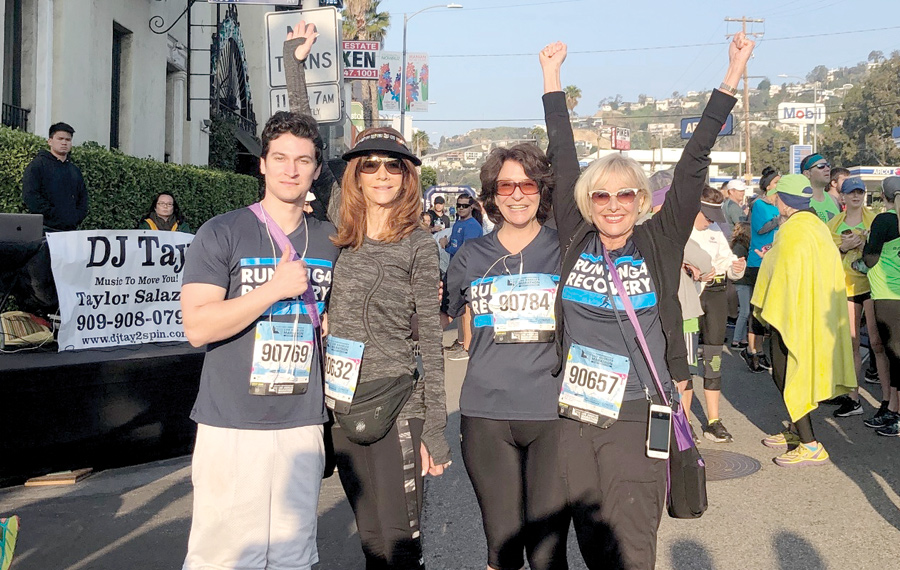
From left: Beit T’Shuvah’s Rueben S., Susan Krevoy, Barbara Tell and Pat Gage ran for recovery during the recent L.A. Marathon. Photo courtesy of Beit T’Shuvah
Beit T’Shuvah’s Running 4 Recovery team took to the streets on March 24 as a featured charity in the Los Angeles Marathon. More than 24,000 people participated in the iconic 26.2-mile race, which began at Dodger Stadium and ended near the Santa Monica Pier.
“[The marathon] is the ultimate community builder, and the Beit T’Shuvah community was out in full force to cheer on the runners as they made their way ‘from the stadium to the sea,’ ” a Beit T’Shuvah statement said.
The Beit T’Shuvah team had 51 members, including 36 residents and 15 community partners comprised of staff, board members and friends, including Pat Gage, a former Beit T’Shuvah board member and longtime supporter.
“One day at a time, one step at a time; goals can be reached, whether it’s a marathon or recovery,” Gage said. “We are all in it together.”
The Running 4 Recovery team raised $116,000 and received donations from approximately 1,500 people. The funds raised from the marathon will help Beit T’Shuvah’s recovery program and provide scholarship support for the program’s residents who need financial assistance to subsidize their treatment.
Students from Pressman Academy and IsIah Academy joining together for a day of learning and fun. Photo courtesy of Rabbi Chaim Tureff
About 100 students from Pressman Academy and IsIah Academy participated in a day of activities to build bridges between Muslims and Jews.
The jam-packed day of activities March 28 kicked off with a praying circle leading to baking bread, participating in the ancient ritual of council and learning about the partnership between Muslims and Jews in Morocco during the Holocaust.
The students also got to play games together and write a song with Jewish indie pop band Distant Cousins that they then performed at the end of the day. Rabbi Chaim Tureff of Pressman Academy said, “it was a truly memorable day.”
Want to be in Movers & Shakers? Send us your highlights, events, honors and simchas. Email ryant@jewishjournal.com.
Filmmaker, producer and speaker Gayle Kirschenbaum has taken several challenging and interesting situations in her life and created films that are engaging and poignant. Her documentaries are extremely personal in nature, and although there is humor and wit to be found, Kirschenbaum, 64, does not shy away from difficult topics. Her film “Look at Us Now, Mother!” deals with Kirschenbaum’s strained relationship with her emotionally abusive mother. She moved to a place of forgiveness toward her mother, and has since been helping others to heal their hurtful relationships. Her relatable manner and powerful message has resonated with people through her TEDx Talk and virtual workshops on “No More Drama With Mama.”
Jewish Journal: What was your mother’s reaction to the idea of making the film?
Gayle Kirschembaum: I asked her if she would go on camera to work on our relationship. And I wasn’t at all surprised that she said yes, because she has a very thick skin and loves all kinds of attention.
JJ: Why do think the film resonated with people?
GK: Oprah [Winfrey] says you should be your authentic self, so maybe it’s that. The film is very authentic; it’s not a vanity piece. There are parts that people can relate to, and stuff comes up for them. I think I responded to a need. So many people out there are suffering. They can be married, they can have children, multiple homes, wealth … but they are in pain. They haven’t released it or forgiven that person, alive or dead.
JJ: How did you evolve from a place of pain and resentment to forgiveness?
GK: It started when I lived in Los Angeles and in the midst of so much pain, I met a woman who had a horrific childhood. And in her healing, she became the facilitator of a psychological board game that I was invited to participate in. The only thing I remember was throwing the dice and when it landed, she told me to stand up, close my eyes and imagine my mother as a little girl. When I did that, I saw the suffering and pain she went through. Then the facilitator said, “Now imagine yourself as a little girl.” And then she said; “Now you come together.” That was life changing.
JJ: So that was a transformational moment in terms of how you looked at the situation?
GK: Yes. I ended up reframing how I looked at my mother. Not just the lack of love, but how I was scapegoated growing up and felt like I was living in enemy territory. As soon as I would see my mother, I was like a wounded child again. I changed my expectations. The key is managing expectations, and that’s what I’ve done.
JJ: How has your relationship changed since the film?
GK: We have grown even closer. It might be hard to believe, but Mom has thanked me for the film. She’s become a bit of a “momstar” and has been cited several times. One woman pointed at her and said, “You are the mother in the film. You’re the most likeable bitch.” [My mother] loves this. My mother is one of the smartest people I know. She is great with investing, a businesswoman, an avid reader and my best story consultant. I have hired many professionals and I will take her. She has a great sense of story and the ability to read a piece about her showing her nasty side and be objective in her feedback. I get her. I understand her wiring. She has no censor, which can be entertaining and offensive.
JJ: It sounds like understanding and compassion is a big part of being able to enjoy a closer relationship.
GK: It is. I know how important it is for her to be the center of attention. Sometimes it is tiring. I look at her as my adult child who is desperate for love. As a sensitive person I can empathize with her. She is going strong at 95 and I have tremendous admiration for her. I told her she should donate her body to science, as she is a phenomenon. She is quite a role model. OK, not in the area of emotional intelligence but hey, I have enough of that for two people. Feeling lucky and blessed to have this time with her. Getting ready for our next travel adventure. South America, here we come.
JJ: Tell us about the work you do on the topic of forgiveness and relationships.
GK: I do virtual workshops because I’ve found that people feel safe and comfortable being in their own home. I’ve also spoken at conferences, and in a variety of situations. People in the mental health field have been drawn to the film, and I’ve spoken at a mental health conference. The film’s message has also been popular in the Jewish world and in the area of women’s empowerment.
“I ended up reframing how I looked at my mother. Not just the lack of love, but how I was scapegoated growing up and felt like I was living in enemy territory. As soon as I would see my mother, I was like a wounded child again. I changed my expectations.”
JJ: It sounds like people have really connected with the idea of forgiveness.
GK: When we don’t learn how to forgive, it affects everything in our lives. I got so sick making the film that my hands got covered in plaque. I saw the best doctors and nobody could help. I wound up helping myself by changing my way of thinking — with positive thinking, meditation and affirmations.
JJ: What role does Judaism play in your life?
GK: The way I was raised, Judaism was actually a huge turn-off to me. I was a sensitive, artistic person growing up in a predominantly Jewish neighborhood where people were judged by their money or what people did for a living. I was surrounded by people who cared about fitting in, having nose jobs, straightening curly hair. I wasn’t especially fond of my rabbi, who wasn’t the spiritual leader I was hoping for.
JJ: Did your feelings about Judaism change over time?
GK: It did. The first time I went to Europe, I met other Jews and they weren’t competitive at all. They were friendly and helpful. I felt part of a tribe. Then I went to the Soviet Union and met Russian Jews who were intellectuals. I connected with other Jews and from then on, I felt a huge sense of pride about being Jewish. There are many incredible things about Judaism. Although I’m not religious, I’m spiritual and I feel very, very proud to be Jewish.
JJ: What’s next for you?
GK: I’m currently writing a memoir about my journey.
Allison Futterman is a writer living in North Carolina.
Civil rights activist, USC professor of social work and best-selling author Ralph Fertig was a stalwart example of the Jewish commitment to social justice.
As a boy, he was profoundly affected by his family welcoming European-Jewish immigrants fleeing the Holocaust into their home on the North Side of Chicago. “Each night, I laid awake while they lingered at the table, recounting atrocities and narrow escapes. It was in that sanctuary that I learned about evil and swore an eternal oath to do battle against racism in all its ugly forms. For a long time, it was a very lonely commitment,” Fertig wrote in his 2018 autobiography, “A Passion for Justice: One Man’s Dedication to Civil Rights.”
Fertig died March 28 at his home in Los Angeles. He was 89.
Fertig was born on Feb. 24, 1930, in Chicago to Lottie Berg Fertig and Joseph Fertig. A graduate of Columbia University and the University of Chicago with degrees in social work, Fertig became a leader in the civil rights movement. In the 1960s, he became a Freedom Rider, traveling to Alabama, where he was dragged from a bus, beaten several times and was nearly hanged by Southern vigilantes. After his narrow escape, Fertig went on to organize, with the Rev. Martin Luther King Jr., the 1963 March on Washington and to help pass the Civil Rights Act of 1964. In recounting the passage of the Civil Rights Act, Fertig wrote, “I hugged Barratt O’Hara, 87, the congressman we had elected from the University of Chicago area, kissed him, and we danced. We had changed the world!”
Working as a community organizer and social worker, Fertig ran settlement homes for immigrant and low-income communities in Chicago and Washington, D.C. He was a fierce advocate for underserved communities, strengthening rights for tenants, welfare recipients, and working to reduce gang violence through innovative approaches. When he left Washington, D.C., for Los Angeles in 1973, The Washington Post called him the “Conscience of Washington.”
After earning a law degree from UCLA in 1979, Fertig served many years as a civil rights lawyer and federal administrative law judge.
Fertig was also a writer. His historical novel, “Love and Liberation: When the Jews Tore Down the Ghetto Walls” (Writers Club Press, 2001), recounts the subjugation of Jews in revolutionary France, and became a Los Angeles Times best-seller.
As a professor at the USC School of Social Work, Fertig inspired the next generation of social workers, employing project-based teaching techniques.
As president of the Humanitarian Law Project and as a consultant to the United Nations, he challenged restrictions to free speech in the U.S.A. Patriot Act before the Supreme Court.
Fertig was a congregant of Leo Baeck Temple, where he served on the committee to aid the homeless.
Fertig is survived by his children Jill, David (Louisa), Katie (Carl), son-in-law Ananda and grandchildren Laura, Thomas, Ravi, Melissa and Thea, and life partner Suzy Marks. He was predeceased by his wives Marjorie, Madeleine, Ann and children Karen and Jack.
A memorial service will be held at 1p.m. April 7 at Leo Baeck Temple (1300 N. Sepulveda Blvd., Los Angeles). Shivah will be held at 7 that evening at Leo Baeck Temple.