Ari Marrache is the type of person to whom a casual “how are you?” warrants an excessively jubilant response. “I’m amazing, living the life!” was his answer today. But that wasn’t always the case. For years, the 32-year-old struggled to find his place in the world. The person Marrache presents to the world today, a bisexual artist with the street name Alef, is a far cry from the young Orthodox boy who was riddled with self-doubt.
For Marrache, Alef is a “superhero,” someone with “something to say and who allowed me to finally be the person I always wanted.” Like the British artist Banksy, Alef never allows himself to be pictured in relation to his work.
Born and raised in Gibraltar, Marrache’s family moved to Israel when he was 9, where they lived in Orthodox neighborhoods in and around Jerusalem. When he was 18, Marrache moved to London to study fine art at the prestigious Central Saint Martins University of the Arts. But a year later, seeing no future in the arts and no way to make money, he transferred to law school. But he lasted only two years in law school. He spent the following five years in Madrid, working a variety of jobs.
In 2013, Marrache returned to Israel and began to work with his father, an art collector and dealer. He built a name for himself as an art consultant and curator, curating exhibitions for young, unknown artists. “I lost money but gained experience,” he said, laughing.
For Ari Marrache, Alef is a “superhero,” someone with “something to say and who allowed me to finally be the person I always wanted.”
Marrache realized that he, too, wanted to present his works to the world. He enlisted the help of someone close to him to choose which works to display for his first exhibition. Marrache selected a piece but was told by that person to leave it out because it was “crap and childish.”
Marrache ignored the advice and he ended up selling the piece. “I saw it as a sign from the universe,” he said. “That act of self-love, of believing in myself, was a miracle.”
A strong believer in karma, Marrache invested most of the money he made from his first sale into buying the work of another emerging artist. Three months ago, Marrache left his job as a gallery manager to concentrate on his painting.
Since that first exhibition, he has sold 100 Alef original works to collectors in New York, London, Paris, Berlin, Athens and Tel Aviv. Their motifs are recurrent: urban landscapes with buildings and TV antennas jostling one another.
Cranes are present in almost all of his works as they are in Tel Aviv’s cityscape. “They symbolize the victory of the Jewish people returning home and building it,” Marrache explained.
Like many street artists, Alef has an unquenchable thirst to brand himself on the city itself. He might, for example, transform a dilapidated electric box into a piece of art. He laughs as he compares it to an alpha-male spreading his seed. “I’ve always been this gentle guy and yet know I’ve unleashed this thing and I can’t stop it. It’s a train that’s going a million miles an hour and if I get off, I die.”
The latest Twitter flare-up between New York City Councilman Kalman Yeger and supporters of Congresswoman Ilhan Omar (D-Minn.) was another example of social media’s usefulness: oxygen and fuel for fires that never seem to die down.
Yeger tweeted: “Palestine does not exist.There, I said it again.Also, Congresswoman Omar is an antisemite. Said that too.”
This statement served three purposes: First, to shore up the councilman’s Brooklyn base; second, to rally Omar’s supporters, who will continue to defend her offensive remarks about American-Jewish support for Israel in Congress; and third, to ensure that division between Zionism and Palestinian nationalism festers like an open wound. As of April 1, Yeger had been removed from the city council’s immigration committee at the request of city leaders. Sadly, this will only add fuel to the fire, raise cries of “political correctness” and not advance the conversation in vital ways.
How unfortunate.
Omar’s earlier remark about support for Israel in Congress being “all about the Benjamins” or her trafficking in the centuries-old canard implying Jews have dual loyalty are far better addressed in quiet conversation than in digital screaming matches on the internet.
I am reminded of 1984, when civil rights leader Jesse Jackson, during his presidential campaign, referred to Jews as “Hymies” and to New York City as “Hymietown.” I was a Jackson delegate at the Wisconsin state Democratic convention that year and was criticized by some of my fellow Jews on the University of Wisconsin campus for supporting someone accused of using anti-Semitic tropes. But as a student of history at Wisconsin, I also was familiar with Jackson’s career and knew that such aspersions against him were absolutely false. Jackson was a proud ally of Jews who offered support in the struggle for black civil rights and was a supporter of Israel.
Personally, I grew up hearing my grandmother, a child refugee from anti-Semitism in her native Belarus, refer to her black cleaning woman as a “shvartze,” the Yiddish term for black that is understood to be a term of denigration and racism. Many of us say things we shouldn’t. The Washington Post and The New York Times extensively covered Jackson’s mea culpa. At a campaign stop in Manchester, N.H., Jackson stated to Jewish leaders at a local synagogue, “It was not in a spirit of meanness, an off-color remark having no bearing on religion or politics. … However innocent and unintended, it was wrong.”
Some Jewish leaders were satisfied, others were not. But in a world that had no social media, the controversy evolved elsewhere. In his book “The Making of a Jew,” the late philanthropist Edgar Bronfman Sr. told the story of his encounter with Jackson when, as head of the World Jewish Congress, Bronfman planned a 1992 meeting in Brussels to examine anti-Semitism, racism and xenophobia. “This international conference was called ‘My Brother’s Keeper,’ ” Bronfman wrote. The questions before us were how to promote the positive aspects of three forces — nationalism, ethnicity and religion — and how to prevent them from becoming destructive.”
Prescient, no?
Bronfman decided to ask Jackson to participate in the Brussels meeting. He knew the earlier remarks were not the sum of the man. Bronfman then recalled that, soon after the 1984 incident, Jackson was invited to meet for lunch with Bronfman at the Four Seasons Restaurant — on Bronfman’s home turf in the Seagram Building. During my 15-year friendship with Bronfman, I loved to hear him tell the story of the conversation they had that day and the advice he gave to Jackson: “You might have said, ‘Before I apologize, and I will, I would like everyone in this synagogue who has never called a member of my race a shvartze to stand up.’ That would have put your use of the word ‘Hymie’ in the proper context.”
This remarkable story about two great leaders hashing out a problem over lunch is at the moral center of my own confrontation with the ugly turn of political discourse in our current enflamed era. And I believe it is an object lesson for Yeger, Omar and other elected officials who wade into the intractable politics of the Israeli-Palestinian conflict to strengthen their own bona fides rather than lead by example to forge a new path forward.
The 2017 Unite the Right rally in Charlottesville, Va., and the 2015 Charleston, S.C., church shooting are two examples of how extreme rhetoric and hatred are made manifest as violence, destruction and death. And it is people of African descent, along with Jews and Muslims, who usually are the victims of such dangerous discourse. We are better served while being in alliance, however difficult, than by taking to the barricades,spewing hatred.
In a quiet room over a shared meal, Yeger and Omar might be able to better communicate their positions. Money in politics, along with charges of “dual loyalty,” are actually worthy of a book-length seminar. That’s how we learned it at Wisconsin with great historians such as George L. Mosse. Nazi racism and Aryan dogma rendered the Jews and blacks as subhuman, as untermenschen. It is how slavery, genocide and the Holocaust have been made possible.
In addition, it is fundamentally gratuitous to argue that “Palestine does not exist.” Of course it does. Are Jerusalem, the Galilee, Jaffa, the Negev, Gaza and the West Bank not home for the millions of Palestinians who say they are home? Who exactly does it help to deny this reality?
Israel may not be a full state yet, but it is an idea on the way to becoming one. Eretz Yisrael, Jewish prayer in the Diaspora oriented toward Jerusalem for 2,000 years, and the concept of Zion were all in existence long before the United Nations declared Israel a state in 1948. To deny Palestine’s existence is as equally hurtful a statement as claiming, as anti-Israel activists are wont to do, that Israel and Zionism are colonial impositions on indigenous people.
Is any of this aided by the presence of hypocritical politicians like New York State Assemblyman Dov Hikind, who showed up to support Yeger recently but is known in the black community as the Jewish politician who showed up at a Purim party in blackface?
To respond adequately to all of this would require too many words for Twitter.
So let me suggest some deep breaths, and some space to read and think and talk. Bronfman is dead and the Four Seasons is under new ownership. But I’ll host anyone holding office today at my apartment in Brooklyn. I am close to the subway and the food is good.
Andy Bachman is executive director of the Jewish Community Project Downtown in New York City.
When Sara gave birth to her second child last October, she was surprised to learn that the newborn — her daughter, Lily — had Down syndrome.
“I didn’t know during the pregnancy, so it took time to learn about the condition,” said the 30-year-old Israeli mother, who lives in a coastal city in central Israel. “At the time, I didn’t know anyone with Down syndrome or what it entails.”
Although Sara and her husband could have spent months searching for the therapies Lily needs to reach her full potential, they learned about the Shalva National Children’s Center in Jerusalem while still in the maternity ward.
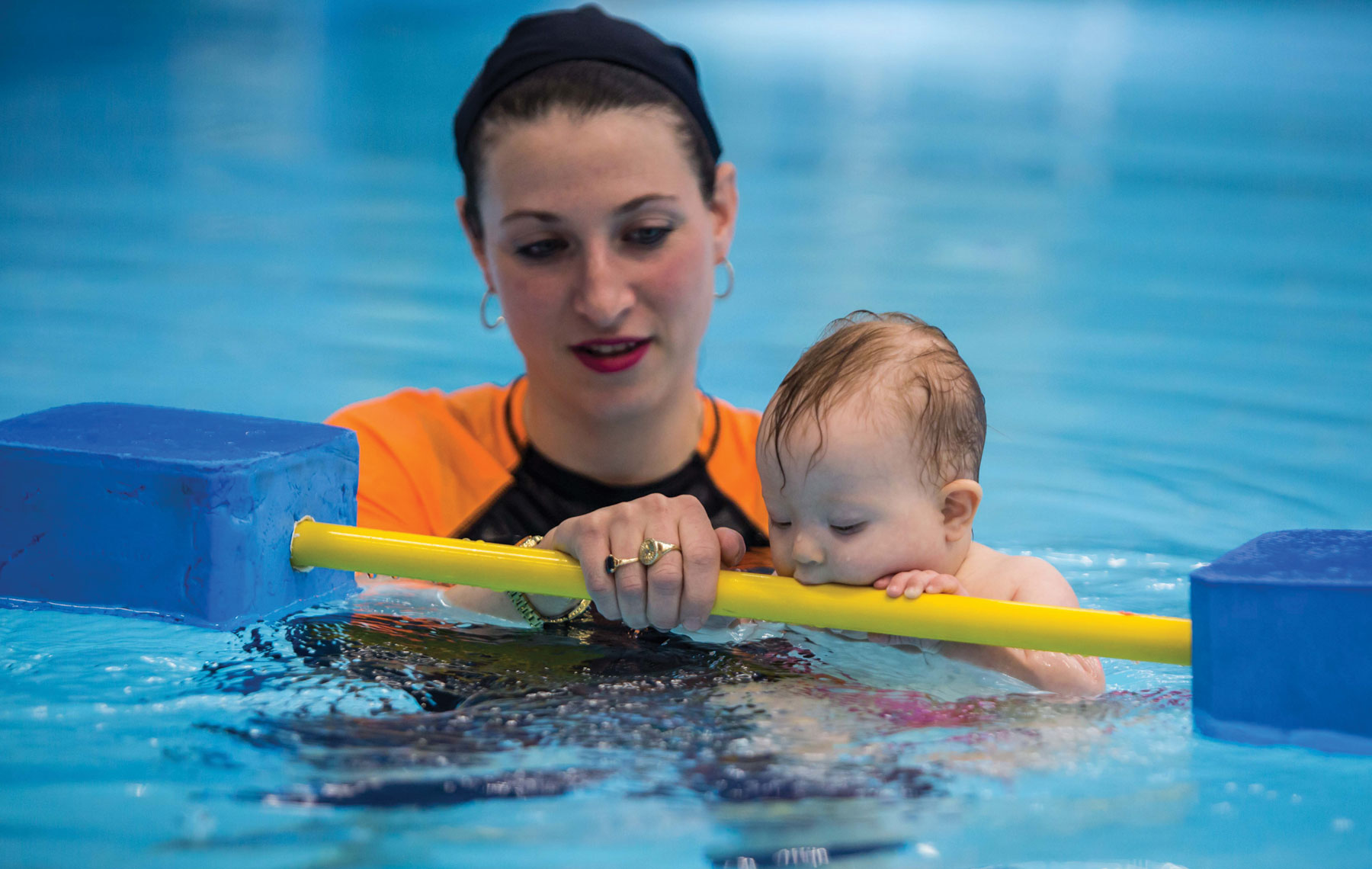
When Lily was 3 months old, Sara began to commute to Jerusalem to participate in Me & My Mommy classes, part of a once-a-week therapy and training program for parents and their children, from newborns to 1 1/2 years old.
“It’s amazing,” Sara said. “You have a hydrotherapy session, physiotherapy, speech therapy, and as a mother you learn the therapies so you can do them the rest of the week.”
She also appreciates the support she gets from other parents.
“There’s an amazing group of mothers in the same situation as I am,” Sara said. “There’s always a 45-minute break, so we mothers can sit and talk together at the same time.”
Once a month, parents are invited as a group to speak to a social worker while the staff cares for the babies. “We have a chat, the social worker asks certain questions to learn how we’re doing,” Sara explained. “Every mother has the opportunity to share.”
For Sara, the drive to and from Shalva can take up to three hours round-trip, “but it’s worth it,” she said. “I know a couple that comes to Shalva from Tiberias [in the north] every Sunday. In fact, they’re moving closer to Jerusalem to be closer to Shalva.”
Founded by Kalman and Malki Samuels in 1990, the nonprofit Shalva organization provides a range of therapeutic and educational services to 2,000 infants, children and young adults with developmental disabilities or delays, autism and other conditions.
All services are provided free of charge and are offered on a first-come, first-served basis. Government ministries usually make the referrals. The children come from every socioeconomic, religious and ethnic sector of Israeli society and sometimes beyond.
“We’ve had United Nations employees who chose to work in Israel because of Shalva,” said Meira Brandwein, a development executive for the organization, as she gave a tour of the center. “We’ve also had individual parents, government officials and university students come to us from around the world to learn from us and bring the tools back to their own countries.”
The Samuels, an Orthodox couple, launched Shalva several years after their son Yossi became deaf, blind and extremely hyperactive after receiving a tainted vaccination shot for diphtheria, pertussis and tetanus. Like Helen Keller prior to her breakthrough with Anne Sullivan, Yossi was deeply frustrated and isolated by his inability to communicate.
“Malki vowed to HaShem that if he found a way for Yossi to connect with her and the world, she would devote her life to helping other parents of children with disabilities,” Kalman Samuels told the Journal.
“You have to get used to a new reality when you have a child with a disability.”
— Sara, Shalva mother
Shalva started in a small rented apartment and grew exponentially over the years, as parents and government ministries struggled to find the right services for children. In 2016, the organization moved from its bustling but cramped headquarters into a new $60 million building that is as beautiful as it is functional.
“We included all of the features, all of the services parents of children with disabilities hope and dream of for their children,” Samuels said.
Prior to entering the building, visitors encounter two brightly colored playgrounds that can accommodate dozens of children at a time, and a heartwarming sculpture of children at the center of a traffic circle.
Brandwein said the sculpture, which depicts a person surrounded by other people, exemplifies Shalva’s mission of enabling families to raise their disabled children at home, in the heart of society. “It signifies a child being raised by an entire community, surrounded and embraced by the world,” she said.
The atmosphere inside the center is equally welcoming and intentionally designed to not give off institutional vibes. The atrium in the building’s lobby “bridges the inside and the outside. Our children are part of the larger community and the community is part of us,” Brandwein said.
Every wall of the building’s lobby was designed to inspire shalva, the Hebrew word for serenity and tranquility. One wall is filled with photos of Shalva children interspersed with the words “Peace,” “Faith,” “Dignity” “Love” and “Inclusion” in Hebrew and English. Another wall bears a verse from Psalms 122:7: “May there be peace within your walls, Shalva, serenity within your places.”
Unlike the long corridors that dominate most major health institutions, the Shalva building has five airy pavilions and clusters of rooms and offices. In addition to numerous therapy rooms, the 11-story building offers an art room, a music studio, hydrotherapy pools, a well-equipped gymnasium, an auditorium, Snoezelen multisensory therapy rooms that help reduce agitation and anxiety, an attractive restaurant that provides training and employment to adults with disabilities, and a disability-friendly oral health clinic — one of only a handful in the country. In the summer, hundreds of children attend Shalva’s summer camp.
Ori Sasson, an Israeli Olympic judoka, created a rehabilitative judo program at Shalva, and partially funded it by auctioning off his uniform. The building also functions as a community center that hosts educational workshops and seminars, which help fund the building’s maintenance and the organization’s programs.
“You can see how far they have come. They are a living testament to what children with disabilities can achieve.” — Malki Samuels
Shalva was also designed to be an emergency response center at times of national crisis. It can double as a bomb shelter for up to 1,200 individuals, including overnight.
The need for such a structure became apparent during Israel’s 2014 war with Hamas in Gaza, when hundreds of thousands of Israelis were forced into bomb shelters, the vast majority of which weren’t accessible to people with disabilities.
While the building has many uses, its main objective is to be comfortable and welcoming to the children and young adults it was built to accommodate. An artist spent six months painting murals of animals, castles and other child-friendly images on every floor.
There is an entire floor with respite apartments, where children and young adults can spend a night away from home in a safe, supervised environment. Each apartment has four bedrooms (one for staff), a bathroom, a living room and a TV.
“These overnight stays provide parents with the opportunity to spend more time with their other children or simply to rest,” Samuels said.
The organization also runs an independent living initiative that allows young adults to leave their parents’ home and live in the community. The apartments operate under the supervision of the Ministry of Labor, Social Affairs and Social Services.
Every Shalva program has a waiting list, but the organization’s new quarters have allowed it to serve many more children, including those with complex disabilities.
“Our goal, our purpose is to prepare children with disabilities for inclusion in Israeli society,” so that they can enjoy the same rights and access as any other person, Brandwein said. That preparation begins almost at birth, with the Me & My Mommy early intervention program.
“The parents learn the tools needed to do their children’s therapies at home,” Brandwein said as we watched a physical therapist teaching a mother how to give a comforting massage to her fussy 6-month-old baby. “Every family receives counseling with professional staff and support groups. We have plenty of fathers coming, too.”
Often, parents are overwhelmed by the news that their child has a disability.
“Some parents arrive here heartbroken, as if they’re hoping we can fix this,” Brandwein said. “Through the program, they develop a greater sense of acceptance and hope and are fortified to take ownership of their child. Sometimes the mother will just hold the baby. What’s important is the love and connection.”
On the surface, Shalva’s preschool programs look much like programs at other facilities — the children love to draw, sing and dance, and jump into the ball pit — but its teacher-to-student ratio is extremely high and the children receive a larger-than-usual array of therapies. By the time many of the children complete kindergarten at Shalva, they are ready to attend mainstream schools.
Once in school, children ages 6 to 21 are invited to participate in Shalva’s after-school program, where they socialize while participating in activities such as drama, music, art, sports and swimming.
The need for a meaningful framework becomes even more important when young adults with disabilities turn 21 and “age out” of the school system.
As part of its vocational training program, Shalva teaches an intermediate culinary and food preparation course in cooperation with the Ministry of Labor.
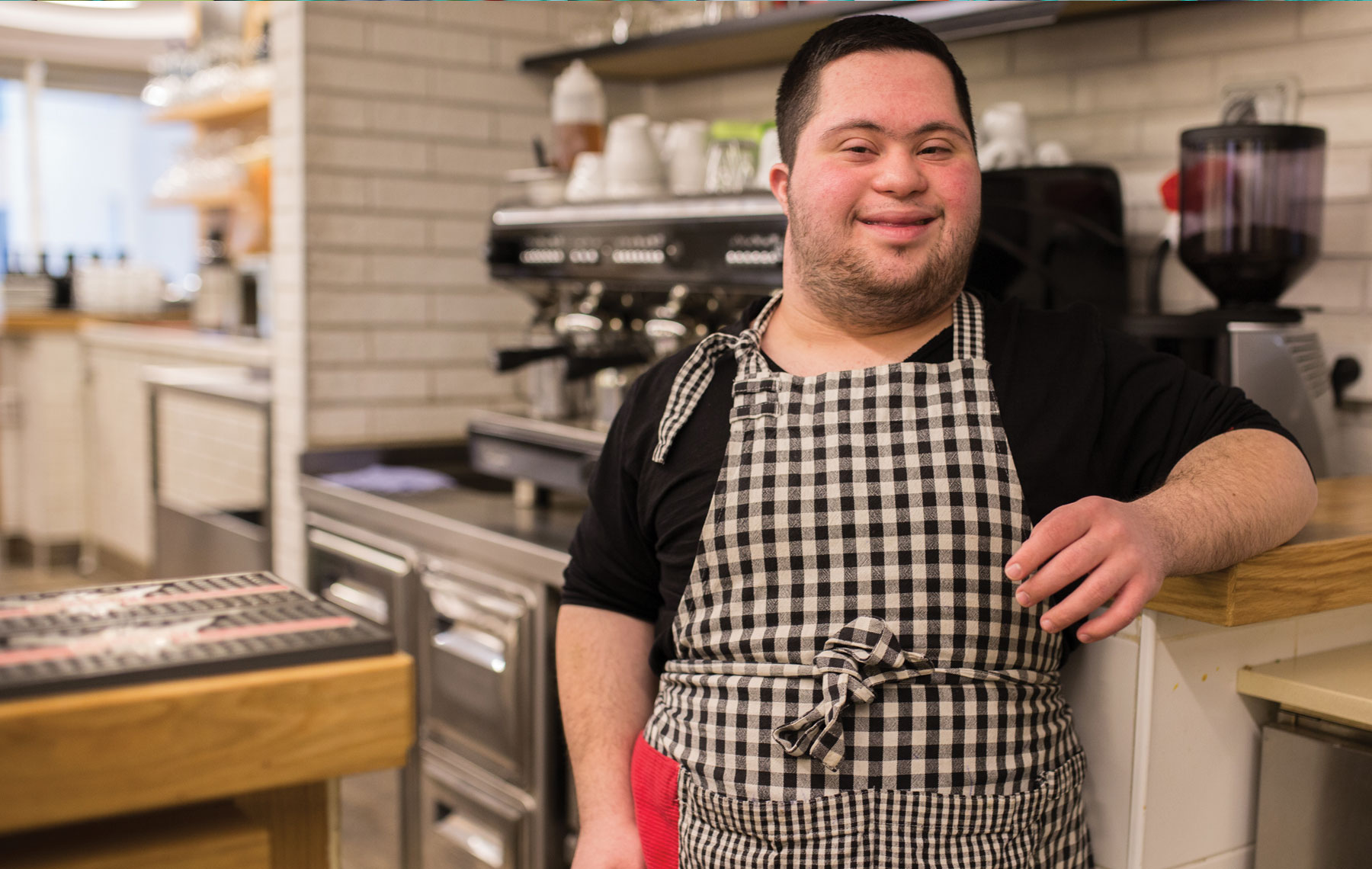
“This isn’t an introductory course. The goal is to prepare them to work in the mainstream,” Brandwein said as we visited Café Shalva, a bright, welcoming dairy restaurant that employs people with disabilities in a wide range of restaurant jobs.
For young adults who cannot work independently, Shalva offers workshops where they create marketable products from handmade soap to ceramics.
“We get orders in the hundreds, from companies and individuals who want to give our products as gifts,” Brandwein said. Many Israeli companies and organizations present their employees with gifts before Passover and the High Holidays.
The employment programs have a family support component: A social worker and occupational therapist are in touch with the participants’ families on a regular basis. For Samuels, it is especially gratifying to see Shalva graduates return to the organization as employees, and not only in the restaurant.
“You can see how far they have come. They are a living testament to what children with disabilities can achieve,” Samuels said.
Tal Kima
Tal Kima, now 22, began to attend Shalva’s afternoon program when he was 13. Today, he works in Café Shalva. He waits tables but his favorite job, he said, is polishing the cutlery. “It gives me satisfaction to work here,” he said during a short work break.
Kima, a musician, also plays in the Shalva Band, a professional group that Shalva has been nurturing for years. Among the band members, Kima and Yair Pomburg, both percussionists, have Down syndrome; Anael Khalifa and Dina Samteh, the lead singers, are blind; Yosef Ovadia, its drummer and vocalist, has Williams syndrome; and Guy Maman, who is visually impaired, plays keyboards and sings. Shai Ben Shushan, the band’s director, is a disabled army veteran. Sara Samuels, a longtime volunteer with Shalva, plays guitar.
The band, which has performed inside and outside Israel, came to the world’s attention in 2018 after performing in the Israeli competition leading to the Eurovision Song Contest. Although the band withdrew from the competition that is scheduled to be held in May in Tel Aviv — because it would have necessitated performing on Shabbat — it will perform during an interval of the Eurovision semifinal.
“Making other people happy makes me happy,” Kima said, explaining why he loves playing with the band.
Back at Shalva’s preschool, the school’s alumni also work as paid volunteers alongside teachers.
“They’re able to identify a child’s challenges and can direct the child more efficiently” than some of the professional therapists, “especially when it comes to developing speech,”, Brandwein said.
“Our goal, our purpose is to prepare children with disabilities for inclusion in Israeli society.”
— Meira Brandwein
Shirel Sprung, 19, from Tel Aviv, is one of 67 National Service volunteers who work at Shalva. She said she specifically asked to be placed at the organization.“I feel like I’m part of a family here,” she said.
The therapists at Shalva agree that working for the organization isn’t just any job.
“When I wake up, I’m excited to go to work,” said Leah Tecotzky, a speech therapist. “I’ve never felt this way before. The people I work with are an amazing staff, and we feel like family. I love working with the babies because I see the progress they make, but it’s the moms who give me the strength to continue. They’re dealing with not-so-easy situations, and some are very young or have very large families.”
Alan Shapiro, a physical therapist, said it is both “meaningful and fun” to work at Shalva “because I know I’m contributing something very important to the child’s future.”
He also praised Shalva’s flexibility. “I feel I have the freedom to do what’s in the best interest of the child,” Shapiro said. “If I think a child needs more therapy, he can get it.”
Sara, Lily’s mother, considers Shalva a life raft in a capricious sea.
“You have to get used to a new reality when you have a child with a disability,” Sara said. “There’s this strong support network from the staff and the other mothers. This is where I get my information and learn about equipment, like special spoons” that babies with poor coordination or weak muscles can hold.
“If Shalva wasn’t here, it would be very difficult,” Sara added. “Shalva is a safe place. It’s a place where you can share and feel comfortable. It’s more than the physiotherapy or the speech therapy. The emotional side is very important, and it’s something I wouldn’t get elsewhere.”
Michele Chabin is an award-winning journalist based in Jerusalem.
You’re probably thinking, “Rabbi you got it wrong. It’s not until the fall and Rosh Hashanah that we celebrate the Jewish New Year.” Yes, this has become the convention as the rabbis shifted the focus toward commemorating the creation of the world. But Torah teaches that it is precisely in the spring that our Jewish calendar begins, “This month … shall be for you the first of the months of the year.” (Exodus 12:1-2) Originally called HeAviv, meaning springtime, this new month, Nisan, is a natural fit when new buds emerge after a dark, damp winter. This month heralds Passover, when we receive the gift of liberation after hundreds of years of slavery in Egypt. The birth of a people is formed and we enter into a new relationship with time.
The Jewish calendar, a yearly cycle of 12 months (except when there is a Jewish leap year, during which a 13th is added), whose names were adopted during our exile in Babylonia more than 2,000 years ago, includes multiple holidays based on the agricultural harvests, important historical events, as well as rabbinic additions of critical moments that enhance our spiritual life. Jews continually remember and celebrate these holy days, each with its own rituals, customs, special character and themes along with an opportunity for personal growth. This happens on multiple levels — required mitzvot (the commanded rituals), family customs in the home, communal gatherings in synagogues and public institutions, as well as being invited inward, to our inner landscape, challenging us to engage psycho-spiritually, mystically through Kabbalah (examining sefirot, expressed through parts of the body) or ethically through Mussar (examining character traits), to bring more meaning and purpose to our lives.
For example, when Passover approaches we not only think about preparing our homes with a thorough ridding the space of chametz, the leavening agent that expands, but we also see this as a metaphor for our lives, an opportunity to examine habits and values, to “clean out” the parts of our lives that can undermine our goals or sabotage our relationships. We might look at the parts of our personality that, like chametz, expand and puff up, feeding narcissistic behavior and impacting our relationships in negative ways. We might question how free we truly are, perhaps enslaved to outmoded behaviors and ideas. Are there inherent taskmasters in our lives — phones, social media, guilt, grief, etc., that control us more than we are aware? Kabbalah invites investigating where in the body dysfunction is expressed. Mussar demands attention to our character traits. This kind of examination might bring new awareness and possible resolution to untapped issues.
“The Jewish calendar calls us to engage in sad and happy moments.”
Each of the holidays is an invitation to experience what the rabbis call keva, fixed requirements, and kavanah, deep intention, of these sacred moments. Both are ways in to celebrate and experience the holy days. Whether through fulfilling the ritual obligations, finding cultural connections or harvesting new awareness of our selves, the calendar is a touchstone to Jewish identity. With their varied themes and emotional expression, each of the holidays gives us an opportunity to elevate daily living and find sanctity in our lives.
Although the cycle is repeated every year, we examine ourselves anew, refining the essence of who we are and experiencing new levels of awareness and wholeness. Unlike the secular calendar that is a reminder of things to do and places to go, the Jewish calendar calls us to engage in sad and happy moments while challenging us to look beneath the surface and ask the hard questions about our beliefs and our behavior such as: What does freedom really mean? How do we see miracles in our everyday lives? Do we need to be enslaved before we can appreciate freedom? Do we need darkness in our lives before we can see the light? Do we treat others — friends, family and strangers — with equal respect?
These and other questions arise to examine our lives and perhaps find the presence of the divine. During the year, I will offer a spiritual doorway into each of the coming holy days, and questions that might bring a connection and a deeper relationship to the Jewish year and the Holy One.
Eva Robbins is a rabbi, cantor, artist and author. To view a chart for this story, visit Robbins’ blog.
You may recall that after the horrible synagogue shootings in Pittsburgh, a brouhaha erupted over an apparent insult to Conservative Jewry. People claimed that Israel’s Ashkenazi Chief Rabbi, David Lau, wouldn’t call Tree of Life a synagogue because it’s a Conservative shul. But I’d like to correct the record: Rather than dissing Tree of Life, Lau actually validated it.
An honest reporting mistake metastasized into a Big Lie, because many opponents resent this politically incorrect correction. The fake narrative of the brutally insensitive rabbi is more popular than the subtle story of someone with whom many disagree, who spoke properly, movingly — at least this time.
Zvika Klein, a reporter for the religious Zionist newspaper Makor Rishon, interviewed Lau after the massacre. While calling Tree of Life a deeply Jewish place with a Torah, where Jews in tallitot pray and seek “closeness to God,” Lau bristled. “We are talking about Jews killed because they were Jews,” Lau said. “What kind of question is this? …. They were killed because they were Jews. … Does it make a difference in which beit knesset (synagogue) or in which nusach (tradition/version) they were praying?”
This is unprecedented: The word “nusach” characterizes the Ashkenazi and Sephardi styles of prayer. That means Lau treated the Conservative “nusach” as another legitimate alternative — not that anyone needs his approval!
I asked Klein about Lau’s tone. Klein responded: “He actually was very positive.”
Nevertheless, everyone “knows” that Lau disrespectfully “referred to the Conservative synagogue merely as ‘a place with a profound Jewish flavor.’ ”
What happened?
Ha’aretz misquoted Makor Rishon — then others quoted Ha’aretz, including The Washington Post. Jewish Telegraphic Agency’s Editor-in-Chief Andrew Silow-Carroll, in his lengthy retraction, admitted that Lau “did use the Hebrew word for a synagogue — ‘beit knesset’ — to refer to synagogues like Tree of Life Congregation in Pittsburgh, and at the same time offered a full-throated, and even perturbed, dismissal of those who would make such petty distinctions at a time of tragedy.”
“When does fighting dirty sully you, no matter how dirty you consider your enemy to be?”
Lau called it “a place with a profound Jewish flavor” not to avoid calling Tree of Life a synagogue, but to emphasize its Jewishness. Klein asked, “Is it a synagogue?” Lau replied, “Jews were murdered because the murderer considered the place that he killed them in to have a profound Jewish flavor.”
Silow-Carroll, an award-winning journalist, admitted that he “only checked it (the quotation) against The Washington Post report.” The mistake “shows the pitfalls of working too fast and not checking original sources to the degree that we can. I should have done better.”
What’s everyone else’s excuse?
The correction doesn’t fit the narrative of Big Bad Israelis abusing American Jews. My Facebook post correcting the lie made many “friends” of mine pitchfork-level mad at me, proving how empty that term “friend” is.
This exercise in small-mindedness, political prejudice and pathology makes you wonder: When does fighting dirty sully you, no matter how dirty you consider your enemy to be? And do we have any responsibility as citizens, as fellow Jews, to foster civility?
Correcting the record is not endorsing. Truth-telling is not apologizing. Keeping consistent is not striking false equivalencies — it’s maintaining standards.
Let’s reject a Jewish unity of the hunted targeted in the hater’s sights. Lau should follow up by respecting all Jews, whatever their “nusach.” And my fellow Chief Rabbinate-bashers should fight decently, discriminatingly — when deserved — not deceitfully, demagogically, dishonestly.
Gil Troy is a distinguished scholar of North American history at McGill University in Toronto and author of the recently released “The Zionist Ideas.”
In 1915, Ottoman Turks started to scapegoat the minority Armenians in their country for a war against Russia that it was losing. That year, Turks began rousting Armenians from their dwellings and marching them to their deaths in the Syrian Desert.
At the time, there was no word for this brutal campaign, which resulted in the deaths of some 1.5 million Armenians living in Turkey. It took three more decades and the extermination of 6 million Jews before the word “genocide” entered the lexicon.
On March 15 in New Zealand, the world witnessed the latest expression of another horrific innovation for which there isn’t yet an appropriate word. Yes, the attack by a 28-year-old suspect that resulted in the gun deaths of 50 Muslim worshippers at two mosques in Christchurch, was a mass shooting. Yes, it was an act of terrorism. Yes, the alleged gunman self-identifies as a fascist.
There is commonality between this incident in New Zealand and other recent acts. White supremacy is the connective tissue that binds Brenton Tarrant and his atrocities in Christchurch to the 11 Jewish worshippers slain by Robert Bowers in October at a synagogue in Pittsburgh, and the nine African-American congregants who were fatally gunned down in 2015 by Dylann Roof at Emanuel African Methodist Episcopal Church in South Carolina.
We need to be aware that underlying each of these attacks is an ambition to exterminate members of these races and religions. The victims’ backgrounds vary. The intent is the same. It’s a genocidal idea, but without the power of government to facilitate the act. The genocides committed by the Nazis, the Hutu leadership of Rwanda, the military of Guatemala and the government of Turkey were acts carried out by the state under ideologically driven leaders.
“Leaders need to take bold steps to counter the spread of hatred.”
The more recent 21st-century nightmares that befell Christchurch, Pittsburgh and Charleston, S.C., were executed by do-it-yourself mass killers whose racial resentments had been whipped up by extremist media outlets and nurtured in echo chambers in dark corners of the internet. They answer to no head of state and are unconfined by geographical boundaries. But they draw from the same genocidal well of hatred.
We are perplexed by this type of killing because we have not seen anything quite like it before and with such regularity. It may be that this form of killing doesn’t need a name, but I refer to it as “aliocide” — killing of the other — picking out innocent people who broadly represent a particular hated group, and slaughtering them indiscriminately because of their association to that group.
The danger, in my mind, isn’t that white supremacists are going to succeed at rounding up and killing all of the Muslims, Jews and people of color, or that radical Islamists have any reasonable chance of taking down the “Great Satan” that they believe characterizes the West. Rather, it’s that they will succeed in driving us apart from one another with fear, because fear is the fertile soil of hatred itself. These horrible events are designed to drive us apart. Resisting them means having the strength to come together.
Solutions?
Tech companies and the intelligence apparatus of Western governments must treat white nationalism with the same seriousness they reserve for Islamic terrorism, recognizing its lethal threat.
Lawmakers and thought-leaders — on the left and the right — need to fully acknowledge the trend of rising anti-Semitism and take action that reflects an understanding that this form of hate is genocidal to its core.
Academic institutions need to focus on the hate that thrives on campus and online, and unequivocally counter it within their communities.
World leaders need to take bold steps to counter the spread of hatred. Turning a blind eye to it is all that is needed to prompt the most unhinged members of online communities to rain bullets into unsuspecting groups of people, whoever they are.
Stephen D. Smith is Finci-Viterbi executive director of the USC Shoah Foundation.
Even though most Jewish holidays and celebrations begin with the blessing over challah, I’ve never learned how to bake it. Challah is one of my favorite foods, so every now and then, when I’d see a recipe online — “Challah in a Bag,” “Easy Challah,” “Challah in the Instant Pot” —I would it print out and stick it in a file … never to be seen again.
Ricanati told me that challah had saved her life. More than 10 years ago, she was at her wits’ end from juggling her work as a physician at a Midwest hospital with raising her three young children. Around Rosh Hashanah, a friend suggested she bake challah. Taking time out to bake challah each week, she said, brought much-needed balance back into her life.
Ricanati said baking challah taught her about the power of community. Whether she bakes alone or with others, just knowing women around the world are preparing for Shabbat at the same time in the same way creates a connection.
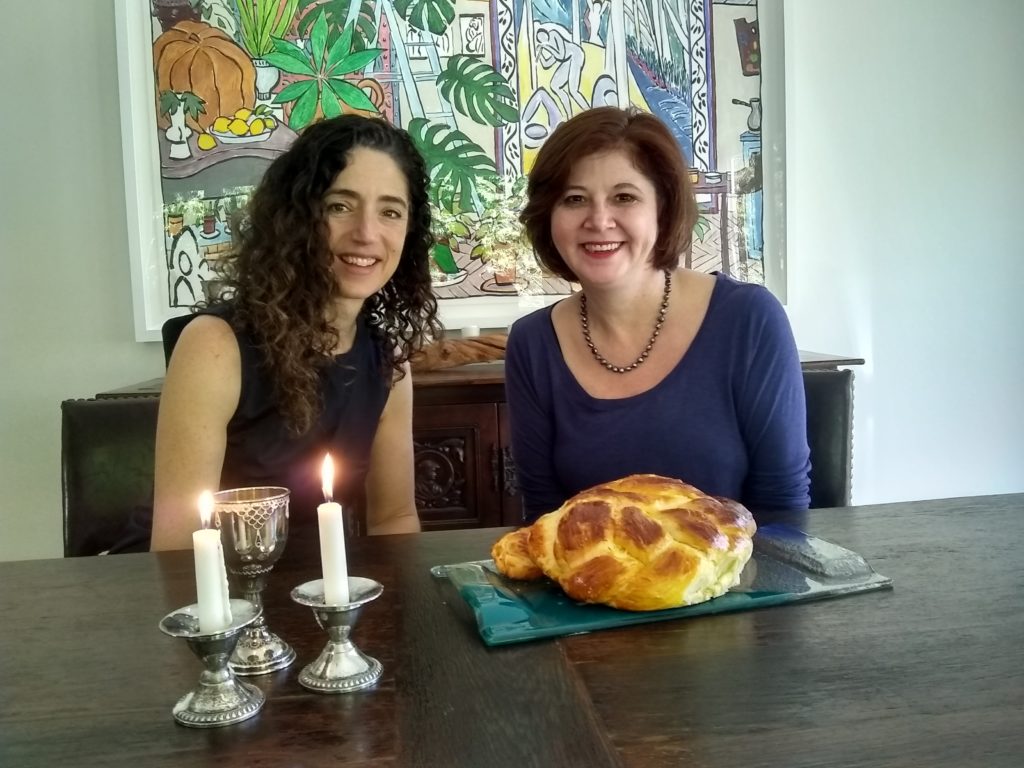
When I arrived at Ricanati’s home for my lesson, all the ingredients — yeast, oil, eggs, sugar, flour and salt — were already laid out, along with the bowls and utensils. Ricanati explained that we would be baking two challot to symbolize the double portion of manna distributed on Shabbat during the Israelites’ Exodus from Egypt.
Before we began, Ricanati asked me to set our intention. She said the challah doesn’t taste as good if she doesn’t start off with this acknowledgment. And so we made our challah in honor of “the health and happiness of beloved friends and family.”
First, we mixed warm water and sugar with the yeast. We put that mixture aside to “bloom” while we combined the rest of the ingredients — and 2 cups of the flour — in a separate bowl. After adding in the yeast mixture, we put in another cup of flour and continued to add flour as needed. As we kneaded the dough, we chatted, confirming Ricanati’s message about community. She put the oil in the bottom of a mixing bowl, where we placed the kneaded dough and waited for it to rise.
“I didn’t think anything could smell better than the aroma of chicken soup. I was wrong. We took our challot out of the oven, said the blessing and literally broke bread.”
When the dough was ready, we partook in another ritual. This one, I discovered, was the difference between making challah and baking bread.
“The mitzvah of making challah has to do with this idea of the separation of challah,” Ricanati explained. “We take a piece [of the dough], separate it, say a blessing and get rid of it. That is to commemorate when we used to make an offering at the Temple.”
We then took out the remaining dough and cut it into six pieces, which we turned into long strands. My sections, and resulting braids, were so uneven I turned my second loaf into a round challah. Still, they were passable for my first attempt. We painted our challot with an egg wash and put them in the oven.
And then came that aroma! I didn’t think anything could smell better than the aroma of chicken soup. I was wrong. We took our challot out of the oven, said the blessing and literally broke bread. The challah was delicious.
As I’ve reflected on the experience, I’ve wondered what took me so long. How is it possible that I never made challah before? Sorry, local bakeries, I may never buy challah again.
As I was gently nudged around the packed lobby of the Brooklyn Academy of Music (BAM) on March 30, the final night of the Batsheva Dance Company’s sold-out run, I found myself agreeing with a young woman with purple hair who was quite vocal in blaming the elegant mob scene on BAM’s disorganization.
But I soon realized that BAM wasn’t disorganized at all. The 2,000-plus people in attendance were being a bit aggressive in finding their seats simply because they didn’t want to miss a second of Israeli choreographer Ohad Naharin’s latest work, “Venezuela.” What was most astonishing was that more than half of the passionate crowd looked like people I would have expected to see outside with signs calling for an Israel boycott. I even spotted two keffiyehs.
The Tel Aviv-based Batsheva — founded by Baroness Batsheva de Rothschild in 1964 — has long held a preeminent place in the dance world, both critically and popularly.Last September, after nearly 30 years as Batsheva’s artistic director, Naharin handed the reins to Gili Navot, a former dancer with the company, while he assumed the position of house choreographer.As the lights dimmed in BAM’s gorgeous Beaux Arts Howard Gilman Opera House, the music began with solemn Gregorian chants and the curtains rose on a group of dancers in still life. The audience’s sacred silence was, I imagine, what rabbis pray for.
“The young audience members’ adoration … pointed to an important idea: Israel should be exporting more of its artistic genius.”
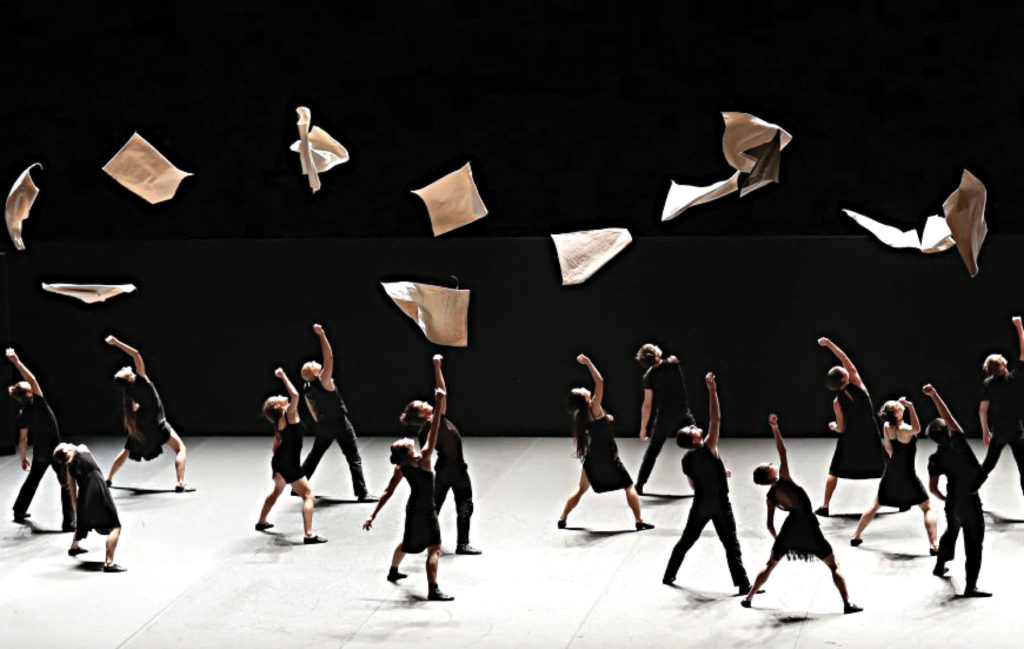
Since this was my first time seeing Batsheva — my first two loves, Israel and dance, merging with ethereal intensity — my emotional sensors were already on high alert. What I wasn’t expecting was the spiritual beauty that laced through Naharin’s signature style: sensual explosions of movement, kaleidoscopic raw energy, fearless visceral physicality. The stillness of the opening scene quickly erupted into what my dance teacher used to call controlled chaos.
“Venezuela” comprises two, 40-minute sections placed in juxtaposition — the same choreography but different music, lighting, dancers and overall feel. Naharin won’t say why it’s called “Venezuela,” but it apparently has nothing to do with the country’s current situation. The work made its debut in Tel Aviv in 2017.
If there was a political message, it was cryptic. One of the last scenes included cloths with the colors of the Palestinian flag. Was the second half what history would have been like if the Arab countries had accepted the United Nations partition plan in 1948? Perhaps. The music, though raunchy, definitely took an upbeat swing in the latter sequence. Whatever his political message, Naharin clearly believes that the point of art is to create art, not spout politics.
Naharin’s fearless embrace of beauty — believing that innovative work is a way to move the trajectory of beauty forward — will also ensure that his work, known for pushing boundaries, will ultimately fall into that difficult category of “timeless.”
Throughout that night’s 80-minute performance, the audience remained transfixed, mesmerized. After a performer’s final primal scream, the audience rose to give the 18 dancers a well-deserved, multiple-curtain-call standing ovation.
I have no illusions that if Batsheva had performed at New York University or Columbia University, there would have been anti-Israel protests, just as there were at the University of Colorado in Boulder, Colo., the week before. But the reception at BAM — known for its progressive artistic programming — should give all of us pause.
The young audience members’ adoration trumped whatever else they had learned about Israel and pointed to an important idea: Israel should be exporting more of its artistic genius. Doing so won’t stop the Omars and Sarsours from spouting lies, but it will do precisely what they fear: humanize Israelis.
If I had to sum up Naharin’s message in “Venezuela,” it would be this:
Life can be exquisitely harsh. One needs to work to find the beauty and the meaning, but they’re there. And once you change the music — the narrative — you can see the details far more clearly.
Karen Lehrman Bloch is an author and cultural critic living in New York City.
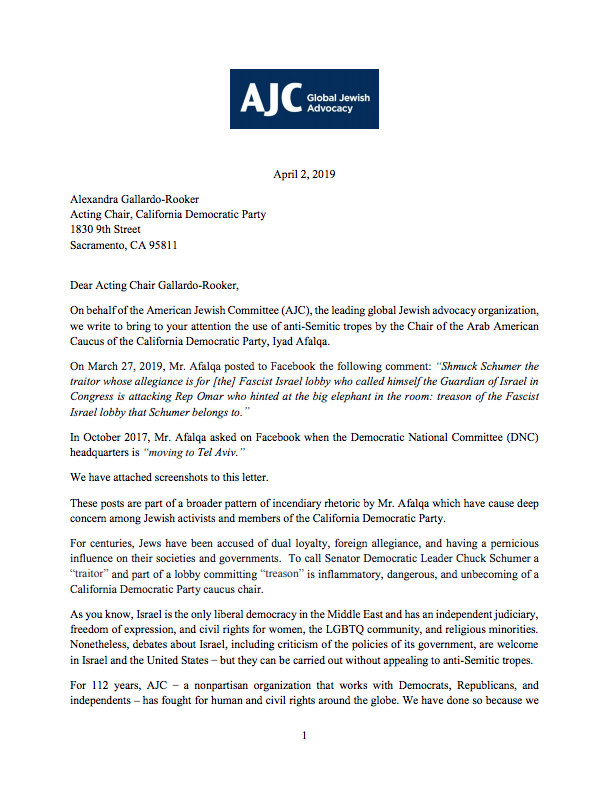
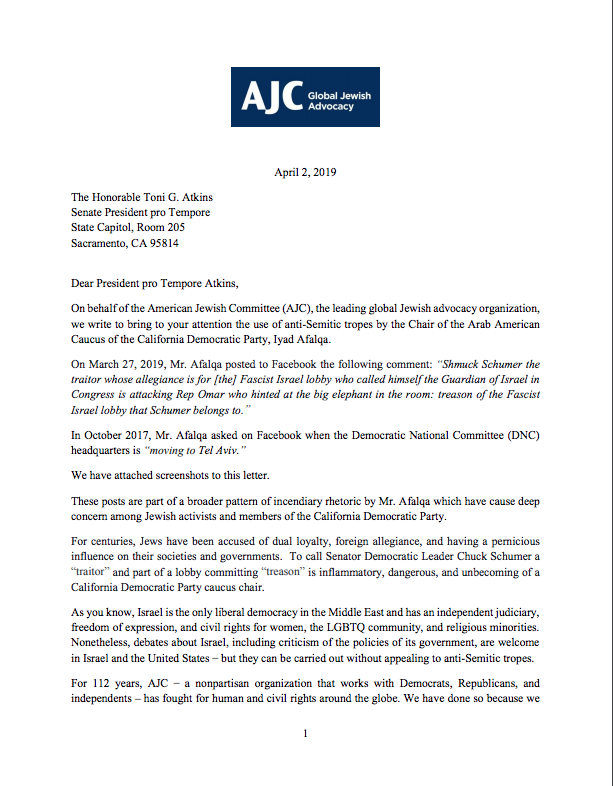
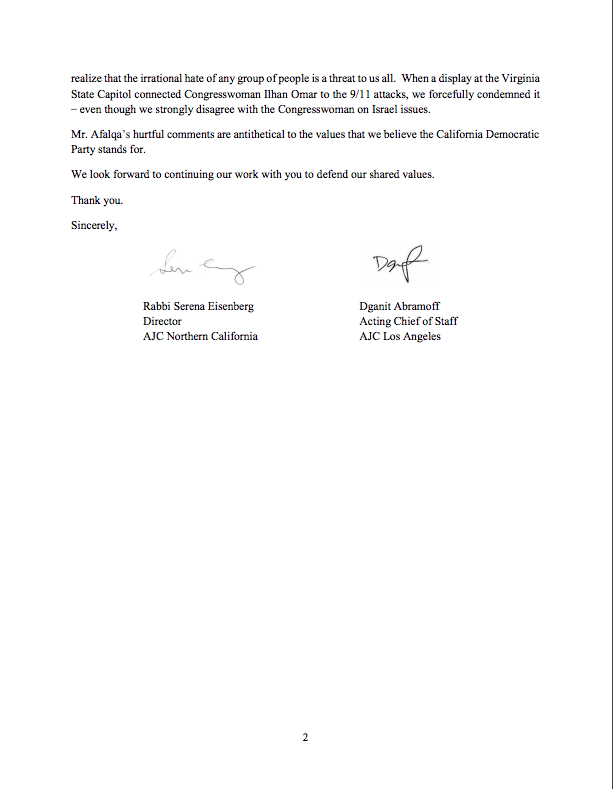
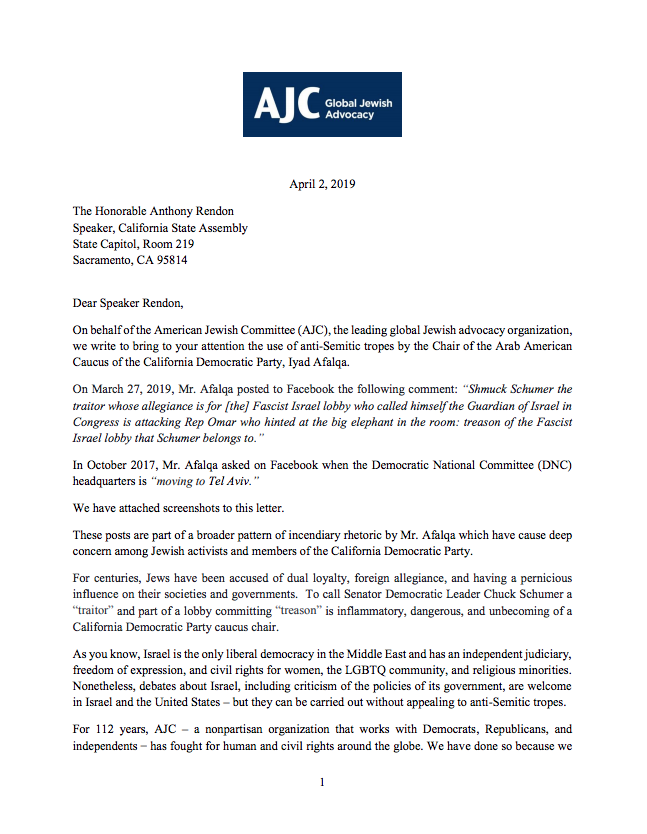
The American Jewish Committee’s (AJC) Northern California and Los Angeles chapters sent letters to California Democratic leaders regarding recent “anti-Semitic tropes” made by the Arab-American Caucus Chair of the California Democratic Party, Iyad Afalqa.
The letters, which were sent to Acting Chair of the California Democratic party Alexandra Gallardo-Rooker, California Assembly Speaker Anthony Rendon (D-Los Angeles) and Senate President pro Tempore Toni G. Atkins (D-San Diego), pointed out that Afalqa wrote in a March 27 Facebook post that Senate Minority Leader Charles Schumer is a “traitor whose allegiance is for [the] Fascist Israel lobby who called himself the Guardian of Israel in Congress is attacking Rep Omar who hinted at the big elephant in the room: treason of the Fascist Israel lobby that Schumer belongs to.”
They also noted that Afalqa wrote in an October 2017 post asking when the Democratic National Committee would be moving its headquarters to Tel Aviv.
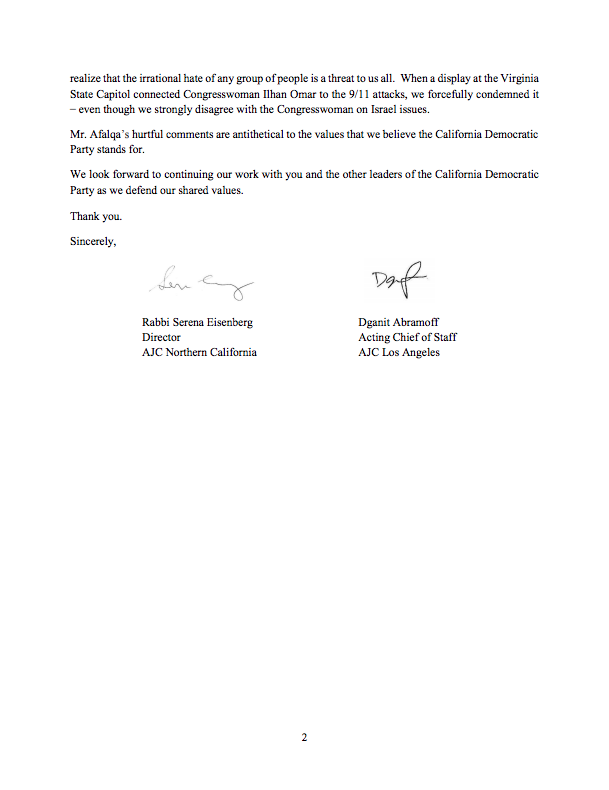
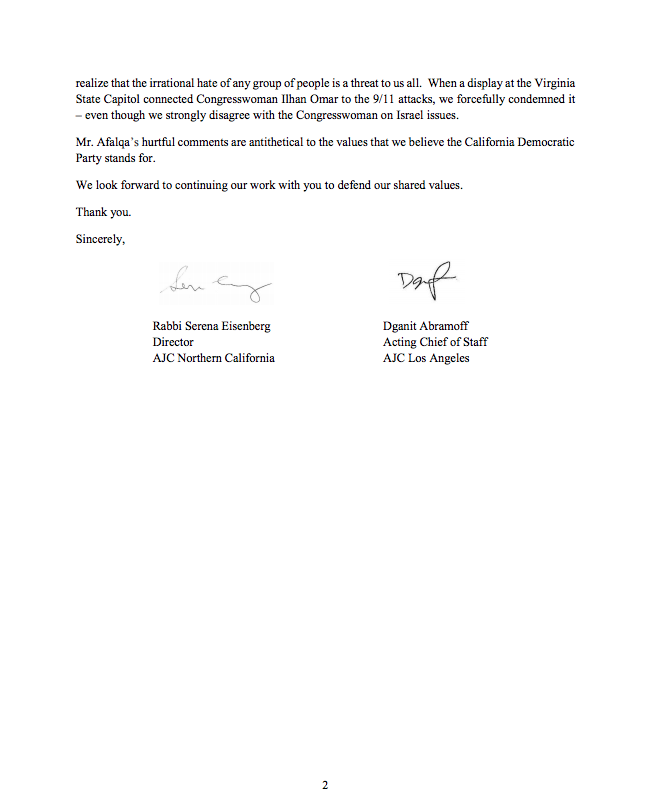
“These posts are part of a broader pattern of incendiary rhetoric by Mr. Afalqa which have cause deep concern among Jewish activists and members of the California Democratic Party,” AJC Northern California Director Rabbi Serena Eisenberg and AJC Los Angeles Acting Chief of Staff Dganit Abramoff wrote. “For centuries, Jews have been accused of dual loyalty, foreign allegiance, and having a pernicious influence on their societies and governments. To call Senator Democratic Leader Chuck Schumer a ‘traitor’ and part of a lobby committing ‘treason’ is inflammatory, dangerous, and unbecoming of a California Democratic Party caucus chair.”
They added that criticism of the Israeli government can be done “without appealing to anti-Semitic tropes.”
“Mr. Afalqa’s hurtful comments are antithetical to the values that we believe the California Democratic Party stands for,” Eisenberg and Abramoff concluded the letter. “We look forward to continuing our work with you and the other leaders of the California Democratic Party as we defend our shared values.”
Afalqa, Atkins, Rendon and Gallardo-Rooker did not respond to the Journal’s requests for comment.
JERUSALEM (JTA) — The body of Israeli soldier Zachary Baumel, an immigrant from the United States who went missing in Lebanon some 37 years ago, was returned to Israel.
Baumel disappeared on June 10, 1982, in a battle at the beginning of the Lebanon War along with two other Israeli soldiers, Sgt. Yehuda Katz and Sgt. Tzvika Feldman. Feldman was in the same tank as Baumel when he was killed.
Israel has negotiated for the repatriation of their bodies for decades.
Baumel’s body was transferred to an El Al plane via an unnamed third country in an operation by Israeli intelligence agencies, according to the Israel Defense Forces. It was not repatriated as part of a deal with any other country.
Prime Minister Benjamin Netanyahu in a statement broadcast live in Israel said that in addition to recovering Baumel’s remains, his tzitzit — a ritual Jewish garment — and his tank jumpsuit also were recovered.
“He was considered missing for 37 years,” Netanyahu said. “For all those years, the State of Israel had invested immense resources to resolve the riddle of his fate.”
The bodies of all three soldiers were believed to be held by Palestinian organizations in Syria. A tank from the Battle of Sultan Jacoub was returned to Israel from Russia in June 2016. The Israeli media reported that Russia was involved in the retrieval of the remains, though it was not officially confirmed.
Baumel’s remains were identified at the Forensic Medicine Institute in Abu Kabir with the involvement of the chief rabbi of the Israeli military, Rabbi Brig.-Gen. Eyal Karim, according to the IDF. The family was notified on Wednesday, the same day that the return was publicly announced. The families of Feldman and Katz also were informed of the development.
IDF spokesman Ronen Manlis said in a statement that two IDF chiefs of staff and the last two military intelligence heads were involved in the repatriation, as well as officials from military intelligence, research and operations, the Israel Security Agency and the Mossad.
“Every IDF commander, myself more than any other, carries on his shoulders a commitment to be concerned for every soldier who joins the army and who is sworn to the State of Israel,” the IDF chief of staff, Lt. Gen. Aviv Kochavi, said in a statement. “And the commitment extends to every family whose most precious asset is entrusted to our hands, and to Israeli society that places its sons in our trust.”
President Reuven Rivlin said in a statement: “On this difficult, moving and sad day, our thoughts are with the Baumel family, crying and hurting with them as they bring their son Zachary to eternal rest in our country, our land. I thank the IDF and the whole Israeli intelligence community for their commitment, bravery and action, day and night, to bring our soldiers and those who fell defending the country and the people, home. We will not cease until all our soldiers have returned home.”
Israeli ethicist Rabbi Yuval Cherlow, a tank commander during the Lebanon War who helped evacuate the wounded from the Battle of Sultan Jacoub, expressed gratitude for the repatriation of Baumel’s remains.
“Ever since that horrific battle at Sultan Yacoub, we always stressed that as long as there was even a faint possibility to bring our lost brothers home — whether alive or not — we had a moral and human responsibility to do so,” he said. “Bringing Zachary Baumel to his final resting place in Israel is the fulfillment of a national responsibility, both as a nation and to our soldiers. We offer our sincerest gratitude to all who were involved in this holy task and this is the ultimate display of commitment to our soldiers. We hope and pray that all the remaining missing will be returned home to their rightful places in the land of Israel.”
Baumel moved to Israel with his parents and siblings from Brooklyn in 1970. He attended a hesder yeshiva, which combines religious study with army service.
His father, Yona, died in May 2009 at the age of 81. He believed until his death that his son was still alive, and had met with numerous world leaders and interviewed hundreds of witnesses during his search for information about his son and the two soldiers who disappeared with him, according to reports.
The last postcard Zachary Baumel sent to his family before going missing in Lebanon read “Don’t worry, everything is OK, but it looks like I won’t be home for a while.”