Former New York Democratic Assemblyman Dov Hikind released an April 3 video on Twitter criticizing the Boycott, Divestment and Sanctions (BDS) movement as “discrimination.”
Hikind began the video by pointing out that the BDS movement singles out Israel, yet ignores countries like China, which has imprisoned 1 million Muslims, or Russia, a country that has murdered journalists. He added that supporters of the BDS movement frequently invoke freedom of speech, but “that is not the issue,” Hikind argued.
“My tax dollars, the tax dollars of the 26 states that have passed anti-BDS legislation, do not have to support your company that makes a decision to boycott the people of Israel, the Jewish state,” Hikind said. “My tax dollars do not have to support your discrimination.”
Anti-BDS legislation typically involves states barring companies that engage in boycotts of Israel from receiving government contracts and/or preventing such companies from receiving public investment funds.
Hikind concluded the video by highlighting that “the biggest supporters of BDS are the leaders of Iran, the leaders of Syria, the leaders of Cuba, Nicaragua, Venezuela.”
“BDS equals anti-Semitism,” Hikind said.
In the tweet posting the video, Hikind wrote, “BDS targets Israel while ignoring rest of the world.” He added that BDS is “the same force” that removed New York City Councilman Kalman Yeger from his spot on the council’s immigration committee for tweeting that “Palestine does not exist” but shields Rep. Ilhan Omar (D-Minn.) “a free pass on her anti-Semitism.”
MUST WATCH: What is BDS about?
BDS targets Israel while ignoring rest of the world. It’s the same antisemitic force that convinced @coreyinnyc to oust a Jewish councilman for stating a fact while @ilhan gets a free pass on her antisemitism from the Dems.
When you enter the newly revamped Milky Way restaurant at 9108 W. Pico Blvd., the aroma immediately reminds you of home. And that’s exactly how the late Leah (“Lee Lee”) Spielberg Adler would have wanted her family restaurant to feel.
The Milky Way, an iconic Pico Robertson kosher dairy eatery, opened its doors 40 years ago but closed following Leah’s death in 2017 when she was 97. Now, its doors are open again.
The Spielberg family — Nancy, Sue, Anne and Steven (yes, the filmmaker) — reimagined the space by working with restaurant consultant and creative chef Phil Kastel and the restaurant’s general manager Stephanie Wilson.
Guests can still enjoy Jewish classics like cheese blintzes and potato latkes, but the menu also has more elevated options such as halibut with teriyaki, fettuccini, and eggplant Parmesan.
“Phil brought an energy and a spirit to the project unlike any other, and I knew we had to go with him,” said Nancy Spielberg. “More than anything, he got what our mom meant, not just to us siblings but to the Orthodox and kosher community in Pico Robertson. He was very sensitive to the kashrut laws and also kept vegan and gluten-free dishes in mind, which opens the restaurant up to those diners who might not themselves observe a kosher diet.”
One of the most exciting new menu items is the Impossible Cheeseburger, a plant-based burger that tastes and looks like a meat patty.
“Kosher food is kind of misunderstood,” Kastel said. “Leah loved Thai food and sushi and Mexican food, and that’s what she put in the Milky Way restaurant. So for me, it was a natural fit. I love creating with bold flavors. What I found out, which surprises a lot of people, is that most items in your pantry are kosher.”
Though the menu is revamped, every item still pays tribute to Leah in some way, including the Apple Dream Pie.
A slice of Apple Dream Pie, a twist on Leah’s classic apple pie; Photos courtesy of The Milky Way
“Nancy had a dream that she was here at the restaurant eating with her mom and [Leah] had apple pie a la mode, and she had requested two different kinds of pepper on top of her apple pie.”
Kastel, inspired by what he thought was a silly conversation, created the Apple Dream Pie, which incorporates a floral essence from pink peppercorns in the pie’s caramel sauce.
Kastel said another exciting element about the new Milky Way is that its menu and ingredients will change about every 90 days depending on what’s in season. Beginning in mid-April, the restaurant will also be entering new territory with a Sunday brunch.
“After Passover, we will be launching a Champagne brunch menu, so that’s kind of exciting,” Kastel said.“There’s about 12 or 14 items on [the menu]. I don’t see a ton of kosher brunch spots up and down the street, so we’re kind of really excited about that.”
“I feel our mom’s presence and just know she’d be thrilled with the changes. She’d be dancing and twirling among the tables.”
— Sue Spielberg
Along with changes to the menu, the revamp also pays close attention to family details, and Leah’s essence is scattered throughout, as though she never left.
“Before the refresh, there was a beautiful red carpet in the restaurant that was really special to Lee Lee and the family, and we still have that in the lounge,” Wilson said. “There’s also a four-minute video of Lee Lee throughout the years, which is so amazing to see her in the restaurant, and it shows how much pride she had in the Milky Way. I feel like what we’ve created here will carry out that same pride.”
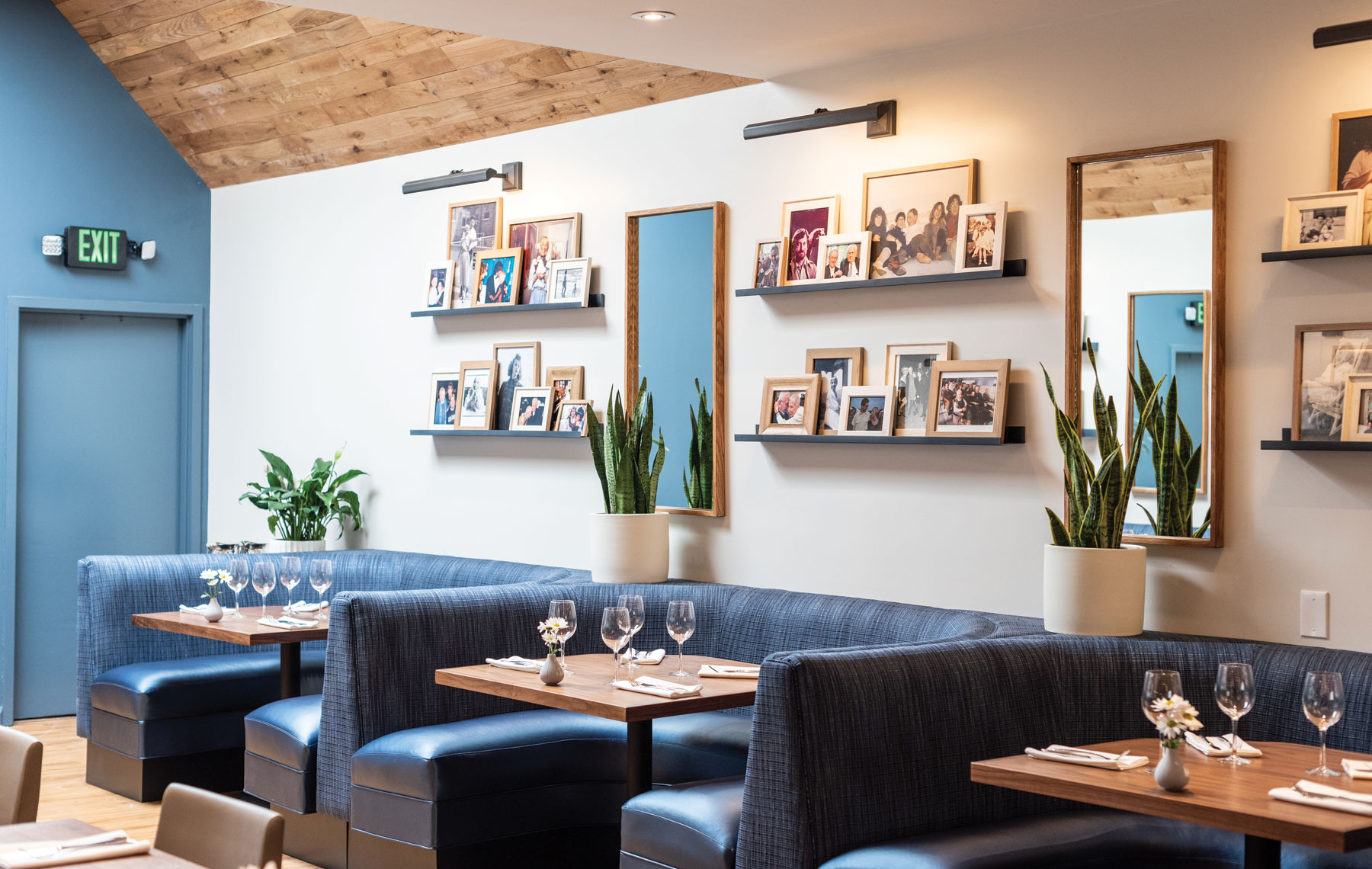
Patrons can also enjoy other portals into Leah’s life through the family photos on the walls, her son’s film posters in the hallways, and a newly added wine bar where guests can enjoy their favorite libation as Leah did. (Each day, Leah took a break when she would ring a bell and sit down with a glass of wine.)
Another nuance of the restaurant, Wilson said, are the denim aprons employees wear and the denim-covered booths, which honor Leah’s usual daily work attire of Levi’s jeans, pearls and red lipstick.
The interior of the dining hall; Photos courtesy of the Milky Way.
“I’ve worked in restaurants for over 20 years,” Wilson said. “I started working in a family restaurant, and I’m so happy to be back working for a family. I take so much pride in what I do. For me, I feel like I’m at home. It’s my second home.That’s how we take care of our friends at home and that’s how we take care of our guests here.”
Sue Spielberg said she and her siblings are confident their mom would like the changes they have made in her memory.
“I feel our mom’s presence and just know she’d be thrilled with the changes,” Sue said. “She’d be dancing and twirling among the tables. I’m excited for my little granddaughters — my mom’s great-grandkids, one of whom is also named after her — to enjoy the food and see the family photos and learn about our incredible mom.”
Temple Mishkon Tephilo, one of the oldest continuously operating synagogues on the Westside, is celebrating its 100th anniversary by recognizing the diversity of its Venice community.
“Venice is a real potpourri of individuals,” said Rabbi Gabriel Botnick, Mishkon Tephilo’s rabbi for the past three years. Venice residents have an “activist mentality. They’re educators and nonprofit professionals who are dedicated to justice and also to traditional Jewish life,”
Even the high-tech professionals who have moved into the area in recent years have a “drive to have continuity, to pass down love of Judaism to the family,” he added. There are also younger people, who aren’t necessarily looking to be affiliated with any one place and are still seeking.
“All these different people make up Venice, and Mishkon Tephilo is the big tent that holds everyone in place,” Botnick said.
“You’re not going to get your three-piece suits [at Mishkon Tephilo],” said Cindy Goldstein, a longtime member and the Conservative synagogue’s president. “People wear anything from jeans to everything in between. It’s just like Venice. It’s all about variety and choice, and we make room for all the different possibilities.”
Goldstein recalled that when she moved to West Los Angeles in 1989, “There was a big picture of a woman rabbi on the cover of the L.A. Times Magazine.” That woman was Naomi Levy, who had just become Mishkon Tephilo’s rabbi, and the first female rabbi to helm a Conservative West Coast congregation. Goldstein was intrigued because, in her experience, “women were never on the bimah, except for the prayer for peace. I loved it and stayed.”
Levy stepped down in 1996, and the congregation hired Rabbi Daniel R Shevitz, who remained for the next 20 years. When Schevitz retired, the synagogue hired Botnick, and membership has increased every year since then, Goldstein said.
Mishkon Tephilo’s latest membership numbers counted 169 family units, including 279 adults and 74 children (ages 12 and under).
Botnick has made changes that have pleased some members and not others, Goldstein said, including incorporating “more musicality” into services. Na’or, a Friday night service featuring musical instruments, has been attracting more worshipers, especially younger people. But in trying a “Na’or Baboker” (a Shabbat morning version of the program), some people complained about how the music from that service, held in the social hall, could be heard in the sanctuary where the more traditional service was taking place.
“One of our strengths in the past has been our adaptability,” Goldstein said. “Every rabbi brings change, and we are adapting very well. We are able to work with the change and yet keep our traditional focus on Conservative Judaism. And all our members are very devoted to synagogue and community, so even when there are fierce arguments, everyone has the best interests of the congregation at heart.”
“My mission as a rabbi is to sell people on meaningful Jewish life and show it’s not out of reach. I wear Converse and an untucked shirt to work. I’m relatable.”
— Rabbi Gabriel Botnick
The synagogue’s 100th anniversary gala on April 7 will be appropriately eclectic, featuring a DJ and dancing, as well as interviews with a number of former and current members and members sharing in-person memories. An interactive visual display will illustrate key moments in Mishkon Tephilo’s history alongside world events in a Torah-scroll-type format. Attendees will be invited to add personal milestones and events to the timeline, effectively writing themselves into the congregation’s history.
The synagogue renewed Botnick’s contract for another three years, and his role is “wearing the hat of CEO for future growth and also being the rabbi.”
“The community is coming more alive,” Botnick said, “and we are trying to figure out how to address the different needs to grow the community even more.”
Botnick also spoke to the synagogue’s role in caring for its neighbors — some of whom are homeless — through social action programs, inviting them to have meals with the community and recommending resources.
“Being in the community gave me the opportunity to really realize some of the teachings in our tradition,” Botnick said. “When you’re walking past individuals on a daily basis, you stop, ask their name and listen to their story. When you give matanotlaevyonim [giving gifts to the poor on Purim], you know them, the people of your community.”
Botnick and Goldstein said one of Mishkon Tephilo’s challenges is to strengthen the physical space of its synagogue building located at 206 Main St. “The building is aging but is still big and charming and wonderful in its historic sense, and we are hoping to be able to improve it and preserve it,” Goldstein said.
“The building is almost as old as the community,” Botnick added. “It needs some TLC. I always think back to the first years of IKAR in the Westside JCC auditorium.” (Botnick is a former IKAR rabbinic intern). “What happens in the space isn’t about the space itself, it’s about the energy that people bring into the space. That is part of the hope in the coming years — to find new ways to not just spruce up but revitalize the building.”
Meanwhile, the synagogue’s leadership is preparing to serve the changing needs of its membership and surrounding community.
“My mission as a rabbi is to sell people on meaningful Jewish life and show it’s not out of reach,” Botnick said. “I wear Converse and an untucked shirt to work. I watch the same Netflix shows that other people do. I’m relatable.”
Botnick called the synagogue’s offerings “accessible, not outdated or monolithic. That’s one of the driving factors of our success. You don’t have to water down and short-sell Judaism in order to get people to buy into it. You just have to find the right way to present it.”
Botnick hopes Mishkon Tephilo will continue to be “the heart and center of Jewish life here in the Santa Monica and Venice neighborhood.
“People who are looking for a place to connect with Judaism realize there is this center that’s been here for a long time,” he said. “That’s not something to take for granted. It’s really something to celebrate.”
The Israeli gusto for innovation hasn’t skipped a beat in any category. Just as the country’s startups and tech firms have made advances in many fields, gastronomy is another category where Israel shines.
In its 70 short years as a nation, Israel has developed a reputation as a leader in the food realm. Tel Aviv has developed a reputation as a gourmand’s paradise among international travelers, who often are shocked to discover that you can find virtually any type of cuisine in the city cooked to very high standards. The incredible fusion that exists in Israel, where 170-plus cultures have blended to make “Israeli cuisine,” is the subject of heated debate among Israeli chefs and diners.
Spend some time anywhere in the country and the conversation will circle around to food — yours, theirs, your next meal, your last one. Jews talk about food a lot, and in Israel, where family recipes and grandma’s cooking are such a large part of the Shabbat ritual, part of the “home cuisine” movement shines through in the restaurants.
The austerity period of the young nation lasted until the 1970s, when an economic boom produced a startup nation of foodies. Israelis no longer content to eat at home began to travel and bring back the cooking styles and techniques of faraway places. Yet they never turned away from their native food. The result is a thrilling food landscape with its roots in the Middle East’s most ancient recipes using the freshest local produce prepared with the techniques of Europe, Asia and North America.
It’s not your grandmother’s Israel and it’s not just about falafel, hummus and Israeli salads. But in recent years, it’s difficult to find a more diverse travel destination for food experiences than Israel, including sprawling food markets, dives, casual beachy and high-end fancy restaurants. From Tel Aviv and Jerusalem to the Galil, Israel has grown into a modern-day Garden of Eden for the discerning eater. A reality TV show and a documentary spotlight how cooking is another frontier that Israelis have conquered.
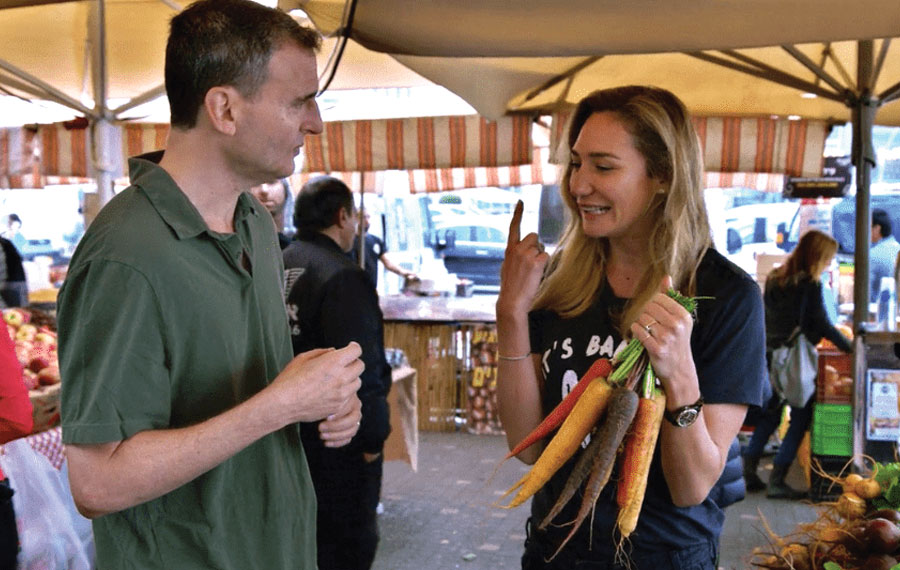
“Somebody Feed Phil” (Netflix): What happens when a Jewish, Los Angeles-based television writer and creator of the hit series “Everybody Loves Raymond,” Phil Rosenthal, leaves behind the bland world of his parents Ashkenazi food and travels to some far-flung destinations, including Israel? The two best things — comedy and food. Rosenthal is a self-professed food novice — he said he didn’t even taste garlic until he was in college — so imagine his surprise at the flavor explosion he experiences when he travels to Israel and gets hand-fed shakshuka by the “Doctor” himself, Bino Gabso, (Dr. Shakshuka, Jaffa’s famous shakshuka restaurant in the flea market.) While Rosenthal, more like a kid in a candy store than an adult father of two, is led around Tel Aviv, Jaffa, Caesarea and Acre by legendary chefs and food personalities such as Israeli-American restauranteur Michael Solomonov, the viewer benefits from Rosenthal’s decidedly nonculinary background.
Rosenthal’s Jewish food knowledge seems to have stopped at jarred gefilte fish and his mother’s stringy brisket, so he is blown away by what he experiences in some of the country’s most famed gems. In what can be described as a happy-go-lucky version of Larry David meets the locals for a laugh and a nosh, Rosenthal seems to recognize the change in Israel from his younger days of visiting the country as a bar mitzvah boy.
It’s heartening to see how his connection to the country and the people are transformed through his expanding palate. Of course, the show features many cameos of some of Israel’s iconic food staples, like sabich, a sandwich made from fried eggplant, and Israeli salads dressed with tahini stuffed inside a fresh pita or the gizzard and oxtail soups he’s served in the Yemenite quarter in Carmel market. But the show’s main strength is more about the people whom Rosenthal encounters.
“Somebody Feed Phil” also features another ingredient that’s not found in other typical reality-TV shows — Rosenthal’s parents. At the end of each segment, his 90-year-old parents are featured in a Skype call from their son. It may not surprise you to know that his parents were the inspiration for actor-comedian Ray Romano’s fictional parents on “Everybody Loves Raymond” but their charming appearances will leave no doubt in your mind.
“Spend some time anywhere in the country and the conversation will circle around to food — yours, theirs, your next meal, your last one.”
“Hummus! The Movie” (Amazon): Probably my favorite doc that I recommend about food in Israel, “Hummus! The Movie” was written and produced by Israeli documentary filmmaker Oren Rosenfeld, who started his career as a photojournalist covering the Second Intifada. Perhaps because of his background and obvious passion for the subject matter, “Hummus” is an interesting glimpse into past and modern-day issues in Israel beyond food.
The film features snapshots into the lives of three unusual restaurateurs, each representing a completely different experience of modern Israel and shedding light on cultural and social issues that affect them. By focusing on a small group of completely diverse people, Rosenfeld takes his passion for hummus and brings the viewer along as his subjects work, struggle and make decisions. Jalil, a sweet, young Christian Arab from Ramle, takes over his family hummus restaurant and tries to make changes to keep himself challenged while he is being pulled to follow his dream of opening a place in Berlin.
Eliyahu, a formerly dreadlocked drifter turned Chasidic Jew with a young wife and family in tow, runs a chain of successful kosher hummus restaurants all over the world and believes in the mystical powers of chickpeas.
Then there’s Suheila, a hardworking Arab woman who takes over her father’s hummus business. After her brothers drive the restaurant into debt and decline, Suheila forgoes marriage and family to become the first Arab woman in the market to own a business. She is crowned the official “King of Hummus” in a highly promoted national contest, much to the chagrin of the generations of male-owned “hummusiyas” that don’t take too kindly to the judges’ decision.
There is also a series of interesting side characters like Olivier, a Benedictine monk, whose lack of culinary prowess puts him on a quest to find the tastiest hummus after his fellow monks ask him to refrain from taking his turn to cook the monastery meal. In his search for what to serve on his night to serve dinner, he goes in search of the best hummus, and discovers the role hummus plays in the communal lives of Israeli Arabs, Jews and Christians.
In addition to the touching personal stories and the entertaining commentary on Israeli life and food from some of Israel’s most famous food personalities, the film is much more than about hummus. In an amusing segment of the film, we witness the backstory and observations of the Guinness World Record adjudicator who comes to Israel to judge the Israeli entry for the “world’s largest serving of hummus.” We hear from the previous Lebanese record holder, whose 5,000-kilo (11,000-plus pounds) world record is bested by an Israeli competitor. This is not only a lovable and touching film but one that will make you very, very hungry. Don’t attempt to watch without having immediate access to a pita and a plate with a healthy smear of its namesake.
Yamit Behar Wood, an Israeli-American food and travel writer, is the executive chef at the U.S. Embassy in Kampala, Uganda, and founder of the New York Kitchen Catering Co.
One verse, five voices. Edited by Salvador Litvak, Accidental Talmudist
“This month shall mark for you the beginning of the months; it shall be the first of the months of the year for you.” –Exodus 12:2
Rabbi and Cantor Eva Robbins expandedspirit.org
On this special Shabbat, Shabbat HaChodesh, the new month, we read from two Torahs. The additional special reading reminds us that we are entering the “first of months” and is apropos because it is the month of Nisan, which heralds one of the three special chagim (festivals), Pesach (Passover).
We read these sentences once before on Jan. 12 in Parashat Bo, when our forebears confronted the horrific darkness, chaos and “killing” of the Egyptian first-born sons. As the terrifying night approached and pervaded the entire country, a new time was “birthed”; a measure of a month entered the newly created calendar. As death approaches and the Egyptian gods are extinguished, symbolized by the slaughtering of the paschal lamb, a new people emerges, with the light of a uniquely formed cycle, a year.
This parallels the beginning of Torah, when darkness and chaos, “tohu vavohu v’choshech,” pervaded the universe and God said, “Let there be light … and God separated between the light and the darkness. God called the light Day and the darkness Night…on the seventh day God rested from His work.” Creation introduces the measure of a day and a week; Pesach introduces the measure of a month. As the world comes into being, order and light guides the newly created human being; as Pesach comes into being, a calendar of structured times, both holy and ordinary, will bless a new nation.
Let us hold in our consciousness, to celebrate and honor what Torah teaches, that this moment is truly the beginning of the year.
Rabbi Michael Barclay Temple Ner Simcha
The issue of months, the calendar and astrology have always been significant in Judaism. Our sages and texts going back to Talmudic times discuss the influence of each month on the individual’s entire life (as well as the location and even hour and minute of birth being influencers). Sefer Yetzirah (second-century text) delves deeply into the correlation between months, astrological signs, parts of the body, and letters of the Hebrew alphabet. Authentic “Jewish astrology” understandings are powerful and worth studying in depth with a knowledgeable guide; and have been practiced and understood throughout our history all the way back to Father Avraham (B. Talmud, Bava Batra 16b).
But although the new moon, month or constellations are accepted to have influence, as Jews, we are not ultimately controlled by them. Ours is a higher destiny. Through practice of the mitzvot and study of Torah, we have the ability to transcend the astrological destiny and the inherent power of each new month. “From the time that the Torah was given to Israel, the Israelites were withdrawn from the rule of the stars and constellations; however, if one does not follow the ways of the Torah, he returns to be under the domain of these natural influences.” (Zohar, Vol 3, 216)
As we enter this new month of Nisan, may we all be blessed to experience the qualities of the month, and the special relationship every Jew has with God that allows each of us to go beyond the power of the stars.
Rabbi Avraham Greenstein Professor of Hebrew, Academy for Jewish Religion
This verse contains the commandment for the nation of Israel to keep track of time, to mark the beginning of the year and the beginning of each month. The commentaries note that it is the first commandment that the people of Israel were commanded as a nascent nation, and Seforno sees in this particular significance: Israel’s new autonomy as a nation is most noticeable in that they are now masters of their own time. As slaves, their time belonged to Egypt. As a free people, their time is now their own. They can now determine their identity as a nation by what they do with their time.
This theme of being a master of your own time is central to Jewish tradition, and it lies at the center of the notion of free choice and personal agency within Judaism. Pirkei Avot (Ethics of the Fathers), a series of fundamental statements about Jewish values, attitudes and practice, contains numerous exhortations for us to be conscious of what we do with our time. We are reminded to make full use of the time we have for Torah study (Avot 1:13, 2:5, 3:3, et passim), and to make full use of our days (2:2, 2:15, 4:16-17, et passim).
Since time is in limited supply, it is not enough for us to passively mark the passage of time. Rather, Jewish tradition demands that we actively fill our time with meaningful activity, generosity, and growth. In doing so, we define ourselves as a people and justify our freedom from Egypt.
Salvador Litvak accidentaltalmudist.org
On the Shabbat before the first day of Nisan, the Hebrew month in which we left Egypt, we add a special passage to the weekly Torah reading. We call it Shabbat HaChodesh, the Sabbath of the New Moon, and we read this law, the first commandment given to the Jewish people as a nation. Some debate exists as to whether the passage comes to teach the moon phase in which all Hebrew months begin, or that Nisan is the first month. In fact, the name Nisan doesn’t appear in the Torah, nor do any other names of months. They are called only first, second, third month, etc.
Ramban said the months are numbered not just for the sake of scheduling but rather to keep us mindful of the exodus from Egypt. He notes that the days of the week, which also lack proper names in Hebrew, are called the first day from Shabbat, second day from Shabbat, etc. The days of the week thus remind us constantly that God created the world.
The months remind us that God interceded in history. One might have thought that God set the universe in motion and then let it proceed according to natural laws. The months spring from the Jewish redemption from Egypt to teach that God remains involved. This is why we sing Hallel, songs of thanksgiving and praise, at the beginning of every month. When Passover approaches, we face a massive to-do list. These items are not chores but rather opportunities to thank and connect with our Eternal Redeemer.
Miriam Yerushalmi CEO, SANE
Sefer Vayikra (Leviticus) is the book of laws. Why remind us that this mitzvah about the moon is “the first … the beginning”?
The moon, in its waxing and waning, embodies growth. Every month, it begins as a thin sliver; after slowly achieving wholesome perfection, it gradually diminishes to near-nothingness, then re-emerges and regrowth begins. The cycle of “humility” to “greatness” repeats.
The Talmud states: “In every place you find God’s greatness, there you will find His humility.” Tanya teaches that “God abides only where there is no sense of self or separation from Him.” Any arrogance or self-conceit is a barrier to spiritual growth and closeness to HaShem. A verse early in the Rosh Chodesh haftarah reminds us of this, while the above verse underscores the moon’s centrality to Judaism: “The heaven is My throne and the earth is My footstool, (so) what house can you build (worth) for Me?”
God is not talking arrogantly here. He is teaching a profound lesson.
HaShem doesn’t need our Torah learning, represented by the heavens; He doesn’t need our mitzvots, represented by the Earth; HaShem doesn’t need a house, represented by the Beis HaMikdash (Holy Temple) for his Shechinah (divine presence) — just as the highest essence of our soul doesn’t even enter the house of our bodies.
This teaches us that on one level, this service is not essential for Him, but for us. To enable us to reach the greatness of humility, like the moon. As the moon becomes small, it becomes great. This is our goal.
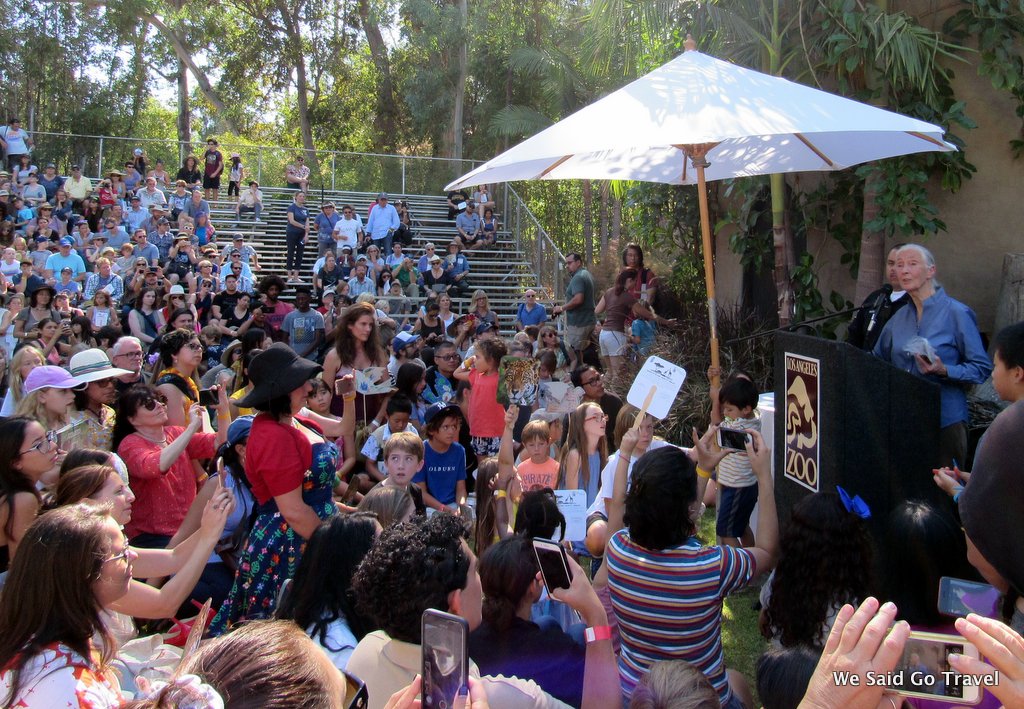
Dr. Jane Goodall turns 85 today and she has changed the way we understand primates on our planet with her 50 years of love and research in Africa and around the world.
When she was a little girl, her mother “supported her love of animals that she was born with.” She brought earthworms to her bed to investigate them when she was one and a half and her mother helped her bring them back to the garden so they would live. When she was four and a half, she was on a family holiday in the country and went to visit the hens in the henhouse for four hours. Her parents were so worried the police were called but when she was found, her mother patiently listened to her observations about the animals.
Video: Dr. Jane Goodall at LA Zoo in celebration of United Nations International Day of Peaceon September 23, 2018
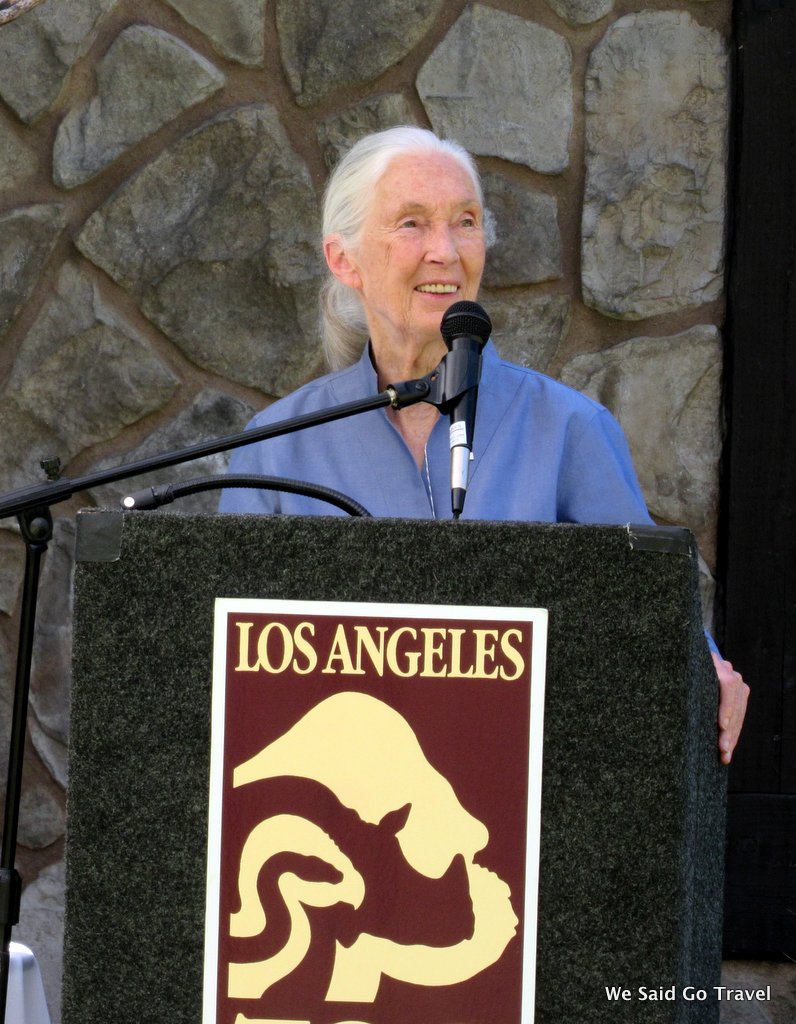
Goodall explained to a group at the LA Zoo in celebration of United Nations International Day of Peaceon September 23, 2018 about how her time in the henhouse is how we create scientists: “be curious, ask questions, search for the right answer, decide to find out for yourself, make mistakes, not give up and learning patience.”
Goodall wanted to learn more about animals and read books in the library and saved her pocket money to buy books at the second hand bookshop. When she was ten years old, she bought the book, “Tarzan of the Apes.” She told the crowd that she “fell passionately in love with the lord of jungle but he married the wrong Jane.”
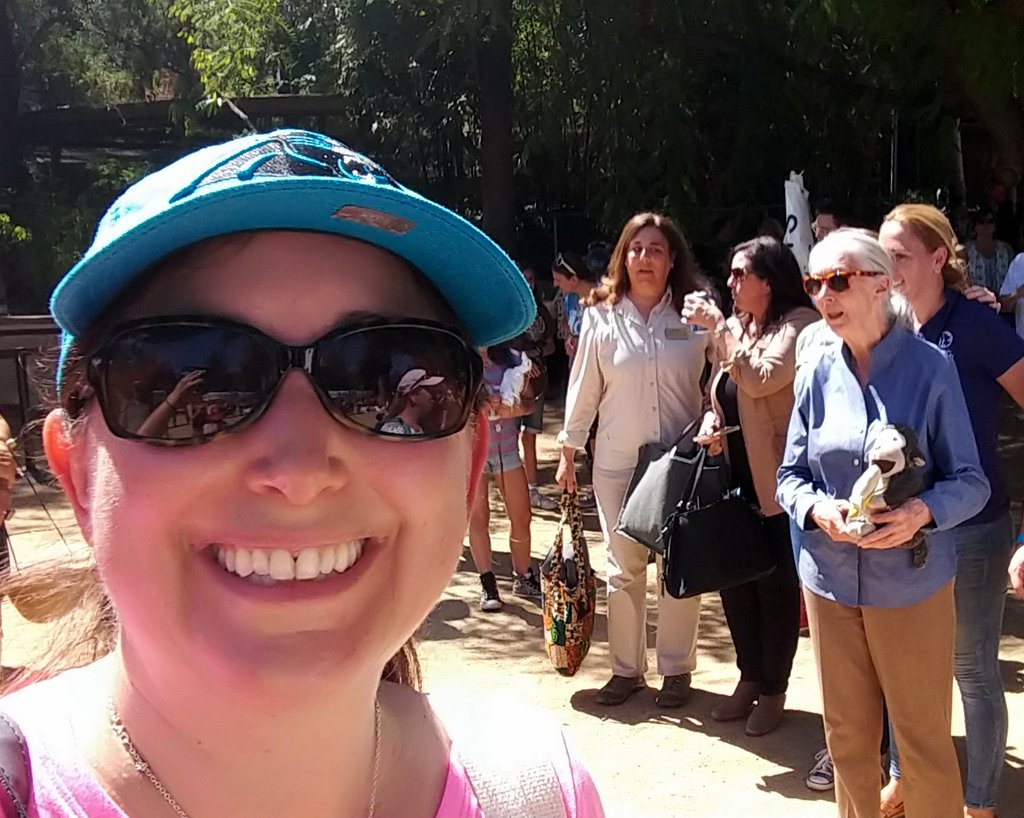
Lisa Niver and Dr. Jane Goodall
She told us, “That was when my dream began. I will go to Africa when I grow up, I will live with wild animals and I will write books about them.” As with many dreamers who dream great dreams, Goodall told us, “Everybody laughed at me. They said, ‘Jane how will you go to Africa? You don’t have any money. The dark continent is far away.” Goodall explained that: “Girls did not have opportunities like that back then.”
Dr. Jane Goodall speaking at the LA ZOO for UN International Peace Day
But her mother said: “Jane, if you really want to do this thing, you are going to have to work really hard, take advantage of all opportunities but don’t give up.” And Goodall explained that “I have taken that message to young people all around the world particularly to children in deprived communities. I wish my mom knew how many children and people have come up to me and said: Jane you have taught me that since you did it, that I can do it too.”
Goodall stayed in school until she was eighteen but did not have enough money to go to college. When a school friend invited her to Africa, she worked for six months as a waitress to get enough money to go to Kenya by boat. There were no tourist planes at that time.
While in Kenya, she was introduced to Louis Leakey, the curator of the Natural History Museum, who spent his life searching for our earliest ancestors. Leakey offered her a job and suddenly she was surrounded by people who could answer all her questions about plants, birds, animals and insects. It was Leakey who decided Goodall was the person he had been looking for to study the animal most like us —the chimpanzee. She made the observation that a chimpanzee is capable of using a piece of grass to fish termites from their nest that he is capable of modifying an object by picking a leafy twig and stripping the leaves which is the beginning of tool making. At the time, it was believed that only humans used tools. This observation allowed Leaky to go to National Geographic Society and they agreed to provide money to carry on with the study with photographer, Hugo Van Larete to document their work. The recent Geographic Documentary called Jane, Making Use is footage from their work together.
Celebrating Roots and Shoots at the LA ZOO
Leaky arranged for Goodall to go Cambridge and work to receive aPhD in animal behavior. She told us her days at the research station were the best of her life. She spent hours every day in the rainforest understanding the interrelatedness of all living things.
In 1986, at a conference at the Chicago Academy of Science, there were people studying chimpanzees in 6 parts of Africa. Goodall learned about chimpanzees being treated badly in circuses, about research facilities doing painful procedures on chimpanzees and about forests disappearing. Goodall said she “went as a scientist planing to continue my wonderful life, but left as an activist and knew I had to do something.”
She visited medical research labs and saw the conditions, went to some of the bad zoos and led to a campaign to release all chimps into sanctuaries. She learned about the plight of African people living in and around chimpanzee habitats with crippling poverty, lack of good health and education facilities and very often the ethnic violence. She wanted to save the chimpanzees and the local villages. In 1994, they started programs with twelve villages and worked to restore fertility to farmland, create youth education programs, add more health facilities, create water management programs, develop microcredit for an environmental sustainable program, scholarships to keep girls in school after puberty and information about family planning. It was so successful that now 72 villages are involved and it has spread to 7 other African countries.
Goodall said that “people have become our partners in preserving the environment for future of their own children and not just to save the chimpanzees but to save the future of our environment for all.”
In 1991, Roots and Shoots began with 12 students in Goodall’s home in Dar El Salem, Tanzania. The students told her: “they were not just worried about wildlife, also worried about homeless children with no where to live, illegal dynamite fishing that was destroying the coral reefs, some were worried about the poaching in the national parks and why wasn’t the government prosecuting the poachers.”
Dr. Jane Goodall speaking at the LA Zoo
Her main message has been: “Every single one of us makes an impact on this planet every single day. We all have a choice as to what kind of impact we are going to make. Are we going to leave the world a little better after today or don’t we care?”
Goodall explained that she does have hope for the future. There are now young people participating in Roots and shoots in 80 countries, with 150,000 active groups and it is growing all the time. There are 2,000 groups in China, and it is growing fast in Canada, Latin America, across Europe and in many African countries. The first groups have just started in the Middle East. She continued: “Young people who are so passionate and so determined to make change and so empowered and you cannot help but have hope. It gives me my greatest reason for hope. We are not the only beings with personalities, minds and emotions. It is changing how we think and act each day.”
Dr. Jane Goodall speaking at the LA Zoo
Goodall told us “if we get together, if we each realize that each day we make a difference, and collectively we make a huge difference, if we realize at least in democracies, we can influence the government and as purchasers we can influence business in the way it conducts its business, there is a lot of hope in the future but only if we all get together. The young people and Roots and Shoots that is our great hope for the future, the young people, their parents and their teachers. We can make this a better world.”
Happy Birthday Dr. Jane Goodall and
thank you for all you have done to change the world.
Let’s admit Southern California’s long-guarded secret:
There are actually seasons here. Perhaps not as drastically distinct as the seasons of the Northeast, nonetheless, Los Angeles erupts in raucous bloom in springtime, green bowers bake into brown under the summer sun, trees and shrubs constrict into the fall, and the chill of winter nourishes the region back into bloom.
Which brings me to today and its springtime blessing.
This morning, walking through the backyard toward my car, I passed our resurgent orange tree, in full bloom. If you’ve never caught a whiff of a newly blossoming citrus tree, you haven’t smelled paradise. Delicate white petals swirl in symmetric circles of beauty, and the perfume they produce is sweet, pungent and inspiring.A strong citrus scent, distillation of orange, hit me suddenly, grabbing my attention and infusing the yard with its whiff of bliss.
Smell, the Zohar teaches, is the most spiritual of the senses. Touch is tactile and physical, as is taste. Sight is light bouncing off of physical objects. But scent wafts on the wind and seems ethereal and otherworldly. Memories unlock because of smells’ connection to particular occasions (recall the smell of turkey on Thanksgiving, or the scents that unlock memories of seders long forgotten, of kitchens laden with the smells of Shabbat).
It turns out that Judaism recognizes the elevated spirituality of springtime blooms. There is a blessing the Talmud instructs us to recite not more than once a year, in the season when flowers bloom. In honor of my garden’s orange tree (and, I suppose, also in honor of the region’s extraordinary super bloom!), I stood in the yard, under the beckoning sunlight of a springtime morning, and recited these ancient words of mindfulness and gratitude:
We praise you, Holy One our God, Majesty of Space/Time, Who withholds nothing from the world, and who created goodly creations and beautiful trees in order to provide pleasure to humanity.
What a wondrous tradition that bids us to notice the resurgence of life and light in the spring! How marvelous that Judaism understands that pleasure is itself a gift from God, and that nature’s exuberance and beauty isn’t just a practical, functional response. There is such a thing as beauty for its own sake, pleasure for its own sake, raucous delight as a value in and of itself.
Life is a gift. Pleasure, beauty and joy emerge in its wake.
It is deeply Jewish to breathe deeply, savor the scents, and to then give thanks.
Rabbi Bradley Shavit Artson holds the Abner and Roslyn Goldstine Dean’s Chair of the Ziegler School of Rabbinic Studies at American Jewish University and is the Dean of the Zacharias Frankel College at the University of Potsdam, training Masorti rabbis for Europe.
Sunlight streams through the skylight in the space that serves as a boardroom in Frank Gehry’s sprawling offices in Playa Vista. The room is filled with mementos and photographs taken with famous people that speak to the 90-year-old architect’s renown that spans decades and continents.
As Gehry ambles into the room via a sliding glass and wooden door that opens onto his company’s cavernous workspace filled with busy architect bees, he pumps his left fist in the air and declares, “I’m an atheist!”
This opening statement, as the unfolding interview will attest, is no random pronouncement. Gehry knows this is an interview being conducted by a Jewish paper about his design for the $300 million World’s Jewish Museum, slated to open in Tel Aviv in 2023 to coincide with Israel’s 75th anniversary of independence.
The museum will span 5 1/2 acres and overlook the Mediterranean. Once complete, it will connect Hayarkon Park, the Mediterranean Sea and anchor the Tel Aviv North development. It aims to become an iconic cultural draw highlighting Jewish accomplishments.
Yet throughout the hourlong interview, Gehry makes it clear this project is not about returning to his Jewish roots, which he admits he abandoned during the reception immediately after his bar mitzvah.
“I found the people disingenuous at my bar mitzvah,” he says by way of explanation. “It was a small shul in Toronto. My grandfather was the president of the congregation. I worked hard on the piece I had to study and read and afterward I started talking to some of the people in the congregation about it. They didn’t know what I was talking about. They were just there for the schnapps and the food, and [they] split. I said, ‘Wait a minute.’ So I talked to my grandfather. He was more interested in the principles and the humanity [in Judaism].”
“I’ve always been looking for a way to avoid decoration and we’re living in a world where everything’s in motion and I thought maybe if you expressed motion in architecture, that would create feeling that would be relevant.” — Frank Gehry
And that, in a nutshell is how Frank Gehry became an atheist.
And yet, Gehry is a delightful conundrum — an interlocking mental jigsaw puzzle that doesn’t follow any predictable form (much like his architectural designs). It’s how he is capable of denouncing any connection to Judaism yet still counts the Talmud as a major source of inspiration.
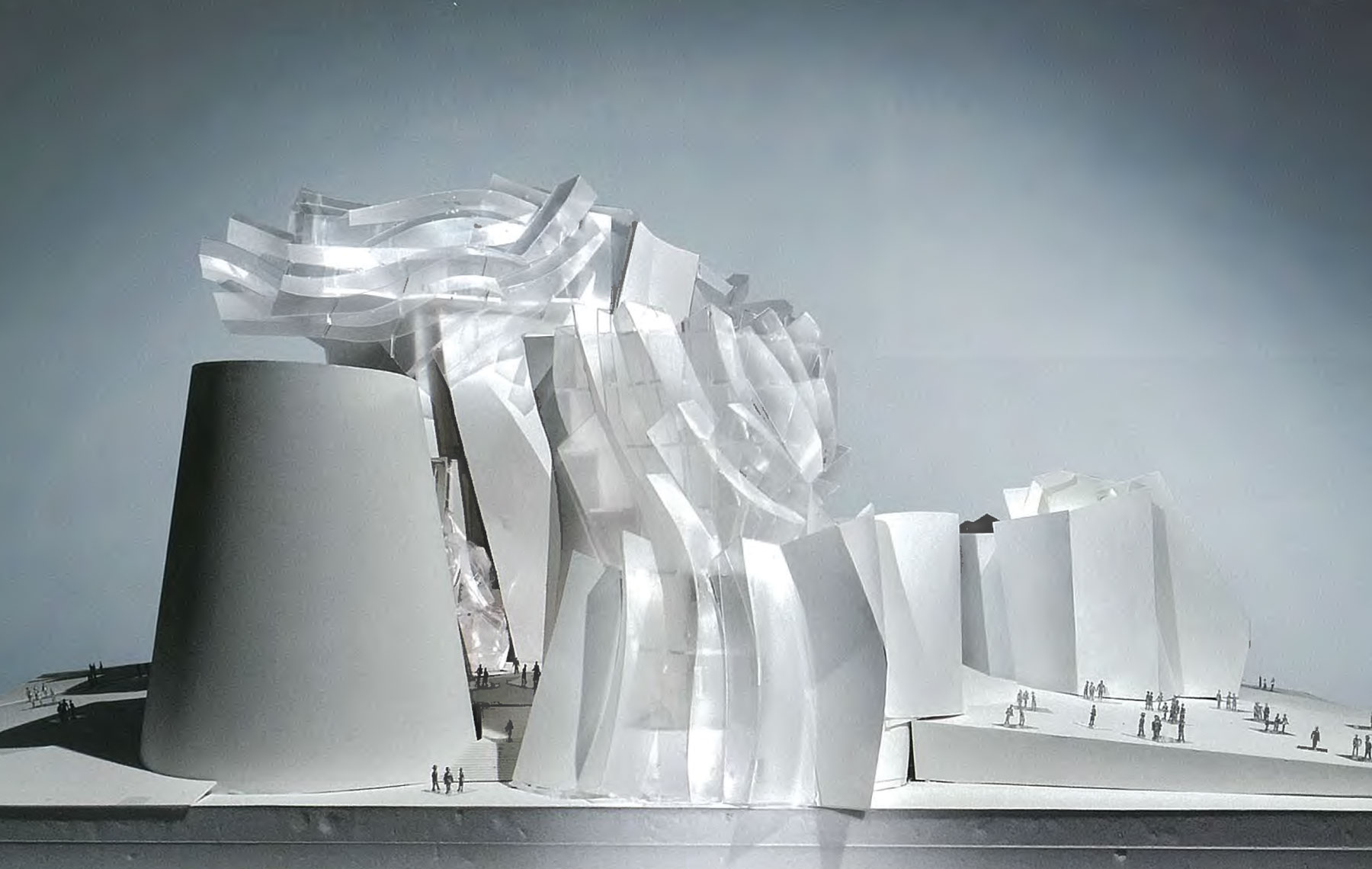
“The Talmud starts with the word ‘why,’ ” he says. In fact, on the model of the museum sitting in his offices, the word “why” in Hebrew (Lamah) is carved into one of the buildings, although he says he doesn’t know if that will be included in the final construction.
“There’s a curiosity built into the [Jewish] culture,” he explains. “I grew up under that. My grandfather read Talmud to me. That’s one of the Jewish things I hang on to probably — that philosophy from that religion. Which is separate from God. It’s more ephemeral. I was brought up with that curiosity. I call it a healthy curiosity. Maybe it is something that the religion has produced. I don’t know. It’s certainly a positive thing.”
Which raises the question: If Gehry (born Frank Goldberg) doesn’t identify as Jewish, why take on a uniquely Jewish project in the Jewish homeland?
The decision, he explains, has far more to do with fellow Canadian Gail Asper of the Asper Foundation, the visionary behind the museum. Gehry signed onto the project because of Asper’s vision. “I liked her,” he states matter-of-factly. “She spent time with me and told me what her dream was.”
That dream includes a place that highlights contributions by the Jewish people to the world. What clinched the deal for Gehry was when Asper showed him the Canadian Museum for Humans Rights in Winnipeg, Manitoba. Initially conceived by Asper’s late father, Izzy Asper, Gail spearheaded the project after her father died suddenly in 2003. The museum officially opened in 2014 and has since become a world-renowned, must-visit destination.
A major part of the Human Rights Museum’s draw is the stunning structure designed by Albuquerque, N.M., architect Antoine Predock. Gehry says after seeing the Human Rights Museum, “it was clear [Asper] understood architecture and the power of architecture and that what she was trying to accomplish with it [in Tel Aviv] seemed like a reasonable mission.”
“There’s a curiosity built into the [Jewish] culture. I grew up under that. My grandfather read Talmud to me. That’s one of the Jewish things I hang on to probably.” — Frank Gehry
More importantly, Asper “had a passion that seemed real. It was clear to me that Gail wanted to have a building that could do what Bilbao did,” he adds, referring to his Guggenheim Museum in the northern Spanish city of Bilbao, which opened in 1997. “It will open the eyes of where the building becomes part of the art, part of the story, and so it couldn’t just be a box.”
Gehry believes the World’s Jewish Museum will help Asper tell her story — “a building that will become [something] that the people of Tel Aviv will be proud of and it will be a positive story about what Jews accomplished under duress in many cases.”
In a phone interview with the Journal while visiting Gehry’s office, Asper says, “The site will have the greatest story that’s never been told about the Jewish people. It will celebrate the joys, not the oys. [The museum] is more about how Jewish values have transformed and improved the world.”
For Asper, having Gehry bring her vision to fruition “is like hearing angels sing,” she says. “Frank immediately loved the vision. I know that beautiful architecture inspires the soul and Frank [designs] incredibly breathtaking, inspiring buildings. I love Bilbao. I love the Disney Concert Hall. I love what he does. And for all the countries in the world to not have some extraordinary breathtaking Frank Gehry building, Israel absolutely deserves that. And Israelis deserve that. They put up with an awful lot living in Israel. They pay high taxes. They’re dodging rockets, even in Tel Aviv.”
Of Gehry’s design, Asper says, “The one we chose is breathtaking [and] in keeping with the white city [of Tel Aviv]. Frank is iconic and beautiful. People have such challenging lives, it’s a gift to be able to give them something beautiful.”
The gleaming white and glass design comprises a series of buildings, one of which looks like leaves coming out of the top of a tree.
“It’s a simple program,” Gehry explains. “It’s galleries and a library and an auditorium and a restaurant and a public meeting space. It seemed logical to put the restaurant and the public meeting space on top so they get the view. And to use the auditorium as a way to enclose the public space and create a garden with the elements. So it’s kind of a private entrance garden people could meet and spend time in.”
As to the glass and “tree-like” elements of the project, Gehry explains: “I’ve always been looking for a way to avoid decoration and we’re living in a world where everything’s in motion and I thought maybe if you expressed motion in architecture, that would create feeling that would be relevant.”
He adds how important it is to him that when you enter a space, it evokes certain feelings. “So I thought certainly a museum for a program like this should have a character to it and I didn’t want to use decorative elements from the 19th century. So it’s easier to make a restaurant more flamboyant. It could be built with glass and we’ve done a lot of experimenting with that and our hope is to be able to have a building that’s expressive on the skyline but also is very special to be inside.”
The interior is the purview of Ralph Appelbaum, whose company Ralph Appelbaum Associates will helm the exhibits. Appelbaum is world-renowned for curating some of the most iconic museums around the world, including the Smithsonian National Museum of African American History & Culture in Washington, D.C., the Canadian Musuem for Human Rights in Winnipeg, the United States Holocaust Memorial Museum in Washington and the Jewish Museum and Tolerance Center in Moscow. He’s currently working on Barack Obama’s presidential library in Chicago.
“We’ve won over 40 national and international awards for the [Human Rights Museum],” Asper says. “[Appelbaum] is in over 700 museums around the world and he’s the best idea museum guy.”
Among those on the Tel Aviv museum’s prestigious advisory council are Rabbis David Wolpe and Joseph Telushkin; author and nationally syndicated radio host Dennis Prager; Malcolm Hoenlein, executive vice chairman of the Conference of Presidents of Major American Jewish Organizations; and Israeli historian and writer Fania Oz-Salzberger, all of whom will have a hand in shaping the vast project.
The project will include the museum’s “Genesis Garden,” the Grand Lobby and six pavilions: the Covenant & the Land of Israel pavilion will be a multimedia experience, introducing the foundations of Jewish thought and values; the Creativity pavilion will showcase the impact of Jewish culture and its contribution to the arts; the Enterprise pavilion will be a retrospective of how Jewish professions evolved as a result of segregation, anti-Semitism and constant displacement, and will include stories of the development of the world’s first stock exchange, the film industry, the comic book industry, the success of today’s Startup Nation and the global impact of Jewish business icons, including its mobsters and oligarchs; the Science & Inquiry pavilion will look at how Jewish ideas and values have led to transformative contributions to science, medicine and technology; the Philosophy & Education pavilion will highlight how Jewish continuity, even Jewish uniqueness, depends not on central places, monuments, heroic personalities or rituals but rather on written words and an ongoing debate between the generations; and the Tzedek, Tikkun Olam & Tzedakah pavilion will highlight ways for people to engage in philanthropy and social change.
“The site will have the greatest story that’s never been told about the Jewish people. It will celebrate the joys, not the oys.” — Gail Asper
“I think [the museum] can be an important message for the world that a lot of people accomplished many things in the fields of science and art and education and all the important topics we live by and we are inspired by,” Gehry says.
So how do you physically design a Jewish museum that doesn’t incorporate references to the Holocaust?
“I think there is an important story to be told about these people,” Gehry says of the Jewish people. “Their beliefs, their upbringing, their inspirations and aspirations and their accomplishments. I think that there is something going on in the world that brings these people to the fore.”
And while this is Gehry’s first building in Israel, it’s not the first time he’s been asked to design a project in the Jewish state. In 2004, he signed on to design the Museum of Tolerance in Jerusalem. In 2010, he pulled out of the project, which is now being designed by Israeli architect Moshe Safdie. Officially, Gehry resigned because of “financial issues.” In this interview, the response is, “I don’t want to talk about that.”
However, he is willing to say, “I’ve had so many funny relationships with Israel about buildings. I don’t know if I’d accept a project in Israel other than this one. I had bad experiences, one after another. I’m not excited about going there. I’m excited about doing a building with Gail, and her mission is something I believe in. [The museum] will be a positive story about what Jews accomplished under duress in many cases, with a lot of misunderstandings and bad stuff happening through the Holocaust.”
The Holocaust is also something Gehry doesn’t really want to talk about “especially as it seems to keep happening in one form or another.” However, he then adds, “I lost 33 family members in Auschwitz. I didn’t know them and that was just my mother’s family. So you hope that kind of stuff isn’t repeated; that people find a pride in their own history. That includes the art and architecture, music, certainly. My heroes are [conductor] Zubin Mehta and [former Israeli Prime Minister] Shimon Peres.”
Gehry points to a photograph hanging on a wall featuring him and the late prime minister. Peres became a close friend and Gehry says that was one positive thing that came out of signing on to do the Jerusalem Museum of Tolerance project.
“He was a good friend and he talked to me about architecture,” Gehry recalls.
“The interior is the purview of Ralph Appelbaum, whose company will helm the exhibits. Appelbaum is world-renowned for curating some of the most iconic museums around the world.”
“There was a dinner in Jerusalem to announce the Museum of Tolerance building. I was seated between [former Prime Minister] Ehud Olmert and Shimon Peres. That afternoon I was at the Israeli president’s [Moshe Katsav] house and presenting the model, and while I was talking, I said, ‘Excuse me a minute. I have to talk to my grandfather.’ ” Gehry pauses, raises his eyes heavenward, and continues: “I said, ‘Zayde, I’m in the president of Israel’s house and I’m presenting a model for a museum in Jerusalem and I’m standing between Shimon Peres and Ehud Olmert!’
“[Peres] gave me a 20-minute intro and he knew all about my architecture, which was very moving, and he would invite me whenever I was in Israel to be with him. And he came [to Los Angeles] a few months before he died and asked if he could come by my office.”
Gehry also speaks fondly of Olmert’s wife, Aliza, an artist in her own right and a patron of the arts in Israel. He points to a horizontal painting of trees done by her on a wall of his office and says, “I have my ties and feelings about [Israel] that are related to [Aliza] and Shimon and Moshe Safdie.”
And it’s art — not religion — that has seen Gehry talk about wanting to possibly design a synagogue some day. “You’re talking about a transcendent space,” he says. “Creating a feeling that takes you somewhere. I think that I look at religion as trying to find your place in the world. You’re trying to put yourself in a place and when you go out into nature, your feelings are brought out and it’s fascinating to try to capture that feeling in a building. Very few have done it. The old cathedrals have done it. That’s what I’d like to try and think about. I don’t care what religion it is.”
And then, without pausing for breath, he adds, “I love hearing the Kol Nidre when it’s done well, so every once in a while I go and hear it if they’ll let me in.” He turns to his assistant and asks, “What’s that one place I like where I went?”
It becomes clear that Gehry attended Kol Nidre services at IKAR, led by Rabbi Sharon Brous. “Yes,” he says. “IKAR. [Brous] did talk to me a long time ago about doing something. I’m ready if she is. I like her a lot!” (Editor’s note: IKAR already has hired another architect to design its new space.)
Gehry is passionate about putting art back into architecture. “The issue for architecture is that historically, it was considered an art, and since the war, since modernism, it got mixed up with other issues like commercial developers. It slowly became just stupid,” he says.
That, he adds, has led to artists “and a lot of the world no longer considering architects [as] artists. So I think what’s needed is architects who are artists.”
And the World’s Jewish Museum aims to be an architectural piece that is also a piece of art. And while the Museum of Tolerance project in Jerusalem may not have panned out for him, Gehry’s excited about the Tel Aviv project.
“Modernism was built in Tel Aviv,” he says, referencing the late Israeli architect Ram Karmi, known for his brutalist style and designing, among other iconic buildings, Israel’s Supreme Court building. “His sister [architect Ada Karmi-Melamede] is doing interesting work. I think [architecture] is less loaded in Tel Aviv. It seems to be freer.”
In the days before election day on April 9, the first rule is humility. Don’t presume to know, because you don’t. Yes, the polls tell a story, revealing a slight advantage to the right-religious camp. But they tell other stories: More than 10 percent of the Israeli electorate hasn’t yet decided. Four to five parties might not get enough votes to cross the 3.25 percent electoral threshold. And besides, there are still days left in the campaign — days without public polling (Israel’s law does not allow the media to publish new polls in the three-day run-up to election day). A lot can happen in three days.
Still, here are the likely possibilities and the things to consider for next Tuesday, when Israelis go to the polls:
Does Prime Minister Benjamin Netanyahu have an assured 61-seat majority? If the answer is yes, game over. The next coalition is still long and difficult weeks of negotiations away, but it is likely to be a repetition of the current coalition.
How are those 61 seats counted? Likud plus the United Right, the New Right, the two Charedi parties (UTJ and Shas), Yisrael Beiteinu and Kulanu. If these parties have 61 seats, Netanyahu can comfortably move to form his coalition. If not, there is still Zehut to consider. The right wing-religious-libertarian party made no commitment to the prime minister, and its leader, Moshe Feiglin, is a true independent. If you count to 61 only by adding Feiglin to the mix, Netanyahu could be in trouble.
What if Netanyahu’s base fails to claim 61 seats? Here again we must ask: With or without Feiglin? But let’s assume Netanyahu doesn’t have a majority. Then we must ask: How many seats did Likud get compared with Kahol Lavan (Blue and White). If Likud is in the lead, Netanyahu is still likely to get a chance at forming the next coalition. If Blue and White has more seats, and Netanyahu doesn’t have a majority, the president has more leeway to ponder the options, and possibly allow Blue and White’s Benny Gantz to form a coalition.
What coalition can Netanyahu form? If his base accrues 61 seats (it’d be easier without Feiglin, but still possible despite Feiglin), Netanyahu has a coalition. If the base doesn’t get 61 seats, the prime minister is stuck. All other potential partners — namely Blue and White and Labor — are committed never to join him.
Can Gantz form a coalition? Only if all parties become convinced that a Netanyahu coalition is impossible. If the parties face the option of either joining Gantz or holding a new election, some parties might calculate that Gantz is the better choice. It could be Kulanu, Yisrael Beiteinu, the Charedis or even the New Right.
Another scenario that ends with a Gantz coalition: Likud loses badly, Netanyahu decides that he has no choice other than to quit, and a unity government — Blue-White-Likud — is formed.
Will we get the answer on election day? Not necessarily. The electoral threshold is a wild card. Imagine a party that gets 3.24 percent of the vote, when the military vote not yet counted. Imagine that this party is Yisrael Beiteinu, without which Netanyahu doesn’t reach 61 seats. This is a reasonable scenario if voters put stock in the polls. If this happens, we’d have to wait for all votes to be counted carefully, maybe more than once, until a clear picture emerges of the most likely outcome.
Are there wild cards other than the electoral threshold? Sure. Consider the possibility (I know, this is hard to envision) that some politicians aren’t telling the truth, or (also hard to envision) that some politicians might change their minds after election day. Example: Moshe Kahlon decides that it’s time for Netanyahu to go. Example: One of the Blue and White factions decides that its commitment not to join a Netanyahu coalition was merely election rhetoric. Example: President Reuven Rivlin finds an excuse to let Gantz form a coalition although he has no majority.
All of these are unlikely, but possible. All of these are part of the post-election process. On the eve of election day, maybe that’s the most important thing to remember. Unlike what happens in the United States, in Israel, election day is not the end of a process, it’s the middle of a process. After the people have spoken, it is time for politicians to interpret the meaning of it.
Shmuel Rosner is senior political editor. For more analysis of Israeli and international politics, visit Rosner’s Domain at jewishjournal.com/rosnersdomain.
(JTA) — A Jewish man was in the right place at the right time when an elderly man attempted to jump off a New York bridge.
Tuli Abraham, 30, told the Gifter in Gotham news website that he and his wife were driving over the Verrazano-Narrows Bridge, which connects the boroughs of Brooklyn and Staten Island, toward Brooklyn on Sunday and decided at the last minute to take the lower level rather than the upper, his typical route, due to an accident.
Halfway over the bridge, the car in front of the couple stopped and the driver got out, telling Abraham that he was going to jump. The 79-year-old man climbed over the rail, but Abraham was able to grab his belt in the split second before he jumped.
Abraham, who is Orthodox, told Gifter in Gotham that he held onto the man’s belt as he dangled over the edge of the bridge while his wife called 911; she then filmed the incident. The man struggled, and Abraham said he nearly had to let go before he was joined by a state trooper who happened to be driving by, and then by an off-duty police officer, and then by several New York police officers who arrived with the Emergency Services Unit summoned on 911.
It took them all to pull the as yet-unidentified man back to safety.
The police later held a news conference on the ground near the bridge and, though Abraham was not there, they acknowledged that without the help of the “Good Samaritan” they may have lost the jumper.
“I did what anyone else would have done,” Abraham said, adding that he was ready to get on with his life.
He is the son of Isaac Abraham, a community activist in the Williamsburg section of Brooklyn, who noted on Facebook that the New York State Police press office, which credited its trooper with saving the man, “just can’t give credit where credit is due.”