

The Israeli gusto for innovation hasn’t skipped a beat in any category. Just as the country’s startups and tech firms have made advances in many fields, gastronomy is another category where Israel shines.
In its 70 short years as a nation, Israel has developed a reputation as a leader in the food realm. Tel Aviv has developed a reputation as a gourmand’s paradise among international travelers, who often are shocked to discover that you can find virtually any type of cuisine in the city cooked to very high standards. The incredible fusion that exists in Israel, where 170-plus cultures have blended to make “Israeli cuisine,” is the subject of heated debate among Israeli chefs and diners.
Spend some time anywhere in the country and the conversation will circle around to food — yours, theirs, your next meal, your last one. Jews talk about food a lot, and in Israel, where family recipes and grandma’s cooking are such a large part of the Shabbat ritual, part of the “home cuisine” movement shines through in the restaurants.
The austerity period of the young nation lasted until the 1970s, when an economic boom produced a startup nation of foodies. Israelis no longer content to eat at home began to travel and bring back the cooking styles and techniques of faraway places. Yet they never turned away from their native food. The result is a thrilling food landscape with its roots in the Middle East’s most ancient recipes using the freshest local produce prepared with the techniques of Europe, Asia and North America.
It’s not your grandmother’s Israel and it’s not just about falafel, hummus and Israeli salads. But in recent years, it’s difficult to find a more diverse travel destination for food experiences than Israel, including sprawling food markets, dives, casual beachy and high-end fancy restaurants. From Tel Aviv and Jerusalem to the Galil, Israel has grown into a modern-day Garden of Eden for the discerning eater. A reality TV show and a documentary spotlight how cooking is another frontier that Israelis have conquered.
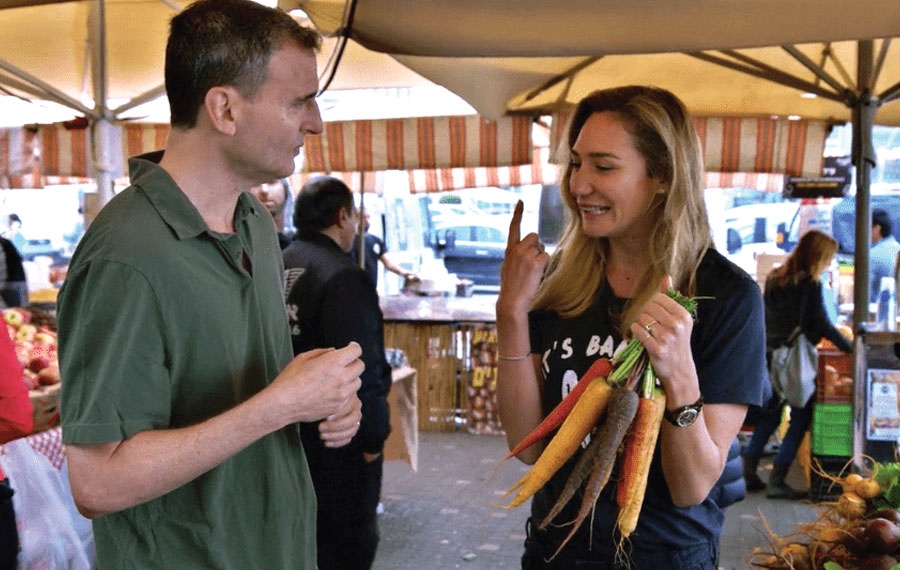
“Somebody Feed Phil” (Netflix): What happens when a Jewish, Los Angeles-based television writer and creator of the hit series “Everybody Loves Raymond,” Phil Rosenthal, leaves behind the bland world of his parents Ashkenazi food and travels to some far-flung destinations, including Israel? The two best things — comedy and food. Rosenthal is a self-professed food novice — he said he didn’t even taste garlic until he was in college — so imagine his surprise at the flavor explosion he experiences when he travels to Israel and gets hand-fed shakshuka by the “Doctor” himself, Bino Gabso, (Dr. Shakshuka, Jaffa’s famous shakshuka restaurant in the flea market.) While Rosenthal, more like a kid in a candy store than an adult father of two, is led around Tel Aviv, Jaffa, Caesarea and Acre by legendary chefs and food personalities such as Israeli-American restauranteur Michael Solomonov, the viewer benefits from Rosenthal’s decidedly nonculinary background.
Rosenthal’s Jewish food knowledge seems to have stopped at jarred gefilte fish and his mother’s stringy brisket, so he is blown away by what he experiences in some of the country’s most famed gems. In what can be described as a happy-go-lucky version of Larry David meets the locals for a laugh and a nosh, Rosenthal seems to recognize the change in Israel from his younger days of visiting the country as a bar mitzvah boy.
It’s heartening to see how his connection to the country and the people are transformed through his expanding palate. Of course, the show features many cameos of some of Israel’s iconic food staples, like sabich, a sandwich made from fried eggplant, and Israeli salads dressed with tahini stuffed inside a fresh pita or the gizzard and oxtail soups he’s served in the Yemenite quarter in Carmel market. But the show’s main strength is more about the people whom Rosenthal encounters.
“Somebody Feed Phil” also features another ingredient that’s not found in other typical reality-TV shows — Rosenthal’s parents. At the end of each segment, his 90-year-old parents are featured in a Skype call from their son. It may not surprise you to know that his parents were the inspiration for actor-comedian Ray Romano’s fictional parents on “Everybody Loves Raymond” but their charming appearances will leave no doubt in your mind.
“Spend some time anywhere in the country and the conversation will circle around to food — yours, theirs, your next meal, your last one.”
“Hummus! The Movie” (Amazon): Probably my favorite doc that I recommend about food in Israel, “Hummus! The Movie” was written and produced by Israeli documentary filmmaker Oren Rosenfeld, who started his career as a photojournalist covering the Second Intifada. Perhaps because of his background and obvious passion for the subject matter, “Hummus” is an interesting glimpse into past and modern-day issues in Israel beyond food.
The film features snapshots into the lives of three unusual restaurateurs, each representing a completely different experience of modern Israel and shedding light on cultural and social issues that affect them. By focusing on a small group of completely diverse people, Rosenfeld takes his passion for hummus and brings the viewer along as his subjects work, struggle and make decisions. Jalil, a sweet, young Christian Arab from Ramle, takes over his family hummus restaurant and tries to make changes to keep himself challenged while he is being pulled to follow his dream of opening a place in Berlin.
Eliyahu, a formerly dreadlocked drifter turned Chasidic Jew with a young wife and family in tow, runs a chain of successful kosher hummus restaurants all over the world and believes in the mystical powers of chickpeas.
Then there’s Suheila, a hardworking Arab woman who takes over her father’s hummus business. After her brothers drive the restaurant into debt and decline, Suheila forgoes marriage and family to become the first Arab woman in the market to own a business. She is crowned the official “King of Hummus” in a highly promoted national contest, much to the chagrin of the generations of male-owned “hummusiyas” that don’t take too kindly to the judges’ decision.
There is also a series of interesting side characters like Olivier, a Benedictine monk, whose lack of culinary prowess puts him on a quest to find the tastiest hummus after his fellow monks ask him to refrain from taking his turn to cook the monastery meal. In his search for what to serve on his night to serve dinner, he goes in search of the best hummus, and discovers the role hummus plays in the communal lives of Israeli Arabs, Jews and Christians.
In addition to the touching personal stories and the entertaining commentary on Israeli life and food from some of Israel’s most famous food personalities, the film is much more than about hummus. In an amusing segment of the film, we witness the backstory and observations of the Guinness World Record adjudicator who comes to Israel to judge the Israeli entry for the “world’s largest serving of hummus.” We hear from the previous Lebanese record holder, whose 5,000-kilo (11,000-plus pounds) world record is bested by an Israeli competitor. This is not only a lovable and touching film but one that will make you very, very hungry. Don’t attempt to watch without having immediate access to a pita and a plate with a healthy smear of its namesake.
“Hummus! The Movie” is now playing on Amazon, iTunes, Google Play and Vudu.
Yamit Behar Wood, an Israeli-American food and travel writer, is the executive chef at the U.S. Embassy in Kampala, Uganda, and founder of the New York Kitchen Catering Co.

































