fbpx

April 3, 2019

Make Your Own Gehry-Inspired Architectural Model

In honor of Frank Gehry, who is gracing our cover this week, I thought it would be fun to play architect and create a scale model of a building inspired by iconic structures like Walt Disney Concert Hall in downtown Los Angeles and the Guggenheim Museum Bilbao in Spain. 

I had never made a model before, but with some common objects I found around the house, I was able to channel my inner architect. This would be a fun activity for kids to introduce them to architecture and make them into budding Gehrys.

What you’ll need:
Small empty boxes
Empty paper towel tubes
Random household objects
Aluminum foil
Foam board or cardboard


1. Gather boxes, paper towel tubes and any small random objects you can find around the house. I collected a bunch of things to give me choices, but I ended up mainly using one box and a paper towel tube. I decided that including too many shapes would make it ungapatchka. But that’s me — you’re the architect of your own imagination.


2. If you decide to use the paper towel tube (and I certainly recommend it), cut it into pieces. However you cut them, the curve of the roll will stay intact, creating wavy shapes for your building. You can also cut up boxes if you’d like so that your building does not have the traditional four walls. 


3. Cover your architectural elements in aluminum foil. The foil mimics the titanium walls in Gehry’s work. The great thing about using foil is it molds around your objects easily, and you don’t need to secure it with glue or tape.


4. Cut a piece of foam board or cardboard for the base of your model. Then start assembling all the objects you’ve covered with foil, gluing the elements to the board and one another. Experiment. Remove some things and reposition others. I decided my building needed a finishing touch, so I covered a clothespin in foil and made that the doorway.


Jonathan Fong is the author of “Flowers That Wow” and “Parties That Wow,” and host of “Style With a Smile” on YouTube. You can see more of his do-it-yourself projects at jonathanfongstyle.com.

Make Your Own Gehry-Inspired Architectural Model Read More »

Anti-Semitic Flyers Found in UC Santa Barbara Neighborhood

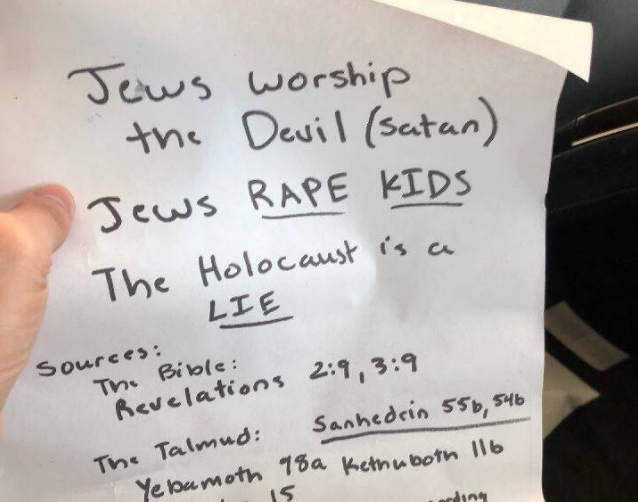
Several anti-Semitic flyers were found in a neighborhood near UC Santa Barbara (UCSB) on March 31.

UCSB Student Senator Gabriella Shofet posted a picture of the flyer to her Facebook page that same day; the flyer reads: “Jews worship the Devil. Jews RAPE KIDS. The Holocaust is a LIE.”

“This is what anti-Semitism looks like. In 2019. A block away from my apartment,” Shofet wrote. “My heart aches.”

https://www.facebook.com/senatorshofet/photos/a.1147031538804521/1190619067779101/?type=3&theater

Students Supporting Israel at UCSB shared Shofet’s post on their Facebook page, writing: “Posted on windshields across Del Playa in Isla Vista. It’s 2019 and anti-Semitism is alive, even in our communities.”

https://www.facebook.com/senatorshofet/photos/a.1147031538804521/1190619067779101/?type=3&theater

Cyndi Silverman, director of the Santa Barbara Anti-Defamation League, told the Journal in a phone interview that the flyers were found in an area where Jewish UCSB students reside.

“We’re really concerned,” Silverman said. “Santa Barbra Tri-County has just been a hotbed – we’ve had so many anti-Semitic incidents over the last two years.”

Santa Barbara Hillel posted on their Facebook page that the flyers “were discovered on a number of parked cars in Isla Vista as well as in some mailboxes.”

“Santa Barbara Hillel condemns this anti-Semitic crime,” the post stated. “We are coordinating closely with law enforcement to ensure everyone’s safety. Chancellor [Henry] Yang and top UCSB administration take this seriously and are working with us to investigate and respond. Santa Barbara Hillel is here at all times to support students, and we encourage anyone affected by this to take appropriate action.”

Santa Barbara Hillel also encouraged anyone with information about the flyers to contact the UCSB Police Department at (805) 893-3446 or the Isla Visa Foot Patrol at (805) 683-2724.

Andrea Estrada, director of News and Media Relations at UCSB, told the Journal in an email, “We are aware of reports of flyers off campus that contain hateful language. We support our local law enforcement’s efforts to investigate them, and we encourage our students to report any incidents of bias on campus or off.”

Anti-Semitic Flyers Found in UC Santa Barbara Neighborhood Read More »

Author and Scholar Talks About the Importance of Words and Meaning

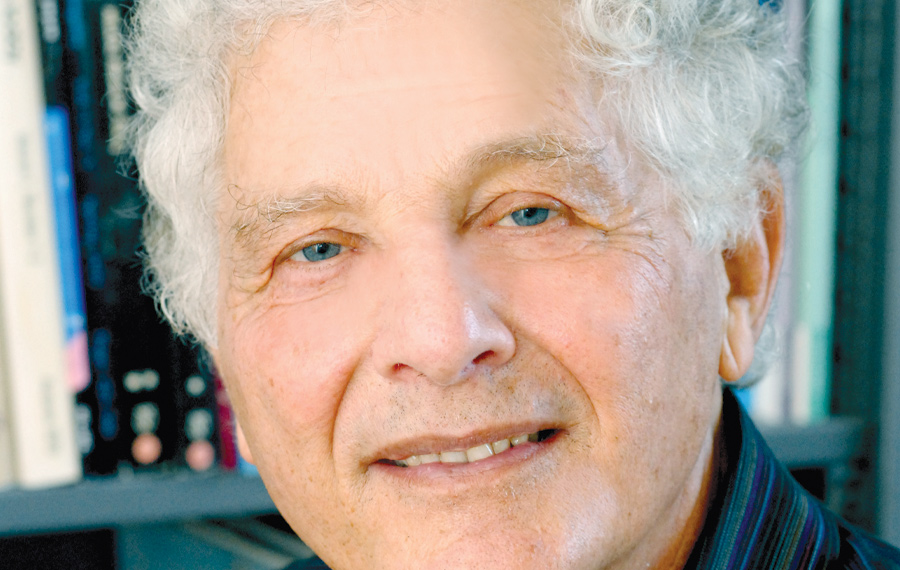
Robert Alter, professor emeritus of Hebrew and comparative literature at UC Berkeley and author of “The David Story” and “The Five Books of Moses,” spoke with Jewish Journal book editor Jonathan Kirsch by phone about Alter’s new books, “The Hebrew Bible” and “The Art of Bible Translation.”

Jewish Journal: Bible scholars sometimes refer to the “place in life” of a particular biblical text as it existed before the Bible itself was canonized. What do you regard as the “place in life” of your translation?

Robert Alter: What I want to do is to make the literary greatness of the Bible available to modern readers. The Hebrew Bible has very few abstractions, and the human situation was imagined through the body and the physical world. A lot of that gets obscured in existing translations. I try to give readers a better sense of the concrete world view of the biblical writers by hewing to the physicality of the original text.

JJ: What has been the response to your translation?

RA: In the age of email, readers are much more ready to write authors than when they had to put a stamp on an envelope. What has surprised me, really astounded me, is that I’ve gotten an outpouring of mail from religious people — some religious Jews and many religious Christians, including clergy. I assumed that literary people, including entirely secular people, would be keen to get a translation that does more justice to the literary art of the Bible, but it seems that there is a hunger among many believing people for a translation that takes us closer to the world view of the original Hebrew. 

JJ: I suspect that many of your readers first encountered your early writing on the Bible in the context of a “Bible as literature” class. Do you feel comfortable with that category?

RA: Yes and no. In many colleges, there are no specialists in the Religion Department, and the Bible is represented in the curriculum in the English Department. I’m OK with that. But it’s a slightly odd label because it is like saying “Dante as literature.” Dante’s writings are works of literature, but he is also a deeply religious writer.

JJ: Do you feel that any of the word choices in your translation have an impact on the theology that traditional rabbis and sages have extracted from the biblical text?

RA: Yes, I do. For example, the word “salvation” as equivalent of the Hebrew word “yeshua” still has a terrific amount of currency in modern translations of the Bible, both Jewish and Christian. In the Bible, however, the Hebrew doesn’t mean anything like salvation. Salvation suggests the sky opening up and the soul gloriously redeemed. The biblical word is a here-and-now word, and it means something like “getting out of a tight fix.” That’s why I translate it as “God is my rescue.” 

JJ: Much effort has been expended to blur the gender of the deity in Jewish liturgy in the more progressive movements in Judaism. Did you make any word choices in your new translation to address the feminist critique of the Bible as a patriarchal document?

RA: Not really. Grammatically, God is unmistakably masculine in the Bible. I don’t think we can honestly translate the Bible to fit our own 21st-century values. Some of the values in the Bible we may find objectionable, but there is no question that it was a patriarchal society and they thought of God as male.


Excerpt From “The Art of Bible Translation”
The practice of translation, as I have learned from experience, entails an endless series of compromises, some of them happy, some painful and not quite right because the translator has been unable to find an adequate English equivalent for what is happening — often brilliantly — in the original language. The reflections in this book, then, on translating the Bible are offered in the spirit of humility, not triumphalism, with the underlying point that I have tried to do in my English version of the Bible what others translators by and large have not seen the need to do because they had at best only a patchy sense of the literary aspects of the Bible.

From the beginning my translation was impelled by a deep conviction that the literary style of the Bible in both the prose narratives and the poetry is not some sort of aesthetic embellishment of the “message” of Scripture but the vital medium through which the biblical vision of God, human nature, history, politics, society, and moral value is conveyed.

I did not initially have a very clear sense of the audience to which my work was directed. My only thought was that I wanted to make the Bible available for English readers in language that might at least intimate something of the power, the subtlety, and the beauty of the Hebrew. 

The actual readership was broader and more varied than I would have imagined. As it turned out, I received enheartening words from Orthodox Jews, from a Methodist minister, from a Presbyterian organist, even from an Episcopalian nun who said that my translation of Psalms had changed her spiritual practice. Responses repeatedly came from unexpected quarters, such as the fourteen-year-old girl at a Jewish day school who told me in impressively literate English that she had come to trust my commentary more than any other.

Both the narrative and the poetry of the Bible deploy an extraordinary imaginative use of language that has very few equals in the whole ancient world and none among the geographical neighbors of ancient Israel. These formidable literary resources were of course usually marshaled for what we must call, lacking a better term, religious ends, but the full breadth of nuanced perspective on the interactions between the human and divine realms will not be visible in translation if the stylistic subtleties of the original are ignored. Translations are inevitably approximations of the original, but all of us engaged in the enterprise need to aspire to closer approximations. That is what I have sought to do in my own translation of the Bible.

Excerpted from “The Art of Bible Translation” by Robert Alter. Copyright © 2019 by Robert Alter. Reprinted by permission.

Read More: A Masterful Primer on Bible Translation


Jonathan Kirsch, author and publishing attorney, is the book editor of the Jewish Journal. 

Author and Scholar Talks About the Importance of Words and Meaning Read More »

A Masterful Primer on Bible Translation

By pious tradition, it took 72 sages to complete the Septuagint, the first translation of the Bible into Greek. Robert Alter, by contrast, did it all by himself, although it took him two decades of hard work. Now the Bible according to Robert Alter is finally done.

Alter, professor emeritus of Hebrew and comparative literature at UC Berkeley, embarked on his own translation of the Hebrew Bible in 1999 with “The David Story,” a translation of and commentary on the Book of Samuel. Five years later, he had completed “The Five Books of Moses.” He finally worked his way through the Tanakh, and Alter’s translation of the Bible in its entirety was published last year in a three-volume set as “The Hebrew Bible: A Translation With Commentary” (Norton).

Now Alter has crowned his life’s work with “The Art of Bible Translation” (Princeton University Press), which serves as an essential companion volume to his own translations. And it can be seen as the completion of a trilogy that started with “The Art of Biblical Narrative” (1981) and continued with “The Art of Biblical Poetry” (1985), which contributed importantly to the teaching of “the Bible as literature” as distinguished from its use in religious belief and practice. 

Indeed, Alter is not a rabbi or a theologian, and he draws on his own expertise in language and literature to overcome what he regards as a centuries-old tradition of inaccurate translation that started with the King James Version. His goal is to re-translate the Bible in contemporary language while, at the same time, remaining faithful to what he regards as the genius of its original authors.

 “Biblical Hebrew, in sum, has a distinctive music, a lovely precision of lexical choice, a meaningful concreteness, and a suppleness of expressive syntax that by and large have been given short shrift by translators with their eyes on other goals,” Alter explains in his introduction to “The Hebrew Bible.” “The present translation, whatever its imperfections, seeks to do fuller justice to all these aspects of biblical style in the hope of making the rich literary experience of the Hebrew more accessible to the readers of English.”

Precisely because Alter is more concerned with fidelity to the original meanings of the ancient text itself rather than any religious interpretations of the text, he has dared to make innumerable changes, some great and some small, in the words and phrases that we are accustomed to encountering in other English translations. Consider, for example, the second of two passages in Genesis where the creation of human beings is described, one as appears in the 1917 Jewish Publication Society translation (which is strongly influenced by the familiar King James Version) and the other as Alter has rendered it in “The Hebrew Bible.”

“Robert Alter’s goal is to re-translate the Bible in contemporary language while, at the same time, remaining faithful to what he regards as the genius of its original authors.”

JPS (1917 edition): Then the LORD God formed man of the dust of the ground, and breathed into his nostrils the breath of life; and man became a living soul. 

JPS: Alter: “[T]hen the Lord God fashioned the human, humus from the soil, and blew into his nostrils the breath of life, and the human became a living creature.” (Genesis 2:7)

Alter explains that he chose “human” for the Hebrew word adam and “humus” (which is defined in as “the organic portion of soil”) for the Hebrew word adamah in an effort to preserve “the Hebrew etymological pun” that appears in the original text of the Bible. Not incidentally, of course, he also avoids the gender of the first human being. Later, as Alter puts it, God “fashions” the first man out of soil, but God “builds” the first woman from his rib because, as Alter explains to us, “the LORD is now working with hard material, not soft clay.”

The aspirations, strategies and fine points of decision-making that entered into Alter’s work as a Bible translator are explained in intimate and often charming detail in “The Art of Bible Translation,” which is an indispensable gloss on “The Hebrew Bible.” 

Alter’s touchstone is not what the various translators before him have made of the Bible but rather what can be found in the original. He points out that “concrete Hebrew terms” often are translated into “theologically fraught ones,” as when the Hebrew word nefesh is rendered in English as “soul” when it actually means “essential self,” “being” or “life-breath.” He focuses on the rhythm, syntax, dialogue, word choice, “sound play” and “word play” that the original biblical authors employed so brilliantly in their own work.

While Alter prefers not to enter into theological debate, he acknowledges that the Bible is not, after all, purely a work of literature. “From the beginning my translation was impelled by a deep conviction that the literary style of the Bible in both the prose narratives and the poetry is not some sort of aesthetic embellishment of the ‘message’ of Scripture but the vital medium through which the biblical vision of God, human nature, history, politics, society, and moral value is conveyed.”

Still, the fact remains that Alter’s version of the Bible is not suitable for the study of Torah as it is conducted in some synagogues and all yeshivot. Alter himself knows it; when he muses on the responses he has received from “unexpected quarters,” he includes a young woman who is enrolled in a Jewish day school. Still, you will find that Alter empowers his readers to decide for themselves which version is most serviceable for the uses each one of us makes of the Bible.

Read More: Author and Scholar Talks About the Importance of Words and Meaning


Jonathan Kirsch, author and publishing attorney, is the book editor of the Jewish Journal.

A Masterful Primer on Bible Translation Read More »

Finding a Younger Audience with ‘The Cat Who Lived With Anne Frank’

Since it was first published in 1947, “The Diary of Anne Frank” has been adapted for film and stage, while the memoir itself has been republished and adapted with illustrations.

Seventy-two years after its first publication, David Lee Miller and Steven Jay Rubin decided to tell Anne’s story through a very different set of eyes: cat eyes. 

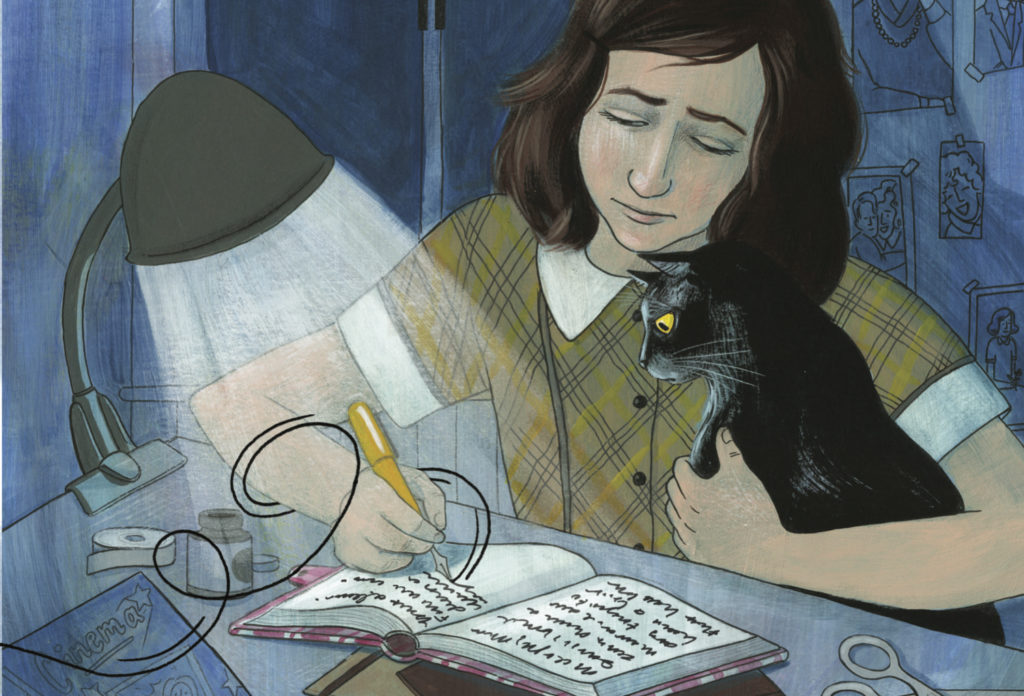
“The Cat Who Lived with Anne Frank” (Penguin Random House Publishing), a new children’s book out now, invites readers to meet Mouschi, the cat who lived in the annex with the Frank family. 

Since the Holocaust is an important subject to teach and the number of survivors is decreasing, Miller, 62, of Westlake Village, and Rubin, 67 of Los Angeles, said they felt compelled to reach and educate a younger audience through a sweet, curious and adventurous cat.

“We were really sensitive to the subject. In no way did we ever want to trivialize the Holocaust,” Miller told the Journal in a joint phone interview with Rubin. “But in this time of hate — we have preschoolers getting active shooter drills — we focused on keeping it historically accurate about a slice of Anne’s life from the point of view of the cat who actually lived in the annex.” 

Rubin said people have a hard time dealing with copious amounts of depressing news, so stories about the Holocaust can be difficult to digest. Anne’s story allows them to talk about intense subjects and reach young people at the same time. 

“Anne Frank’s story has always been a gentle inspirational lead into historical events,” he said. “She didn’t realize that she was reaching out to millions of people who could identify with a young person writing under those extreme conditions. … She’s always been kind of a gateway to history. That’s why she’s very still much in the news.”

Through Mouschi’s eyes, the reader experiences a dangerous world filled with “black spiders” (Nazi soldiers), yellow stars (Jewish people), angry dogs and a world of hate from an omnipotent source. 

“What did the cat think of this strange situation where people never go outside, they tiptoe around all day, they can finally talk at night?” Rubin asked after pondering the idea one day while rewatching the 1959 “Diary of Anne Frank” film. 

“Through Mouschi the cat’s eyes, the reader experiences a dangerous world filled with ‘black spiders’ (Nazi soldiers), yellow stars (Jewish people), angry dogs and a world of hate from an omnipotent source.

Miller and Rubin spent many months researching the Frank family and the events that led to their arrest. They visited Amsterdam and included details about other families that helped Jews escape. They utilized pages from Anne’s diary that incorporated Mouschi’s life and even discovered a rule where Jews couldn’t own pets, which made Mouschi’s presence more important. They also studied Miller’s cats for inspiration. 

Rubin added that there were many drafts of the story, and various “trial and errors” before they came to the conclusion that they didn’t have to include every detail about Anne’s life, since the story was about what Mouschi knew. 

“The last thing we wanted was the Nazis breaking into the attic at the end, capturing the family and sending them to a concentration camp,” Rubin said. 

Instead, they created a story around Anne’s dreams developing on paper and Mouschi being there through all of it, and that Anne is writing to the cat. The cat wonders if anyone will “hear my girl’s words.” 

Through Anne’s diary entries, we discover that Mouschi’s mouse-chasing noises risk their safety, his fleas affect the humans’ hygiene and his ability to come and go from the annex allows the reader to see what is happening in the outside world.

On his outdoor adventures, Mouschi witnesses Dutch resistance fighter Jannetje Johanna Schaft help rescue Jews from the Jewish Theater, and the Amsterdam zookeepers who were keeping Jews safe. 

Mouschi’s adventures; Illustrated by Elizabeth Baddeley. Courtesy of David Lee Miller and Steven Jay Rubin

“In Mouschi’s travels, he could have easily found himself wandering by the Jewish Theater or he could have wandered by the zoo and seen the Jews hiding above the tiger cages,” Rubin said. 

Miller added, “We were always amazed by the powerful stories.” 

The book, filled with poetry, beautiful illustrations by Elizabeth Baddeley and dark themes with a hopeful twist, is already gaining traction, just two months after its release. Miller said it has reached the hands of elementary, middle and even high school students who have been moved by the story.

“It’s kind of for all ages, in a way,” Miller said. “When a book has huge amounts of imagination or is very poetic, it becomes a book for everyone.” 

In addition to the book, Miller and Ruben have adapted it into a screenplay and hope to create an animated feature titled “Mouschi.” 

Rubin said he was around 8 or 9 when he first learned about the Holocaust and remembers being taught if it were to happen again, it would happen in the United States. 

“Our book tells the story as a counterpoint to people who don’t know what the Holocaust is or people who are denying that it occurred,” he said. “It couldn’t be more relevant than ever with everything going on in the world right now.”

Finding a Younger Audience with ‘The Cat Who Lived With Anne Frank’ Read More »

Renée Taylor’s Humorous Take on Weighty Issues in ‘My Life on a Diet

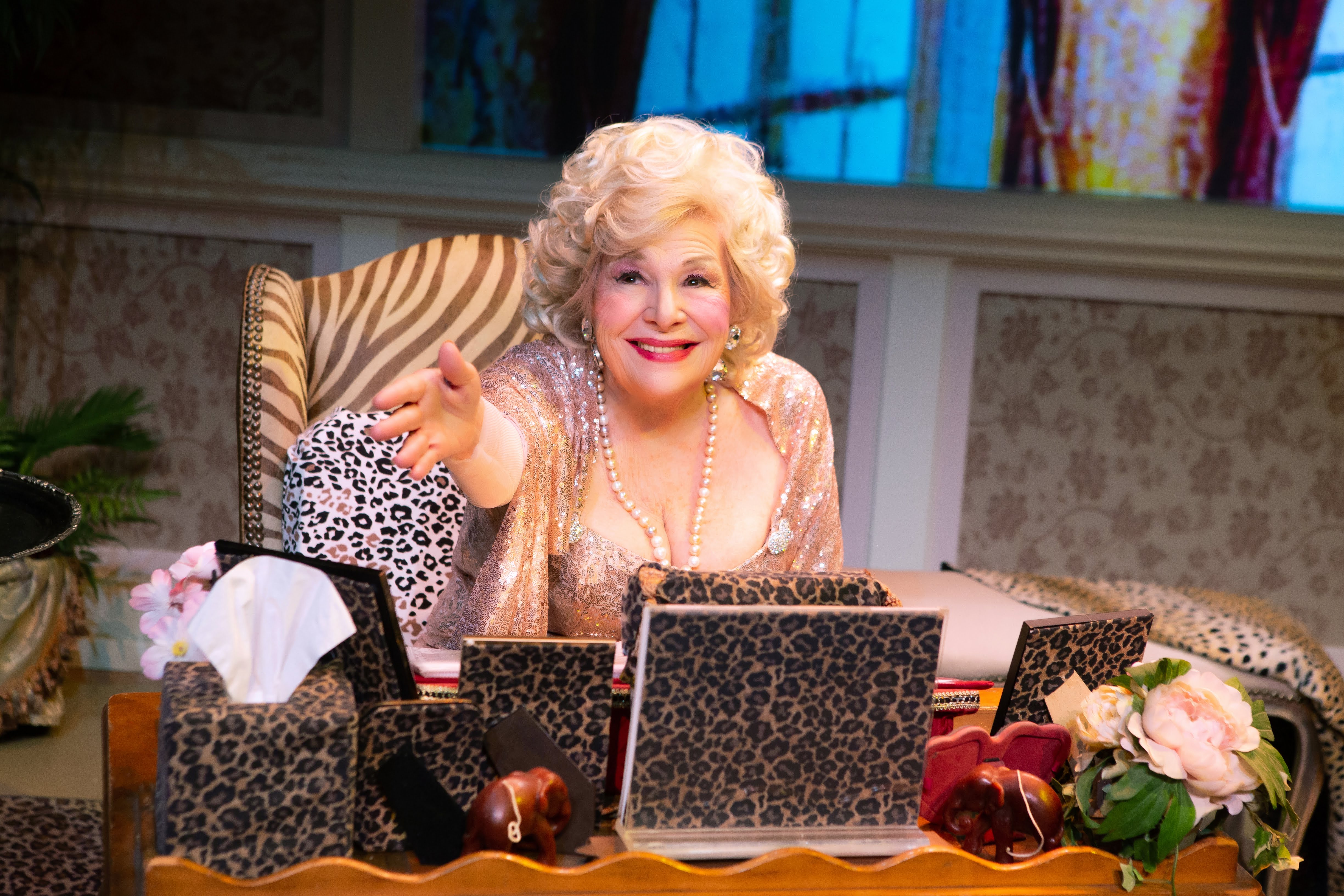
Comedy veteran Renée Taylor reminisces about her life in showbiz, many of the famous friends she made along the way and her eternal battle with weight in “My Life on a Diet,” her autobiographical solo show opening at the Wallis Annenberg Center for the Performing Arts on April 5.

Written with her late husband of 53 years and frequent collaborator, Joseph Bologna, who died in August 2017, the show had a successful off-Broadway run in 2018. The Journal had a chance to view a tape of one of those performances ahead of a phone conversation with Taylor. 

The octogenarian actress, known for her portrayal of Fran Drescher’s mother Sylvia Fine on “The Nanny” and appearances in “The Producers,” Adam Sandler’s “The Do-Over,” “How I Met Your Mother” and “How to Be a Latin Lover,” collaborated on 22 projects with Bologna, including plays, TV series and television movies, and four screenplays, most notable of which was the Oscar-nominated “Lovers and Other Strangers.” 

“Joe thought it would be very helpful and inspirational to people to share my experiences as a young actress and all the diets I’ve been on,” Taylor said. “I dedicate the show to him.”

Bologna is very much a presence in Taylor’s stories and the images projected behind her throughout the show. She also speaks lovingly and often about her mother, Frieda Wexler. “I knew my mother was very funny,” Taylor said. “She wanted to be an actress. I got her a role in [the 1971 movie] ‘Made for Each Other.’ ” 

Taylor began writing essays about her “wacky family” in junior high school and made her professional stage debut at age 15 as a slave girl in a Purim pageant at Madison Square Garden. “I got $5 for dancing across the stage,” she said. “Melvyn Douglas played the king.”

“Taylor made her professional stage debut at age 15 as a slave girl in a Purim pageant at Madison Square Garden. “’I got $5 for dancing across the stage.’”

Other famous names pepper her anecdotes, including Jerry Lewis, who cast her in her first movie, 1961’s, “The Errand Boy,” Marlon Brando, Marilyn Monroe and the women who became her close friends, Barbra Streisand, Lainie Kazan and Drescher. Like them, she became known for playing funny Jewish women, “very pushy” mothers in particular. Playing Drescher’s big-haired, food-obsessed mom “was my favorite,” Taylor said.

On the dramatic side, she was offered the role of Golda Meir in the Broadway play “Golda’s Balcony” and regrets not taking it. But she later wrote her own show about Israel’s first female prime minister and continues to perform it for organizations and synagogues.

Renée Taylor in “My Life on a Diet.”
Photo: Jeremy Daniel

Taylor feels a deep connection to her Jewish identity. “It’s a very strong part of me,” she said. Of Russian ancestry, she grew up in the Bronx, N.Y., in a Reform Jewish home and has been a member of Los Angeles’ Creative Arts Temple for many years. “Joe and I used to get up and read the prayers on Yom Kippur and Rosh Hashanah. We were very active in the synagogue,” she said.  She has been to Israel twice, the first time for her son Gabe’s bar mitzvah.

Now a writer and filmmaker, Gabe Bologna directed his parents in the movie comedy “Tango Shalom,” which will begin showing at film festivals soon. “Joe plays a priest and I play an Orthodox Jewish mother,” Taylor said, adding that Gabe is also a Holocaust scholar. “He wrote a Holocaust movie called ‘Brundibar’ that’s going to shoot in the Czech Republic,” she added.

Taylor is working on a few scripts of her own, one about Mae West and another a play called “The Book of Joe,” about her husband and their life together. “We loved each other and we respected each other,” she said. “We had so much fun and we had so many laughs. All our successes and our failures were an adventure. To me, the point of life is growing and having fun. People ask me, ‘Why don’t you retire?’ I say, ‘I’m having too much fun.’ ”

Taylor has always had a keen interest in psychology and behavior “and why people do what they do. I probably would have been a psychotherapist if I wasn’t a writer and an actress,” she said. “I also love fashion and I don’t think there’s such a thing as looking your age or dressing your age. You just dress to express yourself and how you’re feeling.”

She’s excited about being back onstage, making people laugh and sharing her stories. “I like communicating with an audience in person and getting feedback from them. I love when people come backstage and they tell me what experiences they’ve had on different diets and what they’ve learned,” she said. 

With a lifetime of crazy fad diets behind her, Taylor finally found one that works. She follows Dr. Oz’s plan and doesn’t eat after sundown or before sunrise. 

“Sometimes, in the middle of the night, you want to get up and eat something. I drink water instead and I make all my dinner dates at 5 or 5:30,” she said. For her, the key to aging well, staying healthy and remaining vital is “loving what you do, loving yourself and keeping your sense of humor. You can’t take yourself seriously.”


“My Life on a Diet” runs April 5-14 at the Wallis Annenberg Center for the Performing Arts in Beverly Hills.

Renée Taylor’s Humorous Take on Weighty Issues in ‘My Life on a Diet Read More »

Family Reunites Following Father’s Deployment to Afghanistan

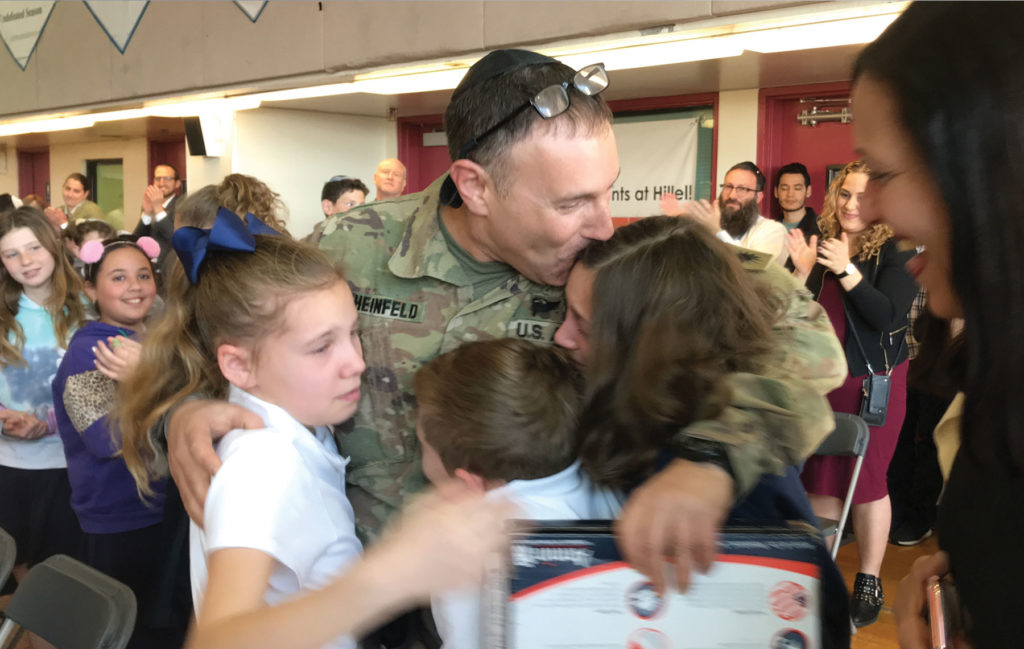
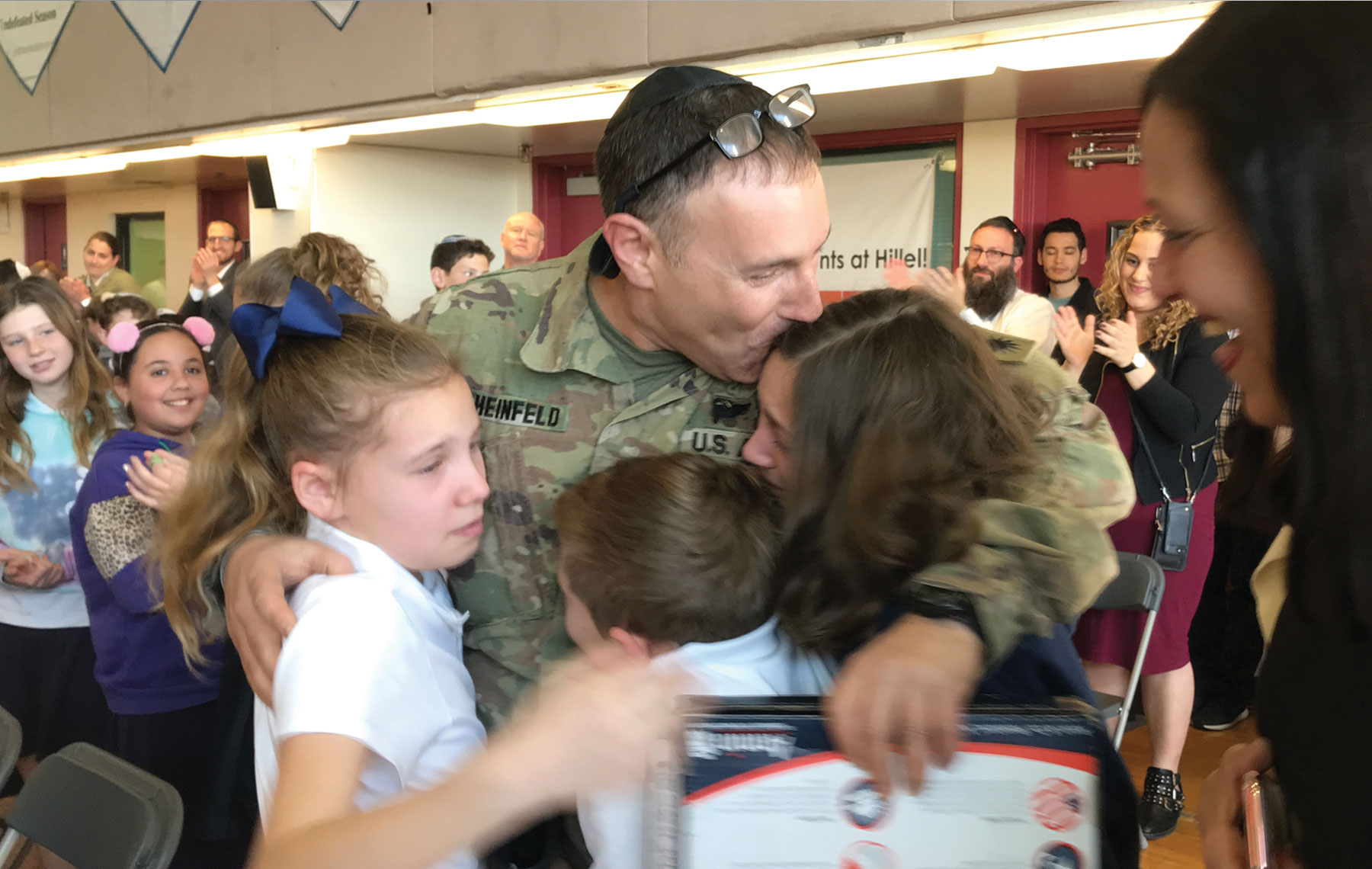
On March 15, Tamar, Batsheva and Yudi Scheinfeld got the surprise of their lives when their father, Maj. Moses Scheinfeld, returned home from his nine-month Army deployment in Afghanistan.

The siblings, who attend Harkham Hillel Hebrew Academy in Beverly Hills, were attending a multigrade school assembly and had no idea what was in store.  

“Our teacher gets excited about every holiday, and this holiday was Purim,” said Batsheva, 11. “I thought he was going to dress up and run around, and everyone was wondering why fourth grade was there, because fourth grade is usually not there.” 

“I was really bored,” 9-year-old Yudi told the Journal. “But when I saw my dad, then I wasn’t bored and I ran up and hugged him.” 

Harkham Hillel Rabbi Y. Boruch Sufrin helped coordinate the surprise with the help of the children’s mother, Rivka. She had just picked up her husband that morning and immediately rushed to the school.

“It was very hush-hush,” Rivka said. “We knew he was coming home before Purim. [The kids] were shocked. They were so happy that he was back.”

“This country has been great to the Jewish people, and a way of repaying that is by joining the military.”
— Maj. Moses Scheinfeld

Moses, originally from Manhattan, has been in the Army for more than a decade after taking part in the ROTC program at Rice University in Houston. Moses said while he didn’t grow up in a military family, serving in the Army as a Jew means a great deal to him.

Moses Scheinfeld reuniting with his children; Photo courtesy of Rivka Scheinfeld

“I think I was always interested in [the Army],” Moses, 53 said. “Being Jewish and being in this country [relates to] this idea of hakarat hatov, which is this very important idea in Judaism. It means gratitude and recognizing the good. This country has been great to the Jewish people, and a way of repaying that is by joining the military.” 

While he was away, teachers and friends in the community were there to step in and look after the family.

“The teachers were really good to them and watched over them; they always made sure they were OK,” Rivka said. 

One of their teachers even introduced them to an unlimited children’s books app called Epic that would become Yudi’s new obsession.

“I learned a lot about the Army and hopefully I want to be in it when I grow up,” Yudi said. “I learned about Rangers and all that stuff, and training, and, yeah, I want to be in it.”

It’s now three weeks since Moses came home, and while the children are busy with school and extracurricular activities, Moses is enjoying being in the moment with his loved ones. The family sat with the Journal before Shabbat in their home in Beverlywood to talk about life with their patriarch back home. 

The kids said they were happy to be able to celebrate Purim together. Asked what the best part about having their dad back was, the oldest, Tamar, 12, quietly replied, “Him just being around.” 

“I’ve been away [when] Tamar was in a championship [basketball] game and she played with Shaquille O’Neal’s daughter. I was training in France,” Moses said. “That’s a very common phenomenon among parents in the military. … You go away for long periods of time and you miss things.” 

Fortunately, Tamar and Yudi both have birthdays coming up soon that the family will get to celebrate together. Their wish list of activities with their father during Passover break includes rock climbing, roller-coaster rides and a possible Disney cruise.

“So we can catch up on nine months and three days,” Yudi said.

Family Reunites Following Father’s Deployment to Afghanistan Read More »

Peace-Inspired Art: Tree of Life

Inside Ricardo Basta’s jewelry store in Century City sits an elaborate Tree of Life pin on a wooden stand.  A plaque on the base reads: “What we have in common is stronger than what divides us.” 

The pin, Basta, said, was designed to promote world peace. It took three years to make and as such, Basta, 60, was unaware how prescient it would become in the aftermath of the Tree of Life synagogue shooting in October 2018 in Pittsburgh. 

Rather, he said, it was his multicultural background that served as his inspiration for the piece. His grandfather, uncle and mother were Holocaust survivors who escaped Germany and moved to Argentina in 1937. Basta’s Italian father grew up a block away from them in Argentina, where Basta was born.

“My mother’s Jewish and my father was Catholic, so I was able to get along with everybody,” Basta said. “If there was an event in the church, I went to church. If there was an event in the synagogue, I went to the synagogue.”

Basta said he believes people too often use religion to divide rather than unite one another. “The Muslims, the Jews and the Catholics come from the same place, the same God,” he said. “It’s just one is still waiting for the Messiah, the other one got the Messiah and the other one took the prophet as the Messiah. The only difference is the messenger. If we all think of the same thing as our God, why are we fighting so much?”

“The [tree’s] roots are 18-karat gold, and represent our roots in the world; the stone represents the desert [in Israel]; and the base, of course, is me.” — Ricardo Basta

Pointing out the details of the pin’s design, Basta explained that the diamond-encrusted “eye” at the top of the coral tree with jade leaves represents God looking over Jews, Catholics and Muslims. Below, each religion’s symbol, created with yellow diamonds, has the word peace in its native language: Hebrew, Latin and Aramaic. Tiny doves made from palladium (a silvery-white metal) represent peace. The base is made from a wood called Curupay, which comes from Paraguay. 

“The [tree’s] roots are 18-karat gold, and represent our roots in the world; the stone represents the desert [in Israel]; and the base, of course, is me,” Basta explained.

A third-generation jeweler, Basta runs the family business with his cousin Ernest Jr. and his wife, Karen. Daughter Sarah, 26, son Andrew, 24, are also involved in the industry.

Basta’s grandfather started buying and selling jewelry in Germany in the 1920s and 1930s. After fleeing Germany in 1937 to Argentina, Basta’s uncle Ernest Sr. became an apprentice jewelry maker at the age of 12. In the mid ’50s, Ernest moved to California. When Basta moved to Los Angeles at the age of 19, he trained under Ernest. 

To date, Basta has won close to 25 American Gem Trade Association (AGTA) awards for his intricate, unique designs. 

“I love the process [of jewelry design], and I love the beauty,” Basta said. “I like the challenge of it. I buy stones, and I have no design in mind. I just grab a stone, a piece of wax and I start carving. I wing it.”

In his quest to spread his message of peace, Basta plans to donate his Tree of Life to the Vatican Museum or somewhere similar. 

“You can’t put the amount of work that I put into these pieces into a calculator because they are unsellable,” he said. “How do you figure if something took you three years? How do you create that into a price?”

Peace-Inspired Art: Tree of Life Read More »

Young ‘Shinshinim’ Bring Israel to America

Until last summer, Itay Muntz, who grew up in Kfar Yedidia in central Israel, had never been to the United States. But in August the 19-year-old arrived in Los Angeles for a volunteer stint at Lashon Academy Charter School, a public school in Van Nuys with a robust Hebrew language program. 

Muntz is one of 13 shinshinim (emissaries) currently doing a year of service in Los Angeles through the Jewish Agency for Israel. Some, like Muntz, are working at schools; others are at synagogues or other Jewish organizations.

Shinshinim is the Jewish Agency’s Young Ambassadors Program, which began 21 years ago in Connecticut with just two Israeli young adults. While it is not uncommon for Israeli teens to defer their military service to do a year of volunteer work, nearly all of the opportunities are in Israel. The Jewish Agency is the only organization that offers service opportunities outside of Israel. It is highly competitive, with a rigorous and comprehensive application process. Only about 10 percent of initial applicants land positions, according to Tal Lipschitz, regional director to the West for the Jewish Agency.  

This year, there are a total of 170 shinshinim working in countries around the world. The bulk of them are in the United States and Canada. But this is the first year the agency’s program has come to Los Angeles. Among the organizations participating, in addition to Lashon Academy, are Wise School, Wilshire Boulevard Temple, Shomrei Torah Synagogue, Sinai Akiba Academy, Pressman Academy, Shalom Institute and Ami School (an extracurricular Hebrew program). 

Organizations split the costs of their shinshinim (airfare, a modest monthly stipend, rental car, insurance, etc.) with the Jewish Agency. The Jewish Federation subsidizes the program. Students live with host families. Most live with at least two different families over the course of their stay. The idea is to ease the burden on families who commit to providing “food and warmth and open arms,” Lipschitz said. 

Every Monday, the shinshinim gather for a few hours to talk about their successes and struggles, sometimes listen to a guest speaker or just hang out.

For Muntz, the experience has been even better than he expected. He misses home and has confronted language and cultural barriers, but the families and staff at Lashon “really embrace us,” he said. “They really took us into the school family.” 

Along with the other shinshinim placed at Lashon, Muntz helps with Hebrew instruction at the school, often working with students who need extra support or those who could use additional challenges. With help from the school site supervisor, he and his colleague also crafted the curriculum for an Israel study program and are leading regular 30-minute classes.

Muntz said he especially appreciates being able to connect the Israeli-American and Jewish-American students to their heritage. But he is equally passionate about introducing the school’s Latino students to Israel.

Nearly all of the organizations that signed on this year have signed up for next year, when Los Angeles will play host to 16 shinshinim. This includes Wise School, where Malka Clement is the director of Hebrew and Judaic Studies. 

According to Clement, Wise’s shinshin is “like the Pied Piper. Wherever you see him, you see a line of kids following him. … Our emissary is doing exactly what the Jewish Agency sets as their goal. He has brought Israel to us as a young face, with current issues, really making sure that every family in this community knows [him] deeply and meaningfully.”

Added Lipschitz, “Besides the [shinshinim] talking about Israel, we really count on them to go back to Israel and bring back to the Israeli people and the country what they learn about here. This is our mission at the Jewish Agency. We want to create one peoplehood. Shinshinim are big game changers.”

Young ‘Shinshinim’ Bring Israel to America Read More »

IsraAID Seeks Local Volunteer Experts

In recent years, Lesbos, a small Greek Island in the northern Aegean Sea, has seen the arrival of thousands of asylum seekers fleeing conflicts in the Middle East. Many remain in refugee camps, their status in limbo. In March 2018, The New York Times dubbed Lesbos “The Greek Island of Despair.” A few months later in July, 31-year-old Lucy Uber, a pediatrician from Studio City, went to Lesbos to volunteer and lend her medical expertise. 

“I was working in a clinic in a refugee camp there,” Uber told the Journal, “and that’s when I became exposed to the work IsraAID was doing.” 

IsraAID, an Israeli-based humanitarian organization has been working on the ground in Lesbos since 2015, providing invaluable medical and psychological support. It has also set up the “School of Peace” for refugee children on the island. With Israeli Arabs making up a key part of IsraAID’s volunteer contingent, aid and education is often provided in Arabic, the mother tongue of most beneficiaries.  

But no matter where crises occur around the globe, there’s a good chance IsraAID is there. Founded in 2001, IsraAID has worked in emergency and long-term development settings in 47 countries. The nongovernmental organization (NGO) has a dedicated staff of 300 personnel worldwide, including offices around the United States, and nearly 2,000 high-level professionals on standby for volunteer missions. Most of them live in Israel. 

Now, IsraAID is ramping up efforts in Southern California to entice local young professionals like Uber to take part in volunteer missions under the banner of its recently launched IsraAid Humanitarian Professionals Network (IHPN). 

“There are three pillars to IHPN — recruit, engage and deploy,” Farah Shamolian, a Los Angeles-based program director for IsraAID told the Journal. “The idea is to create a roster here in the United States of professional expert volunteers.”

Shamolian and her volunteer “task force” comprising influential community members already have recruited more than 100 IHPN signees. Her goal is to double that number of professionals in the medical, mental health and engineering sectors by the end of the year. IsraAID also has plans to expand the venture to the Bay Area and New York. 

“In the United States, it’s all very exciting,” Seth Davis, executive director of IsraAID USA, the American arm that launched two years ago, told the Journal. “We’re creating a movement that connects professionals in a meaningful way representing Israel. It’s in values, heritage and history. It’s truly invigorating to start something like this and watch it get all this traction.”

In 2018, IsraAID secured a cutting-edge grant from the Jewish Community Foundation of Los Angeles to install IHPN locally. Through word of mouth, email blasts, one-on-one meetings and cultivating personal connections, Shamolian launched IHPN in January with the first of six planned monthly engagement sessions in Los Angeles. The sessions offer expert briefings, emergency preparedness training and priority access to deploy on IsraAID missions. 

“It’s really inspiring to be in the same room with high-level doctors and so many individuals of different backgrounds who are all interested in humanitarian work and giving back,” Shamolian said after February’s “Day After the Disaster” session attended by about 40 members. “It’s so great to see that in Los Angeles, and it’s growing.” 

One of those members at February’s session was a familiar face to Shamolian — her Taft Charter High School classmate Uber. Uber left the session inspired.   

“It’s really inspiring to be in the same room with high-level doctors and so many individuals of different backgrounds who are all interested in humanitarian work and giving back.”— Farah Shamolian

“I think it’s really special to be surrounded by people from different areas of expertise in different fields that all bring something to the table when it comes to this process of having a disaster response,” Uber said. “We’re learning together how we’d best prepare for something like that.” 

Uber will be taking part in an IsraAID mission to Kenya in April, volunteering to work with more than 160,000 refugees living in Kakuma Camp. At one of the world’s largest refugee camps, Uber can expect to see more than 100 patients a day. 

However, not everyone in the IHPN is as experienced as Uber and ready to deploy immediately. Ben Raffi, 36, an ear, nose and throat surgeon who lives in Torrance, attended the February IHPN engagement session alongside Uber, marking his first involvement with IsraAID, or any humanitarian agency for that matter. 

“It was exciting to be there and it’s such an easy cause to rally behind,” said Raffi, who hopes to find time in his schedule to deploy down the line. “I wanted to find a way to combine my professional interests and my enthusiasm for pro-Israel philanthropic work. It’s one of the ways to show support for Israel and promote its positive influence in the world without having to get into the messiness of some of the politics.” 

But when it comes to Israel, politics can be hard to ignore. So, what is it like representing an Israeli humanitarian agency abroad? Niv Rabino, who spent a year in Lesbos as IsraAID’s Head of Mission, told the Journal that the experience shattered his expectations. 

“On a daily basis we’d meet people from all over the Middle East who never encountered Israelis, and there was definitely stigmas and misconceptions,” he said. “That environment was quite unique and incredible in all the breaking of false concepts and making unlikely connections. Also, other NGOs saw us Israeli Jews and Arabs working together and that changed a lot of minds. It was powerful and I was mostly unprepared. When I came into development, I never considered that building bridges would leave the biggest mark on me.” 

For Uber, a graduate of Tel Aviv University’s Sackler School of Medicine, heading out on an IsraAID volunteer mission is about more than helping to provide pediatric care to Kenyan refugees. She said it feels like a chance to rekindle a connection to Israel. 

“When I left [Israel] I felt a void,” she said. “I feel like this was an amazing opportunity to feel connected even though I’m not there. This allows me to be connected to a cause that embodies everything Israel stands for.”

IsraAID Seeks Local Volunteer Experts Read More »