Rabbi Jillian Cameron, Beth Chayim Chadashim
With so many things out of our control, during these High Holy Days I hope to offer the message that we are always stronger together in community. For 53 years, Beth Chayim Chadashim has been a safe and a brave space and in these uncertain times, living those values, being the calm in the storm and joining together to build our collective resilience, celebrate joys and to work towards the world we want to see is vital. Strong community is what has always gotten our people through difficult times.
Rabbi Julia Knobloch, Temple Beth El in San Pedro
On the upcoming High Holy Days, I will speak about how praising life is praising God, a God who loves life. For many people it is difficult in these disturbing times to find purpose in attending synagogue, engaging in prayer, thinking about God, when what is going on in the world, in Israel, in our country flies in the face of much of our liturgy and values. I aim to give hope by re-instilling a sense of wonder for the world, an awareness for the preciousness of life amidst disenchantment, doubt, and heartbreak.
On Erev Rosh Hashanah I will talk about how my new home of San Pedro reminds me of a place still dear to my heart, Lisbon in Portugal, and how memories can help transcend the passing of time, on this Day of Remembrance. I will then elaborate on how the blessing of mechaye hametim, who revives the dead, can be understood, from a purely poetic perspective, not as an expression of faith in an actual resurrection, but as an expression of the human longing to transcend mortality against the rational knowing that this is impossible. I’ll bring it full circle by exploring what that might say about loving life.
On Rosh Hashanah Day, I will be more prosaic, looking back at what 5785 brought to Los Angeles, our country, Israel and the world. We have several people among our congregants who were affected by the Palisades and Eaton fires, and of course being in a port town, immigration is a resonant topic. How can we tackle the new year with hope and resilience? In that same vein, Yom Kippur will be largely about how memories bring resolve and forgiveness, and how we, like Yonah, are all in the same boat to some degree despite differences in opinions, education, or social status.
Rabbi Alex Kress, Beth Shir Shalom
Judaism has always taught us how to live in the tension between fear and hope. We carry the pain of recent traumas: the rise in antisemitism, the massacres of Oct. 7, the hostages still in Gaza, the Palisades and Eaton fires. These past two years have reminded us how fragile and precious life truly is. At the same time, we carry within us the Jewish gift of resilience.
This year, my teacher, Rabbi Michael Marmur, reminded me of the children’s book “We’re Going on a Bear Hunt.” When faced with the many challenges of our day, “We can’t go under it. We can’t go over it. Oh, no! We’ve got to go through it.” Being Jewish is accepting what is, dreaming about what can be, and then building it.
Our tradition does not allow us to become stuck in despair. We do not wallow in the “valley of the shadow of death.” We walk through it. To me, this is the Jewish story: taking our pain and the challenges before us and transforming them into creativity, compassion and community. There are so many stories like this from the past few years, from Rachel Goldberg-Polin’s gut-wrenchingly hopeful poetry, to Beth Shir Shalom and Kehillat Israel partnering after the fires to care for our communities, to an Israeli Jewish woman donating her kidney to an Arab coworker’s sick daughter.
This High Holy Day season, as uncertainty and fear abound, I want my community to remember that our tradition doesn’t ask us to deny our fears. Instead, it calls on us to rise above them and be a light unto the world.
Rabbi Mendy Mentz, Chabad of West Bel Air
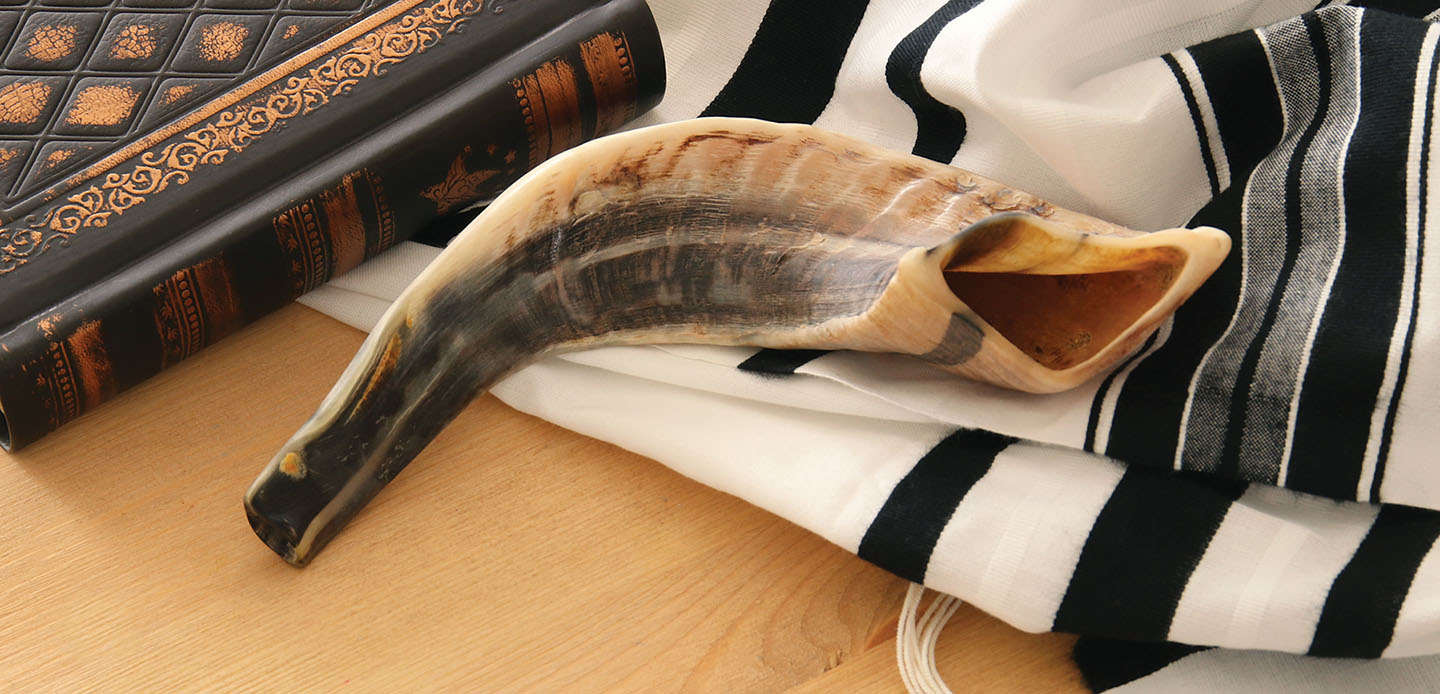
“Shofar, take me home!”
If you’re anything like me, you’re living in a 2025 world where the noise gets louder, the cost of life gets higher, and the sense of existential political chaos keeps growing.
That kind of world puts us in survival mode.
But deep down we know we’re at our happiest, calmest, most fulfilled when we place ourselves and our purpose at the center of our lives.
This year, let’s unplug from updates and plug in to Sinai, our source of Jewish continuity and living.
Let’s take just one mitzvah and make it our island of connection, sanctity, and ownership.
The power to silence the noise and truly hear your soul’s voice is awakened with the sound of the shofar.
Let’s stand shoulder to shoulder, coming home together as connected Jews.
Rabbi Joel Nickerson, Wilshire Boulevard Temple
As we enter the High Holy Days, we are reminded that Jewish identity cannot remain casual or passive in a world that increasingly challenges who we are. At a time of rising antisemitism and anti-Zionism, the call of this season is to step with intention into the fullness of religious Jewish life.
“Religious” Judaism is not about rigid perfection or one “right” way of practice. It is about commitment, creativity, and grounding our daily choices in values that have sustained the Jewish people for thousands of years. Too often, we limit ourselves with narrow definitions — “just cultural” or “only spiritual.” These may feel meaningful, but they can leave us unprepared for the challenges ahead. The High Holidays invite us to leave that mitzrayim, the narrow place, and embrace the wider landscape of Jewish possibility.
Claiming a “religious” Jewish identity transforms us in three ways. First, it roots us in moral reasoning shaped by generations of wisdom, teaching us to respond strategically and faithfully rather than reactively. Second, it gives us authority and belonging within Jewish life, empowering us to engage as full participants. Third, it provides practices and frameworks that help us navigate both joy and grief, grounding us in meaning when the world feels unstable.
This is not about retreating into fear, but about living with courage, resilience, and hope.
Our tradition has always taught that when the world tries to diminish us, the most radical response is to become more Jewish: more committed, more learned, more confident.
On Rosh Hashanah we declare, Hayom Harat Olam – today the world is born. This year, let us also be reborn as a people deeply rooted in our religious identity, shining our light with strength and purpose for the year ahead.
Rabbi Miriam Potok, Adat Shalom
It’s possible to have, at the same time, unity on the one hand and disagreement on the other.
I have the honor of being the rabbi of a proudly Zionist congregation. And I also have the honor of being the rabbi of a community filled with a diversity of opinions.
Every time our minyan meets, we pray for the soldiers of Israel’s Defense Forces, and we pray for the safe and swift return of our hostages. We repeat these prayers every Shabbat morning; we conclude our Shabbat morning service as we rise and sing Hatikvah. Visitors to our community have said that these traditions of ours make them feel welcome and safe. They know that they are in a place where they will be understood.
And when we gather in community, we are also aware that just because we are unified doesn’t mean we all think the same way. When we might want to opine on who is best for us to vote for, we do well to stop and remember that the person sitting next to us in shul or in Torah Study might not agree with our viewpoint. And that difference of opinion is not a problem. On the contrary, it’s a gift.
With our world as divided as it is, how often do we get the opportunity to sit and eat bagels with people who don’t share our political party preference? How often do we get to stand in song and prayer with friends who think the candidate we support is out of their mind? We know, from our experience, that it is possible to be diverse in our views at the same time we are unified by our friendship and by our most essential values.
We will always have a variety of opinions in the world. When we can belong to a community that is diverse on the one hand, and unified on the other, we can learn how to bring our most essential values to the forefront. We can stand strong, together, to advance the causes that mean the most to us, that are the essence of who we are.
Rav Ahud Sela, Temple Ramat Zion
While Israel is facing an actual war against an immoral enemy, the Western world is facing a moral challenge. How do you morally fight an immoral enemy? Hamas does not share the same moral commitments that Israel and the West do, like not targeting civilians and not using civilians as human shields. In fact, Hamas uses Israel and the West’s moral commitments against it in war. We need to agree on a moral way to fight an immoral enemy, or we have already lost the war to the extremists and terrorists, either by abandoning our moral commitments and becoming immoral like them, or by giving up the fight completely.
While Israel is battling a physical enemy, and the West faces a moral challenge, American Jews face their own challenge, namely, for their identity. The rise in antisemitism from the right and left, and the cancellation of alliances with Jews and Jewish groups has forced American Jews to face a reckoning. Who are we? People will respect Jews who respect themselves. And while you need an army to fight a battle, you need a school to shape an identity. American Jews must double and triple their Jewish commitments. They must go back to school to educate themselves, return to synagogues to pray and celebrate, resume giving to Jewish organizations that take care of the needy and vulnerable. Only an educated, observant, and generous Jewish life is robust enough to face the challenges of the coming generation.
Rabbi Lori Shapiro, Open Temple
Over the past five summers, my family and I have traveled over 50,000 miles through the United States. The country we witness is vastly different from the narratives offered in the news or on social media. The splintering of America isn’t a political divide; it isn’t segregated by race, religion or even citizenship; the idea of America is best captured through a question: “How safe do we make one another feel?”
When welcoming a stranger – whether it is Hagar and Sarah or someone who has never stepped foot in a synagogue before in their lifetime, what will determine whether or not they open up to the wisdom of our sages and the voices of our ancestors is our ability to communicate to one another “as much through our nervous systems as our intellects.”
Polyvagal theory, created by Stephen Porges, Ph.D., “emphasizes the role the autonomic nervous system plays in regulating our health and behavior.” At a time when our country seems as much divided because of unresolved trauma as anything else, Dr. Porges’ Polyvagal Theory provides insight into the role of the Viduii, the Al Chet and all other prayers of the season. As Open Temple offers our annual High Holy Day Ritual Lab as “The Burning Man of the Jewish Year,” we weave our ancient rituals into embodied, somatic experiences as described in the Talmud. The Avodah service is reimaged as a Goat Yoga flow (where we become the sacrifice); Erev Rosh Hashanah is recast as a Sunset Silent Disco (where the role of “fire in our lives” is reimagined overlooking the Pacific Palisades), and our annual radical ritual “Burial” at Hillside Memorial Park and Mortuary on Kol Nidre. Open Temple’s ritual lab invites all into an embodied practice of Judaism as we learn to self-regulate through Radical Jewish Ritual.
Rabbi Erez Sherman, Sinai Temple
When there is uncertainty and worry, we must look towards each other. Our liturgy teaches us Hayom harat olam, today is pregnant with possibility. It is difficult to see the opportunities before us through a veil of darkness. It is our responsibility to continue joy. As Rabbi Alan Lew teaches, joy is not simply happiness, but joy is the ability to put your whole self in. Our whole self includes pain and sorrow along with wholeness. Joy takes courage and courage will take community.
Rabbi Yoshi Zweiback, Stephen Wise Temple
A powerful and urgent lesson for our time is embedded in the liturgy of the Yamim Noraim. Throughout these Days of Awe, we refer to God as Melech al kol ha’aretz — sovereign over all the earth — and also mekadeish Yisrael — the One who sanctifies Israel. Our tradition demands both particularism, caring fiercely for our own people — including through our tireless advocacy on behalf of our hostages — and universalism, extending compassion and justice to all humanity mipnei darkei shalom — for the sake of peace. In this new year, we are called to embrace both truths at once: to defend our people with pride and to act with empathy for all of God’s children. Is this hard? It’s among the greatest challenges we can imagine. But as Leonard Fein — writer, activist, and founder of Mazon: A Jewish Response to Hunger— of blessed memory, taught: “The tension between particularism and universalism can never be resolved — nor, for that matter, should it be. Some tensions — this among them — are meant not only to challenge us but also to enliven us.” (The Peoplehood Papers 12, p. 23)