Your heart beats fast. You can feel it thumping in your chest. A wave of heat comes over you. Beads of sweat form on your forehead. Your breath quickens. It feels rapid and shallow. Your arms and legs are tense. The muscles in your shoulder and neck feel tight and strained.
Have you ever felt that way?
It’s natural. It’s your body’s way of responding to threat or danger. Your body is preparing you to fight the threat, run from danger, or freeze in the hopes that the threat will leave you alone and move away.
We, as a people, have been in this very fight, flight or freeze mode for almost two years. It began the morning of Oct. 7, 2023, when our Jewish family in Israel was brutally attacked and cruelly targeted for death and destruction. When our family members were butchered, burned, tortured, raped and captured for ransom.
Horrific beyond words. Terrifying beyond description. We’re still living the trauma of that October morning today — 700 days later. The pain, trauma and fear are still with us. They’re in the cells of our bodies. We remain tense and hypervigilant, scanning the environment for another sign of attack. Even here in America, 7,600 miles away.
We are justified in our fears. They’re valid. Just four months ago, two young people in Washington, D.C. — a beautiful couple soon to be engaged — were gunned down as they left a Jewish museum. Doubly tragic, this couple was dedicated to peace and reconciliation between Israelis and Palestinians.
We are justified in our fears. They are valid.
Only this past June, 15 people were wounded, one of whom later died, in the serene, idyllic city of Boulder, Colorado. A man with a homemade flamethrower sprayed fire against an innocent crowd gathered in a park. He torched an 88-year-old Holocaust survivor among the 15 innocent victims of the attack.
What are we to do with this ongoing trauma and continued threat? How are we to heal our bodies and minds of their justified fears of another attack — in Israel, America, Europe — anywhere in the world where Jewish people live and are targeted by antisemitism and people who hate?
I don’t pretend to have all the answers. I’m no expert in responding to baseless hatred. To the would-be terrorist. To the person lurking in the shadows, intent on violence.
I do, however, know something about calming our bodies and minds when we feel threatened, when the threat has passed, or when it’s not imminent, even though the trauma remains. Because I’ve been studying mind-body science for over 30 years. I’ve been practicing it just about every day during the past three decades. Yet, so much more importantly, Judaism has been teaching it for over three thousand years.
The Jewish world needs these practices and teachings now to meet the moment we’re in. The moment we’ve been in for close to two years, since Oct. 7. Truth be told, we’ve all been in this traumatized state even longer — since Oct. 27, 2018, when the Pittsburgh synagogue shooting occurred.
We’re on a journey of collective recovery. Wise, loving compassion and kindness will guide our steps and give us the healing that we need.
Judaism offers us each day — and especially at this time of year, during these Yamim Noraim, these High Holy Days of Awe — a path of compassion. God, the Source of life, is the Source of our compassion. Our tradition teaches that compassion is one of God’s primary attributes. As the Torah says, Adonai, El Rachum v’Chanun. “The Eternal is a God of compassion and grace” (Exodus 34:6).
This beautiful Hebrew word rachum comes from the Hebrew word rechem which means “womb.” A mother’s womb that surrounds her child with warmth, nourishment and support. So too, in this moment of our deep need for healing from the trauma of antisemitism, we surround ourselves with healing warmth and support.
Where does it come from?
It comes from family, friends and community. Loving community that embraces our collective pain and trauma, and holds it in its arms, cradling our suffering, like a mother cradles a crying baby in her arms — to soothe her and him.
That’s what we need from one another. That’s what we have to give one another: Compassion. Rechem. Rachum. Rachamim.
Modern neuroscientists describe compassion as the heartfelt desire to alleviate suffering. It is built into our brains and bodies as mammals. We all have it. We all can turn to it and use it. We move from the fight, flight or freeze mode of our sympathetic nervous system into the soothing, compassionate, care system of our parasympathetic nervous system in our bodies.
We move from fear to love. From fear to compassion. We reach out and connect with each other in bonds of kindness, love, and caring. And we heal. We heal our broken and constricted hearts through the innate wholeness and openness of one another. The great Hasidic master Rebbe Menachem Mendel of Kotzk taught: “There is nothing so whole as a broken heart.”
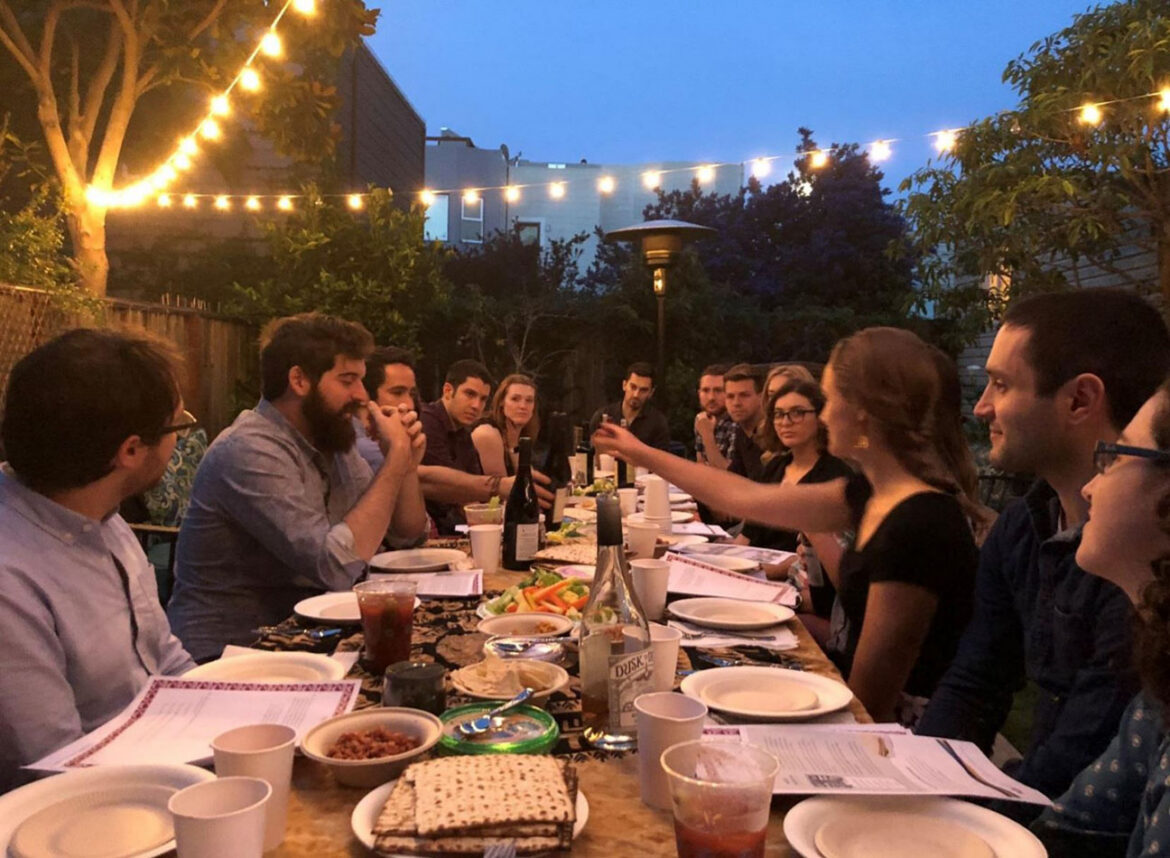
We offer our broken hearts to God. We share our broken hearts with one another. We turn toward our trusted neighbors, friends, family members, community members and allies — and we connect with them. We sit or stand in their presence. We talk. We listen. We laugh. We cry. We celebrate. We mourn. We give. We receive. And as Jews, of course, we eat and drink together.
We offer our broken hearts to God. We share our broken hearts with one another. We turn toward our trusted neighbors, friends, family members, community members and allies — and we connect with them. We sit or stand in their presence. We talk. We listen. We laugh. We cry. We celebrate. We mourn. We give. We receive. And as Jews, of course, we eat and drink together.
We do all the things that friends and family and community do with one another to relate, connect and heal. We heal our collective trauma and renew our collective nervous systems with connection, lovingkindness and compassion.
There is at least one more important path to our recovery that also moves us from fight-or-flight to calm and safety, from sympathetic to parasympathetic nervous system activation in our bodies and minds. That is the age-old Jewish spiritual practice of blessing and gratitude.
It’s called hakarat hatov. Literally, “seeing the good.” Seeing the blessings in our lives — in gratitude.
Judaism guides us to wake up each day in gratitude, to begin anew each day in appreciation of all the good that surrounds us — all the good which is within us.
Prominent voices in the Jewish world have rightly lamented that we felt abandoned on Oct. 7 and the days that followed. Many people turned a blind eye to our shocking suffering: friends, former allies, teachers and students on college campuses, local school boards, local, national and international leaders. Not all, but many of them hardened their hearts like Pharoah of ancient Egypt. They hardened their hearts to the unfathomable pain of our broken hearts.
We felt abandoned, alone, our trauma invalidated. All true. And, at the very same time, when we turned toward the good, hakarat hatov — when we lifted our tear-soaked eyes to perceive the goodness surrounding us, we could see many people standing right beside us, offering us their love, compassion, and kindness.
We saw the brave souls near Nova, like Bedouin minibus driver Youssef Ziadna and Israeli farmer Oz Davidian, who risked their lives and families to save our young sisters and brothers under brutal attack right outside Gaza. Closer to home, the courageous security guards here in America who stood watch — and continue to do so — over us, our families and Jewish institutions, risking their lives and families to keep us safe and protected.
God bless them. We see their goodness.
We recognize all the Jewish and Jewish adjacent organizations in Israel, America, and around the world, who worked and continue to work day and night, tirelessly, to keep our people safe, comfort us, and help us to heal.
God bless them. We recognize their wise and loving acts.
We acknowledge all our Jewish and non-Jewish friends and neighbors who spoke to us — and who continue to — in sympathy, solidarity and understanding. Their warmth and succor help us feel safe and soothe our troubled spirits.
God bless them. We see the beauty of their souls. We are deeply grateful.
We appreciate how our Jewish community and the thousands of Jewish communities across the planet are a source of love, friendship and support during these difficult times.
We are enveloped by at least 100 blessings each day, as the Talmud reminds us (Menachot 43b).
There is still much healing that needs to be done. So we can feel safe. So we can truly begin again, as these High Holy Days beckon us to do.
In this new year, we can begin again when we acknowledge and embrace our fear and pain. We will begin again when we open our hearts to compassion, lovingkindness, appreciation, and the good will of those who are standing right beside us — whether they be near or far, Jew or gentile, human or Divine.
May God bless us for a new year of health and safety, for goodness, wholeness, and healing.
Shanah tovah u’metukah. Wishing you a good and sweet year.
Rabbi Rick Schechter is the spiritual leader of Temple Sinai of Glendale, California.