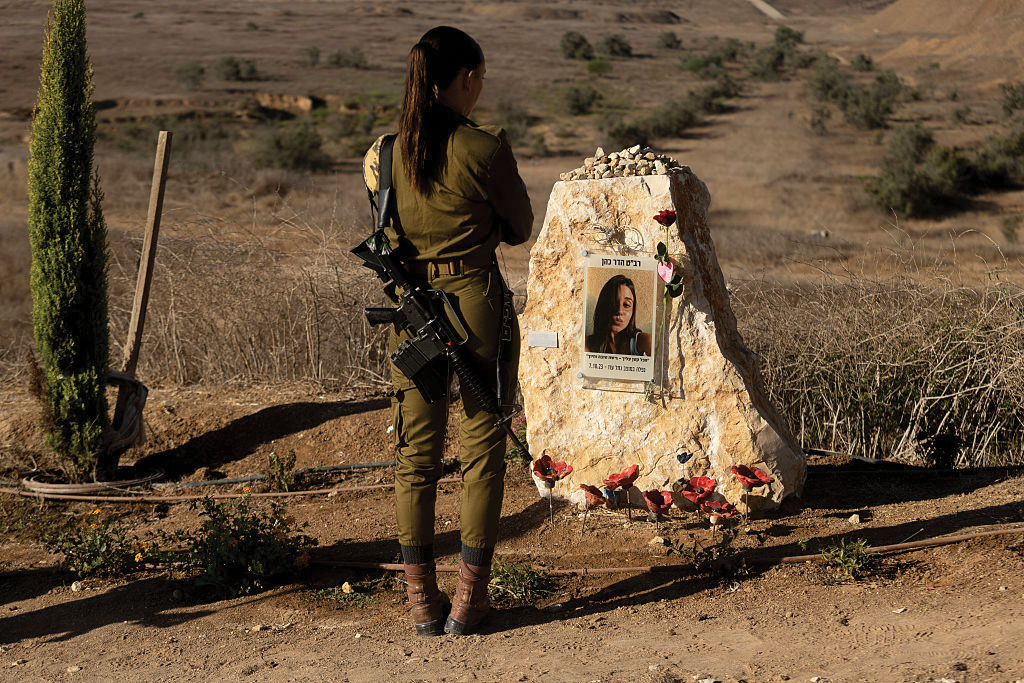

In a speech that went viral on social media and that now has over half-a-million views on YouTube, the commander of the IDF’s Unit 7007 addressed his soldiers in a pre-Shabbat message as they prepared to enter Gaza following the horror of Hamas’ October 7th attack:
“We are in a historic time,” he began. Decrying the holding of hostages and the “deplorable evil” of brutality of Israel’s enemies, looking into the eyes of the soldiers standing in formation around him, the commander invoked the faithful fighters of our people’s past.
“We are not alone,” he then thundered, voice rising with emotion. “Standing here with us – I can feel it – are the soldiers of King David. Here with us today are the Maccabeees. We are here today with Mordechai Anielewicz, the warriors of the Warsaw Ghetto. Here with us today are the fighters of the Lehi, the Etzel, the Haganah the Palmah, all the warriors of Israel from the time we became a nation until today.”
Echoing the Passover Haggadah he continued, “I imagine in a few years, when the younger guys have children and grandchildren, the older guys have their grandchildren and great-grandchildren, and their children will ask” were you there when so many of our people were attacked so mercilessly?
The commander then offered a resounding response: “and you will say ‘Yes, my dear son, I was there. And you know what I did? I left my home, I left my work, and I went to fight.’ And they will ask you: ‘You went out to fight?’ And you will say: ‘Yes, I fought the evil.’ ‘What happened at the end, father?’ ‘We were heroes. Battalion 7007 were lions and we defeated the enemy.’ From generation to generation the heroism of this battalion will be told.”
The words of Israel’s modern Maccabees, like those of Matityahu and his sons, sought spiritual strength in the succession of heroes from days past. As the First Book of Maccabees records, when the elder Hasmonean father lay on this deathbed as his children, led by Judah, prepared the battles that would birth the Festival of Lights, he too cited the faithful courage of canonical heroes.
“Arrogance and scorn have now grown strong; it is a time of disaster and violent wrath,” Matityahu began, “Therefore, my children, be zealous for the law and give your lives for the covenant of our ancestors. Remember,” he encouraged them, “the deeds that our ancestors did in their times, and you shall win great honor and an everlasting name.”
Matityahu then, as the IDF captain would centuries later, listed the leaders who modeled unrelenting bravery and undaunted faith: “Was not Abraham found faithful in trial, and it was credited to him as righteousness? Joseph, when in distress, kept the commandment, and he became master of Egypt. Phinehas our ancestor, for his burning zeal, received the covenant of an everlasting priesthood. Joshua, for executing his commission, became a judge in Israel. Caleb, for bearing witness before the assembly [during the incident of the Ten Spies], received an inheritance in the land. David, for his loyalty, received as a heritage a throne of eternal kingship. Elijah, for his burning zeal for the law, was taken up to heaven. Hananiah, Azariah and Mishael, for their faith, were saved from the fire. Daniel, for his innocence, was delivered from the mouths of lions.”
“And so,” the father of Judah and his brothers concluded, “consider this from generation to generation, that none who hope in Heaven shall fail in strength. Do not fear the words of sinners, for their glory ends in corruption and worms. Today exalted, tomorrow not to be found, they have returned to dust, their schemes have perished. Children! Be courageous and strong in keeping the law, for by it you shall be honored.”
As we celebrate over Hanukkah’s eight days the valor of those who rose to resist villainy – in those days and in our time – we mark the words of Maccabees both ancient and modern. By looking once more to hallowed heroes of the past, we continue to stand strong, with the courage and conviction that light will shine forth once more as the forces of darkness are rendered history’s dust.
Rabbi Dr. Stuart Halpern is Senior Adviser to the Provost of Yeshiva University and Deputy Director of Y.U.’s Straus Center for Torah and Western Thought. His books include “The Promise of Liberty: A Passover Haggada,” which examines the Exodus story’s impact on the United States, “Esther in America,” “Gleanings: Reflections on Ruth” and “Proclaim Liberty Throughout the Land: The Hebrew Bible in the United States.”