Since its signing at the G7 Summit, President Trump and Vice President Vance have spent significant time expressing confusion about the reaction to the memorandum of understanding (MOU) with Iran – even as their own public statements in the days since have sharpened that response and, at times, raised new questions about how much leverage the United States believes it actually has.
But there is nothing confusing about the response.
Americans – and Israelis in particular – are not reacting to spin, or to partisan framing, or to media distortions.
They are reacting to the text of the agreement itself, and to what has followed it.
The administration’s defenders have suggested that critics are overreacting, misunderstanding, or selectively interpreting what is presented as a pragmatic diplomatic effort. But this argument collapses under even minimal scrutiny. The concerns being raised are not based on speculation. They are based on the clear terms of the deal – and increasingly, on how those terms are being publicly contextualized by the administration itself.
At its core, the MOU offers Iran substantial relief – economic, political, and strategic – in exchange for commitments that remain, at best, vaguely defined and conditionally enforced. This is not a matter of ideological interpretation. It is a matter of sequencing.
Concessions are immediate. Compliance is deferred. Enforcement is uncertain.
And subsequent public remarks have only deepened that concern, with administration officials emphasizing the risks of not reaching a deal – signaling urgency on Washington’s side that Iran appears to have little incentive to reciprocate.
Negotiations are about leverage – and about not signaling, before an agreement is reached, which side believes it needs the deal more.
Which brings us to Vice President Vance.
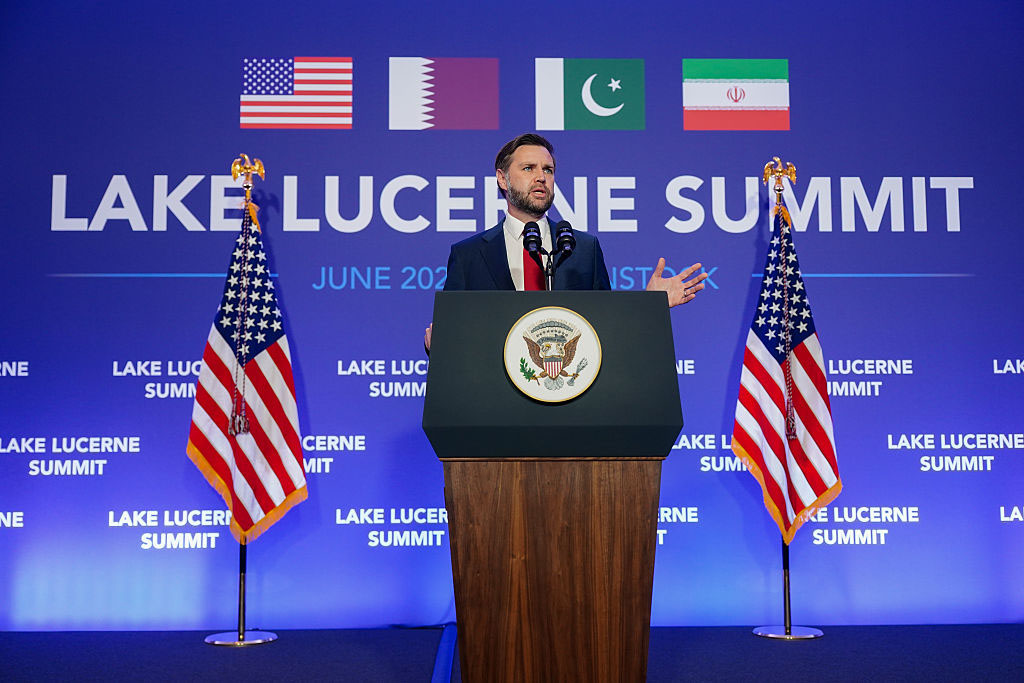
In recent days, Vance has taken a more visible role in defending the agreement – not only against domestic critics, but against Israel as well. In one particularly striking statement, he suggested that Israel should refrain from publicly criticizing the deal, framing such criticism as unhelpful to the broader diplomatic effort.
That message has since been reinforced with unusually blunt public remarks warning Israel against “attacking the only powerful ally” it has – a framing that subtly but unmistakably shifts the alliance from one rooted in shared strategic interests to one conditioned on political compliance.
This is not a trivial rhetorical shift.
It suggests that disagreement – even from a sovereign ally directly exposed to the consequences of the deal – is being recast as disloyalty.
For Israelis, this is not an abstract concern. It is existential.
The MOU includes provisions addressing Iran’s regional activities, including its support for proxy groups such as Hezbollah. On paper, this appears to acknowledge one of the central security threats facing Israel. In practice, however, the language is sufficiently ambiguous that enforcement becomes a matter of interpretation rather than obligation.
Israelis therefore read these provisions differently.
They are not looking at theoretical compliance mechanisms; they are looking at lived experience. They have spent decades dealing with Iranian-backed forces on their borders, navigating cycles of escalation that have cost thousands of lives.
From that perspective, assurances that Iran will “reduce” or “moderate” its regional behavior – without clearly defined benchmarks or enforcement triggers – do not inspire confidence.
That perception has been reinforced by public comments by Vance suggesting Israel cannot “kill its way out” of its security challenges – language that, intentionally or not, reframes deterrence and self-defense as obstacles to diplomacy rather than conditions for it.
This is the disconnect.
The administration appears to now be operating from a more conciliatory framework in which diplomacy is treated as inherently stabilizing, and therefore preferable – even when the underlying terms introduce new uncertainties.
Israel, by contrast, operates from a framework shaped by repeated exposure to agreements that failed to constrain adversaries while limiting its own range of action.
These are not theoretical disagreements. They are rooted in fundamentally different risk assessments.
And those differences matter because they affect how each side interprets the same document.
Consider the issue of ballistic missiles.
The MOU plainly does not prohibit Iran from continuing to develop missile capabilities. Instead, it gestures toward future discussions – language that, in diplomatic terms, often signals deferral rather than resolution.
Yet within days of signing the MOU, the administration appeared to argue both that Iran has legitimate claims to ballistic missile capabilities it was previously told it could not retain – and that failure to reach a deal could carry significant economic and geopolitical consequences for the United States.
That mixed signaling has been echoed at the highest levels: while the president has alternated between warnings of renewed military action and caution about the costs of escalation, the vice president has simultaneously emphasized progress and the importance of turning a “new leaf” with Tehran – contradictions that risk weakening the credibility of both positions in the eyes of negotiators.
Iran, like any strategic actor, will respond to incentives far more than rhetoric.
And the incentives embedded in this agreement are clear: front-loaded relief in exchange for back-loaded, ambiguously enforceable commitments.
This is not a new dynamic. It is a familiar one – one that has played out repeatedly in past negotiations with Iran, with lamentable results.
Which raises a broader question:
If the administration understands this history – and there is no reason to believe it does not, given its past sharp criticism of prior Iran deals – why structure a deal in a way that appears to replicate its most criticized elements?
One possible answer is that the goal is not to eliminate risk, but to manage it.
Another is that the administration believes the alternatives to diplomacy are sufficiently undesirable to justify significant concessions.
But if that is the case, it must be acknowledged openly.
Because the current approach attempts to present a high-risk agreement as a low-risk one.
And that is where the credibility gap emerges.
The issue is not that critics of the MOU are opposed to diplomacy.
It is that they recognize the difference between diplomacy that constrains adversaries and diplomacy that empowers them.
They understand that agreements are not judged by their intentions, but by their structure.
They can read the language. They can assess the sequencing. They can identify the gaps between commitments and enforcement.
And increasingly, they can observe how subsequent statements by senior officials reinforce those gaps rather than address them.
The result is a growing perception – shared by critics across the political spectrum – that pressure is being relaxed before it has achieved its stated objectives.
This is why the backlash has been so immediate and so intense.
It is not driven by misunderstanding. It is driven by comprehension.
When officials express surprise at that reaction, they are not revealing a failure of public communication. They are revealing a mismatch between how the agreement is being presented and how it is being received.
Because the public is not reacting to narratives, but to substance.
And the substance raises legitimate questions – about leverage, about enforcement, and about whether the agreement, as structured, advances or undermines the strategic objectives it claims to serve.
And that is why, despite the confusion expressed by its architects, the reaction to this agreement has been neither irrational nor driven by “fake news.”
We have read the MOU.
We are upset because we can read.
Micha Danzig served in the Israeli Army and is a former police officer with the NYPD. He is currently an attorney and is very active with numerous Jewish and pro-Israel organizations, including Stand With Us and the FIDF, and is a national board member of Herut North America.