fbpx

June 25, 2026

Shabbat, Sound Healing and a Dog Named Manifestation

At a sold-out Shabbat dinner in Brentwood, the potluck table had falafel, Israeli salads, noodle kugel and squash salad. Some guests brought yoga mats. Jordana Reim had already set pillows and knit blankets on the living room floor for about 40 people.

Her white West Highland terrier named Manny — short for Manifestation — walked around before the meditation began. Reim warned the group that during the meditation, there is a chance they might get licked by Manny. For the entire session, Manny slept.

The guests ranged from their mid-20s to their 50s. Some knew each other. Some arrived as strangers. People ate and introduced themselves for about an hour and a half before Reim turned down the lights and began the sound healing session.

After the session, people stretched. People sighed. There was no rush for phones. No phones went off during the session. That counts for something in 2026.

For Reim, who has built her work around mindfulness, meditation, sound healing and Shabbat, the point is direct. Reim calls the evenings “Light Gatherings.”

“If you chose to be there, you belong,” Jordana Reim told The Journal. “And that’s how I want people to feel. I want people to come into a Light Gathering and feel as though no matter their background, that they belong within it.” Reim began hosting Shabbat and sound healing gatherings in 2018.  She estimates that 20 to 30% of people who pay to participate in her Shabbats are not Jewish.

Two weeks after the attacks of Oct. 7, 2023, Reim hosted a Shabbat sound healing only for people who identified as Jewish. Reim wanted the first post-Oct. 7 gatherings to give Jewish attendees a place to speak without hearing other responses from outside the community.

“At that time, what we were feeling was minimized, or at least the feeling that I was feeling was anything I was feeling was minimized, not important, and there wasn’t space to feel it among many who were not feeling that.”  The format includes food, Jewish wisdom, candle lighting, discussion and sound healing. “I realized that as a concept, and especially as I started doing it every month and the event became more and more popular, that this is something that I hope has legs beyond me.”

Reim’s road to the Light Gatherings can be traced back to her college years at SUNY Binghamton in upstate New York, where she was diagnosed with ulcerative colitis at age 20.

“It really messed up my life at the time. It was very challenging. I nearly did not finish college because I was so sick. My last semester of my senior year, I mean, my entire colon was inflamed, and I was taking something like 25 pills a day just to be able to make it through the day. So that’s when I really leaned on my yoga practice and I understood what it means and how wonderful it is to have health because it was the first time that I didn’t have it.”

Yoga became the practice she leaned on when her health changed at Binghamton. After college, she moved into advertising and production, where she worked as an executive producer and built a career that included work for R/GA, Saatchi & Saatchi and Nike.

In 2011, she moved from New York to California. Los Angeles gave her more space for yoga and meditation, but it also brought a new kind of stress. She had never owned a car before moving to California, and driving in Los Angeles became its own strain.

“I used to get so anxious and I felt like I was doing a workout every time I was driving to work because I was clenching my jaw and probably every muscle in my body,” Reim said.

She left advertising about 10 years ago and took time to travel and figure out who she was outside the corporate world.

“I had just been in Nepal and met an incredible teacher who showed me sound healing, which was a meditation that I absolutely loved,” Reim said. “And I had done some training with him and I wanted to share that with people. So I started doing sound healing at first at my own events at Shabbat for my friends who would come over and then I would play a little bit for them afterwards.” Reim began hosting them each month, and knew she was on to something as they became more popular

“It’s a rest ritual in the hopes that in the future there are others who want to host light gatherings and maybe they’re sound healers or maybe they do something else, song or meditation or another, maybe there’s artwork involved, something that feels like a rest ritual that is done on Shabbat to make it special.”

She wanted to have “a space where we could share what we were feeling without hearing everything else that was going on,” Reim said. “We were feeling minimized — I was feeling minimized and not important. There wasn’t space to feel it among many who were not feeling that.”

At Light Gatherings, she opens with Jewish wisdom, then moves around the room with her brass Himalayan singing bowls, padded mallets, crystal bowls and tingsha bells.

“Primarily now I’m hosting these Light Gatherings where we bring people together for rest rituals that are rooted in Jewish wisdom,” Reim said. “And a big part of that is sharing Jewish wisdom at the beginning.”

Her work also reaches people outside Shabbat settings. Reim’s current work includes mindfulness, meditation, breathwork and sound healing in addiction recovery and rehab facilities, where clients may be in early recovery, detox or treatment settings.

“A big part of my work now is helping people in recovery with mindfulness and meditation and coaching,” Reim said. “And I started doing it because someone asked me to fill in and I thought, okay, is this something I can do? And the answer was yes. So I went and I did it and I realized how needed it was immediately.”

At the Brentwood gathering, after the lights came back on, people stretched and volunteered to share where the meditation took them. The room stayed with the pace of the night for a little longer, with most of the participants socializing afterwards for almost two hours.

“People often arrive curious, a little bit anxious,” Reim said. “I can sometimes sense that there’s some social anxiety and people leave happy, laughing, full, connected.”

For readers who will not attend a gathering, Reim offered a smaller practice: one minute, three breaths and a pause.

“Just taking a minute a day to just pause and to take three breaths and to start to tune into yourself,” Reim said. “There’s a meditation that we do just by taking a moment of silence to observe the flame and to look into the flame and to be mindful that this is Shabbat beginning and this is a time of pause and before we do anything wonderful, we get to pause first so we can really enjoy it. The true wellness that we can offer with Shabbat is slowing down.”

Shabbat, Sound Healing and a Dog Named Manifestation Read More »

America 250 Exhibit Brings Revolutionary and Civil War Histories to Life

The Ronald Reagan Presidential Library is known for its impressive exhibitions, and the latest is likely to draw both history lovers and those who are less enthusiastic about history lessons.

As part of a nationwide initiative leading up to America’s 250th birthday, the National Archives and Records Administration temporarily transferred more than 30 rare documents, records, and artifacts from its storage vaults in Washington, D.C., to 10 Presidential Libraries across the country, including the Reagan Library. The effort expanded the National Archives’ ongoing “Opening the Vault” exhibition series to a broader audience, giving visitors a unique opportunity to experience historically significant materials up close. Each Presidential Library featured a distinct selection of items, ensuring a different experience at every location. The documents were carefully selected by the National Archives’ Office of Presidential Libraries in collaboration with nonprofit Presidential Foundations.

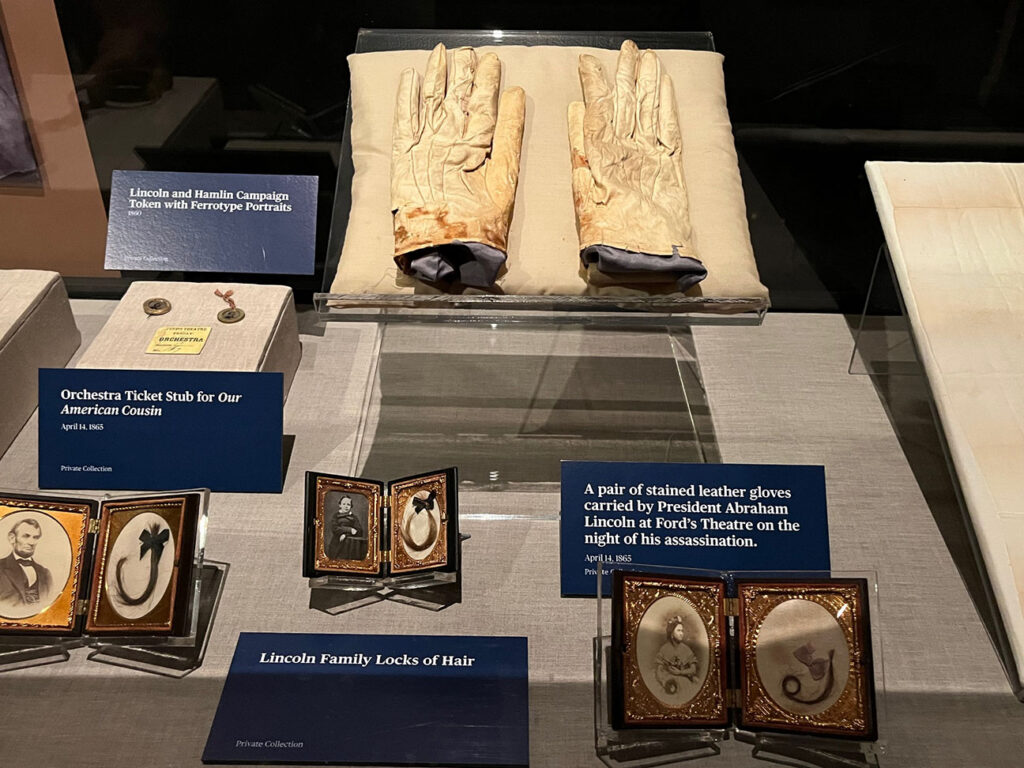
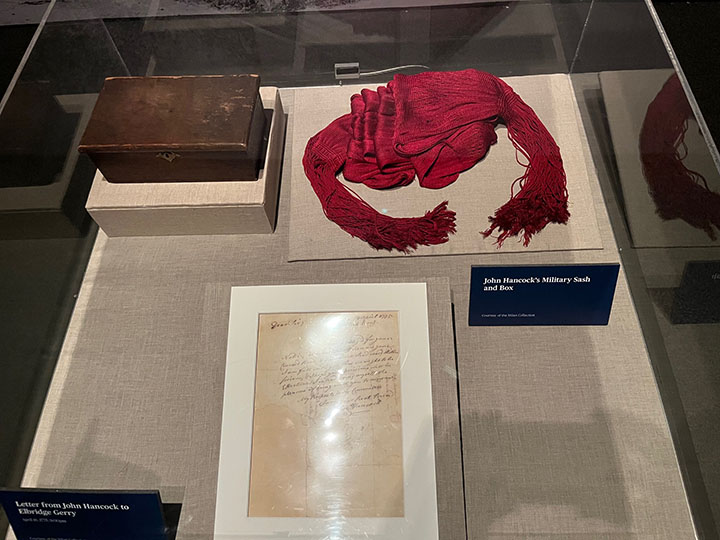
In the “America 250” exhibition at the Reagan Library, the curators were able to bring history to life through a series of extraordinary artifacts including John Hancock’s military sash and box, including strands of George Washington’s hair, letters by Presidents George Washington, John Adams and Abraham Lincoln, and personal items Lincoln carried on the night of his assassination – among them a Ford’s Theatre ticket stub, a pair of blood-stained leather gloves, and a white handkerchief.

The exhibition serves as both a reflection on the nation’s past and a tribute to the individuals who helped shape its course, presenting American history as a narrative that begins with its founding and focuses on the pivotal moments that shaped its early development.

Having visited the library many times before, I usually skip the permanent exhibits and head straight to the visiting shows. However, for first-time visitors, it’s worth setting aside at least three to four hours to fully explore the museum, take in the stunning outdoor views and visit the final resting place of Nancy and Ronald Reagan.

Many of the items at America 250 have rarely been displayed publicly, with some appearing on the West Coast for the very first time. Their inclusion adds a sense of immediacy to the exhibition, allowing visitors to encounter historical artifacts that have long remained outside public view.

It is one thing to read about history in a textbook; it is another to encounter it up close and personal through artifacts and handwritten letters. In those moments, the past feels almost tangible — as if it can be reached and understood in a more immediate way. Take, for example, John Hancock’s letter to Elbridge Gerry on the night of Paul Revere’s ride. Written only hours before one of the most recognizable events in American history, the letter captures the urgency and uncertainty of the moment:

“Dear Sir,

“I am much oblig’d for your Notice; it is said the officers are gone Concord Road, & word I will send word thither. I am full with you that we ought to be serious, & I hope your Decisions will be Effectual. I intend doing myself the pleasure of being with you tomorrow. My Respects to the Committee. I am your Real Friend, John Hancock.”

The exhibition features Revolutionary and Civil War-era weapons, alongside documents and artifacts that frame the military and political struggles of the 18th and 19th centuries.

A Civil War cannon from the Battle of Gettysburg looks so well preserved that it would keep you wondering if it’s the real thing or a replica (rest assured it’s original).

It is striking to imagine just how physically demanding life was for a soldier during the Revolutionary War. Marching long distances in harsh conditions was already grueling, but soldiers did so while carrying a heavy musket — often weighing around 10 pounds with a long barrel designed for battlefield volleys rather than precision or ease of use. Every movement, from loading to aiming to firing, required strength, discipline and repetition, turning even a single shot into a carefully practiced sequence under pressure.

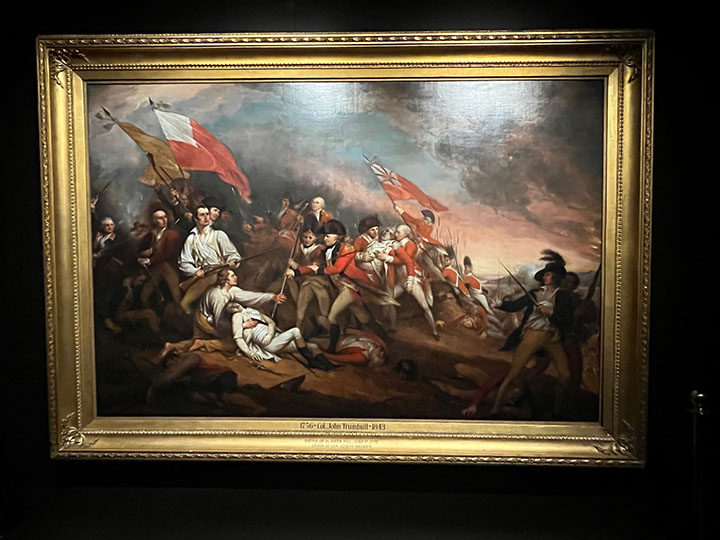
Many visitors are especially drawn to artist John Trumbull’s paintings, which depict in great detail important events. Trumbull’s dramatic scenes of the American Revolution helped shape how generations of Americans visualize the nation’s founding. One of his most famous works in the exhibit is “Declaration of Independence,” on loan from the U.S. Capitol.

Trumbull’s authority as a painter of the American Revolution came not only from his artistic skill, but from his unique position as both a participant and a witness to history. A veteran of the war who served as aide-de-camp to George Washington and later to Horatio Gates, Trumbull had direct access to many of the people who shaped the nation’s founding. After the war, he sought out firsthand testimonies from key figures — including signers of the Declaration and prominent military officers — and traveled to meet them or their families, sketching their likenesses and gathering details. With the encouragement and assistance of Thomas Jefferson, he created careful studies of these individuals, sometimes copying earlier portraits when necessary, to ensure historical accuracy. This meticulous process allowed Trumbull to reconstruct scenes with remarkable fidelity, turning personal accounts and lived experience into visual narratives. As a result, his paintings do more than depict history — they help define how we understand and visualize the pivotal moments of the American Revolution today.

On Saturday, June 27 at 6 p.m., the Reagan Library will host a patriotic concert with a new symphonic work that sets President Ronald Reagan’s most influential speeches to music from his Hollywood films and more.

The “America 250” exhibition, running through Sept. 20, 2026.

Ronald Reagan Presidential Library, 40 Presidential Dr, Simi Valley, CA 93065 

America 250 Exhibit Brings Revolutionary and Civil War Histories to Life Read More »

Simply Gifted — Carrot and Tahini Topped Sweet Potatoes

My career in retail started early. As young children, my brother Rafi and I would accompany my mother to various Westfield malls in Sydney, where she worked as a manager at David’s World of Fashion, the ladies clothing stores owned by her brother. The “juniors” (young salesgirls) would entertain us in the stockroom or out in the mall, while my mother was selling on the floor. (I have a clear memory of standing in the display window, pretending to be a mannequin. I was four.)

As a teenager, my skills as a salesperson were honed by working with my parents in their stores. Then, I opened my own fashion boutiques on the Third Street Promenade and on Montana Avenue in Santa Monica.

I truly loved selling clothes and making people happy. But I’m so glad to not have the stress of rent, staff and managing inventory. Not to mention the modern perils of competing with Amazon.

That’s why I’m full of admiration for my friend Jill Cooper Lefferman, founder of Gifted LA on Pico Boulevard. Her store is visually stunning and thoughtfully curated with unique gifts sourced from talented artisans and makers. From books and baby clothes, cards and candles, to sophisticated board games and contemporary fashion, special jewelry and monogrammed gifts, you’ll find a lot of things to love at Gifted. Honestly, the Judaica collection might just take your breath away!

Jill from Gifted LA with Sharon and Rachel

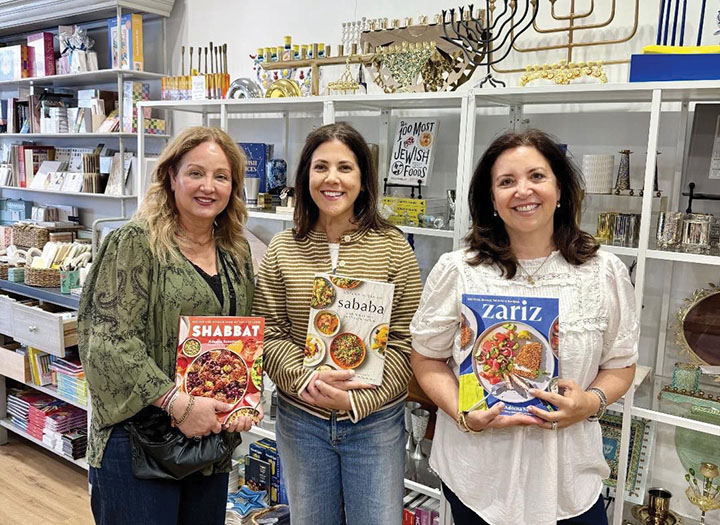
Gifted also holds special events like community Mahjong gatherings and artisan pop-up shops. Recently, Jill hosted New York Times best-selling author Adeena Sussman, for a signing of her beautiful new cookbook, “Zariz.”

Rachel and I so admire Adeena, so we were thrilled when Jill proposed that we prepare a few of her recipes to share at the event.

The “Zariz” book cover promises “100 Easy, Breezy, Tel Aviv-y Recipes” and that promise holds true. The recipes in the book are creative, but not too complicated. Rachel baked the Super Seeded Crackers and the Baharat Spiced Mushroom Hummus. I made the Caramelized Onion & Labaneh Dip, the Roasted Corn Guac and the Smoky Tomato & White Bean Dip.

Everything was bright, fresh and delicious. We couldn’t stop dipping and noshing. But the recipe that impressed Rachel and me the most was Adeena’s Carrot Tahini Ginger Dip/Dressing.

Inspired by a traditional Japanese salad dressing, it has you blending carrots, tahini, ginger, garlic and rice vinegar. The result is a bright velvety yellow dip that is sweet, gingery and irresistible!

I immediately made another batch and paired the dip with roasted salmon and fresh veggies. I got rave reviews.

—Sharon

Like most Jewish Moroccan kids, I grew up eating dafina, a slow cooked overnight stew featuring meat, potatoes, wheat berries and garbanzos. My favorite part of the hamin was always the sweet potatoes.

My mother was from Spanish Morocco, so she made her Avas, a bean stew, in the Spanish style. She used onion, garlic, paprika, cumin, bay leaf and chunks of sweet potato. It may sound strange but it was so good!

Nowadays, as a mother and grandmother, I need to cook healthy, nutritious meals and sweet potatoes are one of my favorite ingredients. I like to cut them up, toss them with olive oil and salt, sometimes a little rosemary or thyme, then roast them to caramelized perfection. My new favorite sweet potatoes are the Japanese Murasaki, a white variety. They’re great roasted, but sometimes I even boil with peel on and mash them. They are so sweet and buttery.

I’m watching my diet, so their dense, chestnut-like sweetness, high mineral and fiber content, along with a lower glycemic impact makes them a great choice.

Recently, I’ve started serving these Japanese sweet potatoes with Adeena‘s carrot, tahini and ginger dip. My family loves it and my daughter Rebekah says it’s the best thing I’ve ever made!

—Rachel

Carrot Tahini Ginger Dip/Dressing

by Adeena Sussman

1 medium carrot, roughly chopped

1/3 cup pure tahini paste

3 Tbsp water

3 Tbsp unseasoned rice vinegar

3 Tbsp neutral oil

2 Tbsp toasted sesame oil

2 Tbsp sugar

1 ½ tsp kosher salt

2″ piece of fresh ginger,  peeled

2 garlic cloves, peeled

In a blender, combine the carrot, tahini, water, vinegar, neutral, and sesame oils, sugar, salt, ginger, and garlic and blend on high speed until creamy and smooth, 45 seconds to 1 minute. Transfer to an air type container and chill to thicken, one hour.

Roasted Murasaki Sweet Potatoes

by Sephardic Spice Girls

3 medium Japanese sweet potatoes, washed

¼ cup olive oil

2 tsp salt

2 tsp dry rosemary

Preheat oven to 425°F.

Cut potatoes into thirds, then place in a medium bowl.

Drizzle with oil, salt and rosemary, then toss until well coated.

Place potatoes skin side up on a large parchment lined baking sheet.

Roast for 30 minutes or until bottom of potatoes are golden brown.


Sharon Gomperts and Rachel Emquies Sheff have been friends since high school. The Sephardic Spice Girls project has grown from their collaboration on events for the Sephardic Educational Center in Jerusalem. Follow them
on Instagram @sephardicspicegirls and on Facebook at Sephardic Spice SEC Food. Website sephardicspicegirls.com/full-recipes.

Simply Gifted — Carrot and Tahini Topped Sweet Potatoes Read More »

Celebrate Lemon Month: Pickled and Preserved Lemon Recipes from Beth A. Lee

There are plenty of foods that get their own day, week or month. June is National Lemon Month, and it’s definitely one worth celebrating.

Beth A. Lee, founder of the OMG! Yummy food blog and author of “The Essential Jewish Baking Cookbook” is a huge advocate for lemons. Lee loves citrus so much, she co-wrote a book on it with Sarene Wallace. “Preserved Citrus: 50 Sweet, Savory & Juicy Recipes” will be out in Spring 2027.

Beth A. Lee

“I love them for their visual appearance – like sunshine in fruit form,” Lee told The Journal. “In fresh form, the [acidity and brightness of the] juice [and zest] can be both the perfect finishing touch to a savory dish or the wow factor in a baked good that makes you crave another bite again and again,” she said. “In preserved form, after they are salt-cured, they transform into a different flavor profile … it can become the savory, “umami” star of a dish. The peel, she said, “becomes the main carrier of flavor and in a sense, becomes even more lemony than it was in its original fresh form.”

Lemons are one of those ingredients that can wear many hats, Lee explained. Fresh lemons are the perfect finish to a cocktail, salad dressing, soup, marinade, fish or chicken main, pasta, pesto, etc. “Once preserved, think of them anywhere you might use fresh lemon in a dish but don’t be afraid to explore beyond the expected,” Lee said. “Savory preserved lemon peel in a sweet dish? It can absolutely work.”

People always ask Lee and her co-author Sarene Wallace where to buy preserved lemons. Their answer: Make your own. “It just takes citrus and salt, a jar and some time,” Lee said. “While you are waiting for that first jar to finish preserving (takes 3-4 weeks), make some quick pickled lemons; they only take 24 hours.

“Not as magical as what the fully preserved lemons offer but pretty great; use them almost anywhere you might use a fully preserved lemon.”

Lee’s recipes for pickled and preserved lemons are below.

Lee had no idea what an amazing citrus lemon is when her family planted a Meyer lemon tree in their backyard. “The tree has thrived and delivered fruit to us every year we’ve spent in our home,” she said. “My daughter has an expression, ‘Everything tastes better with lemon on it.’”

And they say it’s the apples that don’t fall far from the tree.

For many more ideas about how to use lemons, check out Beth and Sarene’s Facebook group and Substack called Sumac & Sunshine. And follow OMY Yummy on Instagram, Facebook and Substack.

Quick Pickled Lemons Recipe

4 unwaxed lemons

1 tp plus 1 tsp sugar

2 teaspoons kosher salt

2 -3 thyme sprigs

sterilized mason jar

Slice off the end tips of each lemon, slice them into 1/4-inch rounds, and remove the pits. Stack the rounds and chop them into small cubes.

Place the lemons and their residual juices into the mason jar. Add the sugar and salt and thyme and mix well. Close the jar and let the lemon mixture sit on the counter overnight. Refrigerate after 24 hours.

Preserved Lemons, Ottolenghi-style

6 – 8 Meyer, Eureka and/or Lisbon lemons

6 – 8 Tbsp kosher salt

1 cup (approx.) fresh lemon juice – enough to cover the lemons in the jar after one week

1 sprig rosemary (optional)

2 sprigs thyme (optional)

10 peppercorns (optional)

1 spicy red pepper (optional)

2 Tbsp olive oil

Sterilize your 1 qt glass jar canning jar; run it through the dishwasher, run under very hot water, use your instant pot – just make sure it is clean.

Cut 2 slits in each lemon to create a well to put the salt in, being careful not to slice all the way through. (If you do, no big deal, many people preserve quartered lemons. It will work too). Add about 1 tablespoon of kosher salt to each lemon.

Place the lemons in the glass jar fitting them in as tightly packed as you can.

Close the jar and let them sit in a cool dry place for about a week. You’ll notice juice beginning to accumulate in the jar.

After a week, open the jar, add your aromatics of choice – thyme, rosemary, peppercorns, coriander, cardamom, star anise, cinnamon, a whole pepper – your taste buds can be your guide. Then cover the lemons and aromatics with enough lemon juice to cover them all and close it up.

Let it sit out in that cool dry place for 3 or 4 more weeks. You can occasionally shake it about if you’d like. Right before you refrigerate, top with a seal of olive oil, then place in the refrigerator and start experimenting!

Notes: Some recipes for preserved lemons add the juice to cover the lemons from the very beginning along with the aromatics, rather than waiting a week. This works too!

Use organic, unwaxed lemons if at all possible. If not, be sure to scrub the outer skins well to remove any coating.

Remember to store the jar in a cool place, preferably under 70°F, until you refrigerate them. Warm environments are not optimal for preservation.

There is some new discussion among sources/experts about whether white mold on your lemons is indeed harmless or not, Beth advises. When in doubt, throw the lemons out! Her previous opinion was: if white mold develops on any of your lemons, it is generally harmless – just remove/rinse it off. Any other colors of mold are not good and if you see them, toss the lemons. “I have rarely had any issues except a touch of white mold a couple times,” she said. “And I lived to tell this tale.”  

Celebrate Lemon Month: Pickled and Preserved Lemon Recipes from Beth A. Lee Read More »

Table for Five: Chukat-Balak

One verse, five voices. Edited by Nina Litvak and Salvador Litvak, the Accidental Talmudist

This is the statute of the Torah which the Lord commanded, saying, Speak to the children of Israel and have them take for you a perfectly red unblemished cow, upon which no yoke was laid.

– Numbers 19:2


Sara Yoheved Rigler

Author, “Holy Man” and “8 Seconds to Connect with Hashem”

The law of the Red Heifer made mystics of us all. While most of the mitzvahs of the Torah are amenable to reason, this ritual — that makes the spiritually impure pure while making the person who administers the ritual impure — defies logic. Rabbi Chaim Shmuelevitz, the legendary Rosh Yeshivah, questioned why this verse starts, “This is the chok [decree] of the Torah,” instead of, “This is the chok of the Red Heifer.” He answers that a chok is a mitzvah that makes no sense to us. We do it simply because God has commanded us, and this characterizes all the mitzvahs of the Torah.

The mitzvahs operate on a level beyond rationality (like quantum mechanics, anyone?). The culture clash of Hanukkah pitted Greek logic against Jewish wisdom, replete with paradox, based on spiritual laws that cannot be seen, measured or analyzed. While Jewish rationalists explained almost all of the mitzvahs in a way that appeals to our rational minds, the law of the Red Heifer is the boundary beyond which rationality cannot tread.

According to Kaballah, the 613 mitzvahs of the Torah are 613 ways to bond with God. I don’t refrain from eating pork because I’m afraid of trichinosis. I refrain from eating pork because God asked me to. Certainly, eating unkosher food causes spiritual blockages, but I don’t have to fathom the spiritual physics. I buy my husband the birthday gift he requested because I love him. I do the mitzvahs because I love God.


Rabbi Menny Chazanow

Rosh Beis Medrash, Beis Medrash of Hancock Park

“Zos chukas haTorah” — This is the statute of the Torah. Not a statute. The statute.

The parah adumah is Torah’s great paradox: the same ritual that purifies the impure simultaneously renders the pure impure. No explanation has ever fully satisfied. And yet the Torah doesn’t call this “the statute of the Red Heifer.” It calls it the statute of the Torah itself. The Or HaChaim asks: why? He answers with something radical. We are meant to approach all of Torah the way we approach the Red Heifer — as a supra-rational decree whose ultimate cause exceeds our grasp. Every mitzvah, at its root, is a chok.

But does that mean we should perform mitzvot in silence, without trying to understand them? Nachmanides, commenting on the mitzvah of shiluach haken, offers a correction. We may never fathom the divine cause of a mitzvah, the ultimate “why” behind G-d’s will. But we can discern its aim — what it cultivates in us, what it teaches about moving through the world. Cause and aim are not the same thing.

The Hassidic masters go even deeper. Every mitzvah contains both dimensions simultaneously: the supra-rational and the rational. Each is an encounter with a transcendent G-d whose will exceeds comprehension, and at the same time an integrated human experience that calibrates our moral and spiritual selves. Not two types of mitzvot. Two layers within each one. The tension between them isn’t a problem to be solved. It’s the point itself.


Rabbi Pinchas Winston

Thirtysix.org

The quintessential chok — statute. There are commandments that we easily understand, like “don’t murder.” You don’t have to be religious to appreciate the value of laws like that. The Red Heifer? It’s mitzvot like this that make doubters question Torah Judaism more and test the faith of followers. It’s not that the logic isn’t there. It is VERY there. It’s just that “there” is not “here,” making the commandment hard to grasp. Kabbalah explains that there are five layers of spiritual consciousness, ours being the lowest and most physical. They become more spiritually sophisticated as a person ascends, something only possible if a person spiritually refines themselves. A high IQ can help, but it by no means guarantees that a person will ever get past the first and lowest level of spiritual consciousness. Some of the greatest minds never did. There are 613 commandments, but they are not all “rooted” on the same level. We may perform them on earth, but their ability to rectify levels of reality depends on the spirituality of the mitzvah, the spiritual plane it is based in. If a mitzvah doesn’t make sense to us, that is the clear sign that it doesn’t operate on our level of reality. It causes rectification on a higher level which then flows down to our level. The mitzvah of the Red Heifer may defy our logic, but it also tells us that ours is not complete and inspires us to seek an even profounder understanding of life.


Rabbanit Alissa Thomas-Newborn

Gratz College, New York-Presbyterian, and Netivot Shalom

The statute of the Red Heifer is one of the most mysterious in our tradition. The ashes from the Red Heifer make a person pure, while the process of facilitating the creation of the ashes causes the one doing it to become impure himself. How can something that purifies also cause impurity? Sforno and other commentators reflect on the meta-impact of this ritual. Sometimes to rectify something, we have to use an extreme. For example, in order to heal or treat an illness, doctors will use an otherwise seemingly harmful medication. Or to bend a bent iron back into its original form, more pressure than was originally exerted is required. But our rabbis recognize that these explanations are still likely to leave us with a lingering lack of clarity, reflecting the nature of this mitzvah as a “chok” (a law without a rational answer). Rather, learning to live with “not knowing” is the task we are called to address. This is easy to say and much harder to live. The Red Heifer exemplifies the existential effort to have faith, even when we do not understand or do not have an answer to the “why” questions in life. In the space where this mitzvah impurifies as a way to create the source of purification, we face the contradictions and blurriness of being human. Resisting the urge to resolve, we are challenged to ask ourselves how we can better live with the unknown and find spiritual value in doing so.


Abe Mezrich

Author, “Words for a Dazzling Firmament”

Here is an animal who could grow to be a mother. Who could be so strong she holds a yoke. She is red – the color of blood, the color of living. We kill her and burn her to ash. We bring her ash to a place or to a person who has encountered death. This makes things pure again.

Isn’t it absurd? To see how life is cut short by death. How death is overturned by the life that is possible. Somewhere a man or a woman has died. Somewhere a little cow refuses to give death the last word.

Table for Five: Chukat-Balak Read More »

Fifty Reasons Why Jews are Particularly Grateful for America – and Others Should Be Too!

This is an excerpt from the e-book “250 Reasons to Thank America.” 

We are two Jews in love with America. We’re also friends. We’re also writers.  We bond over many things, one of them being an aversion to whining.

We can always find reasons to whine about anything. There are a million reasons, for example, to whine about America, just as there are a million reasons to whine about France, Spain, Israel or Greece.

Given that America is celebrating its 250th birthday this year, we thought we’d offer you a whine-free zone zone by launching the e-book, “250 Reasons to Thank America.” We picked reasons that move us. You’ll have your own. The point is not to have an exhaustive list but to take a time-out to thank our country.

As a little taste of the book, and because the word Jewish is in our name, here are the 50 reasons why Jews are particularly grateful for America.

That is our birthday present, 250 years in the making:

1. 1787: No Religious Test: In Article VI, Clause 3 of the U.S. Constitution, the Framers insisted “no religious test shall ever be required as a qualification to any office or public trust under the United States.” This repudiates the European and Middle Eastern laws barring Jews from government service.

2. 1790: Washington’s Welcome Mat: President George Washington shows that America’s welcoming spirit is not just formal and legal. Replying to Moses Seixas, warden of the Sephardic Touro Synagogue in Newport, Rhode Island, Washington proclaims that America’s government gives “to bigotry no sanction, to persecution no assistance.” He wants America’s Jews to “continue to merit and enjoy the good will of the other inhabitants — while everyone shall sit in safety under his own vine and fig tree and there shall be none to make him afraid.”

3. 1791: Separating Church and State: With the Bill of Rights ratified, the First Amendment vows: “Congress shall make no law respecting an establishment of religion, or prohibiting the free exercise thereof.”

4. 1840: Refuting the Damascus Blood Libel: Secretary of State John Forsyth makes history when he instructs America’s minister in Turkey to protect persecuted Jews. America shows its passionate commitment to defending Jews abroad, purely on a human rights basis.

5. 1847: Mr. Blue Jeans: A young Jewish peddler arrives safely from Germany fleeing discrimination, alongside tens of thousands of others, thanks to the 1847 Passenger Act mandating more sanitary conditions on boats arriving in America. The American Jewish population will soar from 15,000 in 1840 to 300,000 by 1880. This young man, like many others, will go West, but few will experience the extraordinary success of Levi Strauss after U.S Patent No. 139,121 for “Improvement in Fastening Pocket-Openings,” makes him and his blue jeans household names.

6. 1852:  Jewish Hospitals: The Jews’ Hospital in New York — today Mount Sinai Hospital — symbolized many American Jews’ determination to fight employment discrimination simply by founding their own organizations, and outdoing the original. From 1850 to 1955, Jewish communities will establish 113 acute-care hospitals in 24 American cities, that cumulatively have healed millions of Americans from coast to coast.

7. 1862: Jews Can Be Chaplains Too: When Abraham Lincoln signs the Chaplaincy Equalization Act, saying military chaplains no longer have to be of a “Christian denomination,” Rabbi Jacob Frankel becomes America’s first Jewish military chaplain – and another barrier collapses.

8. 1863: “Father Abraham Undoes Jew-Hatred”: When “Father Abraham” hears of General U.S. Grant’s General Order No. 11, banning Jews from “The Department of the Tennessee,” Lincoln cancels it immediately, later explaining:  “to proscribe a class is, to say the least, to rob the sustainable of the rights which belong to all.” Grant genuinely regrets his sin, even becoming the first sitting president to attend the opening ceremony of a synagogue – Adas Israel – and actually sitting through the entire three-hour service.

9. 1883: Give Me Your Tired, Your Poor: Seeking donations to finance the pedestal of the Statue of Liberty, Jewish poet Emma Lazarus writes “The New Colossus,” urging, “Give me your tired, your poor, your huddled masses yearning to breathe free …” Those words will be etched on the pedestal in 1903. Meanwhile, from 1880 through 1924, approximately 24 million immigrants will be welcomed by her words – more than 10% of them Jews from parts of the crumbling Ottoman Empire, as well as Eastern Europe.

10. 1887: The Welcoming Front Porch: In Brownsville Brooklyn and dozens of other lower middle-class neighborhoods, immigrants from different countries and of different religions buy or rent houses with front porches. The street-oriented life – sharing stories, trading recipes, looking out for all the neighborhood kids – creates all-American bonds. The contact minimizes many frictions that often grow from segregated communities and ghettoes, making Jews feel welcome neighbor to neighbor.

11. 1889: “Saluting the Flag at the Mott Street Industrial School”: This photo of mostly young Jewish immigrant students, taken by the Progressive reformer Jacob Riis, captures the magic of the American public schools. There, all were welcome, regardless of religion, all received the same desk, regardless of status, and all received an impressive education.

12. 1893: Redemption on Henry Street: Appalled by the poverty and sanitary conditions on the Lower East Side, Jewish nurse Lillian Wald launches a public nursing initiative, the Henry Street Settlement. It grows into a laboratory for social innovation and human dignity, empowering young Jewish immigrants through sports, theater, quality medical care, and civil rights activism. And in 1903, 20,000 children swarm Seward Park on the Lower East Side where, thanks to Wald and others, New York City opens this first permanent, municipally built playground.

13. 1908: The Brandeis Brief: In Mueller v. Oregon, the Supreme Court accepts the pathbreaking approach of Louis Brandeis. This Progressive lawyer submits two pages of legal citations and a hundred pages of scientific, medical and sociological data. This brief helps convince President Woodrow Wilson to nominate Brandeis to the Supreme Court in 1916. The Brandeis Brief opens the courts to accepting evidence beyond legal reasoning to help make America more just – especially in the 1954 landmark blow against school segregation, Brown v. Board of Education.

14. 1909: Look for the Union Label: In the Uprising of the 20,000, also known as the New York Shirtwaist Strike, a 23-year-old Ukrainian-Jewish immigrant named Clara Lemlich inspires the members of the International Ladies Garment Workers Union with a speech in Yiddish to strike for a 52-hour workweek and a 20% wage increase. As many as 80% of the strikes are Jewish women, mostly teens and young adults. The strike, while emphasizing Jewish and labor self-empowerment, is supported by the “Mink Brigade,” wealthy socialites like Alva Vanderbilt and Anne Morgan. Ultimately, it’s a milestone in advancing workers’ rights and women’s rights.

15. 1911: The American Passport Protects Every American: The United States nullifies its 1832 commercial treaty with Tsarist Russia when the Russian Empire dishonors the American passports of American citizens because they happen to be Jewish too. In America – unlike Russia and so many other countries – there is no forced national identity card and religion does not appear on passports or drivers’ licenses.

16. 1917: It’s Tax Deductible!: The War Revenue Act of 1917 makes individual charitable donations tax deductible, essential to the spread of Jewish philanthropy. Today, Americans donate nearly $600 billion to charity annually, with U.S. households averaging $1,394 in donations. Modern American Jews donate up to $9 billion annually – between 75 to 90% of the funds to non-Jewish causes – with 75% of Jewish households donating, averaging over $2,526 annually.

17. 1924: The Jews Invent Hollywood and Hollywood Reinvents America: Bypassing Wall Street insiders, the merger of Metro Pictures, Goldwyn Pictures and Louis B. Mayer productions into Metro-Goldwyn-Mayer, MGM, helps Jewish outsiders led by Mayer – born Lazar Meir in Ukraine – create the great American dream machine. These self-made men improvise the star system, with Clark Gable, Joan Crawford and others reinventing themselves to help feed Americans entertaining and initially patriotic fairy tales on the big screen.

18. 1933: The Jew Deal: Although it was antisemites who mocked Franklin D. Roosevelt’s New Deal as “The Jew Deal,” as many as 20% of FDR’s top advisors were Jews – at a time when Jews barely constituted 3.5% of the American population. Leading Jewish New Dealers included Secretary of the Treasury Henry Morgenthau, Special Counsel to the President Samuel Rosenman and the Supreme Court Justice Felix Frankfurter. But FDR’s open-minded hiring spree emphasized the importance of expertise and idealism over breeding and contacts, transforming the federal bureaucracy and the broader landscape at a critical moment.

19. 1933: America’s Genius for Welcoming Welcomes Geniuses: Albert Einstein arrives in America, ultimately representing thousands of scientists and academics, who shift the world’s center of gravity from the Old World to the New World. Einstein’s refugee colleagues will win at least half-a-dozen Nobel Prizes, split the atom, create game theory, help develop computers, modernize radar, invent the MRI, explain how stars generate energy through fusion, teach how cells convert food into energy and cure polio. Along the way, they transform America’s universities from country clubs for aristocrats to centers of excellence, training tomorrow’s superstars.

20. 1934: Hank Greenberg Americanizes Baseball: Leading the Detroit Tigers down the stretch in the pennant race, on his way to hitting 139 RBIs, Hank Greenberg publicly consults a rabbi, deciding to play on Rosh Hashanah yet sit out Yom Kippur. Americans cheer him for being principled, and American Jews relish his respect for his tradition and the sheer physical power the 6′ 4” slugger projects. Greenberg helps transform the American Jews’ image while convincing many skeptical older American Jews that their sons’ obsession with this childish game was legitimate.

21. 1941: GI Jews and Joes: Within days of Pearl Harbor, Jews start enlisting – ultimately 550,000 men and women will serve, constituting about 4% of the American military, which ultimately mobilizes over 16 million Americans. An estimated 11,000 Jews never return home. Joining the war effort helps mainstream American Jews, as they become increasingly aware that they are fighting side-by-side with fellow Americans against totalitarianism and for their oppressed brethren in Europe and North Africa too.

22. 1942: “Send a Salami … to Your Boy in the Army”: The new slogan of Katz’s deli, initially founded in 1888, reflects co-owner Rose Tarowsky’s worry that her son Izzy, a bomber pilot in the South Pacific wasn’t eating well. Such patriotism helps the Jewish deli become an American institution, especially after it inspires a song-and-dance routine in the 1952 Jerry Lewis-Dean Martin movie, “At War with the Army.”

23. 1942: God Blesses America with a “White Christmas”:  Irving Berlin, the songwriter who in 1918 wrote “God Bless America,” sees his Christmas song – sung by Bing Crosby – become the best-selling physical single ever. Americans’ openness to Jews’ writing their most sacred patriotic and spiritual hymns reflects an extraordinary acceptance and appreciation of the quality of product rather than the identity of its creators.

24. 1944: Roddie Edmonds Says “We’re All Americans”: Nazis running his prison camp order Master Sergeant Roddie Edmonds to separate American Jewish POWs from their fellow Americans. Edmonds orders all 1,275 American prisoners to step up, telling the Nazis, at gunpoint, “We’re all Americans.” Edmonds went to his grave with this story. It only emerged when his granddaughter started researching his story for a college assignment.

25. 1944: The Nonsectarian GI Bill: The GI Bill’s generous benefits – with no religious tests – gave lower-class American Jewish veterans a remarkable boost, helping many enter the middle class by financing their educations and helping them buy homes in suburbia.

26. 1945: The 761st (All Black) Regiment Frees a Concentration Camp: At a time when blacks were still forced to serve in segregated units, the 761st regiment fought in the Battle of the Bulge, terrified racist Nazis whenever they took any captives, and helped liberate the Gunskirchen concentration camp in Austria.

27. 1947: The Gentleman’s Agreement that No Bystanders Are Innocent: When “Gentleman’s Agreement,” starring Gregory Peck, wins three Academy Awards, Americans start to notice that being polite in the face of discrimination against Jews or anyone else, is not gentlemanly or ladylike – the terms at the time – but un-American.

28. 1948: The Displaced Persons Act: After Harry Truman signs the Displaced Person Act, America will welcome 140,000 Holocaust survivors over the next decade or so. Most are between the ages of 20 and 40, because few children or elderly Jews survived the Nazi horrors.

29. 1949: “The Goldbergs”: Continuing its 17-year radio run, from 1929 to 1946, “The Goldbergs” spends another seven years – until 1956 – entertaining Americans on their living room TVs. Molly Goldberg’s “Yoo-hoo Mrs. Kramer” helps accustom Americans to television during its Golden Age, and while humanizing and universalizing the American Jewish immigrant experience. Meanwhile, programs like “Your Show of Shows” – with its all-Jewish writers’ room starring Mel Brooks, Carl Reiner, Neil Simon and Woody Allen – so mainstreamed a manic, sardonic Jewish sensibility, most Americans associated it with “television” or “comedy,” not realizing how deeply urban, immigrant, Eastern European, and Jewish it was.

30. 1954: Jennie Grossinger and the Borscht Belt Grace the Cover of Time Magazine: As the first hotelier and immigrant Jewish entrepreneur featured on Time’s cover, Jennie Grossinger represents the many comedians who performed in the Borscht Belt, including Mel Brooks, Eddie Cantor and Joan Rivers, and the millions of vacationers who visited more than 500 hotels or more than 50,000 bungalows over half a century of hospitality, American Jewish style.

31. 1957: “I Like to Be in America”: With the words of Stephen Sondheim, the music of Leonard Bernstein, the choreography of Jerome Robbins, the script of Arthur Laurents and the producing skills of Harold Prince, “West Side Story” reflects how Jews were transforming Broadway, while telling a broader story of forbidden love and immigrant angst, focused on the clashing Puerto Rican and white gangs.

32. 1960: “No More Pencils …” on the Jewish High Holy Days: Respecting the fact that Jews, mostly women, comprise nearly half its teaching staff, New York City’s Board of Education closes all its schools on Rosh Hashanah and Yom Kippur.

33. 1961: “You Don’t Have to Be Jewish to Love Levy’s Real Jewish Rye”: One of the most memorable advertising campaigns in history mostly uses subway posters to have an Irish policeman, a Native American man and a young black boy mainstream the eating of rye bread.

34. 1965: Needs-Blind Admission Breaks the Ivy League Quotas: Appointed as dean of undergraduate admissions at Yale, 29-year-old Russell Inslee “Inky” Clark, Jr. implements a merit-based, needs-blind admission system, recruiting Jews, blacks, public school graduates and, in 1969, women. Clark’s legacy proves that fighting against discrimination of one, helps defeat discrimination against all.

35. 1966: Frank Sinatra in “Cast a Giant Shadow”:  Frank Sinatra leads an all-star cast including Kirk Douglas, John Wayne, Yul Brenner and Angie Dickinson, all of whom wanted to show their support for the new Jewish state by starring in this movie about the American Jewish war veteran who volunteered in the 1948 war, Mickey Marcus. While representing a generation of American celebrities who supported Israel, Sinatra stood out. He smuggled $1 million in cash to an Irish ship captain in March, 1948 to buy bootlegged arms for the Jews, raised funds for the State after its establishment, defied the Arab boycott with a 1962 Israel concert tour, and proudly visited Hebrew University in 1978 for the dedication of The Frank Sinatra International Student Center on its Mount Scopus Campus.

36. 1967: The Most Important Missing “The” in The History of The Middle East: After helping Israel win the Six Day War – and becoming increasingly supportive of Israel – the United States insists that U.N. Security Council 242 seeking a “just and lasting peace” endorse “Withdrawal of Israel armed forces from territories occupied in the recent conflict.” Dropping the word “the” means that Israel must not leave all the territories and can remain in the Old City of Jerusalem and elsewhere.

37. 1968: Martin Luther King, Jr., and Rabbi Abraham Joshua Heschel sing “We Shall Overcome” in Hebrew: Celebrating Heschel’s 60th birthday, King comes to the Concord Resort, the heart of the Borscht Belt. King is moved when the members of the 1968 Rabbinical Assembly link arms and sing Anu Nitgaber, “We Shall Overcome.” King calls antisemitism “a betrayal of all that is highest and best in the Christian tradition.” Less than two weeks later, the 39-year-old King is assassinated in Memphis, Tennessee.

38. 1973: Operation Nickel Grass Resupplies Israel During the Yom Kippur War: With Israel reeling from a combined Arab surprise attack, America’s Operation Nickel Grass delivers 22,325 tons of military tanks, artillery and ammunition, over 567 missions in 32 days by air. A seaborne resupply delivers another 33,210 tons. In return, Israel wins, then sends back to America captured Soviet hardware and invaluable intelligence. The militaries of the two countries become increasingly interdependent after that.

39. 1975: Moynihan’s Moment: America’s Fight Against Zionism as Racism. U.S. Ambassador to the U.N., Daniel Patrick Moynihan, a liberal Democrat working for the Republican President Gerald Ford, leads a bipartisan, all-American fight against the U.N.’s declaration that Zionism Is Racism. Most Americans recognize the resolution as antisemitic, not “just” antizionist. And most applaud, when, as New York’s Senator, Moynihan works with two other Republican Presidents, Ronald Reagan and George H.W. Bush over 16 years, to get the resolution repealed, which finally happens in 1991.

40. 1979: Tehrangeles: As many as 80,000 Persian Jews flee the totalitarian Iran regime following the Khomeini Revolution. Over half settled in Beverly Hills, Westwood, Santa Monica and other parts of Los Angeles.

41. 1984: The United States Holocaust Memorial Museum: The groundbreaking ceremony for this memorial and museum, on prime federal land just off the National Mall, epitomizes decades of American support in liberating the concentration camps, absorbing survivors, and making sure that Americans from coast-to-coast learned the essential lesson of “Never Again.”

42. 1986: Natan Sharansky Freed: Although Natan Sharansky is a Soviet prisoner who is freed from the Gulag and flies to his new home in Israel, the American government and the American people helped save his life and free him. Sharansky’s long-delayed but ultimately short walk across Berlin’s Glienicke Bridge to freedom represented America’s deep commitment to saving Soviet Jews and America’s constant pressure on the Evil Empire, which imploded in 1991.

43. 1991: A leading Republican, William F. Buckley, Jr., Denounces Republican Antisemites: The intellectual leader of the Conservative movement overcomes his own antisemitic upbringing to write a passionate denunciation of Pat Buchanan and others who use their foreign policy isolationism to mask their antisemitism. Buckley starts writing an essay but it grows into a book “In Search of Anti-Semitism.” It’s a sorely-needed model today that you fight antisemitism and all bigotry among your natural allies not your rivals.

44. 1993: The Oslo Peace Process: America has done much to defend Israel – and much to seek peace in the region – including Jimmy Carter’s Camp David Accords brokering an Egypt-Israel Peace Treaty in 1979. Still, Bill Clinton and the American government showed tremendous love for Israel, the Jewish people, and the region by devoting so many resources to the Oslo Peace Process, notwithstanding Yasser Arafat’s ultimate refusal to compromise.

45. 1993: “Not in Our Town”: When white supremacists throw a rock through the window of five-year-old Isaac Schnitzer, targeting his Hanukkah Menorah, 10,000 Americans in Billings, Montana, mobilize. They paste paper menorahs published in The Billings Gazette on their windows.  This mass civic hug – reflecting the “happy ending” to most acts of antisemitism in American history – inspired the PBS documentary and mass movement against hate: “Not in Our Town.”

46. 1994: Adam Sandler’s “The Chanukah Song.” You don’t have to be Jewish to enjoy this charming, entrancing ditty. But Jews have a special appreciation for how this song, and so many other popular culture touches, made many American Jews feel not just tolerated, not just accepted, but fully American – and normal.

47. 1998: The Koshering of the Oreo Cookie: Nabisco frees Jews from the Hydrox ghetto, letting them enjoy the world’s most popular cookie world, replacing lard with partially hydrogenated vegetable oil and spending millions to get an OU – Orthodox Union – kosher certification. While appealing to the $3 billion kosher food market, the move leaned into the great American health craze. Cornell University studies estimated that 80% of kosher food consumers in America are not Jewish, with 55% of buyers trusting the health and safety of kosher products and 38% living a vegan or vegetarian lifestyle.

48. 2018: America’s Embassy in Jerusalem: As President, Donald Trump fulfills a pledge made by Democrats and Republicans for decades to recognize Jerusalem as Israel’s capital and move America’s embassy from Tel Aviv to Jerusalem. The collapse of the “Palestine Veto,” because the threatened wave of Palestinian terror protesting the embassy move never occurred, strikes a blow against terrorism. It also paves the way to the 2020 Abraham Accords expanding Israel’s zone of peace to the UAE, Bahrain, Sudan and Morocco.

49. 2023: President Joe Biden Leads America in Embracing Israel: Biden’s Oct. 18, 2023 visit, the first American presidential visit during wartime, along with the deployment of the USS Gerald R Ford and the massive resupply of Israel – culminating in a $14.3 billion aid package – reassures Israelis – and American Jews – after the horrors of the Hamas massacre. On Nov. 14, 2023, waving American and Israeli flags – unlike antizionists who burn both – over 290,000 Israel supporters fill Washington’s mall. Republicans and Democrats, Evangelicals and liberal Jews, pray, mourn and demand the release of the hostages together.

50. 2025: Bunker Busters: On June 22, 2025, seven U.S. Air Force B-2 Spirit stealth bombers dropped 14 Bunker Busters – GBU-57A/B Massive Ordnance Penetrator (MOP) bombs, weighing 30,000 pounds each – over Iran’s fortified nuclear facilities. This necessary assault after decades of threats represents the seamless cooperation between the U.S. military and Israel, and decades of bipartisan support, even as Israel remains the DIY ally, usually preferring to Defend themselves and do it themselves.

Fifty Reasons Why Jews are Particularly Grateful for America – and Others Should Be Too! Read More »

Rosner’s Domain | What Is ‘Right Wing’ in Israel?

It is remarkably easy to identify as right wing in Israel. Perhaps that explains why the majority of Israeli Jews place themselves somewhere to the right of center. What makes it so easy? The baseline entry requirement is notably low. All it takes – or at least, the lion’s share of what it takes – is to oppose the creation of a Palestinian state. A massive majority of right-wing voters, whether they define themselves as “Right” or “Center-Right,” agree that being on the right simply means being against a Palestinian state.

It is a low bar because, in truth, most Israeli Jews oppose a Palestinian state today. This includes a sizable number of Israelis who view themselves as politically “Center” or even “Center-Left.” Granted, one can split hairs over the nuances: those who oppose it for practical, security reasons versus those who oppose it on principle because they believe the land belongs to the Jewish people. One can also differentiate between those who oppose it for now – believing the time is not ripe and will not be for the foreseeable future – and those who oppose it eternally, regardless of whether the Palestinians miraculously produce a leader like Nelson Mandela, Anwar Sadat, or Martin Luther King Jr.

While these distinctions matter, we are looking at the Israeli political landscape with a broad brush to understand what the public actually means by the label “Right.” According to data I gathered for the Jewish People Policy Institute (JPPI), an overwhelming majority views opposition to a Palestinian state as the ultimate litmus test. No other policy position we tested came anywhere close to it in intensity. The baseline message is unambiguous: if you do not oppose a Palestinian state, you cannot be considered part of the Israeli Right.

What is the next defining characteristic? It is a far more contentious one: supporting the original judicial reform. Notice the precision here, which was not lost on the respondents of our survey. It is not merely a desire for general judicial tweaks – something many Israelis support – but an alignment with the sweeping package introduced by Justice Minister Yariv Levin. That original plan plunged Israel into a dizzying vortex of protests, social friction and bitter animosity, a domestic storm from which the country has not fully recovered, even in the wake of a grueling war.

The judicial reform question reveals a profound fault line dividing the right camp into two distinct factions. Among those who identify strictly as “Right,” a clear majority views support for the original reform as a fundamental hallmark of right-wing identity. Among the “Center-Right,” however, that support plummets to 36%. Our previous polling consistently highlights this divergence. Center-Right Israelis show a much higher willingness to compromise on judicial overhauls to preserve social cohesion. On a Palestinian state, they stand united; on the judiciary, a massive gap opens up.

The divide deepens further on the future of the Gaza Strip. A quarter of right-wing respondents believe a true rightist must support building Jewish settlements in Gaza. In the Center-Right camp, that figure drops to a marginal 11%. This is not just a disagreement over ideology, but over political reality. When you filter out those who answered “don’t know,” a literal majority of the Israeli Right expects Gaza resettlement to happen in the near future. This expectation is entirely unique to the Right; the Center-Right is deeply skeptical, with 79% flatly stating that Gaza settlements will not happen.

There is another interesting distinction: the Right is heavily driven by geopolitical and antiestablishment sentiment. The Center-Right, by contrast, places far greater emphasis on a classic Western conservative pillar: economics. Specifically, the desire for lower taxes. In this sense, Israel’s Center-Right looks much more like the traditional Western Right of a Margaret Thatcher or a Ronald Reagan. Their focus on the economy defined their conservatism just as much as, if not more than, foreign policy. Generally speaking, economic debates play a shockingly minor role in defining personal identity in Israel. It is an anomaly among Western democracies, and many would argue it leaves Israeli politics hollowed out, given that economic philosophy shapes the bedrock of a society – touching on personal responsibility, communal safety nets and individual liberty.

This brings us to a final, telling disconnect between how the Right views itself and how it is perceived by the rest of the country. Only 10% of right wingers say that supporting Prime Minister Benjamin Netanyahu’s continued tenure is a defining feature of being right-wing. Yet, 26% of the Center and a staggering 45% of the Left insist that loyalty to Netanyahu is the ultimate litmus test for the Right.

In other words, right-wing voters view themselves as ideologues driven by core issues and substance, not by the admiration for a single politician. Meanwhile, the Center and Left see a camp driven by a cult of personality rather than policy. The Right says, “We are principled conservatives.” The opposition says, “You are just Bibists.” It is a classic dialogue of the deaf, and it explains why Israel’s political tribes continue to talk past one another.

Something I wrote in Hebrew

As Gadi Eisenkot rises to become Netanyahu’s main election rival, here’s what we found about the two:

This is a confrontation between two entirely different archetypes. On one side stands Netanyahu, a profoundly polarizing figure. In a recent survey, the two primary words used by the public to describe him were “leader” and “liar” – the absolute pinnacle of praise alongside the ultimate expression of distrust. On the other side stands Eisenkot, whose political brand is anchored in a completely different set of values. In that same poll, the top two words defining him were “honest” and “credible,” followed closely by “leader,” “military man” and “personable.” Ultimately, it is a clash between a leader who electrifies and divides, and one whose strength lies in quiet, straightforward trust.

A week’s numbers

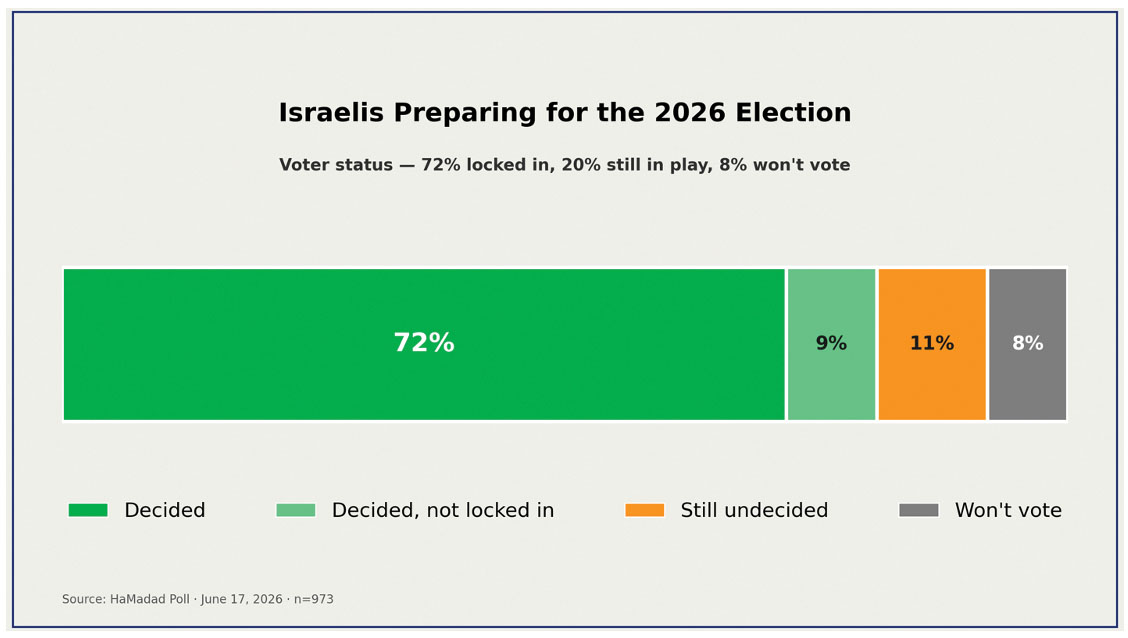
How many of us are still undecided? More than a few (based on my weekly poll for Channel 13 News).

A reader’s response

Eilam Hirsh writes: “Trump is going to end up as the worst president for Israel ever.” My response: I hope not, but I see the potential for such an outcome. Let’s keep our fingers crossed.


Shmuel Rosner is senior political editor. For more analysis of Israeli and international politics, visit Rosner’s Domain at jewishjournal.com/rosnersdomain.

Rosner’s Domain | What Is ‘Right Wing’ in Israel? Read More »

Abu Yair: The Left’s New Superstar

On the morning of Oct. 7, 2023, as Israel came under attack, a familiar military figure suddenly appeared on television screens across the country: Yair Golan.

Dressed in uniform, Golan was seen entering combat zones and assisting in the response to the Hamas massacre. For many Israelis, it was their first real introduction to him. Despite his senior military background, he was far from a household political name.

Then something remarkable happened.

A massive public relations campaign followed. Almost overnight, Yair Golan transformed from a retired general into one of the most talked-about politicians in Israel. He united Labor and Meretz and created The Democrats, a party identified with Israel’s Zionist-left and liberal camp. Meretz itself had failed to cross the electoral threshold, yet under Golan’s leadership the new party now consistently polls between nine and 12 seats.

Whether one agrees with him or not, Golan has proven himself to be an exceptionally skilled politician. He understands modern political marketing, voter outreach and coalition-building.

In Arab communities, he has even earned a nickname: “Abu Yair.” His outreach efforts toward Arab citizens are impossible to ignore. Much of his social media presence, including content associated with his party, is published in Arabic. He frequently speaks directly to Arab audiences and has made a clear effort to engage a population of more than 2 million Arab citizens of Israel.

This strategy resembles trends seen across Europe and North America, where progressive and liberal parties increasingly compete for minority voting blocs. Supporters view this as inclusive politics and coalition-building. Critics see it as placing electoral considerations above the concerns of the Jewish majority.

That perception was reinforced for many Israelis following one of Golan’s most controversial statements during the war, when he said: “A sane country does not wage war against civilians, does not kill babies as a hobby, and does not set for itself goals of population expulsion.”

For many Israelis, this was not seen as criticism of government policy, but as an attack on IDF soldiers, the young men and women risking their lives to defend the country. In their eyes, the IDF remains a national consensus and should not be portrayed in such terms.

The controversy did not end with public criticism. Following the remarks, Defense Minister Israel Katz ordered that Golan no longer be invited to official IDF activities and barred him from entering military bases in his former capacity. The decision further highlighted the depth of the backlash his comments generated among many Israelis.

For many Israelis, statements like these reinforced the belief that parts of the political left are more focused on criticizing Israel than standing with the victims of the massacre, the hostages, fallen soldiers and their families. As a result, many voters feel increasingly disconnected from the Israeli left.

Yair Golan remains a strong supporter of the two-state solution. For many on the right, this symbolizes a political camp that continues to believe peace can be achieved through territorial concessions despite the lessons many Israelis drew from the war.

Many of Golan’s supporters also oppose the settlement movement in Judea and Samaria, viewing it as an obstacle to a future agreement with the Palestinians. Critics argue that this has turned the settlers and pioneers of Judea and Samaria into one of the primary targets of the Israeli left.

The Israeli right may strongly disagree with Golan’s positions, but dismissing him would be a mistake. He has revived a struggling political movement and established himself as one of the most influential opposition figures in Israel.

Israelis should get used to seeing The Democrats, led by Golan, as a significant force in Israeli politics over the next four years. Whether the party ultimately finds itself in the opposition or as part of a governing coalition will be decided by voters at the ballot box.

What is already clear is that Golan has successfully rallied much of Israel’s peace camp, many believers in the Oslo vision and a significant portion of the older generation that once formed the backbone of the Labor movement. His voice, and the political camp he now leads, are likely to remain a prominent part of Israel’s national conversation for years to come.

Love him or hate him, Abu Yair has become the left’s new superstar.


Maoz Druskin writes about Israel, democracy and the challenges of national identity in modern societies.

Abu Yair: The Left’s New Superstar Read More »