fbpx

October 29, 2025

Two Years Beyond Oct. 7, 2023

I am writing this on Oct. 6, 2025, just a day shy of Oct. 7 — a date that carries tremendous emotional weight for me, as I’m sure it does for many. I place it among the two most devastating moments in my life: the untimely death of my father at 54, one day after I turned 24, and the shocking and unexpected death of my younger sister, Susie, on a Wisconsin road. In each case, the world fell away beneath my feet. I was transported to a new reality, one that required a slow and painful adjustment to whatever it held in store. So it was with Oct. 7.

My wife and I had been staying in Brooklyn at the time, celebrating the birth and bris of our newest grandson, born to my son Isaac and his wife. It was a time of unbounded joy — its own kind of new reality, one that expanded my sense of the world and of myself. The closest thing I can compare it to was pulling back the lens of a camera to reveal not a new scene, but the same one—suddenly, and unimaginably, more vast. It contained more possibilities, more understanding, a clearer sense of priorities, and mostly, I think, a deeper gratitude for all I had been blessed with.

Such was my mood that Saturday morning, a Shabbat that fell on Simchat Torah — the most joyous of all the Jewish holidays. I slept in and woke with that same sense of gratitude. As I walked down the stairs, I saw my wife. For those who have been married a long time, knowing the mood of one’s spouse becomes an instantaneous, visceral knowledge. There was no guesswork, only the certainty that something terrible had occurred. Not an inconvenience, not a broken pipe or a bill that needed to be paid — this was far beyond that.

“Something happened in Israel,” she said. “I don’t know exactly what, but there’s been a terrorist attack. A lot of people have been killed, and many have been kidnapped and taken into Gaza. That’s all I know right now.”

So, why, you might ask, would this news—and the staggering details that came afterward—be on par with the deaths of my father and sister? I’ve thought a great deal about that over these two years since Hamas’ pogrom. The question becomes more refined: what place does Israel hold for me, a Minnesotan-born Jew? What is it that is so compelling about this tiny strip of land?

Oftentimes it’s something as simple as a scent that brings me back to an answer. Some say that our sense of smell — perhaps because it warns of danger or decay — roots itself more deeply in memory than any other sense. I know that’s true. There are moments when I’ll catch something familiar — a whiff of blue spruce or night-blooming jasmine. I’ll stop what I’m doing and be carried back to Israel, to the sense-memories of my childhood: the first time I traveled there with my parents, siblings, grandparents, aunts, uncles and cousins. I was eight years old then. It was June of 1968, exactly one year after the Six-Day War. I didn’t understand the import of that brief, epoch-changing war, but I did intuit something about peoplehood, about family, about tribe — about belonging.

It was there that our family, who had gone West before the Shoah, met another branch who had survived and gone East, to Israel — to the only place on earth that would accept them. To the only place on earth that would embrace them. And so, I, too, was embraced — showered with love from people I had never met. This feeling — not the holy places, not the sea, not the roar of jets with blue Magen David stars on their wings — spoke of acceptance and protection. It was people. It was love. It was the sensation, exquisite and heretofore uncommon, of being part of something beautifully mine. There was one more aspect, one I could not fathom, only feel, which is the centrality of the land of Israel; something universal, something cosmic.

Think for a moment about history, ancient and recent, and about the present. Think about the role this seemingly insignificant piece of real estate has had in world consciousness. Consider how for millennia, countless wars have been fought over it; consider how often it has played on the news, in poetry, and in song. One answer to these questions, which has intrigued me for decades, is this: in Solomon’s temple, the Beit HaMikdash, which stood some 3,000 years ago in the place where the Al Aqsa mosque stands now, there was a space called the Holy of Holies. It was there that the High Priest of the Jewish people would enter once a year on Yom Kippur, to relate directly to God. It was said to be the “interface” between the temporal world and the spiritual. It’s doubtful any rational person would take this seriously. But then again, no rational person can fully explain the magnetic pull the land of Israel has in the human imagination.

When I think about Israel today, and in the days since Oct. 7, I am not thinking about the government, politics, or infrastructure. I am thinking about brothers and sisters. But how is it possible to mourn, to fear for, to love and support people you’ve never met? This is not a psychological question, but a spiritual one.

In my view, every person is a Tzelem Elokim — created in the image of God. Each is sacred. None are to be reviled based on color or creed. To do so is to commit a kind of moral insanity. Each person, whether they know it or not, belongs to a past, a peoplehood—even if that past or peoplehood has been lost. I know, beyond a doubt, that I am part of Am Yisrael, the family of Israel. Oct. 7 saw Hamas acting out its own distorted sense of peoplehood. It led them to commit the greatest acts of evil. For many, the word “evil” feels anachronistic, something from a distant or irrelevant history. To the contrary, evil always lives among us.

I recall a psychologist friend of mine, an older man who has since died, who wouldn’t use the word even for those who committed the worst crimes. “Bad brains,” he would say — at least until I pressed him. He was a man steeped in the latest scientific theories. One day, as he told me about his early years as a therapist, he mentioned that while earning his degree, he’d gotten into conflict with a professor over his unwillingness to work with certain people. My friend refused to treat sex offenders, particularly those who had harmed young children. “I just couldn’t do it, nor can I now,” he said. I pushed back. “What if they simply needed your help?” He paused. “Even so, I find them evil and disgusting.”

This is to say that no matter how we’ve been educated or acculturated, we all know that evil exists—and that it must be confronted. Oct. 7 was our horrific reminder.

Allow me to jump to the present. Many of the world’s leaders are widely reviled. Some of my readers have written to me saying that certain political figures are themselves evil, that they should be destroyed or erased. Indeed, people have strong emotions.

There’s an old moral hypothetical you may have heard: knowing what you now know, would you have killed Hitler while he was still a baby? The tension is obvious — you would commit the murder of a child to prevent the murder of millions.

But let me invert the question: if all the hostages were released, and peace — not merely a ceasefire, but real peace — were to break out across the Middle East, would we still despise the figures who helped bring it about, even if we once found them unbearable?

And what if the peace we long for had to come through brutal and tragic means? Could we — at least, those of us who have not been directly traumatized by serious injury or by the loss of loved ones — accept that some things must pass through darkness before arriving at light? Would we be willing to see that, at times, the instruments of redemption may not resemble the ones we would have chosen?

Now, after many years, I’ve come to see that my father’s death led to circumstances I could never have imagined — to experiences so beautiful they once lay beyond my comprehension. To be fair, I haven’t been able to do that with my sister’s passing. And yet with enough time, I know it’s possible. Would I have preferred that my father not die? Of course. And for my sister as well.

But here we are — with scars that will never heal, but might, with time, soften. With the scents of pine and jasmine. With a sky above us that has remained, and will forever remain, untouched by war. With oceans and rivers unconcerned with the machinations of humankind. With love, now freer to express itself. With things of importance taking precedence over things of lesser consequence. And with a faith that, though battered and bruised, still carries each of us forward.

May we seek peace. May we find it, even through the fog of our well-founded doubts. These are days of revelations and wonders. Just as we do, they too, long to be noticed and embraced.


Peter Himmelman is a Grammy and Emmy nominated performer, songwriter, film composer, visual artist and award-winning author. 

Two Years Beyond Oct. 7, 2023 Read More »
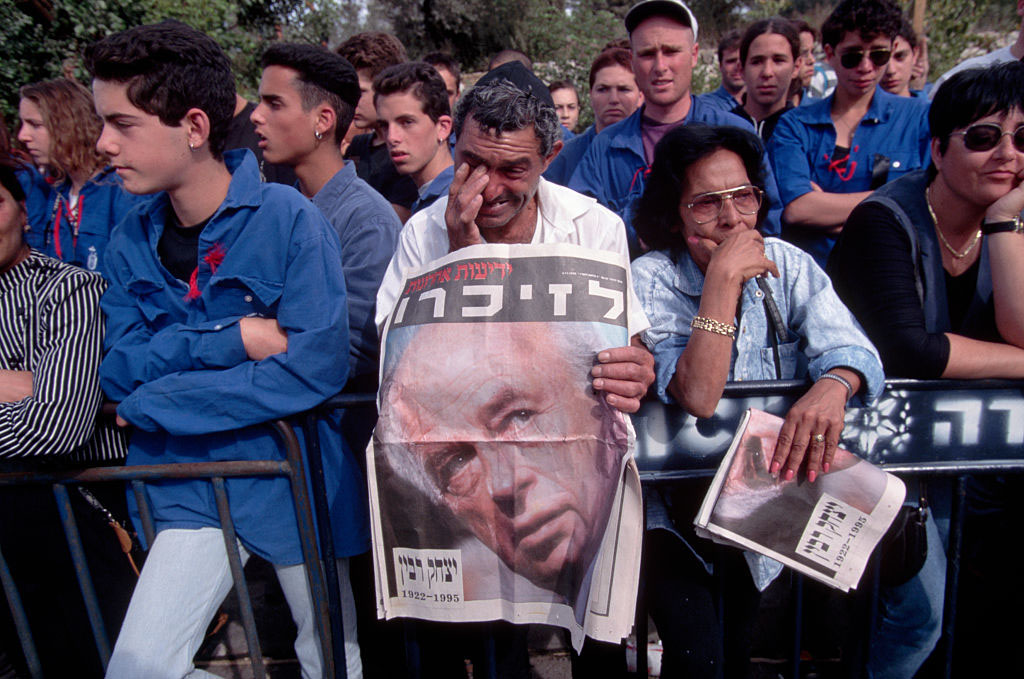
Rosner’s Domain | The Rabin Mirror Still Stands

Three decades is a long time for a country to ponder the meaning of a single night. And yet Israel has managed. The night Prime Minister of Israel Yitzhak Rabin was shot, 30 years ago next week, is not an event tucked away on a shelf; it is a hinge moment that still squeaks every time we open the door to our daily recriminations over day-to-day politics. In Israel and in other countries, some assassinations have receded into the footnotes. Ask most Americans about James Garfield and you’ll get a shrug; a streaming drama, forthcoming on Netflix, may briefly revive him. Rabin is different. Israel is too young to forget its leaders and too implicated in his story to let it fade. His murder is not simply history. It is a mirror.

The Garfield comparison is useful in one way: it reminds us that an assassination can be swallowed by history when the surrounding controversies are settled. Garfield’s doctors blundered, medicine improved, the republic moved on. Israel has not moved on, because the argument embedded in Rabin’s career – war and borders, Oslo and partition, identity and sovereignty – never ended. It remains the argument under every argument.

Israel has not moved on, because the argument embedded in Rabin’s career — war and borders, Oslo and partition, identity and sovereignty — never ended. It remains the argument under every argument.

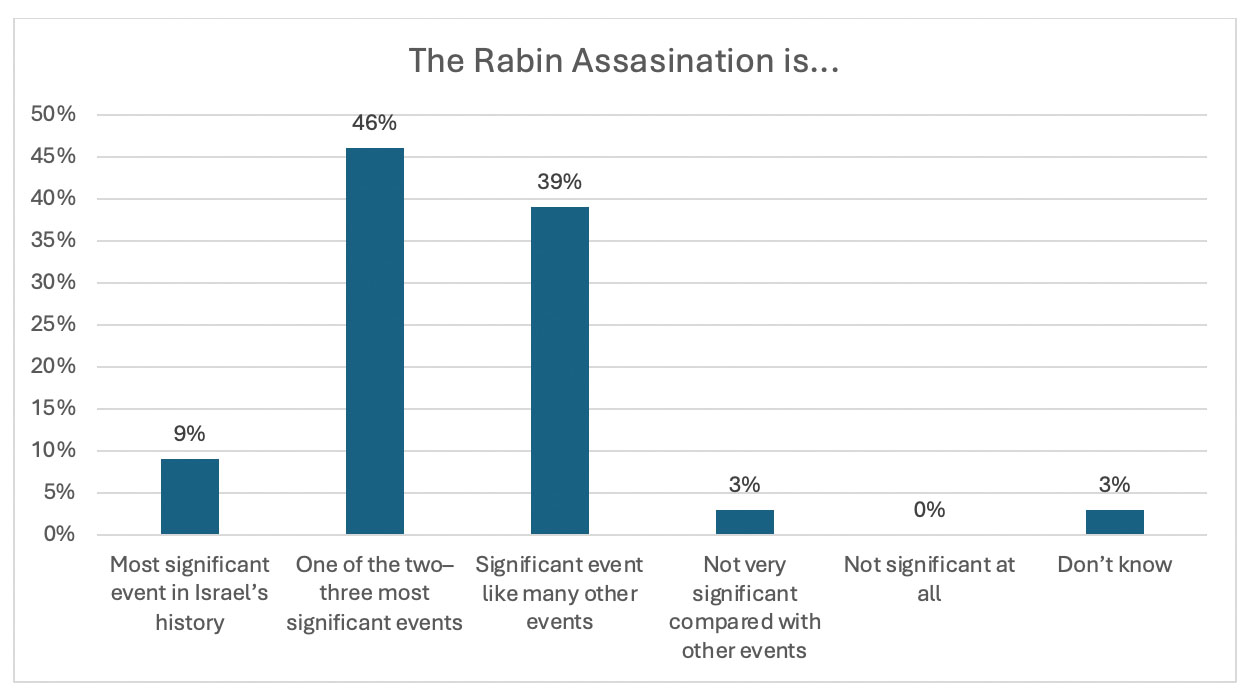
How do Israelis remember, and how do they measure that memory? The picture is layered. Among those who remember that night, most call it “very significant.” One of two or three formative shocks (see the graph to the right). But there’s also a significant group which says: it is important, yes, but “like many other events” That last phrasing, tellingly, is more common among people who identify with the right. They do not deny the trauma; they do downgrade its significance compared to other events.

On Rabin the statesman, the ledger is mixed but leans positive. About three in four Israelis assign him a positive contribution, many emphatically. Roughly one in five assigns a negative contribution  — and here the right splits almost evenly. This is not partisanship; it is a theory of causality. If you think the central fact of Rabin’s career is the Oslo Accords, and if you think Oslo was fundamentally misdirected, then a negative verdict can be coherent without being callous. It is not an argument for murder. It is an argument about policy and legacy.

Oslo, indeed, is the crux. With three decades of hindsight, the plurality verdict on this attempt at resolving the Israeli-Palestinian conflict is harsh: the process was wrongheaded. And yes there’s also a group saying the idea might have been good but had no chance to succeed. Identity lines map onto all answers: Jews and Arabs answer differently; right and left answer differently. But the deeper fracture is temporal. We disagree not only about what Oslo was; we disagree about what Oslo did.

Which leads to the most uncomfortable question: did the assassination “work”? Many properly recoil at the formulation. Yet a sizable share of Israelis believes the murder halted the Oslo process. That some Israelis can hold, simultaneously, the beliefs that Oslo was disastrous and that only Rabin’s death stopped it, reveals the paradox that must haunt us: a reprehensible act that might have produced what most Israel would consider a desirable result. 

If democracies are measured by procedures surviving trauma, Israel passed the immediate test. After the murder, there was orderly succession. There were elections. There was alternation of power — again and again. One scholar reads this as maturity: grief over a leader was not confused with choice over policy. Another reads it as evidence that the grief was shallower than we remember. The data tilts toward deep mourning, but the argument about depth is itself part of the memory. Perhaps that is fitting. Democracies metabolize trauma not with consensus but with repetition — memorial days, debates and counter-debates, museums and marches and the quiet inventory taken at kitchen tables.

There is also a rhyme between the trauma of the 1995 assassination and the trauma of the 2023 massacre. Rabin’s murder taught us about fragility from within; Oct. 7 taught us about fragility from without. Both can coexist with an equally true lesson about resilience. We break less easily than our enemies hope and our cynics fear. Those who predicted democratic collapse after the assassination were wrong. Those who thought the trauma would heal quickly were also wrong. The murder proved both more and less significant than we imagined — catastrophic in what it revealed, survivable in what followed.

So three decades after Rabin was shot, we do not have closure. Instead we have a lesson and a warning. The lesson: a modern state can be vulnerable and tenacious at once. The warning: the line between fierce politics and violence is thin. Crossing it carries consequences that echo for generations.

Rabin’s assassination will keep echoing because the decisions bound up with his name keep recurring. Every time Israelis debate annexation or withdrawal, compromise or security, the hinge squeaks again. Perhaps that is the real measure of importance — not the drama of the night itself, but the persistence of the questions it forced us to face.

Something I wrote in Hebrew

Is Israel still “independent”? As the debate rages, due to U.S. “dictates,” I wrote this:

If Israel wants to be a little less dependent on the United States … it needs to take two steps that are almost self-evident. It needs to forge ties with additional countries that can help in areas where Israel would like to forgo American assistance… The second step is one of build-up … with the aim of reducing overall dependence … Of course, this is easy to say and hard to do. Israel cannot grow everything, produce everything or supply everything for itself. It certainly cannot do so without a sustained and focused effort to improve its economic condition, which is the key to strengthening. In other words: less dependence on America requires Israel to improve its standing in areas critical to economic strengthening … And this is not what Israel is doing at present. 

A week’s numbers

Two historians I spoke with, Dr. Avi Shilon and Dr. Nurit Cohen, both consider Rabin’s assassination to be the most significant event in Israeli history, at least until Oct. 7, 2023, whose impact is still unfolding. The public, polled by JPPI, is not with them. 


A reader’s response

Ira Levin writes: “Shmuel, I saw (on social media) that you have a new book. Congratuations.” My response: Thank you Ira – as your note gives me an opening to publicize it. “Why Am I a Jew,” forthcoming Nov. 4. You can already preorder it. You’d make me happy if you do. 


Shmuel Rosner is senior political editor. For more analysis of Israeli and international politics, visit Rosner’s Domain at jewishjournal.com/rosnersdomain.

Rosner’s Domain | The Rabin Mirror Still Stands Read More »

Rabbis Need to Be Trained for the Job They Actually Do

Rabbi Lord Jonathan Sacks taught, “Judaism does not mean living in the past. It means living with the past, but with eyes firmly turned toward the future.” While the concern for the rabbinic pipeline and the need for more quality rabbis has already been sounded, we need to simultaneously be engaging in the parallel conversation around rabbinic training. Emerging from the 18th/19th century Haskalah movement, the early Rabbinic Seminary sought to blend traditional Torah learning with secular studies and modern academic methods to best prepare its graduates for holy rabbinic work. Now in the 21st century our rabbinic seminaries still strive towards these same purposes – to prepare graduates for holy rabbinic work. Yet, as the role of rabbi has shifted, our training modes have not kept pace. 

Jewish communal survival is directly tied to our ability to innovate – using the present as the foundation upon which to build a better future. The establishment of the modern state of Israel is an example of such an innovation. In 1902, Theodor Herzl published his utopian novel “Altneuland” (“The Old New Land”). In this work Herzl imagines a future in which the old land is not forsaken but rather is transformed into a modern, thriving, advanced society. A student of his reality, Herzl understood that for the growth and sustenance of Judaism and the Jewish people, Jews need a nation of refuge and national pride. Now, roughly 125 years later, Herzl’s vision is widely celebrated as a core element of the Jewish present and not just a dream of the Jewish future. It is now our generation’s turn to pick up this mantel of vision and begin to imagine how we might critically engage our present as a directive towards building our future.

Let’s not pretend that training rabbis is an easy task. Professionally, rabbis take on a variety of roles including (but not limited to) spiritual guide, educator, pastoral care giver, Jewish legal adjudicator, public speaker, supervisor and fundraiser. A rabbi should be fluent in modern politics and ancient biblical and rabbinic texts, capable of inspiring youth many years their junior while also engaging with those many years their senior. As the classic joke suggests, a rabbi should emerge from school being both young and with 20-plus years of experience. Our seminaries have attempted to navigate the need for these diverse skills with semi-regular curricular shifts around their edges, aimed to better prepare their graduates for the professional work of rabbis. And it’s not enough. Small curricular shifts can’t equip rabbis with the requisite skills need to serve the variegated needs of the Jewish people in modernity.

Rather than patterning themselves on secular academies of higher learning, rabbinic seminaries should seek a new paradigm – the vocational school. Vocational schools provide their learners with hands-on, job-specific training, allowing them to enter the workforce already imbued with the practical skills to make an impact. By maintaining a model of the secular academy, each rabbinic training program tackles the impossible problem of attempting to adequately train rabbis by imparting 4,000 years of wisdom in three to five years of training through extensive coursework in subjects like Jewish History, Tanakh, Talmud, Midrash, Hebrew, Jewish Thought and Philosophy, etc. To add to the complexity, as schools have identified the increased need for skill-based learning, i.e. pastoral care, this discipline too has been shoehorned into the larger academic endeavor. As a result, rabbis are ordained with a significant amount of content knowledge and (at best) an ability and desire to continue to learn outside of the classroom. They learn very little of the valuable skill sets used for the majority of rabbinic work.

If one were to graph the tasks and roles rabbis most frequently navigate professionally, would that graph correlate with the similar chart of time allocation and focus during rabbinic training? At Mem Global, as we’ve invested in our work around building the rabbinic pipeline and developed our own rabbi-centered programs like Base and Embark, we’ve become increasingly aware of the dissonance between skill sets rabbis are trained for as students and the skill sets they need to be successful in their rabbinic work. We believe that rabbis are vital for the Jewish future. And we believe that the significant gaps in rabbinic education don’t adequately prepare emerging rabbis for rabbinic work.

Three examples:

• Relationship building is core to the rabbinic profession and yet, for most students, proportionally very little time is invested in building and refining this skill set.  How might relationship building be a core objective in rabbinic education rather than an ancillary part of a student’s learning?

• Public speaking is a common element within many rabbinic roles. What would it look like if students were equipped, not just with periodic moments of public speaking training, but rather if public speaking was a significant and repeated element of learning aimed to enhance a rabbi’s ability to articulate and communicate both inwardly and outwardly and through a variety of media?

• Rabbis serve as leaders. How might, over multiple years, rabbinical students dive deeply into leadership development, better understanding their own unique talents and leadership style? As a core element of training, how might it look for a student to learn about staff supervision, strategic visioning and change management, to deeply immerse in preparing for a career as a leader?

Admittedly, the shift I’m calling for isn’t simple and, as a zero-sum time game, an emphasis in one area of learning inherently requires a de-emphasis in another.  And yet, this is the hard calculus we are now called to do.  In an age of Sefaria and AI – access to Jewish knowledge is no longer the core element of a rabbi’s role.  Knowledge is now accessible wherever there is an internet connection. Rabbis are no longer the primary or sole access point to Jewish wisdom. Rabbis are now called on for different types of communal roles. Roles that can’t be outsourced.  Roles of relationship building, communication, teaching and leadership. The classic rabbinic training model, despite its fringe efforts to adapt, cannot meet this shift. Rather, a new model is needed. We need rabbinic training programs to serve as vocational schools – best equipping their students with the tool sets of classic Jewish learning and, equally critically, the toolsets of modern leadership to be best prepared to serve the Jewish people.

In the early 19th century Herzl had the courage to assess his reality and dream of an Altneuland – a better future built on the foundations of the present.  It is time for us to begin to dream of an AltneuRabbi, built on the commitment of service to the Jewish people that has compelled rabbis for ages, but enriched through a change of the training model to better meet the needs of the modern rabbinate.  Im tirtzu ain zo agadah – If you will it, it is no dream. 


Rabbi Ari Perten is the VP of Jewish Learning at Mem Global (formerly Moishe House).

Rabbis Need to Be Trained for the Job They Actually Do Read More »

A Place IDF Soldiers Can Speak for Themselves

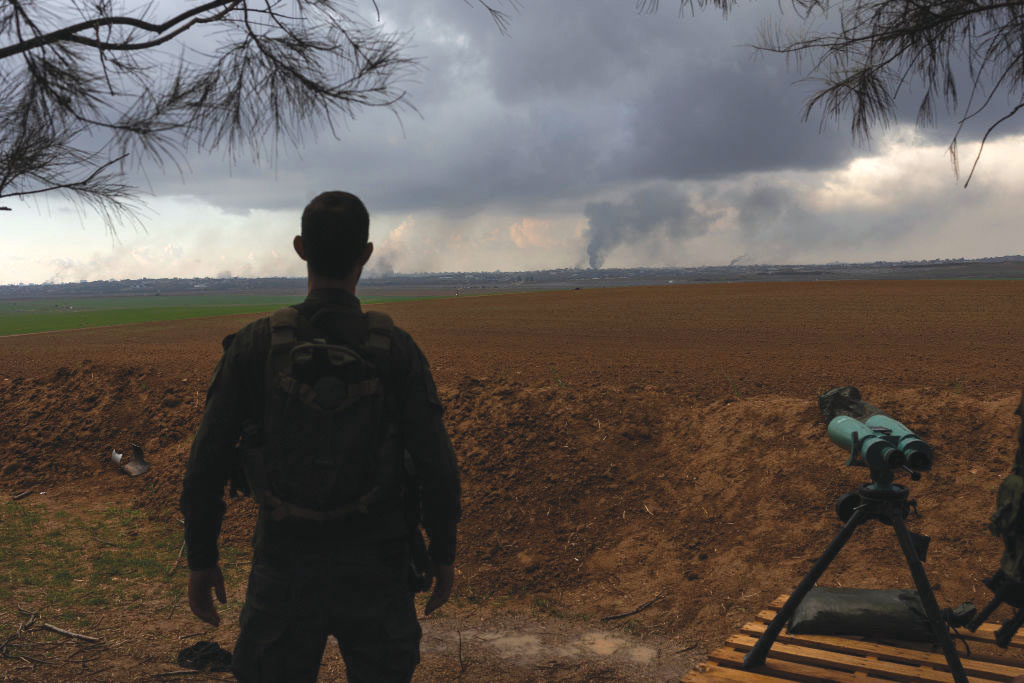
The newest issue of White Rose Magazine, titled “Bearing Witness: IDF Testimonies,” features first-hand accounts of primarily young reservists who were invited to write their own stories from the war that began after the terror attacks of Oct. 7, 2023.

In an editor’s note, executive editor Ben Poser called the issue “its own form of Shabbat,” describing it as a haven for soldiers whose humanity, he wrote, has been erased by media that “speak of Israeli soldiers while invariably obscuring their own voices.”

It’s not hot takes on how to solve the Middle East crisis or the latest incidents of antisemitism gone undeterred on a college campus. Editor in chief Karen Lehrman Bloch gave minimal directions to the soldiers, saying, “we’d like you to write about your experience.” What the soldiers sent back was anything but minimal.

It began when Lehrman Bloch, who has edited White Rose for four years with senior editor and poet Darren Glick, started hearing firsthand accounts that no one else was publishing.

“We were seeing endless commentary about Israel,” Lehrman Bloch told the Journal, “but none from the people actually fighting to save it.”

Named after the 1942 group of German students who tried to disseminate the truth about the Third Reich, the mission of White Rose Magazine is to encourage bravery in the face of fascist ideologies and reteach the principles of classical liberalism. Lehrman Bloch knew what the 26th edition of White Rose needed to be while she was attending a small gathering in New York where IDF reservists described what they had seen.

The collection of writings from soldiers, Lehrman Bloch says, has no ulterior motive other than to allow these soldiers to tell their own stories.

“This is not an official PR campaign from the IDF; we’re a magazine,” Lehrman Bloch said. “This is not activism. We are an intellectual magazine, and because of our heritage,  there’s an onus on us to bear witness.”

Lehrman Bloch and Glick eventually gathered nine contributors. Some were still on active reserve duty; others had fought in previous conflicts. One of them, Dr. Yair Ansbacher, contributed an excerpt from his forthcoming memoir “The War We Failed to Foresee, the Devastating Price We Paid, and the Miracles That Saved Us.” Others, such as Abe and Hezi, wrote their pieces exclusively for White Rose.

In “October 7, 2023,” Ansbacher describes rushing south as the attack unfolded, finding himself among burning kibbutz homes and unburied bodies.

“Later, we watched footage from the GoPro cameras recovered from the dead terrorists,” Ansbacher wrote. “One thing stood out very clearly. The moment they encountered IDF fire, they scattered and became disoriented. All the members of the squad—about ten terrorists—kept calling out the name of their commander, over and over again, waiting for his direction to know what to do next. Their ability to show flexibility and adapt to what happened once the original mission went off course was virtually nonexistent.”

In “My Judean Soul,” Abe, a paratrooper, wrote, “With every step, the atrocities grew worse. I came upon an Israeli vehicle burnt to a crisp. Inside was a mother, completely burned, shielding her two children in the backseat as they hugged each other, also completely burned. That image never leaves my mind.”

Looking back, Abe said, “I will never regret drafting, nor will I regret experiencing what I did because it shaped me into the man I am today. I will always do my best for those who can’t, and often think about those who are no longer here with us.”

In “Surviving Evil,” Aaron documents the quiet work of retrieving bodies from Kfar Aza. “When it became clear there were no terrorists left in the area, part of my squad was given one of the toughest missions imaginable: along with the medical crews and slightly older reservists, it was time to clear the bodies, identify them, and prepare them for a proper burial.”

In “Stepping Into the Unknown,” Hezi, an armored-vehicle reservist, tells of bulldozing through the ruins of Gaza. “It is impossible to describe the cruelty of an enemy that hides behind the innocent, using women and children as shields,” Herzi wrote. “Each time, my heart broke, but my determination grew stronger.”

And in the magazine’s exhibition section, “Giborim – Heroes of the IDF,” Ben Poser presents photographs of soldiers over the last 77 years alongside with quotes from Prime Minister Yitzhak Rabin, Elie Wiesel, Rabbi Lord Jonathan Sacks, and King David (Psalm 27:2-3). The quality of the photographs improves with time but the look of struggle meeting strength on each soldier’s face seems to look the same year after year.

“We’re not hearing somebody’s interpretation of what’s going on in their heads or what’s happening,” Lehrman Bloch said. “These are their voices talking. There is a reason the documentary ‘Bearing Witness’ [by James Maslow] has such a monumental power over Jews especially.” In that documentary, Maslow hears the firsthand stories of survivors of Oct. 7. The 43 minute documentary was released on YouTube in 2024.

Lehrman Bloch said she used restraint in editing the soldiers’ writing, even though English isn’t typically their first language. In fact, she and Glick expected the testimonies to come back in Hebrew. None of them did. She encourages other soldiers to reach out to White Rose to have their stories be heard.

“These guys risk their lives for the truth, for morality, for Israel,” Lehrman Bloch said. “The least we can do is give them the mic and say, okay, what was your experience? And tell us about it. And that will help. And in fact, I think it’s helped them, a couple of them are now thinking about doing books and doing more things from the experience. And so that makes me happy, inspiring these young heroes themselves.”

Glick, who had been in Israel on 10/7 and stayed for months after, helped confirm each story’s authenticity, and knew many of the soldiers personally. His poem “Testimony,” conveys a sense of inward conflict:

Who among us is pure?
In deed and deeper?

Not the warmonger,
Nor the peacekeeper

And I’ve seen too much,
Jaded my core

And felt not enough,
So I embellished the score

Glick explained that White Rose Issue XXVI does something that anyone with a heart can do: listen. The difference here is that White Rose publishes what the soldiers have actually experienced.

“This shows the human side, and one of the things I recognized in spending all that time in Israel was [the soldiers] didn’t have a voice and they were so happy that there was an American or a foreigner that was coming to their bases meeting with them,” Glick said. “I did very little talking. I was there to show my appreciation for what they were doing, risking their lives and defending the country.”

Whatever one thinks of the war, White Rose’s IDF issue stands apart for its simplicity in presenting the most complicated of emotions. It publishes the sentences of people who have nothing to prove and so much to remember and process.

Any IDF soldier—active, reservist, or veteran—who wants to share their testimonies with White Rose Magazine may contact Karen Lehman Bloch at KLBloch@whiterosemagazine.com

A Place IDF Soldiers Can Speak for Themselves Read More »

The Power of a Billion Prayers

Almost immediately after the horrific Hamas attack of Oct. 7, 2023, most Orthodox Jewish congregations began the practice of saying additional Tehillim (Psalms), usually chapters 121 and 130, after the three daily prayer services. In addition, many congregations, Orthodox, Conservative and Reform, added the short Acheinu prayer, a prayer for the release of captives that dates to the Middle Ages.  This 53-word prayer emphasizes the collective pain the entire community feels over Jews suffering in captivity:

“Our family, the whole house of Israel, who are in distress, or in captivity — who stand either in the sea or on dry land — may the Omnipresent have mercy on them and take them out from narrowness to expanse, and from darkness to light and from oppression to redemption, now, swiftly, and soon!”

By my estimate, validated by a Wharton statistics professor, Jews around the world have said the Acheinu prayer over a billion times since Oct. 7. I have personally said the Acheinu over 2,000 times since Oct. 7, thinking every time about my deepest hope that they would somehow be taken “out from narrowness to expanse, and from darkness to light,” words that powerfully express what we now know to be the experience in the Hamas dungeons.

Many of the hostages themselves prayed as well. Some of them were religious when they were taken hostage. Some became religious because of the experience. The sustaining of hope through prayer is often derided in Western liberal societies. But the hostages themselves have attested to the power of prayer in giving them not only hope, but agency. And that gave them a grasp on life itself.

They may also have benefited from knowing that they were being prayed for. Studies have shown that people who know they are prayed for fare better and return to health more often than those for whom prayers are not said.  This is one of the reasons for the focus that synagogues have on prayers for health and healing, with the calling out of specific names of those who need healing. 

Still, adding the prayers was unusual if not unprecedented. Orthodox Jewish prayers change very rarely, and not lightly. The first Siddur, or prayer book, dates to the ninth century; before that, prayers were generally said by heart. The Jewish liturgy became more universal with the advent of the printing press in the 15th century and the creation of the first Soncino book. Although there are occasional changes based on new developments, such as prayers for the health of the relatively new State of Israel, for the most part today’s Orthodox prayer service is little different than what the Soncino printers laid out in the late 1400s.

The tradition of saying prayers in times of need dates back to the Bible. In Genesis, Jacob prayed in advance of a dangerous meeting with his brother Esau, and Hannah prayed for a child in Samuel I.  In Jewish law, Maimonides wrote in his Code, or Mishneh Torah, around 1180 C.E., that it is “permitted for a healthy person to read verses [from the Bible] or chapters from Psalms so that the merit of reading them will protect him and save him from difficulties and injury.”

Over a century ago, both German and British Jews had special prayers for opposite sides in World War I. In World War II, however, Jews were more aligned against the Nazi threat. In March of 1945, a joint declaration from Jews of three countries – Canada, the U.S. and the British Mandate of Palestine — called for “a day of fast and prayer … for the termination of this bloody war, and for the safe return of our sons and daughters.”

Of course, it’s not just Jews that look to prayer in times of need. According to the Anglican Compass’ Jacob Davis, “Anglicans across the centuries have turned toward Scripture, specifically the Psalms.” Many Christians also prayed for Israel specifically after Oct. 7, for which Jews should be grateful.

A generation ago, Jews also responded to the terrorist attacks of Sept. 11 with prayer. In this period, Israel was facing the suicide bombings of the Second Intifada, which killed over 1,000 Israelis, adding to the sense of need for additional prayers.  There does not appear to be any one moment at which synagogues stopped saying extra Psalms in this period, but the immediate fear of a new attack in America eventually subsided, and Israel’s creation of a West Bank security fence helped quell the onslaught of Palestinian suicide attacks. One rabbi I spoke to told me that he stopped saying them in the fall of 2004, and that he feels that “special” prayers lose their specialness if they become permanent.

Oct. 7 made special prayers necessary once again. Even as we prayed for the hostages, most people had little expectation that they would survive the horrors that Hamas had in store for them. I myself wondered whether these prayers would have any effectiveness, even as I dutifully said them, day in and day out, for two years. And while we mourn the 83 who did not make it, we must also celebrate the miracle that 168 of them have survived, an outcome no one would have imagined possible two years ago.

The release of the last living hostages has created a clean end point for the special prayers. Yet it is important to recognize the value of these billion prayers, even as they come to an end. Saying these prayers for the last two years gave seemingly powerless individuals agency during a difficult period, and demonstrated a collective focus on the hostages’ return. At the same time, halting these additional prayers and returning to the traditional service now provides hope that we will not need these prayers again, as well as maximizing their potential effectiveness should they be needed again in the future. 


Tevi Troy is a Senior Fellow at the Ronald Reagan Institute, Senior Scholar at Yeshiva University’s Straus Center, and a former senior White House aide. He is the author of five books on the presidency including, most recently, “The Power and the Money: The Epic Clashes Between Commanders in Chief and Titans of Industry.”

The Power of a Billion Prayers Read More »

Baseball, the Bible and William Brewster

As the Dodgers seek to repeat as World Series champions, it’s little known that one of their stars is an alumnus of a collegiate summer league team named for a Pilgrim who, some believe, drew inspiration from the Hebrew Bible in creating what has been called the first American Thanksgiving.

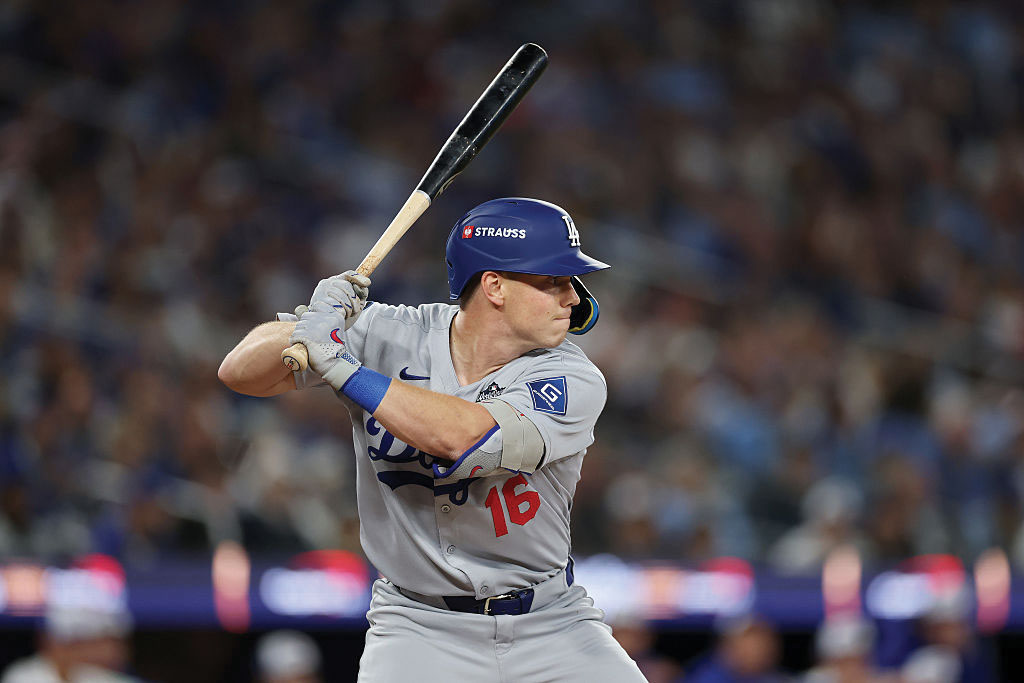
In 2015, before he was drafted by LA, catcher Will Smith, then a junior at the University of Louisville, played 10 games for the Brewster Whitecaps in Massachusetts. He batted .259. Though even the most devoted baseball fans likely have never heard of the team, part of the Cape Cod Summer League, its notable other alumni include the Yankees’ Aaron Judge, the Athletics’ Brent Rooker, and the Mets’ Jeff McNeil. 

The town that hosts the Whitecaps is named for William Brewster. Brewster was born in 1566 or 1567 in Nottinghamshire, England. He and his family fled to Holland due to religious persecution at the hands of the Church of England, and later continued to Leiden in the Netherlands. From there, after narrowly escaping being shipped by the authorities to England for execution, Brewster set sail on the fateful Mayflower journey. He then served as Plymouth Colony’s religious leader for almost a decade, and continued to preach until his death in 1644.

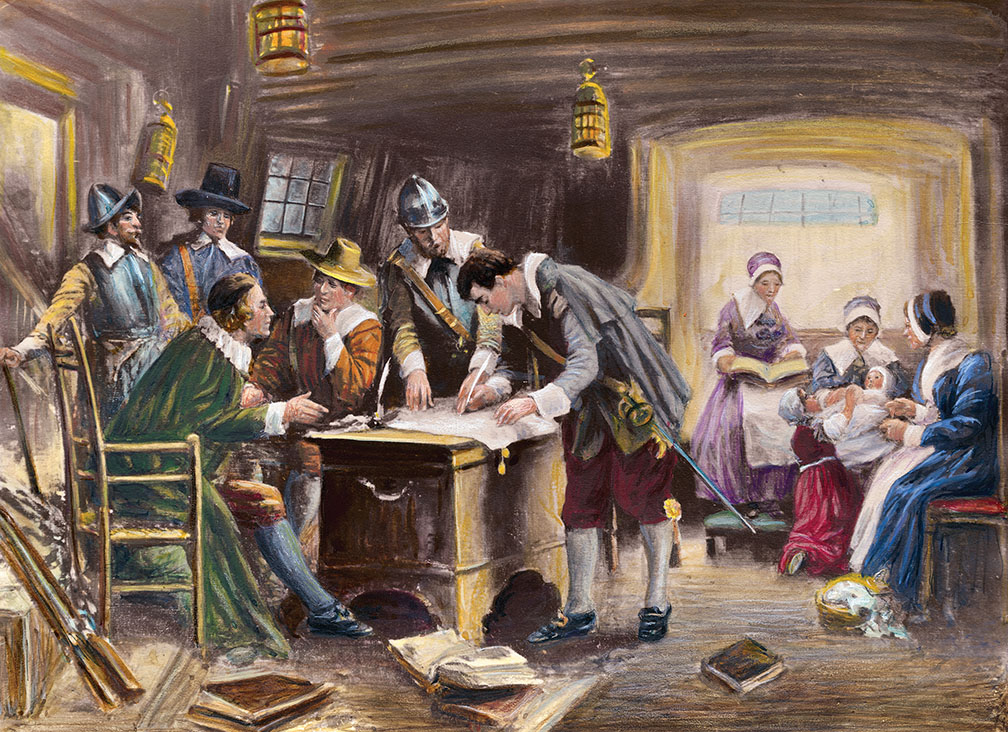
Signing of the Mayflower Compact by Myles Standish, William Bradford, William Brewster and John Carver on board the Mayflower in November 1620. Illustration from a painting by Edward Percy Moran (1862-1935), circa 1900. Bettman/Getty Images

Though the veracity of the details of the Pilgrims’ experience has long been subject to debate, legend has it that on Nov. 9, 1620, after 65 days at sea, the Pilgrims aboard the ship had spotted the American coast at Cape Cod. It was then that Brewster is said to have read Psalm 100 as an expression of the group’s collective desire to offer thanksgiving to God. He likely used a copy of the Bible prepared by Henry Ainsworth (1571–1622), the Separatist English clergyman. 

As the writer Nick Bunker describes in his “Making Haste from Babylon: The Mayflower Pilgrims and their World,” the Ainsworth translation sought to be faithful to Jewish interpretation. As Bunker puts it, “Inspired by the work of the rabbis, Ainsworth made new translations of the Psalms and the Torah. He wrapped around them a commentary, verse by verse and word by word, trying to distill every drop of meaning conveyed by their authors.”

Psalm 100, known as “Mizmor le-todah” in the Jewish tradition, is recited every weekday as part of the morning prayers. Ainsworth’s rendering, slightly modified, reads: “A Psalm for confession. Show ye triumphantly to [the Lord] all the earth. Serv[e] ye [Lord] with gladness: come before him with singing joy. Know ye, that [the Lord] he is God; he made us and not we: his people and sheep of his pasture. Enter ye his gates with confession; his courts with praise: confess ye to him, bless his name. For [the Lord] is good, his mercy is for ever: and his faith, unto generation and generation.”

Brewster’s purported prayer thus marked the Pilgrims’ project, despite its difficulties and the arduousness of their journey, as being graced by God. Though he of course could not have known what the future had in store for his fellow settlers, Brewster hoped that like Israel’s covenant with the Lord, his new community would endure. Whether the tale of his recitation is true or a myth, without a doubt in Brewster and the Pilgrims’ new Promised Land, the faith expressed in the words of the Hebrew Bible would serve as a model for the burgeoning American experiment. 

The late Senator Joe Lieberman (D-Conn.) told the story of Brewster’s recitation of Psalm 100 often, including in his last book, “Faith’s Answers to America’s Political Crisis: How Religion Can Help Us Out of the Mess We’re In.” He saw it as representative of the country’s covenantal character from its initial stages. Lieberman noted, “Our history has been a journey to realize, generation to generation, the ideals and promises of our founding generation … It is in the broadly shared faith and values of the American people, and the sense of unity and common action so many of us derive from the direction we find, the guidance and values we find, in our respective houses of worship.”

Brewster’s legendary expression of thanksgiving would eventually evolve, years later, into the beloved holiday celebrated by millions of Americans, independent of their faith, for centuries. Melanie Kirkpatrick, in her “Thanksgiving: The Holiday at the Heart of the American Experience,” includes Ainsworth’s translation of Psalm 100 under “Readings for Thanksgiving Day,” as “one of the great songs of Thanksgiving as the Pilgrims would have spoken them.”

Whether or not Whitecaps alum Will Smith and the Dodgers emerge victorious once more, then, all Americans have reason to cheer for William Brewster – a fascinating figure whose biblically-infused impact on America continues to inspire. 


Rabbi Dr. Stuart Halpern is Senior Adviser to the Provost of Yeshiva University and Deputy Director of Y.U.’s Straus Center for Torah and Western Thought. His books include the newly released “Jewish Roots of American Liberty,” “The Promise of Liberty: A Passover Haggada,” “Esther in America,” “Gleanings: Reflections on Ruth” and “Proclaim Liberty Throughout the Land: The Hebrew Bible in the United States.”

Baseball, the Bible and William Brewster Read More »

The Foreign Aid-Industrial Complex Has Some Soul-Searching to Do

When surveyed, voters across the West, from the US and the UK to France and Germany, report wanting their tax dollars going toward social services at home while being less enthusiastic about various causes abroad. Governments have also realized that some recipients of their foreign aid have diverged sharply from their own objectives and values, and turned into proxies of anti-American, anti-Western influence campaigns. And so, after years of leaving foreign spending on autopilot, countries have begun to reign in overseas development to reflect the priorities of their electorates.

The danger of modern foreign aid mechanisms thus goes beyond frivolity of spending, and extends – thanks to a lack of oversight and an overreliance on middlemen with varying agendas – into countries’ funding of causes that threaten their own security and flirt with terror glorification and support.

Examples, unfortunately, abound. In December 2020, the US Senate’s Oversight and Investigations Unit made public its findings that major humanitarian NGO World Vision had knowingly channeled funds received from the US government’s development agency USAID to ISRA, an Al-Qaeda affiliate in Sudan. World Vision made these transfers nearly a decade after ISRA was designated as a terror entity by the US Treasury for ties to terrorists “including Osama Bin Laden.” For World Vision, this wasn’t an isolated incident either – in 2016, the organization’s Gaza manager was arrested for and later convicted of embezzling aid money to US-designated terror group Hamas, and “tak[ing] an active and significant part” in its activities.

The USAID black hole took other forms, too. An investigation by NGO Monitor, the independent research institute where I work, has uncovered highly problematic grants channelled through the Tides Network, an opaque “fiscal sponsor” entrusted by an array of federal sources to spend government money.

USAID, the Departments of State, Labor, Agriculture, and even NASA have sent Tides over $55 million since 2008, mainly allotted for civil society initiatives as part of a “Foreign Assistance Program” meant to “advance US foreign policy objectives.” Tides distributed the money to various bodies, theoretically aligned with American policy aims.

However, listed after the innocuous-enough “Fiji Council of Social Services” on the US government’s Tides outlays list is 7amleh, an anti-Israel activist organization claiming to fight “censorship,” by which it means social media companies’ guidelines against hate speech, terror glorification and incitement to violence. Especially since the brutal Hamas attack of October 7, 2023, 7amleh has primarily lobbied Meta to reframe pro-terror agitprop as neutral content. For example, it advocated on behalf of a news account described as “Hamas-affiliated” by the State Department, and pushed back on restrictions against the “Al-Aqsa Flood” keyword, Hamas’s name for the massacre.

Cases extend far beyond the US. Since October 7th, NGO Monitor has revealed UK government funding in the Palestinian territories to NGO partners with links to terror groups, to the tune of £100 million and counting. One project details a cash assistance program coordinated via UNICEF with MoSD, a Gaza ministry “affiliated with the de facto authorities” in the enclave. “Thus,” in the government’s own words, “UK Aid can be linked directly or indirectly with supporting the de factor [sic] authority in Gaza which is part of a proscribed group.” The UK has also been a primary backer of Norwegian Refugee Council operations in the territories, despite the NGO’s “strong partnerships with national and local authorities, particularly with the MoSD in Gaza and the West Bank” – again, Hamas.

Thankfully, NGO Monitor’s revelations come at a time of international introspection that presents an opportunity for change. In February, France launched a commission to review its development aid, following public outcry at “billions squandered on aid to foreign countries.” The US has also wound down USAID, its primary foreign aid vehicle, pending significant reform – realizing it had morphed into a black box which had drifted away from serving American interests.

The problem, said congressman and international development expert Michael Baumgartner, is that foreign aid bodies like USAID have “become trapped in what has been called the ‘iron triangle’ of government programs,” where “bureaucrats, private contractors, and lobbyists work together to block efforts of the executive to control or even understand the agency.” Essentially, development becomes so opaque that legislators and the electorates who elevate them to office lose track and control of their funds’ destinations.

Western governments have come to the conclusion that, while there is value to foreign development, significantly more accountability is needed to bring it in line with voter priorities and make sure it doesn’t fund explicitly hostile causes.

Eliminating the use of groups like Tides and World Vision as passthroughs and “fiscal sponsors” – often coming in with their own ideological agendas – would go a long way. More broadly, foreign development is indeed a valuable component of the West’s soft power toolbox. It is worth revitalizing, but only in a reformed capacity where sufficient oversight, transparency and accountability ensure projects legitimately advance worthwhile foreign policy goals.

____ 

Olga Deutsch is Vice President at NGO Monitor 

The Foreign Aid-Industrial Complex Has Some Soul-Searching to Do Read More »

Fall into Beauty and Peace

We awake to outer chill, the temperature changes and Falls down

Shifting the warmth of a sunny day’s crown.

The leaves Fall, they adorn the ground,

Like brilliant vibrant crystals that glow and abound.

The carefree days of summer’s glow

Fall into inner focus on the earth below.

We move inside to rest and find peace

And support the calm that brings us much ease.

The Jewish month Falls from heavenly attention

Without a holiday in sight our focus is quiet retention.

We Fall into comfort into restful repose

To rebuild our souls, with contemplation, the inside glows.

A time to look within our inner landscape

To our hearts desires so nourishment can take shape.

The Divine Falls below into earth’s ever presence

So Shechinah can shine in nature and maintain Her omnipresence.


Eva Robbins is a rabbi, cantor, artist and the author of “Spiritual Surgery: A Journey of Healing Mind, Body and Spirit.”

Fall into Beauty and Peace Read More »

How Did Mamdani Happen?

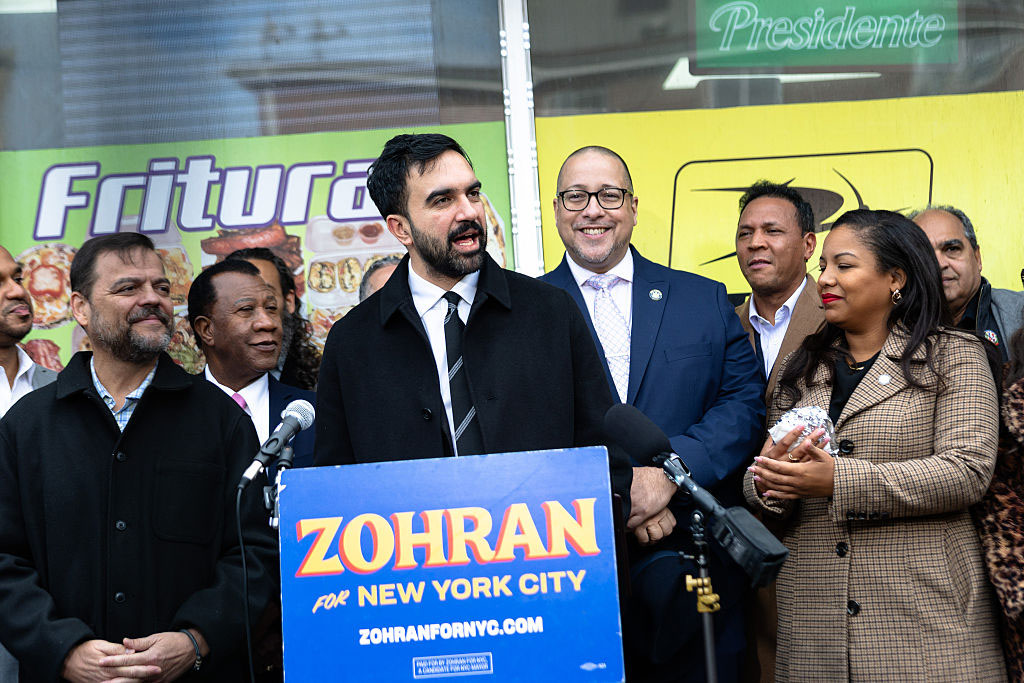
As Zohran Mamdani’s election as mayor of the nation’s largest city – and the city with the nation’s largest Jewish population – becomes increasingly likely, the question that comes with equally increasing frequency and urgency is simply “How?”

The landscape onto which Mamdani ventured is populated by voters who had become exhausted and repulsed by traditional politics. A combination of political, cultural and generational decline has created an environment in which this relatively unknown state legislator could employ his considerable communications and social media skills to present an aggressively progressive agenda to an electorate that was hungry for something different. 

The establishment might have chosen better than a scandal-tarred former governor and an ethically compromised incumbent mayor, but Mamdani propelled himself into front-runner status by effectively contrasting himself against two longtime politicians who seemed to embody what so many New Yorkers and so many Americans have come to dislike about their politics.

As the campaign enters its final days, Mamdani maintains a double-digit lead over former governor Andrew Cuomo. At the time this column was written, increasingly frantic efforts to persuade Republican iconoclast Curtis Sliwa to withdraw from the race have been unsuccessful. Polls show that a two-way race between Mamdani and Cuomo closes to within the margin of error, so if Sliwa were to withdraw, Cuomo’s candidacy would take on new life. Otherwise, it looks like a very steep uphill battle for the last scion of New York’s famous political dynasty.

When the examples of Mamdani’s harsh anti-Zionist agenda became known, beginning with the controversy surrounding his reluctance to condemn the bloodthirsty slogan “globalize the intifada,” the fact that his candidacy continued to flourish confounded many observers both in the Jewish community and more broadly. Cuomo and Mamdani have both heavily targeted Jewish voters throughout the campaign, but those efforts have intensified in recent weeks. Cuomo leads Mamdani by roughly a 2-1 margin among Jewish voters, but that is still a sizable amount of support from New York Jews for a candidate who refers to Israel’s war against Hamas as a genocide, who has promised to arrest the Israeli prime minister and opposes the very notion of Israel as a Jewish state.

Depending on Sliwa’s ultimate decision, it might not be an exaggeration to say that Jewish voters might elect the next mayor of New York City. Even if the final margin ends up exceeding the number of New York Jews supporting Mandani, the fact that roughly one-third of the community’s voters supported a candidate with such a strong history of antagonism toward Israel is immensely disturbing. Some of that backing comes from Jewish voters who prioritize local issues over which a mayor actually has authority, while an unsettling number agree with Mamdani’s sentiments toward Israel and the Middle East. But others might not take Mamdani’s pronouncements as seriously as they would have in years past.

A quick look around the American political universe suggests that last desensitized group could be substantial. A U.S. Senate candidate in Maine has been found to have a Nazi emblem as a tattoo. A Trump nominee for a senior administration position and current White House staffer withdrew his nomination amid an uproar over a social media posting in which he admitted that “I do have a Nazi streak in me from time to time.” The Democratic nominee for Attorney General in Virginia apologized for saying that he would prioritize the assassination of a conservative critic in the state legislature over the killing of Adolf Hitler and Pol Pot. And a group chat of Young Republican organizational leaders included numerous racist, sexist and anti-Semitic postings, including one that simply stated “I love Hitler.” With rare exceptions, members of the bigots’ respective parties stood loyally by them.

Each of these examples has surfaced in the last month. Mamdani’s beliefs regarding Hamas, the Middle East and Israel itself are horrifically unacceptable. Most of our community agrees that the man should not hold public office. But in an environment in which casual and complimentary references to Nazis and Hitler have become so normalized, Mamdani’s outrages may no longer seem quite so outrageous to some.


Dan Schnur is the U.S. Politics Editor for the Jewish Journal. He teaches courses in politics, communications, and leadership at UC Berkeley, USC and Pepperdine. He hosts the monthly webinar “The Dan Schnur Political Report” for the Los Angeles World Affairs Council & Town Hall. Follow Dan’s work at www.danschnurpolitics.com.

How Did Mamdani Happen? Read More »

Promise and Pessimism

There are few sights more uplifting than a mother reuniting with her child after two harrowing years in barbaric Hamas captivity. The love, the oxygen, the release of tears — it all lightens the spirit and reminds us that even in the darkest corners of history, redemption is possible. Through diplomatic artistry that few world leaders have ever demonstrated, the Trump administration dreamt the impossible and, against all odds, achieved it. Credit is due.

But as I watched those videos on repeat, glued to the Israeli news coverage from Hostage Square through the moment of President Trump’s Knesset address, I couldn’t shake the feeling that we were still hostages ourselves — victims of Hamas’ psychological terrorism. The coverage was frenetic, disorganized, unrelenting. It felt like betting your mortgage not on a particular horse, but on the mere fact that the race would run. Even in moments of victory, Hamas managed to hold the Israeli psyche hostage: delaying releases, manipulating the lists of names, swapping exchange locations at the last moment, and leaving families twisting in a torment of uncertainty.

As someone who studied counterterrorism and transnational security at Reichman University and New York University, I’ve learned how terrorism thrives on personalization and psychological control. And yet, even armed with that analytical detachment, I couldn’t look away. That is the true genius of terror: it forces you to feel, even when you know you are being played.

I ache for the families who have lost their loved ones on Oct. 7, and while fighting Hamas — not just in this war, but in the wars before it. And I find myself asking: Was this the war to end them all? Or will we look back one day and wonder, again, what all this sacrifice was for? That answer lies far above my pay grade, but the question itself should haunt all of us.

And yet, alongside the grief, there is a flicker of promise. There’s a sense — tentative, fragile — that we might be turning a page. Could this moment mark the beginning of full regional integration? Could our Arab partners genuinely help build a moderate Palestinian governing body? Could Gaza, against every expectation, become the starting point of a peaceful Palestinian state? Might Israel, at long last, begin to heal—to depolarize, to confront honestly how Oct. 7 happened, and to rediscover a shared moral core?

Then comes the other voice—the realist whisper on the shoulder. Will Hamas truly demilitarize? Is this a permanent ceasefire or merely an intermission? Does a credible, moderate Palestinian leadership even exist? Can we seriously expect peoples, Israeli and Palestinian, brutalized for so long to de-radicalize? Will Israel’s far right accept the reality of a full Gaza evacuation and give up their dreams of resettlement? The questions pile up faster than the answers.

And hovering above them all is another unsettling thought. With deep respect and admiration for President Trump (in the context of this peace agreement), I can’t help but wonder about the friends Israel now keeps — and what that portends for its future diplomacy. Under Trump, there is no daylight between Israel and the United States. But between Israel and much of the rest of the democratic world, there is not just daylight — it’s a polar noon.

When Israel’s most vocal allies now include figures like Tommy Robinson in the U.K., Jordan Bardella in France, Viktor Orbán in Hungary, the Vox Party in Spain, and the Freedom Party of Austria, we should pause to ask: what does this say about the company we keep? What jersey are we wearing on the world stage — and who else is wearing it with us?

Never in my life have I felt such a collision of emotions: elation and dread, hope and exhaustion, faith and fear. Perhaps that’s what it means to be a Jew — to live forever at the intersection of promise and pessimism, to believe in miracles even while bracing for the next blow.

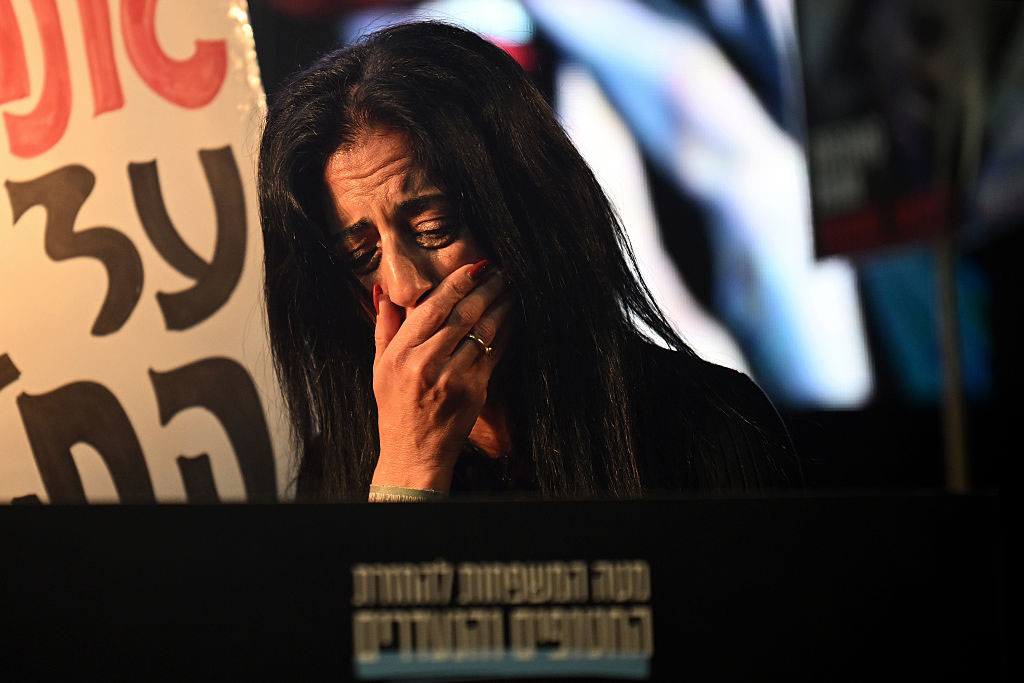
And yet, as Einav Zangauker’s tears fall onto the shoulder of her son Matan, maybe that’s enough reason, for now, to keep believing. 


Coby Schoffman is a Los Angeles-based serial social entrepreneur and Founder of The Nation Foundation (TNF). 

Promise and Pessimism Read More »