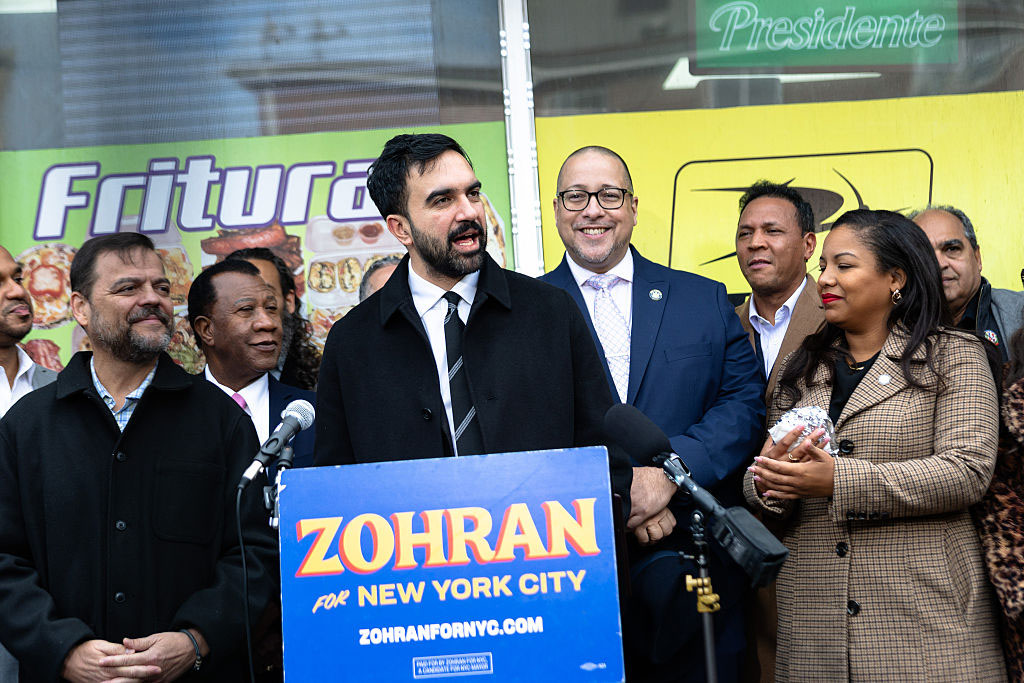
As Zohran Mamdani’s election as mayor of the nation’s largest city – and the city with the nation’s largest Jewish population – becomes increasingly likely, the question that comes with equally increasing frequency and urgency is simply “How?”
The landscape onto which Mamdani ventured is populated by voters who had become exhausted and repulsed by traditional politics. A combination of political, cultural and generational decline has created an environment in which this relatively unknown state legislator could employ his considerable communications and social media skills to present an aggressively progressive agenda to an electorate that was hungry for something different.
The establishment might have chosen better than a scandal-tarred former governor and an ethically compromised incumbent mayor, but Mamdani propelled himself into front-runner status by effectively contrasting himself against two longtime politicians who seemed to embody what so many New Yorkers and so many Americans have come to dislike about their politics.
As the campaign enters its final days, Mamdani maintains a double-digit lead over former governor Andrew Cuomo. At the time this column was written, increasingly frantic efforts to persuade Republican iconoclast Curtis Sliwa to withdraw from the race have been unsuccessful. Polls show that a two-way race between Mamdani and Cuomo closes to within the margin of error, so if Sliwa were to withdraw, Cuomo’s candidacy would take on new life. Otherwise, it looks like a very steep uphill battle for the last scion of New York’s famous political dynasty.
When the examples of Mamdani’s harsh anti-Zionist agenda became known, beginning with the controversy surrounding his reluctance to condemn the bloodthirsty slogan “globalize the intifada,” the fact that his candidacy continued to flourish confounded many observers both in the Jewish community and more broadly. Cuomo and Mamdani have both heavily targeted Jewish voters throughout the campaign, but those efforts have intensified in recent weeks. Cuomo leads Mamdani by roughly a 2-1 margin among Jewish voters, but that is still a sizable amount of support from New York Jews for a candidate who refers to Israel’s war against Hamas as a genocide, who has promised to arrest the Israeli prime minister and opposes the very notion of Israel as a Jewish state.
Depending on Sliwa’s ultimate decision, it might not be an exaggeration to say that Jewish voters might elect the next mayor of New York City. Even if the final margin ends up exceeding the number of New York Jews supporting Mandani, the fact that roughly one-third of the community’s voters supported a candidate with such a strong history of antagonism toward Israel is immensely disturbing. Some of that backing comes from Jewish voters who prioritize local issues over which a mayor actually has authority, while an unsettling number agree with Mamdani’s sentiments toward Israel and the Middle East. But others might not take Mamdani’s pronouncements as seriously as they would have in years past.
A quick look around the American political universe suggests that last desensitized group could be substantial. A U.S. Senate candidate in Maine has been found to have a Nazi emblem as a tattoo. A Trump nominee for a senior administration position and current White House staffer withdrew his nomination amid an uproar over a social media posting in which he admitted that “I do have a Nazi streak in me from time to time.” The Democratic nominee for Attorney General in Virginia apologized for saying that he would prioritize the assassination of a conservative critic in the state legislature over the killing of Adolf Hitler and Pol Pot. And a group chat of Young Republican organizational leaders included numerous racist, sexist and anti-Semitic postings, including one that simply stated “I love Hitler.” With rare exceptions, members of the bigots’ respective parties stood loyally by them.
Each of these examples has surfaced in the last month. Mamdani’s beliefs regarding Hamas, the Middle East and Israel itself are horrifically unacceptable. Most of our community agrees that the man should not hold public office. But in an environment in which casual and complimentary references to Nazis and Hitler have become so normalized, Mamdani’s outrages may no longer seem quite so outrageous to some.
Dan Schnur is the U.S. Politics Editor for the Jewish Journal. He teaches courses in politics, communications, and leadership at UC Berkeley, USC and Pepperdine. He hosts the monthly webinar “The Dan Schnur Political Report” for the Los Angeles World Affairs Council & Town Hall. Follow Dan’s work at www.danschnurpolitics.com.