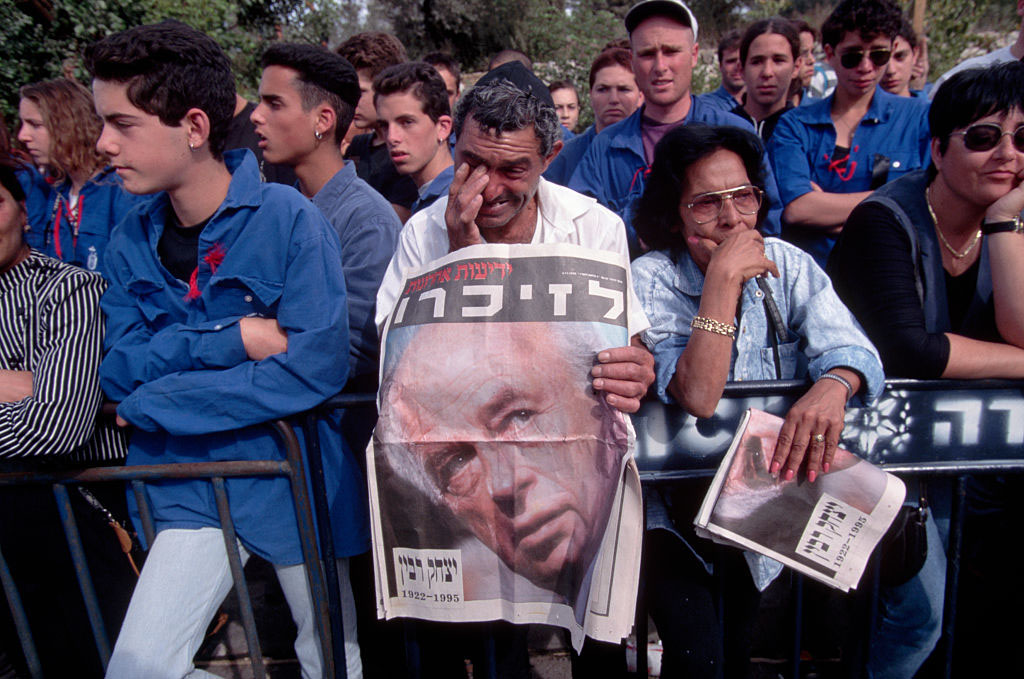
Three decades is a long time for a country to ponder the meaning of a single night. And yet Israel has managed. The night Prime Minister of Israel Yitzhak Rabin was shot, 30 years ago next week, is not an event tucked away on a shelf; it is a hinge moment that still squeaks every time we open the door to our daily recriminations over day-to-day politics. In Israel and in other countries, some assassinations have receded into the footnotes. Ask most Americans about James Garfield and you’ll get a shrug; a streaming drama, forthcoming on Netflix, may briefly revive him. Rabin is different. Israel is too young to forget its leaders and too implicated in his story to let it fade. His murder is not simply history. It is a mirror.
The Garfield comparison is useful in one way: it reminds us that an assassination can be swallowed by history when the surrounding controversies are settled. Garfield’s doctors blundered, medicine improved, the republic moved on. Israel has not moved on, because the argument embedded in Rabin’s career – war and borders, Oslo and partition, identity and sovereignty – never ended. It remains the argument under every argument.
Israel has not moved on, because the argument embedded in Rabin’s career — war and borders, Oslo and partition, identity and sovereignty — never ended. It remains the argument under every argument.
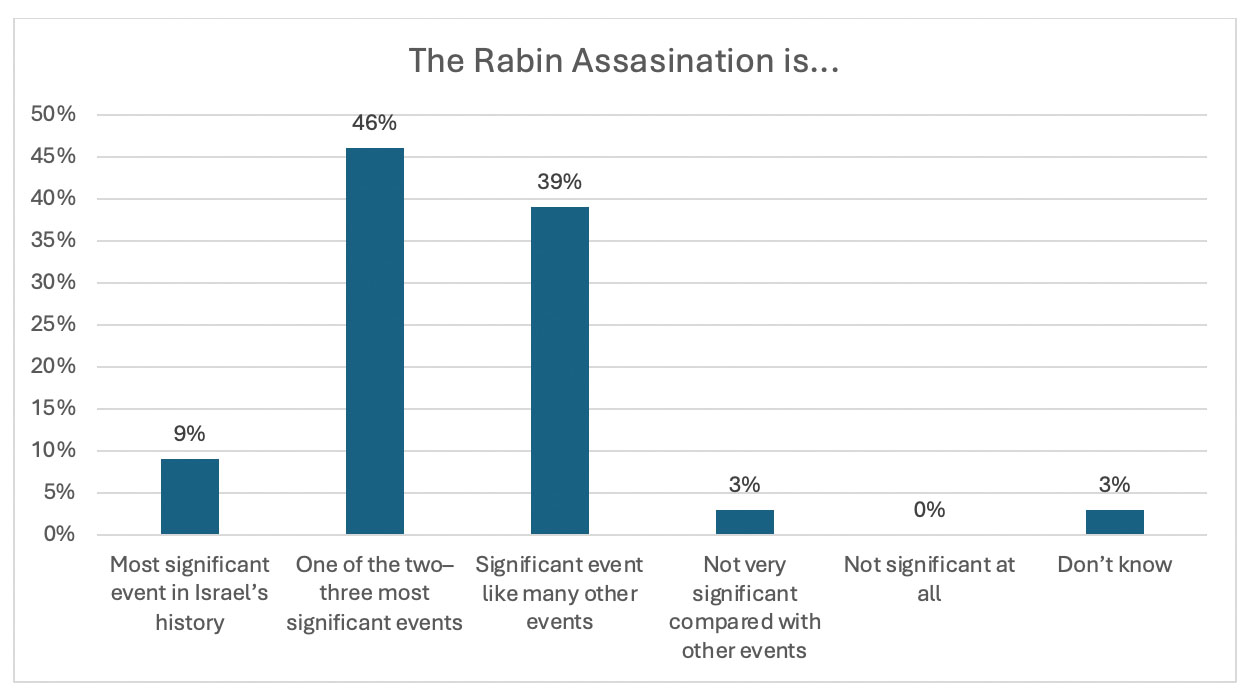
How do Israelis remember, and how do they measure that memory? The picture is layered. Among those who remember that night, most call it “very significant.” One of two or three formative shocks (see the graph to the right). But there’s also a significant group which says: it is important, yes, but “like many other events” That last phrasing, tellingly, is more common among people who identify with the right. They do not deny the trauma; they do downgrade its significance compared to other events.
On Rabin the statesman, the ledger is mixed but leans positive. About three in four Israelis assign him a positive contribution, many emphatically. Roughly one in five assigns a negative contribution — and here the right splits almost evenly. This is not partisanship; it is a theory of causality. If you think the central fact of Rabin’s career is the Oslo Accords, and if you think Oslo was fundamentally misdirected, then a negative verdict can be coherent without being callous. It is not an argument for murder. It is an argument about policy and legacy.
Oslo, indeed, is the crux. With three decades of hindsight, the plurality verdict on this attempt at resolving the Israeli-Palestinian conflict is harsh: the process was wrongheaded. And yes there’s also a group saying the idea might have been good but had no chance to succeed. Identity lines map onto all answers: Jews and Arabs answer differently; right and left answer differently. But the deeper fracture is temporal. We disagree not only about what Oslo was; we disagree about what Oslo did.
Which leads to the most uncomfortable question: did the assassination “work”? Many properly recoil at the formulation. Yet a sizable share of Israelis believes the murder halted the Oslo process. That some Israelis can hold, simultaneously, the beliefs that Oslo was disastrous and that only Rabin’s death stopped it, reveals the paradox that must haunt us: a reprehensible act that might have produced what most Israel would consider a desirable result.
If democracies are measured by procedures surviving trauma, Israel passed the immediate test. After the murder, there was orderly succession. There were elections. There was alternation of power — again and again. One scholar reads this as maturity: grief over a leader was not confused with choice over policy. Another reads it as evidence that the grief was shallower than we remember. The data tilts toward deep mourning, but the argument about depth is itself part of the memory. Perhaps that is fitting. Democracies metabolize trauma not with consensus but with repetition — memorial days, debates and counter-debates, museums and marches and the quiet inventory taken at kitchen tables.
There is also a rhyme between the trauma of the 1995 assassination and the trauma of the 2023 massacre. Rabin’s murder taught us about fragility from within; Oct. 7 taught us about fragility from without. Both can coexist with an equally true lesson about resilience. We break less easily than our enemies hope and our cynics fear. Those who predicted democratic collapse after the assassination were wrong. Those who thought the trauma would heal quickly were also wrong. The murder proved both more and less significant than we imagined — catastrophic in what it revealed, survivable in what followed.
So three decades after Rabin was shot, we do not have closure. Instead we have a lesson and a warning. The lesson: a modern state can be vulnerable and tenacious at once. The warning: the line between fierce politics and violence is thin. Crossing it carries consequences that echo for generations.
Rabin’s assassination will keep echoing because the decisions bound up with his name keep recurring. Every time Israelis debate annexation or withdrawal, compromise or security, the hinge squeaks again. Perhaps that is the real measure of importance — not the drama of the night itself, but the persistence of the questions it forced us to face.
Something I wrote in Hebrew
Is Israel still “independent”? As the debate rages, due to U.S. “dictates,” I wrote this:
If Israel wants to be a little less dependent on the United States … it needs to take two steps that are almost self-evident. It needs to forge ties with additional countries that can help in areas where Israel would like to forgo American assistance… The second step is one of build-up … with the aim of reducing overall dependence … Of course, this is easy to say and hard to do. Israel cannot grow everything, produce everything or supply everything for itself. It certainly cannot do so without a sustained and focused effort to improve its economic condition, which is the key to strengthening. In other words: less dependence on America requires Israel to improve its standing in areas critical to economic strengthening … And this is not what Israel is doing at present.
A week’s numbers
Two historians I spoke with, Dr. Avi Shilon and Dr. Nurit Cohen, both consider Rabin’s assassination to be the most significant event in Israeli history, at least until Oct. 7, 2023, whose impact is still unfolding. The public, polled by JPPI, is not with them.
A reader’s response
Ira Levin writes: “Shmuel, I saw (on social media) that you have a new book. Congratuations.” My response: Thank you Ira – as your note gives me an opening to publicize it. “Why Am I a Jew,” forthcoming Nov. 4. You can already preorder it. You’d make me happy if you do.
Shmuel Rosner is senior political editor. For more analysis of Israeli and international politics, visit Rosner’s Domain at jewishjournal.com/rosnersdomain.