Let’s do something unorthodox and revisit a column. And not just any column – my column from last week. Let’s do it using a critical eye. In a dynamic world, a columnist who strives to be honest with himself and with his readers must look back and ask: Did I serve my readers well? Did I correctly understand the situation I wrote about?
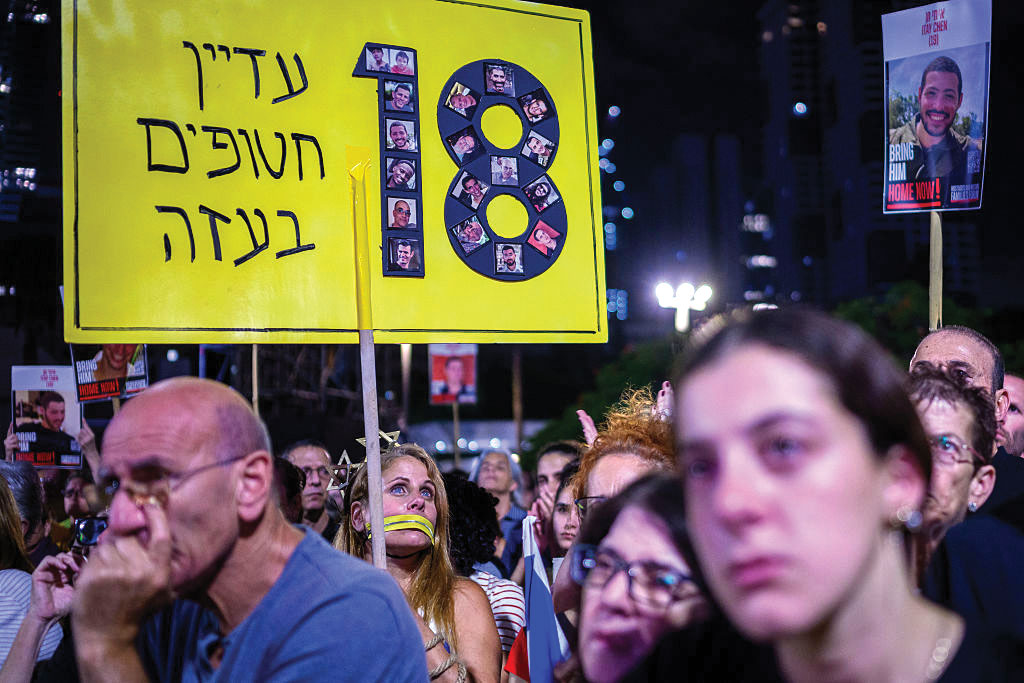
My column last week included the line: “This was a week deserving of the name ‘historic.’” But a week later I no longer feel it does. Why then did I write such a thing? First, a technical point: My deadline for the print edition is Monday, and last Monday was a day of jubilation across the nation, with the hostages being liberated. It seemed like history was being made. The hostages finally came home, and Donald Trump spoke in the Knesset.
Also on Monday, it was reported Trump would attend a meeting of world leaders at Sharm el-Sheikh, and that the leader of Indonesia (the world’s largest Muslim country) would be visiting Israel later in the week. So Monday felt like history, and yours truly did not want to write a routine column, as if this was just another week.
It wasn’t just another week. It also wasn’t a week whose “magnitude” is comparable to “the visit of Egyptian President Sadat in Jerusalem” or “the signing of the Oslo Accords.” In my defense, I did use the word “almost” in reference to magnitude.
Still, had I written the same column today I would not use such a grandiose tone. An important week – yes. A dramatic week – certainly. A historic week – that’s a stretch. Maybe, with time, we’d have to revisit the week again and decide it was indeed historic. That’s what President Trump said, but then again, the President has a tendency to refer to everything he does as unprecedented and historic. A sober observer has to be more careful, both with facts and impressions.
Had I written the same column today I would not use such a grandiose tone. An important week? Yes. A dramatic week? Certainly. A historic week? That’s a stretch.
This makes the second part of last week’s column the more measured one. As I wrote: “Any hope that international forces will be able to complete the process of elimination of Hamas power is questionable. Any hope that a Palestinian government in Gaza can be established in which Hamas does not take part is a test.”
A week after the celebration of a war’s end and the liberation of hostages, a sober reality has sunk in. Hamas effectively controls many parts of Gaza. It executes rivals. Its operatives occasionally attack IDF forces. On Sunday two Israeli soldiers were killed in such an attack. Israel responded using the language of bombs. It also declared that the Rafah Crossing to Gaza will not be opened. The ceasefire suddenly seemed fragile, until the U.S. intervened to calm things down. A quick deescalation followed, and Israelis started to get this feeling of flashback. It felt similar to the pre-Oct. 7 order: a Hamas attack, an Israeli retaliation, some threats, meager excuses — and back to quiet.
“Turning Gaza from a looming threat to a pacified neighbor — that’s the challenge,” I wrote. Last week it seemed remote, with a gleam of hope. Regional leaders gathered on a stage to declare their commitment to the Trump plan. This week it seems even more remote. Hamas was quick to reassert its power. The world is slow to enforce what the Trump plan promises — “the temporary transitional governance of a technocratic, apolitical Palestinian committee.” It is also slow to assemble a counter force whose job is to make sure that “all military, terror and offensive infrastructure, including tunnels and weapon production facilities, will be destroyed and not rebuilt.”
What remains is awkward and unstable. Israel still controls half of the Gaza Strip, but is reined in by the U.S. – and cannot act with force against the resurrecting Hamas. Aid is getting in, but a significant rebuild would be impossible under the current circumstances. Hamas is testing Israel. No one assumes that the Sunday attack was the last attack. In fact, it was probably a first attack, a first test of the new rules that at present govern the Gaza deadly game. The more of them come, the less likely it is that foreign countries will be willing to put their forces at risk by attempting to replace Hamas as the rulers of Gaza. Either they will not send their forces — or they will send forces that would tolerate, and maybe even assist Hamas, rather than dismantle it.
Does this sound like a week deserving of the name “historic”?
Or more like a week deserving of the name “déjà vu“?
Something I wrote in Hebrew
A lot of polls and models predict that no “bloc” can decisively win the next election in Israel. Here’s what I wrote:
There could be a surprise, and one of the blocs will win (according to the Madad.com model this has about a 30 percent chance of happening). It is more likely that there will be no surprise and no bloc will win (70 percent chance of happening). It seems that Israel, as a collective, is having a hard time deciding. It has been having a hard time for quite a few years, and even a major war and a major crisis have not changed this fact. If anything, that is what might be surprising.
A week’s numbers
Here’s what Israelis were saying a few days after the war “ended” (Maariv Daily poll).

A reader’s response
Goldi N. writes: “Now it is time for Israel to repair its relations with the Democratic Party.” My response: I wish it was simple. Maybe as long as Trump is President, Israel only has one of two choices: get along with him, or repair the relations (in such case, amid the high stakes, Israel’s choice would be clear).
Shmuel Rosner is senior political editor. For more analysis of Israeli and international politics, visit Rosner’s Domain at jewishjournal.com/rosnersdomain.