Monday – when the hostages were released — was a day of the heart.
Tuesday — the international summit in Cairo — was a day of the mind.
This was a week deserving of the name “historic.” Israel has had many such weeks. Some of them – the visit of Egyptian President Sadat in Jerusalem comes to mind – ended in triumph. Some of them – the signing of the Oslo Accords in the Rose Garden comes to mind – ended in tragedy. So yes — this was a week of almost such magnitude. It was a week in which one could almost believe our cynical politicians as they were lionizing our heroes in uniform. It was a week in which one could forgive the embarrassing fawning with which all world leaders must shower a president-child. It was a week in which one must set aside political biases and matters of taste, to acknowledge that President Donald Trump and his team just executed an initiative of Kissingerian scale. It was a week of American statesmanship on a level we haven’t seen in decades.
Triumph or tragedy? Patience is what we must have. Because the war is over in some way, but not quite over in many other ways.
Patience. We’d like to already know we’ve won the war. But it’s impossible to know, because what will determine the outcome of a two-year war that ended is mostly in the future. Who will control Gaza — in the future. Whether Hamas will hold on to power — in the future. Whether there will be calm for months, for years, for decades, forever — in the future. What will happen with relations with Turkey, Egypt, Saudi Arabia — in the future. What will happen to Iran’s nuclear program — in the future.
What happened this week was positive — a hostage release deal. What happened this week was encouraging — America is back, leading, cajoling, manipulating, twisting arms, getting things done.
This was a week of three parallel battles of narrative. The battle within each of us, because deep down all Israelis understand that while the war is over, it is not over in the sense that Gaza ceases to be a challenge, a threat, a menacing presence on our border. No Israeli in his right mind would confuse the celebration for the released hostages with the illusion that peace had come.
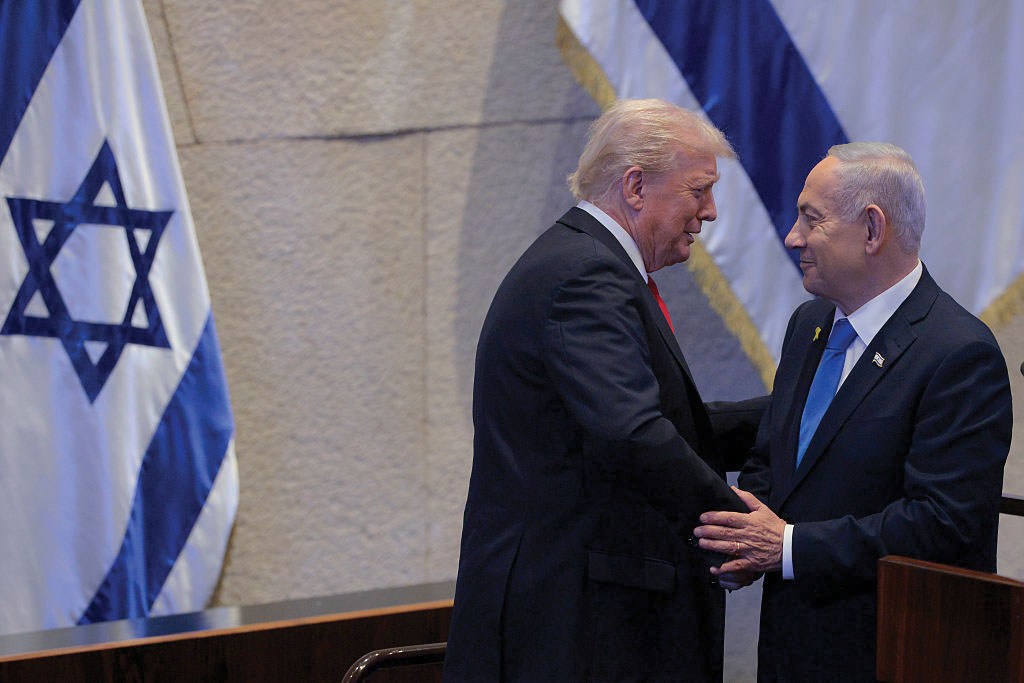
Then, there’s the battle for the narrative of the war for strategic purposes. The battle waged in the Middle East and around the world. If Israel is seen by its neighbors as a winner, this adds to its power of deterrence. So it’s imperative for the country to remind itself and its observers of the triumph over Hezbollah, of the 12-day domination over Iran’s sky, of the total destruction of Gaza. Telling and retelling this story is important, because if Israel is not seen as a winner, then someone, somewhere, might already be planning for the next round. Trump, by triumphantly visiting Israel before the summit with the leaders of the Arab world, greatly contributed to Israel’s ability to present itself to the world as a winner.
And of course, there’s the internal battle for the narrative of the war for political purposes. 2026 is an election year. If the voters are convinced that the war was won, they might give credit to the coalition for its insistence on victory – and forget its responsibility for calamity. If the voters are disappointed with the outcome, the coalition has little to show for. On Monday, speaking with the president of Egypt, preparing to host the president of Indonesia, praised by Trump, cheered by his majority in parliament, PM Netanyahu seemed like a man who does not intend to let Israelis have an easy choice against him.
As with most narrative battles, there’s temptation to reach a quick and clear resolution. To flip to the last page and get to the ending. But our reality is complex. The war of weapons is over for now. The war of diplomacy is just beginning. It is beginning with grand promises and expectations for a new era. It is beginning with a heart that says “yes – and a mind that says “caution.” Consider a case from a year ago in Lebanon. A flawed agreement ended the war against Hezbollah. Why flawed? Because Hezbollah never truly intended to honor it and disarm. Thus, Israel must retain its ability to act against Hezbollah’s attempts to restore itself to a position of power.
Gaza is not Lebanon. The geography is different, the level of destruction is different, the demographics are different. And yet, some parallel lessons can be learned. Any hope that Hamas will willingly disarm is false. Any hope that international forces will be able to complete the process of elimination of Hamas power is questionable. Any hope that a Palestinian government in Gaza can be established in which Hamas does not take part is a test. Whether one calls “the end” a victory or merely a respite, the challenge is still there: Turning Gaza from a looming threat to a pacified neighbor – that’s the challenge. No celebration should make it be forgotten.
Something I wrote in Hebrew
Responding to (mostly opposition leaders’) claims that “the same deal” was on the table a year ago, I wrote this:
Heraclitus, the cryptic Greek, said you can’t step into the same river twice. That saying has turned from philosophy to cliché – but still, it helps clarify a point. The deal from a year ago … cannot be the deal of today. The details may be similar, even identical. The general approach may be the same. But a deal like this is never a document isolated from its context … The real meaning of “the deal” includes both the content and the full context. So no, the deal from a year ago is not “the same deal” as the one today.
A week’s numbers
Here’s one item that Israel must consider as they battle for the narrative: why did it take two years? The graph is from a poll conducted before the agreement was finalized.

A reader’s response
Debby Hoffman writes: “Shmuel, can’t you see that Trump made the deal to help his family make deals with Qatar?” My response: 1. You don’t know that. 2. Yes, there’s worry about Qatari influence on the White House. 3. Sometimes the motivation is less important than the outcome.
Shmuel Rosner is senior political editor. For more analysis of Israeli and international politics, visit Rosner’s Domain at jewishjournal.com/rosnersdomain.