fbpx

May 15, 2025

“For the Love of Animals” at The Braid

The theme of The Braid’s latest True Jewish animal stories — and the humans who love them — are at the center of The Braid’s latest salon theatre production. “For the Love of Animals” features 12 captivating animal stories that showcase the best of Jewish values. 

“The love we show our animals reveals a lot about who we are as people,” the Braid’s founder and artistic director Ronda Spinak said. “I originally conceived of this show as a love letter to animals. … But, as I collected these true stories from the Jewish community, I realized this show has an even more important mission … to overturn [Jewish] stereotypes and give the world a real window into the Jewish soul.”

Co-directed by The Braid’s producing director Susan Morgenstern and current NEXT+ artistic fellow Genevieve Fowler, “For the Love of Animals” has stories of dogs and cats, rats and bats, pigeons and parakeets. There’s even a mischievous horse and a bearded dragon. “I hope that in encountering these stories of love, loss, fear, joy, humor and hope, audiences feel community and connection,” Fowler told The Journal. 

“We are living in a moment rampant with challenges, divisiveness and misunderstanding,” Fowler said. “My hope is that in showing stories of expansive human love for all creatures, audiences will come together for a moment of unity, allowing them to reenter the world as better human animals than before.”

Among the writers with stories in the show are Emmy-winner Cindy Chupack (“Sex and the City,” “Modern Family”), acclaimed photographer Penny Wolin (whose work has hung in the Smithsonian) and 11-time winner of The Moth, Mindy Myers. Other contributors are writers Vanessa Bloom, Jessica Cabot and Lisa Pearl Rosenbaum, as well as Joshua Reuben Silverstein, who performs his own story and several others. The cast also includes Avalon Greenberg Call, Cherish Monique Duke and Lisa Robins. 

“Animal stories appear all over the Torah, right from the opening,” Rosenbaum told The Journal. “They make great story partners for humans to ponder from the serpent in the Garden of Eden, the menagerie in Noah’s ark, Balaam’s talking donkey and on and on.”  

Rosenbaum’s story, told in the aftermath of the LA fires, is about her family’s efforts to save the life of their parakeet. “Our odd little blue parakeet, who had more of a relationship with our dog than with us, refused to get back in his cage [during the Palisades fires],” said Rosenbaum, who is the author of the award-winning novel “A Day of Small Beginnings” and co-writer of the play, “The Violin-Maker.” “How being forced to leave him behind in our house as the evacuation orders were blasting from our phones, made this bird the focus of our worry about what the fire would take from us.”

Bloom, an Abby Freeman artist-in-residence at The Braid, authored the story about the aforementioned horse. “I was the youngest and shortest girl [at my first sleepaway camp] and was paired with Top Dollar, a mini horse who … might be physically small but his personality was huge and he liked to bite people,” she told the Journal. “I had to figure out quickly how to handle him and work as a team in our showmanship class.” She added, “It was definitely a struggle figuring it out, but by the end we won first place!”

Bloom’s biggest takeaways from her experience were that confidence, which helped her make the right decisions regarding Top Dollar, and listening were key. “In the end we reached an understanding that allowed us to show off the best of our abilities,” she said.

Cabot, a recent NEXT emerging artist fellow at The Braid, hopes the show “helps all of us remember that our relationships with animals can be just as special and profound as our relationships with humans, and honestly sometimes even more so,” she told The Journal. 

Cabot was walking her dog when she found an injured pigeon on the side of the road. “I debated what my responsibility was in the situation and ended up taking the pigeon to my home in a box, while I debated and searched for the most compassionate way to assist the pigeon,” Cabot said. “With my story in particular I hope that if someone else ever finds themselves in a situation where they can do something to help an animal, they’ll be inspired to know their actions can make a positive and meaningful difference.”

“For the Love of Animals” is more than a collection of Jewish animal stories. It’s an experience that will leave everyone smiling.

“Our animals make us realize our responsibility towards those who can’t speak for themselves, who are dependent on us for care,” Rosenbaum said. “They make us laugh, they’re with us when we grieve, they get us through life and they’ve supplied humans with stories from time.

“For the Love of Animals” runs May 18-June 22 in person in Los Angeles and the Bay Area, as well as live on Zoom. For schedule and tickets, go to the-braid.org/animals.

“For the Love of Animals” at The Braid Read More »

Persian Jewish Leaders Inspire a New Generation of Activists

An engaging panel discussion on the involvement of Persian Jews in Jewish activism was held at Sephardic Temple on April 22. The event, organized by StandWithUs and Kol Israel, drew dozens of Persian Jews from both the older and younger generations. Moderated by Roz Rothstein, CEO and co-founder of StandWithUs, the panel featured three activists running for the World Zionist Congress who urged the Jewish community to vote for Kol Israel, Slate 4.

Kol Israel is a nonpartisan, nondenominational faction that brings together Jews from all backgrounds and political ideologies — right and left, Orthodox, Conservative, Reform, Secular, Sephardic and Ashkenazi. Its mission is to educate and empower the next generation of leaders and activists committed to advancing Jewish continuity. The group believes Zionism should be inclusive and free of labels or predispositions, aiming to serve as a welcoming home for all Jews who wish to work toward a better Israel and a stronger sense of Jewish peoplehood, without being confined by political or religious frameworks.

Roz Rothstein, who moderated the panel, said she deeply understands the fears of the older Persian generation — those who immigrated to the U.S. from Iran and were oppressed and afraid to speak up. 

“I’m a daughter of Holocaust survivors and I was embedded in this fear, in this trauma and in this PTSD. So, right away, I felt a strong connection to the Persian community,” said Rothstein. “To say that you are not involved is not true. Our team at StandWithUs includes many Persian members working on global issues. But from an outside perspective, I do think the Persian community could become even more engaged and do more for the Jewish community.”

Dr. Sheila Nazarian, a plastic surgeon, TV personality and public speaker, also shared her story. She escaped from Iran with her sister and mother after the revolution. Her activism began in 2021, following the events in Sheikh Jarrah and the conflict between Israel and Hamas. Until then, she said, she was a busy mother of three kids, ages, 13, 16 and 17 and had made a name for herself as a successful plastic surgeon and the host of the Netflix series, “Skin Decision: Before and After.”

“I have one son in college, and I realized how much antisemitism there is on college campuses. I went to Columbia University. I wanted to create a safe place for my kids and that’s how I got involved in activism,” Nazarian told The Journal.

Initially, her efforts were met with skepticism and resistance. “Everyone said, ‘What are you doing? What makes you think you can make a difference? You have kids — you need to think about your safety.’ I replied, ‘I’m doing it for my kids. If we don’t speak up now, what will our grandkids have to go through?’”

Nazarian admitted that at first, she herself wasn’t sure her activism would make a difference — but it did.

“I’m very busy with work, but when I saw my colleagues shouting ‘Apartheid,’ ‘Genocide,’ and all those ridiculous accusations, I went into survival mode. I started waking up in the middle of the night with anxiety — something I’d never experienced before. I lost a lot of followers, but I knew I couldn’t stop. It felt like Iran all over again. And I thought, our parents didn’t bring us to America to stay silent. They left everything behind so we could have freedom of speech and freedom of religion.”

The younger Persian generation, however, is more actively engaged, Nazarian said. They see firsthand what’s happening on college campuses. They witness the hate and feel compelled to take action. Since Oct. 7, many students have spoken out, including in front of Congress, sharing their campus experiences, the rise in antisemitism, and the failure of university administrations to protect them. Notably, many of these outspoken students are the children of Iranian Jewish immigrants.

 “There was a recent poll that showed younger people believe Israel is responsible for all the problems in the Middle East,” said Nazarian.

Matthew Nouriel, a nonbinary digital activist and content creator, serves as the Community Engagement Director at JIMENA — Jews Indigenous to the Middle East and North Africa. Like Nazarian, he began his Jewish activism in May 2021. Fearlessly, Nouriel took to social media to set the record straight about what was happening in Israel and to express support for the country. As expected, those posts drew significant backlash, but that didn’t stop him.

 “Zionism is fighting for its life right now and the people opposing us love to see us divided,” said Nouriel. “All this slate cares about is the continuation and survival of Zionism and the next generation. They intentionally chose a delegation with a diverse background — Mizrahi, Ashkenazi, Sephardi, LGBTQ+. We care solely about the survival of Zionism and making sure the next generation understands what it truly is, because that’s what’s at stake right now.”

Chloe Levian, senior southwest campus regional manager at StandWithUs and a UCLA graduate who once served as president of Bruins for Israel, said she never thought she would become an activist. But everything changed once she started college.

“I came out of my bubble and realized there are people who don’t like Jews. With every incident, I became louder and louder,” said Levian. That awakening led her to get involved with StandWithUs. “Now I get to empower Jewish students across many campuses to share their stories.”

There was a consensus among the panel that while the Persian community is known for being generous and giving, its involvement often remains within the community rather than extending outward. The younger generation — mostly children of Iranian immigrants — tends to be more engaged, as they better understand what’s at stake.

“During Yom Kippur, I gave a speech here [in Sephardic Temple] and said, ‘I know you’re afraid, but for God’s sake, don’t discourage your kids from speaking up,’” said Nazarian. “This isn’t Iran. We have laws and protections here. We either act now and save America, or it will be too late. When these young people grow up, we won’t have much support left.”

It’s a message she hopes resonates with the younger generation—the grandchildren and great-grandchildren—to never stay silent in the face of antisemitism and injustice.

Nazarian acknowledged that she risked losing everything she had worked so hard to build. “There was so much fear of being canceled in 2021, but I thought, you know what? I’ve been successful, if I lose my patients, so what? I’m doing what’s right.”

Fortunately, the opposite happened. Despite losing 150,000 followers, her clinic is thriving. “I have more patients today and they’re all aligned with me,” she told the Journal. “We talk about meaningful topics, we have really interesting conversations and I no longer feel like I have to walk on eggshells. I would do it all over again. God rewards authenticity. God rewards courage. And when you have a strong moral compass, you have nothing to be afraid of.”

Persian Jewish Leaders Inspire a New Generation of Activists Read More »

How a Retired Hebrew Professor in New York Inspired a Change in Israel’s Eurovision Song Entry

In March, Rivka Halperin was watching KAN, a satellite Israeli TV station, from her home in New York when she excitedly heard about Israel’s song choice for the 69th annual Eurovision Song Contest, set to take place in Basel, Switzerland, this week. The Israeli artist, Yuval Raphael, was soulful; the song, “New Day Will Rise,” was pulsating and resonant. But there was one problem with the song that was meant to represent Israel at this year’s Eurovision that jolted Halperin.

“I’m sitting at home, anxious, curious, and listening to the song, and all of the sudden, I say to myself, ‘I can’t believe it. Of all the smart people in Israel, how could someone have made such a mistake’?”

As a former professor of Hebrew language and Israeli culture, whether at Princeton, New York University (where she obtained her doctorate), Columbia University or the Jewish Theological Seminary, Halperin immediately heard the mistake: The song, which is mostly sung in English, briefly quoted King Solomon’s Song of Songs. Raphael sang in Hebrew, “Many waters cannot quench the love, nor can rivers flood it; should a man give all the property of his house for love, they would despise him.” But due to the differences between biblical and modern Hebrew, Raphael mistakenly sang the word, “V’neharot” (rivers) instead of the correct version, “U’neharot.”

“I thought my ears were burning, literally,” recalled Halperin. “They used a few Hebrew words in the whole song. How was it possible that one of them was a mistake?”

Halperin admits that most Hebrew-language listeners, especially Israelis themselves, may not have cared much about the mistaken word. “But,” she added, “You have to hear it from my point of view as a professor of Hebrew. In the Bible, there are even vowels underneath the words. It was avoidable.”

Perhaps if Halperin had hailed from France, Spain or other larger countries that compete each year at Eurovision, which enjoys an extraordinary following worldwide (except in America), the mistake would have gone unchecked. But Halperin is from Israel, a tiny state where seemingly everyone is linked by one or two degrees of separation. The retired academic and grandmother simply took to her laptop to find an email address for someone at the Israel Public Broadcasting Corporation (IPBC/KAN), the participating broadcaster in the Eurovision contest that is also responsible for selecting and producing Israel’s annual song entry. 

Halperin praised the song as hopeful and “very, very appropriate” for such a difficult time, and shared kind words about the well-known Israeli songwriter Keren Peles. But in an email to the broadcaster, she also pointed out the mistake. To her delight, KAN wrote back immediately. “They acknowledged it and apologized, and promised they would change it,” she said. Later that evening, Halperin was waiting for her usual Israeli TV news program to begin, and there it was: An announcement that the 24-year-old singer, Raphael, was going to rerecord the whole song because someone had found a mistake in it.

Only in Israel. And only with Israelis. 

For her part, Raphael is an inspiring young woman with a heartbreaking story: she survived Hamas’ horrific massacre at the Nova music festival on Oct. 7, 2023, by hiding under dead bodies for hours inside a bomb shelter. In various interviews with Israeli media, Raphael has said that she expects jeers, protests and many Palestinian flags in the audience this week in Basel, which holds a special place in Jewish and Zionist history. It was in Basel where, on Aug. 29, 1897, Theodor Herzl convened the first World Zionist Congress. Switzerland was also where Raphael spent three years as a young child.

Last year, Eurovision forced Israel to rewrite its song, “Hurricane,” which was performed by Eden Golan, because it was deemed too political. “I’m 100% focused on the music, I’m 100% focused on my song,” Raphael said in an interview with The Times of Israel in March. TOI claimed that Raphael was adopting a “carefully apolitical tone” ahead of the song contest. 

Currently, 72 former Eurovision contestants have called for Israel to be banned from the competition. Ireland has asked to meet with the European Broadcasting Union (EBU) to discuss Israel’s inclusion in the annual contest. Israel has won Eurovision four times: 1978, 1979, 1998 and 2018.

In the long scheme of things, with a seven-front war, excruciating loss, a country burdened with mass Post-Traumatic Stress Disorder (PTSD), and a renewed call for tens of thousands of IDF reservists to reenter Gaza, does one word in a European song contest in which last year’s Israeli representative, Golan, was booed and harassed, truly matter?

“I always tried to put in my students a love of the language and Jewish tradition, history and culture,” said Halperin. “I know the mistake was a minor thing, not only in relation to Eurovision, but in general. But after they corrected the song, I emailed them a beautiful quote in Hebrew that there was ‘a restoration of the crown to its former glory.’”

Halperin, who was born in Poland and moved to Israel as a little girl, is so passionate about the Hebrew language that in 2006, she accepted an offer by a Franciscan monk to establish a Hebrew department at the Higher School of Hebrew Philology in the historic Polish town of Toruń. She taught at the university until 2013.

Given her love of language, it is no surprise that Halperin’s daughter, Shirley, is also a wordsmith. She is currently the co-editor-in-chief of The Hollywood Reporter, after having served at Los Angeles Magazine, Variety, and many other magazines. “As an appreciator of language, it thrills me to no end that my mom — aka מורה‭ ‬רבקה‭ ‬— is having her peak Hebrew teacher moment,” Shirley told The Journal. “For once, I’m glad she’s correcting someone other than me!”

Halperin believes that a lack of familiarity with one’s mother tongue is not unique to Hebrew. “Like in many other languages, the younger generations introduce words in English into their everyday speech, which degrades the purity of the Hebrew language,” she lamented. “And it’s not just slang and social media; hosts and pundits on television insert English phrases interchangeably, and these are the people who were trained in proper grammar and usage.” 

She continued, “Hebrew is based on the biblical language. But even on television, long viewed as a fortress of proper speech, as these ways of speaking become normalized, authentic Hebrew loses in the proposition.” For Halperin, the distance “from the roots of the language stretches even farther. Not when citations from the Bible contain mistakes; that’s a big no-no from this linguist’s point of view. [But] Hebrew isn’t just a language, it’s also tradition and culture, and that’s why I couldn’t let the mistake go.”


Tabby Refael is an award-winning writer, speaker, and weekly columnist for The Jewish Journal of Greater Los Angeles. Follow her on X and Instagram @TabbyRefael 

How a Retired Hebrew Professor in New York Inspired a Change in Israel’s Eurovision Song Entry Read More »

Eurovision: Nova Survivor Yuval Raphael to Sing on International Stage

When the Eurovision Song contest finals take place on Saturday, May 17 in Basel, Switzerland, Israel’s contestant Yuval Raphael will take the stage with high hopes and intense scrutiny. It’s a moment that would have been unthinkable 19 months ago, when Raphael was nearly murdered on the darkest day in Israel’s modern history.

Raphael, then age 22, attended the Nova Music Festival on Oct. 7, 2023. She survived with a crushed foot, shrapnel wounds to her scalp, and temporary loss of feeling in her toes. Before the end of October, she found the strength to publicly share her story in the media, and continues to do so.

Israel’s mere participation in Eurovision, which they’ve done dating back to 1973, has drawn criticism. More than 70 former Eurovision contestants from across Europe — including those from Iceland, Portugal, Ireland and the U.K. — have signed an open letter to the European Broadcasting Union (EBU) calling for Raphael’s disqualification and the exclusion of Israel’s public television broadcaster, KAN, from Eurovision altogether. 

Eurovision Director Martin Green rejected those demands and said, “Eurovision is a competition between public broadcasters, not between nations, and it must not be used as a springboard for political sanctions.” A similar scene unfolded in 2024 when Israel’s entrant Eden Golan competed at Eurovision in Malmö, Sweden. There were large demonstrations outside the venue, jeers from fellow contestants, and even death threats. Still, after Golan performed “Hurricane,” she placed fifth and returned to Israel a hero.

The contest takes place at the St. Jakobshalle arena, which seats 8,000. Israel’s National Security Council (NSC) has warned its citizens traveling to Basel that there have been 360 protests and anti-Israeli demonstrations in Switzerland over the past year. 

“These are expected to continue during the Eurovision song contest, directed at Israelis or the Israeli delegation” NSC said. “It is recommended to stay away from these centers of friction and demonstrations, which may escalate into violence.”

Raphael’s song, “New Day Will Rise,” is an operatic pop ballad that was written by Israeli singer-songwriter and composer Keren Peles, who co-wrote Israel’s 2024 entry.

Raphael sings the first verse in English and the second in French. Each chorus is in English. The bridge after the second chorus is in Hebrew, drawn from Song of Songs: “Many waters cannot quench love, neither can the floods drown it.” The final chorus returns to English: “New day will rise, everyone cries, Don’t cry alone, Darkness will fade, All the pain will go by, But we will stay, Even if you say goodbye, A new day will rise, New day will rise.”

In rehearsals, Raphael wore a black suit with flamenco sleeves. She sang on a chandelier-adorned spiral staircase and balcony, inspired by a famous photo of Theodor Herzl standing on a balcony at the Grand Hotel Les Trois Rois during the Fifth Zionist Congress in Basel in 1901. That particular congress resulted in the founding of the Jewish National Fund and steps towards reclaiming a Jewish homeland in Eretz Israel. 

Raphael, 24, comes from Ra’anana where she grew up riding horses and dreaming of being a performer. She even spent three years of her childhood living in Geneva, Switzerland. 

Her Eurovision page says that “despite the relatively recent start, Yuval’s life-long dream has always been to become a singer, with a particular interest in the soul and R&B genres. As a child, she listened to classic rock bands like Led Zeppelin and Scorpions, as well as iconic singers such as Beyoncé and Céline Dion.” During her compulsory service in the Israel Defense Forces, Raphael worked at the border of Israel and Gaza and ran a checkpoint for Palestinians going into Israel for work.

Two years later, just five kilometers from the Gaza border on Oct. 7, 2023, Raphael was among the thousands of Nova Festival attendees who were attacked by Hamas terrorists. Raphael and others took shelter in a roadside bomb shelter as terrorists rampaged through the area. 

“[The terrorists] went inside the bomb shelter, first, they shot everyone that was in the pathway,” Raphael said in an interview at the Jerusalem Institute of Justice. “Then they came inside and started shooting everyone inside.”

She lay still for eight hours, following her father’s instructions via phone to play dead. 

“Then came the grenades,” Raphael said. “That was a new kind of fear. The sound was different, the force stronger, the panic worse.” Her foot was crushed beneath a body, and she used another to shield herself.  

“When I saw my family at the hospital, I felt guilt saying it — but I felt like I’d been reset to zero,” Raphael said on the Yael Landau YouTube channel in 2023. “I used to think I had problems. I thought I had issues. But this gave me a whole new starting point.”

She was sharing her story publicly less than a week after the attacks. On Oct. 31, she posted her first video since the attacks—performing a cover of Sia’s “Elastic Heart.” In the caption, she wrote, “music is a huge part of me and my life, and at this time, it is no exception it is the one thing that really helps me through it all. This song really helps me describe what I’m feeling at the moment and hopefully will give strength to those who need it.” Raphael testified at the United Nations Human Rights Council in Geneva in March 2024. “I am here to open my heart — on behalf of myself and the 364 souls brutally murdered during the Nova Festival on Oct. 7,” Raphael said. On the first anniversary of the attacks, she posted photos from the bomb shelter, and wrote “You can’t change, but you can get stronger to be healed.”

In November 2024, she got her break when she competed in Season 11 of the television singing contest, “HaKokhav HaBa” (“The Next Star”). Raphael would continue to advance round after round. By the end of January, she won and was selected to represent Israel at Eurovision. The video for her song dropped on March 9 and evokes moments from Nova Festival when attendees fled Hamas terrorists across dirt farmland.

“There are a few lines [in the song] that say, ‘Everyone cries. Don’t cry alone,’” Raphael said in an interview with StandWithUs on May 12. “That’s a message I would love to spread, because I feel like all of us are going through struggles, all of us are going through ups and downs. Embracing each other, supporting each other, having each other’s backs.”

Before the finals, Raphael has to get past the second day of semi-finals on Thursday, May 15 at 12:00 pm Pacific time. The top 10 out of 16 will advance to the finals two days later.

Israel has won Eurovision four times: Izhar Cohen and the Alphabeta with “A-Ba-Ni-Bi” in 1978, Milk and Honey’s “Hallelujah” in 1979, Dana International’s “Diva” in 1998, and Netta’s “Toy” in 2018. Last year, Eden Golan was the top vote-getter from fans in 14 countries.

Raphael remains optimistic. On May 5, in a meeting with Israeli President Isaac Herzog, she said “On the one hand I come as someone who wants and has all the intentions to win — and on the other hand I can’t help but feel the victory in advance of the fact that I have the right to do it.”

The Eurovision Song Contest semi-finals begin at 12:00 pm Pacific Time on Thursday, May 15, and the finals at 12:00 pm Pacific Time on Saturday May 17. The show can be streamed live on NBC’s Peacock streaming platform. Fans can vote at https://eurovision.tv/vote  

Eurovision: Nova Survivor Yuval Raphael to Sing on International Stage Read More »

Eli Tsives Speaks Out After Latest UCLA Protest Turns Violent

Eli Tsives went to UCLA to study and earn a degree. However, since Oct. 7, he has become more than just a student — he’s now also an activist and influencer. It wasn’t a role he planned to take on, but one that was sort of thrust upon him.

A few days ago, he posted a video on his Instagram account taken by a fellow Jewish student. In it, Tsives is seen surrounded by a group of pro-Palestinian demonstrators wearing black-and-white keffiyehs — a scarf that has become a symbol of Palestinian nationalism. One of them is heard yelling at him, “You don’t belong here.” The scene was violent and frightening.

The following day, Tsives explained in an interview with The Journal what had preceded the attack. “It was 9 p.m. They had a movie screening of the one-year anniversary of the encampment at Bruin Plaza, and they aren’t allowed to do that because the chancellor had banned the club,” said Tsives. “The police were sent immediately to disperse them, and then the protesters moved to the Hill, which is the residential area. I was standing there with my Israeli flag. One of them grabbed it and ran away, and I ran after him. As I was catching up to them, they circled around me — like eight or so protesters — and they started grabbing me and taking swings. One got me in a headlock. The entire thing was very quick.”

The movie the protesters intended to watch was “The Encampments,” a 2024 film about pro-Palestinian protests at several university campuses. Around 200 protesters began gathering at Wilson Plaza at 7:30 p.m. and later marched along Bruin Walk to De Neve Plaza. They blocked traffic until reaching the Ronald Reagan UCLA Medical Center pedestrian area.

According to UCLA, one police officer was physically assaulted during the protest. One protester, who is not affiliated with UCLA, was arrested for battery. Reports indicate that he slapped a security officer and has since been issued an administrative “stay-away” order, preventing him from returning to campus.

While Tsives said he is not scared or worried for his own safety, he expressed concern for students who might not know how to defend themselves. “The reality is that a lot of Jewish parents are very nervous after seeing this video, and rightfully so. But I need to remind Jewish parents that we can’t let our emotions get the better of ourselves. We can’t start freaking out during a time of uncertainty. We will win — we already are winning. If you look at UCLA and compare it to last year, it’s amazing how much it has changed. It’s getting better. It really is.”

One of the major changes, Tsives said, is the appointment of new Chancellor Julio Frenk, who assumed the role on Jan. 1 of this year.

“He is amazing and is doing a lot for Jewish students,” said Tsives. “He is Jewish himself, his family survived the Holocaust, and he is a big supporter of the state of Israel. He is the reason why SJP [Students for Justice in Palestine] is banned and why police presence is so common on campus now.”

Although SJP was banned by the new chancellor, their Instagram account is still active and they are still organizing gatherings and protests.

“What we need to be asking,” Tsives said, “is how we can work with the administration, the government, and different organizations to ensure that Jewish students feel safer on campus.”

He emphasized the need for law enforcement to be empowered: “California’s government has placed restrictions on police when it comes to controversial issues like this. We need to give district attorneys the freedom to prosecute and make sure students who break the rules are held accountable.”

Meanwhile, like many Jewish parents with children at UCLA, Tsives’ parents are concerned.

“My mother is scared — but more furious,” he said. “Still, I have confidence in this new administration. They’re doing a lot. Other schools? Not so much. It’s unfortunate that it took the federal government threatening funding cuts for universities to act. But if that’s what it takes, so be it.”  

Eli Tsives Speaks Out After Latest UCLA Protest Turns Violent Read More »

AJU Gala Honors Harold J. Masor for Transformative Leadership in Jewish Education

American Jewish University (AJU) hosted its annual gala on Sunday, April 27 at the Beverly Wilshire Hotel. The evening honored Harold J. Masor, outgoing chair of the board of directors, in recognition of his visionary leadership and enduring contributions to Jewish education and communal life.

Remarks from AJU leadership, including President Dr. Jeffrey Herbst and Dr. Bruce Powell, dean of the Masor School for Jewish Education and Leadership, highlighted the institution’s progress and its ambitious path forward.

 “To serve this increasingly complex, messy and exciting world, Jewish institutions must evolve rapidly,” said Herbst. “I came to American Jewish University in 2018 because I believed that the power of a nondenominational university — devoted to Jewish wisdom and spirituality to serve the entire Jewish lifecycle — could be of tremendous service to the changing Jewish world.”

Dr. Herbst outlined the University’s multifaceted approach to Jewish education, citing programs like Camp Alonim, the Brandeis Camp Institute, the Miller Introduction to Judaism Program and the Whizin Center for Open Learning as examples of AJU’s reach across all ages and stages of Jewish life.

A beautiful tribute video was screened during the evening, featuring family members and friends who spoke about Masor’s incredible contribution to Jewish education.

“Harold and I decided to keep Friday night Shabbat dinners ever since Sarah was born in 1983,” said his wife, Amy. “Not only is Harold generous, he’s generous with his heart and we are very fortunate to have each other.”

Sarah Rosenstock recalled those Shabbat dinners and how her father still blesses each child and grandchild during the weekly tradition. “I hope to carry that on,” she said.

“He saw through his own experience the powerful transformative quality of Jewish life,” said Rabbi Brian Schuldenfrei, senior rabbi of Adat Ari El. “That’s why I believe that Harold so invested in institutions like Camp Alonim, the AJU and here at Adat Ari El, because he knows that Judaism can transform people’s lives.”

Powell emphasized the essential role of leadership in driving this mission forward. “Harold embodies the definition of leadership: have a vision, support the vision and support the professionals who execute the vision,” he said. “Because of his financial support, the newly named Masor School for Jewish Education and Leadership has experienced exponential growth and is now the largest degree-granting program in the nation in Jewish early childhood education.”

Masor, who served as chair of the board for four years, is a longtime leader in the Los Angeles Jewish community. A founder of de Toledo High School and past president of Adat Ari El synagogue, he has focused his philanthropic efforts on ensuring Jewish continuity through education. In 2024, Harold and his wife, Amy, made a landmark gift to AJU’s endowment, prompting the renaming of the School for Jewish Education and Leadership in their honor.

Reflecting on his service, Masor shared, “Over the many years of my involvement with the Jewish community in various leadership positions, my main focus has been on the continuity of the Jewish people. I believe that the university has a bright future. As the Jewish world continues to evolve, AJU has the flexibility to grow, adapt and have a presence where it matters most — today and for generations to come.”

AJU Gala Honors Harold J. Masor for Transformative Leadership in Jewish Education Read More »

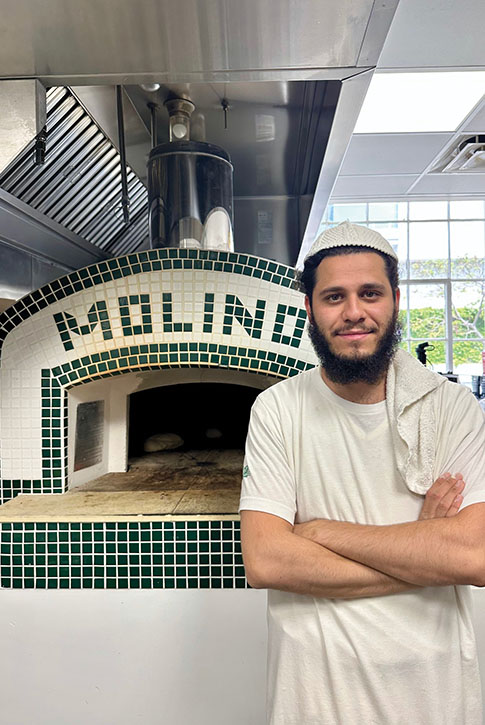
Bella Pizza at Molino on Pico

In 1973, when my family left Casablanca for the United States, my aunt Clara and uncle Menasse moved to Barcelona, then joined his extended family in Paris.In 1983, they decided to move to Los Angeles, with the hope of giving their kids a better chance of making Jewish friends and marrying Jewish people. My brothers and I were overjoyed to be reunited with our cousins, who were more like brothers and sisters to us.

Soon after, as a student at Santa Monica College, Felix met Patricia, a beautiful French-speaking girl from Zaire. The crazy coincidence is that Patricia’s family, like Neil’s, were Sephardic Jews from the island of Rhodes and they were distantly related. 

The real beauty of the situation is that we all raised our children together. Now that they are young adults, the next generation remain very close. 

Recently, Sharon and I interviewed Moshe, Felix and Patricia’s son about his new kosher pizza restaurant Molino. He told us that his mom is a fabulous cook and that growing up, he loved spending time in the kitchen with her. During Covid, he started a catering business. He bought a home pizza oven and began experimenting with pizza dough. There was a lot of trial and error. He learned that many factors, including the weather, can affect the quality of the dough.

Moshe Fhima, owner of Molino

At Molino, he prepares the pizza dough two days in advance. For Tuesday’s pizza orders, he starts the dry yeast rise and prepares the dough on Sunday, letting it rise until Monday. On Monday he adds more flour and water and forms the balls, leaving them to ferment and rise in the refrigerator until Tuesday. 

Moshe advises the home cook, who wants to bake amazing pizza to let the dough ferment. If the instructions say to let rise for one or two hours, leave it in the fridge to rise overnight. He recommends using half the yeast that recipes call for because this makes the dough light on the stomach and easier to digest. Salt is very important. So is hydration—the dough should be sticky. 

He also advocates using a pizza oven stone or a pizza baking steel to ensure a really crispy crust (this can also be used to bake breads, including sourdough). He says to set the oven to 550°F and preheat for at least 45 minutes.

His Molino pizza sauce is very simple and is made with San Marzano canned tomatoes, roughly crushed (sauce should have some texture). Adding salt and olive oil rounds out the flavor. Moshe strives to source the highest quality ingredients. For pizza, a good mozzarella is key. It was difficult to source good Chalav Israel mozzarella, but he found a mozzarella called Fior di Latte (milk flower in Italian). Made in Italy from fresh cows milk, he orders it from Abaita, one of the best dairy restaurants in New York. 

Travel in Europe and eating at incredible kosher restaurants inspired Moshe. His ambition for Molino is to replicate those joyful, flavorful dining experiences. 

Since opening Molino, the restaurant has taken off like fire. The amazing Italian dishes they serve truly rival the offerings of the best kosher restaurants in Rome. I mean, how cool that you don’t have to fly to Europe to indulge in a light, crispy, kosher contemporary Neapolitan pizza!?

—Rachel 

Almost two decades ago, we celebrated my son Ariel’s bar mitzvah in Jerusalem. He wrapped tefillin and had an aliya to the Torah at the Western Wall. Then we celebrated with an exquisitely catered luncheon in the Ottoman era buildings of the Sephardic Educational Center in the Jewish quarter of the Old City. 

On our way back to Los Angeles, we stopped in Paris for some relaxation, sight seeing and fine kosher dining. On our first night, Ariel insisted that we eat at a dairy restaurant just off the Champs Elysee. I know that we ate pastas and salads, but it was the thin crust pizza with fresh mozzarella that really stood out. It was truly the best pizza I had ever eaten. 

A few months ago, Ariel informed me, with great excitement, that his good friend Moshe Fhima was opening a pizza joint. He told me, not just any pizza. Really gourmet pizza!

Well, I recently tried Molino pizza and it took me right back to that amazing pizza in Paris!

Molino’s pizza has a crust that is thin and crispy and chewy. The tomato sauce has a rich, deep, tangy flavor which contrasts beautifully with the fresh milky and smooth mozzarella cheese. 

Buon appetito!

—Sharon  

Pizza Dough Recipe

This is not Molino’s pizza recipe, but it’s perfect for making pizza at home.

This recipe requires an 18- to 24-hour rise in the fridge. You will need bread flour and purified water, active dry yeast, kosher salt, sugar and olive oil.

Don’t forget to use San Marzano canned tomatoes for the sauce and fresh herbs for topping, along with mozzarella cheese.

9 grams active dry yeast

690 grams 00 flour or bread flour, plus ½ cup flour for shaping

20 grams kosher salt

15 grams sugar

9 grams active dry yeast

455 milliliters filtered water, lukewarm

15 grams olive oil, plus extra for brushing crust

Place the flour, salt, yeast and sugar in the bowl of a stand mixer fitted with the dough hook attachment. Add the water and olive oil to the dry ingredients. Mix on low until the dough comes together, forming a ball and pulling away from the sides of the bowl. Increase mixer speed to medium and knead for 5 minutes.

Remove the dough to a lightly floured countertop and smooth into a ball. Lightly oil a mixing bowl, place the dough in the bowl and cover with plastic wrap. Refrigerate for 18 to 24 hours.

Place rested dough on the countertop. Punch down the dough into a rectangle, then tightly roll into a 12- to 15-inch log. Split the dough into 3 equal parts. Flatten each third into a disk, then shape into a smooth ball by folding the edges in toward the center several times and rolling it on a slightly moistened counter.

Cover each ball with a clean cloth and allow to rest for 30 minutes.

To bake, place a pizza stone on the lower rack and preheat the oven to 500°F (or 550°F if possible) for 45 minutes.

Sprinkle flour on a peel (pizza spatula) and place the dough in the middle. Pound the dough into a disk, then pick it up and pull it to create the outer lip. Stretch the dough by placing the dough on a board and continuously turning and pulling. Make sure the dough doesn’t stick to the peel.

Brush the lip with olive oil, then dress the pizza with tomato sauce.

Top with fresh herbs, like oregano and basil and a good mozzarella.

Slide the pizza onto the hot pizza stone.

Watch dough for the first 3 to 4 minutes. Pop any big bubbles that start ballooning with a knife.

Bake for 7 minutes or until the top is bubbly and the underside is nicely brown.

Remove pizza to a cutting board. Let rest for a few minutes before slicing.


Sharon Gomperts and Rachel Emquies Sheff have been friends since high school. The Sephardic Spice Girls project has grown from their collaboration on events for the Sephardic Educational Center in Jerusalem. Follow them
on Instagram @sephardicspicegirls and on Facebook at Sephardic Spice SEC Food. Website sephardicspicegirls.com/full-recipes.

Bella Pizza at Molino on Pico Read More »

Table for Five: Emor

One verse, five voices. Edited by Nina Litvak and Salvador Litvak, the Accidental Talmudist

Speak to the children of Israel, saying: In the seventh month, on the first of the month, it shall be a Sabbath for you, a remembrance of [Israel through] the shofar blast a holy occasion.

– Lev. 23:24


Yehudit Wolffe

Founder, Bais Chana of California, & KosherSofer.com

Why are we commanded to blow shofar? How is it connected to the power of transforming a regular day into a Sabbath (Rosh Hashanaho), a holy occasion?

Shofar is narrow at the opening where we blow/wider at the end where the sound blasts. We can learn from hostages and soldiers who “blew the shofar”:

The shofar is narrow where we put our efforts. This represents difficult moments, which offer us the opportunity to make a blast, to change ordinary into holy. When we use our free choice, as hostages and soldiers did at the hardest times, to overcome difficulties, we persevere, give our inner strength to see and do good, with even a smile, (as Agam Berger did), we create the sound of the shofar which makes a day holy and brings the ultimate Redemption’s “shofar of Moshiach,” the symbol of our efforts throughout the generations of G-d hiding; we bring the true, complete Redemption which is the eternal Sabbath, where all the world will recognize G-d as the Almighty king! The Rebbe Maharash said: “The world says that if you have obstacles, go around them… I say immediately leap over them!” When we are connected to G-d’s truth, G-d’s will which is revealed in Torah, we can leap over obstacles immediately. The power to transform is within us!


Rabbi Tal Sessler 

Temple Beth Zion

The Vietnamese Buddhist sage Thich Nhat Hanh instituted a mindfulness practice in his monastery. At regular intervals, a bell would sound in the monastery, and everyone would desist from their mundane tasks, rise, breathe inwardly and outwardly, and reconnect in cosmic stillness with their inner core.  

The English poet John Donne was also sensitized to the sound of the bell. For John Donne, the bell is sounded to re-sensitize us to our sheer finitude and looming mortality.

Unlike engaged Buddhism and medieval Christianity, Judaism does not make use of the bell as a meditative tool for soulful introspection and existential contemplation. In Judaism, we have the shofar, which we sound, according to Maimonides, to awaken us from our dogmatic slumbers, shake off the sleepiness of the trivial and the mundane, and ponder the brevity and fragility of human existence. The purpose of the shofar, to borrow from Alan Seeger, is to remind us that we have “a rendezvous with death.” Rosh Hashanah is called a “Day of Remembrance,” also because the shofar blasts implore us to remember, in the words of the psalmist, that a human lifespan is akin to “a fleeting shadow” on the face of eternity. Much of our life is spent in frantic denial of what Heidegger called our “being-toward-death,” and we desperately seek to repress the ticking clock of our temporality. But the sound of the shofar summons us to embrace our mortality and lead a dignified and benevolent existence.


Rabbi Shlomo Yaffe

Congregation B’nai Torah, Springfield, Mass. 

This verse, of course is a reference to Rosh Hashanah, which we know today as beginning the Jewish year, as the Day of Judgement, but listed here as the beginning of the seventh month, counting from Nissan — using the calendar of the Pilgrimage festivals which begin with Passover.

Where do we see this idea of a Judgment Day in the text?

The key word here is “zichron” — Remembrance. It is the Day where G-d “retrieves from memory” all the past year’s doings and sets the stage for the opportunities and parameters of the choices we will make, thereby creating the future memories we will have of the coming year.

At the beginning of the book of Job we have the following dialogue: “1:6-8 Now it was The Day, that the sons of God came to present themselves before the LORD … And the LORD said unto Satan: ‘Whence comest thou? … And the LORD said unto Satan: ‘Hast thou considered My servant Job, that there is none like him in the earth, a whole-hearted and an upright man, one that feareth God, and shunneth evil?”

The translation of the Hebrew is indeed “The Day” with the definitive article, and according to our Sages this means  a day of consideration of the past year: Rosh Hashanah. So, the term remembrance in our verse means just that  — the day at which the memories we have created by our choices come before G-d for analysis and creation of our destiny in the coming year.


Dr. Erica Rothblum 

Head of School, Pressman Academy of Temple Beth Am

This parsha refers to Rosh Hashanah, and two words stand out: zichron (remembrance) and teruah (the shofar blast). While they can be read together — as remembering the day through the sound of the shofar — perhaps we understand them better when first understood separately. Sforno teaches that zichron calls for inner spiritual preparation as we approach the day of judgment. Ramban interprets teruah as a crying or sobbing sound, expressing human brokenness. Read together, the verse becomes a call to reflect not only on our own lives, but on the state of the world. Preparing for judgment means not just personal repentance, but asking: How have I responded to the brokenness around me? The sound of teruah echoes wherever people are in pain — in our communities, in our cities, in Israel and across the world. As Rabbi Tarfon said: “You are not obligated to complete the work, but neither are you free to desist from it.” Rosh Hashanah reminds us that spiritual preparation is not abstract — it’s rooted in compassion, justice, and repair. There are four-and-a-half months until we again hear the shofar’s cry. What will each of us do between now and then to help heal a fragment of that brokenness — and to truly be ready for the day of remembrance? 


Kylie Ora Lobell

Community editor, Jewish Journal

This quote is describing Rosh Hashanah, when Hashem created the world. The shofar blast we hear on this holiday is meant to stir our souls, to wake us up to repent for our misdeeds and try to become better people in the year ahead … and beyond. While Rosh Hashanah is when we focus on self-improvement, the truth is that to be a Jew means to constantly be working on ourselves. Every Torah class we attend, every shiur at synagogue we listen to, every session we have with our chavruta, our study partner, is an opportunity to grow as a person. Rosh Hashanah is when we make these big, lofty goals, but every day, we must put in the time for self-reflection and growth. This can also be a little more abstract: perhaps you learn patience by waiting on hold for a customer service representative, or you hug your child instead of getting angry at them when they’re acting up. Figure out a character trait you hope to fix and then work on it. We are not put on this planet to be idle; we are put here to better ourselves and the world around us. Come up with your yearly goals at Rosh Hashanah, but also your daily ones. Ask yourself: What can I do to improve now? Hear that shofar blast in your mind and make that radically beautiful change today.

Table for Five: Emor Read More »

Jay’s New Challenge

Jay Sanderson is sipping on an iced matcha latte as the two of us have breakfast in Studio City. We’re meeting to discuss the news, announced just days earlier on May 5, that he would, effective immediately, become interim president of American Jewish University (AJU).

“My first instinct was to decline,” Sanderson says, seated underneath an awning of the Ventura Boulevard-facing café, shading him from the city’s unexpected heatwave. “I never would have thought, one, that anyone would want me to do it, and two, that I would actually say ‘yes.’”

This candor is very Jay. I’ve known Sanderson, 68, since his time serving as president and CEO of Jewish Federation Los Angeles — known during Sanderson’s tenure, from 2011-2022, as the Jewish Federation of Greater Los Angeles. In many ways, his time at the Federation coincided with my time at The Jewish Journal, where I served as a staff writer from 2010-2020.

And in 2022, when Jay handed over the proverbial torch to current LA Federation President Rabbi Noah Farkas, it felt like the right time. Jewish LA was grappling with the hangover of a global pandemic, and the following year, there’d be true upheaval caused by the attack of Oct. 7 that would permanently alter the texture of the Los Angeles Jewish community.

In late 2023 and for much of last year, as Jewish organizations united to combat unprecedented levels of antisemitism, Sanderson, it seemed, was comfortably cocooned, attempting to reinvent himself on social media as a chef and mixologist, though that didn’t mean — to borrow language he coined when leading Federation — he stopped caring about the Jewish future.

“The minute I left, I basically was gone from the Jewish world, other than my personal relationships,” he said.

But now Sanderson’s back, not at the Federation, but at a similarly influential, legacy-driven institution, one that outsiders look at when gauging the health and robustness of West Coast Jewry. This is true particularly for the Conservative movement, as AJU houses the Ziegler School of Rabbinic Studies, a seminary for clergy seeking to serve at Conservative synagogues.

In his new interim role, Sanderson is succeeding AJU’s former President Jeffrey Herbst, whose resignation was announced in a May 5 letter by AJU Board Chair Harold Masor and Incoming Board Chair Larry Platt. The letter was shared via email with the university’s community before news organizations, including this one, published stories about the leadership transition.

In assuming the role at AJU, Sanderson becomes the university’s fifth president since its founding in 1947 — and only the second non-rabbi president in its history.

So, what responsibilities does Sanderson feel as he takes the reins of AJU? What’s his vision for what the university, which operates a rabbinical school, graduate degree programs, community events and onine education, ought to be? And how does the former LA Federation CEO plan to meet the daunting challenge of making AJU, well, great again?

During a nearly two-hour breakfast, the fedora-wearing Sanderson — shades of his influencer days making cocktails on Instagram remained — addressed these questions and more. Though, it being less than one week since he began in the new gig, specifics were somewhat limited, including what the future portended for longstanding AJU programs, such as Camp Alonim and the Ziegler school. 

What is certain is storytelling will be a big part of the mission, said Sanderson, who before his stint at the LA Federation helmed Jewish Television Network, which partnered with PBS to produce the documentary series, “The Jewish Americans.” 

AJU, Sanderson said, hasn’t been telling its story effectively, which has limited its ability to raise its public profile. And an institution with as compelling a history as AJU has — prior to becoming AJU, it was the University of Judaism, which eventually absorbed the Brandeis Bardin Campus in Simi Valley, to become the sprawling institution it is today — ought to be better at telling the community what it’s all about, he said.

“My focus is the audience,” he said, channeling the former media executive still apparently residing in him. “If you focus on who you want to reach and what they want, you will have a line around the door. But there’s been a disconnect in Jewish life between institutions and the audiences, and I don’t look at the world that way.”

Though AJU sold its Bel Air-based Familian Campus to Milken Community School last year, the university maintains a presence on the campus via a leaseback agreement with the Jewish private school. AJU currently operates at three locations: the Bel Air campus, which is now dubbed “Milken East,” its Ziegler Campus, located in Beverly Hills, a short distance from the heavily Jewish Pico-Robertson neighborhood, and the Brandeis-Bardin campus, which is home to Camp Alonim and offers spaces for lifecycle events, such as b’nai mitzvot and weddings, as well as educational retreats and conferences.

In particular, the Brandeis-Bardin campus will play a central role to AJU’s future growth, Sanderson said. In fact, Sanderson married his wife, Laura, at the Brandeis campus in 1984, and he views the picturesque, 2,700-acre site, one of the largest pieces of land that is Jewish-owned outside of Israel, as a largely untapped resource in the community.

Sanderson, in some ways, was an obvious choice for the presidency. In February, several months before naming Sanderson AJU’s interim president, the university had tapped Sanderson to spearhead the 2050 Institute, a program that was tasked with envisioning what Jewish life ought to look like 25 years from now. Not just local Jewish life, but all Jewish life.

In previous interviews about the 2050 Institute, Sanderson spoke of Jewish and non-Jewish leaders from a variety of disciplines — technology, business, entertainment and marketing, to name a few — coming together at the Brandeis campus for in-depth discussions about the future of Jewish life for an experience like an “Aspen Institute,” albeit focused on Jewish ideas.

Given that a crucial part of AJU’s future will be its online impact, Sanderson is essentially also going global in his new role. As he assumes the role of interim AJU president, he’s more energized than ever about the work of 2050 Institute, he said. 

Also, he will be tasked with overseeing approximately 70 employees, fewer than the 130 employees of the LA Federation at the time of Sanderson’s departure, but a considerable number, nonetheless. AJU’s staff includes full-time, part-time and seasonal employees. Largely, the seasonal staff are those hired for the summers to work at Camp Alonim, Sanderson explained.

Along with Camp Alonim and the Ziegler School of Rabbinic Studies, now also under Sanderson’s purview is AJU’s Masor School for Jewish Education and Leadership, which offers a Bachelor of Arts in early childhood education, a master’s in early childhood education, a doctorate in early childhood education leadership as well as a doctorate in Jewish education and communal leadership, among other degrees.

He’ll also be overseeing AJU’s Miller Intro to Judaism Program, which offers in-person and online courses for those seeking to convert to Judaism or want to learn more about how to bring Judaism into their lives. The program is run under the auspices of AJU’s Maas Center, which continues to operate a community mikvah on the Bel Air campus now owned by Milken Community School.

In other words, there will be a lot on Sanderson’s plate — much more than the gluten-free toast he ordered during our breakfast together.

Richard Sandler has known Sanderson since his pre-Federation days working at JTN. Sanderson’s stint as Jewish Federation CEO, in fact, coincided with the start of Sandler’s tenure as chair of the Federation’s board. 

 In a phone interview, Sandler—who today serves as chair of Milken Community School and was, he said, “intimately involved” with the process surrounding AJU’s sale of its Bel Air property to Milken—predicted Sanderson would face many of the challenges he had when starting at the Federation. 

 “AJU has a credible name, but I don’t think most people today understand AJU’s present mission and business,” Sandler said. “We faced similar issues when Jay and I first started working together at Jewish Federation, and Jay proved he is extremely capable of doing what needs to be done.”

“Jay is an innovator and a deep thinker,” Julie Platt, a previous chair of Jewish Federation, told the Journal. “I’m excited to see how those unique skills move American Jewish University forward.”

When Sanderson was leading the Federation, he had a reputation as being blunt and outspoken, someone who took pride in being thought of as a “disruptor.” It’s been nearly 15 years since he first began working at the Federation, and the world has been through a lot since then, yet in many ways Sanderson is still a guy who isn’t afraid to call it as he sees it. 

Yet, there have been changes in Sanderson. The father of two grown children has gotten more patient as the years have gone on, and it’s a quality that’ll serve him well as he embarks on this new professional chapter, he said.

“This is my next chapter and AJU’s next chapter,” he said. “I’m looking into the future of AJU, not the past, and I feel lucky to be working with great people with whom my job is to reimagine AJU.”

But “I’m probably not like any other university president,” he said. “If you call me a university president, I’m not like any other university president in the university system. If you look at me as a change agent and someone who is deeply committed to the Jewish people and Jewish leadership, then I’m the perfect person for the job, but I’m not a rabbi, and I’m not a Ph.D., and I’m not going to act like it.”

In some ways, yes, it’s the same old Jay. And AJU might just benefit from that.

Jay’s New Challenge Read More »