fbpx

April 3, 2025

Choices of Charoset

One seder plate — and table — mainstay is charoset. That sweet mix of fruit, wine and nuts is something many look forward to all year.

“Growing up, we always had my mother’s shepherd-style charoset, which was my favorite at the Passover seder table,” Alon Shaya, co-founder of Pomegranate Hospitality and author of the cookbook “Shaya: An Odyssey of Food, My Journey Back to Israel,” told The Journal. “After moving back from Italy, I adjusted it to include hazelnuts, pistachios and vin santo, which, I think, is a beautiful complement to all the dried fruits.”

He added, “Today, I love it with roast duck for dinner or toast and labneh for breakfast.”

Alon Shaya’s Charoset

Alon Shaya’s Charoset Photo by Rush Jagoe

Yield: About 4 cups

10 Medjool dates, pitted and chopped

7 or 8 dried figs (6 ounces), chopped

6 ounces (about 1 cup) dried apricots, pitted and chopped

½ cup hazelnuts, toasted

½ cup pistachios, toasted

3 Granny Smith apples, peeled, cored, and chopped

1 small yellow onion, chopped

1/3 cup rice wine vinegar, preferably seasoned

1/3 cup sweet sparkling white wine, preferably Moscato d’Asti

1/3 cup sugar

3 Tbsp honey

3 Tbsp apricot preserves

¼ tsp Morton kosher salt

½ tsp ground cinnamon

¼ tsp ground cardamom pods

¼ tsp ground allspice 

Grated zest from ½ orange

Grated zest from ½ lemon

1 ½ Tbsp lemon juice

1 ½ Tbsp orange juice

Roughly chop the dates, figs and apricots, removing any woody stems or ends. Add them to a food processor along with the hazelnuts and pistachios, and pulse to chop coarsely, taking care not to pulverize the mixture into a paste. It’s okay if some of the nuts remain whole. Set aside. 

Add the apples and onion to a large saucepan with the vinegar, wine, and sugar. Bring to a simmer over medium heat, then turn the heat down to low and cover the pot. Cook until the onions are translucent but the apples still hold their shape, 6 to 8 minutes.

Scoop everything from the food processor into the saucepan with the onions and apples; add the honey, apricot preserves salt, spices, and zests. Cook over medium-low heat, stirring occasionally, until all the dried fruit has softened and absorbed the juices from the pan and the liquid has reduced to a point where it’s no longer bubbling. When you give it a taste, the flavor should be warm with fruit, alive with spice, with just a savory note in the background. The apples should still have some body to them.

Remove from the heat, and cool to room temperature before stirring in the orange and lemon juice. Leftovers keep well in the fridge for several days.

Beth Lee grew up eating Ashkenazi-style charoset with apples, walnuts, cinnamon and sweet kosher wine. 

“[It was] chunky so it never stayed on the matzah but oh does it taste like comfort and Passover to me to this day,”  Lee, author of “The Essential Jewish Baking Cookbook” and blogger at OMGYummy.com, told The Journal.

“I’ve modernized my version a bit with a suggestion of smaller pieces of nuts and apples — maybe even a food processor — [and] the option to use regular, not sweet, red wine and some currants and orange zest,” she said. “But it still rings true to my childhood flavor memories every time!”

Ashkenazi-style Charoset from Beth Lee

1 medium sized apple, peeled, cored and chopped (will be about 1.5 cups)

Juice of ¼ of a lemon

½-1 cup walnuts toasted and chopped

¼ cup currants optional but recommended

½ tsp cinnamon or to taste

2-3 Tbsp of kosher wine or red wine (adjust to your taste)

¼ tsp orange zest optional but recommended

Toast and chop the walnuts.

Peel, core and chop your apple and then sprinkle with a bit of lemon juice to retard any browning. 

Remember, the smaller you chop the nuts and apples, the better the charoset will stay on your matzah when you eat it.

Once the walnuts have cooled a bit, mix with the apples and if using, add the currants.

Add cinnamon and wine and if using, the orange zest,  if using and mix well.

Taste for flavor, adjust if needed. Charoset is all about your own preferences so adjust as you like it. Also, let it sit for a little while to let all the flavors come together and then taste it again.

Notes: 

Ashkenazi charoset gets better tasting with time so feel free to make this hours or even a day in advance. Leftover charoset also keeps well for several days in the refrigerator.

I put a variation of ½-1 cup of nuts in the recipe because it’s really up to you what balance you want between apples and nuts. If you’re not sure, start with a half cup, taste the mixture and then add more nuts if you want a nuttier feel and taste. Also, apples vary in size so sometimes you’ll have more or less apple. Let your taste buds be your guide!

Choices of Charoset Read More »

Seder Favorites with a Twist

Passover will be here before we know it. While there are some seder favorites to look forward to year-round, it’s also fun to mix things up. 

Chef and spice master Lior Lev Sercarz, owner of La Boîte, enjoys gefilte fish. Yet, he understands that the traditional version is not always a crowd-pleaser. 

“We wanted to offer a delicious and easy alternative that everyone can enjoy during the seder,” Lev Sercarz told The Journal. “Our approach? Introducing the flavorful Moruno spice, with its vibrant saffron notes and coarsely ground coriander, to create a layered, lightly fried fish cake.” 

This modern take is perfect with horseradish sauce (recipe below) or any other favorite condiments.

Seared Gefilte Fish Cakes

By La Boîte Culinary Director Helen Park

Yield 24 2-oz cakes

2 pounds fresh white fish, preferably cod or haddock, diced ¼”

½ cup grated carrots

½ cup red onion, thinly sliced

2 eggs

½ cup matzah meal

¼ cup roughly chopped parsley

1 Tbsp Moruno spice blend  

½ tsp fine sea salt  

½ tsp ground black pepper  

Oil for cooking

In a large bowl, combine all of the ingredients, except oil for cooking, well. Portion the mixture into ¼ cup oval patties and place them onto a parchment lined tray. In a large nonstick skillet, heat oil to coat the bottom of the pan to shimmering. Sear each fish cake until golden brown on both sides and cooked through. Add more oil, as needed. Serve warm with the horseradish sauce.

Beet Horseradish (Hezeret)

1 Tbsp  amchoor  

12 oz package steamed peeled beets, cut into quarters

¼ tsp fine sea salt  

1 Tbsp sugar

1 cup prepared horseradish

Chop the amchoor, beets, salt and sugar in a food processor until finely chopped. Add the prepared horseradish and continue processing until a smooth, bright puree. Serve chilled.


If you are tired of the same-old same-old potato recipes for Passover, try Judy Elbaum’s trompe l’oeil potato brioches. 

“They are one of my favorite side dishes to serve on Passover with beef, poultry or fish,” Elbaum, founder of LeaveIttoBubbe.com, told The Journal. “They look so much like the classic French brioche bread, yet they are a tasty and creative way to serve potatoes.”

Passover Potato Brioches

Makes about 24 potato brioches 

Kosher for Passover vegetable spray

Parchment paper

Matzah cake meal

3 ¼ pounds Yukon gold potatoes,
cut into quarters

1 stick margarine cut into small pieces, room temperature

2 tsp kosher salt

4 Egg yolks

freshly ground pepper to taste

2 Tbsp chopped fresh herbs (dill, parsley, chives or a combination of 2 or more)

You will also need 2 non-stick 12-cup mini muffin pans.

Preheat the oven to 400°F. Grease the individual cups on the muffin pans with melted margarine or vegetable spray and refrigerate before using. Dust the bottom and sides of the muffin cups with matzah cake meal. To prevent sticking, I cut out circles on parchment paper to fit the bottoms of the muffin cups.  

Place potatoes into a large saucepan, and cover with water. Add 1 teaspoon of the salt. Bring to a boil then reduce heat to a simmer and cook the potatoes until they are soft — about 20 to 30 minutes. 

Drain the potatoes. Peel them, then force them through a potato ricer into a large mixing bowl. Add the margarine, remaining salt, 3 egg yolks, pepper and fresh herbs and combine well. Allow the potato dough to cool in the fridge for 1 to 2 hours, until it is easy to handle, and no longer sticky.

Remove from the fridge, then lightly flour your hands and a pastry board with matzah cake meal. Use about 2 generous tablespoons of the potato dough for each potato brioche.  Pinch off a small marble sized piece of the dough. Roll the larger piece of dough into a ball. Make a small indentation in the center of the large ball, roll the smaller piece of dough into a marble sized ball, and place into the indentation. The potato muffin will look like a small brioche. Repeat with the remaining dough.  

Add 1 tablespoon of water to the remaining egg yolk and beat well.  Brush the egg glaze onto each potato brioche before baking.  Bake in the preheated oven for 20 to 25 minutes or until golden brown.  Remove gently from muffin pans. Can be made a day ahead and reheated for 10 minutes in a 350°F oven before serving.


Pam Stein, In Pam’s Kitchen, hosts the second Passover seder each year, and always incorporates a theme. 

“My seders are replete with traditional foods such as matzah ball soup, chicken and tzimmes, but they take on a geographical flair,” Stein told The Journal. “My husband and I pick a city or country and base our dinner around the flavor profiles associated with the chosen destination.” She added, “The culinary motif is not shared in advance, leaving our guests to discover what they’ll be dining on when they arrive.”

Stein developed this recipe after a visit to New Orleans, as part of a Cajun and Creole based-menu. “Cajun Matzah Farfel Kugel merges the comforting textures of traditional kugel with the spicy flavors of Cajun cuisine,” Stein said. “Instead of potatoes, matzah farfel is used as the base.” 

The key is to use Cajun seasoning: a combination of paprika, cayenne pepper, garlic powder, onion powder, thyme and oregano. 

“This kugel is far from the sweet, cinnamon-and-sugar version,” she said. “This one is spicy, savory and full of flavor.”

Cajun Matzah Farfel Kugel 

Serves 12

3 Tbsp extra virgin olive oil 

4 celery stalks, diced 

5 green onions, chopped 

1 large green bell pepper, chopped 

28 ounces Matzah farfel 

4 large eggs, yolks broken 

1/4 tsp salt 

1 Tbsp Cajun Seasoning  

42 ounces  chicken broth 

1/4 cup parsley, chopped 

Preheat the oven to 350°F. Also, butter a 3-1/2 quart casserole dish. Set aside. 

In a large skillet, over medium heat, add olive oil. When oil is warm, add celery, green onions and green pepper. Sauté for 3-4 minutes until just tender. 

Add matzah farfel, eggs, salt and Cajun seasoning. Stir to combine. 

Pour in chicken broth. Fold the matzah farfel into the broth allowing the farfel to  absorb the liquid. Continue folding the farfel until all the liquid is absorbed.  

Stir in the chopped parsley. 

Spoon farfel mix into the prepared casserole dish. Bake for 40-45 minutes. Serve warm.  

Cover and refrigerate leftovers for up to 3 days.

Seder Favorites with a Twist Read More »

Magic in the Air: Fabulous Fish & Best Brisket

The Pesach seders I spent as a young child at the home of my grandparents Aba Naji and Nana Aziza will always be the gold standard. I will always cherish the impressions. My grandmother’s pristine home aglow with the light of her many candles. The long table set with piles of matzah, crystal bowls filled with halekh (Babylonian charoset made with date syrup and crushed walnuts) and piles of freshly washed romaine leaves. 

The many glasses waiting to be filled with wine and grape juice and the hard-boiled egg on each plate, as a memory of the korban (sacrifice) that was offered at the Holy Temple on the holiday of Passover two millennia ago. 

The anticipation in the air as my grandfather started the seder by holding up the round matzah and leading us in a singsong chant of “ha’lach’ma anya” (the bread of affliction) in Aramaic, as well as the ancient Babylonian Judeo-Arabic that my family spoke in Iraq. 

Then my grandparents would call Rafi and me over. In an act of generational continuity, they would tie matzahs wrapped in silk scarves around our backs. They would give us sticks and encourage us to pretend that we had just left Mitzrayim (Egypt). All the adults would play-act with us and ask where we had come from and where we were going. We would answer “Jerusalem!”

Pesach is the most perfectly scripted holiday. The perfect way to engage children in the redemption story of the Jewish people. 

The Haggadah sets the story against the backdrop of the great pyramids of Egypt, the mightiest empire in the world at the time. The mighty Pharoah stubbornly refuses to allow the enslaved Israelites to leave. He doubles down in the face of HaShem’s ten supernatural plagues, hardening his heart. Up until the slaying of the firstborn of the Egyptians. 

Then the Israelites have to leave in haste, carrying with them matzah, the unleavened bread at the center of the holiday. 

Just when it seems like a clean getaway, Pharaoh and his army pursue the Israelites, pinning them against the depths of the Red Sea. There is another miraculous intervention by Hashem, who parts the Red Sea, allowing the Israelites to escape yet again. The cruel Egyptians, their horses and their jewel-encrusted chariots drown at the bottom of the sea. 

Dayenu. 

Over the years, my beloved grandparents and my amazing, smart, funny and saintly father have left the stage. They leave a void that my mother, my brothers and sisters-in-law and Alan and I are tasked with filling. Passover is the opportunity to carry on the legacy and engage the next generation with the wonder. 

I am grateful to watch my children and my nephews and nieces embrace my family’s Iraqi traditions. It’s extra special to watch them savor my mother’s halekh. Every year, she painstakingly makes date syrup by boiling dates and straining the pulp through a cheesecloth and boiling the juice to make a delicious honey. 

While many of the traditions have remained the same, my family has picked up one very Ashkenazi tradition—to serve a roast for holiday meals. 

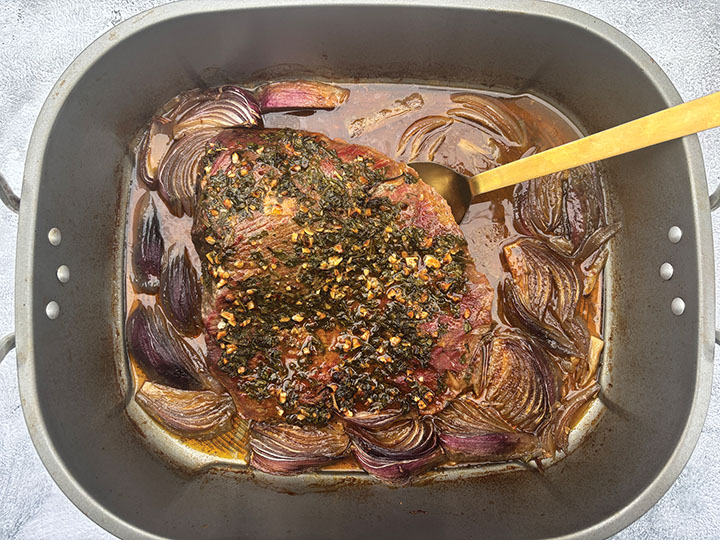
Rachel and I dreamed up this fabulous Best Passover Brisket recipe. It’s really simple and it will work with any cut of meat—brisket, chuck, shoulder or eye roast. There’s fresh parsley, Aleppo pepper, sweet paprika and jarred Silan, as well as lots of purple onion and garlic. The meat comes out tender, moist and oh so flavorful. 

It’s almost as miraculous as the Exodus story! 

—Sharon 

Over the years, my perspective of Passover has changed dramatically. 

When I was young, my excitement would be focused on finding the afikoman and receiving a special gift.

As a teen, Passover brought the burden of helping to clean the house. It meant looking forward to the drama of my father singing “Bibilou” and holding the seder plate over all our heads. But also sitting through a very long, boring seder, only broken by the parts where I enjoyed singing along. 

As a young, full-time working mother I dreaded the amount of work that came with Passover. It was always overwhelming to think about all the cleaning and all the cooking. 

As our children grew older Passover became more fun. Neil would buy dry ice and add it to the bowl. The kids would be so excited, watching the smoke come out of the bowl as we recited the 10 plagues. He would have all kinds of fun toys and children’s Haggadahs to engage the kids. Finding the afikoman was the highlight—our kids and nephews and nieces scoured the house to find it and we would always have many gifts to go around. 

During the week I would serve our favorite family Passover foods such as burmuelos (cheese matzah farfel pancakes) and “build your own” matza pizza, so they wouldn’t miss pasta too much.  

These days, I don’t feel the dread anymore. I feel like I’ve got this Passover thing down. I have a wonderful sense of accomplishment when the spring cleaning is complete. After all these years of hosting, I know that I’ll be cooking my family their favorite dishes. At the seder, I will set the scene with my best tablecloth, my finest china and sparkling crystal. 

My mother’s candelabra will grace the table. I will make my mother’s Moroccan soup, her potato and meat pastelitos and her delicious Moroccan fish recipe will be served in her fabulous fish dish. 

I will prepare my mother-in-law’s ancient Ladino recipe for yummy keftes de prasa (fried leek and potato patties).

Nowadays, my grown children look forward to gathering with family and a few friends at our table. Having my father sing bibilou is still the highlight and the kids still want to find the afikomen. 

When I think of Passover, I’m no longer frazzled. I focus on feeling the joy and the new memories we will create as our family grows. 

—Rachel 

Quick preserved lemon 

1 lemon, washed

1/2 cup kosher salt

Slice the lemon into thin rounds and remove seeds. 

Dip each lemon slice into the kosher salt and fully coat both sides.
Place the lemon in a plastic bag or a freezer safe container. Freeze for a few hours or a day.
Use just like preserved lemon.

Moroccan Fish

3 lbs sea bass (or any firm white flesh fish), filleted and cut into portions

1/4 tsp salt, for salting fish

2 medium eggplants 

1/2 cup extra virgin olive oil, divided

2 leeks, thinly chopped

1 Tbsp cumin

2 Tbsp sweet paprika

1 tsp salt

1 tsp white pepper

1 14oz can cherry tomatoes or diced tomatoes 

3 medium cloves garlic, roughly chopped 

1 cup water 

1 bunch cilantro, roughly chopped

1 dry chili pepper 

1 Tbsp capers

1/2 preserved lemon, diced 

Place fish skin down on a plate lined with paper towel and season with salt. Set aside.

Partially peel the eggplant by leaving thin strips of skin. Cut the eggplant into 2 inch cubes, then place in a bowl. Liberally salt the eggplant, then toss so that all the pieces are salted. Set aside for 15 minutes. Use paper towel to remove the salt and squeeze the liquid from the eggplant.

In a large skillet or a Dutch oven with lid, warm 1/4 cup oil over low heat, then add sliced leeks and sauté until golden. Add the cumin, paprika, salt and pepper to the pot and stir to coat leeks. 

Place the eggplant in the pot and continue to sauté. Add the additional oil and keep stirring for two minutes.
Add the canned tomatoes, water and garlic and stir gently. Add the chopped cilantro, reserving a handful for garnish.

Add the preserved lemon (or lemon juice and chili pepper). 

Cover and simmer for 15 minutes, stirring occasionally to ensure the eggplant doesn’t stick to the bottom of the pan. Continue to simmer until juices have thickened and eggplant is soft.

Spoon all the thickened sauce into an ovenproof dish, then nestle fish tucked in the sauce. Bake immediately for 20 minutes at 350°F or refrigerate and bake before serving.

Garnish with fresh cilantro just before serving.

Best Passover Brisket

1 4lb brisket or shoulder roast

8 large cloves garlic, chopped

1/4 cup brown sugar 

2 tsp sweet paprika 

1/2 tsp Aleppo pepper

3 tsp kosher salt 

1 tsp black pepper 

1/3 cup extra virgin olive oil 

1/4 cup organic Silan (date syrup)

1 cup chopped Italian parsley 

2 medium purple onions, cut into wedges 

1 cup cold water

Preheat oven to 350°F.

Place meat in a large roasting pan.

In a medium bowl, combine the garlic, brown sugar, paprika, Aleppo pepper, salt and pepper. Add oil, Silan and parsley and mix into a paste.

Spread the paste over the roast.

Place the onions around the roast and pour water around the edges of the pan. 

Cover with a crumpled sheet of wet parchment paper. Make sure to tuck the edges inside the pan to prevent dripping in the oven. 

Cover with a tight layer of aluminum foil. 

Roast in the oven for 2 hours, then remove from the oven to baste with juices. Add 1/2 cup more water if pan juices have evaporated. 

Lower oven to 300°F and roast for 1 to 2 hours until fork tender. 

Let the roast rest, then carve and serve with onions and juices. 


Sharon Gomperts and Rachel Emquies Sheff have been friends since high school. The Sephardic Spice Girls project has grown from their collaboration on events for the Sephardic Educational Center in Jerusalem. Follow them
on Instagram @sephardicspicegirls and on Facebook at Sephardic Spice SEC Food. Website sephardicspicegirls.com/full-recipes.

Magic in the Air: Fabulous Fish & Best Brisket Read More »

Table for Five: Vayikra

One verse, five voices. Edited by Nina Litvak and Salvador Litvak, the Accidental Talmudist

If a person sins and commits one of the commandments of the Lord which may not be committed, but he does not know, he is guilty, and he shall bear his transgression.

– Lev. 5:17


Rabbi Janet Madden

Malibu Jewish Center and Synagogue

In our secular legal system,”ignorantia juris non excusat” — “ignorance of the law is no defense” — is a long-settled principle. At first glance, it might seem that this is similar to Vayikra 5:17’s statement of sin and guilt. But because the Book of Calling and Being Called immerses us in teachings about how to be holy and whole, our verse references essential soul-medicine. 

Mitzvot are, literally, commandments, but the Aramaic root of the word “tzavta” means to attach. And that meaning suggests that we are being called to a rich opportunity for connection. When we go wrong — as we inevitably do — when we do something that we should not or don’t do something that we should, we know, in our deep soul-selves, that we have become detached from the Divine. We carry the burden of our transgressions in our unmoored selves until we do teshuvah and return to our aspirational selves with renewed knowledge that enhances our own souls and the souls of those with whom we are connected.

Levi Yitzchak of Berdichev read our verse literally: “one of the Lord’s commandments which should not be done.” Based on this reading, he taught, “sometimes it is possible to perform a mitzvah in such an improper manner that it would have been better not to do it at all.”

That is, don’t live pro forma, viewing the mitzvot as performative. These teachings are opportunities for life-saving attachments. Learn. Live fully. Be better. Be holy souls. 


Baruch C. Cohen 

Trial Attorney

In Leviticus 5:17, we learn a profound lesson about responsibility, even in the case of unintentional sins. The verse teaches that we are accountable for our actions, even when we fail to recognize their wrongness. God holds us responsible not only for intentional actions but also for those committed out of ignorance or misunderstanding.

A crucial element of this verse is the distinction between sins of defiance and sins of ignorance. A person who knowingly disobeys is held to a higher standard than someone who errs due to lack of knowledge. This speaks to God’s deep understanding of human nature, considering both intention and awareness when determining guilt. However, just as I remind my clients in the legal world, “ignorance is no excuse for the law,” the same applies here in spiritual terms. Claiming ignorance or saying “I’m a good person” does not absolve one from responsibility. Even if the sin is unintentional, it still requires atonement and rectification.

This passage emphasizes the importance of actively seeking knowledge, particularly through engaging with Torah, to understand God’s commandments. As a litigator, I often tell clients that it is their responsibility to know and understand the law, and the same applies spiritually. Ignorance does not remove responsibility. The Torah urges us to be proactive in learning what is right and wrong, ensuring that our actions align with God’s will. Only through this effort can we fulfill our moral and spiritual duties.


Aliza Lipkin

Writer and educator, Maaleh Adumim, Israel

“It’s not your fault” is a phrase people love to hear. It alleviates the shame many people experience when they are partly or entirely culpable for something that went awry. They then either indignantly assign blame to others or bemoan their bad luck and throw up their hands in despair. 

Victim mentality is pervasive in today’s society. It has become the norm for individuals and mobs to target others, hurling accusations and seeking some form of retribution for their perceived grievances. This is a dangerous mentality that causes chaos and violence that spreads like wildfire and destroys the fabric of society. 

The Torah warns against such an attitude by commanding us to take responsibility for our wrongdoings, intentional or not. We are even obligated to bring a sacrifice to atone for sins committed unknowingly. While this appears punitive, it is instead, a golden opportunity that empowers individuals to reclaim control of their lives. One expends precious time, money, and effort to fulfill this obligation. The guilt offering thus fosters introspection and accountability, hopefully ensuring that the individual will be more conscious and cautious in his actions. When we don’t take responsibility for our actions — intended or not — we surrender our autonomy. Taking responsibility, on the other hand, grants us the freedom to learn from the past, make choices, take decisive action, and change the trajectory of our lives.


Rabbi Moshe Kormornick 

Bestselling Author, “Short Vort” 1 & 2, “The Last Slave” (co-author)

Simon is taking a well-deserved break in the lab. He leans back on his chair, reaches for the cup next to him, and while thinking of his accomplishments of the day, downs the contents of the drink. That’s funny, he thinks to himself, it didn’t taste like coke. He immediately scans the table and sees his untouched cup full of coke, and then he realizes, he must have drunk the tainted cup –the one that with enough poison to kill a person in a few hours if an antidote is not taken soon after. Amused at his “silly” mistake, he shares what happened with his co-worker, who looks at him in shock. 

“Simon, we need to get you to a hospital immediately!” 

“But it was an accident,” said Simon in astonishment at all the fuss. “I didn’t mean to drink it, what’s the big deal!?”

How ridiculous does this sound? We all know that irrespective of any ill-will, someone who drinks poison needs an antidote — it’s just a reality! Yet, when it comes to drinking spiritual poison — sinning, even accidentally — we tend to shrug it off as if it didn’t matter. Our verse demonstrates the fallacy of this attitude, and just like there are times when someone, through no ill-will, makes a mistake that requires a remedy, so too, there are certain sins that need remedies, because their damage to the soul is a reality — a natural consequence of a destructive action, despite the lack of intention behind it. 


Dr. Sheila Tuller Keiter

Judaic Studies Faculty, Shalhevet High School 

“I don’t feel tardy,” wisecracks a student in a Van Halen song.  The rule is clear: be on time for class.  But you may not realize you are late. How can you be punished for violating a rule you don’t even realize you’ve violated? The Talmud offers the example of a person eating what he thought to be permitted fat only to find out it was forbidden fat. Why should that matter if it was an honest mistake? The Torah says it matters.  

We often call these events accidents, and accidents happen. Still, some accidents can cause considerable damage. Confusing the gas pedal for the brakes can be deadly.  But often accidents can be innocuous — no harm, no foul.  Take the Talmud’s forbidden fat scenario. I unknowingly ate it. But nobody got hurt, so it’s all good, right?

The Torah does not allow us to declare “Whoopsie” and walk away. In the larger balance of the universe, the wrong has still been committed. Once you discover the error, you must atone. If this is true for accidentally eating the wrong kind of fat, how much more must this pertain when our thoughtless actions actually hurt others? Only the child justifies her misdeeds by claiming, “But I didn’t mean to!” How often do we innocently say something that turns out to be hurtful? It is too easy to claim good intentions and ignore the pain.  Whether you feel tardy or not, the bell has rung, and it’s time to fix it.

Table for Five: Vayikra Read More »

Rabbis of LA | Rabbi Cooper on What’s Behind the Current Wave of Antisemitism

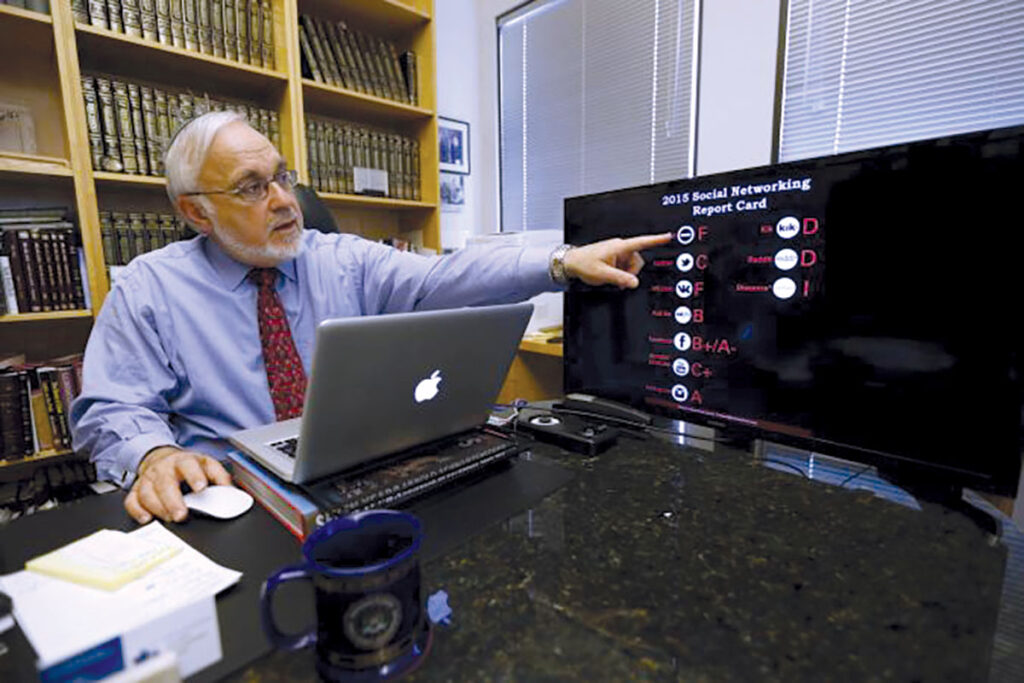
When he was a 27-year-old rabbi, Abraham Cooper helped Rabbi Marvin Hier establish perhaps the world’s foremost enemy of antisemitism, the Simon Wiesenthal Center.

At 75, the associate dean of the Wiesenthal Center travels the world with a vigor that belies his age. When The Journal called, he was in Paris. He would be home just before Shabbat, then fly to Washington, D.C. The New York native was in Paris for a series of meetings. He suggested a Zoom call at midnight– his time – because the next day was jammed with commitments.

Besides Oct. 7, what did Rabbi Cooper think is behind the rise in antisemitic incidents, especially, but not only, on college campuses? “There are multiple reasons, multiple failures,” he said. “These were going on before Oct. 7, but not to the present extent. The cause that many of us continue to feel most directly is the abject failure of the elite universities in the United States to stand by their Jewish students.

“I am not even talking about ideologically. I am talking contractually. Parents pay a ransom, a handsome sum for their children to attend a top school. Yet schools allow mostly outsiders — but not always — to block your way from getting to class, to bully, harass and sometimes attack you, and schools do nothing.”

While granting that such inaction is widespread, how can it be justified? The answer, he said, was best put by Dr. Judea Pearl when he spoke to a group of academics and students from UCLA at the Wiesenthal Center’s Museum of Tolerance. (They did not feel comfortable enough to host the meeting at UCLA.) Prof. Pearl said of the protesters and antisemitic sympathizers: “Don’t kid yourselves. They have been building tunnels underneath our universities for years.” To Cooper, “this means we not only are looking at foreign support or corruption by Qatar and others in the Middle East. “

We are looking at ideologues, he said, “some of whom are holdovers, believe it or not, from the heyday of the Soviet period when I was growing up in the Soviet Jewry movement.” Cooper, who came of age at the start of the 1970s, recalled professors who revered Stalin as God-like, even after the Soviets themselves admitted he was one of history’s top mass murderers. “Unfortunately,” the rabbi added, “Jews were among those true believers.”

That’s not, he said, a total shock. “But the fact is that one of the systems you think would kick in was academics. You’d think they would defend a community that has no input to decisions made by the state of Israel.”  Didn’t happen, he noted. What kind of academics, he asked, would give a moral blank check to terrorists who have boasted about their direct hands-on murders of families, including babies?

Next in the guilty line, by Rabbi Cooper’s measure, are journalists. Much of the legacy media, he said, always has rushed to invoke, to rely upon, “dodgy” statistics – as long as they made Israel look bad  – even if the numbers come from the mass murderers who did the crimes.

Who will stand up for the Jewish community?

“If you can’t go to your academic institutions to stand up for you,” he said, his voice trailing off. They take “huge amounts of money spent by Jews, including many survivors, to endow Jewish Studies programs across North America for such a moment as this… I just found out that tragically, with a few important exceptions, they were AWOL.”

Who then will advocate for Jews? It may seem logical to tell Jewish students or professors to speak up, but, said Rabbi Cooper, “not every campus has superstars like Dr. Judea Pearl.” He grants that “plenty of other superstars felt — ideologically or otherwise — they were uncomfortable defending Israel, which has been demonized on campuses for decades. Fortunately, though, there were Jewish academics who played opposing roles. Needless to say, many students drinking from that resource were pre-positioned to go out” and defend Israel. 

But, the rabbi added, “obviously large sums of money came from Iran and other sources. This enabled Students for Justice in Palestine and all the rest” to stand stoutly against the Jews.

“What we saw was a powerful, coordinated campaign that still is going on. It started in Germany, and a few days later spread across Europe, as in ‘From the river to the sea,’ with threats to Jewish communities. Next, it jumped the pond, over to us, Montreal, Toronto, New York, Chicago, later on Los Angeles and Australia, where you have the same one-liners being spouted at events.”

Rabbi Cooper said that similar tactics are taken today to try and isolate Jewish students. He spoke of escalating attacks against synagogues. Russian authorities recently thwarted an attack on a Moscow synagogue by someone from Central Asia. So this is global. How are the dots connected?  That, said the rabbi, is up to federal authorities — “beyond my pay scale.” Citing recent attacks, Rabbi Cooper suggests looking at the modus operandi, the timing — this was prepackaged with push-button precision.

No question who the guilty parties are. “Media will not push back,” he said. “Academics, far from standing up, will remain silent or say ‘You got what you deserved.’ This brought him to the third point: “What about diplomats? What about the NGO world? What about the United Nations?“

No mystery about responses to those questions. Overwhelmingly, there are two well-traveled responses to attacks on Jews: Either silence — as in the case of the International Red Cross — or, “Yes, it was terrible … but you have to understand …”

As soon as the word “but” comes in, the rabbi explained, “that is the international signal that it was kosher to go whole hog against Israel – despite the fact they had suffered 40 9/11 attacks in one day. Forget about the U.N. Human Rights Council – we never expected anything from them. The people at the top of the U.N. …

“Who would stand up for us at the U.N? The U.S. itself was a little lukewarm in certain circumstances – that obviously is changing now.” But in the diplomatic arena, there is no chance of support.

As for the media, Rabbi Cooper brands them “lazy, and ideologically coming from the same place.” The commonality is explained – justified – by the majority coming from the same schools. All are predisposed to hold Israel accountable the way no other country is. “At the same time they regurgitate the talking points the Hamas mass murderers are spouting,” said Rabbi Cooper.

Jew-hatred, he said, is a political football. This is a case where if it didn’t happen overnight, there is a little blame to go around for everybody. That also goes for “some” Jewish leaders who, “at least until Oct. 7, felt uncomfortable going after” some enemies of the Jewish people. Rabbi Cooper cites the trend to embrace DEI. “This put Jewish folks on the defensive every which way. 

“When you have all of these,” he said, “it’s like a runaway train with multiple braking systems to slow down the train, and they were shot to hell.”

Rabbis of LA | Rabbi Cooper on What’s Behind the Current Wave of Antisemitism Read More »

Rabbi Abraham Cooper – Our Man in the Gulf

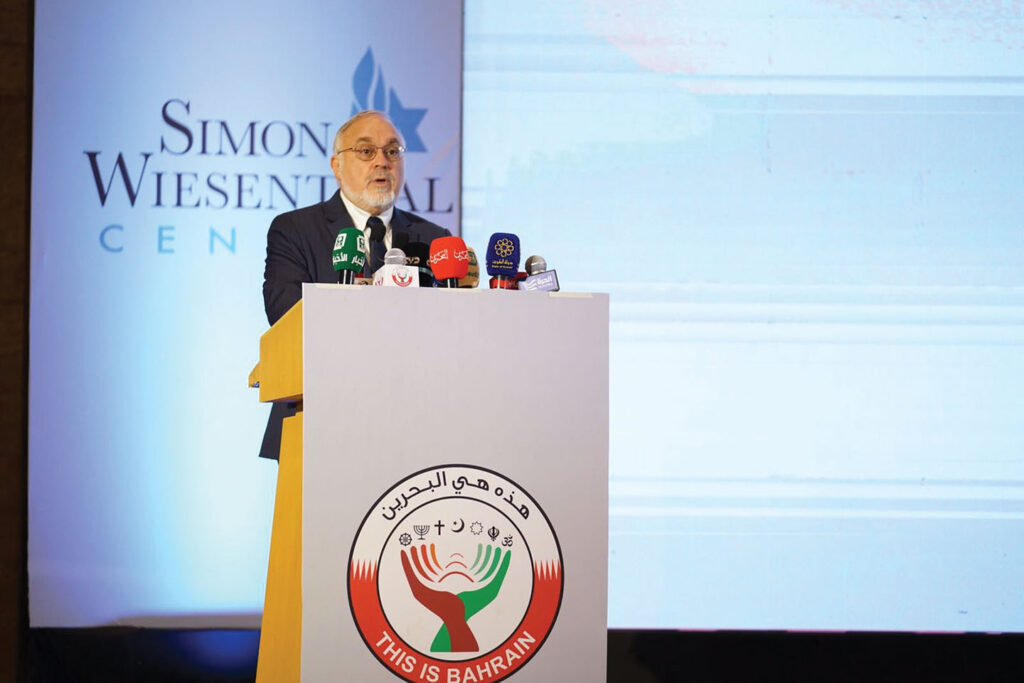
Rabbi Abraham Cooper stood in front of 400 people at an iftar for peace event in Paris. During the Ramadan break-fast held this past March, he and other religious leaders spoke to the families whose loved ones are still being held hostage in Gaza. 

In his speech, Cooper, the Simon Wiesenthal Center’s associate dean and director of global social action, talked about the meaning of the moon in both the Jewish and Islamic traditions. 

“We are here tonight because the faithful in this room believe that God commands the children of Abraham to pay special attention to the small sliver of the light of the moon,” he said.  “For generations, Muslims awaited word from two witnesses to verify that they saw the beginnings of the new moon, after which they launched the month of Ramadan. For our Jewish ancestors who had just experienced the miracles of the Exodus from Egypt, they would learn from Moshe that there was a mitzvah, a commandment, so important he couldn’t wait for Har Sinai.” 

That mitzvah? To sanctify the new month when the light of the moon had begun to shine. Tracking the moon was a way to recognize and sanctify time. 

“These newly freed slaves were handed this precious gift of time,” Cooper continued. “Men and women were free for the first time to control time; the time of the slaves was never their own. Today, the moon encapsulates humanity’s conviction. It’s all about light … I dedicate my blessings tonight to the people who have not seen the light of the moon, and some who will never get to see the light of the moon again. May the surviving Israeli hostages be blessed to experience that sliver of light.”

This event was not out of the ordinary for Cooper. Long before the Abraham Accords were signed in 2020, the rabbi had been laying down the groundwork for peace amongst the Jewish and Arab and Muslim communities. With his extensive interfaith background, including meeting with leaders like Pope Francis and Imam Hassen Chalghoumi, the only pro-Israel imam in Europe, Cooper is constantly building alliances with other groups and strengthening their relationships with the Jewish community. His work gives the community hope during a difficult time, in a post-Oct. 7 world, with hostages still languishing in Gaza. 

“The pain will be there for a very long time,” Cooper said. “We have to be proud of who we are. When you stand for who you are and you’re strong, you will be more likely to achieve peace.”

Visiting Arab Countries to Bring About Unity

In 1977, Cooper, an Orthodox Jew, came to Los Angeles to help Rabbi Marvin Hier start the Simon Wiesenthal Center (SWC). The SWC runs the Museum of Tolerance, defends the safety of Jews and Israel and educates on and combats antisemitism around the globe. Through his work, Cooper has traveled the world but has recently focused on Arab countries that are pushing for peace. 

The pro-Israel Imam Chalghoumi, who requires 24/7 security from the French government due to his stance, told Cooper that he sent his family to live in Bahrain to protect them. The rabbi didn’t know Bahrain was such a welcoming country; he wanted to see it for himself.  

“In 2017, I went to Bahrain with 24 faith leaders, and I was shocked to walk through the downtown area, where they were holding the Hindu Maha Shivaratri festival near a Shia mosque, and I heard church bells ringing,” he said. “There is also the Bahrain Synagogue in Manama.” By and large, this is not allowed in other places in the Middle East.

When leaders in the country spoke to Cooper, they told him, “This is who we are. We are very proud of our religious tolerance.” The visit led to The Kingdom of Bahrain Declaration, where Jewish, Muslim and Christian leaders, including Hier, signed a document that outlined His Majesty King Hamad bin Isa Al Khalifa’s plan to build a more religiously tolerant Middle East and to fight extremism and antisemitism. The signing ceremony took place at the Simon Wiesenthal Center in LA. 

“Building relationships is something I am personally committed to doing,” said Cooper. “There are moderates out there. The idea is to find these people of various faiths and create and deepen relationships.”

Another place where Cooper and the SWC have found allies in peace is the United Arab Emirates, a partner in the Abraham Accords. He first formed relationships with leaders there thanks to Mohamed Alabbar, an Emirati real estate developer who worked on the Dubai Mall and the Burj Khalifa, the world’s tallest skyscraper. 

“He is an amazing businessman and someone who is fearless in the pursuit of peace,” Cooper said. “He became very fast friends with Rabbi Hier and attended the rabbi’s granddaughter’s wedding in Jerusalem. He also wore a big kippah, and the Hasidic rabbis thought he was from the Carlebach Shul.”

Before the Accords were officially announced, Cooper said he saw “the schematics for Abraham. … The UAE was building a mosque, a Catholic church and a shul on the same campus.”

When Cooper went to the UAE to be a judge for a humanitarian prize, he stayed at the hotel closest to the synagogue and spent two Shabbats there. “The first one, we had a minyan, and the second, a new rabbi from the UK was being installed. Through thick and thin, Chabad has made a major impact there.”

On Sept. 15, 2020, President Donald Trump hosted the signing of the Abraham Accords at the White House, where Israeli Prime Minister Benjamin Netanyahu and the foreign ministers of the UAE and Bahrain, Sheikh Abdullah bin Zayed Al Nahyan and Abdullatif bin Rashid Al Zayani, gathered to make history. Cooper was there to witness it. 

“Former United States Secretary of State Mike Pompeo had sent a short letter to the SWC, thanking us for helping with the building blocks for peace,” the rabbi said. “We were early investors in trying to identify people to work with in the faith community, with the goal of normalizing contact.”

Focusing on Peace in a Post-Oct. 7 World

From 2023 to 2024, Cooper served as the Chair of the U.S. Commission on International Religious Freedom. As part of his work, he traveled to Saudi Arabia with an American delegation. While he was touring Riyadh, a UNESCO site, controversy erupted when an official, one of his hosts, called him and asked him to remove his kippah in public. 

“They told me, ‘We have laws in this country, and only symbols of Islam and no other religion can be shown, so please take off your kippah,” said Cooper. “I told him, ‘You wouldn’t ask a Muslim woman to take off her hijab. So, no. I went to the Soviet Union 50 years ago and spent a month there and didn’t take off my kippah for them. I’m sure not taking it off for you.”

He then said, “I’m here leading an American governmental group looking into religious freedom. Are you sure?” According to Cooper, the official replied, “You know what? I think I should check. I’ll call you back.” Cooper was given a final answer: “They said, ‘If you don’t take off your kippah, you have to leave the premises. You’ll be escorted out,’” he said. 

He replied, “I will leave, but you have to understand I will now be leaving Saudi Arabia as well because I can’t do my job here.”

Cooper and his group cut their visit short. Eventually, Cooper received an apology, and Saudi Arabia posted a public apology too. He intends to keep trying to establish peaceful relations with the country and work towards religious tolerance and freedom there. 

“You have to be patient when dealing with our cousins,” he said. “The more you push something, the longer it’s going to take. Kavod, respect, is very important. What happened with my kippah, it was important to gently remind them that kavod is a two-way street.”

In his dealings with Arab and Muslim leaders, Cooper has found that they are “comfortable if you’re honest with them. If you’re an Orthodox Jew, be an Orthodox Jew. Minimize the schtick.”

In his dealings with the Arab and Muslim leaders, Cooper has found that they are “comfortable if you’re honest with them. If you’re an Orthodox Jew, be an Orthodox Jew. Minimize the schtick. Be who you are. And don’t apologize for being who you are – including a Zionist.”

A Brighter Future Ahead

With President Trump in office again, Cooper is hopeful that we are one step closer to peace in the Middle East.

“Trump is surrounded by serious people, and he wants to build on a major achievement from his first presidency,” he said. “Everybody wants peace and is interested in the day after. We are no longer in a world where the mantra was that if you want progress between Muslims and Jews, you must solve the Palestinian issue first. It’s simply not true. In fact, maybe the opposite is true.”  

“We are no longer in a world where the mantra was that if you want progress between Muslims and Jews, you must solve the Palestinian issue first. It’s simply not true. In fact, maybe the opposite is true.” 

From Cooper’s perspective, “normal Palestinians want peace, but they are silenced by their leadership. They aren’t fools. They want to be a part of it. I hope to create an environment where peace is available. If they overplay their cards, they will lose Israel, and other countries will move forward. It’s delayed because of Oct. 7. Israel has to protect its citizens.”

The rabbi believes that perhaps the Accords can be expanded to include Indonesia, the world’s largest Muslim country, as well as other Asian nations. “Qatar is a huge problem, because the people running the show there hate us,” he said. “And Kuwait also, because of their theological basis of Islam. There’s the aggressive Turkish president, who has deep pockets because of their cousins in Qatar. We have the Iranian regime, but if you get rid of the Ayatollahs, the Iranians will be right there with us. It’s still a rough neighborhood. People have to start working on real exchanges and relationships.”

He is always seeking out partners who want to see a better world. 

“What motivates me is looking for normals, like Japan or India, or anywhere I know I can go and have a round-trip ticket,” he said. “I won’t be going to North Korea or back to Russia anytime soon.” 

When the ceasefire happens and Hamas is no longer a factor in Gaza, the rabbi thinks the peace process “will move fast.” 

As for now, Cooper is going to continue his crucial work: for his community, for his country, for Israel and for the good of humanity. He’s striving to fulfill his mission as a Jew who, like the moon, shines his light onto the world. 

“We are trying to create, sustain and grow relationships that will outlast the storms,” he said. “And what Israelis and Jews have to do is stay the course, show love for each other and stand strong.”

Rabbi Abraham Cooper – Our Man in the Gulf Read More »

The Peace No One Sees Coming

A vast majority of Israeli Jews agree on one thing: “There is no chance for a peace agreement with the Palestinians in the foreseeable future.” Are you surprised? Probably not. You didn’t fall off your chair, right?

How big is this majority of no hope? According to the latest JPPI survey, 84%. That’s up five points from the same question last year. In other words, Israeli Jews were already skeptical about peace. Now, they’re even more so.

And just to be clear: Arab citizens of Israel aren’t exactly optimistic either. Only 31% of them disagree with the statement that “there is no chance” for peace. A quarter of them are undecided. Nearly 10% simply don’t know. The largest group, 38%, actually agree with the Jewish majority: peace isn’t coming — at least not any time soon.

This is, in many ways, an easy question with an easy answer (one might wonder why the percentage of those agreeing with it rose over the past year. Last year wasn’t exactly a time of peace talks either). It’s easy to explain why peace isn’t happening. Much harder to explain is what’s the alternative.

So — what is it?

We asked a follow-up question. Agree or disagree with the statement “ultimately, there is no substitute for a long-term peace agreement with the Palestinians.” If you agree with it, it is kind of saying yes for peace, not now, not soon, but maybe, someday. 

Alas, here, too, skepticism grows. Those who strongly agree with the “no substitute” statement dropped from 29% to 19%. Those who strongly disagree (namely, the ones who apparently think there is a “substitute” for peace with the Palestinians) rose from 38% to 45%. Overall: 55% disagree with the “no substitute” statement. Only 35% agree. So about a third of Israeli Jews are still clinging to the belief that peace, someday, somehow, is the long-term answer to the conflict.

Two-thirds think otherwise — or don’t think at all about the long term. Maybe they’ll change their minds. Maybe they have other ideas: endless conflict, population transfer, third-party deals, one-state solutions … who knows? Creative options abound. Their pros and cons are well known. But maybe most just don’t want to talk about the long term. The short term is pressing enough.

If they aren’t thinking long-term, hopefully someone among Israel’s leaders is. The country is doing many important things right now, aimed at containing threats in the immediate future. It hopes to eliminate some enemies altogether – though we all recognize that this is a slow, uncertain process.

Hezbollah has been hit hard, but it’s still in Lebanon. Total removal? Not likely anytime soon. Iran continues to maneuver, successfully for now, despite pressure from Washington. It relies on China and Russia — who have their own maneuvers going, often unnoticed while the West focuses on Ukraine and Gaza. Hamas hasn’t been uprooted either. Israel is trying — and maybe it will succeed. Maybe. There was some flirtation with the idea of a mass Gazan exodus. It could still happen. But President Trump, it seems, has cooled on that idea. One way or another, the Palestinian issue — with us since the dawn of Zionism — isn’t going away. Not even if Hamas disappears. Not even if 500,000 Gazans decide to leave. 

So what now?

This is a moment to think about long-term goals. Strategic goals. What is Israel’s long-term vision?

Is it full control of Judea, Samaria, and Gaza? Okay, let’s not be afraid of the idea — let’s just think it through. If control comes, will citizenship for all Palestinian residents follow? And if not — how will Israel handle the inevitable criticism from Western democracies, who will (rightly) say this isn’t a democratic policy?

Or perhaps Israel assumes — not unreasonably — that by the time it comes to that, the West won’t care. Maybe democracy itself will be so diminished as a global ideal that the criticism will vanish. Still, even then, millions of Palestinians without rights won’t simply sit quietly. They might rebel. They probably will.

There are, of course, other possible goals: a Jewish-majority state with a minimal Arab population. And there are ways to get there: total Palestinian emigration, or withdrawal from territories with large Palestinian populations, or even population swaps. Israelis know these scenarios. But knowing isn’t deciding. Knowing isn’t choosing a destination and navigating toward it.

Maybe we simply can’t choose. Not yet. Maybe we’ll decide after the war. After we see what the new world order looks like. After we know whether normalization with Saudi Arabia is possible. After we know whether Iran has the bomb. After, and after, and after.

In the meantime, we float. We improvise. We pursue the obvious, immediate goal: security. That’s what we’re doing now. That’s what we do when we — most of us — reject the idea that “there is no substitute for a peace agreement.”

In the meantime, we float. We improvise. We pursue the obvious, immediate goal: security. That’s what we’re doing now. That’s what we do when we — most of us — reject the idea that “there is no substitute for a peace agreement.” When we essentially say that there is a substitute. But we’re not saying what it is. Not to ourselves. Not to anyone.

Something I wrote in Hebrew

Israeli opposition parties’ lack of vision:

There’s another question — no less important — that Israel’s opposition parties need to ask themselves: How does it intend to improve the State of Israel? At the moment, its leaders’ main message is one of preservation. Don’t touch the courts. Don’t replace the Attorney General. Don’t interfere with the heads of the Shin Bet, the IDF, or the civil service. This is an understandable instinct – especially in the face of a coalition charging forward like a camel that drank a barrel of beer… but understandable isn’t the same as productive. This preservationist instinct isn’t a healthy one… Israel is in the midst of a serious crisis – one that demands repair. Repair means change. Yes, even in governance.

A week’s numbers

In the coming months, former PM Naftali Bennett will be the main political target of the coalition. Why? Because he is the one seen as more fitting than Netanyahu to be a PM (Ch12 News poll).


A reader’s response

Gloria A. writes: “Shmuel, are your views representing all Israelis?” My response: No. On a good day, they represent my own views, on a bad day, not even that.


Shmuel Rosner is senior political editor. For more analysis of Israeli and international politics, visit Rosner’s Domain at jewishjournal.com/rosnersdomain.

The Peace No One Sees Coming Read More »

Fighting Intergenerational Poverty in Israel

Aryeh Lurie grew up in grinding poverty in Jerusalem. He recalls that as a child, his mother would salvage old cucumbers that were about to be tossed in the garbage by the local market, pickle them, and serve them to her family as lunch. Despite this level of impoverishment, when cooking a hot stew for Shabbat, his mother brought the first portions to neighbors even poorer than her own family. “Her first concern was to give to people who had nothing. I said to myself, when I grow up, I will act for the benefit of the people of Israel,” Lurie said.

Despite this level of impoverishment, when cooking a hot stew for Shabbat, his mother brought the first portions to neighbors even poorer than her own family.

As a successful businessman, in 1988 Aryeh Lurie founded Yad Ezra V’Shulamit, dedicated to feeding hungry children and families throughout Israel. It’s an enormous task. Israel has one of the greatest discrepancies between the wealthy and the poor of any Western society, and fully one-third of all Israelis live under the poverty line. This translates to about one million children living with actual, raw hunger. 

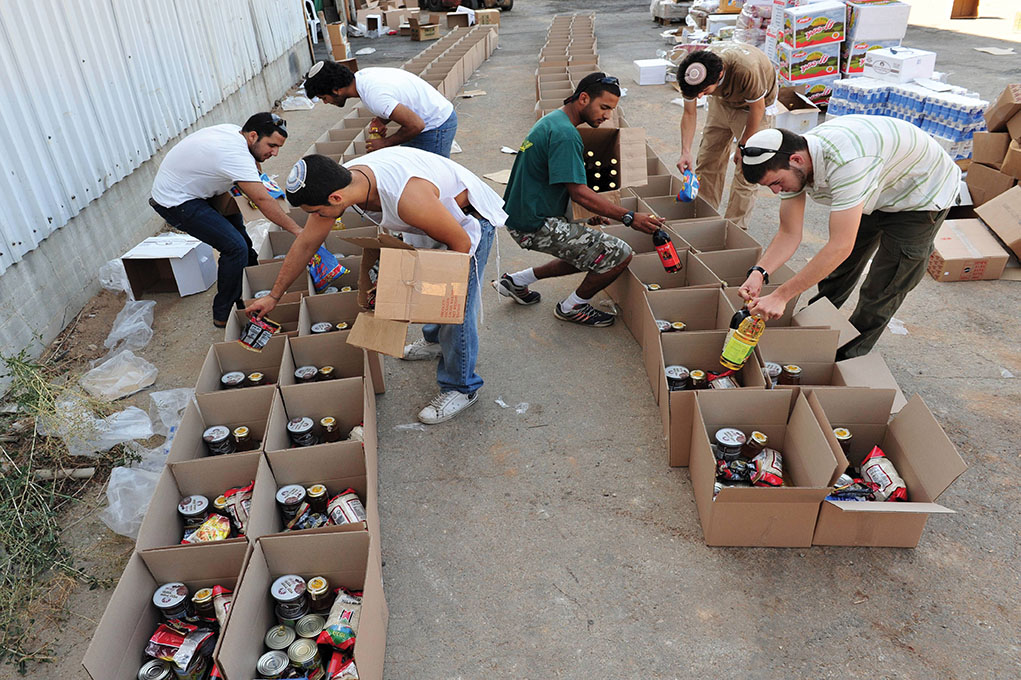
Yad Ezra V’Shulamit distributes more than one million pounds of food every week at 93 distribution points across the country, and more than five million pounds on Passover and Rosh Hashanah. Holidays aside, they distribute more than 12,000 food baskets a week feeding more than 300,000 people. The baskets include chicken, grains, dairy products, fresh produce, bread, seasonal holiday items, and food vouchers. 

The Gaza war has ramped up the needs that were already pressing. According to Yad Ezra V’Shulamit, the war had led to more than 220,000 people losing their jobs, including 40% of citizens in the north. Food and supplies were delivered to the front lines for families under fire, as well as those evacuated to other locations. 

Having been a poor child himself, Aryeh Lurie is driven to make life more secure physically and emotionally for today’s generation of hungry children. To that end, Yad Ezra V’Shulamit operates two large children’s centers, each in one of the poorest neighborhoods of Jerusalem and Tzfat. A newer, smaller center serves Ethiopian children in Neve Yaakov. Altogether, the centers serve about 750 children who are given breakfast, a hot lunch, tutoring, emotional therapy and activities such as art, baking and drama. Poverty is often accompanied by other problems, such as family dysfunction, depression, and even abuse, making these centers a safe, welcoming, and nurturing place for the children to be.   

Having been a poor child himself, Aryeh Lurie is driven to make life more secure physically and emotionally for today’s generation of hungry children. 

Intergenerational poverty is a chronic problem that afflicts many in these communities. Reaching these children in their formative years and helping fill their physical and emotional needs that would otherwise go unmet can help them shape a better future and fulfil their potential, according to Tefilla Buxbaum, director of the organization.  

“What happens if a child comes from a poor home and doesn’t get the basics, like proper food, proper clothing, school supplies and emotional support?” she said. “What happens when most of their classmates have more than they do? They feel ‘less than’ everyone else and unworthy, God forbid. This can end up defining who they are. When a child comes into a Yad Ezra V’Shulamit Children’s Center, their world expands.  They are served a daily hot lunch, help with homework and given lots of love, proper clothing including a winter coat, school supplies and even summer camp. They can feel, ‘I’m normal, I’m OK, I have everything like everyone else.’”


Yehuda Liebenson, a Chicago native who made aliyah in 2009 and is a former tank commander in the IDF, lost his job as a tour guide after the war broke out. He lives with his family in Beit El, very close to Ramallah and other Arab towns, and serves on security patrols. As a resource development manager with Yad Ezra V’Shulamit, Liebenson fundraises to help fill a seemingly bottomless pit of need.  

While in Los Angeles last week, Liebenson explained the organization’s expanding scope of work at a dinner hosted at Shiloh’s restaurant and underwritten by local donors. In addition to the food baskets, the organization provides aid to widows and orphans, distributes thousands of packets of baby formula to struggling mothers, sends supplies to the front lines, offers heavily subsidized or free weddings for orphans and needy couples and more. The need for psychological services has skyrocketed as the war has triggered endless cases of PTSD, divorces from economic hardship and extended military duty, behavioral problems among children, and other wartime stressors.  

“We are not the only group offering essential aid in Israel,” he said, “and Am Yisrael has been very generous. There is so much need on many fronts, but when you are talking about children not having enough food, that speaks to everyone on a basic emotional level. We can’t let children go hungry.” 

Liebenson sees hope and progress in breaking the cycle of intergenerational poverty through the work of Yad Ezra V’Shulamit. As one example, a young woman named Zahava who grew up in the centers from the age of five donated her first paycheck as an adult to the organization. “I can’t thank you enough,” Zahava said in her note. “This place changed my life and I want to do for another child what you did for me.” 

To learn more and to donate, go to yadezra.net.


Judy Gruen is the author of “Bylines and Blessings,” “The Skeptic and the Rabbi,” and other books. She is also a book editor and writing coach. www.judygruen.com

Fighting Intergenerational Poverty in Israel Read More »

Coach Pearl Plays Offense for Israel and American Hostage Edan Alexander

Press conferences in the NCAA college basketball tournament are laser focused on the task at hand. Questions surround officiating, injury updates, and a game plan for the week ahead leading to the Sweet Sixteen.

While coaches rarely use a platform to address the most important causes of their heart and soul, there are moments of historic proportion that we recognize we are watching much more than a game.

This weekend, Coach Bruce Pearl of Auburn University, the number one seed in the country, took the opportunity to begin his press conference by putting basketball aside and boldly declaring that there is an American, Edan Alexander, still held in captivity by Hamas in Gaza.

Bruce Pearl is not simply a basketball coach. He is an American Jew whose personal story deeply impacts the words he uses in the press room. Eight months ago, I had the honor of interviewing Coach Pearl on the “Rabbi On The Sidelines” podcast, where he explained his love for this great country of America and his love for Israel.

It was the United States of America that saved Coach Pearl’s family.

Born in 1960, just 15 years after the Holocaust, Pearl’s grandfather escaped Eastern European pogroms with a few siblings and came to America at the age of 11. 

 When Coach Pearl was 7 years old, he saw his grandfather, a plumber, watching the evening news and crying during the Six Day War. He could not take his eyes off the TV, worrying that Israel would not exist on the map the next morning, threatened with annihilation by surrounding countries. He explained that if there was a state of Israel in 1932, his family could have gone there and perhaps would have survived the horrors of the antisemitism they faced.  

At that moment, his grandfather made him promise that he too would love Israel and understand the importance of its existence and how deeply Israel’s success is linked to how we are able to live the American dream. At 32 years old, his grandfather became an American citizen, and continued to be proud to be an American.

In a moment of destiny, Coach Pearl has lived out this American Dream on the basketball court, and it is this same court that has enabled him to share his love of Israel with an audience that may not be able to locate the small piece of land on a map.

In 1982, Coach Pearl was about to go to Israel after his graduation from Boston College, when Coach Tom Davis called to offer him an assistant coaching position at Stanford. He declined the visit, but that call commenced his journey from school to school, rising the ranks of college coaches, eventually reaching the Final Four in 2019. 

And it was basketball that eventually brought Coach Pearl to Israel for the first time 27 years later, in 2009, as head coach of the USA Maccabiah team, which included future University of Florida coach Todd Golden, a fellow number one seed coach in this year’s NCAA tournament.

There are some coaches who keep their personal and professional lives in separate lanes. What happens off the court stays off the court. This is not the case with Coach Pearl. Since Oct. 7, 2023, his words and actions demonstrate the strength of how the basketball court can be an avenue to raise awareness in the world. 

Last season, the Auburn basketball staff wore American and Israeli flag pins at every game. On the commentary desk of March Madness during the 2024 Final Four, that pin was ever present for the entire nation to see. In the early days after Oct. 7, Coach Pearl would put on a piece of scotch tape with a different number each day, reminding the world how many days the 250 hostages were being held.

In his own words, “We have learned throughout history that silence is complicity and when you see something wrong, you have to stand up and say something.”

“We have learned throughout history that silence is complicity and when you see something wrong, you have to stand up and say something.” – Coach Bruce Pearl

In August of 2022, Coach Pearl did the unthinkable. He took his team, consisting of mostly Christian students, to Israel. He gave them the opportunity to baptize in the Jordan River, to touch the stones of the Western Wall, to float in the Dead Sea, and to witness the diversity of a land that showcases the commonalities of faith.

That winter, Auburn played the University of Southern California in a late December matchup. Before that game, Coach Pearl came to Sinai Temple. With everyone dressed in their finest Sabbath clothes, Coach Pearl arrived late from practice wearing Auburn warmups. He began, “I was asked to speak because I’m a basketball coach. But I agreed to speak because I’m Mordechai Shmuel. I love being Jewish. I love my country. I’m a Jewish basketball coach in Auburn, Alabama. This is the greatest country in the world!”

Sixty-four college basketball teams competed this week with the goal of living out their athletic dreams, to cut down the nets in San Antonio for the Final Four.

Forty-eight teams may have gone home disappointed that their season ended with a loss. The NCAA tournament always ends with a montage of memories accompanied by the song “One Shining Moment.”

This year, when the nets are cut down, and a champion is crowned, we must recognize the shining moment we have just experienced from a courageous American and coach. Bring Edan Home Now.


Rabbi Erez Sherman is Senior Rabbi of Sinai Temple. 

Coach Pearl Plays Offense for Israel and American Hostage Edan Alexander Read More »

Israel’s Crisis of Faith

Claim One: The Prime Minister of Israel cannot afford to mistrust the head of the Shin Bet — Israel’s internal security agency — during a time of war. This is why Bibi wants to fire Ronen Bar, whose leadership has been called into question after presiding over the worst intelligence failure in Israel’s history.

Rebuttal One: Netanyahu is cynically firing Bar because Bar is investigating him and others in his administration over the “Qatargate” scandal. This has nothing to do with trust but is rather a desperate attempt to remove anyone who gets in his way.

Claim Two: Military pressure is the best way to achieve Israel’s war goals — defeating Hamas and securing the release of the hostages. In the face of Hamas intransigence, this is why Netanyahu resumed fighting in Gaza.

Rebuttal Two: Netanyahu is terrified of losing political power and can only keep his coalition together by continuing the war in Gaza. He is more than willing to sacrifice the lives of the hostages on the altar of his own political ambition.

Claim Three: Netanyahu is resisting an internal probe of Oct. 7 because he is laser-focused on the war effort, and such a probe must wait until after the war has been won.

Rebuttal Three: Netanyahu is resisting an internal probe of Oct. 7 because it would reveal the extent to which he is responsible for the deadliest day in Israel’s history.

This essay will not be debating these claims and counterclaims.

I will not try to convince you that Netanyahu is acting in Israel’s best interest or that he is acting cynically for self-preservation. I have my own opinions on these matters, but ultimately, when it comes to a debate about a person’s inner motives, all we have is conjecture. Is Bibi fighting for Israel? Or is Bibi fighting for Bibi? Only one man knows the truth.

At a certain point, however, the question itself becomes a kind of fact. The mistrust that many Israelis feel may be justified or unjustified, but it cannot simply be waved away.

Netanyahu claims that a prime minister cannot afford to mistrust the head of the Shin Bet during a war. So be it! But neither can a nation afford to mistrust its prime minister during a war. If Israelis are going to continue to sacrifice for the war effort, putting their lives on the line every single day, they need to believe that their sacrifice is for the safety of their people — not for the sake of one man keeping his job.

And yet, the cloud of suspicion over Bibi’s choices cannot be easily dismissed. Perhaps it can be ascribed in part to a sort of “Bibi Derangement Syndrome” on the Israeli left, but it’s also a fact that Netanyahu has serious conflicts of interest, which inevitably invite suspicion about his decision-making.

For instance, firing the head of a department that is investigating your administration is inherently suspect. So is resuming a war when your coalition members have openly threatened to topple your government if you don’t. So is rejecting public demands for an Oct. 7 probe that would almost certainly reveal critical errors made during your tenure.

It’s possible that Bibi is acting in good faith, but even the appearance of political motivation is concerning. Judges recuse themselves not just to prevent bias but to uphold public trust, which a justice system cannot function without. The same principle applies to leadership — any perception of self-interest can erode confidence when trust is most essential.

It’s unclear how the public can be expected to trust the PM in light of these compromising realities. Unsurprisingly, many polls show that they don’t.

A poll from Reichman University’s Institute for Liberty and Responsibility found that only 17% of Israelis trust the government.

A December Channel 13 poll reported that only 29% of the public trusts Netanyahu.

An April poll revealed that a staggering 50% of Israelis believe Netanyahu is acting primarily out of concern for his own political future.

Whether the public is right or wrong to distrust Netanyahu is debatable — but it’s ultimately irrelevant. A lack of trust in leadership is a fact that cannot itself be debated and has consequences of its own.

Whether the public is right or wrong to distrust Netanyahu is debatable — but it’s ultimately irrelevant. A lack of trust in leadership is a fact that cannot itself be debated and has consequences of its own.

Israel cannot achieve its war aims without restoring basic trust in the government. Whether or not Netanyahu has been treated unfairly by his critics, the crisis of trust is undeniable.

Netanyahu most of all should recognize this. And by not stepping down, he only strengthens the perception that his own grasp on power is more important to him than the well-being of his people. But that’s just my own speculation, and as I mentioned, we need not speculate.

Israel’s crisis of faith is not a matter of opinion—it is a reality that none of us can afford to ignore.


Matthew Schultz is a Jewish Journal columnist and rabbinical student at Hebrew College. He is the author of the essay collection “What Came Before” (Tupelo, 2020) and lives in Boston and Jerusalem.  

Israel’s Crisis of Faith Read More »