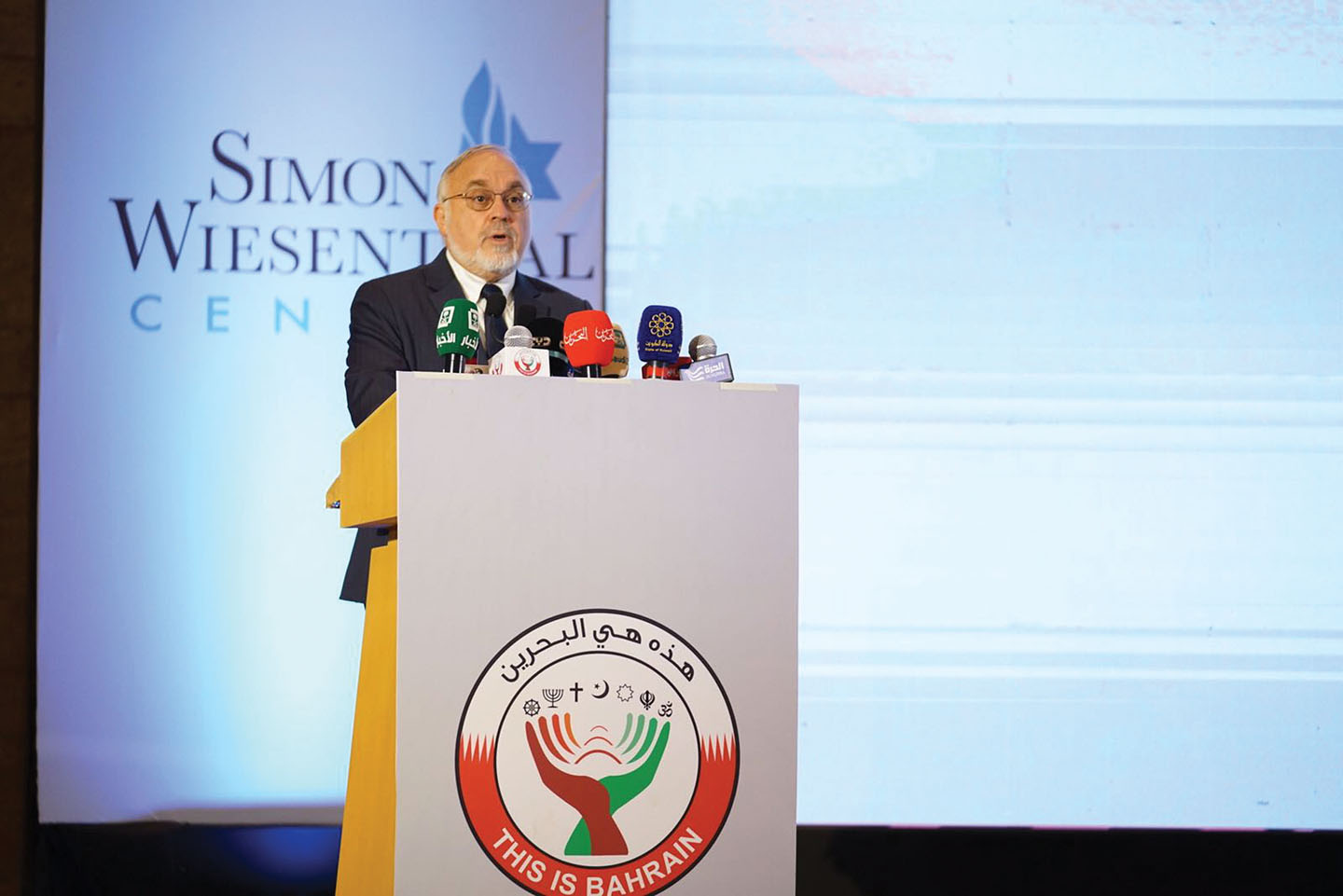
Rabbi Abraham Cooper stood in front of 400 people at an iftar for peace event in Paris. During the Ramadan break-fast held this past March, he and other religious leaders spoke to the families whose loved ones are still being held hostage in Gaza.
In his speech, Cooper, the Simon Wiesenthal Center’s associate dean and director of global social action, talked about the meaning of the moon in both the Jewish and Islamic traditions.
“We are here tonight because the faithful in this room believe that God commands the children of Abraham to pay special attention to the small sliver of the light of the moon,” he said. “For generations, Muslims awaited word from two witnesses to verify that they saw the beginnings of the new moon, after which they launched the month of Ramadan. For our Jewish ancestors who had just experienced the miracles of the Exodus from Egypt, they would learn from Moshe that there was a mitzvah, a commandment, so important he couldn’t wait for Har Sinai.”
That mitzvah? To sanctify the new month when the light of the moon had begun to shine. Tracking the moon was a way to recognize and sanctify time.
“These newly freed slaves were handed this precious gift of time,” Cooper continued. “Men and women were free for the first time to control time; the time of the slaves was never their own. Today, the moon encapsulates humanity’s conviction. It’s all about light … I dedicate my blessings tonight to the people who have not seen the light of the moon, and some who will never get to see the light of the moon again. May the surviving Israeli hostages be blessed to experience that sliver of light.”
This event was not out of the ordinary for Cooper. Long before the Abraham Accords were signed in 2020, the rabbi had been laying down the groundwork for peace amongst the Jewish and Arab and Muslim communities. With his extensive interfaith background, including meeting with leaders like Pope Francis and Imam Hassen Chalghoumi, the only pro-Israel imam in Europe, Cooper is constantly building alliances with other groups and strengthening their relationships with the Jewish community. His work gives the community hope during a difficult time, in a post-Oct. 7 world, with hostages still languishing in Gaza.
“The pain will be there for a very long time,” Cooper said. “We have to be proud of who we are. When you stand for who you are and you’re strong, you will be more likely to achieve peace.”
Visiting Arab Countries to Bring About Unity
In 1977, Cooper, an Orthodox Jew, came to Los Angeles to help Rabbi Marvin Hier start the Simon Wiesenthal Center (SWC). The SWC runs the Museum of Tolerance, defends the safety of Jews and Israel and educates on and combats antisemitism around the globe. Through his work, Cooper has traveled the world but has recently focused on Arab countries that are pushing for peace.
The pro-Israel Imam Chalghoumi, who requires 24/7 security from the French government due to his stance, told Cooper that he sent his family to live in Bahrain to protect them. The rabbi didn’t know Bahrain was such a welcoming country; he wanted to see it for himself.
“In 2017, I went to Bahrain with 24 faith leaders, and I was shocked to walk through the downtown area, where they were holding the Hindu Maha Shivaratri festival near a Shia mosque, and I heard church bells ringing,” he said. “There is also the Bahrain Synagogue in Manama.” By and large, this is not allowed in other places in the Middle East.
When leaders in the country spoke to Cooper, they told him, “This is who we are. We are very proud of our religious tolerance.” The visit led to The Kingdom of Bahrain Declaration, where Jewish, Muslim and Christian leaders, including Hier, signed a document that outlined His Majesty King Hamad bin Isa Al Khalifa’s plan to build a more religiously tolerant Middle East and to fight extremism and antisemitism. The signing ceremony took place at the Simon Wiesenthal Center in LA.
“Building relationships is something I am personally committed to doing,” said Cooper. “There are moderates out there. The idea is to find these people of various faiths and create and deepen relationships.”
Another place where Cooper and the SWC have found allies in peace is the United Arab Emirates, a partner in the Abraham Accords. He first formed relationships with leaders there thanks to Mohamed Alabbar, an Emirati real estate developer who worked on the Dubai Mall and the Burj Khalifa, the world’s tallest skyscraper.
“He is an amazing businessman and someone who is fearless in the pursuit of peace,” Cooper said. “He became very fast friends with Rabbi Hier and attended the rabbi’s granddaughter’s wedding in Jerusalem. He also wore a big kippah, and the Hasidic rabbis thought he was from the Carlebach Shul.”
Before the Accords were officially announced, Cooper said he saw “the schematics for Abraham. … The UAE was building a mosque, a Catholic church and a shul on the same campus.”
When Cooper went to the UAE to be a judge for a humanitarian prize, he stayed at the hotel closest to the synagogue and spent two Shabbats there. “The first one, we had a minyan, and the second, a new rabbi from the UK was being installed. Through thick and thin, Chabad has made a major impact there.”
On Sept. 15, 2020, President Donald Trump hosted the signing of the Abraham Accords at the White House, where Israeli Prime Minister Benjamin Netanyahu and the foreign ministers of the UAE and Bahrain, Sheikh Abdullah bin Zayed Al Nahyan and Abdullatif bin Rashid Al Zayani, gathered to make history. Cooper was there to witness it.
“Former United States Secretary of State Mike Pompeo had sent a short letter to the SWC, thanking us for helping with the building blocks for peace,” the rabbi said. “We were early investors in trying to identify people to work with in the faith community, with the goal of normalizing contact.”
Focusing on Peace in a Post-Oct. 7 World
From 2023 to 2024, Cooper served as the Chair of the U.S. Commission on International Religious Freedom. As part of his work, he traveled to Saudi Arabia with an American delegation. While he was touring Riyadh, a UNESCO site, controversy erupted when an official, one of his hosts, called him and asked him to remove his kippah in public.
“They told me, ‘We have laws in this country, and only symbols of Islam and no other religion can be shown, so please take off your kippah,” said Cooper. “I told him, ‘You wouldn’t ask a Muslim woman to take off her hijab. So, no. I went to the Soviet Union 50 years ago and spent a month there and didn’t take off my kippah for them. I’m sure not taking it off for you.”
He then said, “I’m here leading an American governmental group looking into religious freedom. Are you sure?” According to Cooper, the official replied, “You know what? I think I should check. I’ll call you back.” Cooper was given a final answer: “They said, ‘If you don’t take off your kippah, you have to leave the premises. You’ll be escorted out,’” he said.
He replied, “I will leave, but you have to understand I will now be leaving Saudi Arabia as well because I can’t do my job here.”
Cooper and his group cut their visit short. Eventually, Cooper received an apology, and Saudi Arabia posted a public apology too. He intends to keep trying to establish peaceful relations with the country and work towards religious tolerance and freedom there.
“You have to be patient when dealing with our cousins,” he said. “The more you push something, the longer it’s going to take. Kavod, respect, is very important. What happened with my kippah, it was important to gently remind them that kavod is a two-way street.”
In his dealings with Arab and Muslim leaders, Cooper has found that they are “comfortable if you’re honest with them. If you’re an Orthodox Jew, be an Orthodox Jew. Minimize the schtick.”
In his dealings with the Arab and Muslim leaders, Cooper has found that they are “comfortable if you’re honest with them. If you’re an Orthodox Jew, be an Orthodox Jew. Minimize the schtick. Be who you are. And don’t apologize for being who you are – including a Zionist.”
A Brighter Future Ahead
With President Trump in office again, Cooper is hopeful that we are one step closer to peace in the Middle East.
“Trump is surrounded by serious people, and he wants to build on a major achievement from his first presidency,” he said. “Everybody wants peace and is interested in the day after. We are no longer in a world where the mantra was that if you want progress between Muslims and Jews, you must solve the Palestinian issue first. It’s simply not true. In fact, maybe the opposite is true.”
“We are no longer in a world where the mantra was that if you want progress between Muslims and Jews, you must solve the Palestinian issue first. It’s simply not true. In fact, maybe the opposite is true.”
From Cooper’s perspective, “normal Palestinians want peace, but they are silenced by their leadership. They aren’t fools. They want to be a part of it. I hope to create an environment where peace is available. If they overplay their cards, they will lose Israel, and other countries will move forward. It’s delayed because of Oct. 7. Israel has to protect its citizens.”
The rabbi believes that perhaps the Accords can be expanded to include Indonesia, the world’s largest Muslim country, as well as other Asian nations. “Qatar is a huge problem, because the people running the show there hate us,” he said. “And Kuwait also, because of their theological basis of Islam. There’s the aggressive Turkish president, who has deep pockets because of their cousins in Qatar. We have the Iranian regime, but if you get rid of the Ayatollahs, the Iranians will be right there with us. It’s still a rough neighborhood. People have to start working on real exchanges and relationships.”
He is always seeking out partners who want to see a better world.
“What motivates me is looking for normals, like Japan or India, or anywhere I know I can go and have a round-trip ticket,” he said. “I won’t be going to North Korea or back to Russia anytime soon.”
When the ceasefire happens and Hamas is no longer a factor in Gaza, the rabbi thinks the peace process “will move fast.”
As for now, Cooper is going to continue his crucial work: for his community, for his country, for Israel and for the good of humanity. He’s striving to fulfill his mission as a Jew who, like the moon, shines his light onto the world.
“We are trying to create, sustain and grow relationships that will outlast the storms,” he said. “And what Israelis and Jews have to do is stay the course, show love for each other and stand strong.”