fbpx

February 26, 2025

Voice of the People: Uniting Global Jewish Leadership for a Stronger Future

In an effort to strengthen global Jewish unity, earlier this year Israeli President Isaac Herzog launched the Voice of the People Council, a groundbreaking initiative designed to tackle the most pressing challenges facing Jewish communities worldwide.

The council, comprised of 150 leaders from diverse backgrounds, will work over a two-year period to develop actionable solutions for key issues identified through an extensive global survey.

In a phone interview with the Journal, Shirel Dagan-Levy, CEO of Voice of the People, explained that the council will include 50 members from Israel, 50 from North America and 50 from other regions across the world. “Every two years, we will choose new council members and each council will work on the most urgent topics related to the Jewish people,” Dagan-Levy said. “The goal is to develop actionable solutions that will change our reality.”

Dagan-Levy explained that the council’s selection process was designed to ensure real diversity, with an algorithm developed to screen candidates from a wide range of backgrounds. The members span all ages and represent various sectors, including secular and ultra-Orthodox communities, high-tech professionals, Jewish educators, entrepreneurs, media figures, artists and community leaders. She emphasized that bringing together such a diverse group fosters creativity and innovation, which is essential to the council’s mission.

The council members recently gathered for their first virtual meeting, marking the beginning of their two-year journey. In early March, they will convene in Israel for an intensive five-day conference aimed at building trust, forming working groups and solidifying their mission.

The topics the council will address were selected based on a global survey that received over 10,000 responses in six languages. “We wanted to understand what people believe are the most urgent issues facing the Jewish world,” Dagan-Levy said.  

“We wanted to understand what people believe are the most urgent issues facing the Jewish world.” – Shirel Dagan-Levy

The initiative started on April 2023, but after the war, everything was frozen and then they had to kick it off again. “So we re-asked the questions and it was interesting to see what the answers were after the war. Before Oct. 7, antisemitism ranked seventh or eighth in priority, but after the war, it became the number one concern across all languages and demographics.”

As a result, the council’s focus will center on five key issues: antisemitism, Jewish and non-Jewish relations, polarization and dialogue, Israel and the diaspora and Jewish education and heritage.

Each topic will be addressed by two specialized groups within the council, with the goal of developing practical and impactful solutions. “The council is not just about discussion — it’s about action,” Dagan-Levy said. “We want to see real outcomes — initiatives that people will look back on and say, ‘This came from Council #7 or Council #12.’ We want to shape the Jewish future.”

The project, launched in partnership with the Jewish Agency and the World Zionist Organization, is supported by three major philanthropic partners: the Wilf Family Foundation, the Azrieli Foundation and the Patrick and Lina Drahi Foundation. 

For Dagan-Levy and her team, leading this initiative is about more than just policy — it’s about hope. “Especially in these challenging times, it is crucial to focus on the future,” she said. “One of the greatest strengths of the Jewish people is our ability to maintain optimism even in adversity. No one else will do this for us — we must come together and take action.”

“Our Jewish culture is one that celebrates the living vitality of discourse,” Herzog said at the launch of the project. “It is our responsibility to deepen the conversation between us — to come together and have honest discussions about vital issues facing the Jewish people, and to develop the next generation of committed Jewish leaders who will bring their gifts and talents to preserving our precious peoplehood.”

To learn more, please visit: www.voiceofthepeople.network  

Voice of the People: Uniting Global Jewish Leadership for a Stronger Future Read More »

AJU Launches 2050 Institute to Aim for ‘Communal Transformation’

How does Judaism remain relevant for the Los Angeles community over the next 25 years? 

Jay Sanderson, former CEO and president at Jewish Federation Los Angeles, is asking that question as he plans to launch, with the support of American Jewish University (AJU), the 2050 Institute, a new initiative focused on long-term communal planning and transformative ideas in Los Angeles and beyond.

Sanderson, CEO of the 2050 Institute, is spearheading the initiative. Currently the only staff member, he plans to fundraise in order to support the hiring of additional staff. 

The initiative, he told The Journal in a recent Zoom interview, is a “wheel with many spokes,” one that will include an annual summit — which he expected to be held in December — a robust fellows’ program offering mentorship to young Jewish leaders, discipline-directed retreats and a digital platform.

He described the summit as being “inspired by the Aspen Institute,” though its focus will be the Jewish community. Most of the programming will be held on AJU’s Brandeis-Bardin campus in Simi Valley. The inaugural summit will feature both private and public events while gathering thought leaders to address the most pressing challenges facing the Jewish community, Sanderson said.

“The annual summit will bring Jewish thinking from these people from all walks of life at the highest level together, and they will be working on different ideas and projects,” Sanderson told The Journal. “There’s never really been a communal attempt to do long-range planning for the entirety of the community and do it, in this case, for the next 25 years.”

AJU announced the 2050 Institute on Feb. 5. This followed the organization’s announcement this past November that Sanderson — who led Jewish Federation Los Angeles for 12 years, until 2021, before stepping away from the professional Jewish community — would be joining AJU as a senior advisor. 

The 2050 Institute, according to an AJU announcement, will bring together influential leaders, thinkers, creators and philanthropists from across disciplines. While much of the organized Jewish community is currently focused on combating rising antisemitism, the goal will be envisioning what the Jewish community can become further down the road, Sanderson said.

“This whole initiative is about being proactive, not reactive,” he said. “It’s about playing offense, not playing defense. Right now, we’re in a defensive, reactive mode as a community.”

Along with an annual summit, key initiatives of the 2050 Institute will include discipline-specific meetings, a fellowship program for emerging Jewish leaders, a national salon series and a grant-making initiative to encourage innovative solutions for the Jewish future.

“This is a think tank that is going to be successful only if the ideas are able to be implemented to create the kind of communal transformation that I think is necessary,” Sanderson said. “I don’t want to predetermine what the ideas are. I want to find the right people and create the right setting for them to help us think about things. This is going to be an open conversation that will lead to action, that will lead to transformation, with minimal infrastructure.”

“This is a think tank that is going to be successful only if the ideas are able to be implemented to create the kind of communal transformation that I think is necessary.” – Jay Sanderson

The 2050 Institute will consider questions surrounding the affordability of being Jewish and how the community ensures synagogues, day schools and Jewish summer camps continue to hold appeal for Jewish families.

Sanderson previously served as executive vice president of the Brandeis-Bardin Institute, which subsequently merged with the then-University of Judaism to become AJU. Before leading the LA Federation, he helmed a production company that brought Jewish programming to mass audiences. He told The Journal he believes Judaism is a “consumer business” — and if Jewish communal leaders want the product to be attractive to people, they need to evolve and transform what it can be, he said.

Sanderson believes AJU is the ideal home for the 2050 Institute.

“AJU has been a place for big ideas and a place that is forward thinking,” he said. “It’s really part of their DNA as an institution.”

Jeffrey Herbst, president of AJU, said in an interview that the launch of the Institute reflects AJU’s goal of looking forward as it moves on from the recent sale of its Bel Air campus and ending of several academic programs. Doing so, Herbst said, “has allowed us to invest in new initiatives that we believe will serve the Jewish community in the future.”

“There’s that great Wayne Gretzky line that he doesn’t skate to where the puck was but where the puck is going to be — and that’s our philosophy,” Herbst continued. “And that’s why we’ve divested ourselves of programs which may have been appropriate for the past. Now we want to think about the Jewish community, where it’s going in the next 25 years.”  

AJU Launches 2050 Institute to Aim for ‘Communal Transformation’ Read More »

An Orange Soup to Capture the Moment

As a child of the 70’s, I remember orange as a predominant color. Alongside brown, avocado green, dark purple and golden yellow, burnt orange featured in clothing, automobiles and interior design.

I remember the little orange sports car my uncle drove. The ultramodern orange vinyl dining chairs in my grandparents home. The iconic orange floral Finnish brand Marimekko wallpaper in my aunts home (with a shiny orange plastic dome light fixture to match). And of course, I remember wearing plenty of orange floral dresses and even a favorite pair of rust corduroy pants.

Nowadays, we live in a more monochrome age, where a pop of bright yellow, orange or green makes a statement.

But this last week, orange made the biggest statement. Orange balloons, orange sweatshirts, orange ribbons and orange heart emojis symbolized our heartbreak, our pain, our sorrow, our trauma over the tragic fate of the sweet, innocent redhead Bibas boys, Ariel and Kfir and their beautiful mother Shiri.

This week, Rachel decided she was making a vegetarian harira soup. This nutritious soup is full of bright orange root vegetables — butternut squash, sweet potato and carrots. Pulses — red lentils and garbanzos. Aromatics — celery, onions, Italian parsley and cilantro. And spice — harissa, turmeric, cumin and black pepper.

In the souks, restaurants and homes of Morocco, harira is traditionally made with beef, lamb or chicken. It is a very popular, inexpensive street food widely available at roadside stalls. This zesty soup is perfect for a quick hearty meal on the go.

Harira is eaten by the Muslims to break the fast during Ramadan. And like so many other culinary influences, this soup was adopted by the French-speaking Moroccan Jews.

The name harira comes from the Arabic word for silk. And harira soup has a rich, velvety, smooth texture because it is made with a “tedouira,” a thickener made from flour and water. But in this recipe, Rachel kept it gluten-free by replacing the flour mix with an egg whipped with fresh lemon juice.

As children, Rachel and I grew up hearing Arabic. Rachel on the streets of Casablanca, where she lived until she was eight years old. And I in my grandparents home in Sydney, Australia.

How tragic that the last words Ariel and Kfir heard were hateful Arabic words and voices.

One day Moshiach will come. In the meantime, we will be comforted by remembering the sweetness of those little boys and this warm, delicious orange soup.

—Sharon

HARIRA MOROCCAN VEGETABLE SOUP 

1/4 cup olive oil

2 large onions, chopped 

2 tsp ground turmeric

1 tsp ground cumin

1 tsp freshly ground black pepper

2 tsp salt

1 Tbsp harissa paste or 1 teaspoon red chili flakes 

4 celery stalks, chopped 

2 large carrots, peeled and chopped 

1 large sweet potato, peeled and diced 

4 cups butternut squash, peeled and diced 

1 large Yukon gold potato, diced

2 large zucchini, chopped

1 bunch Italian parsley, chopped

1 bunch cilantro, chopped

1 15oz can diced tomatoes

2 Tbsp tomato paste

8 cups vegetable stock (or water)

1 15 oz can chickpeas, drained

1 cup red lentils, rinsed

1 large egg

1/3 cup lemon juice

Heat the oil in a large skillet over medium heat and sauté the onions until they start turning golden. Add the turmeric, cumin, harissa or chili flakes, salt and pepper and sauté together with the onions for 2 to 3 minutes.

Add the celery, carrots, butternut squash, sweet potato, potato and zucchini, then stir to coat vegetables with the spice mixture. 

Add the parsley, cilantro, tomatoes and tomato paste and stir. 

Add the vegetable broth and bring to a boil, then add the lentils and garbanzos. Cover the pot, lower heat and simmer for an hour. 

In a small bowl, whisk the egg with the lemon juice until smooth. Stir into the soup, then allow the soup to simmer for 5 minutes. 

Garnish soup with cilantro and parsley. 


Sharon Gomperts and Rachel Emquies Sheff have been friends since high school. The Sephardic Spice Girls project has grown from their collaboration on events for the Sephardic Educational Center in Jerusalem. Follow them
on Instagram @sephardicspicegirls and on Facebook at Sephardic Spice SEC Food. Website sephardicspicegirls.com/full-recipes.

An Orange Soup to Capture the Moment Read More »

Paula Shoyer: The Kosher Baker, Correcting Baking Mistakes and Babka Bites

Known as “the kosher baker,” Paula Shoyer started baking at the age of five with her Easy Bake oven. At the time, she had no idea it was even possible to make baking her career.

“Growing up in the late 70s early 80s [it felt] like you were expected to pick one of five career paths; nobody was asking you what you love to do,” Shoyer, author of “The Healthy Jewish Kitchen,” “The Holiday Kosher Baker” and “The Kosher Baker,” among others, told the Journal. “I baked in high school [and] all through college, but it never crossed my mind that that was a career. “

Shoyer went to law school and had been practicing law for about six years, when her husband’s work brought them to Geneva, Switzerland, where she had a legal job for two years. After Shoyer’s daughter was born, she decided to go to cooking school in Paris for fun. It evolved into an amazing career.

“I took all of those dairy pastry desserts, converted them into parve or dairy-free desserts, so that I could eat them with my shabbat meat meals,” Shoyer said. “People started asking me to cater for them, and I started teaching cooking classes in my apartment in Geneva.”

After returning to the United States, Shoyer edited cookbooks for others, and then started writing her own.

“I’m so happy in my kitchen, testing recipes over and over again, trying new combinations and hoping to avoid the bake and dump where something is a complete fail,” she said. “That’s my happy place.”

When asked what people get wrong with baking, Shoyer said most often they use the wrong sized eggs.

“Recipes for baking are calibrated for large eggs,” she said. People tend to use extra large and jumbo eggs.

The other problem: people don’t measure properly. For instance they’ll measure flour in a liquid measuring cup and vice versa. Doing so is messy and inaccurate.

“A measuring cup for solid ingredients is your typical cup with a handle; the reason you’re using it for solids is that you can scoop it up and then level it,” she said. “If you have a Pyrex one-cup measuring cup, and you want to measure flour, you see where the one cup line is, but you can’t get that level.”

Then, when you measure a liquid in a dry measuring cup, and you fill it all the way to the top, it’s going to spill by the time you get to your bowl. You actually put in less than the recipe says.

“It’s not like cooking where you just throw another something in the soup,” Shoyer said. “It’s science; if you’re going to vary certain things, then it’s just not going to come out as intended.”

The oven may also prevent your baked goods from coming out perfectly.

“The level of heat [in every oven] is very different,” she said. “To account for that, whenever you make a recipe … for the first time, you’re going to reduce the baking time.”

If the recipe says bake a cake for an hour, do it for 50 minutes. If it says to bake cookies for 16 minutes, test them after 12 or 13 minutes. After the first batch of anything, you get to know the oven a little bit better and have a better result.

“You can always add time, but it’s hard to take it off,” she said. “Trust that, when you look at the challah, if it’s too light, it’s not done; if it’s too dark, get them out of there.”

And, when you make a new cookie recipe, start by baking three cookies in the oven, according to the directions but with a slight reduction of the time. Then, you can adjust the timing, if necessary, for the rest of the batch!

And to fix mistakes post-baking?

– If your chocolate chip cookies are burnt on the edges, take a vegetable peeler and scrape around, rather than using a knife). That way you keep the shape of the round cookie and nobody knows that you fixed it.

– If the lattice on your pie is broken – it came out of the oven not as pretty as you hoped – it’s no longer a pie! Take a serving spoon, scoop it out of the pan, put it on a plate with some fresh berries on it. It is now a cobbler.

– If your pie crust has a few broken pieces, add dabs of apricot jam and to help you “glue” things back together.

One of Shoyer’s favorite treats is babka bites. The recipe is below.

“Chocolate babka is just magical: [it’s] bread and chocolate,” she said. “Imagine like a little mini-cinnamon bun, but with chocolate swirls.”

What could be better!

Learn more at  www.thekosherbaker.com and follow Paula Shoyer on Instagram @kosherbaker and TikTok @chefpaulashoyer. Feel free to send a message to Paula, so she can answer your baking questions.

For the full conversation, listen to the podcast:

Watch the interview:

Babka Bites

Makes 46- 48 bites

Photo by Michael Bennett Kress

Dough

¼ cup warm water

½ ounce (2 envelopes) dry yeast

¼ cup plus 1 teaspoon sugar, divided

2 ½ cups all-purpose flour

dash salt

4 tablespoons margarine, at room temperature for 15 minutes

¼ cup canola oil

1 large egg plus one white

Filling

½ cup (1 stick) margarine, at room temperature for 30 minutes

¼ cup unsweetened cocoa

¾ cup sugar

1/3 cup mini chocolate chips

Place warm water, yeast and 1 teaspoon of the sugar into a large mixing bowl or the bowl of a stand mixer and let it sit for 10 minutes, until the mixture bubbles and thickens. Add the ¼ cup sugar, flour, salt, margarine, oil, egg and egg white. Combine with a wooden spoon or a dough hook in a stand mixer until all the ingredients are mixed in. Cover bowl with plastic wrap and let rise 1 ½ hours.

Meanwhile, make the filling. Place the margarine into a medium or large bowl and beat until creamy. Add the cocoa and sugar and beat until combined. Cover with plastic and let sit at room temperature while the dough is rising.

Preheat the oven to 325°F. Place mini muffin papers into a 12- cup mini muffin pan. You will need to bake in batches.

Divide dough in half. On a large piece of parchment paper or other surface sprinkled with a little flour, roll each piece of dough into a 9 X 12 rectangle so that the 12-inch side is facing you. Sprinkle a little flour on the rolling pin if the dough starts to stick to it. Use a silicone spatula to spread ½ of the chocolate filling all the way to the edges. Sprinkle ½ of the chocolate chips all over the chocolate filling and roll up tightly the long way. Cut into ½-inch slices and place one into each of the muffin cups, cut side up. You will have about 24 slices.

Bake for 20 minutes, or until lightly golden.Repeat for the other dough. Serve warm or at room temperature. Store covered at room temperature for up to four days or freeze for up to three months.

Reprinted with permission from “The Holiday Kosher Baker” © 2013 by Paula Shoyer, Sterling Epicure. Photography by Michael Bennett Kress.


Debra Eckerling is a writer for the Jewish Journal and the host of “Taste Buds with Deb.Subscribe on YouTube or your favorite podcast platform. Email Debra: tastebuds@jewishjournal.com.

Paula Shoyer: The Kosher Baker, Correcting Baking Mistakes and Babka Bites Read More »

Table for Five: Terumah

One verse, five voices. Edited by Nina Litvak and Salvador Litvak, the Accidental Talmudist

And they shall make Me a sanctuary and I will dwell in their midst.

– Ex. 25:8


Kira Sirote

Author of “Haftorah Unrolled”

Before there was Sefaria and other databases, there was a book called the Concordance, which lists all the words from all the verses written in the Tanach. But there’s no book or database that lists the words that are NOT written, the words that one would expect to see, and we’re so used to them not being there, we don’t even notice.

”They shall make Me a sanctuary, and I will dwell within it.” That’s the verse we should expect to see. We’re building a ”Mishkan,” a dwelling, and it should say that G-d intends to dwell there, in this dwelling. But — instead of “I will dwell within it it says, ”I will dwell within them.”

The Torah spends a long time describing a structure that was temporary and objects that are long gone. If the objective had been to dwell within it, the entire enterprise would have been ephemeral and meaningless. But the goal was to dwell within the Jewish People, and that goal is eternal.

The sanctuary of Jewish life is based on the sanctuary of the Mishkan.

The synagogue, in Halacha, is referred to as “Mikdash Me’at (”mini sanctuary”).

The light of Torah — symbolized by the Menorah.

Our homes on Seder night — reenactments of the altar, which also had to be free of chametz.

The Holiest of Holies of a Jewish marriage — “when they are worthy — the Shechinah (Presence) dwells within them.”

We have built Him sanctuaries, and He dwells in our midst.  


Rabbi Gershon Schusterman

Author, “Why God Why?”

G-d instructs Moshe to launch a fundraising campaign to build a home for G-d so that He can live, not only in it, but also in them, in the sanctuaries that are in the heart of every Jew. G-d wants to live in our homes and in our hearts. He doesn’t want to be a guest invited only on holidays and lifecycle occasions but wants our homes to be His home too. 

G-d’s sanctuaries were the two Temples which were eventually destroyed by the Babylonian king, Nebuchadnezzar, in 422 B.C.E., and Titus, the Roman general, in 70 C.E. One might ask: How could the all-powerful G-d’s home be destroyed? It should have been impervious to any destructive forces! 

If G-d’s sanctuary is in the Jewish heart, when the Jews strayed from Him and assimilated, they displaced G-d from their hearts and homes. G-d no longer had a home in Jerusalem, leaving His Temple an empty, vulnerable façade. Since the exile, we continue to yearn for G-d and our return to Zion. We want G-d to be conspicuously revealed again in our homes and in His Temple sanctuary. 

While the final Temple will be built by Mashiach — Rashi, Sukkah 41a, says it will be built in Heaven and put into place by Mashiach — it will happen by the rebuilding of the temple in our hearts. Our collective accumulated worship, observance, and self-sacrifice since 70 C.E. has been building the Final Temple. The time is imminent for the final renaissance of Jewish life.


Rabbi Tal Sessler  

Temple Beth Zion

Sanctifying the mundane is a hallmark feature of Hassidic philosophy. According to Hassidism, God is imbued with a metaphysical longing to dwell in the quotidian realm of everyday worldly activities. We are summoned by the Almighty to spiritualize the acts of eating and drinking through the articulation of blessings — mindful articulations of gratitude and cosmic awareness. We even have a benediction for expressing thankfulness for the proper functioning of the body, which we recite after using the bathroom. The insight that a prime goal of Jewish spirituality is to sanctify mundane activities is not unique to Hassidism. A leading rationalist thinker, Rabbi Chaim of Volozhin, famously states in his seminal work of Kabbalistic ethics known as “The Soul of Life,” that the spiritual vocation of the Jew is to become a walking breathing temple for the divine presence to dwell therein. This spiritual insight articulated by Rabbi Chaim, poignantly captures the perpetual meaning of our verse. We become a temple, a cosmic vehicle for the divine, when we make seminal contributions for the amelioration of the societal and metaphysical state of affairs. This is known in the academic scholarly literature as “theurgy,” which means the human capacity to affect the celestial realm by performing spiritual acts in the material world. Buddhist mindfulness is very popular nowadays, and mindfulness is also a cornerstone of various contemporary psychological modalities. Long before spiritual mindfulness became commonplace in contemporary secular society, it already permeated Jewish spiritual practice, as exemplified in our verse.


Rabbi Shlomo Yaffe

Rabbi at Congregation B’nai Torah, Springfield, Mass.

The actual Hebrew for “In their midst” is “Betocham” actually “within them.” Numerous commentators have quoted an earlier source — lost to us — that reads “It is not written within it, but within them — within each and every one.” This exegesis is logical because the verse begins with the singular “a sanctuary” and ends with the plural “within them.” Hence, we understand that the existence of the general, public sanctuary is a function of the collective mosaic of all those “private sanctuaries.”  

The Mishkan, the mobile sanctuary which is the subject of our verse, was built by the Jewish people during their journey from Egypt to the Land of Israel out of a broad range of precious materials and rendered beautifully by profound craftsmanship. 

In this Sanctuary the whole range of mineral, vegetable, animal materials ­— rendered by profound human artistry — come together for the purpose of making a “Dwelling Place” for G-d. Everything G-d created has the capacity to reveal Divinity — if we are willing to find it. 

We experience this in the myriad ways Judaism asks us to elevate our bodies, homes, our commercial and social life and our families through fulfilling the mitzvot that relate to each of those. This includes the ability to use every aesthetic skill not merely for art as an end in itself but as means of limning the Infinite source of all within the finite, by dint of the unique gifts of talent G-d has given to each of us.


Rabbi Ari Averbach

Senior Rabbi, Temple Etz Chaim

It’s easy to believe in God at Mount Sinai. Thunder and lightning and the booming voice of the Divine. In fact, it would be impossible to question God’s existence at that moment. Like questioning the existence of the mountain itself, or of your hand in front of your face. But once we left, once Mount Sinai became a memory, there is a tinge of wondering if it was all a dream. Did we really see the thunder? Did the Creator of the Universe speak to me directly?

How do we carry this moment with us, not just through the desert, but through our lives? We keep a little reminder of that ethereal awe. We use the nicest materials – gold and silver and lapis – to build a communal centerpiece, because God knows we need something shiny.

One generation turns to the next. The people who walked through the parted sea, who were present for revelation, who tasted the manna, themselves became memories. For the next several hundred years, they still had the Mishkan as a reminder, to gaze upon in their moments of curiosity.

But now, for most of Jewish history, even the sacred home for God is just a memory, a story passed down between generations. Rereading this powerful line of Torah, we see that God did not need a small sanctuary to be carried through the desert. That is not the home for God. In that moment, we became the sanctuary. We are the eternal home of God.

Table for Five: Terumah Read More »

People of the Books

In response to Hamas’ barbaric Oct. 7 invasion, Israel decimated its genocidal enemies on both its southern and northern borders, using techniques few people imagined were possible, including a beeper operation straight out of science fiction; survived not just one, but two massive Iranian missile attacks; responded by taking out Iran’s Russian-built air defenses without losing a single plane; and fought a multi-front war with an army of reservists. All in a state the size of New Jersey, while often defying the advice of an American administration which opposed what emerged as many of Israel’s most effective and successful military actions.

Perhaps equally remarkable was that, in the middle of an ongoing existential war, prominent Jewish public intellectuals and distinguished rabbinical leaders wrote thought-provoking books examining the implications of the war for Jews in both Israel and America.

In the middle of an ongoing existential war, prominent public intellectuals and distinguished rabbinical leaders wrote thought-provoking books examining the implications of the war for Jews in both Israel and America.

And perhaps most remarkable of all, the best of this extraordinary output of intellectual effort was a book written not by an Israeli, nor by a Jewish author, but by a non-Jewish American thinker, who recognized the war’s ultimate significance — not only for Israel and America, but for the world.

This essay discusses five of these books. There were more than five books in this category of exceptional intellectual and moral achievement, but these five will suffice to illustrate a post-Oct. 7 accomplishment arguably as significant as the extraordinary Israeli military response. 

The accomplishment presents a challenge that extends beyond Israel and the Jews.


Bernard-Henri Lévy’s “Israel Alone” analyzes the global response to Oct. 7, the virulent wave of antisemitism that followed, and “the most complex war effort that a democratic nation has had to mount in decades,” with terrorists hiding in tunnels below ground and, above ground, behind civilians in hospitals, schools, mosques, and private homes, with an international community demanding “a restraint that they have never expected from any other nation that has been similarly attacked and threatened with extinction” — and insistent demands that Israel produce the “day after” even before it had finished the “day of.” 

Lévy describes the way Israel fought its war, in a uniquely moral way, while being lectured by an immoral world:

Lévy describes the way Israel fought its war, in a uniquely moral way, while being lectured by an immoral world.

“In no other war have we seen an army … give the occupants a final chance to leave the area by saturating the area with leaflets, texts, phone calls, and empty rockets released by drones — all at the risk of giving enemy combatants time to flee or take cover while depriving themselves of the element of surprise, a strategic and tactical asset in any war. …

“I doubt that Israel waited for anyone — the friends who wish it well, the allies that left it alone on the front line of a fight that concerns them as well, or its enemies — to inundate it with pressure, entreaties, and admonitions before choosing to remain true to its code [of arms, which required such moral actions without the need for the hypocritical advice of the world].”

Levy is particularly incisive in his catalogue of the many institutions of the West that left Israel alone, including the United Nations, U.N. Women, feminist groups, the Red Cross, elite universities, their presidents and professors, the left wing of the Democratic Party, various prominent “progressives,” public intellectuals, and others. 

In a supreme test of their avowed principles, they were all found wanting.  


Rabbi Elliot Cosgrove, senior rabbi of New York’s Park Avenue Synagogue, argues in his book, “For Such a Time as This: On Being Jewish Today,” that Oct. 7 was a historic “inflection point,” dividing “all that came before and all that came afterward.” It necessitates, he wrote, a “new vision for American Judaism and American Zionism.” 

Citing a Pew study showing that nearly half of all Jewish Americans consider themselves “Jews of no religion,” Cosgrove warns that the American Jewish connection to Israel might be “paper-thin,” challenged by the gulf between the longstanding Jewish liberalism of America and the mugged-by-reality conservatism of Israelis, who watched offer after offer of a Palestinian state — in 2000, 2001, 2008, 2014, and 2020 — produce only war after war against the Jewish one. 

Cosgrove concludes that the connection between Judaism and Zionism needs to be reinforced: “to be good Zionists, we must be better Jews.” The phrase is reminiscent of Louis D. Brandeis’ historic assertion in 1915, when he became the head of the nascent American Zionist movement, that “to be good Americans, we must be better Jews; and to be better Jews, we must become Zionists.” 

Brandeis believed a Jewish state would provide not only a refuge for the Jews living in Russia and Europe in existential stress, but also a lifeline of a different sort for the American Jews, who were living in relative security but lacked a self-confident identity. “We Jews of prosperous America,” Brandeis wrote, “above all need its inspiration.” 

Zionism eventually produced a double miracle in the 20th century: both a Jewish state in the Jewish homeland, and a vibrant diaspora in America.

Zionism eventually produced a double miracle in the 20th century: both a Jewish state in the Jewish homeland, and a vibrant diaspora in America, whose confidence grew as Israel was established, survived multiple wars, and succeeded. As Daniel Gordis has written, the existence of Israel “transformed even the lives of Jews, like those in America, who chose not to make their lives in the Jewish state.”

Cosgrove sees a need for a “new American Zionism” with a renewed Jewish identity, since that of the past century is slipping away, a casualty of assimilation, intermarriage, and arguments over Israel. He calls for a “Marshall Plan” to remedy American Jewry’s “deficit of memory,” since few American Jews know Jewish history before the establishment of Israel (or even Israeli history before 1967). He suggests “a dose of humility” for American Jews — a recognition that an elected government, seeking to exist in a very rough neighborhood, has the right to make decisions contrary to the sensibilities of Jews living in security far away.  


Rabbi Nolan Lebovitz, senior rabbi of Valley Beth Shalom in Encino, has published a spirited account of his own Zionism, in a book with a provocative title: “The Case for Dual Loyalty: Healing the Divided Soul of American Jews.” Like Rabbi Cosgrove, Lebovitz writes that “Oct. 7 was an inflection point in our Jewish experience in America.” 

The call embodied in the title of Lebovitz’s book is not for a divided political loyalty, but rather the retrieval of the neglected half of American Jews’ dual heritage, derived from both a history extending back 3,500 years and from what Israel has achieved in modern times. He is inspired by the response of Israel’s new “greatest generation” – the one that stepped up en masse after Oct. 7, even as Israel’s government fell down on its job that day: “Most of all, we must draw inspiration from the young Israelis, the young soldiers, the young teachers, and young volunteers, who stepped forward and filled the dark void of October to protect a Jewish tomorrow.”

“Most of all, we must draw inspiration from the young Israelis, the young soldiers, the young teachers, and young volunteers, who stepped forward and filled the dark void of October to protect a Jewish tomorrow.” – Rabbi Nolan Lebovitz

There is a lesson from this relating to American youth, discussed by Gordis in a talk last month with Christians visiting Israel on whether the West still believes in itself: “America has to figure out a way to raise future generations of Americans,” he told them, “who believe in themselves and in their country … with the same passion that we have now discovered that we’ve been able to raise generations of Israelis who believe in and love this country.”

As the epigram for his book, Lebovitz uses the words Moses addressed to the tribes of Reuven and Gad, who sought his permission to live on the east side of the Jordan River while the other 10 tribes crossed over to fight for their land: “Will your brothers go to war while you live here?” The two tribes received permission to remain on the east side, but only if they would support their brethren in their fight across the river. 

Lebovitz writes that this biblical injunction is relevant in this century to Jews living securely in America — to support those fighting for their lives in Israel, because Jews are a single people, not a people with different souls in different places. In “this Oct. 8 world,” he argues, there are mutual obligations as old as the Jewish people itself.

Quoting from Brandeis’ landmark 1915 speech, Lebovitz asserts that there is no division between American and Jewish ideals. Addressing the issue of dual loyalty, Brandeis had asserted that there was: 

“No inconsistency between loyalty to America and loyalty to Jewry. The Jewish spirit, the product of our religion and experiences, is essentially modern and essentially American. Not since the destruction of the Temple have the Jews in spirit and in ideals been so fully in harmony with the noblest aspirations of the country in which they lived.”

Brandeis is known to American Jews as one of the most distinguished justices in the history of the U.S. Supreme Court. But his influence on Zionism was arguably even more historic, since he devoted not only his name but his time, efforts, and substantial wealth to it, in the years both before and after he joined the court. He gave the movement a legitimacy in America that no other public figure could have provided. He thought Zionism was not simply a charitable effort for others, but rather one central to the mission of Jews in the world.

A century later, as Lebovitz’s book demonstrates, Brandeis’ wisdom is still relevant.


The title of Elliott Abrams’ book —  “If You Will It: Rebuilding Jewish Peoplehood for the 21st Century” — comes from Herzl’s most famous aphorism, written half a century before the establishment of the Jewish state: “If you will it, it is no dream.” 

Abrams warns that “the existence of a united American Jewish community strong in its support of Israel is a myth,” and that, even before Oct. 7, Israel had become a divisive issue in many communities and congregations. American Jews, he writes, “may no longer have the luxury of living in a country where there is no significant antisemitism and where the official ties with Israel are strong and unbreakable.” The divergence of views between Democrats and Republicans is startling – and widening. 

Abrams’ book is a valuable analysis of the statistical status of American Jews, and a prescription for the course he recommends for reversing the current trends. He argues that for many American Jews, a universalist concept of Tikun Olam has been substituted for a vanished religious commitment, and that “an immersive Jewish environment … is gone today for all but Orthodox Jews.” When half of all Jewish Americans no longer regard Judaism as their current religion nor are raising their children as Jews, they are statistically Jews, but virtually lost to the Jewish community.

When half of all Jewish Americans no longer regard Judaism as their current religion nor are raising their children as Jews, they are statistically Jews, but virtually lost to the Jewish community.

Abrams’ concluding chapter – “What Is to Be Done?” – is a valuable roadmap forward, including extended suggestions regarding synagogues, schools, and summer camps. He also emphasizes gap years and other travel in Israel. He argues that “a relationship with the Jewish state is an essential aspect of Jewish peoplehood, without which no diaspora community can thrive – or perhaps even survive.”


In 2009, George Gilder followed “Wealth and Poverty,” his classic book on capitalism, with “The Israel Test,” in which he asserted that the miniscule Jewish state was the “central issue in international politics.” The accomplished editor Anne Mandelbaum reshaped the book into a second edition in 2012, and the third edition — published in 2024 — updated its statistics and analysis, with a new introduction by Gilder. In the new edition, Gilder contends that there is now “no more important test for Americans.” 

Gilder writes that most experts — “advocates and critics of Israel alike” — are “blind to the Israel test.” Critics believe Israel “is deeply flawed but commands a colorable case for continued existence …. provided that it improves its behavior.” Advocates marshal “mountains of evidence that Israel is ‘not guilty’ of charges only a madman, a delusional academic, or a U.N. human rights expert could have brought in the first place.” The entire debate, Gilder writes, misses the salient truth: “Israel is hated, above all, for its virtues.” 

Israel has become a major source of Western technological and economic supremacy, while standing on the front line against military and ideological efforts to destroy the West. It is, Gilder writes, “not only the canary in the mine shaft – it is also a crucial part of the mine itself.” Israel is “not a dispensable Jewish ‘best friend’ …. [but] an indispensable strategic ally” of America. The Israel test is whether America can demonstrate the same moral and intellectual strength.

In a chapter titled “Games of War and Holiness,” Gilder portrays Robert Aumann, Israel’s 2005 Nobel Laureate in game theory, who with his “blackmailer’s paradox” analyzed Israel’s predicament as a rational actor in an irrational world: If two people try to divide $1,000, and the first adamantly says he won’t accept anything less than $900, the second may argue endlessly that this is not right or fair, but ultimately conclude that $100 is better than nothing — and accept the deal. 

Aumann’s “game” demonstrated that only if the second person says, “I too won’t accept anything less than $900,” is there any chance for an even split. “To survive as a nation,” Aumann said, “we have to reclaim our belief in the holiness of our cause” – or lose the game. 

In the 20th century, Israel was the result of the alliance of Americanism (the civil religion of freedom and democracy) and Zionism (the movement for a free and democratic Jewish state). America also brought freedom and democracy to Japan; restored it in Germany; preserved it in South Korea; and facilitated it in Afghanistan and Iraq, where it removed tyrants and held multiple free elections, before leaving.  

Israel was the result of the alliance of Americanism (the civil religion of freedom and democracy) and Zionism (the movement for a free and democratic Jewish state).

In his 2023 book, “American Breakdown,” The Wall Street Journal columnist Gerard Baker noted that in the 20th century America helped liberate half the planet from history’s most dehumanizing ideologies, but that in the 21st century America has retreated, “in the grip of a modern ideology that disowns its own genius, denounces its own success, disdains merit, elevates victimhood, [and] embraces societal self-loathing.”

The stunning rise of antisemitism and anti-Zionism on American campuses is part of a broader intellectual and cultural decline in America, whose future may depend on whether an exceptional nation can reclaim its belief in its own cause and find the will to defend it in the world – whether it can, in other words, pass the Israel test. 

These five books – and others written since Oct. 7, including David Friedman’s “One Jewish State,” Victoria Coates’ “The Battle for the Jewish State,” and Brendan O’Neill’s After the Pogrom: 7 October, Israel and the Crisis of Civilization – present issues as important as the extraordinary military aspects of the war. The books are essential reading for an existential exam. Above all, we citizens of prosperous America need their inspiration.


Rick Richman is a resident scholar at American Jewish University and author of “And None Shall Make Them Afraid: Eight Stories of the Modern State of Israel” (Encounter 2023) and “Racing Against History: The 1940 Campaign for a Jewish Army to Fight Hitler” (Encounter 2018).. 

People of the Books Read More »

Not Taking Soldiers for Granted

In April, he’s heading out again. Likely southward, but who knows? In today’s reality, every date is tentative, every destination tentative, every plan tentative. For now, it’s April. And May. And June. All of June. Or maybe nearly all of June. Seventy days, 80 days, 90 days. One member of this generation of reservists. Some juggle their studies in uniform. Some understand that career advancement is currently unavailable for them. Not when they’re so often absent. 

Next week, a new IDF Chief of Staff, Eyal Zamir, will assume his role. Many expectations hang on him, for rejuvenation, innovation and a proper prioritization of means and objectives. Civilians have hopes — they wish to feel secure, they yearn to turn a page. Soldiers have hopes too. The burden on them is heavy. The impact of their service on their lives is significant. Most of them, unlike Zamir, didn’t choose a career in uniform. He needs to remember that. Their commitment to service inspires awe and wonder. His commitment to them should evoke a similar wonder. It must be visible and palpable.

This means taking them into account when announcing new missions, complex tasks, fresh objectives. The Chief of Staff will be there whether Israel fights or not. The reservists will be there if Israel fights, and they can return home if it does not. The Chief of Staff will show up in uniform each morning regardless of how much the IDF is utilizing its recruitment potential. The soldiers will show up more if the IDF isn’t fully utilizing its recruitment potential, and less if it is. It’s his duty to fight not only so that Israel may prevail, but also so that they — the soldiers — can return to their routines, to their studies, to their jobs, to their families, to the careers they chose for themselves, which are not military careers. It’s his duty to convince them that when he calls on them, it’s because there is no other choice.

It won’t be easy, for several reasons. The first — because the objectives of the war have become murky. Is maneuvering in Gaza justified because Israel has a clear mission to complete, or because Israel has no way to end the war, so it simply keeps maneuvering until a new idea emerges? 

And there’s a second reason — it won’t be long after the Chief of Staff’s inauguration before the Knesset must pass a budget, against the backdrop of a somewhat vague promise to pass updated exemption laws that will allow tens of thousands of young Haredim to avoid service. One can imagine the soldier called up for 80 days in April, gauging his readiness to enlist now, and imagining if, in late March, just weeks before he’s due to report, an exemption law passes. In surveys we’ve been conducting we can see the continued increase in the share of soldiers saying their motivation will be damaged if such law passes. In December 2024, 40% said their motivation would be significantly affected. Only a quarter responded that their motivation would not be affected at all (27%).

If there’s reason to be optimistic about Israel in 2025, after seven years of political upheaval, more than two years of social upheaval, and a year and a half bloodied by war — it’s the servicemen and women, in regular and reserve duty. From the day of the massacre, when they all reported for duty, through the long months of battles in the south, then the north, in the first, second, third, and fourth rounds of reserve duty. In a display of determination, of seriousness, of responsibility.

The Defense Minister said this week, at the end of an officer training course, “I have instructed the IDF to prepare for a prolonged stay in the [refugee] camps that were cleared.” It might be the right directive, but it’s important to remember its implications. A prolonged stay means manpower, it means more days of service. In December we asked those already serving how many days it would be “reasonable” to call them up in 2025. Few said it was time to stop calling them. They’ve had enough. That won’t happen. About a quarter said up to 30 days. That won’t happen. And slightly more than a quarter said up to 60 days. That won’t happen either. It’s already clear that the few who bear most of the burden — while most of us do much less — are going through another tough year. 

The outgoing Chief of Staff said at that same ceremony, “The clear security need obligates us to recruit as many [soldiers] as possible.” This is a narrowing formulation — the need is not just because of security needs. It’s economic, it’s societal. And yes, that too is a task for the incoming Chief of Staff. So next week, when Eyal Zamir shoulders the responsibility for Israel’s security, he must also feel the responsibility to preserve the fine spirit of serving Israelis. Without that spirit, it would be much harder to remain optimistic about Israel’s future.

Something I wrote in Hebrew

Writing with Ukraine’s Zelensky in mind:

There’s a new geopolitical reality. Do Israelis understand it? It’s not certain that they are paying it enough attention, but even if they are, they would struggle to determine what it portends. First possibility: Trump is shaking up everything he does not favor in the world — but Israel is a country he likes, for reasons not necessarily important to define, and so he will not shake it. He may be a dangerous bully, but he’s the dangerous bully on our side. Second possibility: Trump shakes up whatever he feels the need to at any given moment, and Israel’s turn could certainly come. A dangerous bully has no friends, only fists. Israel will need much cunning to dodge them.

A week’s numbers

South, north – and now east … (an i24News survey).


A reader’s response

Shahar Kleme asks: “Do you think the resettlement plan for Gazans is still what Trump wants?” Answer: Since he said ‘I’m not forcing it’ I guess the answer is no. When he really wants something, he does tend to force it.  


Shmuel Rosner is senior political editor. For more analysis of Israeli and international politics, visit Rosner’s Domain at jewishjournal.com/rosnersdomain.

Not Taking Soldiers for Granted Read More »

The Three Stooges Go to Lebanon

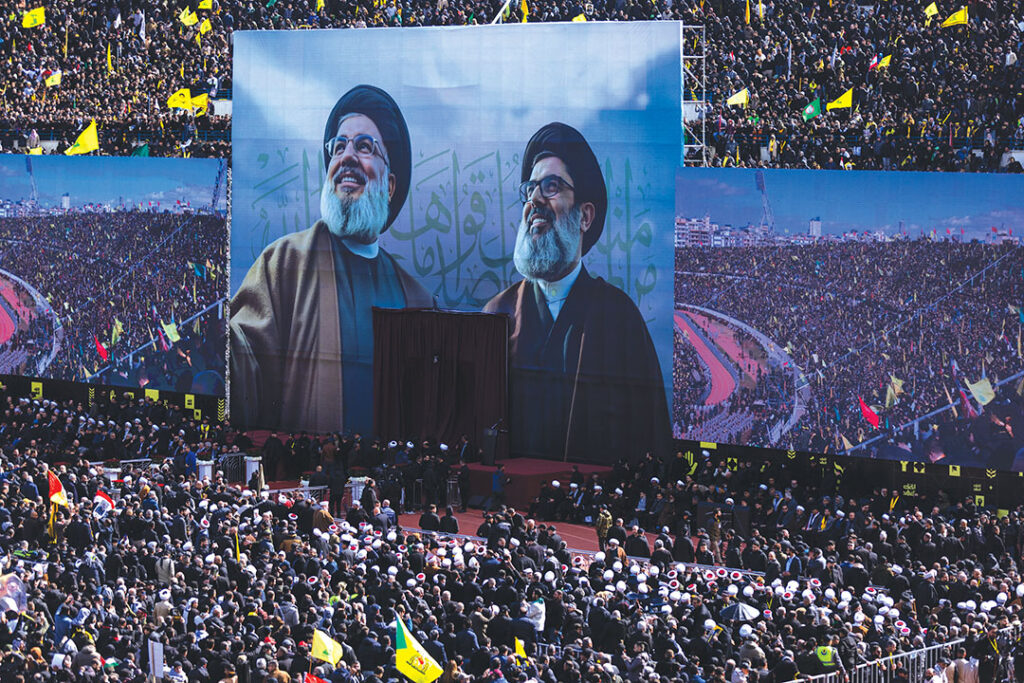
On Sunday, Hezbollah founding leader Hassan Nasrallah was buried in Beirut. A huge crowd filled the stadium, honoring the man whose organization has sowed death and destruction for decades. Yellow Hezbollah flags fluttered in the breeze; black-swathed women pumped their fists in the air or wiped tears from their faces. When Israeli warplanes flew overhead, the crowd chanted, “Death to Israel, death to America, we respond to your call, Nasrallah.”

Confident that “Death to America” does not mean them, a trio of Americans was also there. This announcement was made, of course, on X, where genocidal anti-Jewish rhetoric vies with frolicking baby pandas for likes. “American Communist Party [ACP] Executives Haz-Al-Din, Chris Helali and Jackson Hinkle attended the funeral of the martyred Sayyed Hassan Nasrallah as a show of solidarity to the people of the region from America,” the ACP’s tweet reads. The accompanying photo shows the three men in the stadium, a mural of Nasrallah and his ill-fated successor, Hashem Safieddine, in the background. The American emissaries are solemn in dark suits, though Hinkle wears a bright-yellow scarf, the color of the Hezbollah flag, over his coat. You can taste their pride, their sense of being stiff-necked rebels of U.S. imperialism in the heart of the Resistance. Although more likely, they’re wondering how many more followers they’ll get.

The comrades (their word) have apparently been on quite a journey in the Middle East. In “occupied Palestine,” Hinkle interviewed Hamas leader Basem Naim, posting the video afterward for his 2.8 million X followers. Hinkle, who a few years ago was a San Clemente teen surfer, tells the terrorist leader on behalf of Americans, “We love you guys.” He also met with Hamas members in Doha and had media appearances on Hezbollah’s Al Manar TV, Al-Mayadeen News and Iranian 3rd Channel. When he wasn’t orating into a microphone or posing heroically in a keffiyeh, Hinkle tweeted his adulation for Putin, China and assorted members of the Arab, Palestinian and Iranian “Resistance,” and his fanatical hatred of Israel. He was accordingly praised by Houthi Brigadier-General Abdul Ghani Al-Zubaidi, a man who has pledged to strike British and American targets.

Helali, the ACP’s International Secretary, also interviewed Basem Naim, as well as Hamas leader Osama Hamdan. Helali soared to fame last year, when he ran in Orange County, Vermont as a write-in candidate for bailiff (essentially a stand-in for sheriff: a curious choice for an avowed communist). Helali won with a stunning 446 votes, 2.5% of the electorate. His other vocation is as a high school social studies teacher. His personal experience with Hamas and Hezbollah will certainly be beneficial for his job educating Vermont’s children. 

The group’s intellectual, such as it is, heft seems to come from Al-Din, the ACP’s Executive Chairman and the force behind the YouTube show Infrared. Al-Din is apparently the source of the seemingly-paradoxical ideology—“MAGA communism”—for which he and Hinkle are known. The “MAGA” reference is enough for many commentators to describe Hinkle and his co-thinkers as “right” or “far-right,” but although the group orients to Trump’s working-class following, these really are creatures of the left. They call themselves “Marxist-Leninists,” brandish a modified hammer-and-sickle symbol, denounce Democrats and Republicans, and invoke proletarian causes and history and Marxist theory. 

Last Dec. 31, Al-Din delivered the party’s official New Year’s address from outside the tomb of Lenin in Moscow, near where, he notes, American Communist John Reed and IWW leader Bill Haywood are buried. “Comrades!” he cries—using the endearment no fewer than 10 times in a six-minute speech. The eyes of the party’s bold and hirsute Great Leader blaze into the camera, giving his flock inspiration and hope. Communism suffered a setback after 1991, Al-Din acknowledges, but a new flame has been relit in the reconstitution of the American Communist Party. He extols Marx, Engels, Lenin, Stalin and Mao, predicts an unprecedented period of war and class struggle, rails against “cowards and liquidators mincing in the face of these new developments,” and thunders that communism is not dead — “far from it.” As someone who knows a fair bit about communism, I feel qualified to say: These people are communists. 

The ACP is the latest in an endless stream of sectarians claiming that their party is the embodiment of genuine Marxism. The group was founded last summer in a flurry of pompous declarations, in opposition to what most people think of as “the” Communist Party, the Communist Party USA. The over-100-year-old CPUSA has responded with some consternation to these upstarts trying to claim their name and heritage, and the two groups have lobbed acrimonious accusations against each other. This too is par for the sectarian left-wing course.

What’s a bit novel is the enthusiastic hitching of Western Communism to Middle Eastern jihadism. The trend first emerged around 1978-79, when Western leftists saw the Iranian masses in revolt, and decided not to be too particular about what kind of world these oppressed Iranians, and their leader Ayatollah Khomeini, were actually fighting for. The Iranians were denouncing U.S. imperialism, and that was thrilling enough. 

This red-green alliance deepened with the post-9/11 wars on terror. The result is two totalizing ideologies, each with a bloody history of crushing its avowed enemies, each of which has pledged to dominate the world, that have joined hands despite having belief systems at complete odds with one another. One is rooted in materialism, supports expanding rights for the oppressed including women and is, traditionally, atheist; the other is a fervently patriarchal movement dedicated to creating an Islamic fundamentalist caliphate.  

This red-green alliance deepened with the post-9/11 wars on terror. The result is two totalizing ideologies, each with a bloody history of crushing its avowed enemies, each of which has pledged to dominate the world, that have joined hands despite having belief systems at complete odds with one another.

And the balance of forces is clearly not with the leftists. As slightly-more-savvy Marxists I once knew used to say: “You and the Islamists may climb into the foxhole together, but only one of you will come out.” The comrades of the ACP — and recycling, blue-nail-polish-wearing leftists from Queers for Palestine to Jewish Voice for Peace — may learn the hard way that when the Resistance declares war on all infidels, they don’t mean “except for the ones wearing keffiyehs.” 

“Stooge” is defined as one who plays a subordinate or compliant role to a principal. In the trio’s current glad-handing with Middle Eastern terrorists, it’s clear enough who is the principal and who the dupe. Hinkle may soon decide that fame is better served by casting off the “communist” label, and this fledgling group may fizzle out as so many others have done. Still this Terrorist Fanboys Tour is, at the very least, an outrage against decency. Does American freedom mean there are no consequences for boosting fomenters of terror?


Kathleen Hayes is the author of ”Antisemitism and the Left: A Memoir.”

The Three Stooges Go to Lebanon Read More »

Holy Mother of Moses

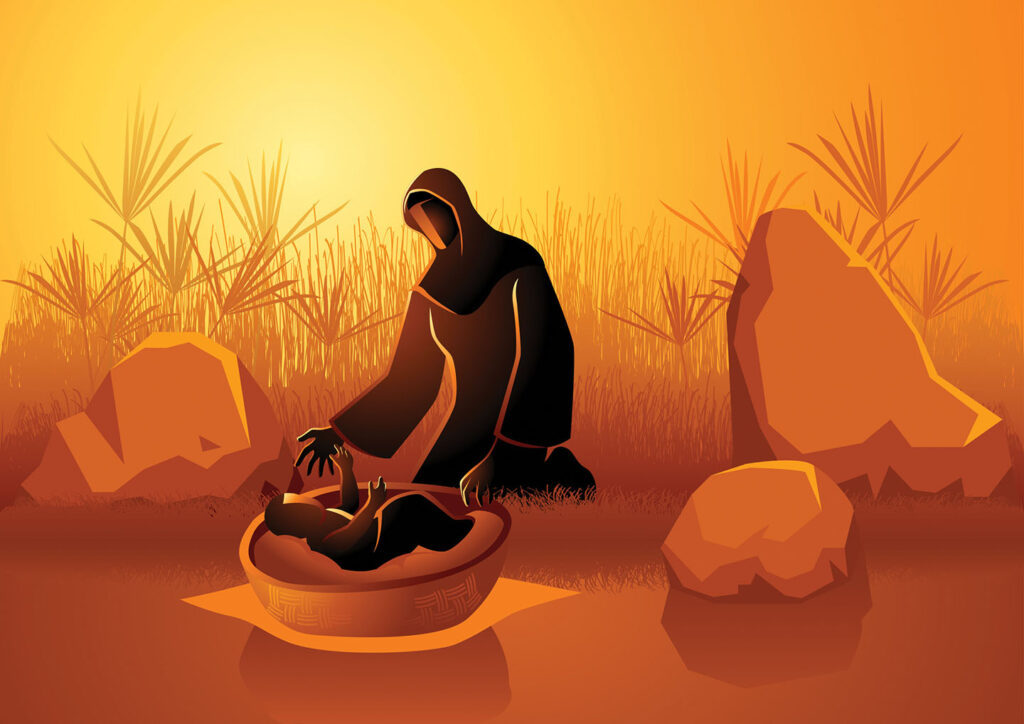
Yocheved, the mother of Moses, merits nary a mention after her son grows up. When Israel’s future liberator was born, she daringly defied Pharoah by hiding the boy in a basket of reeds set upon the Nile. After the baby’s discovery by Pharaoh’s daughter, Yocheved nursed the child in his early years, having been hired by the princess to be the caretaker for her own biological offspring. 

While the Bible records few details about her life outside of this episode, the ancient rabbis fill in the blanks.

The Talmud records that Yocheved was conceived along Jacob’s family’s way from Canaan to Egypt, and born between the country’s entry walls. Through her righteousness, she merited living through the length of the enslavement in Egypt, and left as the people were led by her son.

The Talmud records that Yocheved was conceived along Jacob’s family’s way from Canaan to Egypt, and born between the country’s entry walls. Through her righteousness, she merited living through the length of the enslavement in Egypt, and left as the people were led by her son.

Why was she named Yocheved? Because her face had a semblance of the Divine radiance, ziv hakavod, suggested the Midrash HaGadol.

Professionally, she was a midwife. That civilly disobedient pair who were ordered by the Egyptian monarch to kill Jewish babies upon their birth but did not listen to the murderous command? Though named Shiphrah and Puah in the text, they were actually Yocheved and her daughter Miriam, Moses’ sister.

Why was her alternate name Shiphrah? Because she would cleanse, meshaperet, the newborns, by washing and cleaning them after birth. Or because by merit of her deeds, the Israelites were fruitful, she-paru, multiplying due to her kindness.

She also had yet another name, Yehudiyah. Why? Because through this courageous disobedience, per Vayikra Rabbah, she allowed many Yehudim — Jews — to be brought into the world.

Young Miriam, the Talmud notes, had talked her mother into reconciling with Yocheved’s husband, Amram. After all, the couple had initially separated after Pharaoh’s decree, lest they make any more children who would be marked for murder. Her being blessed with another child was a divine reward for her having saved so many. The “fear of the Lord” that had led her to spare the Jewish children was repaid with mothering God’s great lawgiver.

Yocheved was no spring chicken when she delivered Moses — she was 130 years old. Her husband was much younger — after all, she was his aunt. And Moses’ name wasn’t originally Moses. Yocheved named him Tov, “good,” per Exodus 2:2’s noting that upon seeing him she realized “how good [tov] he was.” 

When she placed him in that reed basket, she was sure to adorn it with a little canopy, for “she said to herself: Perhaps I will not see him under his wedding canopy” after he survives and grows up, says the Talmudic tractate Sotah. 

All three of Yocheved’s children merited miraculous gifts that accompanied the Israelites during their desert wanderings. Moses gifted the people the manna for sustenance. In recognition of Miriam’s greatness, a water-filled well accompanied them wherever they went. And brother Aaron, the High Priest, was the one in whose honor God had the clouds of glory surrounding the Israelites and protected them during their journeying.

Even since she passed away, Yocheved occupies a special place in heaven. The Zohar describes how she leads a special chamber there with thousands of women, where “three times each day, she acknowledges and praises the Ruler of the world, she and all the women with her.” They sing the Song of the Sea, the victory hymn proclaimed after Pharaoh’s forces drowned in the Red Sea, every day, and cite the verse about her daughter, “And Miriam the Prophet … took her timbrel in her hand …” (Exodus 15:20). And, the mystical text adds, “so many holy angels acknowledge and praise the holy Name with her.”

In the meantime, before she was laid to rest, Yocheved completed the journey begun with the Exodus. The one whose name evokes the word kavod, threaded throughout the Bible’s second book — from the heaviness of Pharaoh’s heart (kevad lev) to God’s glory (kevod Hashem) descending on the Tabernacle built by the liberated Israelites — makes it to the end of the entire Five Books of Moses. Seder Olam Rabbah records that Yocheved entered the Promised Land. The mother of Moses, born on the cusp of slavery, merited living out her days in the place designated by God for the people whom her son had liberated.


Rabbi Dr. Stuart Halpern is Senior Adviser to the Provost of Yeshiva University and Deputy Director of Y.U.’s Straus Center for Torah and Western Thought. His books include “The Promise of Liberty: A Passover Haggada,” which examines the Exodus story’s impact on the United States, “Esther in America,” “Gleanings: Reflections on Ruth” and “Proclaim Liberty Throughout the Land: The Hebrew Bible in the United States.”

Holy Mother of Moses Read More »

Israel Elwyn and ETTA: A Collaboration of Heart, Connection, and Support

Advertorial

When two organizations dedicated to serving individuals with disabilities join forces, something extraordinary happens. In honor of the recently celebrated Jewish Disability Awareness, Acceptance, and Inclusion Month (JDAIM) let’s take a closer look at one such partnership between Israel Elwyn and ETTA, two nonprofit organizations on opposite sides of the world—one in Israel and the other in Los Angeles. Together, they have built a meaningful partnership that transcends physical distance, fostering connection, mutual support, and joy through shared activities and experiences.

This partnership blossomed out of a shared vision: to connect individuals with disabilities across continents and strengthen their ties to one another and to Jewish values. Following the devastating events of October 7th in Israel and the fires in Los Angeles, this collaboration has become even more significant, providing a sense of community and resilience.

Bringing Communities Together

The program began with a simple idea: create opportunities for individuals from Israel and Los Angeles to meet via Zoom for monthly activities. These virtual gatherings have evolved into joyful experiences where participants engage in cooking sessions (like making falafel), learning Hebrew, celebrating holidays such as Thanksgiving and Pesach (including a chocolate-themed Seder), and even gardening together.

ETTA program participants expressed how important these sessions are for them, giving them the opportunity to feel deeply connected to the participants in Israel. Although Israel is far, seeing their Israeli friends on Zoom makes them feel close. 

Each meeting begins with introductions and cheering for each other. When a holiday is around the corner, each group makes a toast, expressing their hopes for the upcoming occasion and celebrating friendship.

Racheli Kaplan, Support Coordinator, Supported Living Services at Israel Elwyn, describes the impact of these meetings well, “Meetings involving joint activities have evolved into personal social connections…Beyond the enjoyment they provide, these activities broaden horizons, enhance self-confidence, and strengthen participants’ sense of capability. These activities foster language learning, interpersonal and social skills, as well as solidarity around Jewish holidays and milestones throughout the year.”

Clients in both organizations feel that they understand each other, even when staff has to help translate English or Hebrew.

Naftali, a program participant at Israel Elwyn, shared: “It’s nice to learn a new language and hear about their lives in America. We celebrate holidays together. We also tell them about Israel—what we’re going through now during the war and how we’re coping. They care about us, encourage us, and sing songs with us. I dream of flying to meet them one day.” 

The ripple effect of this partnership extends beyond the participants. Brittany, a staff member of ETTA, noted her favorite aspect of these joint Zooms was “to see how excited the clients are every single time and to learn more about a culture our clients know so well.”

Looking Ahead

As this collaboration continues to thrive, both organizations are exploring new ways to deepen the connection. Upcoming plans include more interactive cultural experiences and even exploring the possibility of an exchange delegation of program participants and staff. 

As Leah Schachter, ETTA’s Director of Volunteers and Special Programs, put it: “I believe that when we bring our incredible clients with special needs together, we unlock amazing potential to grow.”

Israel Elwyn and ETTA remind us that distance is no barrier to connection, and the bonds of community, love, and support can transcend borders. Together, they are creating a brighter, more inclusive future for individuals with disabilities worldwide.


Leah Schacter is Director of Volunteers and Special Programs for ETTA. Sharon Ehrnwald is Assistant CEO for International Relations for Israel Elwyn.

Israel Elwyn and ETTA: A Collaboration of Heart, Connection, and Support Read More »