We often realize that time is relative. Some moments speed by. Others drag their feet. The last ten minutes of Shakespeare in High School English class often seemed like five years.
But the first five years of Maya and Eli’s life have gone by in an instant.
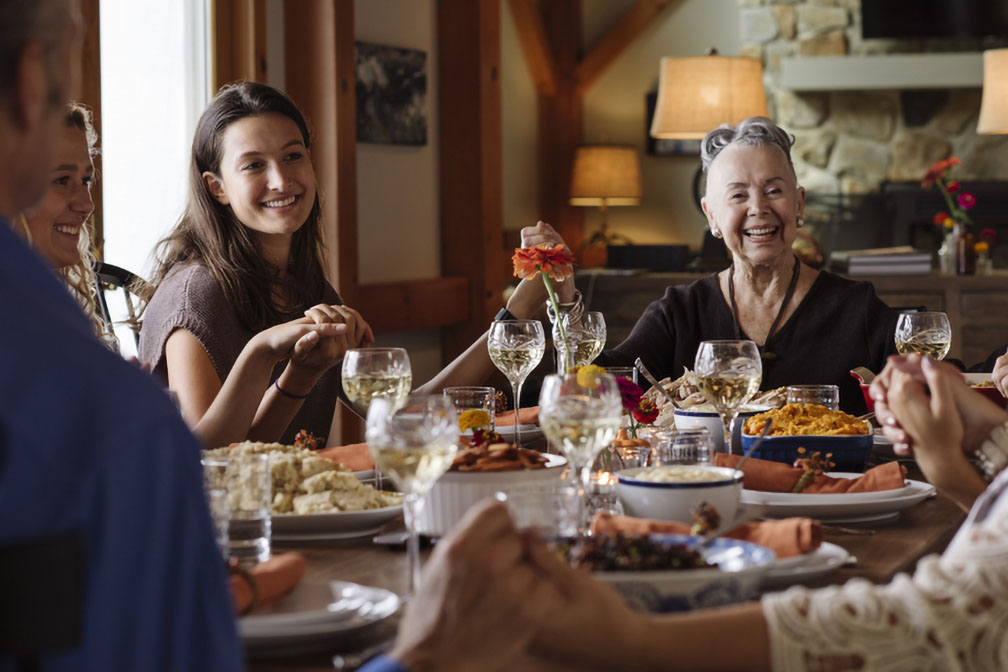
As our country celebrates Thanksgiving, we realize just how important it is to harness a moment in time and not let it pass us by.
A moment to offer gratitude.
A moment to consider how fortunate we are to live in a land of freedom.
A moment to recognize that many around the world do not enjoy those freedoms.
A moment to remember those whose dreams enabled us to do what we do.
A moment to call an old friend to say hello.
A moment to feed those without nourishment.
A moment to pray.
A moment to pause before we say something we might regret.
A moment to say something now, before it’s too late.
A moment to love, to laugh, to dance, to be silly. A moment to do.
A moment to be.
Ron, Maya, Eli, and I wish you and all you love a day and a year filled with moments in time.
A Petition of Consideration was filed to UCLA’s Undergraduate Students Association Council (USAC) Judicial Board on Nov. 25 alleging that USAC Cultural Affairs Commissioner (CAC) Alicia Verdugo discriminated against Jewish students when hiring staff members in the fall.
Ha’Am, a student-run newsmagazine at UCLA, first reported on the petition; the publication’s editor-in-chief, Bella Brannon, filed the petition, which was obtained by the Journal.
“Text messages and documents sent by Verdugo detail the vetting of applicants suspected of being associated with ‘Zionism’ and a hiring sheet revealing the rejection of Jewish students substantiate these claims,” Brannon’s petition states. Her complaint included documentation from the commission purportedly stating that “we reserve the right to remove any staff member who dispels [sic] anti[-]Blackness, colorism, racism, white supremacy, zionism [sic], xenophobia, homophobia, transphobia, sexism, ableism, and any/all other hateful/bigoted ideologies.” Additionally, her petition highlighted an alleged message from Verdugo to series heads stating that “lots of zionists are applying — please do your research when you look at applicants and I will share a doc of no hire list during retreat.”
“No student applicants for the Senate mentioned Zionism or any reference to Israel in their applications,” Brannon’s petition continued. “Even if they had, it should not be a basis for their disqualification. Instead, a policy was created that targeted and excluded Jewish applicants.”
Brannon claimed in the petition that all three openly Jewish candidates who applied for positions were rejected, including herself. “As a student passionate about hip-hop, I applied for a staff position with the Hip Hop Congress at the Cultural Affairs Commission,” wrote Brannon. “In my application, I shared my personal connection to hip-hop, my experience playing music, and my sincere interest in participating in hip-hop culture on campus. Despite my qualifications, I was rejected. Based on the texts and screenshots, I have every belief my identity as a Jewish student played a role in my rejections. Students who were aware of this directive from Verdugo have informed me confidentially that this was the clear instruction and that Verdugo took an active role in rejecting Jewish applicants.” In her application, which is included in the petition, Brannon stated in response to a question on if she would be able to attend a weekend staff retreat if hired: “I keep Shabbat, so would need to follow Jewish observance.” The Ha’Am report noted that another rejected Jewish applicant wrote that “an issue that’s relevant to me is the right to express one’s religion because, as a Jewish student at UCLA, it is imperative that I have the right to express my identity.”
“If you Google me, it’s very clear that I’m a Zionist, but I can’t say the same for the other Jewish applicants, especially one of them who is virtually unsearchable,” Brannon told the Journal. “It seems the only reason they were rejected was their Judaism. Obviously I consider Zionism a very important part of my Jewish identity — the majority of American Jews do — so even if it was discrimination on Zionism alone, it would still be mighty troubling.”
Benjamin Katz, who wrote the Ha’Am report summarizing the allegations in the Brannon’s complaint, told the Journal, “None of the Jewish applicants explicitly or implicitly mention their relationship to Israel or Zionism. The only thing that seemed to have relevance is their insistence on their Jewish identity and how that’s a relevant part of their life, which we thought was a really critical consideration.”
Brannon also alleged in the petition that Verdugo, from the official CAC account on X, blocked her, which Brannon contended “not only discriminatory but also raises serious legal concerns” since the X account is UCLA-affiliated. Further, Brannon highlighted screenshots from the CAC’s social media accounts that she argued promulgated “blood libel” as well as called for the destruction of Israel and celebrated the Oct. 7, 2023 Hamas-led massacre against Israel. One screenshot purportedly showed an Instagram story from the CAC sharing an image of paragliders with Palestinian flags and the words: “Oct. 7 was natives breaking free. What followed was settlers unleashing genocide so the natives would never try to break free again.” Another screenshot highlighted in Brannon’s complaint showed the CAC X account reposting a graphic that called Israel a “genociding Holocausting pedophilic rapist sex trafficking organ & land stealing child murdering terrorist apartheid ethno-state.”
The complaint also highlighted a screenshot of a CAC Instagram post showing a display outside of a UC regents meeting in March depicting a pig holding a bag of cash and a Star of David cannister; Brannon claimed in the complaint that Verdugo “proudly shared on social media their involvement in creating” the pig display.
Brannon further claimed in her complaint that Verdugo was involved in the anti-Israel encampment established on campus during the spring and that there was an official “CAC tent” inside the encampment; more recently, Brannon alleged that Verdugo blocked “four Jewish students from participating in an open mic event ironically named ‘F*ck Your Bans.’ One of the students had a confirmed RSVP but was denied entry. Coincidentally, she was wearing a visible Star of David necklace.” The four Jewish students were Ha’Am reporters. Also, the complaint cites reporting from Ha’Am that Verdugo wrote in a group chat that they weren’t surprised at the USAC representatives that voted against mask mandates and other COVID-19 measures in 2023 because those representatives were “zionists”; when a Jewish student countered by saying that Zionism’s basic claims are accurate, Verdugo replied: “You are being tricked, you have been lied to. The only reason any support is garnered for zionism is because it is politically useful to have a militarized ally in the Middle East. But I think you’ve encountered all these facts before, you simply don’t have the will or empathy to look inside yourself and understand that your parents are liars. They are white, and benefit from white supremacy regardless of religious affiliation.” After facing backlash, “Verdugo issued an insulting, semi-apology,” per Ha’Am.
Brannon’s petition concluded: “This repeated pattern of discriminatory behavior demonstrates that Alicia Verdugo cannot fairly represent all students. Their actions are inconsistent with the principles of equity and inclusion required of their office. We recommend their immediate removal as Cultural Affairs Commissioner and a thorough investigation into the practices of their office.”
Katz told the Journal that Verdugo authored a statement that was posted to the CAC’s Instagram page on Oct. 9, 2023 stating that the CAC “stands in solidarity with Palestinians in their struggle for liberation from Israel.” Verdugo’s statement also states that “condemning the actions of the state of Israel is not mutually exclusive with condemning antisemitism” and that “Judaism is separate from the political movement of Zionism. Establishing this distinction is important to the safety of Jewish and Palestinian individuals alike. Jewish individuals are not uniformly White, do not support White supremacists and are not colonizers or oppressors.”
“As demonstrated by her hiring practices, she seems to conflate the two very naturally,” Katz told the Journal about Verdugo’s views on Zionism and Judaism. “And it’s not coincidental in the slightest.”
Brannon told the Journal: “Alicia Verdugo has repeatedly and unabashedly discriminated against Jews in their tenure as Cultural Affairs Commissioner: From social media posts on UCLA-affiliated accounts calling for violence against Zionists to barring students wearing a Magen David at the door from an event. I applied to staff as someone who can rock on the bass, has a family background in Hip-Hop, and knows that music is an amazing art form that brings people together. I believe that their directive to exclude Zionists was a thin veil to discriminate against Jews, as evinced by the fact that every student who identified as Jewish in their applications was denied.”
Verdugo told Ha’Am in response to the allegations in the petition: “The Cultural Affairs Commission (CAC) is an organization that has historically, and continuously, stood with marginalized and vulnerable populations. As such we do not tolerate or endorse hateful rhetoric or actions of any kind from the world, the university, and especially our staff members. As CAC aims to continue being an organization that fights for the protections and inclusion of marginalized, we will continue to hold our staff to a standard that puts the safety and needs of the communities we serve first.” The Ha’Am report noted that Verdugo did not respond to their follow-up questions on asking why Zionism was included in a list of “bigoted and hateful ideologies” and if they consider “Jewish students to be a group you serve to uplift.”
“At UCLA Cultural Affairs, Jewish students were allegedly rejected for ‘Zionist ties’ — code for being Jewish,” the Jewish Faculty Resilience Group at UCLA posted on X. “Zionism is simply about Jewish self-determination. Twisting it into a slur to exclude Jews is antisemitism.”
At UCLA Cultural Affairs, Jewish students were allegedly rejected for ‘Zionist ties’—code for being Jewish. Zionism is simply about Jewish self-determination. Twisting it into a slur to exclude Jews is antisemitism.https://t.co/ILOXI0c25J via @anteksiler
Judea Pearl, Chancellor’s professor of computer science at UCLA, National Academy of Sciences member and president of the Daniel Pearl Foundation, posted on X that the CAC’s purported hiring policy excluding Zionists is “the most racist document I’ve seen through my 55 years at UCLA” and that “it ought to be fought aggressively, not through useless EDI channels, but through the California Legislature.”
The most racist document I've seen through my 55 years at UCLA (CAC’s hiring policies): “We reserve the right to remove any staff member who dispels antiBlackness, colorism, racism, white supremacy, zionism, xenophobia". homophobia, transphobia, sexism, misogyny, ableism, and… https://t.co/BbMPlatea2
UCLA Hillel Executive Director Dan Gold said in a statement to the Journal, “Hillel at UCLA leadership is currently reviewing the evidence and the details outlined in this petition, but we are appalled that UCLA student leaders would once again openly discriminate against Jewish students. We have been sounding the alarm for months about the hate spewed on social media and in their activism, but these text messages, if validated as real, illustrate just how brazenly anti-Jewish hate is expressed unchecked at UCLA. We can see clearly how it can discriminate against Jewish students. This must end – students and faculty must be held accountable for their hateful and discriminatory actions against Jewish Bruins.”
UCLA and Verdugo did not immediately respond to the Journal’s requests for comment.
UPDATE: The university said in a statement to the Journal, “UCLA unequivocally condemns discrimination in all forms. We are actively reviewing this complaint as it is absolutely critical that every single member of our community is evaluated fairly for opportunities within student government.”
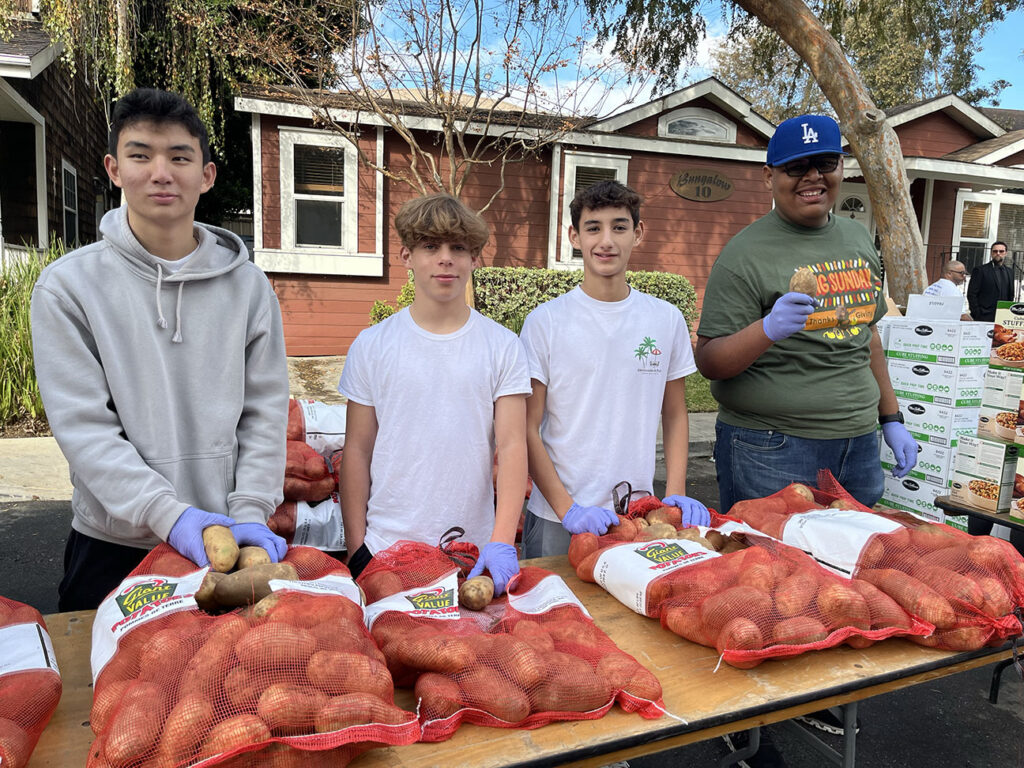
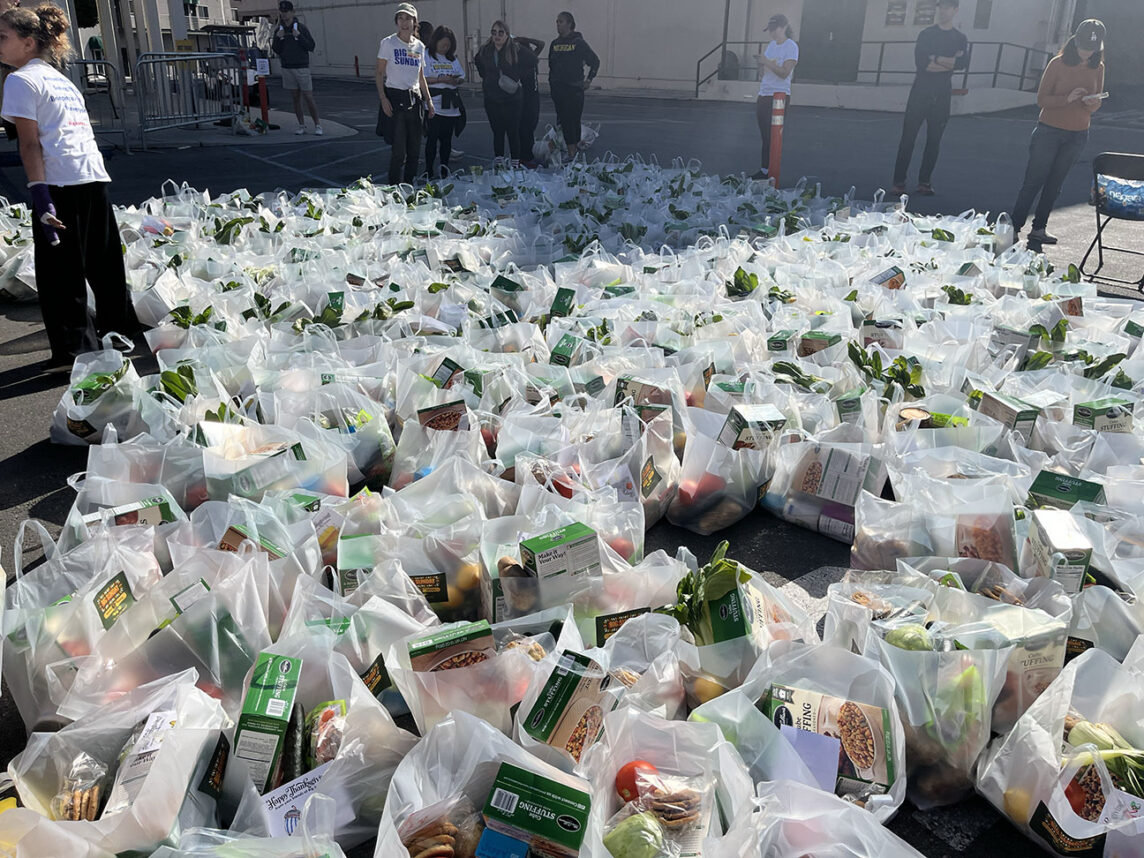
On Nov. 27, the day before Thanksgiving, more than 2,000 volunteers came together at the Radford Studio Center in Studio City to assemble packages of food for the less fortunate.
The spirit of gratitude and togetherness was in the air, with people of all ages turning out.
Local nonprofit Big Sunday organized the event, dubbed “13th Annual BIG Thanksgiving Stuffing Event – a Festival of Gratitude.”
Volunteers assembled bags of food, which were distributed to more than 100 schools and nonprofits throughout Southern California.
“We’re living in such an incredibly divided and divisive time, and such a dark time in so many ways, but this event, between recipients, volunteers, collectors, sponsors, donors, vendors, this one event is going to touch close to 20,000 people of all ages and backgrounds, and we’re just celebrating differences while finding common ground,” David Levinson, founder and executive director of Big Sunday, said. “[This is about] compassion and kindness and community. It’s great we’re feeding all these people, I’m so happy too, but what I’m really happy about is we can all be here and enjoy one another.”
A Los Angeles-based apolitical organization, Big Sunday began more than 25 years ago, with its roots as a mitzvah day at Temple Israel of Hollywood, a Reform synagogue. Today, it is one of the most prolific nonprofits in the country and is focused on connecting volunteers with opportunities to help.
Ahead of Thanksgiving, the Jewish Journal decided it would be worthwhile to reach out to Los Angeles-based faith and community leaders and ask how we can bring civility back to our Thanksgiving celebrations, even when there are people of different political beliefs seated around the table together.
More to the point, we wanted to know: Why is it important that, at least for one evening, we take a break from the heated discourse that so often separates us, and how do we achieve that?
Craig Taubman
As I set out to work on the assignment, I reached out to Craig Taubman, a musician and founder of the interfaith arts, culture and worship center, Pico Union Project. Every year leading up to the High Holy Days, Craig publishes “Jewels of Elul,” in which he asks smart or deep-thinking friends of his for nuggets of wisdom that can be shared over the holidays. For each day of the Hebrew month of Elul, Craig shares a different “Jewel” with the community.
I asked if he had any “Jewels” to offer in preparation for Thanksgiving.
“Thanksgiving is about more than food—it’s about gratitude, connection, and shared humanity,” Craig said. “In a world often divided by politics and ideologies, this season of giving invites us to reconnect through meaningful conversations.
“Jewish tradition teaches us to ask questions, not seek answers,” he continued. “At your table, spark connection by asking thoughtful questions like, ‘What’s a lesson you’ve learned from someone here?’ or ‘What’s been bringing you joy lately?’ For a playful twist, try, ‘If you could invite anyone from history to this table, who would it be, and what dish do you think they’d bring?’
“By seeing one another with curiosity and compassion, we can create moments of civility, connection, and true Thanksgiving.”
As I reflected on Craig’s response, I realized that “seeing one another with curiosity and compassion” wasn’t just good counsel for how to approach Thanksgiving—it’s also a great way to maintain the connections that are important to us in our daily lives. When you show curiosity about a friend or family member’s life by asking them questions, you’re showing that you care.
Rabbi Yanky Khan
Rabbi Yanky Khan, an educator and spiritual leader at Chabad in the Valley, said Jews are well practiced in the tools that make for a successful Thanksgiving, as we put them to the test every week on Shabbat.
“The truth is, every Shabbos, we experience a version of Thanksgiving,” Khan told me. “We gather around the table with family members and guests from diverse backgrounds and differing opinions. Despite these differences, the Lubavitcher Rebbe taught us to recognize that we all share the same essence—the soul—which unites us as one.
“In reality, there is no true separation between us,” Khan said. “We are, and always will be, one family.”
Khan drew a connection between recent current events, involving the tragic death of a Chabad rabbi in the United Arab Emirates in what authorities are describing as an “antisemitic act of terror,” and the importance of the Jewish people treating one another with chesed—loving-kindness.
“Events like this remind us that, whether you are in Dubai, Mumbai, Los Angeles, or Germany, we are one family,” Khan said. “We should set aside our differences and cherish each other.”
Setting aside our differences and cherish each other: As we gather around our Thanksgiving tables this week, it wouldn’t hurt to keep that in mind.
Finally, I posed the question to my mom, who isn’t a rabbi or community leader but has as much wisdom as any if you ask me.
“Setting some ground rules as everyone sits around the table isn’t such a bad idea,” Mom told me. “It can be as simple as someone saying, ‘We’re here for a family Thanksgiving and we’d all prefer it if we didn’t discuss politics tonight.’”
Her suggestion, to quote the great Larry David, was pretty, pretty good.
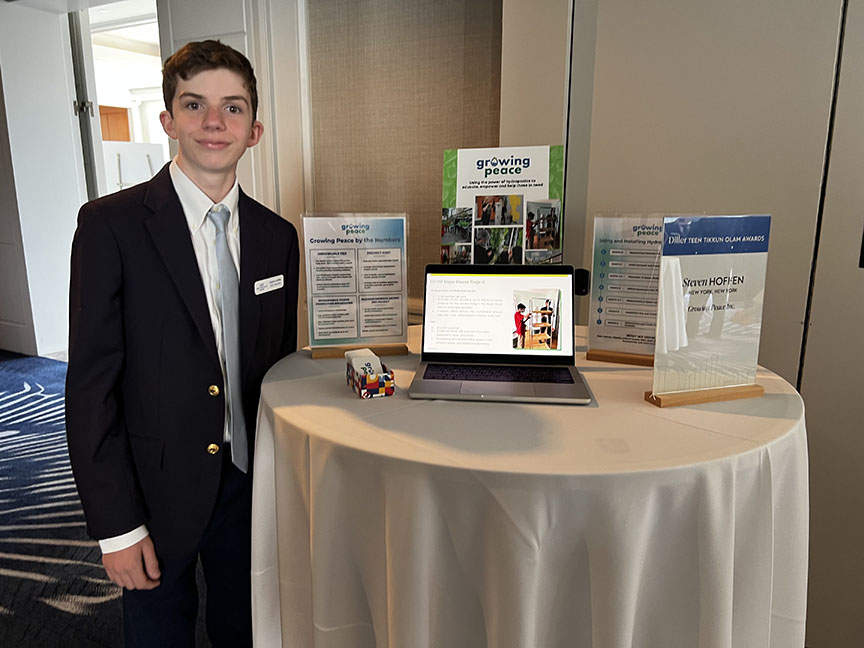
New York teen Steven Hoffen is literally Growing Peace, which is the name of his company, launched in 2021. The organization installs hydroponic systems for communities in need so they can grow their own fresh produce.
“Hydroponics is … this new method of agriculture, where plants are given the nutrients that they need to survive and to grow through nutrient rich water rather than through soil,” the 16-year-old Hoffen, a junior at Riverdale Country School, told The Journal.
Hydroponics, he explained, has many benefits in terms of sustainability that do not pertain to traditional farming: it uses 80-to-90% less water, takes up less space and doesn’t use pesticides or chemicals.
Hoffen said he believes that food, especially in Israel, has the capacity to create peace and collaboration. It’s a human necessity, yet so many people are food insecure throughout the world.
“Once I learned about hydroponics, I was so captivated by the technology and by its ability to produce food so efficiently and sustainably that I wanted to take advantage of what I’d learned,” he said.
The wheels were set in motion in the summer of 2019. On a trip to Israel, Hoffen visited a non-profit organization called Sindyanna of Galilee, where Arab and Jewish women work together.
“They try to create peace between Jewish and Arab communities in Israel by engaging women from each group in different sorts of activities, hoping that they would collaborate with one another and find common ground,” Hoffen said.
The following summer, Hoffen learned about Sindyanna’s hydroponics project, where they install systems in the homes of Jewish and Arab women. Their efforts are supported by an online platform, where residents of the two communities can connect, as well as share tips and photos.
Hoffen created a film, “Growing Peace in the Middle East,” about Sindyanna’s hydroponics project. This led to him creating Growing Peace Inc.
“Learning about the way that Sindyanna was using hydroponics and growing produce to help people [is] what inspired me to think I could potentially do the same in my own community ,” he said.
Hoffen has since installed seven hydroponic systems: one at a food pantry in Tel Aviv, through a partnership with Volcani International and LivinGreen and the rest in the New York City area.
After criminal justice reform advocate Dr. Topeka K. Sam spoke at an assembly at his school, Hoffen looked for a way to collaborate with her.
“What she does and her organization does is try and help women coming out of incarceration find jobs, get education,” Hoffen said. “I was inspired by her mission … so that’s [when] I started installing [hydroponic towers] in New York.”
Growing Peace has systems in Hope House in the Bronx, Edgecombe Residential Treatment Facility, Queensboro Correctional Facility and more. Each tower yields a bounty of five-to-10 pounds of nutritious, organic produce every month.
“Over the past three years, I’ve been volunteering during the school year each week at one or two of them,” he said. “I do love getting on the ground and helping out to maintain the hydroponic systems, because getting that hands-on experience is what’s really fun to me.”
Hoffen is passionate about hydroponics specifically, and generally sustainability, agriculture and food insecurity.
“I really want to continue installing hydroponic systems wherever I can, potentially branching out to other states or potentially other countries,” he said
When asked where his drive of food and giving comes from, Hoffen explained that it connects to the values of Judaism and Tikkun Olam.
“Growing Peace to me is really about trying to give back to the world, to my community and trying to help it out and make the world a better place,” he said. “Whatever little I can do is going to be helpful.”
You don’t need to start a big project to make a difference.
“If you’re not interested in pursuing something that’s super large … you might want to try and help out other people who do have their own initiatives and who are helping people,” he said. “Or you can just do something more local, donate to your food pantry, give to charity, tzedakah, that sort of thing.”
He added, “Whatever you can do and whatever you’re capable of, if it seems like it’s the right thing to do, it probably is.”
However, if you do want to start your own initiative, Hoffen said the first step is to first find out what you’re really passionate about.
“That is what you’re going to work the hardest to achieve … and that’s where you’re going to inevitably make the most impact,” Hoffen said.
Debra Eckerling is a writer for the Jewish Journal and the host of “Taste Buds with Deb.” Subscribe on YouTube or your favorite podcast platform.Email Debra: tastebuds@jewishjournal.com.
In 2014, the government of Israel officially designated Nov. 30 as an annual day to commemorate the nearly one million Jews who were expelled or displaced from Arab and Muslim lands in the twentieth century.
Expounding on this poignant commemoration, a California nonprofit named JIMENA (Jews Indigenous to the Middle East and North Africa), brought forth an initiative known as Mizrahi Remembrance Month, which celebrates Mizrahi and Sephardic traditions and also honors the forgotten Jewish refugees who fled countries ranging from Algeria and Libya to Lebanon and Iran.
Perhaps because I am Iranian, every month is Mizrahi Remembrance month for my family and me, and that pride and heritage is often best expressed through food. Last month, I watched a short video featuring mouthwatering Middle Eastern spices and condiments made by a company called New York Shuk, and I was immediately hooked.
Maybe it was the name: New York isn’t known for shuks, those wonderful outdoor Israeli markets that offer a true feast for the senses, especially the massive mounds of colorful spices. But the city is known for food. The name of the company conjures an image of Israeli vendors in an outdoor market in New York, stuffing and selling heaping bags of fresh Middle Eastern spices such as sumac, shawarma, and my favorite, za’atar.
As it turned out, my imagined ideal wasn’t far from the truth. Ron and Leetal Arazi founded New York Shuk in 2013 in Brooklyn by creating what they called a “couscous booth” in a large, open-air market called Smorgasburg NYC. The couple, who met working in a restaurant kitchen in Israel in 2009, arrived in New York with “only two suitcases and a dream,” Leetal told me in a phone interview last week.
Ron, who grew up in Kfar Saba, and Leetal, who was raised in Rehovot, but later moved to Tel Aviv with her family, are both trained chefs. Leetal also has a background in art and design, having first earned a degree in Visual Design and Display from the University of the Arts in London. She then completed a nearly-year-long intensive course at the Estella Master Class in Pastry, Bakery & Chocolate in Tel Aviv. Ron, who has cooked in kitchens in France, New York City and Israel, attended Tadmor, one of the first culinary schools in Israel.
Ron grew up in a Lebanese-Moroccan family and his mother, Linor, makes a stellar harissa. Leetal’s paternal grandmother was born in Turkey and her grandfather was born in Iraq. Between them, the couple has an unbelievable passion for flavors and spices that is born out of familial heritage and personal stories. And for Leetal, cooking (and baking) remain close to her heart. Her maternal grandfather, Saba Manny, was a baker who lost his wife and children during the Holocaust.
Their company website has a family feel, in part thanks to many black and white photographs of their relatives, including a Passover seder that shows Leetal’s grandfather and his family in Iraq or Ron’s family gathering around a table in Morocco. Leetal designs the simple, yet beautifully artistic labels on New York Shuk products, and works with a graphic designer to create everything related to the company’s visual brand (she created a website “from scratch,” she said). In addition to Ron and Leetal, the company has two full-time employees and handles orders from a fulfillment center in Pennsylvania. “We are four, doing the work of 40,” quipped Leetal.
Ron, who is the co-founder, heads matters related to sourcing ingredients and is usually on the ground working with facilities, namely two co-packers/manufacturers that produce the products, which include an array of spice blends, ranging from shawarma and baharat, as well as condiments, such as their best-selling harissa, or their preserved lemon paste.
For Ron, the biggest surprise of over a decade of business has been seeing “that people in the U.S. actually really love the food we represent,” he told me. And the most rewarding aspect? “Seeing my family’s tradition get into other peoples homes,” he said. When I asked Ron how he maintains a passion for the foods he creates when they occupy his entire work day, he responded, “Being a chef says it all. If you don’t LOVE food and creating food you aren’t able to mentally survive how difficult it is. Do I ever get sick of those flavors? To be one-hundred percent honest? Never. This food is my comfort!”
I first found New York Shuk spice blends at Whole Foods. Soon enough, I had collected half a dozen various varieties, including the fragrant Rosey Harissa, made with rose petals, the brightly green-hued Za’atar, which I mix into egg white omelets as they cook, and the Kafe Hawaij, a glorious combination of cardamom, ginger, cinnamon, and cloves which, when sprinkled over a glass of tea or coffee, feels like a warm hug from your Middle Eastern grandmother.
Photo by Maria Midoes
But the real test was in the bottle of ground sumac berries. Having developed a refined taste for sumac, which I often sprinkle on Basmati rice and meat kabobs, I was skeptical over New York Shuk’s version. Impressively, it offers a savory and fresh tartness that made it difficult for my very Persian family to resist.
New York Shuk offers events and pop-up kitchens, and to date, the company has been featured in outlets such as The New York Times, The Wall Street Journal, Bon Appétit, and Martha Stewart online. In a profile on their Signature Matbucha, The New York Times declared that the company is “putting the Middle East, with an emphasis on Jewish and Moroccan flavors, on the table.”
I asked Leetal to share her and Ron’s journey into the world of running a family-owned business that aims to offer accessible products that are nevertheless a true cut above your average Middle Eastern spice blends. The following was edited for clarity and length.
Jewish Journal: This is so much more than mere a business venture for you and Ron. Tell me about the soul behind New York Shuk.
Leetal Arazi: If you would have asked me this question a year ago, it would be different than how it is in a world-post on Oct. 7. When we started in New York, Jewish food was very one-sided, and, we felt, representative of Jewish Ashkenazi food. We felt it didn’t represent the food we grew up with, whether Ron’s homemade couscous that his mom made or harissa or delicacies that my Turkish grandmother would put on the table. No one in New York saw the food we grew up with as Jewish, but we asked, “Why is this less of a Jewish food than anything else?”
We set out to introduce more Sephardic and Mizrahi Jewish food. But neither one of us had experience with manufacturing or developing products. When we came to New York, we didn’t have funding. We needed to survive, so we cooked. With the couscous bar, we wanted to change the perception of what is couscous, and Ron made and rolled the couscous himself. But we always sought a business that sold packaged products as the end of the line for us.
JJ: How has your business changed for you after Oct. 7?
LA: At the end of the day, we are celebrating who we are. Post-Oct. 7, our mission was heightened. We received backlash this year from people who had a problem with who we are. But it just made our mission way more clear. We’re standing behind our heritage and our story. Oct. 7 made us want to shout it louder. We’re a small business and daily struggles are always there, so we need to have a lot of koach (“strength” in Hebrew) to deal with everything. Unless our mission is crystal clear, it’s very hard to operate.
JJ: What is the manufacturing process behind New York Shuk products?
LA: When we came to the United States, we found lots of spice or condiment products that were made in Tunisia or Morocco, for example. But manufacturing in the U.S. was very important to us. We didn’t want to produce everything in another country, put a label on it and call it a day. We source ingredients from all over the world, but we want to make products in the U.S. The lemons in our Preserved Lemon Paste, for example, come from an organic family farm in southern California. We sourced over 100,000 pounds of organic lemons from our farm partners last year alone. For a product like that, we knew we needed the best lemons.
JJ: There are many Middle Eastern spices available in stores and online. What, in your view, was missing from this market?
LA: Our goal was to build a home in the Eastern pantry, a one-stop shop for the flavors of the Middle Eastern world. But we did everything from scratch. We started with one product (harissa), then created a harissa collection of two condiments and three spices. The goal was to show that we weren’t producing a trendy “hot sauce”, and that’s it. We wanted to bring the depth and meaning out of these products. That meant showing various spice levels and harissa products. We dove into learning how the product is made.
JJ: Speaking of harissa, Bon Appétit has called your harissa, “The Harissa Paste to end all Harissa Pastes.” What makes New York Shuk’s harissa so special?
LA: During development, we explored many different types of peppers. We use Ron’s family recipe. In Ron’s family, they discard the seeds and the skin of the peppers. It’s a very laborious process. There’s no putting the whole pepper into a meat grinder. But it’s not about which brand of harissa is good or which is bad. This is simply our family recipe and that’s what we’re representing. For us, the harissa is mostly about the flavor of the pepper, not necessarily about the heat. The point is not to numb your mouth. We treat our harissa like wine and try to bring different layers of flavor.
JJ: What are some of your favorite memories of food relating to your Jewish identity?
LA: When we lived in Israel, we took our Jewishness for granted. Living in Israel, we never thought we would need to do something actively Jewish. In Israel, Shabbat dinner just happens because that’s what you do. Same with the holidays. We understood very quickly that in New York, we need to choose Jewish traditions every day, especially now that we have small kids.
We actively need to bring those traditions to the forefront, because otherwise, they just die away. The holidays are very special for our families. For Rosh Hashanah, Ron likes to do an entire seder and go through the whole process. I had that growing up and it was special. For Rosh Hashanah, my grandmother had a specialty we looked forward to: quince jam. The Turkish food she made is also very unique because it’s different from other Turkish food; it’s Jewish-Turkish food, and it’s hard to find and research (Leetal’s grandmother, Rika, is 93 and lives in Israel. For her eightieth birthday, her family made a cookbook for her with all of her Turkish family recipes).
JJ: All of your spice products are O-U-certified kosher. Any similar plans for the condiments?
LA: It’s frustrating because there’s no reason why all of our products shouldn’t be kosher. But financially, it’s a burden we basically can’t afford right now. As much as we want it, we also need to stay in business. Hopefully, we will be able to do that. It’s actually super annoying because Ron’s family keeps kosher and we want them to be able to enjoy the condiments as well. All of our spices are kosher because the manufacturing is different and the facility is kosher. The facility for condiments is not. We would need to spend the funds to make it kosher. The barrier to [kosher] entry is very high. But believe me, no one wants our products to be kosher more than us. Hopefully very soon.
JJ: What are your go-to flavors when cooking at home for your family?
LA: We use our shawarma products a lot at home. Those are the ones that people use when they want a real Middle Eastern-Israeli flavor, the one that goes “POW!” in your mouth. Both Ron and I like the underdogs of Hawaij and Baharat spices. In the winter, I like to add Hawaij to soups and Kafe Hawaij to coffee and desserts, even to eggnog.
JJ: How can Middle Eastern spices be incorporated into Thanksgiving staples?
LA: I actually created a post on how to “Middle Eastern-ize” your Thanksgiving. Add harissa to mashed potatoes or shawarma spice to turkey. Make green beans lighter with matbucha. Add za’atar to potatoes, sumac to cranberry sauce and Kafe Hawaij to pumpkin pie. It’s Thanksgiving, but our-style.
For the first time, New York Shuk (@NYSHUK on Instagram) has launched a gift package set: including an option filled with their kosher spices. To learn more about the company, see recipes, receive a special 15 percent holiday discount code (SHUK15) or to sign up for newsletters, visit www.nyshuk.com/
Tabby Refael is an award-winning writer, speaker and weekly columnist for The Jewish Journal of Greater Los Angeles. Follow her on X and Instagram @TabbyRefael
Chicken Shawarma (Courtesy of New York Shuk)
This dish is a staple in our weekly meal prep. Serve with onion-sumac salad (finely-sliced red onion and chopped parsley tossed with olive oil, Preserved Lemon Paste and sumac), tahini swirled with Harissa plus fresh pita bread. In the summertime, we skip the caramelized onions, fire up the grill and keep the chicken thighs whole—it’s a fantastic and easy way to feed a crowd!
—Leetal Arazi
Serves Two
1½ lbs boneless, skinless chicken thighs
6 tbsp neutral oil
1 tsp salt
4 tbsp New York Shuk Shawarma Spice
1 large yellow onion
Cut chicken into small pieces. Toss with 3 tbsp oil, ½ tsp salt, and Shawarma Spice.
Thinly slice the onion. Sauté in a pan over medium-high heat until caramelized, adding 3 tbsp oil and ½ tsp salt midway.
Add chicken to the pan in a single layer. Sear for 1 minute without stirring, then cook, stirring occasionally, until cooked through. Adjust salt to taste.
The goal of making great, as does Adar, the happiness
of Jews does not depend on the behavior of a chief Israeli Rabbiness,
but if she manages to be quite unhardheadedly haredi,
a lot of Jews will be extremely glad that she’s their Rabbi Chief’s First Lady,
though not as glad as Abraham surely was when, though not a maharat,
his wife was the first Lady in their laughter-lavished Sarahrat.
The first line alludes to the rule to increase happiness in the month of Adar that is quoted in bTaanit 28a:
משנכנס אדר מרבין בשמחה, when the month of Adar begins, one increases happiness.
“Rabbiness” is my latest neologism denoting the entity of female rabbis, an entity that is more commonly identified by two other Hebrew words, “rabbanit” and “maharat.” “Sarahrat” is a neologism I have used only in this poem, in order to describe the control that Sarah exercised in the tent she was happy to share with Abraham, but not with his Egyptian concubine, Hagar.
In “Israel’s Chief Rabbinate,” Rabbi Jeremy Rosen writes in his weekly blog on 11/21/24:
While the world’s attention has been focused on the American election, there has been a far less publicized, but still significant, election in Israel for the Chief Rabbinate. Which after months of wrangling was finally decided. With left and right fighting over who should sit on the electoral committee and over egalitarianism…..
This year the Sephardi candidate got through easily in a predetermined election that saw yet another member of the Yosef dynasty intent on keeping it in one family. The Ashkenazi Lau family also tried to maintain their grip on the position but could not gather enough support. The Ashkenazi election came down to two candidates. Eventually Rabbi Kalman Ber from Netanya was elected by 77-58 with Charedi party votes both Sephardi and Ashkenazi. He defeated the more open and impressive Rabbi Micha Halevi of Petach Tikvah who had support from the Religious Zionists.
Both men have good reputations and claimed to be moderates. At the induction ceremony they spoke of embracing all sectors of Israeli life, to support IDF soldiers, visit army camps, and comfort the families of kidnapped Israelis. Rabbi Yosef concluded in English with a Trumpian declaration that resonated with the audience: “We will make the Chief Rabbinate great again!” Chief Rabbi Ber echoed his commitment to unity, expressing the vision rooted of Rabbi Kook. “My greatest mission is to bring about unity among all parts of the people,” he said.
Gershon Hepner is a poet who has written over 25,000 poems on subjects ranging from music to literature, politics to Torah. He grew up in England and moved to Los Angeles in 1976. Using his varied interests and experiences, he has authored dozens of papers in medical and academic journals, and authored “Legal Friction: Law, Narrative, and Identity Politics in Biblical Israel.” He can be reached at gershonhepner@gmail.com.
This time of year, it is common to give thanks. Gratitude for the people in our lives and the blessings we receive.
But for gratitude to fully actualize, we must examine where gratitude lives. How does one cultivate a good heart?
Pirke Avot 2:9 teaches: Rabbi Yochanan asked his disciples, “What is the right path for a person to follow?” In other words, which quality needs refinement to find the best footing in this world? His students responded, “Rabbi Eliezer said, ‘A good eye.’ Rabbi Yehoshua said, ‘A good companion.’ Rabbi Yose said, ‘A good neighbor.’ Rabbi Shimon said, ‘foresight.’ Rabbi Elazar completed the lesson by answering, ‘A good heart.’ Rabbi Yochanan looked at his students and said, ‘I prefer Rabbi Elazar ben Arakh’s because his answer includes all of yours.’”
The cultivation of a good heart is what leads to gratitude. Having the sight to differentiate between what matters and what does not; being a friend to those in need; understanding how to live respectfully among others; seeing and weighing out the consequences of one’s actions. This all leads to the development of a good heart, which leads to the place where gratitude lives.
May it be a season of thanks and a season of good hearts leading the way.
Shabbat Shalom
Rabbi Nicole Guzik is senior rabbi at Sinai Temple. She can be reached at her Facebook page at Rabbi Nicole Guzik or on Instagram @rabbiguzik. For more writings, visit Rabbi Guzik’s blog section from Sinai Temple’s website.
For most Americans, Thanksgiving morning is often associated with watching the Macy’s Thanksgiving Day Parade and some football games, all the while preparing the festive meal.
But for the members of the historic Congregation Shearith Israel (the Spanish & Portuguese Sephardic Congregation in Manhattan), an additional feature of Thanksgiving morning is, appropriately, a religious service expressing gratitude for the blessing of living in America.
Founded in 1654 by 23 Spanish & Portuguese Jews, Shearith Israel is the first and oldest Jewish congregation in America. Having lived through and proudly participated in America’s War of Independence, Shearith Israel’s members took heed to George Washington’s official declaration of Thanksgiving as a national holiday, when he proclaimed November 26, 1789 “as a day of public Thanksgiving and prayer.”
As descendants of Sephardic Jews who were persecuted in the Spanish Inquisition, and ultimately expelled from Spain in 1492, the members of Shearith Israel were grateful to live in the United States, where they were granted full citizenship, freedom of worship and were not persecuted by the government for being Jewish. The idea of an American “day of public Thanksgiving and prayer” deeply resonated with them.
They established an official Thanksgiving service, to be held mid-morning in the synagogue’s sanctuary. Observed to this very day at Shearith Israel in New York, the service features the chanting of several Biblical Psalms of thanks, a prayer for the United States government, and a sermon by the rabbi with a message of gratitude for the blessing of living in America. The service was composed and adjusted by the congregation’s different rabbis, and finalized by Rabbi David De Sola Pool. Rabbi De Sola Pool’s version was printed in 1945 as “Minhat Todah – Service for Thanksgiving Day.”
I feel that it’s no coincidence that the service was printed as an official prayer booklet in 1945 – the first post-World War II Thanksgiving. A prayer book deepens the official status of a prayer service, and I imagine that after the Holocaust, Rabbi De Sola Pool and the congregation felt an even deeper measure of gratitude for having lived in America – and not in Europe – during World War II.
Like the founding members of Shearith Israel, I am a descendant of Sephardic Jews whose ancestors were persecuted and expelled from Spain. I am also a proud first-generation American child of immigrants.
The great Sephardic poet Judah Halevy famously wrote “My heart is in the East,” proclaiming his longing for the Land of Israel.
I have fulfilled Judah Halevy’s longing for “the East,”, and I am now privileged to live in Israel. But I will always be proud to be an American Jew.
On Thanksgiving Day, here in Israel, I will proudly recite the prayers in Minhat Todah, expressing my continued gratitude for the blessing of being an American, and for the blessing that is America.
Happy Thanksgiving and Shabbat Shalom
Rabbi Daniel Bouskila is the international director of the Sephardic Educational Center.
A Saturday night gala during Jewish National Fund-USA’s (JNF-USA) recent Global Conference for Israel honored several pro-Israel leaders, including those who aren’t Jewish but are strong allies of Israel, nonetheless. Pastor Jentezen Franklin, an Evangelical pastor of multicampus church Free Chapel, was recognized with the Tree of Life Shalom Peace Award.
Held in Dallas, Texas, on Nov. 16, at the Hilton Anatole’s Trinity Ballroom, the dressy evening drew some 2,500 attendees, all of whom had come together to show their support for JNF-USA and its work supporting Israel since Oct. 7 while celebrating the organization’s 600,000 individual donors.
Jewish actor and comedian Michael Rapaport emceed the gala, commenting, among other things, on Pastor Franklin’s undeniably robust and impressive head of chair. Sinai Temple Co-Senior Rabbi Erez Sherman and JNF-USA CEO Russell Robinson were among the evening’s speakers and presenters.
The gathering recognized the ongoing contributions of outgoing JNF-USA President Sol Lizerbram, who, in turn, thanked his wife, Lauren, for always standing by his side and joining him in supporting JNF-USA. During the conference, Lizenbram, now serving as chair of the organization, passed the leadership baton to incoming JNF-USA President Deb Lust Zaluda.
The gala was the celebratory highpoint of a multiday conference that, held Nov. 14-17, drew a sizable local contingent, with approximately 70 attendees traveling in as part of the Los Angeles delegation.
People of all ages turned out, with Austin, Texas high school student Yiftah Kovatch — a member of Tzofim (Israeli Scouts) — telling The Journal he was heartened to be around so many like-minded, pro-Israel community members at a time when being pro-Israel is not necessarily universally accepted.
Case in point: Kovatch, 17, recently painted the area around his parking spot at his Austin, Texas high school with the word, “Shalom.” Doing so made his mother nervous, he said. Likewise for his Israeli Austinite friend and peer, 16-year-old Yahli Avni, also a member of Tzofim in Austin. Avni said his mom is anxious that he wears his Star of David necklace everywhere he goes.
At the JNF-USA conference, the two teens needn’t have worried about being confronted with antisemitism or animosity for their support for Israel; they were surrounded by friends.
“We’re all here together for the same cause,” Kovatch said. “To connect to Israel, help out and spread the word.”
A gala dinner organized by OBKLA drew nearly 100 attendees. Courtesy of OBKLA
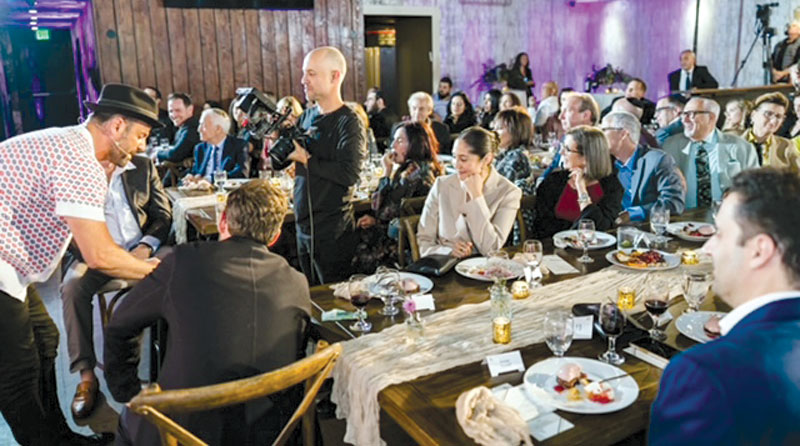
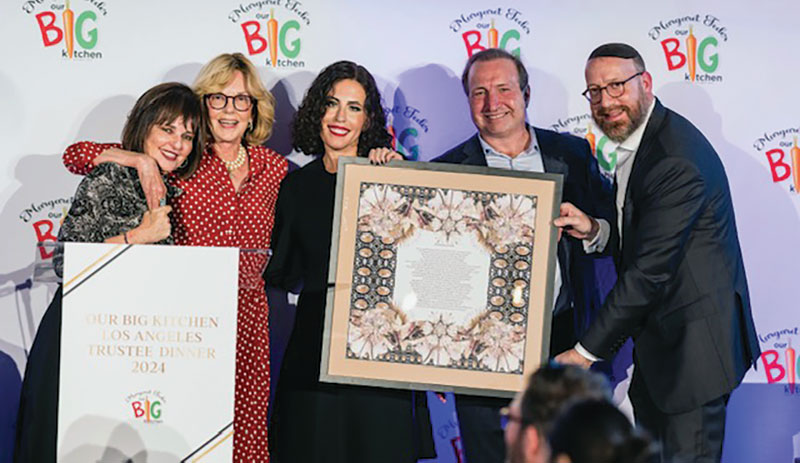
Our Big Kitchen Los Angeles (OBKLA) recently hosted a gala dinner at its community kitchen space in Pico-Robertson, with 90 guests in attendance.
The evening recognized the dedication and contributions of OBKLA’s trustee-level donors, ambassadors and volunteers who assisted with more than hours of volunteering in the last 12 months.
Guests at Our Big Kitchen Los Angeles’ recent gala dinner for trustees. Courtesy of OBKLA
Australian magician James Galea enthralled the audience with his award-winning show.
Dedicated to combating hunger, OBKLA is a bustling hub of activity where volunteers come together to cook and distribute meals to those in need. The idea grew out of an initiative in Australia before being brought to Los Angeles by Yossi and Chaya Segelman. The Segelmans were among those in attendance at the recent event, featuring awards, music and dinner.
From left: Arya Marvazy, Analucia Lopezrevoredo, Sophia Morgan, Grace Osborne, Jordan Daniels and Yehuda Webster. Together they led the event host committee. Photo by Cynthia Silverstein
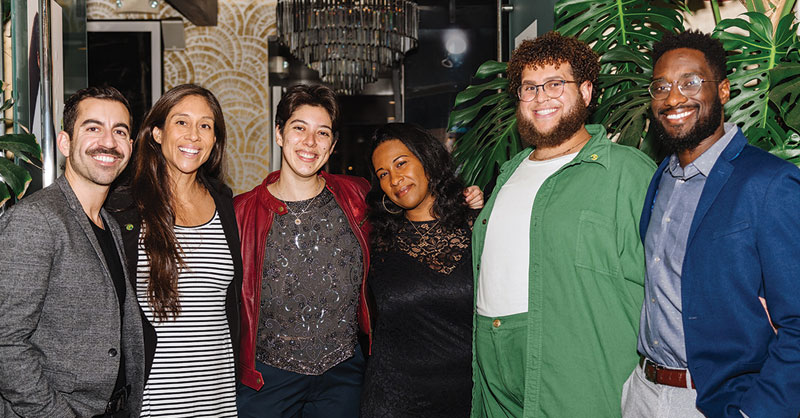
On Nov. 20, Jews of Color Initiative (JoCI) held an event focused on “Community, Connection and Celebration.”
The eveningcelebratedthe Los Angeles JoC Professional Network to honor a year of building a vibrant JoC community in Los Angeles. Jewish Community Foundation of Los Angeles provided support.
“There is a special magic that appears when you offer a community the spaciousness and resources to bring its own visions to life,” JoCI Senior Director of Programs Arya Marvazy said. “In Los Angeles, the Jews of Color Initiative’s Professional Network helps enrich our ever-growing multiracial and multiethnic Jewish community, and the future is as diverse as it is bright!”
Gathering at Nua restaurant in Beverly Hills, attendees enjoyed food and drinks and “heard about the incredible work we’ve done and what’s next for our community,” Marvazy said.
JoCI is focused on grantmaking, research and community education. The organization works to build a “multi-racial, anti-racist Jewish community,” according to its website, “in which Jews of color can experience joy and reach their full potential and belonging as leaders and community members.”