
fbpx

November 27, 2024

Higher Ed Anxiety

Once upon a time, when high school seniors used to ask me, as a professor, “what’s a good school to attend,” they wondered where to best study history or philosophy or commerce. They asked what schools might be most intellectual, or friendly, or humanities-oriented. Last week in Los Angeles, when smart, impressive, idealistic Jewish day school students asked me “what’s a good school” – they were mainly asking: “Where will I be safe and comfortable as a Jew?”

When I met with their college counselors afterwards, I echoed my message to students and parents too: “No, you’re not crazy, the world is. It’s turned on you, on us!” 

How could it be that in 2024, reassurance must be offered – or that this article offering a guide to perplexed parents and students has to be written?

Yes, it’s higher education high anxiety time – with early decision applications filed and most colleges’ Jan. 1 application deadlines looming. As if that annual assault on high school seniors’ psyches weren’t stressful enough, welcome to the most bizarre, nerve-wracking, confounding, disappointing college admission season in American Jewish history.

Welcome to the most bizarre, nerve-wracking, confounding, disappointing college admission season in American Jewish history.

Last year, at this time, most Jews assumed the crisis would pass.  We were still reeling from the horrors of Hamas’ rampage. But most expected that Israel’s war would end quickly – as would the Academic Intifada against the Jews. Few anticipated how long Israel’s just war would continue. Even fewer anticipated how much more hostile many campuses would turn in the spring, or how betrayed most American Jews would feel – by an academic world Jews helped build and fund and which the American Jewish community worshipped.

Since Oct. 7, Israel has been living in three time zones. First, Israelis live in the moment, from second to second, from battle to battle, and, alas, from funeral to funeral. We must win this multi-front war, as soon but as thoroughly as possible. Israel’s fighters remain motivated, seeing all that still needs to be done. 

Second, Israelis – and especially our leaders — must be envisioning the day after, figuring out what victory looks like and how Israel rebuilds. 

Finally, with thanks to Bill Clinton’s 1992 campaign and Fleetwood Mac, we won’t stop thinking about tomorrow, wondering how to apply lessons learned since Oct. 7 to build a better Israel, a better world Jewish community, and a better world.

Similarly, prospective college students and their parents, must live in three time zones. First, the clock is ticking for high school seniors. Each must decide: “What am I doing next year, where do I go, assuming the Academic Intifada is still raging?” Second, we all must brainstorm about helpful takeaways, quick fixes, and improvised solutions that can help so many of us, old and young, navigate this jihad-encouraging storm. Finally, let’s think big, dreaming about a better day – while demanding sweeping higher education reforms so that no student, let alone no Jew, feels threatened on any campus – or any North American street.

At the same time, let’s resist the hysteria fueling the political, media, and academic worlds – and has long been a stable of Diaspora Jewish life. Define the problem, without being defined by it – or exaggerating it.

There is an Academic Intifada – a fury against Israel fed by a wider obsession with “settler colonialism” and identity politics, intensified by the Marxist application of the reductionist oppressed-oppressor binary to race and gender, while demonizing little Israel, as the world’s biggest villain.

Calling it the Academic Intifada uses the haters’ language. When some objected to the Woke theology spreading in intellectual circles, liberals pointed to the War on Woke of Donald Trump and Ron DeSantis to dismiss any critique of academia as right-wing lunacy.  When experts objected that Critical Race Theory reduced everyone to their skin color in racist ways, they were accused of not wanting to fight racism. Anyone who blamed postmodernism simply elicited a “huh … what are you talking about?” 

Now, for over a year, the illiberal liberals dominating many universities have screeched: “Globalize the Intifada … From the River to the Sea.” So let’s take these violence-addled radicals at their word. The Hamas charter endorses Israel’s destruction. The Palestinian Authority’s leader denies Israel’s right to exist in U.N. speeches. And too many academics echo these bloodthirsty cries seeking to eliminate the world’s only Jewish state from the Jordan River to the Mediterranean Sea.

In January, 2024, Harry R. Lewis, a legendary Harvard dean, searched Harvard’s online course catalogue. He found the phrase “Social Justice” mentioned in over 100 courses, the words “oppression and liberation” in over 80, and the Woke buzzwords “decolonize,” “intersectionality,” and “white supremacy” colonizing the curriculum, too. Dean Lewis objected to this flight from complexity, “oversimplified in our teachings as Manichaean struggles — between oppressed people and their oppressors.” All this, he lamented, gave a veneer of academic respectability” to “the ugly old stereotype of Jews as evil but deviously successful people.”

The phrase “Social Justice” was mentioned in over 100 courses, “oppression and liberation” in over 80, and the Woke buzzwords “decolonize,” “intersectionality,” and “white supremacy” colonizing the curriculum, too.

Meanwhile, DEI – Diversity, Equity, Inclusion – regimes dominating many university hiring and promotion committees go far beyond seeking out minority candidates. They impose ideological uniformity in the name of “diversity,” demanding that scholars champion this one politically-charged, anti-intellectual idea. With the universities’ DEI budget approaching 1 billion dollars, and with the average public university employing 45 DEI commissars, doctrinaire bureaucrats are imposing doctrines many professors promulgate and students champion.

Those dismissing the problem as right-wing phantasms are gaslighting the public and fooling themselves. The denial runs deep – and daft. A respected history professor, David Blight, took to The New York Times after the election, admitting “Universities Like Yale Need a Reckoning.”  While pretending to regret the “hubris” of “we university liberals,” when he admits that so many Americans lost “confidence” in universities, Blight stonewalls, blaming “steady diets of negative press about alleged leftist ideological purity.”  

Yet, nine days earlier, Yale students writing in Publius proved that such leftist monomania inhibited debate. They admitted envying the beleaguered minority of conservative classmates forced to sharpen their arguments through constant disagreement with professors and schoolmates. Meanwhile, they in the liberal majority suffocate intellectually, choking on “those buzzwords and slogans” advancing “the Yale political orthodoxy.” 

Still, this mania has not ruined every university, or even every department in the universities dominating the headlines as anti-Zionist danger zones. Exaggerating terrifies our students. Only nuance will set us free. Ratcheting down the rhetoric, viewing this problem in a balanced manner is the best way to find a realistic plan for high school seniors – and, ultimately, to carve ways out of this systemic failure of American higher education to educate students thoughtfully, fairly.

I. In the Moment: What to Do Next Year

Most practically, in deciding where to apply, students should do what they have always done – try understanding who they are and what kind of environment works best for them. Some will thrive amid conflict. Elisha Baker, a Columbia University student hero, argued in Tablet that students should “Stay and Engage.” Universities remain gateways to greater success in America, and we shouldn’t give Jew-haters the delight of driving us out. Moreover, the “resilience” honed by facing down this madness strengthened many young Jews’ identities. 

So, know thyself. Feel free to go to a contentious campus and fight. But, also, feel free to go to a volatile university, avoid politics, and get the education you deserve. 

Different departments have different characters – some are more Woke than others. Different fields have different approaches too. STEM fields remain more resistant to the ideological fanaticism hijacking many humanities and social science fields. Outside of science and math, aggressive radicals are met by the Silence of the Tenured Lambs. The more carefully you look – sifting through course catalogues, student evaluations, and older students’ word-of-mouth — the more informed your decision will be.

STEM fields remain more resistant to the ideological fanaticism hijacking many humanities and social science fields. Outside of science and math, aggressive radicals are met by the Silence of the Tenured Lambs.

Most important, do not view this important college choice only through the lens of the Academic Intifada. Your decision-making moment should be a values-clarification process. Too much of the admissions game has become an endless stress-a-thon of grade-grubbing, resume-padding, grandiose essay-writing, and university brown-nosing, seeking to get our students into what the US News and World Report deems to be the “best” school they can. 

Take a breath. Think about your mind – and soul. Ask what are your or your children’s educational goals? What kind of learning environment works best for you or them? What topics appeal – and which universities highlight those fields? Then go broader. What kind of campus seems most suitable? How robust is the Jewish community – from day to day, from Shabbat to Shabbat?

Our enemies want everything to be about them, their anger, the violence they threaten. When we ignore them, maintaining normal routines and life-long trajectories, we reduce their power rather than exaggerating it. 

While evaluating, address these key tensions:

• Ivy U versus Grassroots U: Last spring, The Washington Monthly reminded us – especially Jewish parents — that there are 1,421 public and private nonprofit colleges. Protests took place on 318 campuses, with encampments occurring on 123 of them.  Most disturbances occurred at the “highly selective colleges” Jewish parents and seniors obsess about. Let’s call them “Ivy U” – even though it’s not just the eight Ivy League schools — as opposed to “Grassroots U.” 

The Woke mind virus has most infected the upper middle class Regressive Progressives and the most privileged intellectuals Ivy U produces and hires. Most Americans don’t appreciate how impressive most American universities are. The glut of good faculty means that many less well-known institutions have top teachers and researchers. And “Grassroots U” often offers true diversity – viewpoint diversity and a mix of economic backgrounds, not just the required rainbow of skin colors. 

American Jews became addicted to America’s elite schools. It’s time to broaden our understanding of what is a “good school” and a valuable educational experience.

American Jews became addicted to America’s elite schools. It’s time to broaden our understanding of what is a “good school” and a valuable educational experience.

• Big Campus versus Small Campus: Even among the elite schools, there’s a great divide. True, many of the ugliest incidents occurred at Harvard, Columbia, UCLA, Berkley, and other super-sized multi-versities. But these large schools also boast larger Jewish communities. They host a critical mass of Orthodox students, Zionist activists, and engaged liberal Jews to push back. Even more important Jewish communities and activities there transcend the politics. Quality Jewish life is quality Jewish life – but quantity helps. 

Similarly, in small schools, the traditional advantage of intimate community often turns ominous. Many smaller selective schools like Swarthmore and Oberlin have students who police one another more aggressively – and cruelly. Jewish students there lack the critical mass – and the anonymity which might allow me to advocate publicly for Israel on the quad in the evening, and sit in chemistry class the next morning without being harassed.

• Red State Colleges versus Blue State Colleges: Just as the institutions American Jews most worship from academia to the media have betrayed them, the progressive cities and suburbs where most Jews live have become the most hostile to Israel. True, right-wing Jew-hatred in Red States is also rising, but not so much in Red State universities. That’s why, in a highly-polarized America, Harvard, in the People’s Republic of Massachusetts, has more Bash Israel Firsters than University of Florida, located in DeSantisburg. And a heartening day-after development is the rise of centers of liberal education exploring not undermining Western Civilization, at University of Florida and elsewhere.

• Yeshiva University versus Secular College: Many Orthodox kids often imply there are only two universities in America: “YU” and “secular college.” YU includes Yeshiva University and Touro College. These contained, supportive, Orthodox environments are distinct but parallel – for better and worse. YU is dramatically improving its secular studies and reaching out more broadly. Consider using your university years to plunge deep into a Jewish environment, with Jewish values and substantive Jewish learning, while getting a degree from a respectable institution.

• North America versus Israel: Dollar-for-dollar, Israeli universities offer the best educational value in the world. After paying tuitions ranging from $5,000 to $20,000, students can fly home for Thanksgiving, winter break, and spring break, while still saving buckets of money, even at current airfares. Even more important, studying in Israel provides a priceless, character-building, identity-deepening Jewish experience, along with exposure to big ideas and world-class researchers.

Finally, just as some students went to Israel for a year to wait out COVID, consider spending a Gap Year in Israel to wait out the Academic Intifada.  Israel is safe for civilians – far safer than certain American inner cities. And while the oppressed-oppressor orthodoxies fueling the Academic Intifada won’t disappear in a year, the protests might fade away soon. As of this writing, this fall semester has been calmer than last spring’s – proving the value of showing firm leadership in universities even as Israel’s wars continue.

More important, rather than running away from the campus insanity, spending a gap year in Israel plunges you into your own Jewish journey in the Jewish people’s forever homeland. Coming to university after a year spent in Israel offers a great inoculation to campus anti-Zionism and contempt for Judaism. A year of maturation, character development, and soul-stretching makes returnees less susceptible to professorial manipulation, peer pressure, even the grade obsession which sometimes derails educational journeys.

Beyond these big picture questions, each university has its own character. Even more important, remember, ultimately, we are who we are. Each of us is bigger than Harvard or Princeton or USC or Stanford. What one gets from educational institutions often reveals more about the students than the educators or the campus. We are ultimately defined by our actions and our values not our academic pedigrees.

II. The Day After: Quick and Easy Fixes

Clearly, universities are broken. The reform required will take lots of time, big money, and sweeping vision. Meanwhile, start small. During the next four-and-a-half years, next year’s incoming students can be agents of change – and its beneficiaries. In assessing universities, judge how open they are to change – and how arrogant or sclerotic they are. And consider four dimensions to improve:

1. The Quality of Jewish Life: Building Inspiring Jewish Communities: We are not victims. Jewish communities can develop and be transformed by new, passionate, proud, pro-Zionist students. Don’t just fight the haters outside – build a meaning-making, supportive, challenging community within.

2. The Quality of Teaching: Fighting Educational Malpractice: The more we frame the challenges as universal, the more successful we will be. Students and parents must become consumer activists, demanding quality education. That means good teaching. That means zero tolerance for educational malpractice which turns the holy classroom podium into a political platform. That means demanding administrators stop any bullying in dorms or on the quad. And that means using whatever levers of power, including tuition strikes with next month’s bill put in an escrow account with dozens of other fellow parents, until basic conditions are met – if problems arise.

Students and parents must become consumer activists, demanding quality education. That means good teaching. That means zero tolerance for educational malpractice which turns the holy classroom podium into a political platform.

3. Building New Centers of Civics-Oriented Liberal Education. Reforming the university will take decades – given that tenured professors can hold their chairs for 40 years. But new centers committed to open-ended, critical and self-critical education, studying great books and Western ideas, can be launched more quickly and cheaply – generating alternatives for students frustrated by today’s Woke Professoriate and Rampaging Snowflakes.

4. Pushing for a Less Woke, More Character-Driven campus: In recent years, Freshman — I mean, First Year — orientation felt like Woke Reeducation Camp on some campuses. Why not assign John Stuart Mill’s “On Liberty” to teach about robust debate rather than imposing some warmed-over Marxist tripe. Focus less on adding more oppressed groups to DEI trainings; teach empathy instead, building character, and a sense of community. Just as the most extreme illiberal liberalism overran elite campuses over 10 years, it’s possible to start dialing it back. 
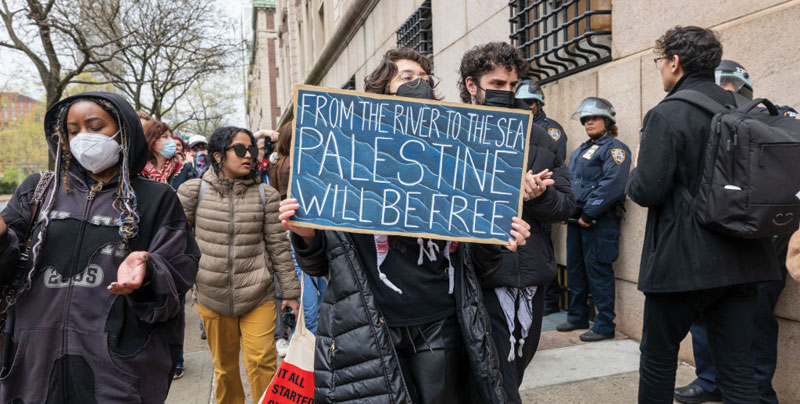
Students and pro-Palestinian activists protest outside of Columbia University on April 18, 2024 (Spencer Platt/Getty Images)

But don’t go overboard. The worst ideas are good ideas that went all accelerator, no brake. Learn what we can from the culture of anti-racism, gender equality, and sensitivity to others, in proportion, without weaponizing biological differences, locking people into biographical or biological categories, and squelching any debate.  

III. Don’t Stop Thinking About Tomorrow

This is beyond this article’s scope. But tomorrow’s college students should be critical, raising big questions with professors and administrators, as well as fellow students and parents: what is the university’s mission today? How are universities succeeding and failing? How must they change? 

Students and parents, especially Jews, must rethink some basics too. Note how frequently adults ask youngsters, “what are you studying,” or “where are you going to school” not “how is your soul?” The message is clear: Get ahead and make money, that’s how we define you. While rethinking universities’ roles, rethink our obsession with getting ahead in our lives and our addiction to certain kinds of universities as the gateways to one particular kind of success.

Finally, tomorrow’s students should learn from their wisest coaches – today’s students. To help, every college Hillel should issue a Zionism and anti-Zionism index, describing their own school – emphasizing positive Jewish and Zionist responses not just the negative. As the Woke movement becomes intertwined with the Academic Intifada, generate a Woke Index – school by school, department by department, professor by professor. Try to be more factual and analytical than personal; don’t make it about creating a counter cancel-culture. Instead, respond to orthodoxies, fanaticisms, and purges, with integrity, subtlety and transparency.

As students and parents weigh these difficult choices, stop to say, “how lucky we are.” In some societies, and among some fellow Americans, you finish high school and go straight to work – or unemployment. In some societies, and among some fellow Jews living in the Jewish homeland, you finish high school and go straight to the army. While military service can be character-building and life-transforming in many positive ways, the opportunity to plunge straight into your studies is a gift from your visionary ancestors who made it to North America, from your hardworking parents, and from your country which, despite some faults, is far more functional than most acknowledge these days. Good luck – enjoy the ride and make the best of it.


Professor Gil Troy, a Senior Fellow in Zionist Thought at the JPPI, the Jewish People Policy Institute, the Global ThinkTank of the Jewish People, is an American presidential historian. His latest book, To Resist the Academic Intifada: Letters to My Students on Defending the Zionist Dream was just published. 

Higher Ed Anxiety Read More »

How This Election Will Reshape the American Jewish Political Story

The results of the 2024 election won’t just shift political power in this nation to the right, as this moment will mark the undoing of the foundations of American Jewish liberalism. In its aftermath, Jews will be confronting a changing political landscape both within our community, and beyond.

This election reminded us that the United States is far more complex and divided — and most assuredly less liberal — than many of us assumed. The country is changing, and new centers of political influence have arisen to compete with Jewish interests.

But perhaps the most important change is the political transition underway within the ranks of our own communal order. Whatever changes the American body politic is undergoing, American Jews are experiencing major internal shifts as well.

A number of factors have contributed to this transformation. American Jewish Orthodoxy, still about 10% of the Jewish population, has increased its political presence. An increasing number of Jewish voters in this election reframed their vote around a core question, “Is it good for the Jews?” Fearing the rise of antisemitism, we find a growing sector of American Jewry whose political choices reflect this changing reality.

At one end of spectrum, the liberal Jewish establishment is aging. At the other end, assimilation and intermarriage are undoing the liberal Jewish base. Younger, secular and intermarried Jews are less connected to Jewish institutions or to Israel, thereby weakening Jewish liberal political influence. In addition, young Jewish progressives, disconnected and angered by Israel’s actions, have moved away from their parents’ traditional liberal politics.

The traditional liberal Jewish perspective that has defined and shaped the political voice of American Jewry is likely to dissipate, as younger, more assimilated Jews will increasingly take on the more generic cultural characteristics and political behaviors that define their generation and social class, and in the process move further away from a connection with Israel.

Even among American Jewish liberals, there is today less consensus on issues such as gender, diversity and inclusion, and Israel. Not only have these demographic and ideological shifts changed American Jewry, but its relation to other groups has been altered as well. American Jewish liberals mistakenly believed that they were part of a much broader coalition, only to find in this post-election moment that there are fewer fellow travelers. The silence following the Oct. 7 Hamas attack on Israel from key coalitional allies represented a clear break as many of these folks saw Israel’s actions as problematic. This disconnect is now difficult if impossible to repair in the immediate term.

Minority groups, whom we assumed to be overwhelmingly aligned with the Democratic Party voted in increased numbers for President-elect Donald Trump. His reelection acknowledges that some former allies hold sharply different views on social policy and human rights.

No wonder some Jews feel isolated, and unsure of where and how to proceed in the aftermath of Donald Trump’s victory.  

 Uncertain about how best to assert their interests, American Jewish liberals will need to regroup, identifying a new set of core issues, causes and candidates that they can embrace.  Their evolving agenda will likely be complex but essential and will need to include:

• Rebuilding partnerships and alliances around selective issues and shared concerns.

• Focusing an agenda that is strategic and identifies several key priority issues that demand collective action and engagement.

• Reaching back to the disillusioned and angry, seeking to bring especially young Jews into community.

• Reaching across the political divide to open conversations and connections, as a possible way to find common ground.

• Understanding and celebrating the value and role of dissent and how best to operate in such a space.

• Promoting a civics initiative designed to foster engagement on the part of young Americans in public affairs, community organizing, and civic responsibility.

• Defending Israel’s right to maintain its security, while seeking to return elements of the Democratic Party into the pro-Israel community. Providing a richer and deeper education into Zionism, what it represents and means for the Jewish people.

The Rise of Conservative Jewish Voices:

Trump received only about 32% of the Jewish vote but the priorities and policies supported by that minority of Jews will now hold sway in the new administration. 

In a second Trump administration, a new cadre of Republican Jews will assume national leadership positions, asserting domestic policy positions on school choice, vouchers, gender identity, legal immigration restrictions and border security, and gun rights that are at odds with the long-dominant liberal positions.

For instance, Trump tapped former congressman Lee Zeldin, a board member of the Republican Jewish Coalition, to head the Environmental Protection Agency, despite Zeldin’s opposition to stricter environmental legislation, which a Pew survey showed 71% of American Jews support. 

In connection with foreign policy priorities, we are likely to see a more nationalist-based agenda, where international regional agreements and partnerships will take a back seat to an America-first mindset.

There exist multiple perspectives on what a “Jewish democratic Israel” represents. The Trump Administration is likely to endorse a “greater Israel” framework supported by the Israeli right, signaling a fundamental shift from the historic two-state premise to a more dominant geopolitical position with Israeli control over disputed areas, reducing the possibility of a Palestinian State.

As a result of this election, we will experience an emboldened Jewish Republican base, strengthened by its recently achieved political gains and by the choices and directions being signaled by this incoming administration, as reflected in President-elect Trump’s early nominations.

As a result of this election, we will experience an emboldened Jewish Republican base, strengthened by its recently achieved political gains and by the choices and directions being signaled by this incoming administration, as reflected in President-elect Trump’s early nominations.

In the aftermath of this election, some Jews will surely withdraw from the political playing field, exhausted and discouraged, while others will rethink how best to perform the role of the loyal opposition, reasserting the Jewish liberal voice and forging a new effort to rekindle a political movement that has, until now, defined the Jewish encounter with America.


Dr. Steven Windmueller is an Emeritus Professor of Jewish Communal Studies at HUC-JIR. He is the editor of a 2021 collection of essays on The Impact of Donald Trump’s Presidency on American Jewry and Israel.

How This Election Will Reshape the American Jewish Political Story Read More »

Rosner’s Domain | The Trump Envy Syndrome

I named it “The Trump Envy Syndrome” (TES). 

It is a psycho-political phenomenon that can be identified among Israelis who see Trump’s victory, his planned revolutionary reforms, as a roadmap for Israel. These are Israelis who won an election with a right-wing coalition before Trump. These are Israelis who admire the bold actions of Trump in America. Before the war, they, too, have tried to be bold, to revolutionize the system. One might think that they learned a lesson having tried and failed to pass a comprehensive and controvercial legal reform. But many of them reached the lesson you wouldn’t expect. They think that they failed not because of overereach but rather because of underreach: They were too hesitant, too timid. Trump’s victory, his audacity in governmental appointments, gives some of them reason to hope and act.

What is Trump trying to do? Many of his voters believe that it’s time to tame the so-called “deep state” systems that rule America against the democratic will of the masses. The sentiment in Israel is quite similar. It reminds one of the many complaints against the power of the Attorney General, the courts, the Shin Bet, the media, the gatekeepers, the senior bureaucracy, the IDF top brass. Naturally, for a similar problem some Israelis prescribe a similar solution: to appoint unconventional people to key positions who can set new policies, clean the house and hand the power back to the elected officials preferred by the public. 

You can belittle the claim that the systems are corrupt, you can try to convince your peers that that’s not the case, you can assume it’s a claim of cynics who just want more power. It doesn’t much change the reality of TES that is metastasizing in Israel. Clearly, there are those in Israel who have similar feelings to Trump voters. Clearly, there are leaders in Israel who think it’s necessary to clean house, some of them cynics, some of them truly believing the house is a total mess. There is readiness among these Israelis – let’s call them by name: Staunch Netanyahu supporters (in Hebrew they are often described as “Bibistim”) to go very far in this attempt to undermine traditional state institutions. 

Trump is currently doing this by daily appointments. You’re familiar with the names, so there’s no need to go over the list. Some Trump appointments are reasonable and routine, some are surprising, and some appear scandalous. But to whom do they seem so? To those who believe that the old order was, more or less, bearable. Not to Trump, who wants a revolution. He has convinced the voters, and himself, that a big shake-up is needed. He will have a cabinet like none ever seen in America before. 

His seeming lack of inhibitions has, in recent weeks, aroused the envy of leaders in the Israeli coalition. Trump starts a second term believing that to achieve his goals he needs to be more aggressive than what we witnessed in his first term. The Israeli coalition is adopting a similar mindset. Two years ago it attempted a revolution by being aggressive. This did not quite succeed, and the conclusion is that an even more aggressive approach is necessary. Thus, we see the return of the “legal reform.” Thus, we hear blunt statements against the established insitutions. Netanyahu, just a few days ago, called these authorities “hunting machines.” He and his allies see how Trump acts – and want the same. They see how Trump ignores the media, his political opponents, the elites – they want the same.

This syndrome is dangerous to Israel. First of all, because it’s not at all certain that what Trump is doing will lead to good results. Even those who support his moves cannot know that what he is doing will lead to good outcomes. It’s a gamble. So one needs to think about what happens if the gamble succeeds, and also what happens if the gamble fails. The answer is, in the case of America, not much. America is a superpower, with an ability to absorb a hard blow and recover. It has the resources of an empire. If Trump’s gamble doesn’t turn out well, it could make things worse, but there won’t be an existential threat.

Israel is not America, and therefore Trump Envy Syndrome is dangerous. here On the battlefield, it is important for Israel to remember that it is not a superpower, and plan its actions accordingly. And the same is true for societal and political actions. Netanyahu cannot be Trump, not because he is less smart, but because Trump operates in America while Netanyahu operates in Israel — different arena, different conditions, which require more cautious risk management. The aggression that Trump can afford in the American arena, without fear of societal collapse, is something that Israel’s government cannot afford, unless it is willing to risk, well, a societal collapse. In the midst of war.

Israel is not America, and therefore Trump Envy here is dangerous. On the battlefield, it is important for Israel to remember that it is not a superpower, and plan its actions accordingly. And the same is true for societal and political actions. 

What Trump Envy teaches us about the coalition isn’t that it’s ideologicaly flawed. It teaches us that the coalition has a severe case of megalomania.

Something I wrote in Hebrew

Following Netanyahu’s blunt attack on the legal system and the Shin Bet, I wrote the following comment:

What we call a “state” has various layers, most of which exist in our imagination. There’s society, landscapes, a flag, an anthem, traditions and culture. There’s territory and currency. And there are institutions. They are responsible for the concrete action that turns a collection of sentiments and ideas into something organized, something we can call a state. A state without institutions is not a state. A state that fights its institutions is a state fighting itself. A state whose prime minister battles its institutions is a state in real trouble. This means we are a state in severe trouble.

A week’s numbers

Trump Envy Syndrome is a symptom of Israelis who believed Trump is the better candidate for Israel (a clear majority) but also the better one for America (not a majority).

A reader’s response

Ari Cohen wrote: “Shmuel, are they really going to have ceasefire in the north?” My response: by the time you read this, it could already be a done deal. That’s why I didn’t want to write about this issue in length for an early deadline. Happy Thanksgiving. 


Shmuel Rosner is senior political editor. For more analysis of Israeli and international politics, visit Rosner’s Domain at jewishjournal.com/rosnersdomain.

Rosner’s Domain | The Trump Envy Syndrome Read More »

Democrats and the Torah

After the recent resounding Republican victory, the Democrats have started a process of determining how they lost so conclusively.  They are looking at politics, candidates and much else – but there is one source that none seems to have consulted.  This is the Torah, the sacred text for Jews and Christians that starts with Genesis and concludes with Deuteronomy.  Why the Torah?  It is, as Moses asserts in Deuteronomy, the ultimate guidebook – designed to provide practical and actionable direction for all people, of all faiths, in all times. This astonishing claim, as I demonstrate in my forthcoming book, “God Was Right,” has been validated by modern social science.     

If the Democrats do consult the Torah, they will realize – right at the beginning – something that may surprise them: They should be feeling great right now.

It is Genesis 4 and Cain, the elder son of Adam and Eve, brings a simple offering to God “from the fruit of the soil.” His brother Abel, a pastoralist, similarly brings an offering, but does so “from the firstlings of his flock and their choicest.” 

With Abel having given his best and Cain having given an inferior offering, God, we read, “turned to Abel and his offering, but to Cain and his offering he did not turn.”  Cain is both angry and sad – he is, in a word, devastated.  Today’s Democrats could relate. 

God has advice for Cain. First, He asks why Cain is upset – as if Cain’s reaction is unnecessary and even mystifying. But God explains his question, saying: “Surely, if you improve yourself, you will be forgiven.”

Defeat, God teaches, presents a remarkable opportunity.  It enables learning, improving and incorporating lessons that enable one to live better long into the future. 

Cain rejects the opportunity — luring his brother Abel into a field, and killing him. Cain is cursed by God to wander the earth purposelessly and aimlessly. 

If the Democrats want to avoid the fate of Cain – which, as the Torah makes clear, was far from inevitable – how might they do so?  The Torah is an abundant source of guidance.  Here are but three of the many lessons they may glean from an honest assessment of their loss: 

1. Celebrate Viewpoint Diversity and Make a Republican Friend.  In the waning days of Vice President Harris’ campaign, she and her surrogates took to crowds and the media.  Kamala Harris said that Donald Trump was a fascist – implying that his supporters were also fascists, or too stupid to realize that they were supporting one.  President Biden said that Trump supporters were “garbage.”   New York Governor Kathy Hochel said that Trump voters were “anti-American.”  Hillary Clinton said, well before the rally at Madison Square Garden, that it was akin to a Nazi rally – as the American Nazi Party held an event there in 1939. President Obama said that black men who were not supporting Kamala Harris were sexist. MSNBC host Joe Scarborough said that Latino men who supported President Trump were racist. How could these Democrat leaders believe such things about more than half of their countrymen? 

Cue Genesis 11:1: “The whole earth was of one language and a common set of words.”  The seeming redundancy is intentional. “One language” refers to the actual mode of communication, while “a common set of words” refers to the content. Everyone, it seems, was required to use a prescribed vocabulary. And with that uniform set of words came a uniform set of beliefs. Everyone, in other words, thought the same. They decide to construct a “tower with its top in the heavens” – but do so “in a valley.” This was, perhaps, the most ill-fated building project ever.  The people knew that God doesn’t have a physical house in the sky, and certainly not one that they could reach by building a structure – particularly starting from a valley.  However, the absence of viewpoint diversity leads to very stupid thinking. 

Do the Democrats, perhaps, speak with a “common set of words”? While they don’t all do so, a consideration of the intellectual milieu in which many reside is instructive.  Try going into a “progressive circle” and wondering what exactly is meant by “the future is female,” challenging the assumption behind “check your privilege,” or questioning whether there is really a “global climate crisis.”  Expect to be ushered out of there — probably on the grounds that you made those in the group feel “unsafe,” “spread misinformation,” “invalidated other’s experiences,” “promoted hate” or something else that would fit into a “common set of words.” 

The data from the social science literature is also instructive.  A study by YouGov in 2020 and another by AEI in 2021, found that Democrats are far more likely than Republicans to report having no friends from the other party.

If the Democrats want to really understand Republicans – and a lot of swing voters – they would do well to cultivate the viewpoint diversity that God expressed the need for in Genesis 11.

If they engage with genuine respect, and a spirit of friendship and brotherhood – they will learn a lot. They will likely see what the social science data shows: that conservatives are more likely to have happy marriages, are more charitable, more likely to volunteer and even more likely to give blood than are liberals.  They will find plenty of other grounds as well for respect that will make them recoil the next time a Democrat says that only racists, sexists, Nazis, anti-Americans and idiots vote Republican.  

If a Democrat engages socially with Republicans (or doesn’t) and still thinks that Trump voters are “garbage,” the Torah offers more guidance.  In Numbers 23, the high priest (Aaron) blesses the people.  The ancient Rabbinic commentators, observing the words that describe how he does so, decreed a rule: One cannot bless the people without loving them.  A leader who does not love the people should find another profession.

In Numbers 23, the high priest (Aaron) blesses the people.  The ancient Rabbinic commentators, observing the words that describe how he does so, decreed a rule: One cannot bless the people without loving them.  A leader who does not love the people should find another profession.

2. Have a rigorous and coherent policy agenda.  What specifically, aside from abortion access (which is now determined by the states), did Kamala Harris stand for or want to accomplish as President? Clearly, the American voter struggled to work it out – which is why she and Tim Walz framed their campaign in terms of “vibes” and “joy.”  

They were not the first politicians to base a campaign on virtually nothing. In Numbers 16, Korach foments a rebellion against Moses.  Korach’s platform: “The entire assembly … are holy … why do you exalt yourselves over the congregation of Hashem?” That’s it – there are no policies he wants to enact, changes he wants to make, no positive agenda he wants to advance.  Korach just says that everyone is special and I should be the leader.  

Korach’s “vibes” campaign is a sharp divergence from the leadership modeled in the Torah. The two great Jewish political leaders in the Torah— Joseph and Moses- each had rigorous policies, only some of which were popular or successful. The result: We call Joseph Tsaddik (righteous) and Moses Rabbenu (teacher)- while Korach is swallowed up into the earth.

Korach’s “vibes” campaign is a sharp divergence from the leadership modeled in the Torah. The two great Jewish political leaders in the Torah— Joseph and Moses— each had rigorous policies, only some of which were popular or successful. 

If the Democrats return to the days when they had a governing vision and a policy agenda, they will have some reconciling to do.  Do they believe in girls sports, or is Title IX transphobic?  Do they want to build housing infrastructure in a timely and cost-effective manner, or maintain all their green (and other) regulations?  Do they want to improve education, or maintain their opposition to choice and now even charters?  Do they want citizens in vulnerable communities to live safely, or to discourage active policing?  Do they want a healthy and thriving young population, or to normalize drug use? 

3. Choose leaders from the people.  It was weeks following her nomination before Kamala Harris gave an interview or a press conference.  When she did engage, she generally did so with mainstream media figures who were supportive of her.  Even then, her answers were so canned that her interviewers sometimes completed her familiar stories.   She gave one interview to Fox – but arrived late, filibustered and had her people demand that it end early.  She refused an invitation to appear on the Joe Rogan Experience, which would have given her three hours to communicate with more than forty million young people. And she concluded her campaign with seven concerts by rock stars – leaving the campaign, apparently, in debt with vendors from those events unpaid.  President Trump concluded his campaign by riding a garbage truck.  

How big a problem is it to be far removed from the people you hope to serve?  Big enough for the Torah to emphasize throughout.  In Leviticus 21:10, God tells Moses to choose a Kohen Gadol (High Priest) who is “great from his brother” – implying that his greatness will derive from his connection with the people.  

Chip Somodevilla/Getty Images

Moses incorporates this lesson in his concluding speech.  In Deuteronomy 18, he instructs the Jews about how to choose a leader: “The Lord your God will raise up for you a prophet like me from your midst, from your brothers.”  The addition of the phrase “from your brothers” teaches us that the leader is not above or in any way better than the people – but is just fulfilling a role like all of his productive fellow citizens.  Consequently, the leader must be comfortable with and relate to the people – a process that will enable him to understand their concerns, appreciate their aspirations and win their trust.  The Democrats once understood this very well; the quintessential modern candidate “from the people” – who everyone would want to have a beer with, and him with them – was Bill Clinton.

These lessons from the Torah, and many more like them, show not only that the Democrats can change – but that there are practical ways that they can do so that will accrue to their benefit, and to that of our great country that is best with two strong and vibrant parties. 

These lessons from the Torah, and many more like them, show not only that the Democrats can change – but that there are practical ways that they can do so that will accrue to their benefit, and to that of our great country that is best with two strong and vibrant parties.


Mark Gerson is the author of the forthcoming book, “God Was Right: How Modern Social Science Proves the Torah is True.”

Democrats and the Torah Read More »

Resilience Workbooks for Many Times, Many Places, Many Children

In 2010 Dr. Naomi Baum was part of a mission to Haiti. At the time, she was a psychologist with 30 years of experience. In the year 2000 she started working specifically with trauma, when the second Intifada began. 

With that background, Dr. Baum realized that in Israel and abroad there was a need to reach more children than is possible through individual or even group therapy sessions. She turned her efforts to training teachers to build resilience in the classroom, understanding that the adults in a child’s environment have the greatest impact on that child’s mental health and resilience.  

Baum also created the Building Resilience Intervention (BRI) model and in 2020 she co-authored the book “ISRESILIENCE: What Israelis can Teach the World.” 

Due to the fact that often teachers and parents are coping with their own trauma, Baum created a resilience workbook for school-aged children, that kids could work on in the classroom or in the home, with the help of an adult or independently. 

The workbooks were translated and used all over the world — in Mexico, Spain, Haiti and in Nepal, after the earthquakes there. The original was published in Hebrew, English, Arabic, Spanish, French, French, Russian, Haitian and Nepalese. It was generic, so it could be used anywhere in times of war or climate disasters. 

In 2012, Tzivy Reiter, LCSW, Director of Children’s Services at Ohel Children’s and Family Services organization in New York and a specialist in children’s mental health, bereavement, trauma and disaster mental health, was running a crisis counseling program at Ohel for survivors of Hurricane Sandy. Reiter said, “I was always fascinated to see how some kids who endured the most difficult hardships were able to prove themselves resilient while others struggled much more. It seemed to me that there were certain ingredients that contributed to a more resilient future for some of them.”

“I got the idea to create a resource that would help kids in their ability to overcome adversity and be more resilient. That’s when I found Dr. Baum.”  She collaborated with Naomi to reach a new population of children who were reeling from the aftermath of the deadly storm. Ohel purchased the right to material from Naomi’s original book, used it as a base to develop a new workbook and implemented it in classrooms throughout New York City who were most impacted by Hurricane Sandy, including students whose homes and classrooms were destroyed. Ohel produced another version of the workbook in early 2019, following the November 2018 Malibu wildfires, similar to the Hurricane version but with wildfire reflection prompts, for use in Ohel’s trauma response work in California at that time.

And then, COVID-19 hit.  

Reiter once again collaborated with Dr. Baum to produce a Covid version of the workbook, called “My COVID-19 Resilience Workbook.”  It helped children process their experiences through COVID, quarantine, long distance learning and social isolation and was used by 10,000 children in Ohel’s school-based services network. As the pandemic wound down, Tzivy and Naomi realized it was time to adapt it to a generic version..   

They went back to the drawing board, to incorporate the latest research on emotional regulation, and added a lot about the little known eighth sense called interoception. “Which is about where you feel feelings in your body. how do you know what you’re feeling, for example, is it excitement or is it anxiety?” says Baum. Reiter added, “More importantly, where are you feeling it?  Is it in the fluttering of your stomach, is it in your clenched fists?”

Thinking of my own grandchildren, I asked, “is part of this helping the children identify what they are feeling physically? So they think, ‘I’ll know this feeling is nervousness because I have to finish something and I’m not getting it done,’ or ‘I’ll know that it’s fear I’m feeling?’” 

“Yes,” Baum said. “Not a small part of building resilience is being able to talk about how you feel, which means being able to be conversant in emotions — giving a name to something, being able to identify how does it feel? What do you think about when you do that? What’s your behavior like? That understanding is a big part of resilience.”

“Not a small part of building resilience is being able to talk about how you feel, which means being able to be conversant in emotions — giving a name to something, being able to identify how does it feel? What do you think about when you do that? What’s your behavior like? That understanding is a big part of resilience.”

The theory, she explained, is that the talking about it is in itself is a healing factor. “After we go through all the feelings and they identify them – for example, worried, sad, happy – they can look inside and see how much they’re feeling those feelings themselves.  They can understand that feelings aren’t ‘all or nothing.’ Maybe I feel a little frustrated. Maybe I feel very scared. There’s a thermometer on each feeling. “

One of the new important features of the book is the “Power Pack,” which helps children identify the different tools they can use to cope with their feelings. 

“For preschool kids Tzivy and I created  a story book called ’I Feel That Way and That’s Okay,’ also produced by Ohel, and a companion coloring book focusing on feelings.”  The coloring book is delightful. I’ve already passed on my complimentary copy to my grandchildren, who are thrilled with it.

Both books are colorful and engaging. “Inner Space” and “I Feel That Way and That’s Okay” come with separate Teacher’s Guides with supplementary activities. Reiter says, “The ‘Inner Space’ workbook technically is for ages 5-10 but we find the sweet spot is 6-9; it especially does well with children in 2nd, 3rd and 4th grades who are at a great developmental age to complete the activity pages and internalize its lessons.” .” It includes categories like Joy, Sadness, Worry, Frustration, and Calmness, and the Teacher’s Guide includes a section titled “Identifying Children who Need Further Support.” 

“After Oct. 7, 2023, Tzivy called me,” says Baum, “and said, ‘We have to get out the Hebrew version [of “Inner Space”].’

“We completed the translation, design and within 10 days of the war starting, we were ready to go to print.” They began with OrlyPrint, a press in Gush Etzion. They could only do 10,000 copies, as their workers were on reserve duty.. “We heard that the Be’eri Press had returned to work shortly after Oct. 7. Tzivy and I both thought it would be a great thing to go to them.” Be’eri Press is owned and run by Kibbutz Be’eri, one of the kibbutzim that was hardest hit on Oct. 7, 2023.  It was a case of resilience meets resilience.  

Thus far, they have distributed the “Inner Space” books to between 200-250 schools all over Israel. “We got to the schools by word of mouth,” Baum said. “I started with friends and colleagues. Requests came in like hotcakes. I got some to evacuees from southern and northern Israel who were being hosted at hotels at the Dead Sea and Jerusalem.

“The last 2,000 or 2,500 went down to the Gaza envelope communities, the ones that had been attacked or evacuated, to the places where people had returned home.” She stays in touch with the schools and has done Zoom trainings for teachers.

“Kids love working in the book. One school, located in Kibbutz Yavne, took 450 copies and did a whole curriculum around it. We had schools all over — in the greater Tel Aviv area, in Gush Etzion, and in various towns in the Negev. 

“The printing experience with Be’eri has been great, and giving them the work is the living example of resilience. They came back to work within a week. Part of resilience is coming back into your life, and we see that the people who are doing better, are the people who carry on.

“We talk about resilience as ‘bouncing back.’ I always say it’s not bouncing back. It’s bouncing forward because you never come back exactly to the place you left. 

“The concept was coined by Froma Walsh, a social worker, almost 30 years ago. You come back into your life, but you don’t come back exactly. You’re a different person. Your perspective has changed. You’ve changed. You’re not going back to Oct. 6th. 

“You’ve got to move back into your life with a certain amount of flexibility. Sometimes you can’t. If you’ve been injured, you can’t exactly go back to what you were doing before.  Sometimes you have to make modifications. But you’re still a vital, active person. 

“In this book, we talk about lots of different things that people can do to help themselves. There are suggestions for connections, creativity, movement, entertainment, and giving to others; that really strengthens you.

“Because the book is generic it can also be used by a therapist who’s working in various family situations, for example, with children whose parents are getting divorced. We had about 1,000 copies that went to foster care organizations for use with foster children.

“It’s beautiful in that it can be a jumping off point for parents to engage in conversation.” 

The book has also been used widely in the United States, Reiter said. “Schools have been more open to mental health in general, and willing to invest the time to do prevention in the classroom, using social emotional resources and resilience-based curriculum like ours. Oct. 7 only added to that sense of being overwhelmed and having a desire to create a space for kids to process their feelings.    

“Young children today know much more than they used to, and are going to internalize the tension and instability experienced by the adults around them, even if they don’t understand a lot of what is happening.  

“As the weeks wore on [after Oct. 7], most of the kids’ concerns transitioned into the normal concerns of school children (friends, schoolwork) but many of the teachers remained troubled and highly impacted by the ongoing war in Israel. We were often asked by teachers, ‘How much should we be bringing to our students?  We want them to feel that sense of unity and responsibility for their brothers and sisters in Israel, but we don’t want to burden young children who may not have this on their mind right now.’  

“Some teachers were very troubled by this, so while actionable responses are always an important thing to promote (Tehillim, tzedakah campaigns, letters/drawings to soldiers); how much do we want to impose a narrative around coping with our fears and anxieties about the war if it is not on the kids’ minds? 

 “The workbook provided a framework for labeling and identifying emotions.   There are no specific prompts in the book about Oct. 7 or the ongoing war, even in the versions of the workbook that were circulated in Israel. That was a very deliberate decision we made.  We wanted the children to be able to project as much or as little as they needed to. It turned out to be a good decision, based on feedback that we received both at home and especially in Israel,” Reiter continued.

“One example that was reported to us:  Danit Schusterman, a 4th grade teacher in Brooklyn, expanded on the lessons for the emotion ‘Happy.’ She explored with the kids the moments of happiness that occur throughout the day. It’s not required or expected that they be happy all day long. She made a timeline with the students, and directed them to put smiley faces on the timeline next to the moments that made them happy. 

“Students put smiley faces on things like mom making them a smoothie for breakfast, recess, when their friend shares snacks with them, when the dismissal bell rings.  Some kids had lots of smiley faces. Others struggled to identify even one.   

“This exercise helps them learn to pay attention to those moments.  It teaches them what is and isn’t a reasonable expectation of happiness; to pay attention and identify moments of happiness throughout their day; and gave the teacher a lot of information about the children who may be struggling to even find one happy moment in their day, that teachers (and parents) may not have known otherwise,” says Reiter.

Other examples that teachers reported were hearing about family members who had passed away, fears for other family members who were ill, and even ostensibly simpler situations, for example, “There was a student who wrote that she is up all night worrying about her grades.  This student always seemed very untroubled and carefree,” Reiter said.

“I heard about one mom in Israel who used the workbook at home after the war started.   They had identified ’singing’ and ‘hugging’ as a way to cope whey they are scared. The mother told me that the next time they heard a siren, they did a group hug and sang together for 10 minutes until they were able to leave the safe room.   After that, she left the workbooks in the safe room for the kids to have as both a coping tool and a distraction to get through the difficult moments.”

There are 10 versions of the “Inner Space” workbook, all produced by Ohel Kestenbaum International Children’s Services, in English and Hebrew, and they cover a wide variety of religious orientations; the only difference is in the illustrations. There are also workbooks in Ukrainian, Russian, Spanish and Arabic. The preschool workbook is available in Hebrew, English, Spanish and simplified Chinese.

There are ten versions of the “Inner Space” workbook in English and Hebrew, and they cover a wide variety of religious orientations; the only difference is in the illustrations. There are also workbooks in Ukrainian, Russian, Spanish and Arabic. The preschool workbook is available in Hebrew, English, Spanish and simplified Chinese. 

Baum concluded, “At the very end of ’Inner Space,’ there are pages reminding one that there is a place for gratefulness, and for hope, and for looking forward.”

Books by Baum are available at www.naomibaum.com. Workbooks can be purchased at: https://buy.stripe.com/aEU9Bl6H85Tq1iM001. The preschool book, in English and Hebrew, can be purchased on Amazon. For training and lesson plans, email schoolresources@ohelfamily.org


Toby Klein Greenwald is an award-winning journalist and theater director, editor-in-chief of WholeFamily.com, and has taught creative writing and drama to children and adults who suffered trauma.

Resilience Workbooks for Many Times, Many Places, Many Children Read More »

A Heartbeat Away

It was late, near the end of a relentless 36-hour shift during my cardiology fellowship. My body ached, my mind was heavy, and all I could think about was the few precious hours of rest that awaited me. My badge was in my pocket, and I was halfway to the elevator when my pager buzzed with those familiar, urgent words: “Code STEMI.”

A heart attack. Someone’s life was hanging by a thread.

For a moment, I froze. My shift was over. The on-call team was already in place. Surely, this wasn’t my responsibility. Exhaustion tugged at me to keep walking, to head home, to rationalize that someone else would handle it.

But something stopped me.

For a moment, I froze. My shift was over. The on-call team was already in place. Surely, this wasn’t my responsibility. Exhaustion tugged at me to keep walking, to head home … But something stopped me.

I turned back toward the cath lab, and that’s when I saw her — the patient. My heart sank. It wasn’t just another face. It was the mother of one of the pharmaceutical reps who often visited our hospital. I remembered him vividly — his kind demeanor, the pride in his voice when he showed me pictures of her. And now, she was here, her life hanging in the balance.

The team was already in motion, the room charged with urgency. Her main artery was completely blocked — a “widow-maker.” Time was of the essence. Without thinking, I joined the team, working through the intricate dance of precision and focus that was now second nature to me. We threaded the catheter, inflated the balloon, and restored the flow. On the monitor, the rhythm steadied — a single, miraculous beat followed by another. Her heart, once at the brink of stillness, came back to life.

When it was over, I stayed by her bedside, monitoring her progress, watching color return to her cheeks. Days later, when she walked out of the hospital with her son by her side, tears welled in both our eyes. He found me before they left and hugged me tightly. “You didn’t just save my mother’s life,” he said. “You gave my family back its heart.”

I didn’t have the words to respond then, but in my heart, I knew this wasn’t just about medicine or skill. It was something far greater — a moment where God’s presence was unmistakable, orchestrating paths and people to converge in ways that only He could design. It was a ve-heeneh  moment, one of those profound instances where what seems like a coincidence reveals itself as part of God’s eternal plan.

Throughout the Torah, the term ve-heeneh – “and behold!” signals moments where the ordinary meets the divine. Avraham sees three strangers outside his tent and runs to greet them — changing his life and ours forever. A ram, “caught in the thicket,” appears at the precise moment to take Yitzchak’s place on the altar. Eliezer prays for guidance, and behold — Rivka arrives, marking the beginning of a lineage that would change history.

These ve-heeneh moments remind us that nothing in life is random. What seems mundane or coincidental often carries the fingerprints of God, guiding us through the most unexpected circumstances. When we open our eyes to this truth, every interaction, every challenge, and every success becomes an opportunity to fulfill a greater purpose.

In my exhaustion that night, I could have walked away. But like Avraham running to meet the strangers or Eliezer stopping to pray by the well, I chose to act. And through that choice, I was blessed to witness a life restored — a heartbeat renewed, a family healed.

As we enter Shabbat and Thanksgiving, let us reflect on the ve-heeneh‭ ‬moments in our lives — the chance encounters, the unexpected challenges, the small decisions that ripple far beyond what we can see. May we find the strength to pause, to notice, and to act with faith, knowing that we are part of God’s eternal story.


Dr. Afshine Emrani is a cardiologist and internist who serves the residents of Tarzana, California, in addition to the greater Los Angeles area. 

A Heartbeat Away Read More »