fbpx

October 10, 2024

Holy Rebellion

Many people have felt compelled to watch videos of the Hamas attack on October 7th. But not me; I simply cannot. Yet despite doing my best to avert my eyes, I’ve stumbled across multiple descriptions of the horrors of that day. One episode that took place in Netiv HaAsara wounded me profoundly. Reading that story shook my faith, and I couldn’t stop thinking about it afterward. I wondered to myself over and over again: How could God allow young, innocent children to suffer in such a horrible way?

In times of tragedy, faith is a painful riddle. Does loyalty to God demand that, even in moments of grief, one must declare “His work is perfect, and all His ways are just”? Should we treat our broken-hearted questions about God as incipient heresy?

Many embrace as the religious standard the example of Abraham at the akeidah; he is a true knight of faith, pursuing God’s command despite the grief and suffering it will cause him. By this standard we are obligated to meet moments of unjust anguish with stoic resolve; afterward, we should submit to a childlike faith in God that will wipe away any lingering questions.

But there is also a very different perspective on this subject. God is constantly questioned in the Tanakh: Abraham challenges God before the destruction of Sodom, and says “Will the Judge of all the earth not pursue justice?” Moses, at the beginning of his mission to the Jewish slaves, complains to God: “O Lord, why did You bring harm upon this people?” The Book of Psalms asks why God lets the enemies of Israel “devour us like sheep.” The Tanakh contains multiple examples of God being questioned about His conduct; indeed, an entire book, Job, is devoted to this topic.

The questions continue unabated in Rabbinic literature. After some debate, the Talmud declares that one can die without sin, i.e., for no reason. (Shabbat 55b.) Another passage (Shavuot 9a) states that God brings a sin offering each month for having “diminished” the moon, a metaphor for creating a flawed and imperfect world. In other words, God Himself has to atone for failing humanity. Even more radical is a statement in the Midrash (Bamidbar Rabbah 19:33) that Moses convinced God to replace His initial plan of “visiting the guilt of the parents upon the children” with the rule that “Parents shall not be put to death for children, nor children be put to death for parents.” In the Midrash’s account, God admits that Moses’s standard of justice is better fitted for this world.

Yes, there is a Jewish tradition of questioning God, a holy rebellion that begins with Abraham.

This tradition offered great comfort to many Holocaust survivors. Even those who had deep faith carried within an even deeper pain; they had seen too much to stay silent. The path of unquestioning belief was no longer possible for them.

Many questioned loudly. I heard a great deal of feedback from survivors I knew when I gave sermons on faith in God; and I got the same questions even when I didn’t give a sermon.

Others were quiet rebels.  In the early years of Lincoln Square Synagogue, Rabbi Shlomo Riskin asked one member to serve as the cantor for Neilah on Yom Kippur. This man was the perfect choice: he led services regularly on Shabbat, was blessed with an exceptional voice, and was a very kind, caring, and observant Jew. Yet this member refused, year after year, without offering any explanation. Finally, one year, Rabbi Riskin pressed the man to explain why he wouldn’t accept.

The man told Rabbi Riskin: “You know I am a Holocaust survivor. When the war ended, I was very angry with God. For years, I was totally non-observant. I violated the Shabbat and ate non-kosher foods. I was really angry with God. He took everything from me – my whole family was killed by the Nazis. But that all changed when I got married and had children. Slowly but surely, I returned to observance through my children. But I must tell you that every Tisha b’Av, 20 minutes before the end of the fast, I take a drink of water. This is my war with God.”

Eating 20 minutes early on a fast day is the defiance of someone who both loves God and is furious at Him.

Despite the multiple texts attesting to the idea of holy rebellion, it still feels wrong. We are meant to stand in awe of God, our Father and our King. God’s commands serve as the compass around which we orient our lives. So how can one rationalize, let alone admire, these texts of skepticism and defiance?

An insight from Rav Yosef Bechor Shor and the Ramban offers a solution to this question. They say that the Hebrew word for wrestling, vayeavek, is based on the Hebrew word for hugging, chibuk. This linguistic explanation makes sense: Both hugging and wrestling are conducted in close proximity, with entwined hands and face-to-face familiarity. But this linguistic insight is also a psychological insight. It is apathy that is the opposite of love. Wrestling on the other hand is intimate. Even in anger, both parties grab hold of each other because they cannot let go. It is a repressed hug, a longing for a lost connection.

And the holy rebels are engaged in a wrestling match with a God.

Holy rebels speak the truth in their hearts. And that is critical because any meaningful relationship must allow both sides to express what is most important to them. They ask questions because they refuse to have a superficial relationship with God. There is little religious value in denying your feelings in order to present a picture-perfect, but phony, depiction of piety.

One such holy rebel was Rav Levi Yitzchak of Berditchev, a Chasidic Rebbe who made it his mission to defend the Jewish people before God, no matter what. One Yom Kippur, Rav Levi Yitzchak overheard the tailor in the corner of his synagogue doing a spiritual accounting before God. The tailor conceded he had done many misdeeds in the previous year. But then again, he said, so had God. In fact, God’s injustices were worse. So the tailor looked up to God and said: “God, you have done things wrong, and I have done things wrong; why don’t we just forgive each other and call it even?”.

Upon hearing the tailor’s words, Rav Levi Yitzchak couldn’t contain himself. He turned to the tailor and said: “Why did you let God off so easily?”

I wish we had Rav Levi Yitzchak of Berditchev with us today. He could tell God that we are heartbroken. That we have suffered so much. That there is too much injustice, and we have many questions.

And that this year we can’t let Him off so easily.


Rabbi Chaim Steinmetz is the Senior Rabbi of Congregation Kehilath Jeshurun in New York.

Holy Rebellion Read More »

A Bisl Torah – What Do You See?

Wearing a tallit, a prayer shawl on Kol Nidre is a confusing ritual.

Jews know that we wear a tallit during the day. Why wear one on Kol Nidre, the holiest night of the Jewish calendar?

The practical answer is that we wear a tallit when we can physically see the fringes. Sunlight allows us to see the fringes which reminds us of God’s commandments and our obligations to be God’s partners. Kol Nidre takes place right before the sun begins to set. It is technically still day. And we leave the tallit on because there is no need to take it off once nightfall begins.

However, we know there is an additional spiritual element to keeping on the tallit. As we look at the fringes, we ask ourselves, “What else am I supposed to see?” On Kol Nidre and Yom Kippur, we are vulnerable, exposed, seen by God, and seen by each other. Do we see the mourner in our community? Do we see the person that exists within an abusive relationship? Do we see those going through economic hardship or suffering an illness? Or do we continue to cast our eyes downward, ignoring pain and hurt?

And do we see ourselves? Admitting our flaws, cracks, and misgivings. Taking time to confess that which God sees but perhaps we haven’t been ready to see in ourselves.

Wearing a tallit on Kol Nidre connects us, Jew to Jew for thousands of years. During a liminal hour in which we are meant to use the last moments of daylight and squint through the evening, we concede that our souls need mending and our community needs holding. We do both when we are ready to open our eyes.

May we see each other and walk through this new year, together.

G’mar Hatimah Tovah, May we all be inscribed in the Book of Life.


Rabbi Nicole Guzik is senior rabbi at Sinai Temple. She can be reached at her Facebook page at Rabbi Nicole Guzik or on Instagram @rabbiguzik. For more writings, visit Rabbi Guzik’s blog section from Sinai Temple’s website.

A Bisl Torah – What Do You See? Read More »

Wikipedia Describes Nakba As “Ethnic Cleansing”

The Wikipedia article on the Nakba, which is Arabic for “catastrophe,” describes the events of Israel’s war for independence in 1948 as being “the ethnic cleansing of Palestinian Arabs.”

The opening sentence of the article states: “The Nakba (Arabic: النكبة an-Nakbah, lit.  ‘The Catastrophe’) was the ethnic cleansing of Palestinians in Mandatory Palestine during the 1948 Palestine war through their violent displacement and dispossession of land, property and belongings, along with the destruction of their society, culture, identity, political rights, and national aspirations. The term is also used to describe the ongoing persecution and displacement of Palestinians by Israel.”

Wikipedia operates by consensus, a combination of numbers and argument strength regarding site policy. Dating back to March of this year, an overwhelming majority of editors have argued on the talk page of the article it’s kosher under Wikipedia policy to use “ethnic cleansing” in a neutral voice (wikivoice) because it’s the mainstream academic view. It’s not until later in the article does the reader learn of the “Israeli national narrative” that “the Palestinian Arabs voluntarily fled their homes during the war, encouraged by Arab leaders who told Palestinians to temporarily evacuate so that Arab armies could destroy Israel, and then upon losing the war, refused to integrate them. This viewpoint also contrasts Jewish refugees absorbed by Israel with Palestinian refugees kept stateless by Arab countries as political pawns.” But Wikipedia editors know that the majority of their readers don’t read past the lead.

“It’s not the mainstream view,” Tel Aviv University Vice Rector Eyal Zisser told me regarding the history of the use of “ethnic cleansing,” pointing out that Wikipedia uses the term “expulsions” regarding Czechoslovakia’s deportations of Germans in the aftermath of World War II. The Czechs’ deportation of the Germans “were well-prepared and with a clean intention” but “this is not the case in 1948 when there was a war,” Zisser said. An editor who grew disillusioned with Wikipedia after making thousands of edits told me that while Zisser’s argument about the Czechs may be valid to those “outside Wikipedia,” it won’t be compelling to “an experienced editor” as “they can handwave away anything that’s not by a ‘reliable source’ and know how to focus heavily on the sources that say what they want the article to say.”

“The entire Nakba narrative is based on the destruction of Israel,” Middle East historian Asaf Romirowsky, who heads Scholars for Peace in the Middle East and the Association for the Study of the Middle East and North Africa, told me. “The Nakba narrative is basically to equate 1948 to the Holocaust … what they argue is very simple: They say that the state of Israel only exists because of the Holocaust, so if there wasn’t any Holocaust, there wouldn’t be a state of Israel. They go one step further to say that the Nakba [19]48 is the Holocaust and say, ‘How dare the Jews who experienced the Holocaust do something worse to the Palestinians.’ So that’s how the use of Holocaust inversion feeds into all this.” He added that “the fact of the matter is that the majority of the [Palestinian] population left because they were told to leave because of outside forces [from] Syria and Iraq and other places and that these forces promised the Palestinians that they could come back to their homes after Israel was destroyed, but that never happened. They had to make up a reality to justify the lack of a foregone conclusion.” Romirowsky argued that the consensus is that the cause of the Palestinian refugees from the 1948 war is about “a third, a third and a third” attributed to forcible removals, leaving on their own volition and being told to leave by the Arab leaders. His read of the documents is that “the majority left because they were told to leave” and that the Arab leaders wanted “less Arabs in the area” so they “could come in and cleanse the area from Jews.”

“The entire Nakba narrative is based on the destruction of Israel. The Nakba narrative is basically to equate 1948 to the Holocaust … what they argue is very simple: They say that the state of Israel only exists because of the Holocaust, so if there wasn’t any Holocaust, there wouldn’t be a state of Israel.” – Asaf Romirowsky

The use of “ethnic cleansing” to describe the events of the 1948 war is “politicized terminology … that is not the academic terminology,” Romirowsky contended, as “a more honest conversation about the topic would be to look at the works that [Israeli historians] Benny Morris and Efraim Karsh did.” Morris’s work is widely cited throughout the article, though his views are only briefly mentioned. Karsh is not mentioned at all.

It has been argued on the Nakba talk page that because around three dozen scholars have stated that the Nakba was ethnic cleansing or that it’s widely referred to as ethnic cleansing, there needs to be another three dozen scholars to stating otherwise to move away from the use of “ethnic cleansing” in wikivoice, though there was some dispute over whether or not the cited scholars truly equate the Nakba with ethnic cleansing. Regardless, according to Romirowsky, “you could find dozens of Israeli scholars and other scholars who will deny any claim of ethnic cleansing and genocide. Anybody who adopts the ‘ethnic cleansing, genocidal’ narrative is an agitator who is taking things out of context.”

But even then, one editor pointed out to me that determining the weight of material in a Wikipedia article under the site’s neutral point of view (NPOV) policy “isn’t a math problem, you should read all the sources [and] try to get a sense of what they’re about, and try to form a cohesive perspective on what are the most common things, what are the least common things, but it’s not a question of tallying them up.” The editor added that where editors might run into trouble is if “people aren’t prepared or they don’t necessarily know how to collect this, because you should be able to go on any database … and collect 10 or 12 [sources] and do a survey of the material … and you can do some simple back-of-the envelope type calculation perhaps.” The editor contended that a tactic from the anti-Israel editors is that “instead of doing a proper survey” of sources, they simply say “look there’s so many results here that say this, but the point of a survey is you’re supposed to comprehensively take a survey of everything that’s out there that’s reliable on the topic so that you get a strong sense of it and then group them into clusters … but if you only do it for one of the clusters, then you haven’t done it properly.” And that’s what this editor believes happened on the Nakba talk page.

Another editor told me that the lead to the Nakba Wikipedia article “should say something along the lines of some scholars say this is ethnic cleansing while others dispute that, perhaps with a couple of well-known names for each.” Only in the body of the article do you find the names of those who dispute the “ethnic cleansing” claim, like Morris. “It’s enough that significant academics (and others) dispute this for it being unacceptable to use the encyclopedia’s neutral voice,” the editor added.

The longtime editor who runs “The Wikipedia Flood” told me that when the anti-Israel editors “want to say something in Wikipedia’s voice, they say it. They find sources. Opposing sources are never enough. They argue you into unconsciousness if you try.”

And such changes on Wikipedia have real-word consequences. A viral video posted on X in May showed a person asking the Google Nest virtual assistant how many Jews were killed in the Holocaust and Google Nest is unable to answer, but when asked what the Nakba was, it immediately provided the “ethnic cleansing” definition and directly cited Wikipedia in doing so. Google Nest being unable to answer basic questions about the Holocaust doesn’t seem to be Wikipedia’s fault, but the fact that the virtual assistant was able to quickly cite the “ethnic cleansing” line is troubling. Consider that, according to data from Insider Intelligence, 33.7 million people in the United States used a Google Nest speaker, and that number is expected to increase every year through at least 2027.

Similarly, Sunnyvale City Councilmember Omar Din was criticized for calling Zionism a form of hate; The Bay Area Democrat defended himself by citing the Wikipedia article on Zionism, referencing the parts of the article saying that “Zionists wanted to create a Jewish state in Palestine with as much land, as many Jews, and as few Palestinian Arabs as possible” and that “anti-Zionism has many aspects, which include criticism of Zionism as a colonialist,[26] racist,[27] or exceptionalist ideology or as a settler colonialist movement.[28][29] Proponents of Zionism do not necessarily reject the characterization of Zionism as settler-colonial or exceptionalist.”

I have previously delved into the myriad issues with the Wikipedia Zionism article, but the point is that what is written on Wikipedia eventually permeates into the culture at large. So when the Wikipedia article on the Nakba describes it as “ethnic cleansing,” the Jewish community should take note.

Wikipedia Describes Nakba As “Ethnic Cleansing” Read More »

The Academic Intifada Defeats the Association for Jewish Studies

Israeli academics anticipate another nightmarish year. Many are in that honorable but exhausting revolving door known as “miluim,” reserve duty. Many have already buried too many beloved friends, relatives, and students. And many are watching their academic dreams crumple as collaborators shun them in a silent boycott. It’s not just the anti-Zionist haters. Even non-ideological colleagues are freezing Israelis out – they simply don’t want to be harassed by the Academic Intifadists for daring to work together with anyone associated with the Jewish State.

Boycotting fellow academics is like draining oxygen from your own airplane cabin. Scholars soar when they are free to bounce ideas off one another, to encourage unlikely alliances, allowing serendipity to unlock the world’s mysteries. Spurning colleagues because of their homelands, suffocates academia, imposing political blinders on a system that craves openness.

In this hostile, unscholarly, illiberal environment, it’s reasonable to expect the Association for Jewish Studies, AJS, to lead the charge against formal boycotts and this informal, demoralizing and immoral shunning of Israelis simply for being Israeli. After all, as the “world’s largest professional society for Jewish Studies,” AJS collects dues from many Israeli members.  Moreover, AJS members should be courageous mentors spearheading the battle to defend Jewish students. Such heroism would affirm what AJS calls its “core values”: emphasizing “critical inquiry, academic integrity, intellectual honesty, a commitment to on-going learning, and respectful debate” as well as “academic and intellectual freedom….”

Indeed, on September 12, the AJS Executive Committee issued a letter to “oppose institutional academic boycotts that exclude people on the basis of national origin or entail political or religious litmus tests,” given “AJS’s long-standing commitment to the free exchange of ideas.”

So far, so good. Had it ended there, the statement would have been punchy and powerful.

But then, the Executive Committee went weaselly. Its letter “recognizes the right of individual faculty members to exercise their freedom by choosing not to partner or cooperate with other individual faculty members or academic institutions with whom or with which they disagree and to do so absent the threat of institutional reprisal or sanction.”

That addition, amid mounting anti-Israel boycotts both formal and informal, dilutes the denunciation of boycott. Translating this high falutin’ doublespeak, the AJS proclaimed that while departments and universities should not boycott Israeli universities formally, it’s ok if individual professors informally boycott Israeli, Zionist, or even Jewish professors.

That’s the shutdown currently posing the great threat – individuals snubbing Israeli colleagues, either because they “disagree” with Israel, or just don’t want to avoid anything reeking of Israel, which illiberal liberals now smell around anyone who rubs elbows with Israelis.

Obviously, scholars are free to choose with whom to collaborate, with many factors shaping such an important decision. Why couldn’t the AJS make it clear that it was focusing on personal chemistry and autonomy by saying, for example, “that when such noncooperation takes the form of a systematic academic boycott, it threatens the principles of free expression and communication on which we collectively depend.”

That is precisely what the AJS Board of Directors declared unanimously on December 17, 2013.

It’s sobering.  Presented with a clear moral and existential challenge, at this historic juncture, the AJS Executive Committee turned yellow-bellied. Betraying the blue-and-white, it greenlighted informal boycotts – which is blacklisting. Apparently, hobnobbing with Jew-hating colleagues is more important than protecting your Israeli brothers and sisters.

This masquerade, denouncing the very tactic you’re approving, is uncomfortably familiar after October 7th – evoking those feminists who spent years denouncing gendered violence – but rationalize Hamas’ mass rape of Israelis as “resistance.”

The statement then virtue signals, reassuring the world that Jewish Studies professors are also enlightened people of conscience, sickened by that primitive Jewish democracy that dares defend itself against rampages and rockets.

Admittedly, the statement doesn’t mention Gaza or Israel. But when academics write: “We understand that cruelty, injustice, and suffering may inspire moral indignation,” we all know today’s one common target of academic moral indignation: the Jewish State.

Then, meandering illogically and paradoxically in ways my first-year writing students would never dare do, they return to their opening, saying: “However, we resist the argument that institutions should respond to such circumstances by limiting their fundamental commitment to the free exchange and expression of ideas or by ostracizing members of the scholarly community.”

Huh?

It takes a Ph.D. to become this kind of unethical contortionist. Having implicitly approved academics ostracizing colleagues personally, they denounce institutional ostracism, even though the most valuable academic collaborations are colleague-to-colleague.

I get these profiles in faintheartedness. The Academic Intifada is relentless. Propagandizing professors using classrooms as re-education camps and abusing their platforms to bully Jewish students, won’t hesitate to cancel Jew-positive or Israel-positive colleagues. And our enemies know far too well what too many Jewish Studies, ahem, experts, seek to deny: Judaism and Zionism are intertwined.

Our activist students more clearly recognize the powerful, ever-escalating, mutual reinforcement of their Jewish and Zionist identities – and cheer it. Meanwhile, most students see through the Jewish Studies professors’ craven calculus – their wobbling doesn’t convince the haters and it certainly doesn’t reassure besieged pro-Israel students, Jewish and non-Jewish.

I wonder if any of the co-signers of this two-faced statement donned a safety vest and offered to walk one harassed Jewish student to class last year. Did any of them visit a harassed student in a dorm room that became a target for Jew-haters rather than a welcoming, comfortable home-away-from-home. Clearly, the Association of Jewish Studies they lead cowered collectively last year as Jewish students endured the worst eruption of anti-Semitism in our lifetimes. The AJS Website offers no public statements denouncing the encampments or the worst year of campus Jew-hatred.

As the year begins, with this letter, they’re still sniveling, granting Jewish Studies’ legitimacy to the illegitimate assault on Israeli academia.

It’s confusing. The AJS says its “mission is to advance research and teaching in Jewish Studies at colleges, universities, and other institutions of higher learning.” The organization claims to be “committed to the development and strengthening of an institutional and public culture that encourages diverse views, and supports its members’ right to articulate beliefs and positions without fear of retribution.” And, most farcical, “The AJS works to create a sense of community among its membership and to build bridges among Jewish Studies scholars” – even while tolerating personal bridge-busting!

What is boycott, individual or institutional, if not political “retribution”? How does boycott respect “diverse views” and “advance” the cause of Jewish Studies? I can see how such dodges might “advance” individual professor’s careers in PCU – Politically Correct U – but it undermines the cause, betrays academic values, and double-crosses our students who deserve better role-modeling and more examples of courageous defiance from all academics, not just Jewish Studies professors.

Any Jewish Studies professors who are not hackademics, professorial hacks parroting the oppressor versus oppressed line of the day, might want to study the power of Jew-hatred that just cowed the AJS. Jew-hatred is a most totalizing bigotry. It not only makes the haters self-destructive, sacrificing their defining ideals to attack the Jew, but it is overwhelming, railroading bystanders into violating their core values too.

Historians will not look kindly on these un-Jewish cowards, kippah-washing and monograph-washing today’s mania against Israel, Zionism, and Jews. But it’s not too late. The AJS Executive Committee has spoken – and fled for the hills. Where are the donors, many of whom come from the mainstream Jewish community? They should redirect their funds to give Israeli scholars special research funds, and help establish scholarly journals dedicated to the pursuit of truth – not the pursuit of Jews.

And, most pressing, where are the members? By speaking up, by standing for academic freedom and openness, by quoting the AJS’s “core values” to the AJS leadership, they have an opportunity to save Jewish Studies from the Association for Jewish Studies itself.


Professor Gil Troy, a Senior Fellow in Zionist Thought at the JPPI, the Jewish People Policy Institute, the Global ThinkTank of the Jewish People, is an American presidential historian. His latest book, To Resist the Academic Intifada: Letters to My Students on Defending the Zionist Dream was just published.

The Academic Intifada Defeats the Association for Jewish Studies Read More »

Zochreinu – a poem

Remember us for life

Of all the things we want to achieve
this is the biggest –

Our name added to an empty line
in a rapidly filling book that’s

on its way closed for another year.
The only book that matters.

The only achievement that matters.
Bigger than money, bigger than trophies

Bigger than Oscars and diplomas.
Bigger than a bigger house and

a better job. Are you on the list?
This is the only list you want to be on.

As the missiles fly
As our friends are still not home

As they equivocate anti-there to anti-us.
Please, oh Author of the book,

write our names in, even as others
try to erase it. Even as others try to

burn the book, as if there never was a book.
Write us in the book, because

life is life and that is bigger than
borders and taxes and even elections.

Let us live and breathe another year.
For You, for us…Remember us for life.


Rick Lupert, a poet, songleader and graphic designer, is the author of 28 books including “God Wrestler: A Poem for Every Torah Portion.”

Zochreinu – a poem Read More »

The Art of Jewish Resilience: Jewish Sculptor Jonathan Prince Bends But Does Not Break

What is it that keeps Jewish identity from petrifying, from becoming a relic of a time long past? The question of Jewish resilience has perplexed both Jewish and non-Jewish thinkers for centuries. “All things are mortal but the Jew,” wrote Mark Twain in the late 1800s. “All other forces pass, but he remains. What is the secret of his immortality?” There have been countless historical moments in which it would have been more convenient to allow Jewish identity to die out, if only as a means to survival. But we are determined not only to survive but also to survive as Jews.

In a recent piece in the journal Sapir, Daniel B. Schwartz wonders why Jewish people still exist at all. He notes the interesting history and transformation of the word “resilience,” which comes from the Latin resilire, which means “to rebound” and was understood as a characteristic of an object. It was not a term that was applied to people. People could not be resilient. Materials were resilient if they could bounce back after stress or pressure and resume their original form. They can bend; but they do not break. Somewhere along the line, we began to apply this term to people as well. But the meaning is not quite the same. “As opposed to resilient materials or ecosystems,” writes Schwartz, “a resilient person acts with intention and agency.”

We survive, as Jews, because we act with intention and agency.

It was almost uncanny that I had been thinking about these things when I met the sculptor Jonathan Prince at an art exhibit opening in Florence, Italy earlier this year. In a dimly-lit room full of artists, curators and aesthetes, all floating around the space with Champagne in hand, Prince stood out. Standing well over 6 feet tall with close-cropped hair and a welcoming grin, he’s hard to miss in a crowd. His sculptures are stunning—there’s no question about that—and I was delighted to meet him and chat briefly about his work. But when he made a reference to everything being different after Oct. 7th I was confused. “Are you Jewish?” I asked, realizing I had missed an important detail.

Of course Jonathan Prince is Jewish.

But it means something different to him since Oct. 7th, the day that changed what it means to be Jewish for many Jews around the world. And it means something different for his art as well. His work may not be emblazoned with explicit Jewish symbols, but being Jewish informs everything that he does, and once you know this, you can’t not see it in his work.

A few months later at the opening of the Venice Biennale (which runs until Nov. 20 of this year) I saw his piece “Fissure,” which is part of “The Contours of Otherness,” an exhibit hosted by the Jewish Museum of Venice. “Fissure,” weighing more than 1,000 pounds and crafted from CorTen steel, is a large cube that depicts two mountain ranges split by a deep, dark abyss: a metaphor for the division of families, cultures, and social connections. There is a chasm between the two sides, but they are “from the same block, the same earth, the same people,” says Prince. It’s a show-stopping sculpture, and it’s hard not to be pulled toward it upon entering the space where it is currently held. It commands the room. It asks to be read deeply and critically.

I immediately noticed something in particular: It is the space between the two large sides that is most pronounced. The absence is what speaks the loudest. From the absence, the crack, the fissure comes something from which we cannot turn away. What is it? The piece was created as part of the exhibit’s exploration of the migration of people and the ways in which these upheavals impact identity and understanding of the self. But it’s hard not to see in that space, that fissure, every collective tragedy that the Jewish people have experienced from the beginning of time. It’s hard not to find in the cavernous expanse the secret of what it means to bend but not break. The piece is aptly named: “Fissure.” Sacred Jewish texts like the midrashim draw our attention to the spaces, absences, and ellipses that exist between words and sentences. The words and letters written on Torah scrolls are black fire, but it’s the white fire, the spaces between them, that give us the deeper meaning of Torah. Throughout centuries, even as Jews have moved throughout the world and even as we have adapted to the cultures in which we have found ourselves, that space has been preserved.

The words and letters written on Torah scrolls are black fire, but it’s the white fire, the spaces between them, that give us the deeper meaning of Torah.

We see it in Prince’s piece.

Prince knows a lot about what it means to move and change and adapt. He is man of vast and varied talents and forms of knowledge. This past summer I visited Prince and his wife, art advisor and curator Stephanie Manasseh, at Berkshire House, their home in Massachusetts that also houses Prince’s state-of-the-art studio. Berkshire House is a magical space. A gorgeously renovated 1900s dairy farm, it has also become a place to bring creators and others together to make and have dialogue about art. There’s truly no place like it, and it’s hard to ignore the powerful juxtapositions of art and nature that characterize the property. Two of the massive pieces from Prince’s “Liquid State” series, which explores a conversation around geometric forms transformed and softened through the applied will of the artist, can be seen on the property, which is quintessential Berkshires with its vast expanse of lush greenery. But here, the idyllic green land and endless blue skies are also a canvas for something else: the CorTen and mirror polished marine grade stainless steel of Prince’s piece “G2V.” Driven by the idea that we can focus our attention on the liquidity of light rather than of matter is what drives this piece and the others in the series.

But there’s a unique level of genius in the placement of these pieces in a pastoral setting. They become even more striking in this environment. The movement of clouds in the sky and the shifting of light as the sun moves through them and across the sky itself ensures that the piece is in a constant state of change: the liquidity of light that shines from the gap or break in the piece. I can’t help but think that even this is a metaphor for what it means to be Jewish right now. “We want people to understand how amazing it can be to live with these things,” said Prince. “And when [the pieces] are inside, they’re sort of out of context when they’re that kind of scale.”

One would think from the Prince’s success in the art world that he had spent a lifetime in the field. But while he has done sculpting as a passion for most of his life, he was always reticent to try to make a living at it. He worked for many years as a maxillofacial surgeon before moving on to become first a movie producer, even producing a feature with William Hurt and Robert Duvall, and then a special effects director. He also worked in computer animation, as well as an internet media company and an optical media company, among other pursuits. At his last gig in 2002 before making the official transition into full-time sculpting, he had raised 27 million dollars in venture capital for a streaming media technology he developed. But his return to sculpting was, as he said, “the end of a long dream.”

But his return to sculpting was, as he said, “the end of a long dream.”

Prince started sculpting as a child when his father introduced him to the Jewish-Lithuanian sculptor Jacques Lipschitz, a family friend, who had fled Europe for the United States to escape the Nazi regime. Later in life, Lipschitz returned to Jewish religious life, abstaining from work on Shabbat and even wearing tefillin at the urging of the Lubavitcher Rebbe Schneerson. The parallel between Lipschitz’s return to Jewish observance and Prince’s own reinvention of his Jewishness is intriguing. Their work together when Prince was young is perhaps foreshadowing. At the time Prince met him, Lipschitz was working on the memorial bust of John F. Kennedy and he asked Prince to help him put some clay on it. “He was doing a bronze casting, and I fell in love with it and Lipschitz fell in love with me and invited me to come and be his apprentice, every couple of weeks for a year.” After that, Prince created a studio in his parents’ basement. “And I never stopped sculpting,” he said.

Still, the path to art as a profession was a long one, full of many twists and turns and reinventions. “I thought I’d be a famous sculptor in five years. It didn’t work out that way exactly. It really took five years to sell the first piece, and it took 10 years to get any recognition. In 15 years, the practice began expanding.” But “it took Steph to really introduce it to the world.”

Prince’s wife is the force that has helped to drive not just the success of Prince’s work, but also his return to Jewishness. Manasseh, born to a Sephardic/Israeli Jewish family in Montreal, is an art advisor and curator, and she met Prince when she was looking for artwork for a client and discovered Prince’s work. The living space of Berkshire House is in part a testament to her work with Jewish artists, as one of the walls of the living space is covered by a massive Wall Drawing by Sol LeWitt on permanent loan from the LeWitt family and their foundation. Manasseh curated an exhibition of LeWitt’s works for the Jewish Museum of Belgium and consulted on the recent show in Amsterdam. But of Prince’s work she reflects: “I came here, and I said, there’s so much beautiful work here, and hardly anyone knows about you. It’s time to introduce your work the world.”

Manasseh understands the nature of artists and the workings of the art world well. As the founder of Accessible Art Fair, a 16-year project committed to giving underrepresented artists a platform in upscale environments, she has a history of bringing together some of the most important movers and players in the industry and has showcased some of the most significant emerging artists around the world in cities including Tel Aviv, New York, and Brussels, where she and Prince will be opening another studio and art space called Maison Berkshire. So when she discovered Prince’s work and saw his reluctance to self-promote, she knew exactly what to do. Years later, Prince is redefining the way people see and collect art—directly in contact with the artist.

Over a beautiful outdoor lunch of salmon grilled by Prince, I asked him about being Jewish. “With the last name Prince, nobody ever thought of me as Jewish,” he said. “So there’s good news and bad news because people not knowing that I’m Jewish means I get a lot of people saying things like, ‘that cheap Jew’ in front of me, and I say, ‘Hey guys, I’m Jewish, and you’re fired.’”

“You fly under the radar,” I responded, which is really what hooked me in the first place—the idea that someone who has increasingly become more Jewish over the past year, and whose work is so strongly infused with Jewishness, could so easily pass as non-Jewish.

“It’s good and it’s bad,” he said. “It allowed me to not really identify so much because I didn’t have to, because it wasn’t pushed in my face. But Oct. 7th was a slap in the face, and the following antisemitism was the real slap. I think Oct. 7th was really important, because for the first time ever, I had a strong connection to Israel. Suddenly it actually meant something to have some attachments to Israel.” But even when it came to this realization, Manasseh played a critical role.

But Oct. 7th was a slap in the face, and the following antisemitism was the real slap.

“I think that if I wasn’t with [Stephanie], I would have thought, oh, my God, this is horror. And, then sort of just gone on with my business. But knowing how it affects people and family, and having that direct connection was different. I saw Stephanie suffering, and that made me suffer alongside her. And then when antisemitism started raising its ugly head again, it just reminded me that we’ve always been hated, and this is just another great excuse to talk about it. Now it really felt like something. And so identifying as Jewish for the first time in a long time was different for me, and powerful.”

“Is there Jewishness in your work?” I asked the question even though the answer was already clear to me.

“I don’t know the answer to that,” said Prince. “There’s me completely and so yes, of course, there’s the Jewishness of the work as much as my cultural upbringing has allowed me to be who I am today. You know, one of the beauties of art … is that no matter what I’ve done, it shapes the conversation for me, and I’m allowed to investigate all the things from all of the disciplines that I’ve looked at and studied and that have interested me, and so as an artist, I’m a professional manifester of ideas into structure. My studio is a laboratory and it’s a laboratory where I go through ideas, no matter what they are, whether they’re science or spiritual or material, or, you know, from a philosophical and from a material point of view. It’s a beautiful profession to have, especially when you’ve had a varied life, because it can all come together and be meaningful.”

In the year since the events of Oct. 7th, the question of what it means to be Jewish has been answered in competing ways. But one answer that keeps rising to the forefront of these dialogues is that to be Jewish today means to embrace the Jewish value of putting things that are good and meaningful into the world. It’s about doing everything with intention and excellence, creating things that will last: a legacy. This is one reason that Prince decided to do the piece (“Fissure”) for the Jewish Museum in Venice.

“I’ve never wanted my work to be about politics or religion or anything else. I just wanted it to be about what it is for me. And I thought, especially now, this would really be a very political type of statement.” Prince recalls thinking about all the followers he had amassed, and what placing such a substantial piece in a Jewish museum might mean, how many he might lose. “And I said, I don’t care, all of a sudden I feel Jewish, and I would like to make a statement about what I’m supporting.”

Prince’s work explores many themes but the common thread that runs through the work is integrity. While some artists have their work made by others and then simply make an addition at the end to call it their own, Prince doesn’t do this even though it’s more economical when it comes to both time and finances. Everything is made in his studio, which is not common. “Who’s going to have a studio [like mine] where they can build [a piece] and not cast any part of it or have it made, and bend all of the metal from plates of steel and do it by hand and care about it?” Prince’s commitment to excellence extends to every detail of his work. “We polish to 100,000 grit because we really want to push this idea that we’re doing the best that the human hand and spirit can do. And that’s what these works are so much about. And if you look at it culturally and what we [the Jewish community] do and how we care about life and education and music and culture—it goes back to our roots and what we’re brought up to be.”

Prince’s practice and his life are one and the same. “The three most important principles I stand on with my life are love, open heartedness and creativity, and those things are what I’m trying to explore in all of this work. Integrity is crucial, and that’s why these pieces are made here and not by somebody else.”

“The three most important principles I stand on with my life are love, open heartedness and creativity, and those things are what I’m trying to explore in all of this work.”

What Prince and Manasseh have created with Berkshire House is a powerhouse of art and innovation. And every bit of it is infused with what it means to be Jewish. Historically, Jews have always cared about education and intellectual pursuits. We care about books and music and art and philosophy. The intersection of the artistic and the intellectual has long been a space where Jews thrive. We’re curious. We love learning. The value of questions as opposed to answers is built into the very structure of Jewish thought. And isn’t that what art is—a snapshot of a moment in the intellectual and creative process?

What Prince and Manasseh have created with Berkshire House is a powerhouse of art and innovation.

In the world of sculpting, Prince has found his final home. But that doesn’t mean he isn’t constantly reinventing himself through his work. His newest project is a collaboration with the Medici Archive Project that delves deep into the historical and intellectual legacy of the famed Medici family in Florence, Italy. Prince has long been fascinated with alchemy, “an ancient practice that lies at the intersection of science, mysticism, and transformation—mirroring the Renaissance era’s thirst for knowledge and discovery, which the Medici patronized.”

Through his research with the Medici Archive Project to explore alchemical texts previously hidden from public view, Prince examines “the philosophical implications of the creation and transformation of knowledge.” His newest work, “Opus Alchemicum,” in its final stages of production, is the culmination of this research.

The concept behind “Opus Alchemicum” draws on the roots of epistemology—how knowledge is created and passed down through generations. Just as the biblical “Tower of Babel attempted to unite disparate voices in a common pursuit, Prince’s sculpture reflects the convergence of diverse ideas … an architectonic structure that stands on the brink of balance, where chaos and order coexist, and the line between spirit and knowledge blurs.” Ever a man of changing times but also inspired by classical Renaissance innovation, Prince is merging “ancient alchemical principles with cutting-edge technology,” using artificial intelligence (AI) “to reimagine how art can emerge from the intersection of human creativity and machine learning.” It’s a convergence of art, technology and science.

The piece, which will be displayed eventually in Florence, is made of individual steel blocks, “meticulously assembled to evoke a sense of both magic and structure. Each element, like a fragment of knowledge, contributes to the whole, while simultaneously embracing the unpredictability of form.” The sculpture is a unique combination of materials and concepts, “provoking wonder at the delicate interplay of chaos and order, tradition and innovation.” It reflects on the human desire to parse through the mysteries of the world and makes a “bold statement on the future of creativity.”

Resilience requires that one be both flexible and unbreakable.

Resilience requires that one be both flexible and unbreakable. It sounds like a paradox, but it’s not. One must bend and move and transform in order not to break. This is what it means to be Jewish today; maybe this is what it has always meant to be Jewish. I return to the moment at the party when I met Prince, when he said that everything is different for him after October 7. Many of us have expressed similar sentiments; we are no longer who we were. But while many of us simply long to return to the previous state, Prince has the gift of adapting to the changes in our world, both good and bad, and using them to create things that matter. Perhaps there’s nothing more Jewish than this.


Monica Osborne is a former professor of literature, critical theory, and Jewish studies. She is Editor at Large at The Jewish Journal and is author of “The Midrashic Impulse.” X @DrMonicaOsborne


The Art of Jewish Resilience: Jewish Sculptor Jonathan Prince Bends But Does Not Break Read More »

Repentance and Repairing Broken Pottery on Kol Nidrei

That which we have managed to repair
we may love more than what has always been intact.
The cracks that we’ve repaired cause us to care
for them a lot more than for what had never cracked.

The connection of kintsugi to the taste
for what is savory, known as umami,
to what prevents sins that lay us to waste,
repentance, teshuvah, is quite uncanny.

To the outside of any pot we show less favor
than to its contents its producers might have stirred,
but with repentance may improve the flavor
of our demerits for the ways that we have erred

in ways that only a divine observer saw,
repentance comparable to how kintsugi can
improve a broken pot which after any flaw
has been repaired as championed in Japan.

Repentance makes sins which we have committed
like broken pots that by kintsugi are repairable,
and by improving acts that never were permitted,
to dry bones of Ezekiel are comparable.


In the Kol Nidrei service on the night of  the Day of Atonement all the congregation  recite a piyyut, poem, that begins:

For behold, like clay in the hands of the potter, if he wills, he can expand it, if he wills, he can contract it; so too are we in Your hand, Preserver of kindliness and not the accuser.

The mishnah states in the Ethics of the Fathers, mAvot 4:20:

 רַבִּי אוֹמֵר, אַל תִּסְתַּכֵּל בַּקַּנְקַן, אֶלָּא בְמַה שֶּׁיֶּשׁ בּוֹ. יֵשׁ קַנְקַן חָדָשׁ מָלֵא יָשָׁן, וְיָשָׁן שֶׁאֲפִלּוּ חָדָשׁ אֵין בּוֹ

Rabbi said: don’t look baqanqan, at the container, but at that which is in it: there is a new container full of old wine, and an old [container] in which there is not even new [wine].

On 5/26/24 Meir Soloveichik discussed kintsugi (katsugi)  in his podcast “Japanese Pottery and the Nature of Forgiveness,”https://meirsoloveichik.com/journey-siddur/japanese-pottery-and-the-nature-of-forgiveness/,  connecting katsugi to the concept of forgiveness which is the rationale of the third blessing of God in the  Amidah for  being  חנון המרבה לסלוח, God who is graciously willing to forgive. Repentance, teshuvah, is like a golden treasure mined from the mine of regret. 


Gershon Hepner is a poet who has written over 25,000 poems on subjects ranging from music to literature, politics to Torah. He grew up in England and moved to Los Angeles in 1976. Using his varied interests and experiences, he has authored dozens of papers in medical and academic journals, and authored “Legal Friction: Law, Narrative, and Identity Politics in Biblical Israel.” He can be reached at gershonhepner@gmail.com.

Repentance and Repairing Broken Pottery on Kol Nidrei Read More »

A Moment in Time: “What are You Thinking about during the Shofar Blast?”

Dear all,

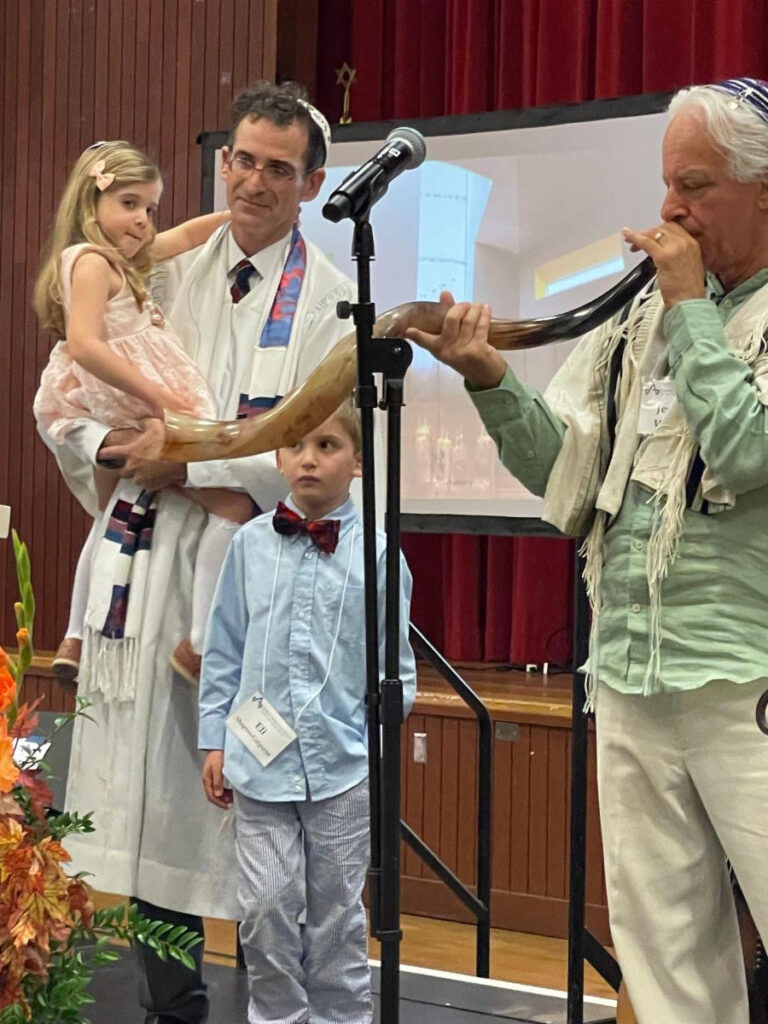
Temple Akiba is so fortunate that each year, Jerry Wiener ascends the bimah so we can fulfill the commandment of hearing/ being present for the sounding of the shofar.

As the long blast of Tekiah G’dolah resonated, many thoughts entered my mind:

Am I being the best Zach I can be?

How can I contribute in a more meaningful way to my family?

Have I paid enough attention to others?

(Am I making sure that Maya’s panties aren’t showing as I am holding her up!?)

Will this next year open a peaceful resolution with Israel and her neighbors?

How many seconds can Jerry sustain this blast?

Am I prepared to listen and respond when called upon (by God and by humans)?

The blast of Shofar bridges an ancient call with the very present moment in time – calling upon us to open doors for tomorrow.

What does that blast mean to you?

With love and Shalom,

Rabbi Zach Shapiro

A Moment in Time: “What are You Thinking about during the Shofar Blast?” Read More »

Imadi: Israel Portnoy’s Musical Journey of Faith, Trauma and Healing

There is an undeniable power and comfort in the words of the Book of Psalms. As a bus full of survivors made its way to safety on Oct. 7, the young Israelis on board spontaneously began singing “Shir Lama’alot“ (Song of Ascents), Psalm 121: “I will lift up my eyes unto the hills, from whence cometh my help.” There was something mystical and deeply comforting in singing those words together.

Singer-songwriter Israel Portnoy is well-acquainted with the Psalms, growing up in an Orthodox home in Hale Barns, Checire, England. In September, he released the song “Imadi” (Hebrew: “With Me”), inspired by Psalm 23:4. The song serves as a profound reminder of the power of faith, blending poetic lyrics with the comforting message that God is present in our moments of need: “As I walk through the valley of the shadow of death, I fear no evil because I know you’re with me.”

“Since October 7, I haven’t been able to release an album,” said Portnoy. “How can I create something relevant in the face of the hostages that are still there? I spoke with many people and I felt frozen. As time goes on and they are still there, you have to kind of live your life. It took me nearly a year to release this song.”

Portnoy’s creative process shifted after the war. “It felt like I was using the simplest words, trying to get straight to the point—expressing both the personal and collective feelings that we all share. This isn’t something that happened and we’ll simply move on from. It’s creating generational trauma, just like the Holocaust did. We’ve barely begun to process it. It’s a long journey and that’s what the song is trying to convey. We’re not alright.”

“It’s a long journey and that’s what the song is trying to convey.” –Israel Portnoy 

Portnoy’s father was a rabbi in South Manchester and today, both of his parents work full-time as relationship therapists and life coaches in Jerusalem.  Music was always central to the family’s life, as both parents were musicians. His father was not only a rabbi but also a cantor, conductor and composer. From a young age, Portnoy remembers singing with his eight siblings around the kitchen table. 

Portnoy recalled in an interview with The Journal the antisemitism he experienced as a child in England, particularly in the town where he grew up. “I have memories of walking to synagogue with my dad as a seven-year-old and people screaming ‘Heil Hitler’ and other Nazi slurs. England just didn’t feel like home.” 

And so, after finishing high school and with his parents’ blessing, he moved to Israel to study at a yeshiva. Together with his brother Mendy, who also made aliyah, Portnoy formed The Portnoy Brothers Band and released several albums. To support himself, he performed at weddings, private events and concerts. His parents and rest of his siblings eventually also made aAliyah and settled in Jerusalem. 

In August 2023, Portnoy decided to move to New York, citing better opportunities for his music career. “My brother Mendy lives close by and I wanted to give it a try while my daughter Aura is still very young,” he said. His daughter was also the inspiration behind his upcoming “AURA” EP, a collection of songs set to be released in the winter.

“Imadi” is the first single from his forthcoming album, “Poetry & Prayer.”

“This album is unapologetically Jewish and I’m excited about some really cool collaborations on it,” he said. 

Reflecting on his musical evolution, Portnoy saidadded, “The first albums I recorded with my brother were more universal—soul, folk and rock.  I’ve always written Jewish music. There is this understanding that when Jews make music, it’s inspired by life. However, since Oct.  since October 7, I’ve felt this shift and desire to own my identity of a Jewish artist and a strong yearning to synthesize [it] in my art.”

Reflecting on the trauma of recent events, he added, “This isn’t something that just happens and then we move on. It’s generational trauma. Today, it’s not easy for anyone, but we are coming together. Music plays a part in that—it’s not just a distraction but a way of healing, of connecting to something deeper.”

After Oct. 7, Portnoy returned to Israel to perform in hospitals for those wounded in the attacks, hoping to lift their spirits. One special request came from a nurse who asked him to perform for a soldier injured in the war.

“His name is Yona from Nes Tziona. He had been in intensive care since October 7 and had both of his legs amputated. One day, a nurse walked by his room and heard him listening to The Portnoy Brothers songs. She said, ‘I know them.’ She remembered us from when we used to play music at the hospital as teenagers. She reached out and we showed up to surprise him. We did a jam session and a Kabbalat Shabbat together. It was really special.”

Portnoy and Yona remain in touch to this day.


Imadi: Israel Portnoy’s Musical Journey of Faith, Trauma and Healing Read More »

Sephardic Torah from the Holy Land | Bialik, Rav Uziel & Eden Golan…

Arise and go now to the city of slaughter;
Into its courtyard wind your way;
There with your own hand touch, and with the eyes of
your head,
Behold on tree, on stone, on fence, on mural clay,
The spattered blood and dried brains of the dead.
Proceed then to the ruins, the split walls reach,
Where wider grows the hollow, and greater grows the
breach;
Pass over the shattered hearth, attain the broken wall

Whose burnt and barren brick, whose charred stones reveal
The open mouths of such wounds, that no mending
Shall ever mend, nor healing ever heal.

(The City of Slaughter, Haim Nahman Bialik, composed in 1904 about the 1903 Kishinev Pogrom)

“We are filled with pain by the saddening and disgraceful images of innocent souls whose bodies were as prey to the sharp teeth of these dark forces of evil. As human beings, we are filled with shame and disgrace as strange beasts disguised as “humans created in the image of God” behave this way. In the face of all of this, we ask ourselves, and the world at large: is this what humanity has come to? Is this the “doctrine of humanity”? Is this the “splendor” of mankind’s strength?”

(Words spoken by Rabbi Benzion Meir Hai Uziel, May 31, 1919, in reaction to the brutal pogroms against Jews in Ukraine)


Kfar Aza. Nir Oz. Zikim. Be’eri. Ofakim. Re’im. Sderot. Nova Party.

“Dancing in the storm

We got nothing to hide

Take me home

And leave the world behind

And I promise you that Never Again

I’m still wet from this October rain

October rain”

(October Rain, Eden Golan, original pre-Eurovision uncensored lyrics)

RIP.

Bring Them Home


Rabbi Daniel Bouskila is the international director of the Sephardic Educational Center.

Sephardic Torah from the Holy Land | Bialik, Rav Uziel & Eden Golan… Read More »