fbpx

October 10, 2024

RESCIND the Noble Peace Prize nomination of UNRWA, U.N. Secretary Antonio Guterres, and ICJ NOW!

To the Honorable Norwegian Nobel Committee,

(Send a copy of this letter to: postmaster@nobel.no, postmottak@smk.dep.no, press@nobelprize.org, media@nobel.no, sekretariat@svenskaakademien.se, sven.nyman@ramrational.com, sven.nyman@ramrational.com, thomas.perlmann@ki.se, registrator@su.se, peterb@dbb.su.se, ulf.danielsson@physics.uu.se, mats.malm@lir.gu.se, berit.reissandersen@dlapiper.com, anna.sjostrom.douagi@nobelprize.org )

We are deeply dismayed to hear that the Nobel Foundation is even considering a peace prize nomination to UNRWA, U.N. Secretary Antonio Guterres, and/or the International Court of Justice (ICJ).

We respectfully ask you to read this letter in its entirety and consider revoking this dangerous decision.

As you know, Alfred Nobel wrote in his will that a portion of his remaining estate should be used to endow “prizes to those who, during the preceding year, have conferred the greatest benefit to humankind” [1].

The U.N. has admitted that their staff members participated in the barbaric October 7th attack on Israel [2].

So the question that begs to be asked and answered is exactly how has UNRWA, Antonio Guterres, or the ICJ conferred the greatest benefit to humankind?

UNRWA: TROJAN HORSE FOR TERRORISM:

As far back as 1952, three years after UNRWA was created, Diplomat David Fritzlan told the U.S. State Department that UNRWA had “failed to accomplish anything in the form of refugee resettlement,” and had made “no effort to make the people independent and remove them from the list of aid recipients.” Moreover, he said that the policy of the Arab League was to frustrate the displaced Arabs for one purpose – to “simply keep the Palestine problem alive in the hope of bringing about the downfall of Israel” [3].

In 1958, when the U.S. and U.K. wanted to defund UNRWA for its failed mission, they were told by Saudi Ambassador Abdullah al Khayyal that if they wanted oil, allegiances, or strategic military intelligence from the Arab world, they would have to keep UNRWA funded [4].

And so began an agency, funded by the world of nations under duress, whose sole purpose was to keep human beings dependent and poor with displaced rage towards Israel and the Jewish People, who have longed to live peacefully alongside their Arab neighbors.

Today, the international community has paid for protection from the Arab world by funding UNRWA to the tune of $1.2 billion a year [5].

UNRWA and Hamas:

With these funds, UNRWA has become inextricably tied with the Hamas terrorist organization.

UNRWA’s senior attorney, James Lindsey, stated that UNRWA takes “few steps to detect and eliminate terrorists from the ranks of its staff, and no steps at all to prevent members of terrorist organizations such as Hamas from joining its staff” [6].

500 UNRWA Gaza employees serve in military positions in Hamas and Palestinian Islamic Jihad (PIJ) [7].

UNRWA employs Hamas members [8] and UNRWA employees admit, “everyone knew” about the Hamas terror tunnels that caused a parking lot to collapse (in 2014); yet no one reported it [9].

UNRWA Compounds & Vehicles Support Hamas:

An UNRWA compound has served as Gaza headquarters for Hamas terrorists, and an UNRWA food warehouse in Gaza was a recruitment office and site for the production of UAV’s [10].

Hamas fires rockets at Israel from nearby UN facilities and hides caches of weapons in UNRWA aid bags and in UNRWA facilities (e.g., schools). Moreover, UNRWA returned missiles to Hamas once the missiles were discovered

[11-14].

Footage shows Hamas terrorists putting guns in UNRWA vehicles on UNRWA property while shooting at Gazan civilians [15].

A distressed Gazan man summarized the UNRWA-Hamas relationship in this powerful interview that is worth listening to (http://m.youtube.com/watch?v=L71iyWy8JT8) [16].

UNRWA’s Money Laundering for Hamas:

UNRWA employees have laundered money for Hamas by building the infrastructure required to launch the October 7 war, paying Hamas terrorists as employees, and relaying Hamas propaganda through UNRWA schools [17].

As Gadi and Reuma Kadem, grandparents whose children and grandchildren were murdered by Hamas-UNWRA terrorists said, “All funders of Hamas-UNRWA and its directors and major players – are fully complicit in the murder of my children and family” [18].

UNRWA Weaponizes Palestinian Children:

UNRWA has poisoned over 545,000 Palestinian children through its P.A. curriculum that teaches hatred of Jewish people and Israel, and promotes violence, jihad, ‘martyrdom culture,’ and omits teaching about peace and co-existence. In fact, 80 UNRWA teachers and staff across more than 30 schools have been caught distributing hateful content within their textbooks [19]. Not surprisingly, numerous Hamas terrorists have graduated from these schools [20] [21].

Since these children are instructed to be murder weapons for a terrorist group, UNRWA is DIRECTLY responsible for all the murders they commit, and for their untimely deaths as terrorists, suicide bombers, and as shields for Hamas [22].

UNRWA and Bloodshed:

UNRWA’s undercover partnership with Hamas was finally exposed to the world on October 7th when they raped, burned, butchered, and murdered 1,200 Israelis and foreigners and then proceeded to take more than 240 hostages into the terror tunnels that UNRWA staff failed to report 10 years earlier [23].

The world discovered that UNRWA had prior knowledge of this massacre, provided vehicles and equipment for the October 7th attack, and 10% (1,200) of UNRWA employees have direct ties to Hamas and Palestinian Jihad. At least 42 UNRWA staff directly participated in the barbaric massacre and kidnapping of Israelis, and a teacher employed by UNRWA held an Israeli hostage inside Gaza for nearly 50 days [24-27].

Hamas via UNRWA dragged Israel into a war and then used the Palestinian people as fodder for their PR campaign to delegitimize Israel by hiding weapons in schools, mosques, hospitals, and homes and preventing Palestinian people from getting food, water, or safe passage. The blood of thousands of Palestinians falls squarely on the shoulders of the Hamas-UNRWA partnership [28-30].

Hamas-UNRWA Bound Together:

Yahya Sinwar, Hamas’ mastermind of the October 7th attack, was a headmaster at an UNRWA school and chairman of the UNRWA Gaza workers’ union [31].

50% of UNRWA employees in Gaza have close family members with ties to Hamas, which negates UNRWA’s ‘neutrality’ [32].

Historic Fact & Reason:

Incontrovertible proof shows that UNRWA never has “conferred the greatest benefit to humankind” especially not in the “preceding year” [33] and therefore does not meet the qualifications stipulated by Mr. Nobel – now or ever.

If the Nobel Foundation had any regard for Palestinians, Israelis, and the Foreign Nationals caught in this horrible war, it would not only withhold this prize from UNRWA but it would also seek to award champions who shut it down and make sure that the Palestinians receive aid in the same way all people in the world do – from the United Nations Refugee Agency (UNHCR).

ANTONIO GUTERRES:

Under his leadership, U.N. Secretary General Guterres allowed the Hamas terrorist organization to infiltrate UNRWA and flourish (described above) to such an extent that 42 UNRWA employees participated in the barbaric October 7 attack. What does Guterres ask for these 42 murderers and rapists? Immunity [34].

The section below describes how Guterres has failed as U.N. Secretary General in his role as an “advocate, civil servant, and CEO” [35]. From his failure to condemn international terrorism to his failure to protect his own employees, his actions show that he has NOT provided the greatest good to humankind. In fact, he has done the opposite – making the world a more dangerous place.

Failed to Condemn Hamas For October 7th Attack and Aftermath:

U.S. Representative Elise Stefanik released a scathing statement condemning Guterres for failing to condemn: Hamas terrorists for their barbaric acts, kidnapping hundreds of innocents, and recently murdering six hostages. Stefanik said that Guterres’ “inhumane silence” and inaction have aided and abetted Hamas in their war against a democratic ally [36].

Refusal to Designate Hamas as a Terrorist Organization:

The U.N. and the ICJ under the leadership of Guterres refuse to designate Hamas as a terrorist organization despite the fact that the United States and 27 other countries do [36a-36b].

Rationalized Hamas Attack and Spread Disinformation about the Conflict:

Only a few weeks after October 7th, Guterres made the following factually and morally vacant comments:

1) Hamas’ actions “did not happen in a vacuum” [37].

He blamed the terror attack on Israel.

2) The “Palestinian people have been subjected to 56 years of suffocating occupation” [38].

He OMITTED that the only reason Israel was in Gaza in 1967 was because that year Egypt, Syria, and Jordan started a war with Israel. He also OMITTED that Israel has NOT occupied Gaza since 2005 – as one of Israel’s many gestures of peace towards their Arab neighbors that have been met with increased violence [39].

3) Israel’s assault on Gaza demonstrated “clear violations of international humanitarian law” [40].

This is absurd. Armies that fight a defensive war against terrorists in urban warfare, like coalition troops in Mosul, have a civilian to terrorist casualty ratio of 4 to 60:1; meaning 4 to 60 civilians are accidentally killed for every terrorist that is eliminated. Israel’s ratio is 1:1, meaning they have reduced civilian casualties four to sixtyfold by comparison. [41].

John Spencer, Former Chief of Urban Warfare Studies WestPoint, said, “Israel has implemented more measures to avoid civilian casualties than any other military in the history of war” [42]. According to International Law (Article 51) and ethics, all of these civilian casualties fall on Hamas who purposely boasts of hiding among civilians to INCREASE civilian casualties [43-45].

Silent About Hamas Sexual Violence:

Despite incontrovertible evidence (video footage, survivor reports) of Hamas’ sexual violence (e.g. rape, mutilation) against Israeli women, Guterres failed to speak out against this scourge on humanity. Only after the U.S. Senate wrote a letter to Guterres (December 2023) expressing their deep disappointment in his silence, did he finally make a statement against it [46].

Excluded Hamas from U.N.’s Sexual Violence Blacklist:

Compounding the gross neglect of his advocacy duties, Guterres excluded Hamas from the U.N.’s blacklist of entities responsible for sexual violence – despite Hamas’ own video footage and survivor reports [47-48].

Failure to Address Sexual Assault by U.N. Peacekeepers:

In 2020, the U.N. confirmed that it received 66 allegations of sexual exploitation and abuse by U.N. peacekeepers, and 91 from U.N. personnel outside of a peacekeeping role. Yet, Guterres did not take decisive action to address these abuses, leaving victims without adequate recourse and protection [49].

Failure to Address U.N. Workplace Misconduct Against Women:

Guterres failed to address the U.N. workplace gender misconduct of Fabrizio Hochschild, and then promoted him to become tech-envoy [50].

Weak Approach to Global Terrorism and Sexual Violence:

Since his tenure (2017), Guterres has failed to take substantial, actionable steps to mitigate the rise in global terrorism, including sexual violence, by Islamic Jihadist groups such as: al-Shabab (Somalia, Kenya); Al-Qaeda, Boko Haram, and JNIM (Sahel Region of Sub-Sahara Africa); ISIS (Democratic Republic of Congo); Taliban (Afghanistan); and Tehrik-i-Taliban-Pakistan (Pakistan) [51].

Failure to Address Global Human Trafficking:

In 2022 alone, there was an estimated 50 million human trafficking victims in South and Central Asia, with Europe trailing as the second-highest region affected by this inhumane practice [52]. Yet, Guterres has not implemented comprehensive policies or mobilized sufficient resources to effectively address this crisis.

Tacit Approval of Authoritarian, Anti-Democratic Regimes:

Guterres refused to denounce Iran’s missile attack against Israel [53].

Moreover, Guterres recently attended the BRICS summit, where he met with authoritarian, anti-democratic regimes. Instead of condemning Russia for human rights violations, he tacitly gave his approval of Putin’s crimes against Ukraine [54].

Guterres offered a muted response, at best, regarding China’s genocide against the Uyghurs, and he failed to act when Turkey bombed the Yezidis and Kurds [55].

Guterres failed to condemn: the Saudi government’s brutal murder of journalist Jamal Khashoggi, the traumatic separation of migrant children from their families, and the relentless bombing of Syrian hospitals by Russian-Syrian forces [56-57].

Rewards Terrorism:

Instead of condemning Hamas, and putting international pressure on them to surrender and return the hostages unharmed and alive, Guterres immediately began to talk about a two-state solution. Discussing this publicly before the terrorists were eliminated and the hostages returned, sent a signal to worldwide terrorists that the U.N., via Guterres, will reward terrorists for their barbarity [58].

Guterres’ comments put worldwide democracies in danger and covered up Hamas’ stated goal – that of outright war until the conquest of the entire Jewish State [59].

https://www.instagram.com/diploact.il

Summary on Guterres:

There is a pattern to Guterres’ behavior: ignore or speak mutedly about jihadist terrorism, sexual violence, and the violence of authoritarian regimes; reward terrorism; and condemn democracies for defending themselves according to International Law.

Guterres’ behavior has signaled terrorists and autocrats that murdering their own citizens or citizens of neighboring countries is normal, that their brutality and repression will go unpunished, and that the principles of democracy and human rights are optional and negotiable [60].

Guterres has not only failed Mr. Nobel’s imperative to “confer, during the preceding year, the greatest benefit to humankind” [61], but he has also hobbled the world’s ability to confront tyranny – setting the stage for world war.

Would Mr. Nobel, or clear-minded members of the Nobel Foundation, want to be written in the history books for that?

INTERNATIONAL COURT OF JUSTICE (ICJ):

Humanity relies on judges to ensure that truth and justice prevail. The qualities that all judges must possess are: faithfulness to and competence in the law; impartiality; and being un-swayed by political bias, partisan interests, public clamor, or fear of criticism [62].

Sadly, the ICJ has violated the world’s trust by being swayed by public opinion, using misinformation and false accusations, and being riddled with conflicts of interest.

ICJ: Broke the Public’s Trust:

Mr. Nobel stipulated that the Peace Prize be awarded to one “who shall have done the most or the best work for fraternity between nations, for the abolition or reduction of standing armies and for the holding and promoting of peace congresses” [63].

The bedrock to promoting peace is mutual trust, however the ICJ has lost credibility and humanity’s trust due to its conflicts of interest and false claims about Israel.

Public Pressure to Adjudicate Israel Despite the Absence of Evidence Swayed ICJ:

When South Africa asked the ICJ to try Israel for genocide, the South Africans brought NO credible evidence of genocide. At this point, the ICJ should have dismissed the case. Yet, the ICJ allowed itself to be swayed by its inherent conflicts of interest and public pressure. It adjudicated the case nonetheless [64].

In May 2024, due to the ICJ’s confusing use of words to describe their ruling to the lay-public, the media’s conception of the ICJ’s ruling was that the ICJ found it plausible that Israel committed genocide. This misrepresentation of the ICJ’s ruling was then blasted throughout the media [65].

It finally took Judge Donoghue, in a BBC interview, to set the record straight, where she said, “The court did NOT decide that the claim of genocide was plausible” [66]. However, the damage to Israel, and to any democracy in need of fighting a just war to stop terrorism, had already been done.

Had the court kept itself from being swayed by conflict or interest or public opinion when asked to adjudicate without any credible evidence, the damage to Israel and to democracies fighting justly against terrorism would have been averted.

ICJ: Currently Being Swayed by Public Pressure Without Evidence:

Currently (October 2024), despite the fact that South Africa still has NO credible evidence of Israel committing genocide, the ICJ court is allowing itself to consider South Africa’s request to extend the October 28th due date of when South Africa must bring credible evidence of genocide to the ICJ court [67].

Once again, the ICJ is allowing itself to be swayed to consider a case against Israel despite there being NO credible evidence for this case.

ICJ Falsely Accused Israel of Occupation:

The ICJ has falsely accused Israel of “occupation of Palestinian territories” [68]. Whether the court is misinformed and/or biased, it violates the public’s trust and interferes with their capacity to promote “peace of congresses” as desired by Alfred Nobel [69].

The following is the information the ICJ is either unaware of or unwilling to discuss:

Predating Islam, the Jewish people established the Land of Israel in the second millennium B.C.E. and lived there for more than 1,600 years. Despite being conquered by the Babylonians, Persians, Greeks, and Romans thousands of Jews have lived for centuries in each of the holy cities of Jerusalem, Safad, Tiberius, and Hebron; and in Gaza, Rafah, Ashkelon, Caesarea, Jaffa, Acre, and Jericho. [70]. Archaeological evidence proves Jewish indigenousy, with cities populated by a Jewish majority prior to the establishment of the modern state of Israel [71].

It is absurd to claim that the Jews who returned to Israel starting in the 19th century were colonialists and imperialists. They did not plant the flag of the antisemitic regimes of Russia, Poland, and Lithuania; and they were kicked out of Yemen, Iraq, Turkey, and North Africa. In fact, these refugees had to overcome Turkish, British, and Pan-Arab imperialism to achieve self-determination. They fled pogroms and persecution, and wanted nothing to do with the countries from which they fled. They did not come to the land with weapons to conquer, but with rakes and hoes to cultivate often swamp-infested land they purchased from absentee landlords. After the Holocaust, the state of Israel was established by international law (1948). While the Israelis were ecstatic to live peacefully among their neighbors within the meager boundaries they were allotted, five Arab countries attacked Israel in the War of Independence. This war was one of many that Muslim extremists committed against the Jewish state to deny Israel’s right to exist [72].

In 1967 Egypt, Syria, and Jordan started a war with Israel. Hafiz al-Assad ordered his Syrian soldiers to strike Israeli civilians, “turn them into dust, pave the Arab roads with the skulls of the Jews, and strike them without mercy” [73]. Miraculously, Israel won the war and gained territory in the Sinai, Golan Heights, West Bank, Gaza, and East Jerusalem. In 1982, Israel gave the Sinai to Egypt, which has created peace between the countries [74].

With similar hope, Israel left Gaza in 2005 as one of many gestures of peace with its Arab neighbors that have been met with violence [75]. This is worth repeating. Since 2005, Israel has NOT occupied Gaza. In response, Hamas overtook Gaza, slaughtered Palestinian leaders, created 450 miles of terror tunnels, launched over 30,000 rockets at Israel, and on October 7 perpetrated the most heinous attacks on the Jewish people since the Holocaust including the kidnapping of Israelis, Americans, and Foreign Nationals still missing today [76-77].

ICJ Rulings Rely on Manufactured Evidence from Biased Witnesses:

The ICJ’s rulings relied in part on ‘evidence’ from UNRWA workers, despite the fact that:

1) 42 UNRWA employees participated in the October 7 attack [78].

2) 10% of UNRWA employees (1,200) have direct ties to Hamas and Palestinian Islamic Jihad (PIJ) [79].

3) 500 UNRWA Gaza employees serve in military positions in Hamas and PIJ [80].

4) UNRWA has weaponized over 545,000 Palestinian children through its P.A. curriculum and schools [81-82].

5) UNRWA employees launder money for Hamas and built the terror tunnel infrastructure [83].

6) An UNRWA compound was used as Hamas headquarters; and an UNRWA food warehouse in Gaza was a recruitment office and a site for the production of UAV’s [84].

Finally, 50% of UNRWA employees in Gaza have close family members with ties to Hamas, which negates UNRWA’s neutrality in bringing credible evidence to the court [85]. Yet, the ICJ allowed this.

Neither the ICJ nor the UN Designate Hamas as a Terrorist Organization:

The United States and 27 other countries designate Hamas as a terrorist organization, yet neither the ICJ nor the U.N. does so [86-87].

The ICJ and UN hold to the above decision despite the fact that the Hamas Charter calls for:

1) The complete destruction of the state of Israel as an essential condition for the liberation of Palestine, and the establishment of a theocratic state based on Islamic law (Sharia).

2) The need for both unrestrained and unceasing holy war (jihad) to attain the above objective.

3) The deliberate disdain for and dismissal of any negotiated resolution or political settlement of Jewish and Muslim claims to the Holy Land.

4) The reinforcement of historical antisemitic tropes and calumnies married to sinister conspiracy theories [88-89].

Bias: ICJ, UNRWA, and Guterres are Arms of the Same UN Organization:

Since the ICJ is the “principal judicial organ of the United Nations” [90] it is by definition inseparable from the deeply corrupt leadership of Guterres and the deeply corrupt and criminally liable organization that is UNRWA (see sections above).

This state of fusion between these three entities severely compromises the impartiality of the ICJ as a judicial body.

ICJ: The Integrity of the Court Has Been Compromised for Years:

For six decades the ICJ’s influence has been declining due to its severe conflicts of interest, such as:

1) The process of election and re-election of ICJ judges.

2) The presence of permanent members of the UN Security Council on the Court.

3) The appointment of ad hoc judges under Article 31 of the Statute of the Court [91].

A glaring example of the court’s bias is: the Chief Judge of the ICJ has been a candidate for Prime Minister of Lebanon, a country that harbors Hezbollah terrorists, who are currently attacking Israel [92-93].

ICJ: Summary:

This document proves that the ICJ, which is fused with the corrupt leadership of Guterres and the criminal organization that is UNRWA, has been biased and falsely accusatory, and has not “conferred the greatest benefit to humankind” [94].

Nobel’s Committee of Five Persons is Selected from Members of Norwegian Parliament with Strong Bias Against Israel:

Defying logic and historic fact, the Norwegian government has taken a strong stance against Israel. It has called for rewarding Hamas with land for their barbaric terrorism against the Jewish State and it was the first country to jump in when the ICC prosecutor threatened to arrest Israeli leaders. Yet, it is the Norwegian government that selects the Nobel’s Committee of Five Persons to decide whom to give the Nobel Peace Prize [95]. The potential bias of this committee is significant.

Conclusion:

This document proves that the criminal UNRWA, corrupt Secretary Guterres, and biased ICJ are entities that are fused together and riddled with conflicts of interest that make their actions on the world stage dangerous for global harmony.

None of these entities match Mr. Nobel’s qualifications for a prize, and the mere consideration of giving this prize to any of them makes humanity pause at either the severe biases and/or backroom financial or political deals that the Nobel Foundation may be a part of.

Giving a prize to any of these entities will strike the final nails on the coffin for this prize and the Nobel Foundation in the eyes of the world and in human history.

https://www.instagram.com/p/DA8uZb3RMKE, https://www.instagram.com/p/DA8uZb3RMKE/

For the full letter and references, click here.

References UNRWA:

1 https://www.nobelprize.org/Alfred-nobel/Alfred-nobels-will/.

2 David Brunnstorm, “Nine UNRWA staff members were possibly involved in attack on Israel, UN says,” Reuters, 5 August 2024.

3 Schwartz, A. & Wilf E. (2020). The war of return: How western indulgence of the Palestinian dream has obstructed the path for peace. New York, NY: St. Martin’s Publishing, p. 17.

4 Schwartz, A. & Wilf E. (2020). The war of return: How western indulgence of the Palestinian dream has obstructed the path for peace. New York, NY: St. Martin’s Publishing, p. 17.

5 Noa Tishby, “Israel: A simple guide to the most misunderstood country on earth,” 2021.

6 Tova Lazaroff, “UNRWA staff not tested for terror ties,” JPost, 31 January 2009.

7 https://govextra.gov.il/mda/unrwa/terror-links, April 2024.

8 Brett Schaefer, “Why Trump was right to end funding for the U.N. Palestinian aid organization,” The Heritage Foundation, 6 September 2018.

9 David Luhnow, “A UN agency is accused of links to Hamas. The clues were there all along,” WSJ, 2 February 2024.

10 “SWU UK expresses deep concern over UK decision to restore 21 million pounds funding to UNRWA,” 19 July 2024.

11 https://twitter.com/cogatonline/status/1732691140493615547, 7 December 2024.

12 https://twitter.com/IDFSpokesperson/status/1733450024703475802, 9 December 2023

13 Raphael Ahren, “UN agency handed rockets back to Hamas, Israel says,” Times of Israel, 20 July 2024.

14 Pesach Benson, “Rockets under relief supplies raise questions about UNRWA,” JNS, 3 December 2023.

15 https://www.reddit.com/r/geopolitics/comments/1cs4n2v/idf_reveals_hamas_members_use_un_vehicles_unrwa/

16 http://m.youtube.com/watch?v=L71iyWy8JT8

17 STL Jewish Light, “Victims of October 7 attack sue UNRWA for allegedly laundering money for Hamas,” 24 June 2024.

18 Ibid.

19 Paul Nuki, “UNRWA cannot operate without Hamas, no wonder it has a neutrality problem,” The Telegraph, 4 February 2024.

20 UNRWA school celebrates Hamas’ ‘jihad warriors’ in Gaza – a report, Jerusalem Post (Nov. 8, 2023).

21 JPost Staff, “UNRWA school celebrates Hamas’ jihad warriors in Gaza – a report,” Jerusalem Post, 8 November 2023.

22 Paul Nuki, “UNRWA cannot operate without Hamas, no wonder it has a neutrality problem,” The Telegraph, 4 February 2024.

23 David Luhnow, “A UN agency is accused of links to Hamas. The clues were there all along,” WSJ, 2 February 2024

24 TOI Staff, “Israel reveals 12 UNRWA staffers it says took part in October 7 says 30 more assisted,” Times of Israel, 16 February 2024.

25 Knesset News, “Approved in first reading: UNRWA to be declared by the State of Israel as a terrorist organization; all relations between UNRWA and the state to be severed,” 22 July 2024.

26 Fern Sidman, “1,200 employees of UN agency have affiliations with Hamas,” The Jewish Voice, 1 February 2024.

27 Mike Brest, “UN Palestinian agency looking into claim teacher held Israeli in attic,” Washington Examiner, 1 December 2023.

28 FDD, “Hamas officials admit its strategy is to use Palestinian civilians as human shields,” 1 November 2023.

29 Newsweek, “My fellow Palestinians: Stop blaming the Jews – Hamas is starving our brothers and sisters in Gaza, 7 March 2024.

30 UN Article 51

31 Paul Nuki, “UNRWA cannot operate without Hamas – no wonder it has a neutrality problem,” The U.K. Telegraph, 4 February 2024.

32 Carrie Keller Lynn & David Luhnow, “Intelligence reveals details of UN agency staff’s links to October 7 attack,” Wall Street Journal, 29 January 2024.

33 https://www.nobelprize.org/Alfred-nobel/Alfred-nobels-will/

GUTERRES:

34 https://allisrael.com/un-seeks-immunity-for-unrwa-workers-who-participated-in-oct-7-atrocities

35 https://www.un.org/sg/en/content/the-role-of-the-secretary-general#:~:text=The%20Charter%20describes%20the%20Secretary,and%20other%20United%20Nations%20organs

36 https://stefanik.house.gov/2024/9/statement-on-failure-of-un-secretary-general-to-condemn-hamas-terrorists-following-murder-of-six-october-7th-hostages-including-an-american

36a Senator Collins Bipartisan group urges UN to designate Hamas as a terrorist organization 11-27-23.

36b https://www.fdd.org/analysis/2024/02/16/top-un-aid-official-says-hamas-is-not-a-terrorist-group/]

37 https://www.cnn.com/2023/10/27/opinions/un-antonio-guterres-israel-hamas-palestine-ghitis/index.html].

38 https://www.washingtonexaminer.com/opinion/2442502/un-secretary-general-antonio-guterres-should-resign/

39 Michal Oren, “Six days of war: June 1967 and he making of the modern Middle East,” 2003.

40 https://www.washingtonexaminer.com/opinion/2442502/un-secretary-general-antonio-guterres-should-resign/].

41 Erin Molan, “Interview with U.S. military expert M. Pregent,” Sky News, 16, June 2024.

42 Twitter, Spencer Guard, John Spencer on Israel, 1752181728016277765.

43 https://www.facebook.com/SkyNewsAustralia/videos/israels-hostage-rescue-operation-was-done-the-best-way-they-could/972155304390046/

44 Erin Molan, “Interview with U.S. military expert M. Pregent,” Sky News, 16, June 2024.

45 Alan Dershowitz, “The war against the Jews,” 2023.

46 https://www.grassley.senate.gov/imo/media/doc/rosen_ernst_grassley_et_al_to_un_secretary-general_antonio_guterres_-_addressing_hamas_sexual_violence.pdf

47 https://press.un.org/en/2024/sc15621.doc.htm

48 https://www.ynetnews.com/article/rjk2coszr

49 https://news.un.org/en/story/2022/03/1114012

50 https://www.politico.eu/article/antonio-guterres-harassment-united-nations-fabrizio-hochschild-drummond/

51 https://www.visionofhumanity.org/deadliest-terror-groups-in-2024/

52 https://www.ilo.org/resource/news/50-million-people-worldwide-modern-slavery-0

53 https://www.israelhayom.com/2024/10/03/un-secretary-general-unrwa-nominated-for-nobel-peace-prize/

54 https://www.kyivpost.com/opinion/40104.

55 https://www.washingtonexaminer.com/opinion/2442502/un-secretary-general-antonio-guterres-should-resign/

56 https://www.hrw.org/news/2019/04/25/why-un-chiefs-silence-human-rights-deeply-troubling

57 https://www.hrw.org/news/2023/10/16/china-un-chief-should-denounce-crimes-against-humanity

58 https://news.un.org/en/story/2024/01/1146097

59 https://www.reddit.com/r/Israel/comments/19amztm/to_everyone_who_supports_the_twostate_solution/

60 https://www.kyivpost.com/opinion/40104

61 https://www.nobelprize.org/Alfred-nobel/Alfred-nobels-will/

ICJ:

62 https://www.uscourts.gov/judges-judgeships/code-conduct-united-states-judges#:~:text=(1)%20A%20judge%20should%20be,decorum%20in%20all%20judicial%20proceedings].

63 https://nobelpeaceprize.org/nobel-peace-prize/about-the-nobel-peace-prize/

64 https://www.jpost.com/breaking-news/article-819470

65 https://www.npr.org/2024/01/26/1227078791/icj-israel-genocide-gaza-palestinians-south-africa

66 https://www.youtube.com/watch?v=bq9MB9t7WlI

67 https://www.jpost.com/breaking-news/article-819470

68 https://melaniephillips.substack.com/p/an-explosive-moment-of-clarification

69 https://nobelpeaceprize.org/nobel-peace-prize/about-the-nobel-peace-prize/

70 Alan Dershowitz, “The case for Israel,” 2003.

71 Alan Dershowitz, “The war against the Jews,” 2023.

72 Alan Dershowitz, “The case for Israel,” 2003.

73 Michael Oren, “Six days of war: June 1967 and the making of the modern Middle East,” 2003, p. 253.

74 Michael Oren, “Six days of war: June 1967 and the making of the modern Middle East,” 2003, p. 253.

75 Alan Dershowitz, “The case for Israel,” 2003.

76 Britannica, “Israel’s disengagement from Gaza”

77 Wikipedia, “Palestinian rocket attacks on Israel.”

78 TOI Staff, “Israel reveals 12 UNRWA staffers it says took part in October 7 says 30 more assisted, “Times of Israel,” 16 February 2024.

79 TOI Staff, “Israel reveals 12 UNRWA staffers it says took part in October 7 says 30 more assisted, “Times of Israel,” 16 February 2024.

80 https://govextra.gov.il/mda/unrwa/terror-links, April 2024.

81 Paaul Nuki, “UNRWA cannot operate without Hamas, no wonder it has a neutrality problem,” The Telegraph, 4 February 2-24

82 UNRWA school celebrates Hamas’ ‘jihad warriors’ in Gaza – a report, Jerusalem Post, 8 November 2023.

83 STL Jewish Light, “Victims of Oct 7 attack sue UNRWA for allegedly laundering money for Hamas,” 24 June 2024.

84 10 “SWU UK expresses deep concern over UK decision to restore 21 million pounds funding to UNRWA,” 19 July 2024.

85 Carrie Keller Lynn & David Luhnow, “Intelligence reveals details of UN agency staff’s links to October 7 attack,” Wall Street Journal, 29 January 2024.

86 Senator Collins Bipartisan group urges UN to designate Hamas as a terrorist organization 11-27-23

87 https://www.fdd.org/analysis/2024/02/16/top-un-aid-official-says-hamas-is-not-a-terrorist-group/

88 Yale Law School, The Avalon Project, Hamas Covenant, 1988

89 https://www.cfr.org/backgrounder/what-hamas

90 https://www.un.org/en/about-us/un-charter/chapter14

91 https://digitalcommons.law.ggu.edu/cgi/viewcontent.cgi?article=1159&context=annlsurvey

92 https://wsj.com/articles/icjs-new-chief-judge-has-a-history-of-bias-against-israel-lebanon-hague-96889d53

93 https://www.bbc.com/news/world-middle-east-67307858

94 https://www.nobelprize.org/Alfred-nobel/Alfred-nobels-will/

95 Elliot Abrams, “Norway: From mediator to prosecutor of Israel,” Council of Foreign Relations, 12 August 2024

This letter was written by a Jewish activist with #EndJewHatred and shared with me to publish.

cc:

American City Council Members

Christians United for Israel

Nobel Foundation, Board of Directors

Press: CNN, Daily Wire, Free Press, OWN, Sky News, Telegraph, VIN, WSJ, etc.

Select Members of the Canadian Parliament

Select Members of the European Parliament

Select Worldwide Governments

United States Congress

WSJ: A Nobel Prize for Terror? Hamas abettors and apologists are on the list of nominees for the Peace Prize.

Israel National News: Nobel Peace Prize: Petition protesting UNRWA nomination quickly gaining traction

Im Tirtzu petition protesting UNRWA nomination for Nobel Peace Prize quickly gains 12,000 signatures. ‘We call on the prize committee not to stain the Prize with the blood found on the hands of UNRWA employees.’


PLEASE ALSO SIGN THE PETITION from IMTIRTZU

On October 10, 2024 10am the petition had 53,654 —add your name here.

We express our strong condemnation of the nomination of UNRWA for the Nobel Peace Prize. Our concerns are rooted in UNRWA’s cooperation with terror groups in the Gaza Strip and Lebanon.

UNRWA workers participated in the events surrounding the October 7th massacre, UNRWA school teachers have been linked to leadership positions within Hamas, and UNRWA facilities have been used to store weapons and serve as launch sites for attacks.

The connection of UNRWA and Hamas contradict the values that the Nobel Peace Prize seeks to promote. UNRWA is no peace mission or humanitarian aid organization: they aid only terror and violence, and promote violence and hatred of Jews and Israelis.

Recognizing UNRWA with the Nobel Peace Prize would send a contradictory message about the values of peace and reconciliation. We urge the Nobel Committee to reconsider this nomination.

Sign here to add your voice – UNRWA is not worthy of the Nobel Peace Prize
The Jerusalem Post: UNRWA retains Nobel Peace Prize candidacy despite evidence proving its ties to Hamas

Approximately 12,000 people signed a petition urging the Peace Research Institute Oslo to reconsider UNRWA’s candidacy for the Nobel Prize.

RESCIND the Noble Peace Prize nomination of UNRWA, U.N. Secretary Antonio Guterres, and ICJ NOW! Read More »

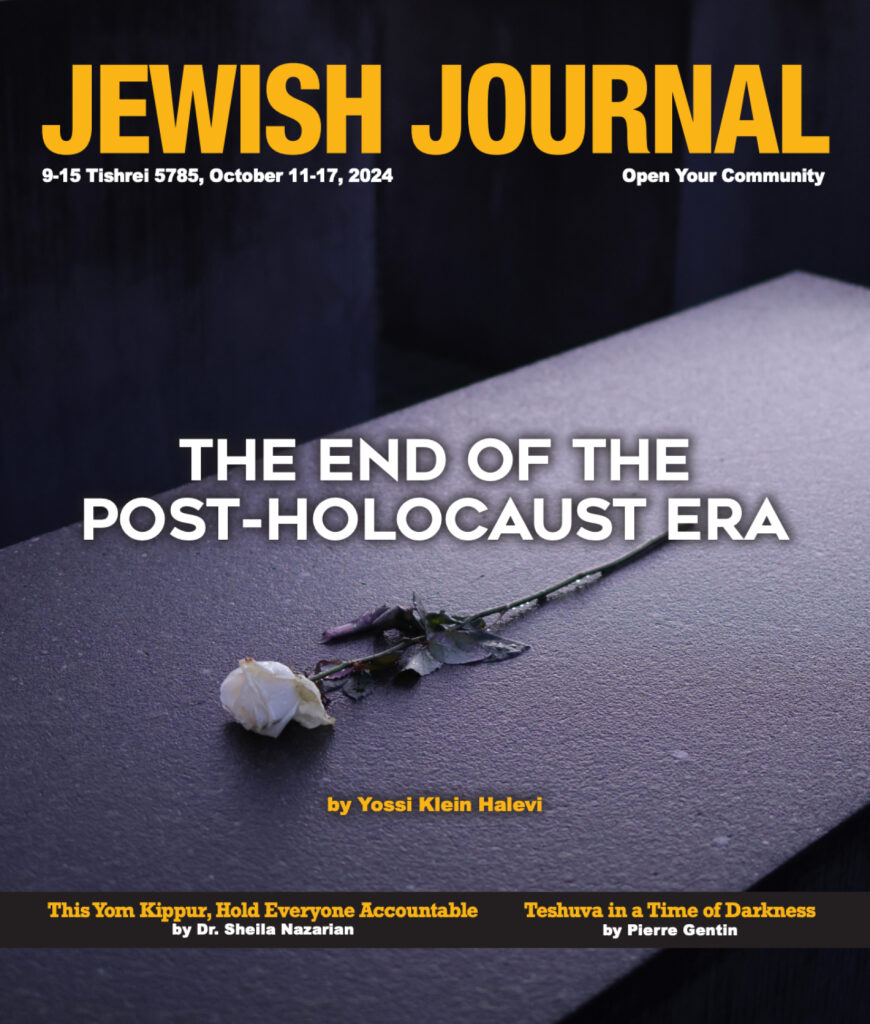
Print Issue: The End of the Post-Holocaust Era | Oct 11, 2024

CLICK HERE FOR FULLSCREEN VERSION

Print Issue: The End of the Post-Holocaust Era | Oct 11, 2024 Read More »

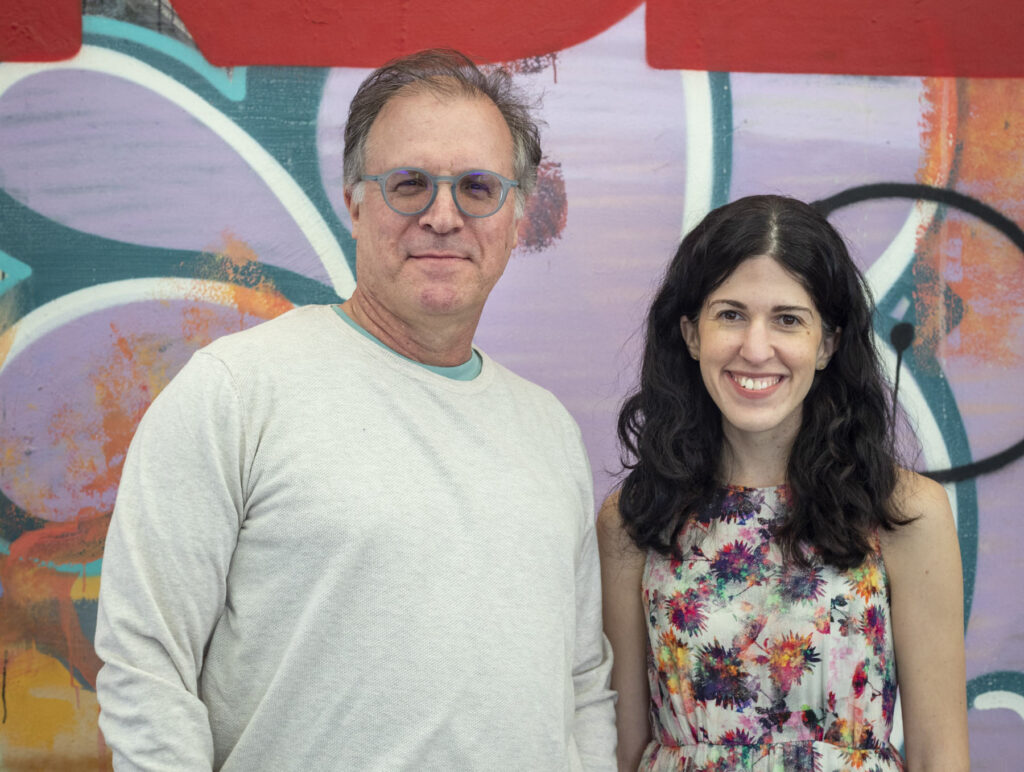
Ilan Stavans and Margaret Boyle: “Sabor Judío: The Jewish Mexican Cookbook” and Brisket Tacos

Ilan Stavans and Margaret Boyle’s “Sabor Judío: The Jewish Mexican Cookbook” fuses two beloved and meaningful culinary cultures.

“The book is a celebration of Jewish Mexican identity, but it also is a celebration of all diaspora identity and how people connect with culture and movement through food,” Boyle told the Journal.

Featuring 100 personal recipes, enjoyed by Mexican Jews around the world, “Sabor Judío” shares the vibrant history of Jewish immigration to Mexico from 1492 to the present. Organized by meal, and including dishes made for Shabbat, Rosh Hashanah, Yom Kippur, Passover, Hanukkah, Shavuot and other holidays, it connects the past to the present and the future.

Stavans called it a “miracle.”

“It’s just astonishing that the anecdote about a cake or about a fish or about a soup can travel from people who are no longer with us, because they left these recipes,” Stavans told the Journal. “At some point [the next generation] will receive those recipes and adapt them in new and exciting ways.”

The authors spent a decade gathering recipes and personal narratives from Jewish Mexican households. Boyle is director of Latin American, Caribbean and Latinx Studies at Bowdoin College and associate professor of Romance Languages and Literatures. Originally from Mexico, Stavans is Lewis-Sebring Professor of Humanities and Latin American and Latino Culture at Amherst College and the publisher of Restless Books.

The pair of foodies met several years ago when Boyle invited Stavans to give a big talk in Jewish studies at Bowdoin.

“We learned, when we were getting to know each other, that we both had these recipe collections – me from my great grandmother and him from his grandmother – that were tied to our  Jewish Mexican family,” Boyle said. “Because he is a big dreamer, he pushed us to do a call to the Mexican Jewish community to think about what recipes other families [were] carrying around.”

They were inundated with submissions, not just from modern fare, but recipes that had been around since the 15th and 16th century.

“It’s really a book about how different generations have migrated with food from one region of the world to another,” Stavans said. “And how the food has become an expression of their process of assimilation.”

Stavans explained that when families settled in Mexico, they discovered they needed to find new ingredients to bring into some of their recipes.

“There were challenges, but there were also new opportunities,” he said. “The extraordinary story of immigration is that it is never static … and food is [a] wonderful  opportunity to understand those changes.”

They also discovered that many families carried around similar recipes.

“Even Ilan and I had [the same] cinnamon sugar, beer cookie … in both of his grandmother and my great grandmother’s recipe books,” Boyle said. “And we are pretty confident they never met each other, but the fact that they were cooking almost identical dishes is really amazing.”

Their recipe for brisket tacos, which is in the book, is below. The recipe fuses dishes prepared by the two matriarchs in Stavan’s and Boyle’s families, Anat Nurko and Phyllis Poplawski. Nurko prepared the three-chile marinade as learned from other women in her family, while Poplawski shared the rhubarb sauce joyfully passed down the generations.

Stavans hopes people go through “Sabor Judío” with a pen or marker in hand, so they can write their reaction to the recipes and start a dialogue.

“In my house, every time you open a cookbook, you will see my notes or my wife’s notes or my grandmother’s notes; we are all intruding and intervening,” he said. ”Hopefully readers and cooks … will do the same.”

Boyle echoed Stavans’ sentiments.

“What I also really love about the book is the way that we are telling stories about the history of immigration, about ingredients and where to find them,” Boyle said. “I am hopeful for that kind of non-linear reading that allows you to move between making a dish and learning something new about the history of the Mexican Jewish community and maybe about yourself.”

Learn more about “Sabor Judio,” Ilan Stavans at RestlessBooks.org and Margaret Boyle on the Bowdoin College website.

For the full conversation, listen to the podcast:

Photograph by Ilan Rabchinskey used with permission, copyright The University of North Carolina Press.

Brisket Tacos in Three-Chile Salsa with Phyllis’s Rhubarb

Serves 8–10

Preparation time: 45 minutes, plus marinating

Cooking time: 4 hours

For the Brisket:

3 cups water, plus more for covering

the chiles

3 dried pasilla chiles

3 dried ancho chiles

3 dried guajillo chiles

4 medium plum tomatoes (about

1 pound), cored, seeds removed, and roughly chopped

½ medium white onion, peeled and roughly chopped

2 medium garlic cloves, peeled and roughly chopped

2 ½ teaspoons kosher salt, plus more as needed

1 brisket (4–5 pounds)

For the Rhubarb Sauce:

2 large rhubarb stalks, cut into ½-inch pieces (about 2 cups)

⅓ cup granulated sugar

¼ cup water

For Serving:

Small (6-inch) corn tortillas, warmed

Chopped fresh cilantro

  1. Place the pasilla, ancho, and guajillo chiles in a medium saucepan and cover with water by a couple of inches. (The chiles will float to the top.) Set the saucepan over high heat, bring to a boil, and continue boiling until the chiles are soft, about 15 minutes. Drain and let cool to the touch.
  1. Wearing gloves, open each chile and remove the veins and seeds. Place the chile flesh and skin in a blender along with the tomatoes, onion, garlic, salt, and the 3 cups of water. Blend until smooth, then taste and add more salt, if needed.
  1. Place the brisket in a large baking dish or roasting pan, cover with the chile salsa, then cover tightly with aluminum foil. Refrigerate for at least 2 hours or up to overnight.
  1. Heat the oven to 325°F. Place the brisket in the oven and cook for 2 hours. Remove the baking dish, carefully flip the brisket over, and continue cooking until fork tender, about 2 hours. Remove from the oven and let rest for at least 30 minutes before slicing or shredding.
  1. Meanwhile, make the rhubarb sauce: Combine the rhubarb, sugar, and water in a small saucepan set over medium heat. Bring to a boil, stirring often, and cook until the liquid thickens and the rhubarb is tender, 5–10 minutes. Remove from the heat and let cool slightly, then use an immersion blender to purée until smooth. Allow the sauce to cool completely.
  1. To serve: Arrange the brisket in corn tortillas and top each taco with a little of the rhubarb sauce and chopped cilantro.

Debra Eckerling is a writer for the Jewish Journal and the host of “Taste Buds with Deb.” Subscribe on YouTube or your favorite podcast platform. Email Debra: tastebuds@jewishjournal.com.

Ilan Stavans and Margaret Boyle: “Sabor Judío: The Jewish Mexican Cookbook” and Brisket Tacos Read More »

Serious Semite: Satisfaction

I saw a miracle in Los Angeles. There were three Englishmen with wrinkles on their faces. Their ages were 77, 79 and 80, and they were performing some songs that were nearly 60 years old. Despite their ages and looks, their lead singer moved like Jagger. That’s because he was Jagger. As the saying goes, moss doesn’t grow on a Rolling Stone.

Despite their age and looks, their lead singer moved like Jagger. That’s because he was Jagger. As the saying goes, moss doesn’t grow on a Rolling Stone.

Mick Jagger literally skipped across the stage, and I nearly cried at seeing that this was possible for a human being. Obviously this mobility isn’t usual for the age group, as demonstrated by Dr. Jill Biden’s husband. Ethics of the Fathers teaches that 80 is the age of “strength.” Jagger clearly got the rabbinic memo, unlike the current president.

I loved how Mick, Ronnie Wood and Johnny Depp’s dad (Keith Richards) wore rugged lines on their face. Their deep facial furrows are a testament to decades of rock ’n’ roll, the genre that they helped invent.

These days I’m thinking a lot about age, as I commute between Los Angeles and London to regularly visit my parents. My father is suffering from the long-term lung disease, idiopathic pulmonary fibrosis. Its symptoms include scar tissue and fibers growing inside the lungs, which gradually reduce lung capacity. It comes with a cough that makes it hard for him to get to sleep, weight loss and reduced appetite. As he suffers, my heart feels like a two-ton weight.

My Dad has a voracious appetite for life, beginning each day with a thirst for playing tennis and golf, trimming the grass and picking apples in their English country garden, and doing a range of DIY jobs around the house. His mobility is more limited at the moment, but fortunately my parents cultivated a card game addiction with their friends throughout the lockdowns. Their habit includes bridge and American canasta, and it is like a poignant full-circle, since my dad’s job was working in a London casino dealing blackjack when he first met my mother 55 years ago. 

It is incredibly hard to watch Dad’s breathing difficulties, but a meaningful by-product of the situation is that it continues to deepen our father-son bond. We spend a lot more time together, and I hear stories that I’ve never heard before, whether it’s dating anecdotes from the late 1960s, tales from his time as a touring musician around the U.K., or memories of now-departed relatives.

In the meantime, I continue to pray for medical breakthroughs to help my father’s health improve, so that in the near future he can move like Jagger.

I would recommend anyone with older relatives to spend time asking questions about past experiences, and listening closely to the answers. It can provide insights into our own life: how we got here, where we are going, and what we can do to maximize enjoyment and meaning along the way.

Despite the inevitability of aging, there is still an obsession with fighting it, and Los Angeles is on the frontlines of the battlefield. Perhaps our energy would be better spent diverting all that energy to fighting antisemitism rather than age.

One great weapon in the anti-age battle is the“Facetune” app, which I learned about through a friend who is a swimwear model. The app allows you to perform all kinds of facial tune-ups on your photos, including reshaping your nose, redesigning your eyes, or squaring your chin line. You can even reduce the size of your tuchus, or increase it, depending on your proclivity. In full disclosure, that’s not something I’ve felt the need to use.

We currently have a president who is 81, a potential-president-in-waiting who is 78, Rolling Stones who are rolling into their eighth decade, and my dad is looking forward to his 80th birthday in January. Longevity is increasing, and it’s predicted that by 2054, some humans will live until at least 160. When I reach the age of 80, I’ll be able to celebrate my mid-life crisis.

Ethics of the Fathers teaches that 70 is the age of “seva,” or satisfaction. So by Rabbinic standards, perhaps Mick Jagger finally got his satisfaction after all.


Marcus J Freed is an actor & writer, and author of “The Kosher Sutras: A Yogi’s Guide to the Torah.” On social @marcusjfreed and online at www.marcusjfreed.com. 

Serious Semite: Satisfaction Read More »

Campus Watch October 10, 2024

Columbia Student Who Said “Zionists Don’t Deserve to Live” Sues University for Suspending Him

Khymani James, who infamously said during a January livestream that “Zionists don’t deserve to live,” filed a lawsuit against the university on Sept. 26 for suspending him.

According to The Daily Wire, the lawsuit accuses the university of caving to “external pressure” in suspending James in April and that James made the remarks in question when he was being subjected to bigoted and threatening message on social media after he started espousing “anti-genocide beliefs” regarding the ongoing war in the Gaza Strip. The lawsuit claims that James was simply trying to deter “others from causing him physical harm.” The lawsuit also states that the university told James in August he was suspended for the academic year for his involvement in a human chain to drive pro-Israel students out of the anti-Israel encampment in May; the lawsuit claims that James was simply engaging in “peaceful self-help.” Further, the lawsuit alleges that the university “privileges a class of self-described ‘Zionist Jewish’ people over everyone on campus who does not share their views.”

UMich Students, Rabbi Held at Gunpoint During Rosh Hashanah Dinner

A gunman broke into a rabbi’s Southfield, MI home hosting a group of Jewish students from the University of Michigan and held them at gunpoint.

The Detroit Free Press reported that the dinner took place on Oct. 2, the first night of Rosh Hashanah. According to local police, the gunman shouted “I’m taking everything, give me everything” when he broke into the home; the weapon was not fired and no injuries occurred. Police believe it was a “crime of opportunity” and have identified the suspect and are working to arrest him. A different individual has been arrested in connection to the crime. University President Santa Ono said in a statement that the gunman fled the scene after taking a bag from inside the house. “This past year, there have been innumerable events locally and globally that have felt overwhelming and unsettling to many in our community,” Ono said. “As tensions in the Middle East have escalated in recent days, it is more important than ever that we work collectively to offer solace and safety to one another.”

Judge Overturns University of Maryland’s Barring of SJP Oct 7 Event

A federal judge nixed the University of Maryland’s decision to bar the campus Students for Justice in Palestine (SJP) from holding an event on Oct. 7.

Judge Peter Messitte ruled on Oct. 1 that the SJP chapter “demonstrated a substantial likelihood that it will prevail [in its lawsuit] on the merits of its freedom of speech claim,” per Jewish Insider (JI). The university had initially approved the event, but reversed their decision after receiving backlash on the matter. The university said in a statement that they will abide by the court’s ruling and that “we will now move forward with the events, addressing those concerns and challenges with care and caution, including the implementation of a robust safety plan. This includes enhanced staffing and resources with a strong security presence.”

UIUC Ends Recognition of SJP Chapter

The University of Illinois-Urbana Champaign (UIUC) rescinded its recognition of the campus Students for Justice of Palestine (SJP) chapter as a student group on Sept. 23.

According to Campus Reform, the university said that the SJP chapter violated university policy with its encampment in April and physically attempting to prevent the encampment from being taken down. The SJP chapter said in a statement posted to Instagram, “The wrongful disbandment of Students for Justice in Palestine at the University of Illinois Urbana-Champaign is part of a disturbing trend of silencing student activism. We will continue organizing with or without the support of our institution as UIUC is dictated by the student body and not the administration.”

“Oct 7 Forever” Graffiti at Baruch College

Graffiti stating “OCT 7 FOREVER” was found on the main entrance of Baruch College’s William and Anita Vertical Campus on the morning of Oct. 6.

The Ticker, the college’s student-run newspaper, reported that the graffiti was scrawled in red paint on a wall and was removed the next day. S. David Wu, the president of Baruch College, said in a statement: “Let me be crystal clear: antisemitism and any form of hatred and intimidation have no place at Baruch College and will not be tolerated. We immediately reported the incident to the NYPD, and a full investigation is already in progress, in cooperation with our Department of Public Safety. The person(s) responsible for this action will be held fully accountable.”

Campus Watch October 10, 2024 Read More »

Dr. Dovi Prero’s Smiles for Noah Project Honors a Young Life

In April 2021, orthodontist Dr. Dovi Prero attended the funeral of one of his patients, Noah Arnold, at Beth Jacob Congregation in Beverly Hills. Noah, just 15 years old, tragically lost his life after a hit-and-run accident.

During the service, Noah’s mother spoke about her beloved son, his loving spirit, his volunteer work at Friendship Circle in Los Angeles, helping children with special needs, and the profound influence Beth Jacob had on him. She also mentioned Dr. Prero’s significant impact on him throughout his orthodontic treatment.

“I was blown away. I’m just an orthodontist. I didn’t have a spiritual relationship with him—why would she mention me?” Prero told the Journal.

It turned out that Dr. Prero’s influence on Arnold was more substantial than he realized. “He had a small jaw and we made it bigger, giving him a beautiful smile. My practice was just starting, so I had more time to spend with him. We would schmooze and I even recommended him some books to read,” Prero said. 

Sadly, a year after finishing his treatment, Arnold was struck by a car, leading to seizures that ultimately killed him.

Prero was deeply moved by Arnold’s mother’s words and felt inspired to honor Arnold’s memory. “I thought about how I could help keep his memory alive,” he said. 

This inspiration led to the creation of the “Smiles for Noah” chesed (kindness) project. 

The project’s website states: “Noah’s smile was infectious and his positive attitude inspired everyone who knew him. He was a kind soul who stood up for those less fortunate. In honor of Noah’s memory, Dr. Prero will provide orthodontic treatment to underserved patients who may be bullied about their smiles and lack access to care. The goal of Smiles for Noah is to give these patients the confidence and self-esteem that come with a beautiful #PreroSmile, just like Noah’s.”

Since launching the project, Dr. Prero has treated many teens in need of braces, including a girl who dedicated her teenage years to caring for her sick father. “She always wanted braces, but it was out of the question. I told her that while her father couldn’t provide this for her during his life, in honor of the care she gave him, I would include her in this program as if it were her father taking care of her orthodontic treatment,” Prero said.

Orthodontic treatment can take several years, making this chesed project a long-term commitment, but Prero is dedicated to the 15 patients receiving braces through Smiles for Noah. “Many have faced life-changing experiences,” he said. “While orthodontic treatment is necessary, it often gets pushed aside. Some have lost parents or dealt with serious illnesses. They often think, ‘It’s OK. My teeth are a little crooked, but I can live with that.’”

Orthodontic treatment can take several years, making this chesed project a long-term commitment, but Prero is dedicated to the 15 patients receiving braces through Smiles for Noah.

Born into an Orthodox family in Chicago – and one of 11 children – Prero was encouraged by his mother to pursue orthodontics. “I saw the positive impact orthodontists had on me and my siblings,” he said. “What I love about orthodontics is seeing my patients every month or two. It’s beautiful to watch them grow more confident thanks to the power of a smile.”

After attending dental school at UCLA, he completed his orthodontic residency at USC and subsequently opened his clinic in Beverly Hills.

“In dental school, there was always a strong emphasis on helping underserved communities,” he said. “It was a recurring topic in many classes, focusing on making dental care accessible to those who can’t afford it. It’s our way of giving back — a moral and ethical responsibility for me, embodying the principle of ‘V’Ahavta Lereiacha Kamocha’ (And love your neighbor as yourself).

Arnold’s parents have been deeply touched by this gesture. 

“Lisa Arnold often visits my office; it brings her comfort to see the mitzvah being done in her son’s memory,” said Prero.“Some people ask me how I’ve achieved success, wondering if it’s due to my marketing efforts. The truth is, I don’t do much marketing — my success is all thanks to the chesed I do. It brings an immense amount of success to the office. My heart empathizes with my patients, and this work is spiritually uplifting for me, transforming the entire office into a vehicle for mitzvahs and chesed.”

Dr. Dovi Prero’s Smiles for Noah Project Honors a Young Life Read More »

Breaking the Fast Is a Piece of Cake

Soft and fluffy, light and airy, there’s something special about sponge cakes. They bring back feelings of home and memories from a time long gone. A classic dessert, sponge cake speaks of afternoon teas and momentous celebrations. 

For me, especially at this time of year, sponge cake whispers memories of Yom Kippur. My mother would bake sponge cakes throughout the year, but we definitely had to have sponge cake for Yom Kippur. My brothers and I would wolf down a slice with a glass of my mother’s fresh Moroccan mint tea. It was the last thing we would eat, before rushing out the door to be at the synagogue in time for the Kol Nidrei prayers. 

Sponge cake seems intimidating and many home bakers won’t even attempt to make it, convinced that their cake just won’t rise. But the recipe I share with you is a sure thing. While you may be shocked by the amount of baking powder required (3 tablespoons), this leavening agent guarantees that perfect high rise and deliciously light, spongy texture. 

Cooking is an art, but baking is a fine science, so be sure to follow the recipe directions carefully.

Cooking is an art, but baking is a fine science, so be sure to follow the recipe directions carefully. 

There are some tips that will make your baking go smoothly. Use a clean, dry bowl for the egg whites. Separate the eggs while they are just out of the refrigerator and still cold (this ensures that the yolk will not break and ruin the egg whites). Allow the eggs to come to room temperature before beating them and add the sugar slowly. 

You must bake the cake in a tube pan because the tube helps the cake bake faster and higher. Make sure not to grease the tube part, only the bottom and side part of the pan.

Don’t open the oven door until you are ready to remove the cake from the oven. When the cake is fully baked, immediately flip the pan over. Suspending the cake upside down means that the warm steam doesn’t deflate the sponge. Allow cake to fully cool upside down in pan.

I promise that this is a recipe you’ll want to make again and again. 

—Rachel

There are certain things that only someone who grew up in a former British colony can truly appreciate. Between Alan (Johannesburg, South Africa) and I (Sydney, Australia), it’s almost an unspoken common language. The headmaster hierarchy, the school uniforms, the little brown suitcases that we carried to school. His obsession with watching sports and playing sports, especially cricket and rugby, tennis and swimming. The food — the little sandwiches, the scones, the creamy tarts, not to mention our family favorites — a good roast chicken with potatoes and a wonderful shepherd’s pie.

So when I joined the Gomperts family, I wasn’t surprised that my mother-in-law Yvonne always bakes a perfectly delicious sponge cake for family birthday celebrations. 

There is nothing more British than a sponge cake. The idea of replacing yeast as a leavening agent with stiffly beaten egg whites may have originated in Renaissance Spain or Italy. But it was the invention of baking powder by the English food manufacturer Alfred Bird in 1843 that truly popularized the sponge cake. In a romantic nod to the young Queen Victoria, British chefs created the Victoria sponge, a cake layered with fresh whipped cream and strawberry or raspberry jam. 

While Rachel’s family starts the Yom Kippur fast with a slice of sponge cake, my mother-in-law usually bakes a sponge for the Yom Kippur breakfast meal. Let me tell you that after 25 hours of fasting, nothing tastes better!

Wishing you and your family and all of Am Israel a G’mar Chatima Tova. May we be inscribed for a year of health and happiness, peace and prosperity. 

—Sharon

Sponge Cake

Sponge Cake
7 egg whites
5 egg yolks
1 1/2 cups sugar, divided
1/4 tsp cream of tartar
1 tsp vanilla extract
1/2 cup vegetable oil
1 Tbsp orange or lemon zest
3/4 cup of orange juice or water
2 1/4 cups plain flour
3 Tbsp baking powder

Preheat oven to 325°F. 

Grease the bottom and sides of  the tube pan. Do not grease the middle tube. In a clean bowl, slowly beat the egg whites until they become foamy. Gradually add the 3/4 cup of sugar and the cream of tartar and beat until the whites are thick and velvety and form stiff peaks. 

In a large bowl, beat the egg yolks with the remaining sugar until the mixture is a pale yellow. Add the vanilla, oil, zest and juice and beat well. 

Gradually add the flour and baking powder until the cake mixture is smooth and well blended. 

Gently fold the egg whites into the cake mixture. 

Pour the batter into the greased cake pan. 

Bake for 40 minutes, then raise the temperature to 350°F and bake for 10 more minutes. 

Cake is baked when a toothpick comes out clean.

Remove the cake from the oven and invert the pan onto a cooling rack. 

Allow the cake to cool completely, without touching the pan.

Gently remove from the cake pan and place on a serving dish.


Sharon Gomperts and Rachel Emquies Sheff have been friends since high school. The Sephardic Spice Girls project has grown from their collaboration on events for the Sephardic Educational Center in Jerusalem. Follow them
on Instagram @sephardicspicegirls and on Facebook at Sephardic Spice SEC Food. Website sephardicspicegirls.com/full-recipes.

Breaking the Fast Is a Piece of Cake Read More »

Sweet Chicken Dishes for Yom Kippur

During the high holy day season, it’s traditional to bring interesting, fruity flavors into typical dishes. These recipes are perfect for your Yom Kippur breakfast, Sukkot or any time of year.

Chef Shimi Aaron grew up in Israel, however, and the combination of fruits and poultry or meat was not common in his home. “I remember our neighbor making chicken with honey and prunes, and I was always fascinated by it,” Aaron, also known as the Babka King of L.A., told The Journal. “Mixing fruits with meats nowadays is a big part of my cooking journey and I love to experiment with unusual combinations of different cuisines and cultures with my food.”

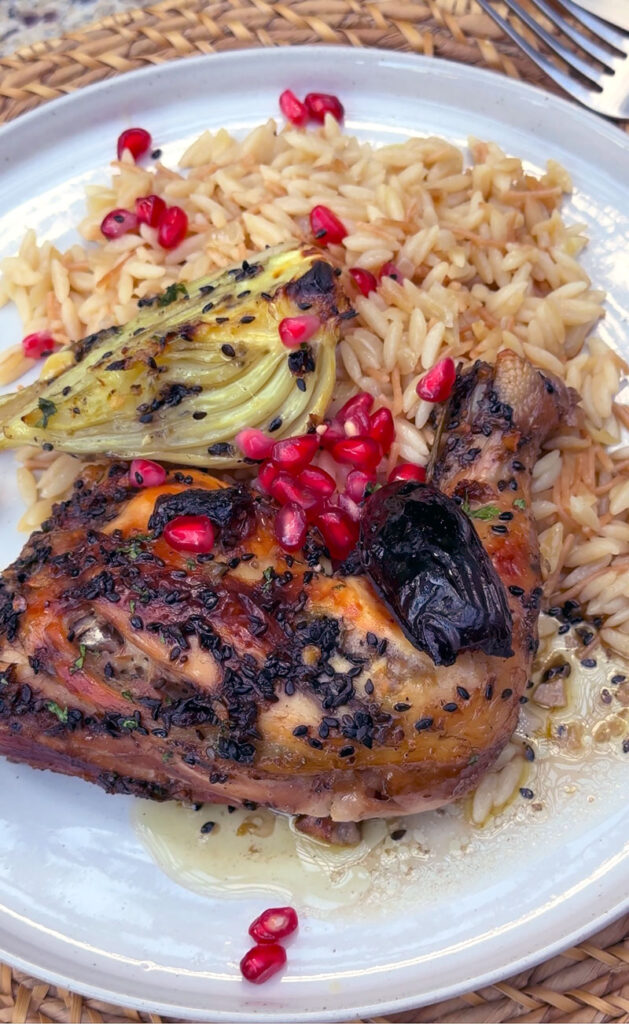
Aaron’s date, honey, pomegranate and sesame chicken with fennel wedges is the star of his high holy day meal this year. And, he explained, it’s the best way to give a traditional main course a different flair. “I love Asian food and I was trying to combine both cuisines in one dish for this recipe,” said Aaron, who is thrilled with the result. “Together with the fennel wedges that literally turn into this dish’s candy, it is sweet, sticky, tangy and super comforting,” he said. “It will leave your family and all of your guests asking for more.”

He suggested serving it over Israeli couscous, orzo or rice.

“Sprinkle some chives or coriander and have the best Jewish New Year,” Aaron said. “Shana Tova, everybody!”

Chef Shimi Aaron’s Date, Honey, Pomegranate and Sesame Chicken with Fennel Wedges  

Ingredients:
6 chicken legs
2 large fennel bulbs, cut in wedges

For the Marinade:
1/2 cup olive oil
1/3 cup sesame oil
3 Tbsp soy sauce
6 Tbsp honey
Juice of 1 lemon
2 Tbsp minced ginger
1 finely diced jalapeño
8 finely diced garlic cloves
1 Tbsp salt flakes
1 tsp coarse black pepper
8 pitted dates, sliced 

Garnish:
Fresh pomegranate seeds/chopped coriander or chives 

In a bowl mix all the marinade ingredients and whisk. Taste and, if you need to add salt or pepper, do so before pouring it over the chicken and fennel. 

Make cuts in the chicken and sprinkle black pepper then place in a bowl. Add the fennel wedges and pour the sauce over it. Mix with your hands, cover and let it rest for at least half an hour to an hour. 

Place the chicken and fennel in a deep baking pan, pour the remaining marinade on top and, using your hands, spread it evenly. Add the dates in between the chicken and fennel and cover with foil. 

Bake at 400°F for one 1 hour and 45 minutes. Carefully remove the foil and broil for another 7 to 10 minutes or until it gets a nice color and the chicken skin is crispy. 

Serve with Israeli couscous and/or fresh salad and enjoy.


For a more traditional chicken with prunes, check out Lily Margules’s Tzimmes. The recipe is shared in June Hersh’s book “Food, Hope and Resilience: Authentic Recipes and Remarkable Stories from Holocaust Survivors.” (All proceeds from the book benefit the United States Holocaust Memorial Museum.)

“Lily was from Vilna, Poland, and, after being deported from her ghetto, she spent time in several work and concentration camps,” Hersh told the Journal. “She was liberated by the Russian army in 1945 and made her way, on foot, from Poland to Prague, Prague to Munich and Munich to Italy.”

In Italy, Margules met and married her husband, Edward. They wanted to make aliyah, but instead went to Buenos Aires and settled there before coming to America. 

“Tzimmes, which in Yiddish means ‘a big fuss,’ is a good name for this dish inspired by Lily’s memories,’” Hersh explained in the book. “Everyone who enjoys it will make a big fuss over you.”

Added Hersh, “She was a remarkable woman and I am so happy to share one of her favorite recipes.”

Lily Margules’ Tzimmes — Chicken with Prunes  

Yield: 4 servings
Start to Finish: Under 2½ hours 

Ingredients:
4 Tbsp vegetable oil
1 (3½- to 4-pound) chicken, cut into 8 pieces (skin can be removed)
2 cups water
½ cup red wine (or broth)
2 Tbsp brown sugar
2 Tbsp honey
2 cups pitted prunes
Kosher salt and pepper
2 russet (or sweet) potatoes (about ¾ pound), peeled and cut into large chunks. 

Heat the oil in a large Dutch oven and brown the chicken parts on all sides, over medium heat, about 15 minutes. Pour off fat and add 1 cup of water, wine (or broth), brown sugar, honey and prunes. 

Season the dish with salt and pepper and bring to a gentle boil. Reduce the heat to low, cover and cook for 1 hour, and then add 1 more cup of water and the potatoes, being sure to tuck the potatoes into the sauce. 

Season to taste with salt and pepper. Continue cooking for 45 to 60 minutes or until the potatoes are fork tender. If the sauce is too concentrated, add some boiling water, heat through and serve.

Sweet Chicken Dishes for Yom Kippur Read More »

Table for Five: Yom Kippur Morning Haftarah

One verse, five voices. Edited by Nina Litvak and Salvador Litvak, the Accidental Talmudist

[God] says: Build up, build up a highway! Clear a road! Remove all obstacles from the road of My people!

– Isaiah 57:14


Sarah Pachter
Author, Speaker

Have you ever entered Yom Kippur with a firm intention to make changes for the upcoming year, but then quickly backslide? You wonder, will I ever change? James Clear, author of bestselling book “Atomic Habits,” writes “Change is not really about motivation, but environment.” 

Physician Anne Thorndike from Boston came up with a revolutionary idea. By merely moving unhealthy drink options in the hospital cafeteria out of sight, healthy drink purchases rose significantly. Removing stumbling blocks isn’t half the battle — it IS the battle. People choose products not because of what they are, but because of where they are. The same is true of life’s choices. 

I was part of a group that learned A Lesson a Day. This two-volume book was wrapped in an encasement that I kept by my bedside. Every time I tried to take out a book, it took extra time and energy to remove it from the snug packaging. Exhausted, I would rationalize, I’ll do it tomorrow. Then morning came, and I forgot. The energy that it took to get the book out of its encasement was actually preventing me from reading each day. All I had to do was remove the obstacle that blocked me! I took the books out permanently, and now I’ve been learning them for five years straight. 

When you remove friction, change happens on its own. My blessing to every reader is that we commit to real change, so next year we can come to Yom Kippur as a new person.


Rabbi Avraham Greenstein
AJRCA Professor of Hebrew

This verse signals a tonal shift in the words of the prophet. Whereas the first 13 verses of the chapter express Isaiah’s strong repudiation of the sinners of Israel, this verse introduces a distinct hope that they will repent. This is something of a radical statement: God sees hope not just for those who are faithful to Him, but also for those whom He would otherwise condemn. Moreover, God urges all of Creation itself to aid sinners in returning. 

These words also contain a compassionate acknowledgment that it is difficult to change bad habits and to correct erroneous presumptions, that we require help in paving new paths of righteousness. If the road we are on is dangerous, we cannot merely backtrack or explore wild and uncharted parallel paths that are just as perilous. We need to diverge and make an entirely new road. 

The metaphor of a road is one that suggests forward movement but also a far-off destination. We may be trying to make progress, and we may be able to conceive of our goals, but we can still be hampered by remnants of our experiences and mistakes. Even when we have chosen a new path, and even if we have determined for ourselves a new and more admirable self-concept, we may still encounter obstacles. 

On Yom Kippur, all of these obstacles are removed. Nothing stands in our way but our own determination to change for the better. Atonement represents God’s faith in us and in our capacity for improvement.  


Dini Coopersmith
Founder and Director, Women’s Reconnection Trips, www.reconnectiontrips.com 

This reminds me of another verse, where Elisha the prophet tells people “this is not the town, nor is this the road“ (II Kings 6:19). When we are going somewhere, we need to know the town to which we are heading, and then we can figure out the road, or the means to reach our destination.

Every year in preparation for the High Holy Days, we have to rethink our destination, so that by the end of this period in the Jewish calendar, we will have a clear vision of our goals and what we want to achieve this year. On Rosh Hashanah every year, Hashem recreates the world, as He did 5785 years ago. Each year is its own unit, and has its own mission and tikkun within the overall destiny of the Jewish People. Hashem resets the calendar and recreates us on Rosh Hashanah, but since there is no past on this day, the judgment is not based on our past, but on our vision and aspiration for the new year. 

On Yom Kippur, however, now that we know “the town,“ it’s up to us to build the highway, to repent, clear the obstacles, fix our actions and behaviors of the past year from the road, and figure out how we will reach our goals. The prophet Isaiah is reminding us to “build up a highway! Clear a road! Remove all obstacles from the road …!“, to align ourselves with our souls and true desire to improve and come closer to God. 


Rebbetzin Miriam Yerushalmi
CEO SANE; Counselor; Author, “Reaching New Heights” series

The road being cleared of obstacles is the path of our life, and the way to achieve this clarity, we are taught, is through a bris milah, a circumcision, of the heart. The imperative to “circumcise our heart” isn’t talking about an eight-day-old baby boy — it’s a mission for each one of us to remove negative character traits. This challenge of getting rid of negative emotions like anger, anxiety and sadness is no small thing. It can be likened to heart surgery: First you must prepare your heart, by davening; next comes the “surgery” itself, performed by articulating words of Torah right after prayer. These ritual practices clear away the obstacles, the blockages which Hashem Himself put upon our heart from the start, and those that we ourselves accumulate throughout the year. Whenever we indulge in materialism or give in to a negative tendency — whether intellectual, emotional or physical — we are doing the opposite of a bris milah; we are adding to those blockages of our heart. Just as we take precautions to prevent hardening of our heart’s arteries, G-d forbid, so too we are prescribed to be careful to avoid creating blockages in the arteries and veins of our soul, the life-force for all of our organs, by behaving in alliance and harmony with Hashem’s Will and our heart’s true will. On Yom Kippur, having worked on ourselves all year long, Hashem will then, with love and compassion, clear the road anew for each one of us, individually and as a nation.


Judy Gruen
Author, “Bylines and Blessings”

Isaiah was one of our greatest prophets, who foretold the destruction of the First Temple. For approximately 40 years he had the unenviable job of warning the Jews away from their sins: idolatry, material excesses, injustice, and turning to foreign rulers for protection, demonstrating their lack of trust in God. These sins directly led to disaster. 

But Isaiah also consistently offered hope of eventual glory days when Israel would be redeemed through authentic repentance and turning to a commitment to justice and mercy. Rabbi Jonathan Sacks considered this reading from the Book of Isaiah to be an “extraordinary” choice to read on Yom Kippur. In it, Isaiah clearly warns that “The fast you perform today will not make your voice heard on high” (58.4). That is because “Even on your fast day you press your interests, oppress all your laborers.” The command to “build up a highway, clear a road, and remove all obstacles from the road of My people” is the imperative for Jews to begin to deal with their fellow men and women with justice and righteousness, to “break the slavery chain.” 

Bountiful blessings will flow to the Jewish people again when they follow God’s laws, leading to splendor and renewal. When we call to God for help, He will say, “I am here.”


Table for Five: Yom Kippur Morning Haftarah Read More »

The End of the Post-Holocaust Era

Already a year? Only a year?

Since Oct. 7, 2023, many of us have felt unmoored in time. I rarely know the date; sometimes I forget the month.

Disorientation is an apt response to the end of the post-Holocaust era, a seminal moment in which many of our most cherished assumptions have been upended.

The post-Holocaust era of the last eight decades was defined by optimism about the Jewish future. However improbably, we had emerged, stronger than ever, from the event intended to destroy us. For all its fluctuations, the post-Holocaust trajectory pointed forward.

Through 2,000 years of exile, the Jewish people were sustained by two dreams. The first – considered so fantastic that it was relegated to messianic times – was that a dispersed and powerless people would somehow reclaim its ancient homeland. The second was that, in the long interim before the coming of the Messiah, Jews would find a welcoming haven in the Diaspora.

After the Holocaust, both dreams were fulfilled. Two great centers of Jewish life emerged – a sovereign Israel and a self-confident North American Jewry, the most successful Diaspora in history. Together, Israel and North America contain close to 90% of the world’s Jews. These two centers presided over the post-Holocaust renewal of the Jewish people – which moved from its historic nadir to the peak of its military, economic and political power.

Nothing like this had ever happened to the Jews – or perhaps to any other people. The transition from brokenness to power was so rapid and decisive that some Jews concluded this must be the messianic era.

Each community reacted to its particular circumstances with the wisdom of Jewish adaptability. For Israelis, that meant military deterrence in a region that sought to destroy them. For Jews in the Diaspora, and especially in North America, that meant responding with “soft power” – lobbying, philanthropy and building alliances with other minorities – in societies that embraced them.

What Israel Lost on Oct. 7

For Israelis, the post-Holocaust era was defined by confidence in our ability to defend ourselves, no matter the circumstance. That confidence was based on our ability to project a credible military deterrence against genocidal enemies – what the pre-state Zionist leader Ze’ev Jabotinsky called “the iron wall.”

On Oct. 7, the iron wall was breached. The most devastating blow in our history was delivered by our weakest enemy; our high-tech, state-of-the-art border was overrun by terrorists on tractors.

On Oct. 7, the iron wall was breached. The most devastating blow in our history was delivered by our weakest enemy; our high-tech, state-of-the-art border was overrun by terrorists on tractors.

Oct. 7 was a pre=enactment in microcosm of the destruction of Israel: the IDF in disarray, the government AWOL, civilians left to fend for themselves with pistols.

Israel’s recent, stunning successes against Hezbollah have helped to partly renew our self-confidence. Morale among our soldiers is arguably higher than at any time since the Yom Kippur War. That may well be the most significant element in restoring our long-term deterrence – an internal Israeli deterrence against despair.

Still, the war for the restoration of our deterrence has only begun. Iran’s massive ballistic strike last week proves that our enemies are hardly deterred. Tens of thousands of missiles and rockets are aimed at Israeli cities from multiple directions. If Iran and its proxies unleash their full arsenal, the Iron Dome anti-missile system will be overwhelmed.

Oct. 7 challenged our faith in the Zionist promise of ending Jewish homelessness. For the first time in Israel’s history, a “security zone” – emptied of civilians in the north – has been created on our side of the border. The inability of the state to ensure that Israelis can live in their homes undermines the credibility of our national home. Undoing that disastrous perception is also a strategic goal of this war.

The return of the Holocaust

The last existential war Israel fought was Yom Kippur 1973. Our subsequent wars, beginning with Lebanon 1982, were asymmetrical, none of them endangering Israel’s survival. As a result, Israelis came to accept the permanence of the Jewish state as a given. A telling indication of that self-confidence was the gradual fading of the Holocaust from our political discourse.

Though Prime Minister Benjamin Netanyahu repeatedly invoked the Holocaust in his warnings about a nuclear Iran, most Israelis tended to avoid that rhetoric. In his 2017 speech on Holocaust Remembrance Day, former president and Likudnik Ruvi Rivlin implicitly challenged Netanyahu, warning against comparing the Holocaust to contemporary threats.

But on Oct. 7, Israel became the most dangerous place in the world to be a Jew. And now the Holocaust is back. Israelis describe Oct. 7 as the greatest massacre of Jews since the Holocaust – though a more apt description would be: the greatest number of Israelis (they included Arab citizens) killed on any day in a century of Arab-Israeli conflict. No less than Hamas’ atrocities, the defenselessness of the victims torments us with Holocaust imagery. By invoking the Holocaust, Israelis are saying: We failed to defeat the Jewish past.

Another sign of the new mood is the constant repetition of the slogan, Am Yisrael Chai, the people of Israel live. That expression was popular among Diaspora Jews who needed reassurance after the Holocaust that the Jewish people had indeed survived. Israelis never adopted the slogan, which revealed an anxiety we thought we had overcome. Of course the people of Israel live: That was the whole point of a Jewish state. Now, though, the slogan appears on highway billboards and in newspaper ads and in popular songs. Suddenly demonstrative defiance seems very Israeli.

Family and friends gather at the Nova festival memorial to mark the first anniversary since Hamas attacked one year ago on Oct. 7, 2024 in Re’im, Israel. (Photo by Alexi J. Rosenfeld/Getty Images)

The anti-Entebbe

Finally, Oct. 7 shattered the notion that the state will protect us and Israelis will protect each other.

Our inability to free the hostages being held in suffocating spaces in Gaza is a constant taunt, reminding us of the failure of Oct. 7. In 1976, the IDF rescued a hundred Israeli hostages whose plane had been hijacked to Entebbe airport in Uganda. The Entebbe rescue became the symbol of the post-Holocaust era of Jewish resilience. (That the hostages were being held by far-left German terrorists made the symbolism of Entebbe even more potent.)

Now, though, the IDF, which is operating within shouting distance of our hostages, has managed to free only eight out of the dozens estimated to still be alive. This is Israel’s anti-Entebbe moment.

Speaking at a demonstration for the hostages, Meirav Cohen, an opposition member of the Knesset, said: “The state of Israel was founded so that there would not be another Holocaust. [When Israeli] citizens are being held in tunnels, starved and abused and then executed by Nazis, this government has totally failed.”

She wasn’t speaking about an operational failure to save the hostages, but a failure of political will. According to his own hostage negotiators, Netanyahu has repeatedly sabotaged a deal – fearing his far-right partners would bring down the coalition.

Certainly an argument can be made for prioritizing victory over a hostage deal. But Netanyahu and most of his ministers have revealed a stunning lack of empathy for the hostages and their families. Pro-Netanyahu media has treated desperate family members protesting against the government’s policy as virtual enemies of the state; Netanyahu supporters have physically attacked them on the streets.

While it appears that Hamas is no longer interested in a deal, a sacred trust between Israelis and the state has been broken.

The defining ethos of the post-Holocaust era was mutual protection: When Jews were in crisis anywhere, fellow Jews everywhere did what they could to help. The great expression of that commitment was the 25-year international movement to free Soviet Jewry.

The notion that the prime minister of the Jewish state would place his political needs ahead of the lives of Jewish captives has upended the credibility of that ethos.

Students participate in a protest in support of Palestine outside of Columbia University on November 15, 2023 in New York City. (Photo by Spencer PlattGetty Images)

The return of conditional acceptance

For the Diaspora, the promise of the post-Holocaust era was that humanity, shamed into contrition, would finally be cured of its Jewish obsession. Jews would no longer be turned into a symbol for whatever a given civilization regarded as the ultimate evil – Christ-killer for Christianity, money-grubbing capitalist for Marxism, race polluter for Nazism.

Certainly, large parts of the world never signed up for the penitence program. The Arab world tried to destroy the newborn Jewish state barely three years after the Holocaust and then destroyed its ancient Jewish communities. The Soviet Union promoted an aggressive antisemitic campaign barely disguised as “anti-Zionism.” And in Western Europe, Jews have been violently targeted by radical Islamists.

But in North America, the promise of Jewish safety took root.

In recent years, there were warning signs that the atmosphere was shifting. The 2018 murder of 11 worshippers in Pittsburgh’s Tree of Life synagogue was the worst massacre in American Jewish history. Synagogues became the only houses of worship requiring round-the-clock security. And anti-Zionism, the ideology that defines the existence of a Jewish state as a crime, penetrated humanities departments across academia.

Still, nothing quite prepared U.S. and Canadian Jews for the post-Oct. 7 shift – in effect, the Europeanization of North American Jewish life.

In recent travels through North American Jewish communities, I encountered a level of fear I’d never experienced before. Some wondered whether there was a future in the Diaspora for Jewish life. Some even evoked Germany of the 1920s. “Now I know what my grandparents were trying to warn me about,” a friend said to me. I suspect that North American Jews who compare their situation to pre-Holocaust Europe know the analogy is absurd, but reaching into our darkest experience is a way of signaling the shock of their new reality.

In speaking to North American Jewish audiences, I noted that, while Israel had become the most dangerous country for Jews physically, it had also become the safest country for Jews psychologically – the one place you could be certain your neighbors shared your horror of Oct. 7. No one challenged that assessment.

This is the first time Israelis and North American Jews are experiencing a shared sense of vulnerability. In the past, when Israel was at war, the Diaspora rallied to its support. Now, many Diaspora Jews seem to be worrying as much about their future as they do about ours.

Statistics tracking the rise in antisemitic attacks around the world since Oct. 7 tell only part of the story. The deeper trauma for Diaspora Jews is psychological: The sense that their acceptance in society – from universities to the political system to the streets – is eroding.

The great post-Holocaust achievement of North American Jews was the gradual end of their conditional acceptance. Until then, Jews understood that social advance depended on toning down one’s Jewishness. Many Jews accepted the trade-off, even changing their family names.

By the 1970s, anti-Jewish discrimination – from university quotas to “restricted” neighborhoods and law firms – had largely ended. For the first time in the Diaspora, Jews felt fully accepted.

The mainstreaming of anti-Zionism in universities and other progressive spaces has restored the era of conditional acceptance. Anti-Zionists insist on a fundamental flaw in Jewish identity that must be corrected as the admission price into the progressive equivalent of “polite society.” We will accept you among us, anti-Zionists tell young Jews on campus, and you may even hold Shabbat prayers and Passover seders at our tent encampments, on one condition: that you expunge Israel from your identity – a commitment that binds the overwhelming majority of the world’s Jews.

For all practical purposes, the debate over whether anti-Zionism is a form of antisemitism is irrelevant. Anti-Zionism is a threat to Jewish well-being – ironically, far more in the Diaspora than in Israel, where we are largely immune to its impact. One immediate consequence of the anti-Zionist mood is to instill in Jews a profound sense of insecurity. Since Oct. 7, according to a poll, over a third of Jewish students on American campuses feel impelled to hide their Jewishness.

Last spring I met with Jewish students at Northwestern University near Chicago. I attended Northwestern in the 1970s, shortly after anti-Jewish quotas had been removed. My experience as a student there was exhilarating: Growing up in a Holocaust survivor family, where the non-Jewish world was seen as intrinsically hostile, I discovered a level of acceptance my parents couldn’t have imagined.

The Jewish reality I encountered at Northwestern in 2024 was the opposite of my own. Jewish students who refuse to repudiate Israel tend to experience social exclusion and socialize mostly with each other.

The experience of Jewish students I met around the country varies from campus to campus. Still, most of those with whom I spoke agree that anti-Zionism is poisoning a generation. As one student put it: What hurts most are the hateful comments of students who aren’t especially political but have absorbed the anti-Zionist atmosphere.

The mainstreaming of ‘political supersessionism’

The anti-Zionist campaign that has gone mainstream since Oct. 7 is a war against the 20th-century Jewish story of destruction and renewal.

However unconsciously, that war draws on old forms of warfare against the Jews. The first is “supersessionism,” the pre-Holocaust Christian doctrine that claims the Church has replaced the Jews as the legitimate heirs of the identity of “Israel.” According to that doctrine, the Jews had forfeited the right to their own story. The Hebrew Bible didn’t belong to the Jews but the Christians.

The political equivalent of supersessionism is denying the Jews the right to their land – a right superseded by the Palestinian counterclaim.

The ideological war against Israel draws on an old Christian obsession with Jewish “sin.” Transforming Israel into the criminal among nations requires magnifying Israel’s crimes – real, exaggerated or wholly contrived – while ignoring those of its enemies. It requires the erasure of Israelis’ humanity – like tearing down posters of the Gaza hostages or blacking out their faces, a literal defacement.

Turning Israel’s war against Hamas into genocide depends on erasing the conditions in which the IDF fights – against terrorists without uniforms who operate from within a civilian population, in hundreds of kilometers of tunnels and in thousands of booby-trapped apartments. Erasing the Israeli narrative of the war extends to how most of the media cite Gaza casualty rates – without noting how many of the dead are Hamas fighters. (Out of Hamas’ current estimate of 41,000 dead, the IDF says close to 18,000 are terrorists – a combatant-to-civilian ratio well within the norm of other asymmetrical conflicts of this century, and under far more difficult circumstances than other armies have faced.)

Anti-Zionists apply that pattern of erasure to the entire story of the Jewish return home. Turning Zionism into our generation’s expression of European colonialism requires erasing the 4,000-year Jewish connection to their land. Reducing the story of Israel’s founding to the ethnic cleansing of the Palestinians requires playing down the war of destruction Arab leaders declared against the newborn Jewish state and the postwar expulsion of nearly a million Jews from their ancient communities in the Arab world. Turning Israel into the occupier and aggressor requires omitting the history of Israeli peace offers and of Palestinian rejectionism.

The deepest source of anti-Israel animus is the symbolization of the Jew as embodiment of evil. The satanic Jew has been replaced by the satanic Jewish state. In demonstrations, caricatures of Netanyahu portray him with fangs, blood dripping from his mouth.

The end of the post-Holocaust era is expressed most starkly in the inversion of the Holocaust. Not only has Holocaust memory failed to protect the Jews; it has become an inspiration and a justification for the latest iteration of Jew-hatred. These days, when a synagogue is defaced with swastikas, we don’t know whether the intent is to celebrate Nazism or to damn us as the new Nazis. A mural in Milwaukee caught the new mood: a swastika embedded in a Star of David, with the words, “The irony of becoming what you once hated.”

The Jew-as-Nazi is the endpoint of political supersessionism: Not only have we forfeited our identity as “Israel,” but we’ve assumed the identity of our worst enemy.

Fighting evil

Perhaps one reason we are unable to move past Oct. 7 is because, on that day, we once again encountered absolute evil.

In the last century, the Jewish people has been successively targeted by three totalitarian ideologies – Nazism, Soviet Communism and now radical Islamism. Each of those movements aspired to remake humanity in its image. Each was obsessed with the Jews as a primary obstacle to achieving its goal. Each felt justified to use any method in pursuing world domination.

Effectively countering evil requires uncompromising resolve.

On Oct. 8, Israelis across the political spectrum agreed that the ground rules of our war against terror must change. Until then, the goal was to contain Hamas and dissuade it from firing rockets into Israeli communities; now the goal was to destroy its ability to govern. That meant denying Hamas immunity: Terrorists would not be allowed to massacre our civilians, cross back into Gaza and hide behind their civilians. Instead, we would pursue Hamas operatives wherever they were based, including hospitals and mosques. The terrible result has been Israel’s most brutal war – and one of its most necessary.

Now those rules are being applied to Hezbollah too.

But fighting terror enclaves on our borders is hardly sufficient. We need to confront the source of evil, which is the Iranian regime.

Fighting terror enclaves on our borders is hardly sufficient. We need to confront the source of evil, which is the Iranian regime.

In its war against Israel, Iran achieved two strategic victories. The first was to surround us with terror enclaves – a “ring of fire.” The second was to outwit the decades-long Israeli campaign to prevent Iran from approaching the nuclear threshold.

Now we are finally dealing with the terror mini-states on our borders. But so long as Iran remains within reach of a bomb, we will not reclaim our deterrence or dispel the existential threat that returned to our national life with Oct. 7. The strategic goal of this war, then, must be the destruction of Iran’s nuclear program, accelerating the process that will lead to the downfall of the Ayatollahs. That is the real “proportionate” response to Oct. 7.

Along with military resoluteness, there is one more essential move in fighting evil, and it is directed inward: We need to resist the temptation to adopt the ways of our enemies. The Israeli far right erodes the moral credibility of our war against evil by infecting us with evil. It endangers the support and understanding of our friends abroad and bitterly divides the Israeli public.

Preserving a decent and democratic Israel is an essential component in the war for our story. Those Jews who seek to turn Israel into a criminal state are a gift to those who insist it already is.

Living with uncertainty

With the end of the post-Holocaust era, Jews need to adjust to a profoundly disorienting ambiguity. That requires, first of all, a realistic assessment of threats and of our ability to respond to them.

Once again Israel is fighting for survival; yet as recent days prove, we still possess the will and the means to defend ourselves. North American Jewry no longer enjoys unconditional acceptance, yet its communities remain the most fortunate in Diaspora history. The “Jewish problem” – as Jewish existence was once defined in pre-Holocaust Europe – has been replaced by the “Jewish state problem.” But Israel is not alone in a hostile world, even if it sometimes feels that way.

The great achievement of the post-Holocaust generation was the reclamation of power. Inevitably, that achievement came with a price: the loss of our innocence. Now we must own the consequences.

We are caught in a pathological loop – condemned as aggressors even as many Jews see us once again as victims. Neither identity is useful to understanding this Jewish moment. We are not victimizers: Any country in our place would have reacted as we did to Oct. 7, if anything with even greater vehemence. Nor are we helpless: The ruins of Gaza and of Beirut grimly attest to our reclaimed ability to defend ourselves.

The morning after the war to reestablish our military deterrence, Israel will be confronted with an internal existential challenge: Healing the divide that has torn us apart. In the year leading up to Oct. 7, Israelis experienced the worst schism in our history. That divide signaled a fatal weakness to our enemies and encouraged them to attack.

Yet on Oct. 8, rather than disintegrate from within, we instantly pivoted to one of the peak moments of Israeli solidarity. No less impressive, we didn’t wait to be mobilized and inspired by our leaders. Even as the government effectively collapsed, we mobilized ourselves. That was the moment of our maturation.

We are heirs, then, to two opposing models of Israel. The first is an old Jewish story: We devour ourselves, and then our enemies do the rest. The second story is new: From the depths of our divisiveness, we reclaim the instincts of peoplehood.

We are heirs, then, to two opposing models of Israel. The first is an old Jewish story: We devour ourselves, and then our enemies do the rest. The second story is new: From the depths of our divisiveness, we reclaim the instincts of peoplehood.

To do so will require agreement that no ideological camp may impose the totality of its political and cultural agenda on this fractious people. Neither an Oslo-like process nor a judicial coup can happen without a national referendum, or some other mechanism ensuring broad support. And when we enact painful policies that will inflame social tensions – for example, changing the nature of the ultra-Orthodox relationship with the state – we do so with respect, appreciating that each ideological camp embodies an essential truth of our identity and experience as a people.

The other day in Jerusalem, I saw a bumper sticker that read, “Our story will have a good ending.” Those words were spoken by Sarit Zussman at the funeral of her son, Ben, a soldier who fell in Gaza. Once that sentiment would have seemed to Israelis self-evident. Now it has the poignancy of a prayer.

Editor’s note: This essay appeared in The Times of Israel and is reprinted with permission. Part of this essay also appeared in The Globe and Mail.


Yossi Klein Halevi is a senior fellow of the Shalom Hartman Institute in Jerusalem. His latest book, “Letters to My Palestinian Neighbor,” is a New York Times bestseller.

The End of the Post-Holocaust Era Read More »