At 6:29 a.m on Saturday Sept. 5 at a particular installation at the annual Burning Man festival, the music stopped, for the third year in a row. Some of the people gathered at the Nova Heaven installation knew why. Many had zero idea. About 70,000 people attended Burning Man 2026, held from Aug. 31 to Sept. 7 in Nevada’s Black Rock Desert. Noya Bartimor flew in from Israel three days before the festival for her first Burning Man.
At the Nova memorial ceremony, Bartimor heard people speaking Portuguese and Farsi. She saw non-Jewish attendees looking around as the music stopped and people around them began to cry.
“I could see on their faces that they don’t know why the music is stopping and they don’t know why everybody’s crying and they don’t understand the situation because, you know, a lot was in Hebrew,” Bartimor told The Journal.
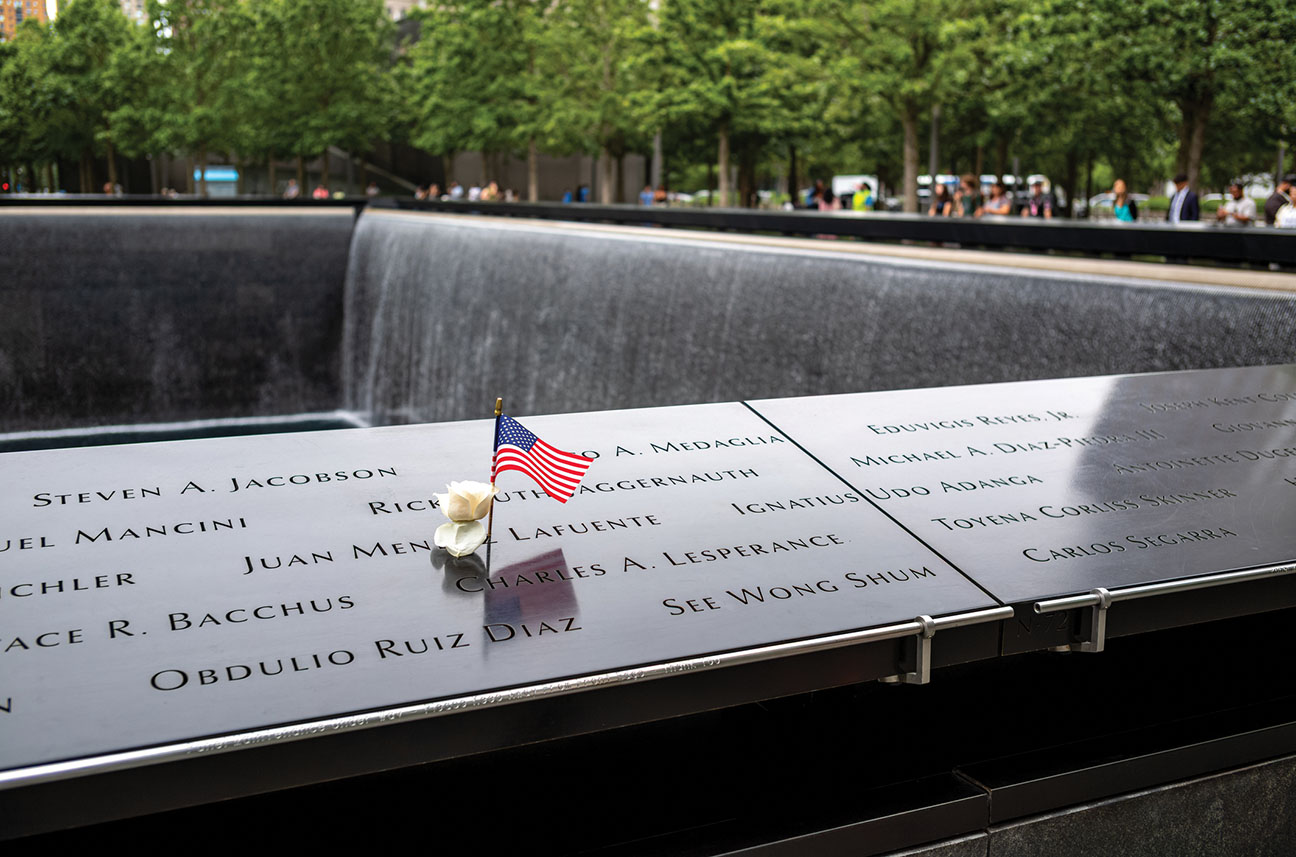
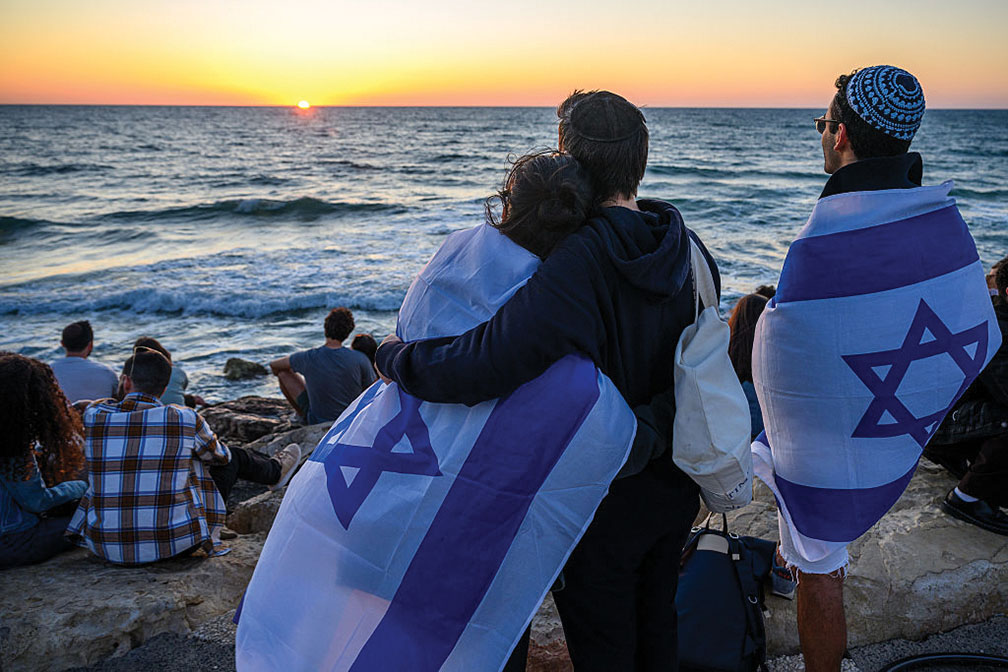
This one took place just one month and two days before the third anniversary of the Hamas terror attacks on Israel on Oct. 7, 2023. The music at the Nova music festival stopped at exactly 6:29 a.m. when Hamas terrorists began their attack.
The project was organized by the Nova Tribe Community Association, the nonprofit created after Oct. 7, by producers of the Nova festival to support survivors and bereaved families and commemorate those murdered. The 2024 Nova Heaven installation recreated Nova’s blue and pink pastel tent and included memorial carrying victims’ names and an entrance bearing the words “We Will Dance Again.” In 2025, Nova Heaven again recreated the tent, with internally lit memorial angels bearing names. This year’s installation, titled “Let There Be Light,” featured 24 triangular lattice-cut wooden sculptures surrounding a central hexagonal platform with an elevated DJ booth—all of which lit up at night. Eighteen smaller triangles carried names illuminated by white lights from within. Six larger triangles created gathering spaces and sent beams of light toward the sky. At the center were 413 circular openings of light, each representing one of the people memorialized by Nova Heaven.
The IDF officially says that 378 people were killed in and around the Nova festival grounds and 44 were abducted. Of those 44 hostages, 25 returned alive: 21 were released and four were rescued by Israeli forces. The remaining 19 were murdered; their bodies were returned or recovered.
For over two years, Bartimor has mourned Omer Smadga, a 25-year-old IDF reservist and Bartimor’s ex-boyfriend, who was killed in Gaza in combat on June 20, 2024.
At Burning Man, Bartimor cried and walked off to the side of the installation to take a moment to breathe. There, she beckoned Smadga for a sign. “Omair you give me a sign, like I want to feel you, I want to know that you can hear me, then give me a sign. Give me something,” Bartimor remembered thinking. Then an Israeli woman she had never met walked up to her and gave her a hug and cried with her. A man joined them a moment later. “I tell them, ‘guys I’m crying because I lost my ex’ and we burst in tears even more and we started hugging and crying, and this was like a very divine moment for me,” Bartimor said.
Then an Iranian man walked over to her. He was not Jewish, and he asked if they were Israeli.
“Then he said, ‘I just wanted to say thank you, thank you from Iran, thank you for saving us, thank you for being there for us, thank you for fighting for us, we are all one, I’m your brother, thank you,” Bartimor said, quoting the man.
While the Iranian man was talking, Bartimor noticed two released hostages who had been kidnapped from the Nova festival, Guy Gilboa-Dalal and Evyatar David.
“And I felt like wow I got chills, even now talking about it [two days later], this was a surreal moment,” Bartimor said. Seeing former Nova hostages at Burning Man hit Bartimor at the same time she was thinking about Smadga. “My ex got murdered, but I’m here dancing with released hostages,” Bartimor said. “They are dancing at the freaking Nova ceremony at Burning Man. They were in captivity for like two years and now they are here celebrating and winning life.”
Bartimor called it a victory.
“For me, it was very, very, very special, one of the most special moments I have ever experienced,” Bartimor said.
She also spotted Palestinian flags at Burning Man. She saw “F— Israel” graffiti and anti-Israel messages on the porta-potties. On one, Bartimor described seeing a Magen David that had been written over with messages including “Free Palestine,” “F— Israel” and “colonizers.”
Bartimor left the graffiti where it was.
“I focused on being loved and love and that’s what I got,” Bartimor said. Still she was shaken by the experience.
“I haven’t personally experienced anything, but that was a bit devastating for me,” Bartimor said. “I was expecting Burning Man to be a politics-free zone and a ‘one love’ zone.” The comments followed her onto Instagram. Bartimor posted a video from a Shabbat gathering at Burning Man with singing and Kiddush. And like many posts she has made to her 22,000 followers on Instagram, she received a plethora of comments including “Free Palestine” and “you colonizers.”
“I was like ‘yo why why are they commenting this?’” Bartimor said. “I just uploaded a video about Shabbat singing and kiddush and it was just like a nice video.”
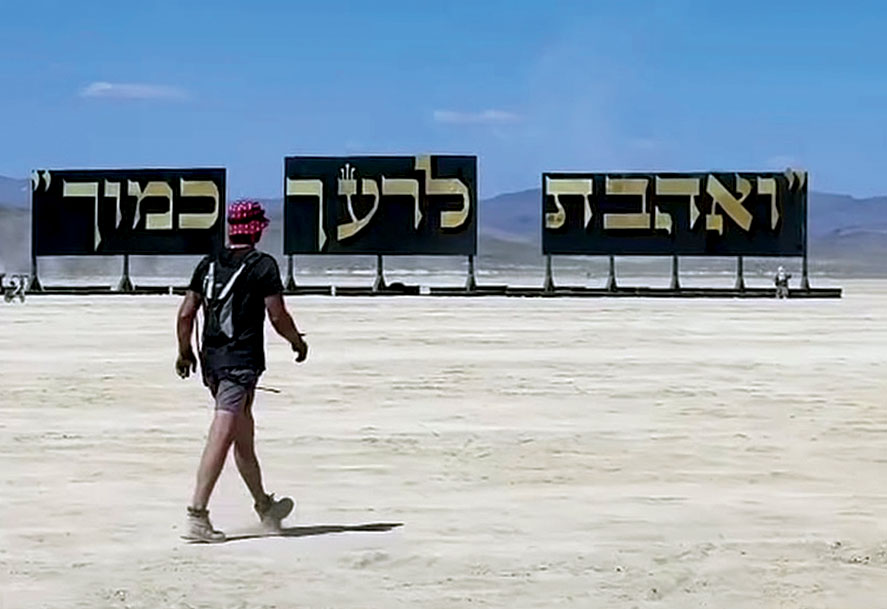
There was one Hebrew message at Burning Man that was hard for Bartimor to miss.
A steel installation measuring 120 feet across the playa and standing about 27 feet high. In Hebrew, it spelled “Ve’ahavta l’reacha kamocha” — “Love thy neighbor as yourself” — in giant Hebrew letters raised above the desert. Titled, “The Golden Rule,” it was created by Los Angeles artist Asher Amar.
Bartimor has the same Hebrew phrase tattooed on her body. “And I remember just seeing that like it’s a crazy big, big, big, big, very big sign that you can see from miles away,” Bartimor said. Bartimor took notice of what Amar chose to do with that much space. Burning Man has massive sculptures, buildings, art cars, sexual art and nudity across the playa. Amar used 120 feet of it for a sentence from Leviticus.
“And this is the beauty of Judaism and this is the beauty of the Jewish heart. Like he could’ve done anything, but he chose to bring a big, big, big message to the world about one love and union and for me that was very special and I feel very honored and proud to be a part of this amazing culture, and religion,” Bartimor said.
None of this was on Bartimor’s calendar a week before.
Three days before Burning Man, Bartimor was still in Israel. A friend called and offered her a spot. The friend had an RV and Bartimor only needed to book a flight.
Usually, Bartimor said, people spend six months preparing for Burning Man. “So this is my first time at Burning Man, I was not expecting to experience that, I wanted to go for a long time, but I felt like this year, all the stars aligned for me to be there,” Bartimor said.
Looking back, throughout the week, Bartimor said she felt Smadga’s presence not just at the Saturday memorial ceremony, but throughout the entire week.
“I felt like he was my guardian angel, and he wanted me to be there,” Bartimor said. “Smadga loved parties. He loved music. He loved festivals. I’m dancing for him. I’m crying for him and this is my little victory.”