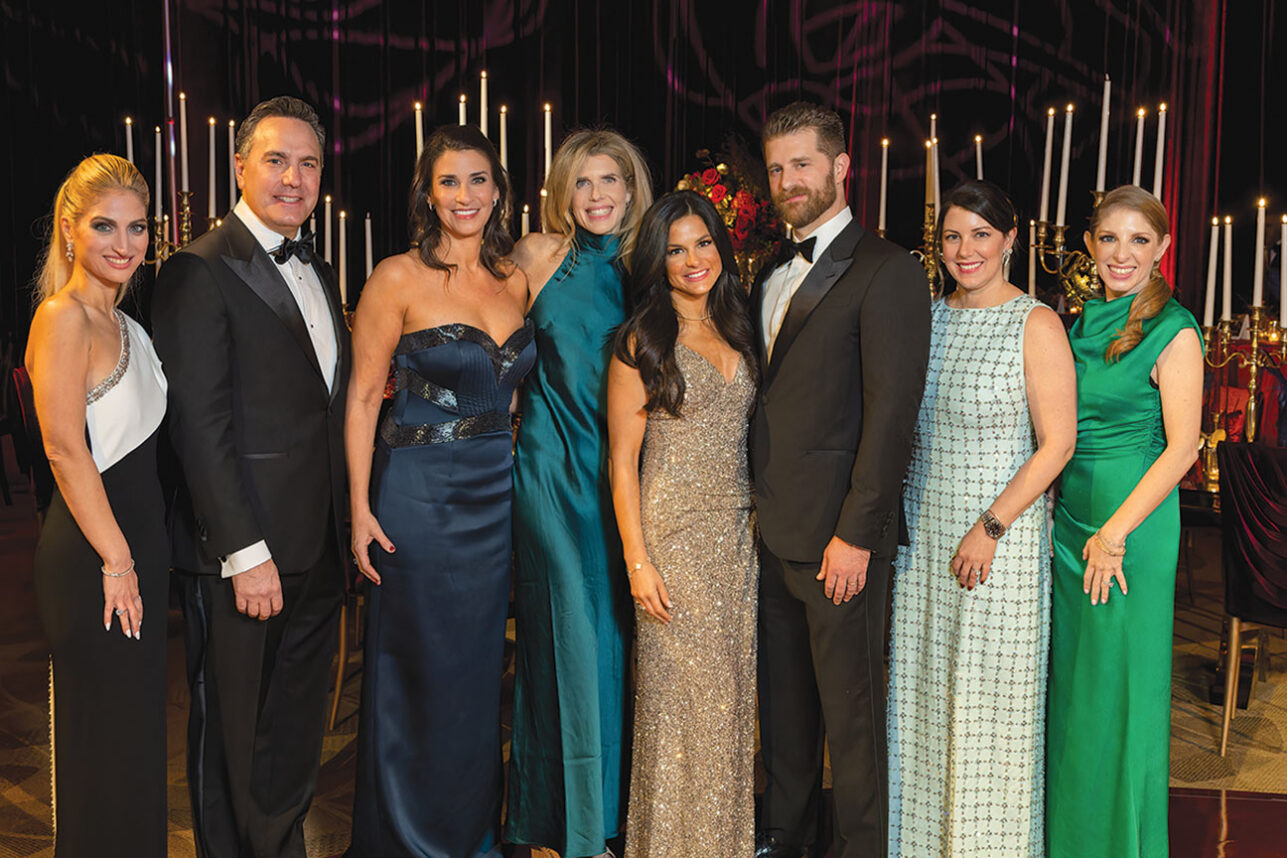
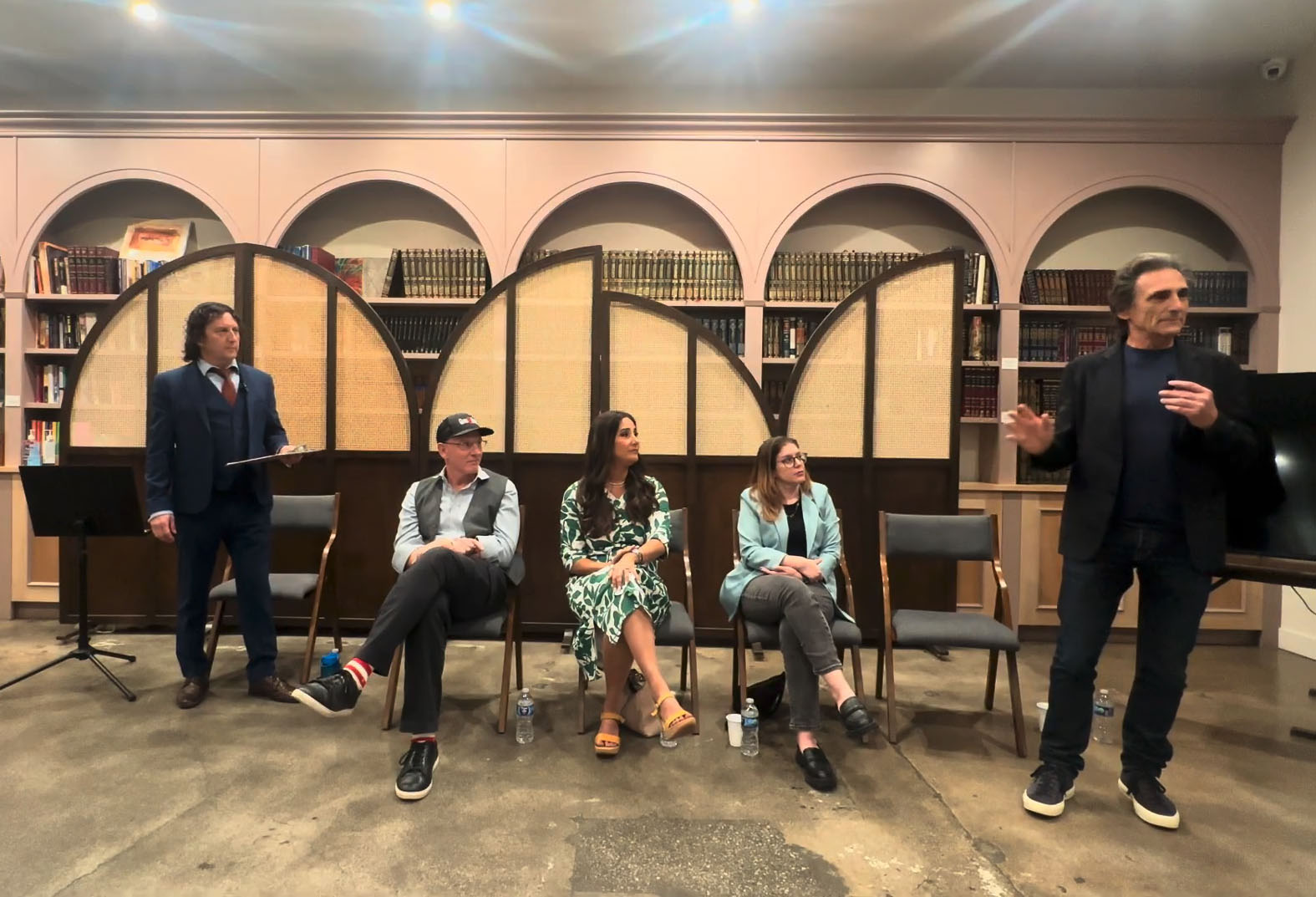
On Oct. 29 in Beverly Hills, Jew in the City founder Allison Josephs joined Marcus Freed, founder of the Jewish Filmmakers Network (JFN), for a public panel —a first official collaboration between Josephs’ Hollywood Bureau — now known as the Jewish Institute for Television & Cinema (JITC)— and Freed’s expanding global network of Jewish creatives.
The event at Happy Minyan also featured producer Lawrence Bender, director Sal Litvak, and screenwriter Allison Peck.
Josephs told the Journal her Hollywood Bureau of JITC was created to address what she described as a longstanding gap in media advocacy.
“The NAACP has a Hollywood Bureau, the Muslim Public Affairs Council has a Hollywood Bureau, GLAAD has one; until now, Jews didn’t,” Josephs told the Journal.
Her organization began as Jew in the City in 2007, countering stereotypes of Orthodox Jews. Their current mission is to be a voice in the entertainment industry by advising writers, producers, and studios on Jewish representation. Josephs said the work has become more urgent since Oct. 7, when misinformation and caricature of the Jewish community fueled exponential antisemitism.
“The automatic assumption that exists still in Hollywood today is why do Jews need help? Jews run Hollywood. So we’re not necessarily welcomed in with open arms as every other minority group is,” Josephs said. “If it were so easy, probably another organization would’ve done this much sooner, but we’re the only ones doing this. And it’s not easy work because you have to have uncomfortable conversations.”
Josephs presented findings from a study conducted with USC’s Norman Lear Center — the first comprehensive review of Jewish representation in 25 years. The research, titled “Jews on Screen: The Visibility and Representation of Jewish Identity in Contemporary Scripted TV,” analyzed 108 Jewish characters and 30 portrayals of Orthodox Jews from television shows in 2021-2022.
“There’s a lack of authentic casting of Jews,” Josephs said. “We were only able to find 56% of actors casted playing Jews were confirmed Jews. And with other groups, there seems to be a higher level. Judaism is not only a religion, we’re also an ethnic group.” She clarified, though, that JITC is “not here to be watchdogs” but to be “ partners with the studios so that we can say to them, ‘we love that you did this, and next time it would be even better if you did that.’” She added, “if we just come out swinging and saying, ‘you suck, you’re the worst, there’s no hope for you,’ then that’s not a very productive conversation.”
For Freed, a British actor and filmmaker, he created JFN for the 2023 Sundance Film Festival’s Shabbat Tent, organized by Rabbi Yonah and Rachel Bookstein of Pico Shul and Jewlicious. It has since held gatherings in Los Angeles, London, New York, Edinburgh, Cannes, and online.
“The event with Lawrence Bender, Allison Josephs, Sal Litvak and Allison Peck was fascinating because it was the first official collaboration between our two organisations,” Freed told the Journal. “We have different missions but have a shared space. For the Jewish Filmmakers Network I very much focus on community building and bringing together Jews in the industry.”
Freed said the network remains an inclusive, non-religious space.
“I’m coming at it from the perspective of being a professional actor and filmmaker, but also being a community organiser and rabbi—even though it’s a completely non-religious space, it’s totally inclusive to Jews as well as some non-Jewish allies who come along.” Freed described the work by JFN and JITC as “absolutely, desperately needed.” Their joint event showcased three recent productions that as great examples of progress in Jewish storytelling: Lawrence Bender’s “Red Alert,” on Paramount+, Sal and Nina Litvak’s feature film “Guns & Moses,” and screenwriter Alison Peck’s Netflix film “You Are So Not Invited to My Bat Mitzvah” —from Adam Sandler’s Happy Madison Productions.
“I wanted it to be focused on Jewish joy,” Peck said about “You Are So Not Invited to My Bat Mitzvah. “I was very careful to not include stereotypes as much as I could, but also to make it feel realistic. The easy way of doing it is like throwing money at the bat mitzvah and making it a money situation. So we really focused on making it about the things that the character Stacy (played by Sunny Sandler) wanted for her Bat Mitzvah. She’s a bratty 12-year-old and not because they’re just filthy rich… it wasn’t a problem she had with being Jewish, it was just the situation of the pressures of being 12, 13 years old.”
Producer Lawrence Bender spoke during the panel about making “Red Alert” for Paramount+, a scripted show about the Oct. 7 attacks. He was especially moved by the survivors who came to the sets where they were being portrayed by actors.
“We have these extraordinary people that we were honored to have on our set who are still a year and a half later, very traumatized,” Bender said. “So I spent a lot of time with them. One thing that I found is that they felt isolated. They felt alone. The very people who were attacked, the very people who need love and need to be held and need to be recognized are the very ones who are feeling like alone in the world, which became even more of a driving mission for myself to be able to tell their stories and make sure people in the world knew who they were.”
Sal Litvak, writer and director of “Guns & Moses,” talked about what he’s observed amongst Jewish actors in Hollywood since Oct. 7.
“There’s a lot of Jewish actors in Hollywood who have been silenced since October 7th and who don’t want to play Jewish roles,” Litvak said. “They don’t want to be typecast. They’re afraid that they’re going to be in that Jewish box too much. I hope that we’re going to see a lot more projects with a diversity of Jewish characters. I mean, we’re ancient people. Forget the stereotypes. We can offer hundreds of different nuanced experiences on screen that haven’t been depicted or portrayed before at all, because being an ancient people, it brings a lot to the table.”
Josephs said all three examples matter because they show range. “It’s not one version of being Jewish,” she said during the panel. “You have an Israeli story, an Orthodox story, and a Reform or secular story, and they all show pride without self-hatred.”
In November 2024, JITC held its second Jewish Media Awards to celebrate authentic Jewish storytelling and representation. The event, at the Lincoln Center in New York, recognized the virtues of Jewish storytelling in “Fauda” and “Jewish Matchmaking” on Netflix, and the Sheryl Sandberg documentary “Screams Before Silence.” The third Jewish Media Awards ceremony is slated to take place in 2026.
Just last month, JITC launched the “Like a Jew” short film and awareness campaign inspired by Always’ “Like a Girl” initiative. The video challenges Hollywood stereotypes by featuring young Jewish children describing what it means to “act like a Jew.”
Freed sees the work of JFN, Josephs’ JITC, as well as the concerted efforts by showrunners and filmmakers as a crucial solution in an industry that feels increasingly hostile to the Jewish community.
“These [films and shows] are so much more than just works of art,” Freed said. “These are tremendously healing to the Jewish soul in addition to their entertainment levels.”