There is no shortage of Holocaust dramas, and although countless stories have been told throughout the years, the Nuremberg trial is one that’s often retold. It has been the subject of, among others, the Academy Award-winning 1961 drama, “Judgement at Nuremberg,” the 2000 miniseries “Nuremberg” and a 2006 PBS documentary.
The new film “Nuremberg,” released earlier this month, once again looks at this pivotal moment in history. Leading Nazi officers stood trial for crimes against humanity, war crimes and crimes against peace. The trial took place in the same city where Hitler announced the antisemitic Nuremberg Laws on Sept. 15, 1935, during the annual Nuremberg Party Rally. These laws laid the legal foundation for the systematic persecution of Jews in Germany.
Among other restrictions, the laws banned marriages and extramarital relations between Jews and “German or related blood” citizens. It forbade Jews from employing German women under 45 in their households. It stripped Jews of German citizenship, making them subjects of the state rather than full citizens.
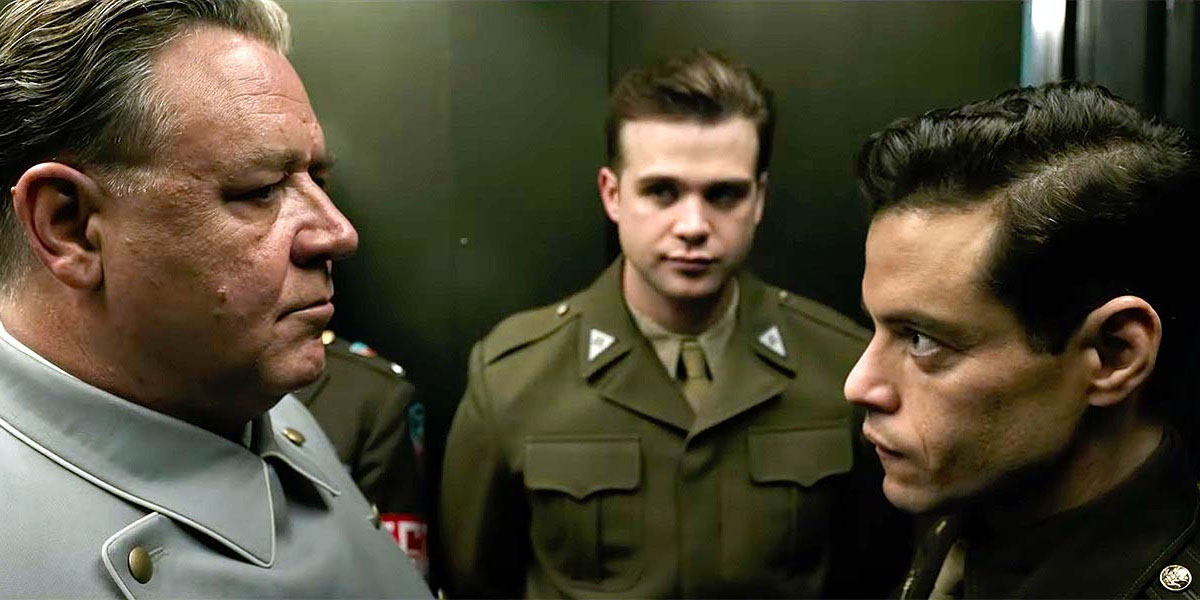
Director and screenwriter James Vanderbilt’s film is based on the 2013 book “The Nazi and the Psychiatrist” by Jack El-Hai. It follows U.S. Army psychiatrist Douglas Kelley (Rami Malek), who is tasked with assessing the personalities and monitoring the mental states of Hermann Göring (Russell Crowe) and 21 other high-ranking Nazis in preparation for the Nuremberg trials.
The first half of the two-and-a-half-hour film focuses on Kelley’s unsettling relationship with Göring as he tries to gain his trust and understand not only why he and others followed Hitler so blindly, but how human beings become capable of such extreme evil. The second part shifts into the courtroom, tracking the historic proceedings.
In a press conference, Vanderbilt said he hadn’t known that psychiatrists were involved in evaluating prisoners during the war. After reading Jack El-Hai’s book proposal, he immediately knew he wanted to tell this story. “It was the quickest I said yes to anything in my life,” he recalled. Still, it took 13 years for the film to reach the screen.
Robert Jackson (Michael Shannon) was an associate justice of the U.S. Supreme Court who took a leave from the bench to serve as the Chief U.S. Prosecutor. At the opening of the trial on Nov. 21, 1945, he delivered one of the trial’s most powerful statements: “The wrongs which we seek to condemn and punish have been so calculated, so malignant, and so devastating, that civilization cannot tolerate their being ignored because it cannot survive their being repeated.”
“The U.S. Army wasn’t interested in a trial at all,” Vanderbilt noted. “There was actually a standing order that Churchill and Roosevelt had agreed upon to shoot these men within 48 hours of their capture. And Jackson said no, this is an incredibly important thing that we have to do.”
Malek, 44, born to Egyptian parents who immigrated to the United States in 1978, described how emotionally charged the filming was. “I could see a chin quiver. I could feel my heart racing … It wasn’t about who would give the better performance, but who would allow us to tell this story about moral courage and resilience.”
Malek, who previously stared in “Bohemian Rhapsody” and “Oppenheimer,” said he was drawn to roles that probe tension, identity and moral responsibility. “Choosing those stories is my way of engaging with complex ideas of silence or complicity,” he explained. In his view, “Nuremberg” forces a deeply personal question: “What do we do in the face of injustice?”
He called his work in the film one of his highest achievements, not just artistically but morally.
“I’ve always been drawn to roles that raise questions rather than give easy answers,” he said. “Whether it’s about identity or power or responsibility.
“Choosing those stories is my way of engaging with complex ideas of silence or complicity.”
Crowe, almost unrecognizable as Hermann Göring, plays the Luftwaffe chief as a man who is charming, manipulative and narcissistic. When Kelley sits down to speak with him, he doesn’t initially appear monstrous at all — just another man worried about his wife and daughter, a reminder of how deceptive human evil can be.
Because the events take place after the war, there aren’t any shocking scenes of Nazi brutality, except for some archival footage that was included during the trial scenes. We see men who look like walking skeletons and piles of bodies being shoved away by a tractor.
Shannon was in awe of the man he portrayed and said it was a humbling experience. “What he accomplished in his life is staggering in comparison to what I’ve accomplished in my own. I guess the one solace of being in what can be considered at times a pretty silly profession is that you get to inform the world, other people, about things that they probably don’t know much about and things, situations, people, stories that are important.”
“Nuremberg” is ambitious. Vanderbilt filmed the courtroom exchange between Crowe and Shannon in a single day. This is one of the best and strongest scenes in the film. Vanderbilt described it as “a verbal gunfight.”
But at times, it tries to cover too much: Kelley’s investigation, the courtroom drama, the political backdrop and even a brief romantic subplot. Yet the film’s strongest scenes are also its quietest: two men in a small room, one searching for humanity, the other trying to rewrite history.
While the film doesn’t reveal anything new or answer the question it sets out to explore — how human beings are capable of such unimaginable cruelty — its value lies in raising the question at all. Eight decades after the Holocaust, we continue to witness acts of brutality against Jews, and even more disturbingly, we still see people justifying it, ignoring it or even celebrating the suffering of Jews. In that sense, this film feels more relevant today than ever. It serves as a necessary reminder, and a history lesson, for those who never learned about it, or have chosen to forget.