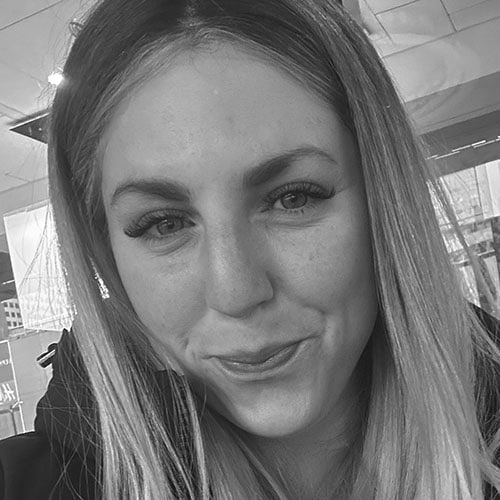
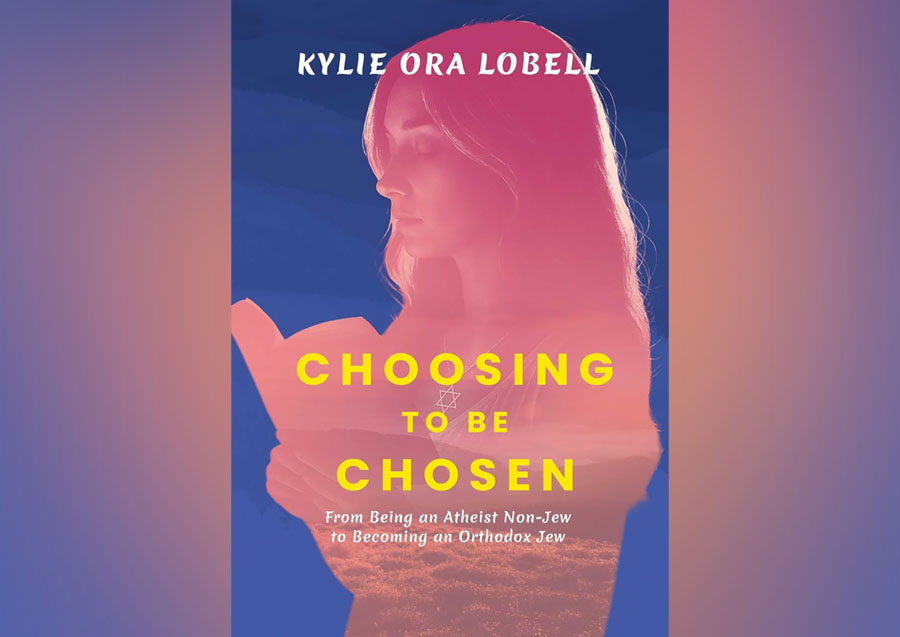
For the past six years, along with writing for The Jewish Journal, I’ve been working on my conversion memoir, “Choosing to be Chosen: From Being an Atheist Non-Jew to Becoming an Orthodox Jew.” It’s about my journey from a broken, secular Christian home to teenage atheism, to a chance encounter with a lapsed Jewish stand-up comedian — my husband Daniel — culminating in a spiritual quest for conversion to Orthodox Judaism.
Mayim Bialik, a superhero for the Jewish people, says, “‘Choosing to Be Chosen’ is an inspiring exploration of what we can become when we listen to the divine rhythm all around us, and how beautiful and satisfying an adventure figuring it out can be. Kylie is a skilled thinker; detailing an awareness that grows and thrives concurrent with her love and her faith. There is something unique and special in Kylie becoming the woman God meant for her to be.”
I wanted to exclusively share an excerpt from my book with my favorite readers, my audience here at The Jewish Journal. If you like it, please consider pre-ordering my book on Amazon or Barnes and Noble so you can get it right away when it comes out on Feb. 17, 2026.
This excerpt is from an early part of my conversion journey, when I went to my first class on Judaism.
When I got to the Introduction to Judaism class at the 92nd Street Y, the other students were a bunch of Wall Street guys and their extremely good-looking fiancées. One was a Japanese woman with perfectly straight, silky hair and a nice white blouse. Another was a blonde bombshell wearing stilettos and diamonds.
I looked down at my pants, corduroys from Target, and my band T-shirt. I thought I must have looked like such a schlub. I’d just learned that word in Yiddish, and it seemed to fit me well.
When the rabbi walked in, I saw he was wearing a brightly colored knit yarmulke with the Phish band logo on it. He was Rabbi Miller, and he explained that he worked at a Modern Orthodox synagogue, and he was excited to teach this class.
The blonde woman raised her hand. “One question before we get started, Rabbi,” she said in a thick Russian accent. “If I become Jewish, does that mean I have to give up lobster?”
“Oh, we’ll get into all that, don’t you worry,” he said, smiling. I laughed to myself and thought, “Yeah, of course you’re going to have to give up lobster, lady. It’s shellfish!”
Rabbi Miller spent the first class talking about the basics of what it meant to be a Jew: to believe in God, and only one God. I learned that if I wanted to convert, I’d have to renounce all my former beliefs. This would be easy, since I didn’t practice a religion other than Judaism. Rabbi Miller explained that Jews follow the Torah, and that traditionally, they believed God wrote it and that Moses, a prophet, gave it to the Jewish people. Judaism was the original monotheistic religion, and other religions — Christianity and Islam, for example — came after it. They had some similarities to Judaism but also changed the Jewish teachings in the Bible and the Quran. The Ten Commandments came from Judaism, but there were actually 613 commandments in total.
The rabbi said that we could view following the commandments and doing the mitzvahs as a way to connect to God, while sinning was a way that we disconnected from God. And on that note, mitzvah, while used colloquially to mean “good deed,” simply meant “commandment.”
After the brief introduction, Rabbi Miller turned to the blonde woman that asked the lobster question at the beginning of class.
“One of the commandments is to not eat shellfish, so unfortunately, lobster is out,” he told her.
With a disappointed look, she crossed her arms.
“But you can still have fish!” the rabbi said, laughing and pointing to the Phish logo on his yarmulke.
I giggled. This was going to be an interesting class, all right.
In the class, Rabbi Miller covered the basics of Judaism: the holidays and calendar, history, lifecycle events and prayer. While there were formal prayers you’d say every day, such as the Modeh Ani (which meant “I give thanks”) prayer when you woke up, or the Shema (“listen”) prayer right before bed, you could also pray to God in free form.
“The purpose of prayer is to get into a habit of building a connection with God,” Rabbi Miller told us. “We can ask God for help, we can thank Him, and we can praise Him. You can ask Him for small things, like help getting a good seat on the subway, or for bigger things, like helping you out financially. God wants us to reach out to Him.”
I raised my hand. “But what if you pray and your prayers aren’t answered?” I asked. I thought about my parents’ divorce and Grandma Jane’s death.
“That’s a tough one, I’ll admit. Here’s the thing: Only God sees the big picture. We can see a small snippet of it, and that’s it. What looks bad could be good, and what looks good could be bad. Our job is to trust that even if He doesn’t answer our prayers, in no way does that mean He’s forgotten about us or doesn’t care.”
Another student, one of the Wall Street guys, raised his hand. “Yeah, Rabbi, people in my family died in the Holocaust,” he said. “I have a hard time believing that was good.”
“I’m so sorry to hear that. My understanding is that what God does is for the best — but we don’t know what ‘the best’ means. This is a classic question: Why do bad things happen to good people? I don’t know the answer. I only trust. And with this caveat, so I don’t sound Pollyannaish or dismissive, it’s totally fine to be mad at God or frustrated. It’s normal, even. It’s part of our relationship with Him. If it was all good, what good would this relationship be? It’d be a shallow one. He wants us to grapple. It’s what makes us more connected.”
We were all silent as we let the rabbi’s words sink in. For the first time, I felt some comfort about my past and my relationship with God. Judaism was helping to repair it.
It made me even more certain: I wanted to be a Jew.
Excerpted from “Choosing to be Chosen: From Being an Atheist Non-Jew to Becoming an Orthodox Jew” by Kylie Ora Lobell. (c) 2026 Published by Wicked Son. Used with permission. Follow her on X: @kylieoralobell or Instagram: @kylieorawriter.