Parents are gathering on a field at their local church. While they socialize with one another and grill delicious food, their children happily play baseball and basketball. For just a few hours, these parents don’t have to watch their kids so closely or worry about any “enrichment” that’s happening or the number on the little league scoreboard.
The parents are free.
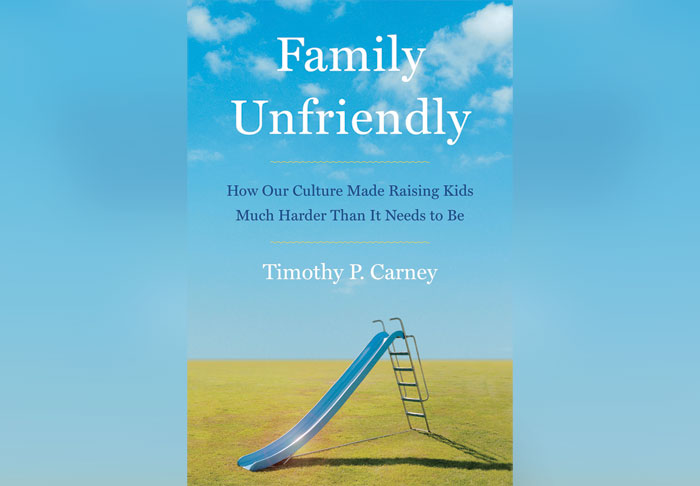
 This is the opening scene of “Family Unfriendly,” a new book by Timothy P. Carney, a senior fellow at the American Enterprise Institute. The book is about just how difficult parenting has become in the United States because of societal standards – and what we can do to change this mentality and make parenting enticing, fun and simpler once again.
“I wrote this book in order to shout as loud as I can: the tiger moms and helicopter parents are doing it wrong,” Carney writes. “And if you are the average parents and are nagged by feelings of inadequacy, then the main thing you’re doing wrong is worrying too much. It’s not your fault. Modern parenting madness isn’t a foible of individual moms and dads. It is a cultural pathology that has massive consequences.”
“I wrote this book in order to shout as loud as I can: the tiger moms and helicopter parents are doing it wrong.” – Timothy P. Carney
“Family Unfriendly” goes through the factors that make parenting much harder than it needs to be and offers solutions for change. Carney spends a good deal of time on the merits of hands-off parenting, lowering standards for kids and avoiding the team travel trap at all costs. He speaks from his own experience: His son, Charlie, played select baseball, where he and the other boys on the team became anxious and miserable because of an overzealous coach. The author saw firsthand how damaging team sports could be if they pressured children into becoming elite, instead of just enjoying it.
“Our culture teaches parents that you need to hone your daughters and sons into high achievers at a young age, and that you have to give them every advantage possible: tutors, lessons, equipment, private training,” Carney writes. “It takes up all of your money and time. Overly ambitious parenting, often unchosen or unconsciously chosen, is one big reason that parenting seems so hard and so costly in modern America.”
The book is validating to hands-off parents and to moms and dads who feel like they’re always doing something wrong. Hint: They aren’t. The outside forces, including the isolating suburbs, a lack of government support for parents and an emphasis on perfection all make parenting challenging, leading younger people to stay away from it altogether.
Carney, a husband, father of six and devoted Catholic, looks at the ever-decreasing birthrates in the Western world, and sees only one country that’s well above the birthrate replacement level: Israel. In “Family Unfriendly,” he tries to figure out why this is, as well as what the U.S. could learn from Israel. He visits the Jewish homeland, chatting with religious and non-religious Jews, observing how children are so highly integrated into the culture
“Babies are everywhere – in the cafes, the restaurants, the theaters, the workplaces,” he writes.
The author went to Israel on a Christian pilgrimage “with the desire to talk to as many secular Jews as possible” he told the Journal. “If you ask an Israeli person their opinion, they’ll give it to you nine out of 10 times. It was a great experience.”
What Carney found was that Israeli society wants children; he cites how Tel Aviv was built around a school building, the very first building erected in the city in 1909. There are places throughout Tel Aviv where parents can relax with their friends and let their children play. Many Israelis let their kids walk to places on their own, letting “free-range parenting” take over, while both secular and Orthodox Jews take the “be fruitful and multiply” mitzvah to heart. A belief in God helps with parenting as well.
“On a subconscious level, once you think to yourself that God has some sort of plan, you know you can’t control every outcome,” Carney said. “That allows people to be happier and more relaxed.”
Though the author is politically conservative, there are several ideas in the book that could appeal to liberals as well – like the government giving cash to couples who have children, making cities more walkable and not placing parenting duties solely on women.
“My cultural goal is to encourage people to get married and have kids,” he said. “That can free you from what’s right or what’s left and actually accomplish that goal.”
The book ends with a look at where our culture stands now: We are experiencing what Carney calls “civilizational sadness.” This has been brought out by our negative outlook of our country, the fearmongering in the media and a lack of faith in our lives.
“Can those who believe we face a climate apocalypse of our own making believe that we are good?” he writes. “Can those who think America is essentially and irreparably racist believe that we are good? Can modern men and women who increasingly reject the idea of a loving God look beyond their own failings and see an ultimately good soul?”
To remedy this widespread gloom, Carney suggests a few solutions: First, we need to bring God back into our lives.
“Religiosity breeds happiness – the social science confirms it, even if Hollywood scripts say otherwise,” he writes. “Specifically, being religiously active — belonging to a religious community and attending services at the church, synagogue or mosque — predicts happiness. In the U.S., the religiously active are 50 percent more likely to say they are very happy than are the unaffiliated or inactive.”
Fittingly, of course, Carney believes that if we have more children, we can also chip away at the sadness.
“Humans are good,” he writes. “The truth is obscured at times by our own self-absorption or by others’ imperfections, but children, in their innocence, reflect mankind’s innate goodness back to us.”
It’s not too late to tackle this family unfriendly trend and the despondency we’re going through. Carney, ever an optimist, sees a way out of it.
“While I think being sad causes us to have less marriage and fewer babies, if somehow we just reverse that a tiny bit, it would be a virtuous cycle: more marriage and more babies will make us more hopeful about the future and make us happier,” Carney said. “If we get a little nudge in the other direction and start a positive momentum, we’d move towards a happier world.”