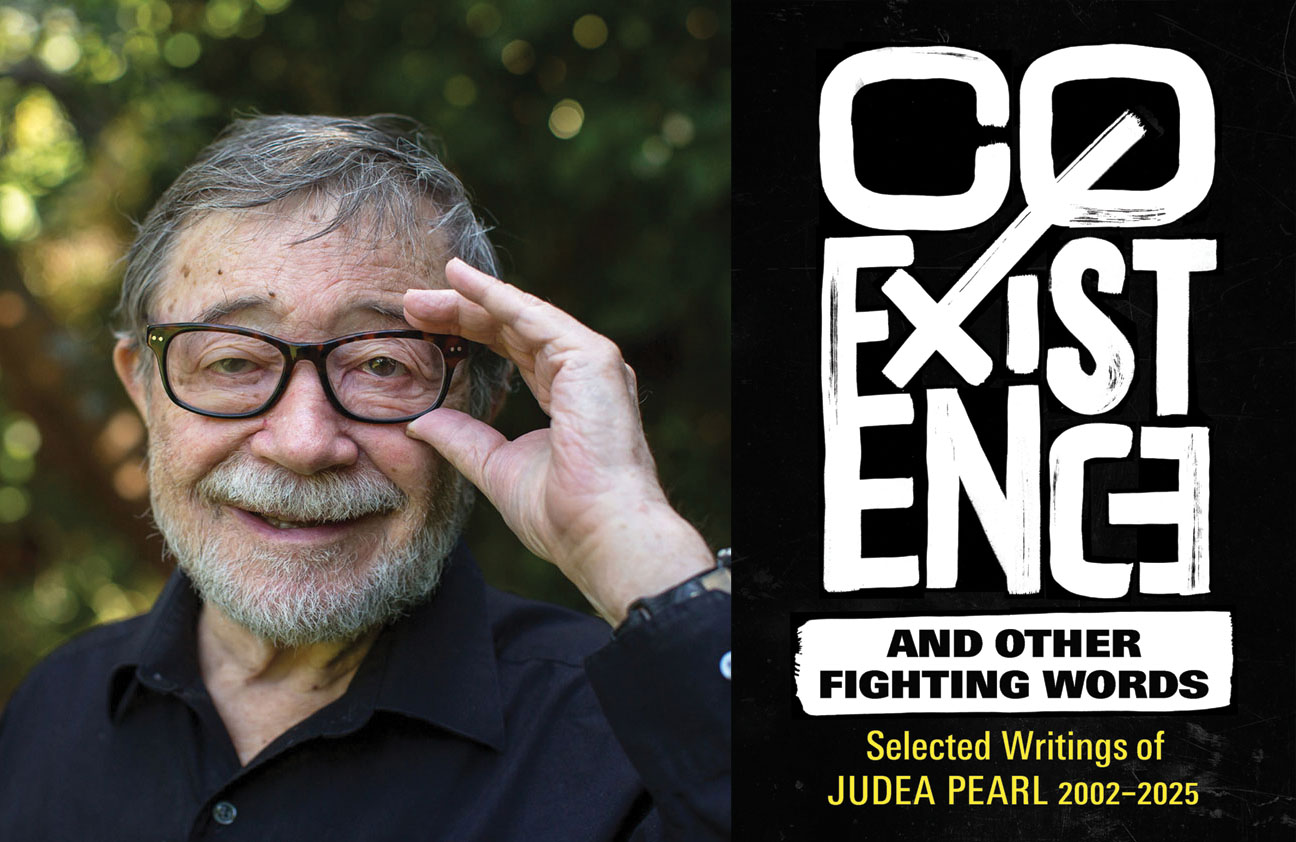
Judea Pearl may be best known to Jewish Journal readers as an enemy of terrorism and an advocate for reconciliation, a role thrust upon him when his son, Wall Street Journal correspondent Daniel Pearl, was murdered in Pakistan in 2002. They younger Pearl’s courageous last words, “I am Jewish,” served as the title of Judea Pearl’s collection of writings about Jewish identity.
Yet, Judea Pearl has also written himself into history for an entirely different reason. The long-serving UCLA professor of computer science “has been the heart and soul of a revolution in artificial intelligence,” said Eric Horvitz, a researcher for Microsoft. Pearl won the 2011 Turing Award, the equivalent of a Nobel Prize in the field of computing, and he is the author of three classic treatises on the surprisingly controversial debate among scientists that has come to be called the “causal revolution.”
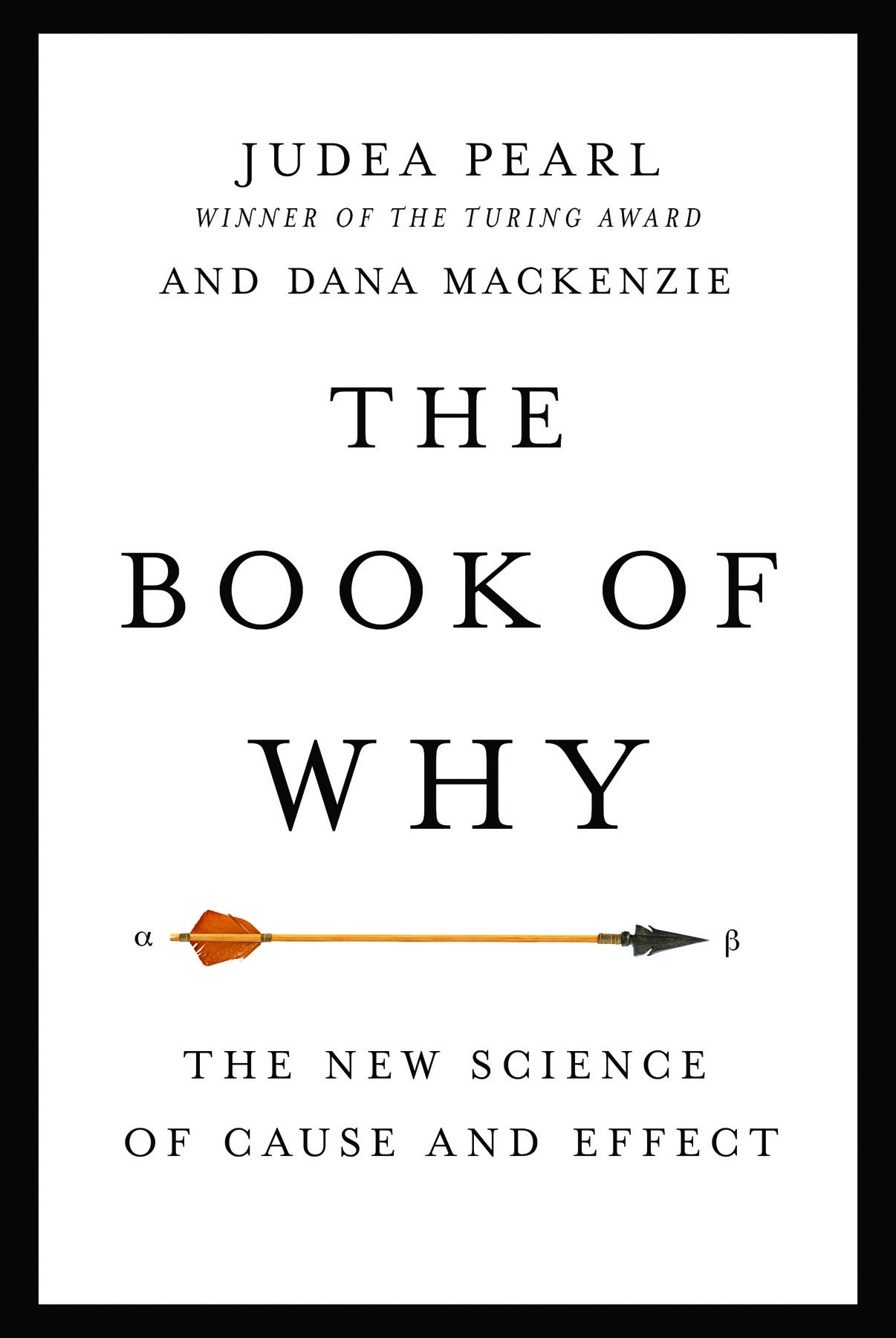
Pearl’s latest book, co-authored with award-winning science writer Dana Mackenzie, is “The Book of Why: The New Science of Cause and Effect” (Basic Books). For the lay reader, “The Book of Why” may seem like science fiction in some passages and a moral treatise in others, but Pearl’s self-described mission is to extract the science of artificial intelligence from its mathematical roots and show what science has revealed about the way the human brain works.
In the book’s preface, Pearl writes: “I aim to describe to you how robots can be constructed that learn to communicate in our mother-tongue — the language of cause and effect. This new generation of robots should explain to us why things happened, why they responded the way they did, and why nature operates one way and not another. More ambitiously, they should also teach us about ourselves: why our mind clicks the way it does and what it means to think rationally about cause and effect, credit and regret, intent and responsibility.”
Pearl and Mackenzie begin with the fundamental proposition that what distinguishes us Homo sapiens from other species is our unique ability to grasp the simple but powerful notion that “certain things cause other things.” Indeed, they see causality as the taproot of history: “From this discovery came organized societies, then towns and cities, and eventually the science- and technology-based civilization we enjoy today. All because we asked a simple question: Why?”
By the end of Pearl’s lively and accessible book, we come to appreciate what the scientific study of causality has accomplished in the real world.
Curiously, science was slow to embrace the notion of causality. “In vain will you search the index of a statistics textbook for an entry on ‘cause,’ ” Pearl and Mackenzie point out. “Students are not allowed to say that X is the cause of Y — only that X and Y are ‘related’ or ‘associated.’ ” The refusal to confront cause and effect was a check on scientific progress. “For example, only a hundred years ago, the question of whether cigarette smoking causes a health hazard would have been considered unscientific. The mere mention of the words ‘cause’ or ‘effect’ would create a storm of objections in any reputable statistical journal.”
Pearl is careful to avoid scientific jargon and to minimize the number of charts, graphs and mathematical formulas through which scientists usually communicate with one another. After all, his mission in the “Book of Why” is to translate hard science into plain language. Ironically, however, he also points out that “dumb robots” can learn about cause and effect only through numbers. And he insists that raw data are also “dumb,” especially if we fail to tease out the correct answers from “big data.”
The danger is that we can mistake “correlation” for causality. “For instance,” he explains, “… there is a strong correlation between a nation’s per capita chocolate consumption and its number of Nobel Prize winners. This correlation seems silly because we cannot envision a way in which eating chocolate could cause Nobel Prizes. A more likely explanation is that more people in wealthy, Western countries eat chocolate, and the Nobel Prize winners have also been chosen preferentially from those countries.”
To ease the lay reader into the more obscure workings of science, Pearl draws on pop culture. When he invites us to consider “a surprisingly large class of paradoxes that reflect the tensions between causation and association,” he uses the TV game show “Let’s Make a Deal” as a case study. Monty Hall would show a contestant what was behind Door No. 3, and the contestant was manipulated into thinking that they had some useful information about what might be behind the other two doors. “Thus, the Monty Hall paradox is just like an optical illusion or a magic trick,” Pearl writes. “[I]t uses our cognitive machinery to deceive us.”
By the end of Pearl’s lively and accessible book, we come to appreciate what the scientific study of causality has accomplished in the real world. “[W]e lit the spark of a Causal Revolution, which has spread like a chain of firecrackers from one discipline to the next: epidemiology, psychology, genetics, ecology, climate science, and so on,” he concludes. “With every passing year I see a greater and greater willingness among scientists to speak and write about causes and effects, not with apologies and downcast eyes but with confidence and assertiveness.”
Pearl was one of the visionary leaders of the causal revolution he describes, and “The Book of Why” is his crowning achievement. Indeed, although the book is co-written with Dana Mackenzie, the first-person singular is used throughout: “I expect that its full potential will be developed one day beyond what I can imagine,” Pearl muses, “perhaps even by a reader of this book.”
Jonathan Kirsch, author and publishing attorney, is the book editor of the Jewish Journal.