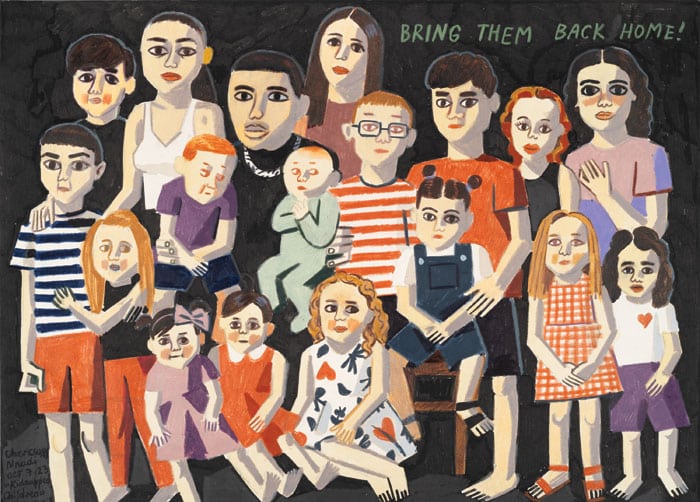
On Oct. 8, Israeli artist Zoya Cherkassky, not knowing what was coming next, took her 8-year-old daughter and fled to Berlin. Zoya, 47, who was born in Kyiv and emigrated to Israel in 1991, also took her art supplies. Creating art was how she processed tragedy.
The early images of the atrocities at Kibbutz Be’eri made Cherkassky think of “Guernica,” Picasso’s 1937 painting of the Basque town after the Nazi Luftwaffe bombed it. Picasso vividly portrayed the horror of inhumanity. Cherkassky began to draw her emotions and quickly produced 12 works that just as vividly show the shock, fear, and brutality of Oct. 7.
A family of ashen, burned bodies look at us in horror, hands pressed against gaping mouths, silently screaming. An elderly couple, hands bound behind their backs, embrace as blood and flames surround them. A mother holds her baby son close as she stares in disbelief at a mass of dead bodies.
“Museums exist to be custodians of world cultural heritage, and this kind of savagery and barbarism is the antithesis of that,” James Snyder, the new director of the Jewish Museum in New York City, said. “We need to speak out against them and do what we can to educate and engage.”
Snyder, who had worked with Cherkassky during his tenure at the Israel Museum, quickly installed her drawings in an all-black room, called “7 October 2023.” For most of us, this was entirely appropriate —in fact, I would love to see more work by Israeli artists. But for the art world, whose hostility toward Israel is renowned, this was considered a “colonial” move.
Metal detectors don’t scan for pro-Hamas “disrupters,” and at three points during the evening these disrupters screamed the usual epithets at Cherkassky.
On the evening of Feb. 12, I went to the museum to hear Snyder interview Cherkassky. The event was packed. We had all gone through security, as every Jewish institution implemented after 9/11. But metal detectors don’t scan for pro-Hamas “disrupters,” and at three points throughout the evening these disrupters screamed the usual epithets at Cherkassky. I’m sure everyone there did the same mental calculation: Metal detectors so they can’t be armed. But of course none of us could be sure.
Which made Snyder’s response all the more interesting. “Thank you for the dialogue,” he calmly told them, as security escorted them out. “This all helps counter polarization.” Cherkassky chose a different tactic: She yelled “F— you!” at the protestors. After another set was forced to leave, Cherkassky said: “I am very happy that there are privileged young people from privileged countries that can know how everybody in the world should act.”
After the third set, a young GenZer behind me screamed out: “This isn’t dialogue; this is antisemitism.” Shockingly, many in the audience screamed at her to “Shut up!”
The Jewish Museum is north of Temple Emanu-El, the site of the Kissinger memorial protests that led to white leftists throwing water in the faces of an elderly couple. There was no public condemnation of the protesters from the synagogue.
All of which begs the question: How should Jewish institutions respond to Oct. 7 and the daily, violent riots that have followed?
Last week I went down to the Museum of Jewish Heritage to hear a panel discuss film clips from Feb. 20, 1939, when 20,000 pro-Nazi Americans filled Madison Square Garden. The footage is terrifying, especially when a Jewish man bravely jumps on the stage and is thoroughly beaten.
The panel made direct parallels to today’s alt-right — Charles Lindbergh became the leading voice of the America First Committee, an isolationist group of 800,000 that was against America entering World War II — and discussed the limits of freedom of speech. But despite the fact that thousands of “Globalize the Intifada” rioters filled Times Square on Oct 8, before Israel began to respond, they purposefully avoided any references to what New Yorkers are now living with on a daily basis.
How could a museum dedicated to the memory of the Holocaust hold an event that intentionally ignored the largest massacre of Jews since the Holocaust?
Toward the end, the moderator even expressed shock that people were “conflating Israel and Jews.”
It turned out to be a prophetic statement but not in the way he intended. At roughly the same time, a young Jewish dentist was murdered by a Muslim in San Diego. Just like in the ‘30s, Jews’ desire to conform — to distance themselves from their heritage — isn’t going to save them. Because as any historian of Jewish persecution well knows — or anyone who has listened to the current chants of “Kill the Jews” — the globalized Intifada has little to do with Israel. It’s about ridding the world of infidels, foremost Jews.
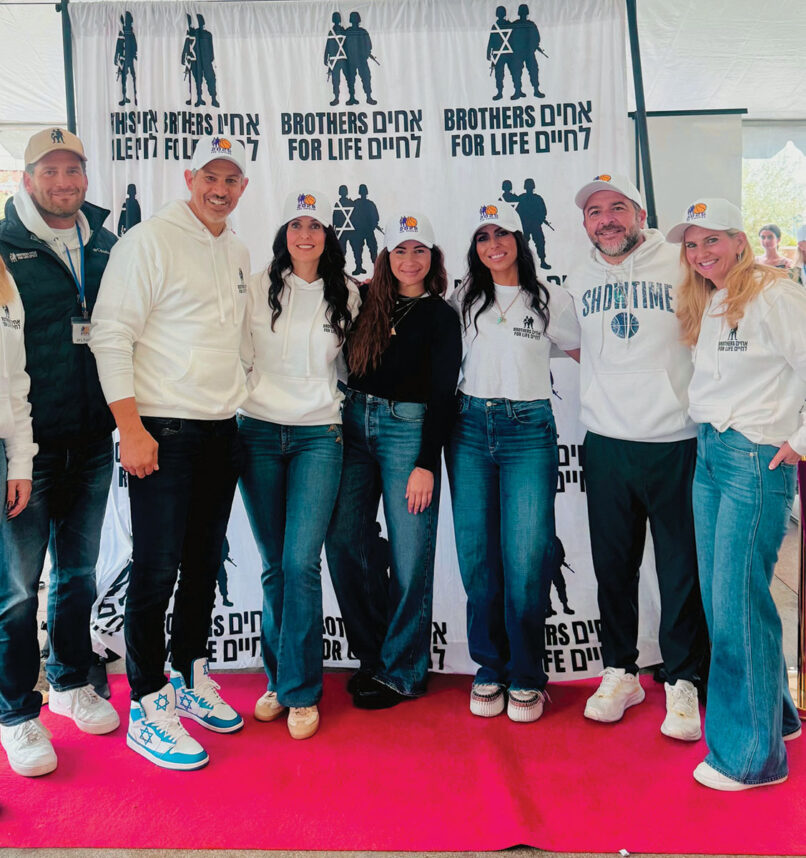
Meanwhile, on the floor below, an Israeli organization called Jerusalem Shield held a fundraiser. The group, started by Ukrainian-born David Roytman, is a rapid response unit of former IDF soldiers. Prior to starting Jerusalem Shield, Roytman had created David Roytman Luxury Judaica. Headquartered in NYC, the brand has 150 outlets all over the world.
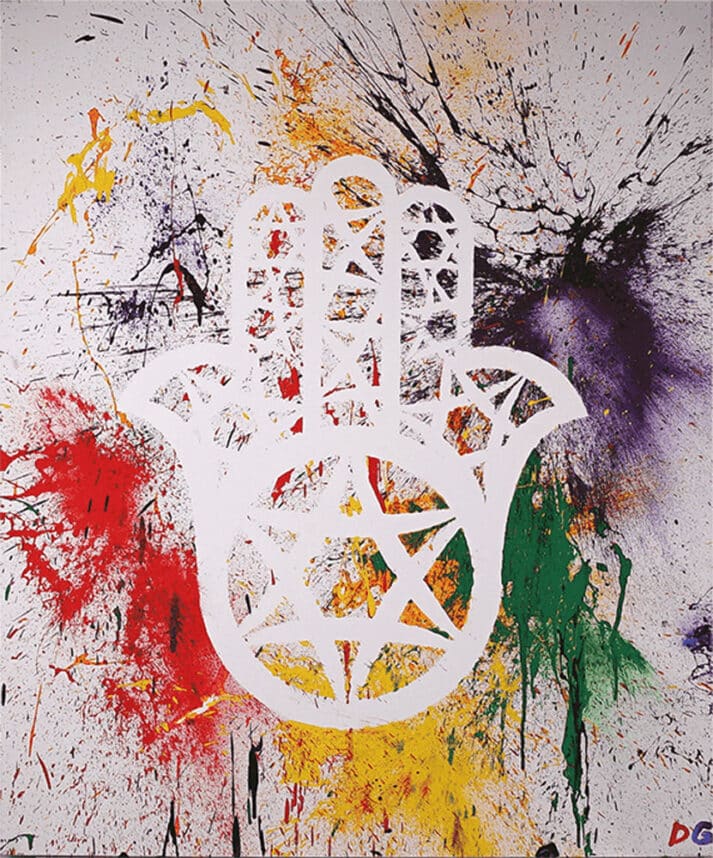
“For 2,000 years, Jews hid the attributes that gave away their origins. They wore the kippah at home, behind closed doors. The Star of David was a mark of persecution,” Roytman writes on his website. The brand was created “to show the world that any attribute of Judaica nowadays is a source of pride.”
I met Roytman in the lobby after both events; I thanked him for everything he does. “You don’t have to thank me,” Roytman said. “I’m just protecting our family.”
Many American Jews have a lot to learn from Israelis about not just the necessity of fighting back but that our 3,000-year connection to our homeland is integral to who we are. We’re beginning to see it from GenZers who are being bullied on campuses. They’re testifying before Congress about the antisemitic violence on campuses and making videos inspiring other Jewish students to stand up for themselves.
Perhaps some of this was meant to be a lesson to those who still haven’t fully processed what being Jewish — ethnically Judean — means. And how allowing your soul to fully grasp that feeling can bring a type of strength, bravery, and resilience that no one can touch. For more secular Jews, Israeli artists, who understand all of this intuitively, may be the best teachers.
Karen Lehrman Bloch is editor in chief of White Rose Magazine.