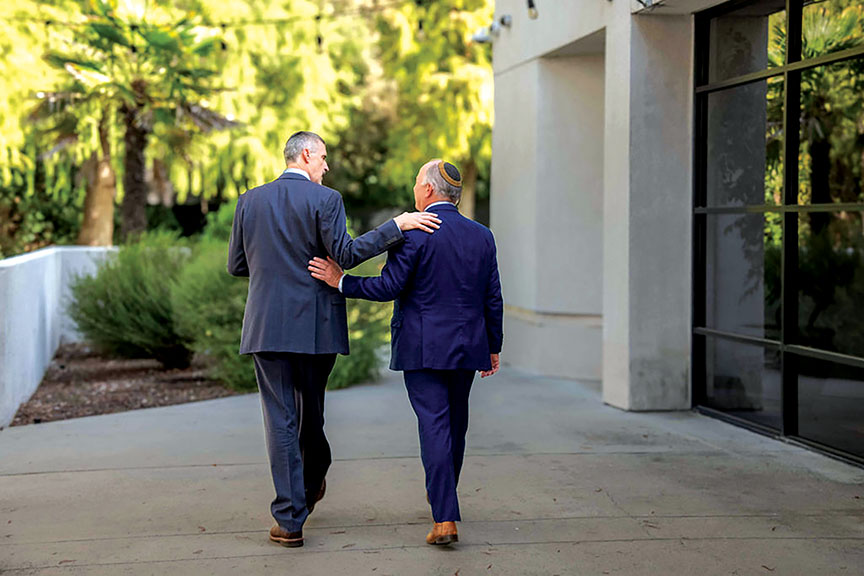
June 30 will be the final day for Rabbis Richard Camras and Stewart Vogel as co-senior rabbis of Hamakom … technically. In reality, they’re not going to take retirement lying down.
Unlike most retirees, Rabbis Camras and Vogel will not be resting on their laurels or reliving past successes. Their vision is set squarely on the future of Hamakom, the three-year-old Conservative West Hills synagogue that is the result of the merger of Rabbi Camras’ Shomrei Torah and Rabbi Vogel’s Temple Aliyah. “Rabbi Vogel and I have felt all along we built two very successful, vibrant, thriving synagogues, down the block from each other,” Rabbi Camras said. “Large, innovative communities. Over a decade ago, we believed that Jewish community in this part of the world would be better served with fewer institutions and more creativity around what a single institution can do.”
When they started discussing the merger three years ago, he said “we spoke about chadash (newness). Could we restructure a synagogue so that it looked less like the synagogue that we typically imagine and more like a place where there are multiple ways in which people can enter and feel engagement with Jewish life?” — tearing down the barriers and walls synagogues often unintentionally create to facilitate an easy access to Jewish life.
From the beginning, they tried to think about the barriers that keep people from joining. And how do they create a new institution that provides multiple different avenues for access to Jewish life? And, just as importantly, are they the best to build that future synagogue?
Rabbis Vogel and Camras point to the grant they obtained to become part of a growing network of synagogues offering afterschool Jewish daycare for elementary students in a different, sophisticated manner through an organization in Atlanta called Jewish Kids Group.
The Valley rabbis created The Spot. “While we certainly have lots of energy and ideas, and excitement about the future,” Rabbi Camras said, “we realized we are toward the end of our careers. It would be better for Hamakom to bring in new rabbinic leadership. Meantime, there were ways we could establish a new community by lowering the barriers and beginning to think more creatively about how people connect to Jewish life.”
Before The Spot, there was The Nook, which provided infant care. Rabbi Vogel said, “What we are looking for are areas in which to engage people from the beginning. The Jewish community is in need of something but they don’t realize they need Jewish community, and that is where The Spot comes in. We’ll take care of your kids in the afternoon.”
Rabbi Camras smoothly picked up the thread. “We will pick them up from school in a van. We will bring them here, give them a snack. We will tutor them, give them arts and crafts and whatever else. We also will teach them Judaica, not for the sake of becoming bar mitzvah, not so that you feel you need to belong to a synagogue, but so that your kids have a sense of Jewish identity and you, the parents, also feel that you are connecting to the Jewish world without necessarily the high barrier of membership and all the accoutrements that come with it.”
They may not be interested in that. They’re interested in one particular need they have, after-school care. “And because they are Jewish, they don’t mind the identity and the Jewish learning that comes with it.” Same thing with The Nook. It was a response “to parents who are fulltime …” Rabbi Vogel picked it up: “… dual-working families and others who just have the need.”
It’s not a preschool, Rabbi Camras said, but “an infant center. They want a Jewish infant center. They want opportunities for the kids to engage in Jewish life, in learning about Shabbat, celebrating holidays.”
Rabbi Vogel adds some detail – “Maybe they don’t realize they need Jewish community, but then they feel it.” Nodding to his co-rabbi, he said that from there, Rabbi Camras was “really instrumental in creating what we call The Spark, which is for active seniors, older adults that will expand to not just for members of our community,” but older adults throughout West Hills. You won’t have to be a member of the synagogue, and there will be opportunities for engagements “around social, travel, education, physical well-being for all older adults in this area, whether you belong or not.”
Rabbi Camras stepped right in, bringing the subject home: “So we have The Nook, The Spot and The Spark. All of those things are attempts to unbundle, as Rabbi Vogel says, synagogue membership from what a synagogue community can offer the world.” To make shul life appealing to those who are disinclined to be joiners.
There were two things they realized, Rabbi Vogel said. “When we talk about chadash [new] and a complete revisioning,” they first had to concentrate on integrating the two shuls and the work of bringing communities together. “That became a lot of the work,” he said. “We considered it our real main job, to bring these communities together to function as one. Most mergers in the country fail. They enter into discussions and just fall apart – very common. Sometimes they will come together, and they will even divorce within a year or two. We had it in the Valley a couple times.”
But even when they stay merged, he admitted, it is not always successful. “We learned a lot of work goes into the merging part.”
Fast Takes with Rabbi Vogel
Jewish Journal: Do you have any unfulfilled goals?
Rabbi Vogel: Not at the moment. I have been so blessed to have done so many different things, to have co-authored a national best-seller in 1998, “The Ten Commandments.” My life has been filled with opportunities when you are not searching for them. I think my next project is going to come along.
J.J.: Best book you have read?
R.V.: “Midnight Library.” Rabbi Camras and I frequently deal with themes of regret. People often regret decisions they made or didn’t make because of how that decision possibly would have affected their lives.
J.J.: What is your favorite Shabbat moment?
R.C.: A number of years ago I was leading a synagogue to Israel. We were praying at the Kotel. Suddenly my son Elie walks by with his Camp Ramah group. In that moment, I just was tearing up.