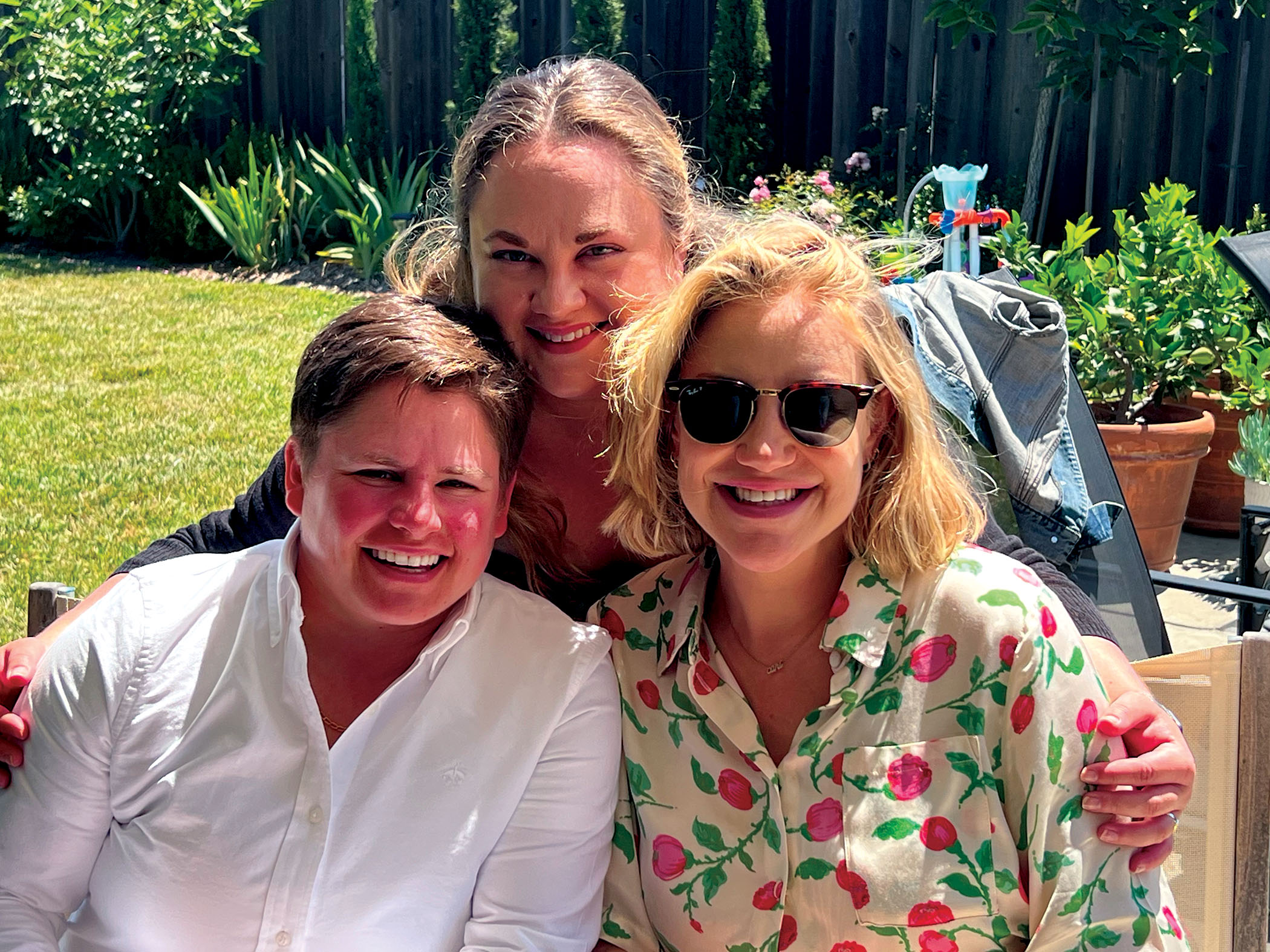
Rabbi Jillian Cameron of Beth Chayim Chadashim firmly insists that she is an introvert. Since no one has heard of such a rabbi, she, at times of professional requirement, undergoes a personality reversal. “I figured out how to do it,” she said. “So I became an extroverted rabbi.”
Rabbi Jillian was raised in Bergen County, N.J., in a loving interfaith family, although no faith would have been a more accurate description, she said. Both her raised-Jewish father and born-Catholic mother had left their roots behind.
How does someone raised in such an environment grow up to be the senior rabbi of a significant synagogue? Beth Chayim Chadashim, in the heart of Pico-Robertson is the first shul founded, in 1972, by and for lesbian and gay Jews.
When she was seven years old, a public school classmate urged her to go along with her to Hebrew School. That changed Rabbi Jillian’s life. She doesn’t exactly recall that life-changing scene. Her parents told her what happened. This no-nonsense manner of telling monumental moments in her life is typical of Rabbi Jillian. The leader of the first shul founded by LGBTQ+ Jews matter-of-factly told The Journal that she realized she was gay around 24 or 25.
When she was seven years old, a public school classmate urged her to go along with her to Hebrew School. That changed Rabbi Jillian’s life. She doesn’t exactly recall that life-changing scene. Her parents told her what happened.
How is it that non-religious parents not only send their older of two daughters to Hebrew School but, to seal the agreement, joined — and became active members of — a Reform synagogue?
Entering Hebrew School at seven was the life-changing moment that no one in the Cameron family could have predicted. At 15 or 16, after realizing she yearned for a career in the rabbinate, there were still significant hurdles to be met.
In a family where the only other Jew was her father, Rabbi Jillian was confronted by challenges from other Jews who insisted she was not really Jewish since her mother never had converted.
“I was Reform all the way,” she said.
“After high school, a part of me knew that being a Jew of patrilineal descent would make my options of places to be different. That didn’t factor into my thinking in high school. Frankly, I didn’t think much about that. In my community, my family was welcomed, celebrated. I didn’t have a sense about how that would be seen by other people until I went to college and people started telling me I wasn’t really Jewish because my Mom wasn’t Jewish.” Rabbi Jillian chose Judaism as her life long before the barbs began. “It was a love affair from seven years old,” Rabbi Jillian says firmly.
“I had community. I had values. I had people who were inspirational. I felt connected. From then on, Judaism has been the center of my life.”
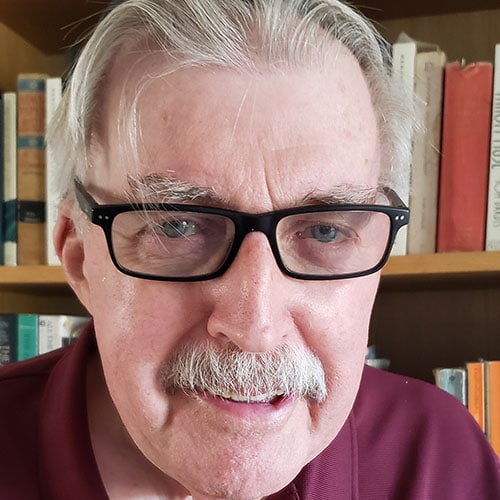
Synagogue membership – and participation – “meant a lot” to Rabbi Jillian’s parents and her sister. “This was the first real community we had as a family.” Rabbi Jillian told The Journal that when she teaches Torah Study to the Beth Chayim Chadashim community, Richard Cameron, her father, is in her Zoom audience. “My parents, Richard and Cathy, who live in Northern California, always have been incredible supporters of my sister and me,” said the rabbi.
When she was 17 and told her parents she was planning a career in the rabbinate, “they probably weren’t so surprised because I was so involved in numerous areas. But I am not sure they ever imagined me being a rabbi.” Still, she said, “they not only allowed but encouraged me on my Jewish path.”
She was not sure she wanted to be a congregational rabbi. In the Boston area, “I worked in one of the centers of Reform Judaism to get a sense of what Jewish life was outside of one synagogue. Having done both – congregational and working with interfaith families — I loved being part of people’s lives,” said Rabbi Jillian. “Congregational life has a lot of ups and downs. It can be difficult.”
During the Journal interview, her dog Yasha happily bounced about her high-ceilinged office. “He is the cuter of the two of us,” she said.
As for BCC, “when this opportunity came along, it was exactly what I was looking for. I had lived in New York for 10 years. Thirty-eight years of Eastern winters was enough.” She was searching for a community “where I could be all the different parts of who we are.” After being interviewed by members of the BCC Search Committee, “I knew this was a place where I could plant roots and grow.”
BCC appealed to her because of “the way people deal with the many pieces of who we are. To celebrate all of the diversity. It’s primarily an LGBT synagogue. But there is so much diversity within those letters. And we have an interfaith population. We have people who come regularly who aren’t Jewish and Jews of color … we are all a slew of different things.”