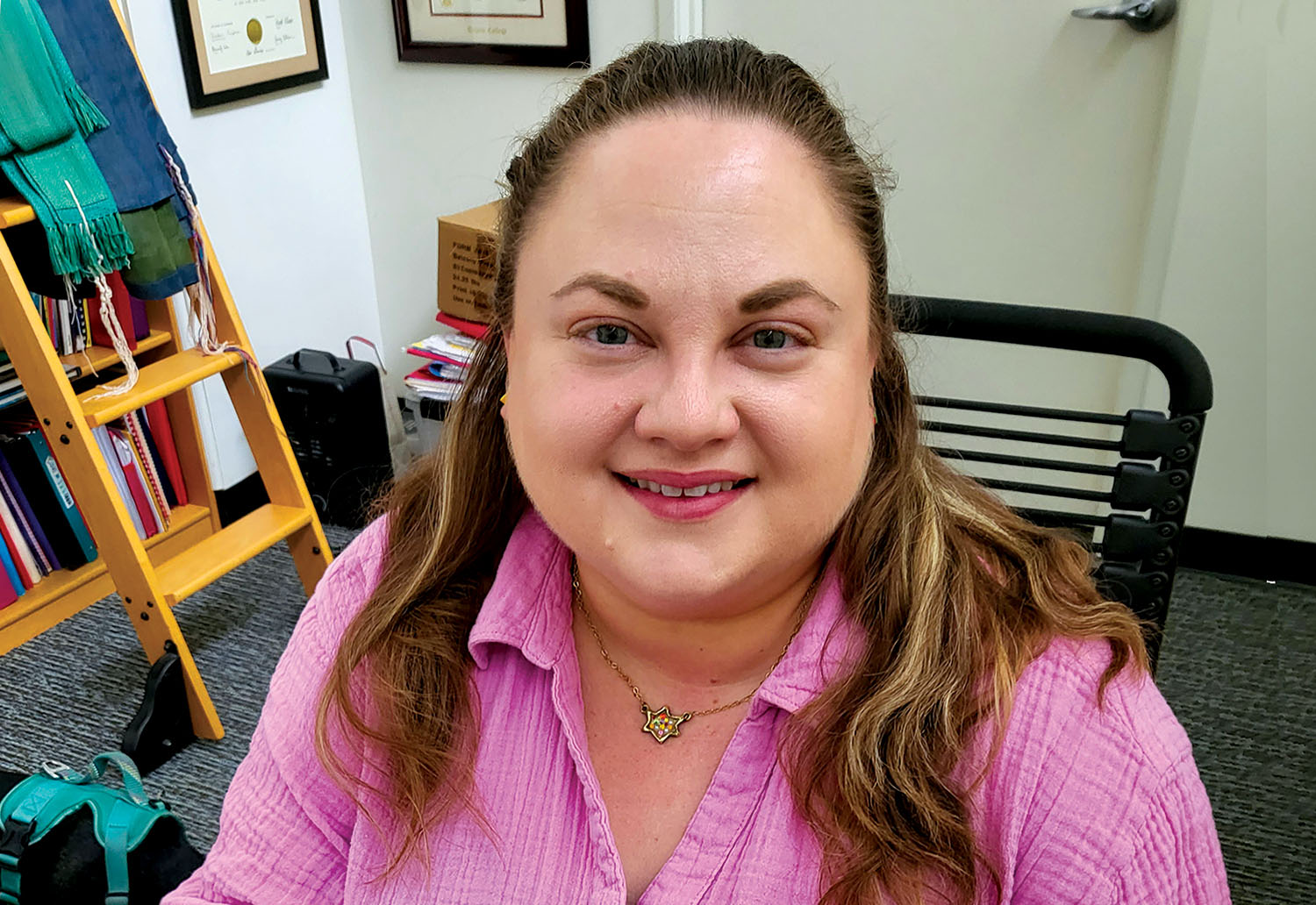
Sitting down with The Journal to talk about her career, Rabbi Jillian Cameron kicked things off with a story about growing up in New Jersey.
“When I was in second grade, my best friend, Julie, invited me to come with her to Hebrew school after school one day. Being the kind of kid who loved school and learning, it didn’t take much convincing. A week or so later, I sat with Julie in her Hebrew school classroom, totally enthralled.”
But she remembers nothing about this story. “I was told about it after the fact,” she said. “This is from my parents’ perspective.” She does remember falling in love with Hebrew school. “More school? This is great! Let’s see what else there is to learn.” It’s a love that lasted. She grew up to be a rabbi and, for the past five years, has been the leader of Beth Chayim Chadashim (BCC), the world’s first synagogue founded primarily by and for lesbian and gay Jews. But in second grade, Cameron would not have been the girl you expected to go into Hebrew school – much less the rabbinate. She described her father and mother as “very loving, supportive people, happy for me to be passionate and excited about things.”
Thirty-six years later, she imagines “they may have had a funny conversation after this because neither of them was religious. My mother was raised Catholic. She decided early on this was not interesting to her. My dad was raised a Conservative Jew. They were hippies. That was their era.” She doesn’t think either of her parents had any sense of engaging in anything religious with their family. “A lot of things had to line up for me to be here right now,” she said.
Her parents joined a synagogue so Jillian could study with her new Hebrew school classmates. It was a Reform shul “so the fact my mother was not Jewish was not a problem for them. My father was like, ‘Alright, I guess.’” But it wasn’t until years later, when she was studying for her Confirmation, that she started thinking about becoming a rabbi. “At 15, 16, I was thinking ‘Hmm, this would be an interesting job.’ But I was probably 17 before I said it out loud.”
She was especially intrigued by the opportunity to have an impact on the lives of people. “I noticed this appealing quality in my rabbi,“ she said. “She certainly had an impact on my life.”
The elder of two daughters, Cameron was fascinated by her rabbi’s relationships with the congregation. She was impressed, then and now, by the way synagogue members “leaned” on their rabbi – “and then there was being able to have an impact on the world doing something with purpose with my life.”
There was one thing Cameron was clear what she did not want: “I wasn’t interested in just buying something or selling something. Nothing is wrong with that, but I could not see myself doing that.”
She considered becoming a lawyer. She believes many who settled into the rabbinate at least first considered a life in law. Other fields also grabbed her attention. “I thought about being a writer, and I love teaching, too. But all the things I loved most, they worked within the rubric of what a rabbi would do.”
As she was nearing her decision, she was trying to figure out how to break the news to her parents. “Very softly,” she concluded. “I was worried they would say ‘What? You could never do that!’ Not that they ever had said that in my life, but if you say something out loud, that means it’s real, right?”
To her relief, there wasn’t any parental pushback. The only family member she ever shared her secret with was her sister. “She is wonderful and lovely,” Cameron said. “When I told her I wanted to be a rabbi, she said ‘Why? You’re so smart.’”
For college, Cameron wanted a school that was not huge and offered Jewish Studies. She chose Trinity College in Hartford, Connecticut. “My rabbi’s husband had gone there,” she said. It felt like a good fit. She worked at a summer camp and did “lots of Jewish things.” This way she could learn more and figure out what the Jewish world was like outside of her synagogue.
Most importantly, she wanted to increase her Jewish knowledge. Growing up, her family celebrated holidays in secular ways – meals and family gatherings. But she does not recall conversations with a religious tint.
Seated at her desk on the ground floor of the majestic corner-lot Beth Chayim Chadashim building, Cameron reflected on her career; was it what she had envisioned? “At the beginning, I wasn’t quite sure,” she said. “I wanted to have a positive impact.”
Fast Takes with Rabbi Cameron
Jewish Journal: What is the best moment of your week?
Rabbi Cameron: It’s a tie. One is my Tuesday Night Torah Study on Zoom. Even if I’m tired and prefer to rest, I open Zoom and see all of those faces and will learn from them. I am uplifted. The other would be Shabbat, people coming together.
JJ: Your favorite childhood memory?
RC: Definitely going to Hebrew school the first time. Another, my grandfather had a boat and whenever we visited, we would go out on the boat. Another, my mother’s side of the family is all Catholic. My grandfather bought me this green tallit that I was ordained in and wear every Shabbat.
JJ: What is your next goal?
RC: I might write a book. I really love fiction.